If you’ve searched lacs or lakhs, you’ve probably noticed that both forms appear online. Some websites write 5 lacs, while others use 5 lakhs. You’ll also find phrases like one lac, one lakh, and lac or lakh on cheque, which can make the difference even more confusing.
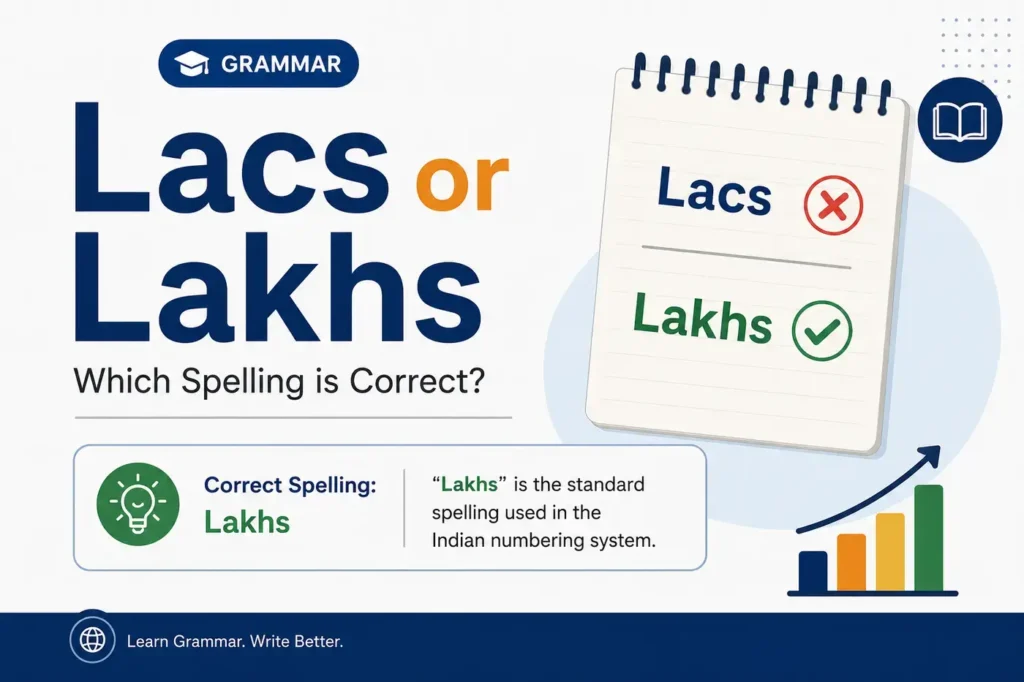
The short answer is that lakh is the standard and preferred spelling in modern English when referring to the South Asian numbering system. Lakhs is the correct plural form. The spelling lac is an accepted variant that appears in older dictionaries, government records, financial documents, and some regional publications. Its plural lacs still appears occasionally, but it is far less common than lakhs in contemporary English.
Understanding this distinction matters because the wrong choice can make formal writing look inconsistent. It is especially important when writing business documents, financial reports, academic papers, legal records, or cheques. Using the standard form also helps readers from different countries understand your writing without hesitation.
This guide explains the meaning, grammar, pronunciation, history, regional preferences, and real world usage of these terms. By the end, you’ll know which form fits everyday writing, professional communication, and formal documents with confidence.
Quick Definition
A lakh is a unit in the Indian numbering system equal to 100,000. The standard plural is lakhs. The spelling lac is an accepted alternative found in some dictionaries and official records, while lacs is its plural form. In modern English, lakh and lakhs are generally preferred because they are more widely recognized and used.
Quick Answer
If you only remember one rule, make it this one.
- Use lakh when referring to a single unit of 100,000.
- Use lakhs when referring to more than one lakh.
- You may still see lac and lacs, but these spellings are much less common in current English.
- For business writing, academic work, websites, and professional communication, lakh and lakhs are the safest choices.
For example:
- One lakh equals 100,000.
- Five lakhs equals 500,000.
- The house costs twenty five lakhs.
- She deposited one lakh rupees into her savings account.
Comparison Table
| Feature | Lakh | Lac |
|---|---|---|
| Part of speech | Noun | Noun |
| Meaning | One hundred thousand | One hundred thousand |
| Origin | Sanskrit | Variant spelling derived from the same origin |
| Preferred modern spelling | Yes | Less common |
| Plural form | Lakhs | Lacs |
| Formality | Standard in modern English | Accepted but less preferred |
| Common contexts | Finance banking education business government | Older documents regional publications some official records |
| Usage frequency | Very high | Relatively low |
| Example | The project cost ten lakhs. | The project cost ten lacs. |
Just as lacs and lakhs can cause confusion in writing, the legal plural spelling guide explains another commonly mistaken word pair that often appears in formal documents.
Meaning of Each Term
Although these words refer to the same numerical value, their usage differs in modern English.
What Does Lakh Mean
A lakh represents 100,000. It is one of the most important units in the Indian numbering system and is widely used in India, Pakistan, Bangladesh, Nepal, and Sri Lanka.
Instead of saying one hundred thousand, people often say one lakh because it is shorter and easier to understand within the South Asian numbering system.
You’ll commonly see this term in:
- Salary packages.
- Property prices.
- Government budgets.
- Business reports.
- Bank statements.
- News articles.
- Educational material.
Examples include:
- Her annual salary is eight lakh rupees.
- The company invested fifty lakh rupees in the project.
- The land was sold for twelve lakh rupees.
What Does Lac Mean
Lac represents exactly the same number as lakh. There is no mathematical difference between the two spellings.
The spelling lac developed as an English variant and still appears in some dictionaries, legal documents, accounting records, and historical publications. It remains familiar to many readers across South Asia, although it is less common in modern writing.
You might still encounter examples like these:
- The contract mentions five lacs.
- The property is valued at twenty lacs.
- The cheque was issued for one lac rupees.
While these examples are understandable, many editors would replace lac with lakh to match current writing standards.
Key Differences
The biggest difference isn’t the meaning. It’s the preferred spelling.
Both words describe the same numerical value, but one has become the standard choice in modern English.
Here’s what sets them apart.
- Lakh is the preferred spelling in contemporary English.
- Lac is an accepted variant that appears less frequently.
- Lakhs is the standard plural form.
- Lacs is still used in some publications but is gradually becoming less common.
- Both forms represent exactly 100,000 and have identical meanings.
When editing financial or educational content, consistency matters. Switching between the two spellings in the same document can distract readers and make the writing appear less polished.
Which Form Is Correct
Both spellings are recognized, but they are not equally common.
If you’re writing today, lakh is the better choice in almost every situation. It is the spelling most readers expect to see in books, newspapers, educational resources, government publications, and business documents.
Choose lakh and lakhs when writing:
- Blog articles.
- Academic assignments.
- Business reports.
- Financial documents.
- Marketing content.
- Government communication.
- Professional emails.
You may keep lac or lacs when quoting an older document or reproducing text exactly as it originally appeared. Outside those situations, using lakh creates clearer and more consistent writing.
Pronunciation Guide
Although the spelling varies, the pronunciation stays nearly the same.
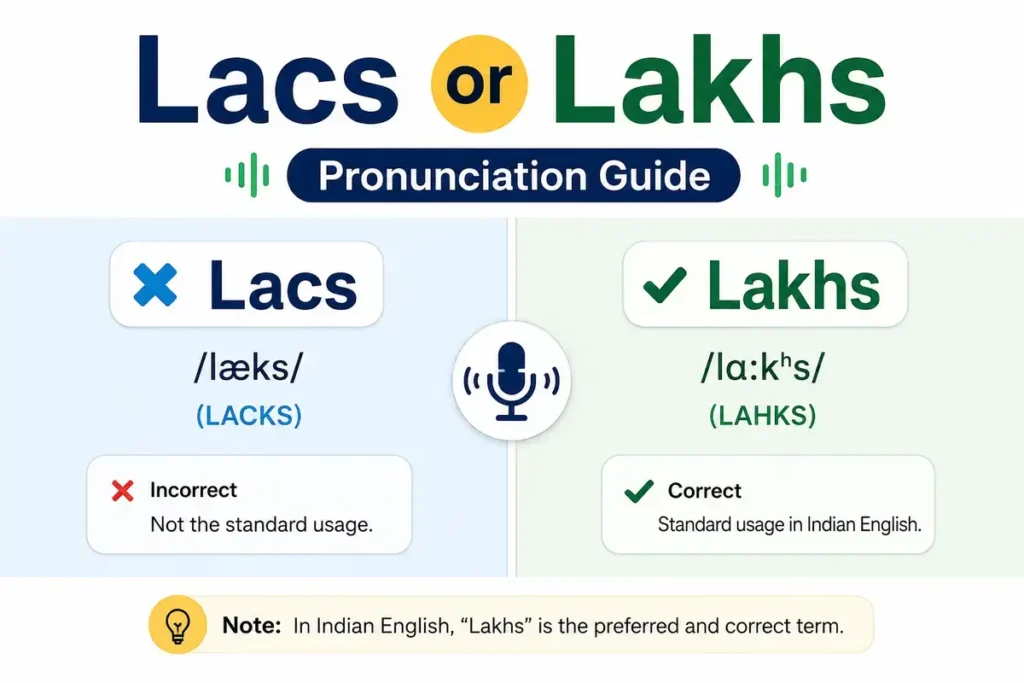
Lakh
IPA pronunciation:
/lɑːk/
Syllable breakdown:
Lakh
The final sound is similar to the ending of the Scottish word loch, although many English speakers pronounce it with a simple k sound.
Lac
IPA pronunciation:
/læk/ or /lɑːk/ depending on the speaker and regional pronunciation.
Syllable breakdown:
Lac
Because this spelling is less common, pronunciation varies more among English speakers.
Common Pronunciation Mistakes
Here are a few mistakes learners often make.
- Pronouncing lakh as lake.
- Adding an extra syllable.
- Confusing lac with unrelated English words that have different meanings.
- Assuming the two spellings represent different numbers.
In everyday conversation across South Asia, both spellings usually sound very similar. The difference is primarily written rather than spoken.
Understanding One Lakh In Numbers
Many people understand the word but are unsure how it looks as a number.
Here are the most common conversions.
- One lakh equals 100,000.
- Two lakhs equals 200,000.
- Five lakhs equals 500,000.
- Ten lakhs equals 1,000,000, which is also called one million.
If you’re wondering about one lakh rupees in number, the answer is:
₹100,000
For international readers, this is written as:
100,000 rupees
Understanding these conversions makes it much easier to read salary offers, investment reports, property listings, and government announcements from countries that use the Indian numbering system.
Expert Language Insight
Professional editors usually recommend lakh because it has become the dominant spelling in modern English publications. Major newspapers, educational websites, business organizations, and financial institutions overwhelmingly favor this form.
That does not mean lac is incorrect. It simply reflects an older or less common spelling tradition that survives in certain documents and regional writing styles.
A useful way to think about it is this. Both spellings are understood, but lakh is the version that most readers expect today. Choosing it helps your writing look current, consistent, and professional without changing the meaning.
Examples in Sentences
The easiest way to understand the difference is to see both spellings in everyday situations. While lakh is the preferred modern form, you may still come across lac in older documents and some regional publications.
Examples Using Lakh
These examples follow current standard English and are suitable for professional and everyday writing.
- She received a scholarship worth one lakh rupees.
- The company invested twenty lakhs in expanding its factory.
- His annual salary is twelve lakh rupees.
- The apartment was listed for eighty five lakhs.
- The charity raised more than fifty lakhs during the campaign.
- They donated one lakh to the local hospital.
- The government announced a relief package of two lakh rupees for affected families.
- The startup reached a valuation of several hundred lakhs before attracting investors.
- The bank approved a loan of fifteen lakhs.
- The project was completed within a budget of thirty lakhs.
These examples reflect the style used in newspapers, business reports, educational material, and government publications across South Asia.
Examples Using Lac
The following examples are grammatically understandable because lac is an accepted spelling variant. Even so, most editors would replace it with lakh in modern writing.
- The agreement mentioned one lac rupees.
- The property was valued at ten lacs.
- The contractor requested an advance of two lacs.
- She deposited one lac into her savings account.
- The business earned twenty lacs in revenue last year.
- They purchased the equipment for eight lacs.
- The insurance policy covered five lacs.
- The company invested fifty lacs in research.
- The cheque was written for one lac rupees.
- The old financial report referred to several lacs of rupees.
If you’re creating new content, the first group of examples is the better model to follow.
If you enjoy exploring commonly confused English words, you’ll also find the difference between bearer and barer helpful for avoiding subtle but important spelling mistakes.
Common Mistakes
The words themselves are simple, but people often make mistakes because they mix spellings, grammar, or numbering styles. Understanding these common errors can help you write more confidently.
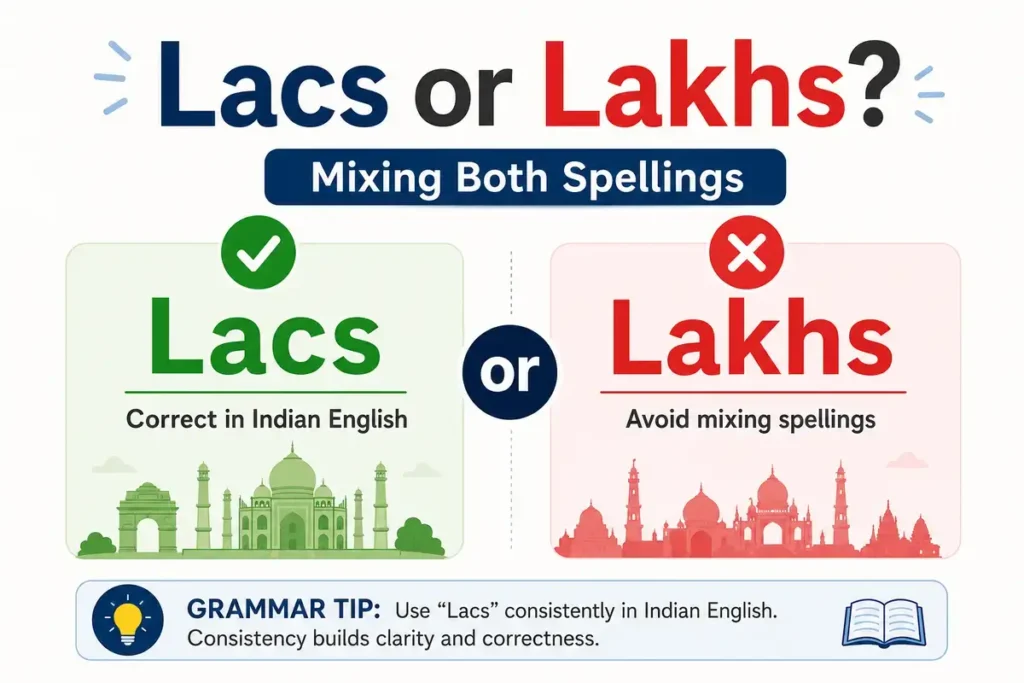
Mixing Both Spellings
One of the most common mistakes is switching between lakh and lac in the same document.
For example:
Incorrect:
The house costs twenty lakhs, and the renovation added five lacs.
Correct:
The house costs twenty lakhs, and the renovation added five lakhs.
Using one spelling consistently gives your writing a cleaner and more professional appearance.
Using The Wrong Plural Form
Many learners are unsure how to form the plural.
Remember these rules.
- One lakh.
- Two lakhs.
- One lac.
- Two lacs.
Avoid mixing singular and plural forms in the same sentence.
Confusing Lakh With Million
These units are related but not equal.
Keep these conversions in mind.
- One lakh equals 100,000.
- Ten lakhs equals one million.
- One million equals ten lakhs.
Knowing these relationships helps when reading international financial reports.
Writing The Wrong Amount On A Cheque
People often ask which spelling should appear on a cheque.
For example:
One lakh rupees only.
This is the wording most banks, businesses, and legal professionals expect because lakh is the standard modern spelling.
If you’re copying the wording from an older legal document that uses lac, keep the original spelling exactly as written.
Mixing Numbering Systems
Another mistake is combining the Indian and International numbering systems in confusing ways.
For example:
Incorrect:
One lakh equals one hundred lakh.
Correct:
One lakh equals one hundred thousand.
Ten lakhs equals one million.
Staying with one numbering system throughout a document improves clarity.
Etymology And Word Origin
The word lakh has a long history that stretches back thousands of years.
It comes from the Sanskrit word laksha, which originally referred to a very large number. Over time, the meaning became standardized as one hundred thousand in the Indian numbering system.
As trade, administration, and education expanded across South Asia, the term became part of several regional languages, including Hindi, Urdu, Bengali, Punjabi, Gujarati, Marathi, Tamil, Telugu, Kannada, Malayalam, and Nepali.
During British rule in the Indian subcontinent, English speakers adopted the word into administrative and financial writing. That’s when the spelling lac also became common in colonial records and official documents.
Today, lakh has become the preferred spelling in most modern English dictionaries, newspapers, educational resources, and business publications, while lac survives mainly as an accepted historical or regional variant.
Regional Usage
The meaning never changes, but spelling preferences vary depending on the country, publication, and audience.
British English
British English recognizes both spellings because of historical connections with South Asia. However, modern British publications increasingly prefer lakh, especially in financial reporting and international news.
American English
The term is not commonly used in everyday American English because the United States follows the international numbering system based on thousands and millions.
When American publications discuss South Asian finance or economics, they usually keep the word lakh rather than converting it to lac.
Many publications also explain the value by adding the equivalent number.
For example:
One lakh or 100,000.
Australian English
Australian English generally follows the same approach as British English. News organizations and educational resources tend to use lakh when referring to South Asian currency, salaries, or population figures.
Canadian English
Canadian publications also favor lakh when covering South Asian topics. Because Canada has a large South Asian community, many readers are already familiar with the term.
Across all four regions, lakh has become the more widely recognized spelling in contemporary English.
Grammar Rules
Understanding the grammar behind these words helps you avoid awkward or incorrect sentences.
Part Of Speech
Both lakh and lac function as countable nouns.
Examples:
- One lakh was donated.
- Several lakhs were invested.
Singular And Plural
Use the singular form after the number one.
Examples:
- One lakh.
- One lac.
Use the plural after numbers greater than one.
Examples:
- Two lakhs.
- Three lacs.
Articles
Use articles naturally when referring to a single unit.
Examples:
- A lakh.
- One lakh.
Most writers prefer one lakh because it is more precise in financial writing.
Sentence Structure
These words usually appear before the currency or item being counted.
Examples:
- Five lakh rupees.
- Twenty lakhs were allocated.
- The company invested ten lakhs in the expansion.
This structure sounds natural in both spoken and written English.
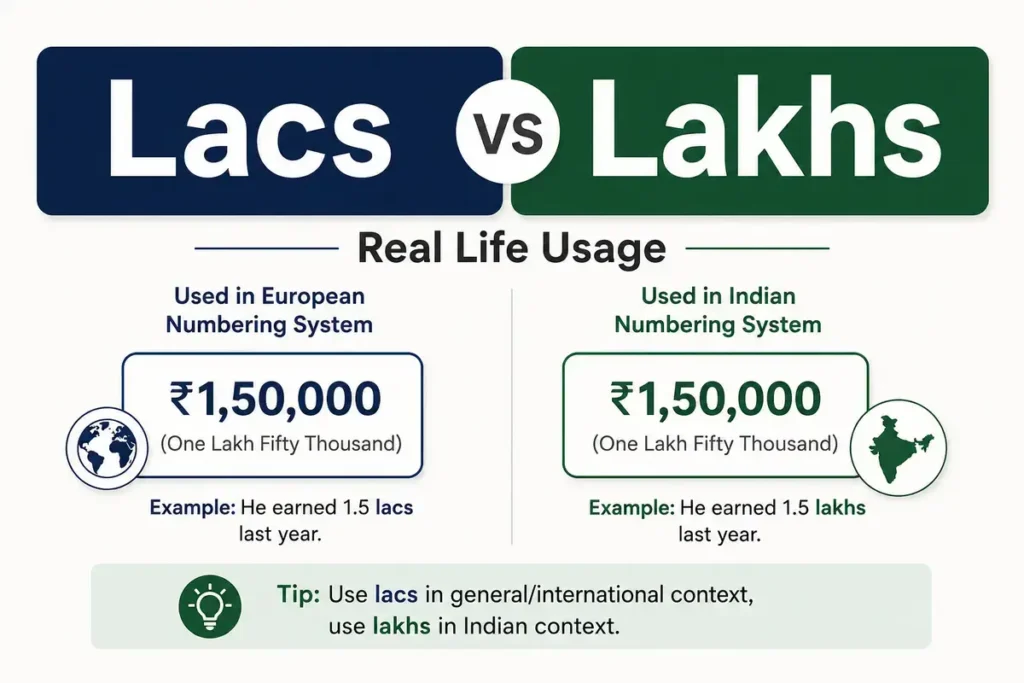
Real Life Usage
These terms appear regularly across many fields, especially in countries that use the Indian numbering system.
Daily Conversation
People often use lakh when discussing:
- Salaries.
- House prices.
- Car prices.
- Savings.
- Personal loans.
Academic Writing
Researchers studying South Asian economics, demographics, or public policy frequently use lakh because it reflects the local numbering system accurately.
Professional Communication
Businesses use the term in:
- Financial reports.
- Contracts.
- Invoices.
- Investment proposals.
- Budget documents.
Consistency is especially important because financial writing leaves little room for misunderstanding.
Literature
Many novels and biographies set in South Asia use lakh naturally in dialogue and narration because it reflects everyday speech.
News And Media
Journalists regularly use the term when reporting on:
- Government spending.
- Election funding.
- Business investments.
- Property markets.
- Stock market activity.
International publications sometimes include the equivalent number in parentheses to help readers who are unfamiliar with the Indian numbering system.
Related Words And Confused Terms
Once you understand the difference between lakh and lac, you’ll notice several other terms that often appear alongside them. Learning these words makes it much easier to read financial reports, property listings, government documents, and business news from South Asia.
Here are some closely related terms.
| Term | Meaning |
|---|---|
| Thousand | 1,000 |
| Ten thousand | 10,000 |
| Lakh | 100,000 |
| Ten lakhs | 1,000,000 or one million |
| Crore | 10,000,000 |
| Million | 1,000,000 |
| Billion | 1,000,000,000 |
These units belong to two different numbering systems.
- The Indian numbering system uses thousand, lakh, and crore.
- The International numbering system uses thousand, million, and billion.
Understanding both systems makes it easier to convert values when reading international financial information.
Here are a few useful conversions.
- One lakh equals 100,000.
- Two lakhs equals 200,000.
- Five lakhs equals 500,000.
- Ten lakhs equals one million.
- One crore equals ten million.
You may also see these related search terms.
- One lakh in English.
- One lakh rupees in number.
- One lakh equals 100,000.
- Two lakh or two lakhs.
- Lakhs to USD.
- Indian numbering system.
- International numbering system.
- Currency conversion.
Understanding Lakhs To USD
Many readers also want to know how to convert lakhs into United States dollars.
There is no fixed answer because exchange rates change every day.
The process is straightforward.
- Convert lakhs into the actual number of rupees.
- Divide that amount by the current exchange rate.
- The result gives the approximate value in US dollars.
For example, one lakh always equals 100,000 Indian rupees. The dollar value depends on the exchange rate at the time of conversion.
When writing articles or financial reports, avoid giving a permanent dollar amount unless you also mention the exchange rate and date. That keeps your information accurate and trustworthy.
Similar to choosing between lacs and lakhs, understanding the correct spelling of busing shows how English usage can vary depending on context and regional conventions.
Expert Language Insight
From an editorial perspective, lakh has become the standard choice in modern English. Most publishers no longer switch between lakh and lac because consistency improves readability and reduces confusion.
Professional editors also consider the audience.
If the content is written for readers in South Asia, using lakh feels natural because it matches everyday language. If the audience is international, many editors keep lakh but add the equivalent number the first time it appears.
For example:
- The company invested one lakh rupees, or 100,000 rupees, in the project.
- The government announced a grant of fifty lakhs, equivalent to five million rupees.
This approach respects the original numbering system while making the information accessible to readers who are more familiar with millions and billions.
When editing financial documents, consistency matters just as much as accuracy. Once you choose lakh, use it throughout the entire document instead of alternating between spelling variants.
Frequently Asked Questions
Is lakh or lac correct?
Both spellings are correct because they refer to the same value of 100,000. However, lakh is the preferred spelling in modern English, while lac is now used less often and mainly appears in older documents or regional publications.
What is the plural of lakh?
The correct plural is lakhs.
Examples include:
- Five lakhs.
- Twenty lakhs.
- One hundred lakhs.
The plural lacs also exists but is much less common in current English.
How do you write one lakh in numbers?
One lakh is written as 100,000.
In the Indian numbering system, it may also appear as 1,00,000, where the commas follow Indian digit grouping.
Both formats represent the same number.
Should I write lakh or million?
The answer depends on your audience.
If you’re writing for readers who use the Indian numbering system, lakh is usually clearer. For an international audience, many writers either use million when appropriate or include the numerical equivalent to avoid confusion.
How do you write one lakh on a cheque?
Most banks and financial professionals recommend writing:
One lakh rupees only.
This wording is clear, widely accepted, and matches modern usage.
Is lakh used outside India?
Yes. The term is widely used in Pakistan, Bangladesh, Nepal, Sri Lanka, and by South Asian communities around the world. International news organizations also use lakh when reporting on the region.
Is one lakh the same as one hundred thousand?
Yes. Both expressions represent exactly the same number.
One lakh equals 100,000.
The difference lies only in the numbering system being used.
Why do some people still write lac?
The spelling lac became common during the colonial period and appeared in many official records, accounting documents, and dictionaries. Although it is still recognized, lakh has become the preferred spelling in most modern English publications.
Conclusion
The answer is simple. Both lakh and lac represent the same numerical value of 100,000, but they are not equally common in modern English.
Today, lakh is the standard spelling used in education, journalism, business, government documents, and professional writing. Its plural form, lakhs, is also the preferred choice in contemporary English. While lac and lacs are still recognized, they appear far less often and are usually found in older records or regional publications.
If you’re writing new content, using lakh consistently is the safest approach. It matches current language standards, improves clarity, and meets the expectations of most readers. When writing for an international audience, consider including the numerical equivalent the first time the term appears. Doing so makes your content easier to understand without changing the original meaning.