Have you ever wondered why Americans talk about baloney vs bologna when the two words sound almost exactly the same? The confusion is understandable because they are closely connected. One refers to a familiar lunch meat while the other can also mean foolish or untrue talk. To make things even more interesting, bologna is also the name of an Italian city and is pronounced differently when it refers to that place or to Italian cuisine.
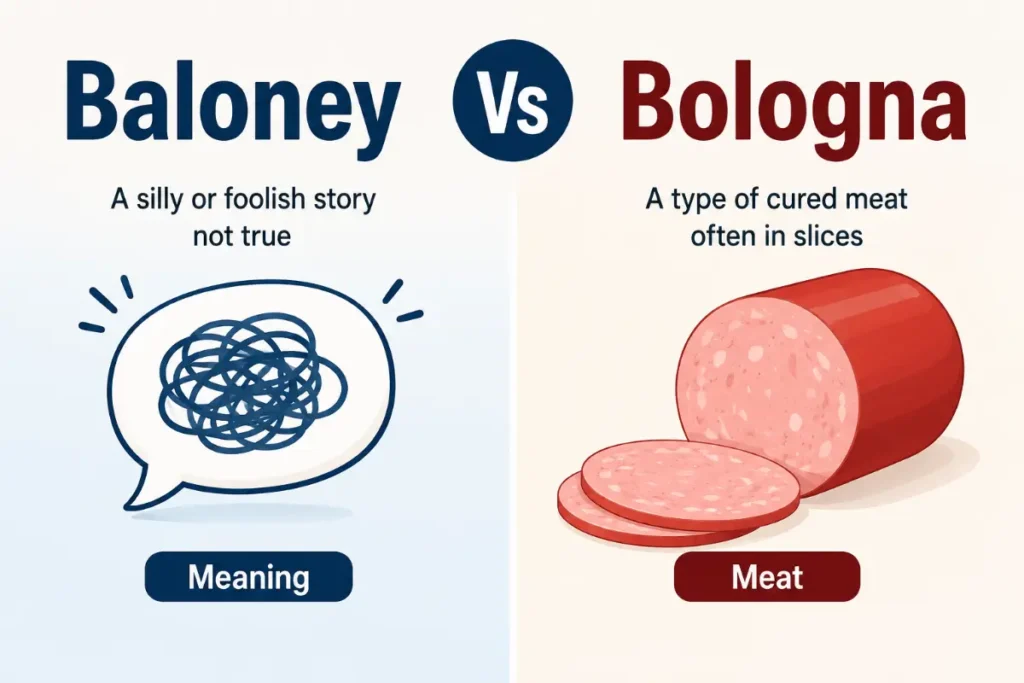
The simple answer is that bologna is the standard spelling for the sausage or lunch meat. Baloney is the standard spelling when you mean nonsense or foolish talk. In American English, however, the meat word bologna is commonly pronounced like baloney.
That unusual relationship between spelling and pronunciation is what causes most of the confusion. English has absorbed the food name from Italian and then developed a separate figurative use from its pronunciation.
This guide explains the distinction clearly. You will learn how the words developed, how Americans pronounce the meat name, how the Italian city is pronounced, how Bolognese fits into the picture, and how to use each term naturally in speech and writing.
Quick Definition
Bologna is the standard spelling for a type of sausage or processed lunch meat. In American English, the food is usually pronounced baloney. Baloney is also a standard English word meaning nonsense or foolish talk. The Italian city Bologna has a different pronunciation, commonly represented in English as bəˈloʊnjə.
Quick Answer
The spelling depends on the meaning. Bologna is the correct spelling for the meat, while baloney means nonsense or foolish talk. In American English, the meat is pronounced baloney, even though it is spelled bologna. The Italian city Bologna has a different pronunciation, so context matters when you hear or read the word.
Comparison Table
| Feature | Baloney | Bologna |
|---|---|---|
| Main meaning | Nonsense or foolish talk | A type of sausage or lunch meat |
| Part of speech | Usually noun | Usually noun |
| Origin | Developed from the pronunciation of Bologna in American English | Italian place name and food tradition |
| Standard spelling | Yes when meaning nonsense | Yes when meaning the food |
| Formality | Informal | Neutral |
| Common contexts | Conversation, criticism, humor | Food, restaurants, grocery shopping, recipes |
| American pronunciation | /bəˈloʊni/ | /bəˈloʊni/ for the meat |
| Italian city pronunciation | Not applicable | /boʊˈloʊnjə/ in common English representations |
| Example | That is pure baloney. | I made a bologna sandwich. |
| Related term | Nonsense, rubbish, foolishness | Sausage, cold cut, luncheon meat |
The most important point in this table is the pronunciation. In American English, bologna and baloney can sound identical when the speaker is talking about the meat. That does not make the spellings interchangeable.
Meaning Of Both Terms
The easiest way to understand these words is to separate their meanings before looking at their history.
What Does Baloney Mean
Baloney is an informal English noun meaning nonsense, foolishness, or something that is not believable. If someone tells you a story that sounds completely untrue, you might respond by saying, “That is baloney.”
The word often carries a mildly dismissive tone. It can be playful between friends, but it can also express strong disagreement.
For example, imagine someone claims that they can become fluent in a new language after studying for ten minutes. You might say that claim is baloney. You are not talking about food. You are saying that the claim is nonsense.
Common meanings include:
- Nonsense.
- Foolish talk.
- Untrue claims.
- Exaggerated statements.
- Ideas that the speaker considers ridiculous.
The word is particularly common in American English. It feels conversational rather than formal, so it works well in dialogue but may sound too casual for a serious academic paper.
What Does Bologna Mean
Bologna has several meanings, and context tells you which one is intended.
The most familiar American meaning is a type of processed sausage sold as a lunch meat. It is commonly sliced and placed between two pieces of bread to make a sandwich.
You might see it described as:
- Bologna sausage.
- Bologna meat.
- Bologna sandwich.
- Bologna slices.
- Bologna lunch meat.
- Smoked bologna.
The word also refers to Bologna, a historic city in northern Italy. That city gave its name to the style of sausage associated with it.
There is another important connection. Bolognese is an adjective and noun associated with Bologna. It appears in terms such as Bolognese sauce and refers to things connected with the city or its traditions.
This is where the topic becomes more interesting. One spelling connects food with a place in Italy, while another spelling became an English word for nonsense because of the way the food name was pronounced.
Key Differences
The difference between the two words is mainly semantic. They can share a sound, but they do not always share a meaning.
Meaning Difference
When someone says baloney in a sentence such as “That is baloney,” they mean nonsense.
When someone says bologna in a sentence such as “I bought bologna at the grocery store,” they mean the meat.
The distinction is therefore clear in writing even though spoken American English can blur it.
Spelling Difference
- Use bologna for the food.
- Use baloney for nonsense.
For example:
- I packed a bologna sandwich for lunch.
- That excuse is complete baloney.
Changing the spelling changes the written meaning.
Tone Difference
Baloney is informal and expressive. It often sounds like something a person would say during a conversation.
For example:
- That is a bunch of baloney.
The phrase sounds conversational and slightly humorous.
Bologna is neutral when it refers to food. It does not carry the same emotional tone.
Grammar Difference
Both words generally function as nouns, but they appear in different sentence structures.
- Baloney usually describes an idea, statement, excuse, or claim.
- Bologna usually refers to a physical food product.
Compare these sentences:
- His explanation was baloney.
- His sandwich contained bologna.
The first sentence evaluates information. The second identifies food.
Context Difference
Context usually solves the problem immediately.
- If someone says, “I need to buy some bologna,” they are almost certainly talking about food.
- If someone says, “That story is baloney,” they mean the story is nonsense.
The surrounding words provide enough information for listeners to understand the intended meaning.
Which One Is Correct
Both baloney and bologna are correct spellings, but they are correct for different uses.
- Use bologna when referring to the food or the Italian city.
- Use baloney when referring to nonsense or foolish talk.
There is one important exception to keep in mind. A person can spell the meat bologna but pronounce it baloney in American English. This is not a spelling mistake. It is the conventional American pronunciation of the food name.
- If you are writing a grocery list, recipe, restaurant description, or food article, write bologna.
- If you are calling someone’s claim nonsense, write baloney.
- If you are talking about the Italian city, write Bologna with a capital B.
That final distinction matters because proper nouns are capitalized in English.
English has plenty of similar-looking words that cause confusion, much like the difference between baloney and bologna and other common spelling confusions.
Pronunciation Guide
Pronunciation is where this comparison becomes genuinely confusing.
Baloney Pronunciation
The standard American pronunciation of baloney is:
/bəˈloʊni/
It has three syllables:
buh LOH nee
The main stress falls on the second syllable.
Bologna Pronunciation American
When Americans refer to the meat, bologna is commonly pronounced:
/bəˈloʊni/
That is essentially the same pronunciation as baloney.
So an American might say:
I want a bologna sandwich.
The listener hears something very close to:
I want a baloney sandwich.
The spelling remains bologna in writing.
Bologna Pronunciation UK
British English commonly uses a pronunciation closer to:
/bəˈlɒnjə/
The exact sound can vary by speaker and accent. British speakers may pronounce more of the written structure than Americans do, although pronunciation varies across regions and individual speakers.
The important point is that the American pronunciation of the food is especially distinctive because the written g and final letters are not pronounced as they might appear to an English learner.
Bologna As The Italian City
When referring to the Italian city, English pronunciation is commonly represented as:
/bəˈloʊnjə/
It sounds roughly like:
buh LOHN yuh
Italian pronunciation is different again. The city’s Italian name is pronounced approximately:
boh LOHN yah
The distinction between the food pronunciation and the place name explains why learners sometimes struggle when they encounter the word in different contexts.
How To Remember The Difference
A simple memory trick can save you from most spelling mistakes.
Think of the meanings first.
If you can eat it, spell it bologna.
If you are calling something nonsense, spell it baloney.
For example:
- Bologna goes in your sandwich.
- Baloney describes a ridiculous claim.
You can also remember the connection through pronunciation. The lunch meat is written bologna but commonly sounds like baloney in American English.
That means the words are related without being interchangeable.
Another useful trick is to remember the Italian city. Bologna is a place name, so it begins with a capital letter when you are referring to the city. The same spelling is used for the food, but it is normally lowercase in that context.
Once you connect the spelling with the meaning, the distinction becomes much easier to remember.
Examples In Sentences
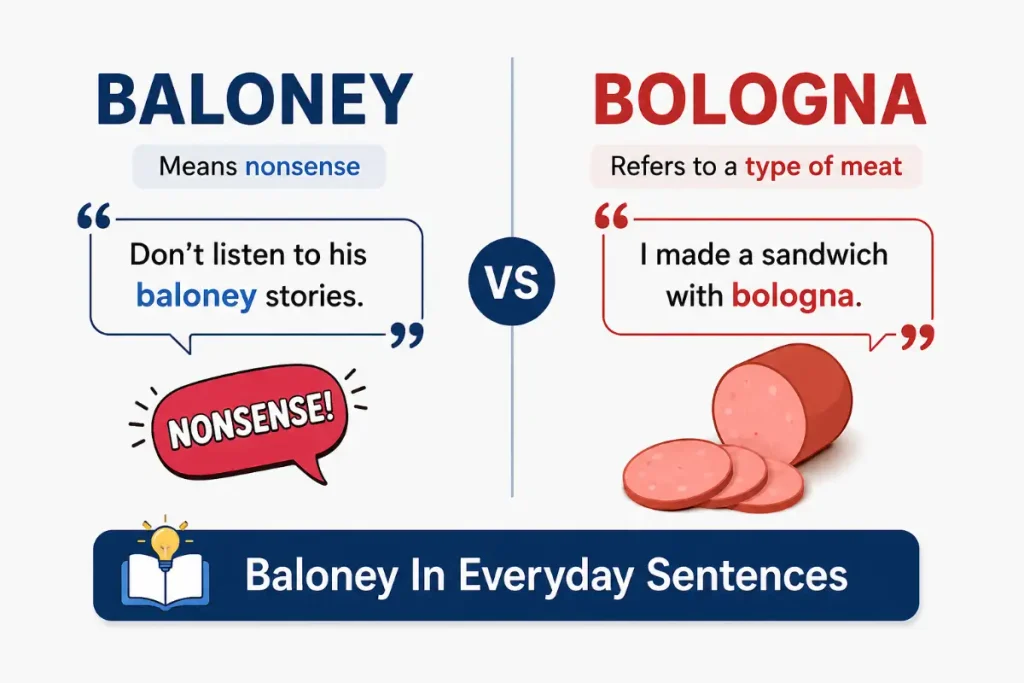
The clearest way to understand the difference is to see each spelling doing its own job. The food is written bologna, while the word for nonsense is written baloney. The pronunciation can make these examples look confusing when you hear them aloud, but the written context keeps the meanings separate.
Baloney In Everyday Sentences
Here are natural examples where baloney means nonsense or an untrue claim.
- That excuse is nothing but baloney.
- He said he could fix the car without any tools, but I thought that was baloney.
- Do not listen to that rumor because it is complete baloney.
- She knew the salesman’s promise was baloney.
- My brother told me I could win the lottery without buying a ticket, which was obvious baloney.
- The article made several claims that sounded like baloney.
- I have heard enough baloney for one day.
- His explanation sounded convincing at first, but it turned out to be baloney.
- The coach called the idea baloney and explained why it would not work.
- If someone tells you that success comes without effort, you might reasonably call that baloney.
The tone can range from playful to strongly dismissive. Friends might use the word jokingly, while someone in an argument may use it to reject another person’s claim.
Bologna In Everyday Sentences
These examples use bologna to mean the food.
- I made a bologna sandwich for lunch.
- She bought a package of sliced bologna at the grocery store.
- The kids asked for bologna and cheese sandwiches.
- We kept the bologna in the refrigerator.
- He added mustard to his bologna sandwich.
- The deli sells several varieties of bologna.
- My grandfather still enjoys a simple bologna sandwich.
- The recipe calls for four slices of bologna.
- We packed bologna sandwiches for the picnic.
- The store had a special price on bologna this week.
Notice the difference. Baloney describes talk or an idea. Bologna describes a food or refers to the Italian city.
Common Mistakes
The biggest problem with these words is not grammar. It is the unusual relationship between spelling and pronunciation. American speakers can pronounce the name of the meat exactly like baloney, even though the standard spelling remains bologna.
Writing Baloney For The Meat
This is probably the most common mistake.
Someone may write:
I made a baloney sandwich.
In standard English, the food should be written:
I made a bologna sandwich.
The pronunciation does not determine the spelling. English has many words that sound different from the way their letters might suggest.
Writing Bologna When You Mean Nonsense
The reverse mistake also occurs.
If you write:
That story is bologna.
Readers may interpret the word literally as the food. If you mean that the story is nonsense, baloney is the appropriate spelling.
The correct sentence is:
That story is baloney.
Assuming Bologna Always Refers To Food
The capitalized form Bologna can refer to the city in Italy. Context matters.
For example:
Bologna is famous for its history and cuisine.
Here the word identifies a place.
By contrast:
I bought bologna for sandwiches.
Here it refers to food.
Confusing Bolognese With Bologna
Another common mistake involves Bolognese.
Bologna is the name of the city and the common American spelling for the lunch meat.
Bolognese means something associated with Bologna. It can describe people, culture, cuisine, or other things connected with the city.
The words are related, but they do not mean the same thing.
Assuming The Spelling Should Match The Sound
English spelling often preserves historical forms instead of matching modern pronunciation perfectly. The word bologna is a good example.
If you only heard the American pronunciation, you might reasonably guess the spelling baloney. That guess works when you mean nonsense, but it does not work for the meat.
This is why learning the word through context is more useful than trying to spell it from sound alone.
Etymology And Word Origin
The history behind these words explains almost everything about their strange relationship.
The food name bologna comes from Bologna, the city in northern Italy. The city has a long culinary tradition, and a sausage associated with the area eventually became known internationally.
The Italian food is called mortadella, while the American product known as bologna developed into a distinct style of processed sausage. The English name connects the food with its Italian place of origin.
Over time, American English developed the pronunciation baloney for the meat. That pronunciation became so familiar that English speakers eventually created the separate word baloney, meaning nonsense.
The figurative sense is generally understood as having developed in American English during the early twentieth century. Its exact path is debated by etymologists, but the connection to the pronunciation of the meat is widely recognized.
This gives English an entertaining linguistic coincidence. The food is spelled bologna but sounds like baloney, while baloney became a separate word meaning nonsense.
That is why these terms feel like two versions of the same word even though modern usage gives them different written meanings.
Regional Usage
The spelling and pronunciation become especially interesting when you compare different English speaking regions.
American English
American English strongly favors bologna for the food and baloney for nonsense. The food is commonly pronounced /bəˈloʊni/, making it sound like baloney.
This is the pronunciation most Americans expect when discussing a bologna sandwich, deli meat, or lunch meat.
British English
British English may use bologna for the food, but pronunciation can differ from the common American form. British speakers are also more likely to encounter the Italian context through European travel, cuisine, and references to the city itself.
The exact pronunciation varies by speaker and context, so there is no single accent that represents every British speaker.
Australian English
Australian English generally recognizes bologna as the spelling for the food. Actual pronunciation can vary depending on the speaker and familiarity with American usage.
The word baloney meaning nonsense is also understood, particularly through American media and international English.
Canadian English
Canadian English commonly uses bologna for the meat and baloney for nonsense. Canadian speakers may encounter both American and British pronunciation patterns because of Canada’s linguistic environment.
For ordinary writing, the same spelling distinction remains useful:
- Bologna for the food.
- Baloney for nonsense.
Why American Usage Matters
American English is particularly important for this comparison because the pronunciation of the meat strongly overlaps with the spelling of the nonsense word.
That is why searches such as bologna pronunciation American and bologna pronunciation UK can produce different results. The spelling is largely stable, but pronunciation reflects regional speech patterns.
Grammar Rules
There is no complicated grammar rule separating these words. The key is understanding their meanings and how they function in sentences.
Baloney As A Noun
Baloney is normally an uncountable noun when it means nonsense.
You would naturally say:
That is baloney.
You generally would not say:
That is a baloney.
The word describes nonsense as a general idea rather than one individual object.
It can also appear after expressions such as:
- A load of baloney.
- A bunch of baloney.
- Complete baloney.
- Pure baloney.
- Absolute baloney.
These expressions are informal and conversational.
Bologna As A Noun
When bologna refers to the meat, it is also normally treated as an uncountable food noun when discussing the substance generally.
For example:
I bought some bologna.
You can also refer to individual portions or slices.
Examples include:
- Two slices of bologna.
- A package of bologna.
- Three pieces of bologna.
- A pound of bologna.
The exact grammar depends on what you are counting.
Bologna As A Proper Noun
When Bologna refers to the Italian city, it is a proper noun and must be capitalized.
For example:
Bologna is one of Italy’s historic cities.
You would not capitalize the food in an ordinary sentence:
We bought bologna at the deli.
The capitalization tells readers that you are referring to a place rather than a food.
Verb Forms
Neither word normally functions as a verb in standard everyday English.
You would not normally create forms such as balonied or bolognaing. Instead, use ordinary verbs around the noun.
For example:
- He called the claim baloney.
- She bought bologna for lunch.
Adjective Related To Bologna
The adjective Bolognese is used for things associated with Bologna.
Examples include:
- Bolognese cuisine.
- Bolognese culture.
- Bolognese cooking.
- Bolognese tradition.
- Bolognese sauce.
This distinction becomes important when people search for baloney vs bologna vs bolognese. These terms are historically connected, but each has its own grammatical and semantic role.
Understanding differences between community terms can be just as important as knowing whether baloney refers to the food while bologna is the traditional spelling behind its name.
Real Life Usage Examples
The difference becomes even clearer when you look at how people actually use these terms in ordinary situations.
Daily Conversation
Imagine someone is making lunch.
Do we have any bologna in the refrigerator?
Here the meaning is obvious. The speaker is asking about food. Now imagine someone is telling an unbelievable story.
That is baloney. I do not believe a word of it.
The same sound may occur in American speech, but the meaning is completely different.
The Bologna Or Baloney Sandwich
The familiar food phrase is bologna sandwich.
Some people casually spell it baloney sandwich because that is how they pronounce it. In standard writing, however, bologna sandwich is the safer and more conventional form.
A typical sandwich might contain:
- Sliced bologna.
- Bread.
- Mustard.
- Mayonnaise.
- Cheese.
- Lettuce or other toppings.
The phrase is especially common in American English and is closely associated with simple deli style lunches.
Academic Writing
The word baloney is usually too informal for serious academic writing unless the writer is discussing the word itself or deliberately reproducing conversational language.
A researcher might write:
The claim lacks sufficient evidence.
They would rarely write:
The claim is baloney.
The second sentence is much more conversational.
Bologna, by contrast, can appear perfectly naturally in academic writing when discussing food, Italian culture, nutrition, history, or linguistics.
Professional Communication
In a workplace setting, bologna is appropriate when discussing food or a product.
For example:
The catering order includes bologna sandwiches.
Baloney requires more care because of its informal tone. It may be perfectly natural in a casual conversation between coworkers, but a formal report would normally use words such as unsupported, inaccurate, unfounded, or false.
Literature And Media
Writers use baloney when they want dialogue to sound informal, skeptical, humorous, or distinctly conversational. A character saying That is baloney immediately sounds less formal than a character saying That claim is unsupported.
The food word bologna appears naturally in stories involving meals, grocery shopping, family life, school lunches, diners, and American culture.
Gaming And Internet Culture
Online communities sometimes play with the relationship between the two words. A user might deliberately write baloney when discussing the food because the spelling reflects the way many Americans pronounce it.
That does not make the spelling standard for the meat. It simply shows how pronunciation can influence informal internet writing.
Reddit discussions about the topic often focus on exactly this point. People notice that Americans say the meat name like baloney and then wonder why the package says bologna.
The answer is historical rather than purely phonetic. The spelling preserves the connection to the Italian place name, while American pronunciation developed along its own path.
Food And Restaurant Menus
Restaurants and grocery stores generally use bologna in menus, labels, product descriptions, and advertisements.
You are much more likely to see:
Bologna sandwich
than:
Baloney sandwich
The latter may appear as a playful variation, but the former is the standard written form.
Science And Linguistics
The relationship between these words is also useful in discussions of language change. It demonstrates how pronunciation, borrowing, regional speech, and semantic development can interact over time.
The story is not simply about a spelling mistake. It is an example of how English adapts words borrowed from other languages and how familiar pronunciations can eventually produce new vocabulary.
Related Words And Confused Terms
The difference between baloney and bologna becomes easier once you connect both words with the terms that commonly appear beside them. Some related words describe food, while others belong to language, pronunciation, or Italian culture.
Baloney And Bologna Vs Bolognese
These three words look closely related, but they do not have the same job.
Baloney usually means nonsense, foolish talk, or an untrue statement. It is informal and often carries a slightly humorous tone.
Bologna can refer to the processed sausage commonly eaten in sandwiches. It can also refer to the Italian city of Bologna when it begins with a capital letter.
Bolognese is an adjective and noun connected with Bologna. You may see it used for people, culture, cuisine, or things associated with the city. In English, Bolognese sauce is a familiar culinary expression.
The easiest way to separate them is to think of the context.
| Word | Main meaning | Typical example |
|---|---|---|
| Baloney | Nonsense or foolish talk | That explanation is baloney. |
| Bologna | Processed sausage or lunch meat | I made a bologna sandwich. |
| Bologna | Italian city | She visited Bologna last summer. |
| Bolognese | Related to Bologna | They served Bolognese cuisine. |
Bologna Meat
Bologna meat is a type of processed sausage commonly sold sliced for sandwiches. In American English, the word is generally pronounced like baloney, even though the spelling looks very different.
The name is connected historically with Bologna in Italy. Traditional mortadella from Bologna is a distinct Italian sausage, so it is more accurate to describe American bologna as historically related to that tradition rather than treating the two products as identical.
That distinction matters because food names often travel across languages and change along the way. The spelling may preserve part of the original history while the pronunciation and recipe adapt to local English usage.
Baloney Or Bologna Sandwich
For the food, bologna sandwich is the standard spelling in American English.
You may occasionally see baloney sandwich in informal writing, jokes, advertisements, or playful contexts. That spelling reflects the familiar pronunciation, but it is not the usual standard spelling for the meat.
For example:
I packed a bologna sandwich for lunch.
The sentence clearly refers to food.
If someone writes:
That whole story is a baloney sandwich.
the phrase becomes a playful figurative expression suggesting that the story is nonsense. The humor comes from connecting the food meaning with the figurative meaning of baloney.
Words That Sound Different From Their Spelling
English contains many words whose pronunciation does not closely match their spelling. Bologna is an especially memorable example because American speakers pronounce the food name almost exactly like baloney.
This does not mean the spelling is incorrect. It reflects the history of the word and the way English pronunciation developed.
Similar pronunciation and spelling differences appear throughout English. The important skill is learning the conventional form rather than trying to spell every word exactly as it sounds.
If you enjoy clearing up similar word choice differences, exploring terms with closely related meanings can make confusing English vocabulary much easier to understand.
Expert Language Insight
The most useful way to understand these terms is to separate spelling, pronunciation, meaning, and history.
Spelling tells you how the word is normally written. Pronunciation tells you how speakers say it. Meaning tells you what the word communicates in context. Etymology explains where the word came from and how it developed.
Those four pieces do not always line up neatly in English.
The food is written bologna but commonly pronounced baloney in American English. The figurative word is written baloney and pronounced the same way. That creates an unusual situation where two spellings share essentially the same pronunciation but have different meanings and standard written uses.
Context does most of the work.
- If you are talking about lunch, a deli counter, sliced meat, or a sandwich, bologna is the natural spelling.
- If you are criticizing an argument, rejecting a claim, or calling something nonsense, baloney is the natural spelling.
Capitalization adds another useful clue. Bologna with a capital B normally refers to the Italian city. bologna with a lowercase b normally refers to the food when it is used as a common noun.
The pronunciation of the city is another important distinction. American English speakers commonly pronounce the food in a way that resembles baloney, while the Italian city has a pronunciation closer to boh LOHN yah. English speakers may use slightly different approximations, but the city should not automatically be pronounced like the lunch meat.
Why The Confusion Persists
The confusion survives because spoken English does not show spelling.
When someone says baloney, a listener cannot know from sound alone which spelling the speaker intends. The surrounding words provide the clue.
Consider these sentences:
- I bought some baloney.
- I bought some bologna.
When spoken aloud in typical American English, the two sentences can sound almost identical. On the page, however, the spelling immediately changes the interpretation.
This is a classic example of how English can contain homophones or near homophones with different meanings and spellings.
A Practical Editing Rule
When editing your writing, do not spell the word according to how it sounds.
Instead, identify the meaning first.
- If the meaning is nonsense, use baloney.
- If the meaning is lunch meat, use bologna.
- If the meaning is the Italian city, use Bologna with a capital letter.
- If the meaning is something associated with Bologna, consider Bolognese when that adjective is appropriate.
This simple meaning first approach prevents nearly every common mistake.
FAQs
Is baloney the same word as bologna?
Not exactly. In American English, the two words are pronounced essentially the same when bologna refers to the lunch meat. Baloney usually means nonsense or foolish talk, while bologna usually refers to the food.
Why is bologna pronounced baloney?
The food name entered English through a history of borrowing and pronunciation changes. American English developed a pronunciation that sounds like baloney, even though the conventional spelling remained bologna. The exact history of the figurative word baloney is less certain, so it is best not to treat one simple origin story as proven fact.
How do Americans pronounce bologna?
For the lunch meat, Americans commonly pronounce bologna as bə LOH nee, which sounds essentially like baloney. This is different from the pronunciation of the Italian city.
How is Bologna pronounced in the UK?
British English speakers commonly use an English pronunciation of the food name that is close to bə LOH nee. The Italian city has a different pronunciation, and educated speakers may aim to preserve a closer approximation of the Italian form.
Is bologna meat named after Bologna Italy?
The food name is historically associated with Bologna, the Italian city. However, American bologna is not simply the same product as traditional Italian mortadella. The two are historically related but differ in their recipes and culinary traditions.
Is it baloney sandwich or bologna sandwich?
Bologna sandwich is the standard spelling for the food. Baloney sandwich can appear as an informal or humorous spelling because the meat is pronounced like baloney, but it is not the conventional spelling.
What is the difference between bologna and Bolognese?
Bologna can refer to the Italian city or the American lunch meat, depending on capitalization and context. Bolognese describes something connected with Bologna, including people, culture, cuisine, or other things associated with the city.
Why do bologna and baloney sound the same?
American English pronunciation makes the lunch meat bologna sound essentially like baloney. The spelling reflects different histories and meanings, so the words can sound alike while remaining separate written forms.
Conclusion
The easiest way to remember these words is to connect each spelling with its meaning.
- Use baloney when you mean nonsense, foolish talk, or an untrue claim.
- Use bologna when you mean the lunch meat or sausage commonly used in sandwiches.
- Use Bologna with a capital letter when you mean the Italian city.
- Use Bolognese for an adjective or noun describing something connected with Bologna.
The pronunciation creates the real trap. In American English, the lunch meat bologna sounds essentially like baloney, so hearing the word does not tell you which spelling to use. Writing requires you to identify the meaning first.
Remember this simple rule: baloney is nonsense, bologna is food, and Bologna is a city. Once you separate pronunciation from spelling and meaning, these confusing words become much easier to use correctly.