Have you ever typed finaly or finally, paused for a second, and wondered which spelling is correct? It is one of the most common English spelling mistakes because the two words look almost identical. A single missing letter can turn a correctly spelled adverb into a misspelling, making writers question their grammar and spelling skills.
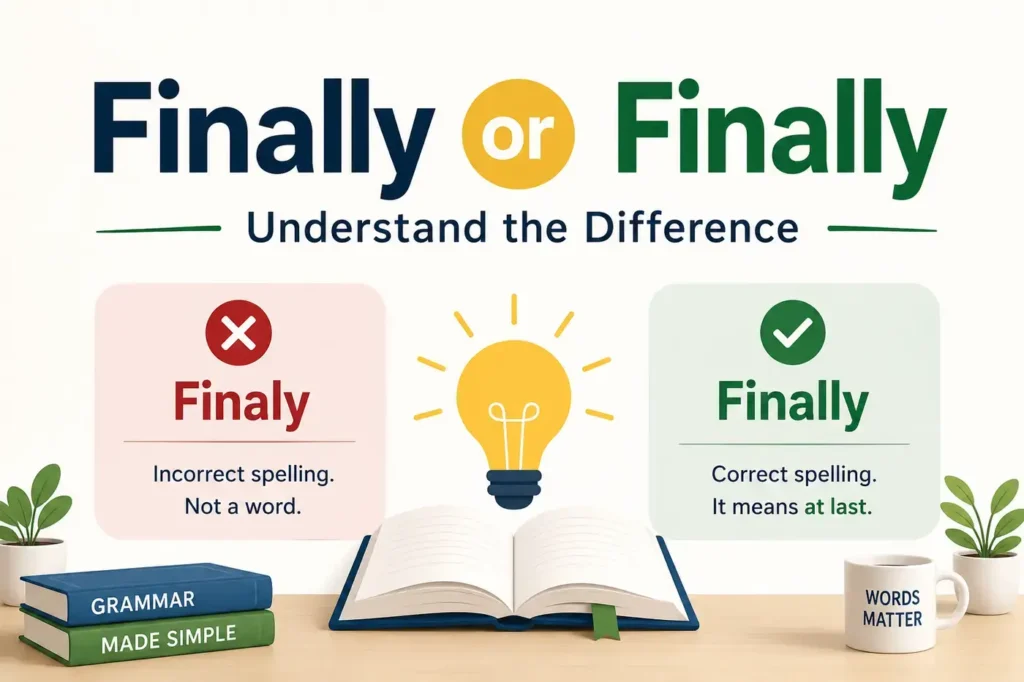
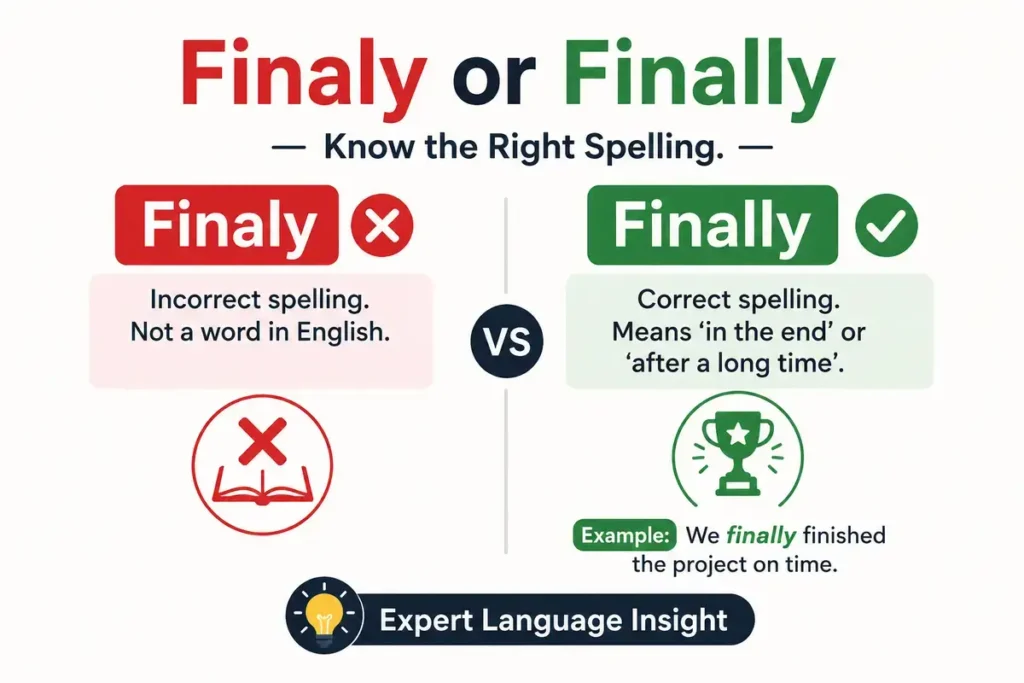
The good news is that the answer is simple. Finally is the correct spelling. Finaly is a misspelling and is not recognized as a standard English word. If you are writing an email, an essay, a social media post, or a professional document, you should always use finally.
The confusion usually happens because people spell the word the way it sounds. Since the extra l is not strongly pronounced, it is easy to leave it out while typing. Fortunately, once you understand how the word is formed, remembering the correct spelling becomes much easier.
This guide explains the correct spelling, meaning, pronunciation, grammar, usage, sentence examples, common mistakes, word origin, and practical writing tips. You will also learn how professional editors spot this error and how to avoid making it in your own writing.
If you’re interested in avoiding other common spelling mix-ups, learning the difference between stellar and steller can help you write with greater confidence.
Quick Definition
Finally is the correct English word. It is an adverb that means at last, after a long time, or in the last part of something. Finaly is simply a spelling mistake and should never be used in formal or informal writing.
Quick Answer
If you only need the short answer, here it is.
- Finally is the correct spelling.
- Finaly is incorrect.
- Finally functions as an adverb.
- It usually means at last, in the end, or as the last point.
- Always use finally in school assignments, business writing, emails, books, and everyday communication.
A simple way to remember the spelling is to look at the word final. When you add the common adverb ending ly, the result is finally, not finaly.
Comparison Table
| Feature | Finally | Finaly |
|---|---|---|
| Part of speech | Adverb | Not a standard English word |
| Meaning | At last In the end As the final point | No accepted meaning |
| Correct spelling | Yes | No |
| Origin | From final plus the suffix ly | Misspelling of finally |
| Formality | Standard in all writing | Never appropriate |
| Common contexts | Conversation Essays Emails Books News Business writing | Typing mistakes Search queries |
| Usage frequency | Extremely common | Appears only as a spelling error |
| Example | We finally reached home. | Finaly we reached home. Incorrect |
Meaning Of Finally
Understanding what the word means makes it much easier to remember and use correctly. Although finally has only one spelling, it can express several related ideas depending on the sentence.
The most common meanings include the following.
- Something happens after waiting for a long time.
- Something happens at the end of a process.
- Someone introduces the last point in a discussion.
- An event reaches its conclusion.
Because the word serves different purposes, context helps readers understand the intended meaning.
Consider these examples.
- We finally finished the project after several weeks of hard work.
- The rain stopped, and the sun finally appeared.
- Finally, I would like to thank everyone who supported this research.
- She finally understood the lesson after practicing every day.
In each sentence, the word signals the last stage of an action, event, or discussion.
Why Finaly Is Incorrect
Many spelling mistakes happen because English pronunciation does not always match spelling perfectly. This is one of those cases.
The word finaly is missing one l, so it does not follow standard English spelling rules. You may occasionally see it in online comments, text messages, or search queries, but dictionaries do not recognize it as a correct word.
People usually write finaly because they:
- Type too quickly.
- Forget that final ends with al before adding ly.
- Spell the word exactly as they hear it.
- Miss the extra l while proofreading.
- Rely too heavily on autocorrect.
Most modern spelling checkers automatically change finaly to finally, which helps reduce the mistake before publication.
Key Differences Between The Two Spellings
At first glance, the two spellings seem almost identical. In reality, one is a proper English word and the other is simply a typographical error.
Here is a quick comparison.
| Finally | Finaly |
|---|---|
| Correct English spelling | Incorrect spelling |
| Listed in dictionaries | Not listed in standard dictionaries |
| Used by native speakers | Appears only as a mistake |
| Accepted in formal writing | Never accepted |
| Functions as an adverb | Has no grammatical role |
The difference may seem small, but correct spelling has a big impact on readability and credibility. A single missing letter can make polished writing look rushed or careless.
Which Spelling Should You Use
There is no situation in standard English where finaly is considered correct. Every major dictionary, style guide, and grammar reference accepts only finally.
When proofreading your writing, take a moment to check words ending in ly. Small typing errors often slip through because your brain reads what it expects to see instead of what is actually written.
To avoid this mistake, remember these simple rules.
- Start with the adjective final.
- Add the suffix ly.
- The finished word becomes finally.
- If you see finaly, correct it before publishing or submitting your work.
Building this habit will improve both your spelling accuracy and your confidence as a writer.
Pronunciation Guide
Although many people misspell the word, its pronunciation is straightforward.
IPA Pronunciation
Finally
/ˈfaɪnəli/
Syllable Breakdown
Fi.
Nal.
Ly.
The word has three syllables.
When spoken naturally, native speakers often pronounce it smoothly, which is one reason some writers accidentally leave out the second l while typing.
Common Pronunciation Mistakes
Pronunciation errors are less common than spelling mistakes, but a few still occur.
- Stressing the last syllable instead of the first.
- Dropping the middle syllable in very fast speech.
- Confusing it with words such as finite or final.
Listening to native speakers and reading the word aloud while writing can reinforce both the pronunciation and the correct spelling.
Expert Language Insight
Professional editors rarely spend time debating this spelling because the answer is already settled. During proofreading, finaly is treated as a straightforward spelling error, just like writing becaus instead of because or seperate instead of separate.
One useful editing habit is to look for common suffixes. English adverbs ending in ly follow predictable spelling patterns. Once you recognize that finally comes directly from final plus ly, the correct spelling becomes much easier to remember. Instead of memorizing the whole word, focus on how it is built. That small shift helps writers avoid the same mistake in many other adverbs as well.
Examples In Sentences
The easiest way to remember the correct spelling is to see it in natural sentences. Notice how the word changes the meaning of each sentence by showing that something happened at the end of a process or after a period of waiting.
Examples Using Finally
These examples show the correct spelling in everyday situations.
- We finally reached the airport after sitting in traffic for two hours.
- She finally found the book she had been searching for all week.
- The children finally fell asleep after the movie ended.
- I finally understood the math problem after practicing several times.
- They finally announced the winner during the closing ceremony.
- The restaurant finally reopened after months of renovations.
- He finally apologized for the misunderstanding.
- We finally finished painting the house before sunset.
- Finally, I would like to thank everyone who supported this project.
- The team finally achieved its goal through patience and hard work.
Examples Showing The Misspelling
The following sentences contain the incorrect spelling. They are included only to help you recognize and avoid the mistake.
- Finaly we reached the airport. ✗
- She finaly answered my email. ✗
- They finaly completed the assignment. ✗
- I finaly remembered his name. ✗
- We finaly bought a new car. ✗
- The train finaly arrived. ✗
- He finaly agreed with the proposal. ✗
- The baby finaly stopped crying. ✗
- Finaly the meeting ended. ✗
- I finaly passed my driving test. ✗
In every example above, finaly should be replaced with finally.
Grammar Rules
Understanding the grammar behind the word makes it easier to use confidently in both speaking and writing.
Part Of Speech
Finally is an adverb. It modifies verbs, adjectives, other adverbs, or entire sentences by indicating the final stage of an event or introducing the last point in a discussion.
Examples include:
- She finally arrived.
- We finally completed the project.
- Finally, let us review the main findings.
Sentence Position
The word is flexible and can appear in different places depending on the sentence.
At the beginning:
- Finally, the storm passed.
In the middle:
- She finally accepted the invitation.
At the end:
- They reached home finally.
Although all three positions are grammatically correct, placing the word near the verb often sounds the most natural in everyday English.
Verb Tenses
The word works with many verb tenses.
Present tense:
- I finally understand your point.
Past tense:
- She finally finished the report.
Present perfect:
- They have finally arrived.
Future tense:
- We will finally meet next month.
The meaning remains consistent because it describes the timing of an event rather than changing the tense itself.
Common Mistakes
This spelling mistake appears so often that editors spot it almost immediately. Fortunately, it is also one of the easiest errors to fix.
Leaving Out One Letter
The most common mistake is writing finaly instead of finally.
Correct:
Finally.
Incorrect:
Finaly.
Remember that the adjective final becomes finally after adding the suffix ly.
Confusing Final With Finally
These words are closely related but serve different grammatical purposes.
Final is an adjective.
Example:
- This is the final chapter.
Finally is an adverb.
Example:
- We finally reached the final chapter.
The two words often appear in the same sentence, but they perform different jobs.
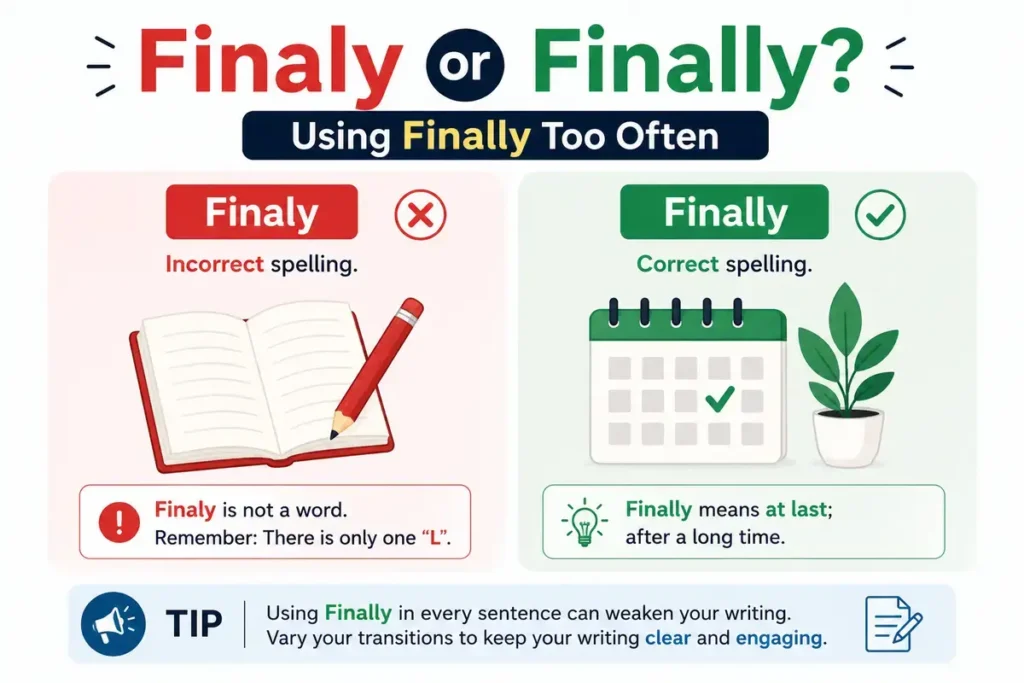
Using Finally Too Often
Because the word signals the end of an action, repeating it several times in the same paragraph makes writing sound repetitive.
Instead, vary your wording with natural alternatives when appropriate.
Examples include:
- At last.
- In the end.
- Eventually.
- Ultimately.
- As a final point.
Choosing different expressions creates smoother and more engaging writing.
Forgetting To Proofread
Small spelling mistakes are easy to overlook because your brain automatically fills in missing letters.
A slow final proofread often catches errors that spell check misses.
Similar to deciding between finally and finaly, choosing the right descriptive word can make your writing more accurate, as seen in the comparison of indulgent vs sober.
Word Origin And History
The history of the word explains why its spelling follows a predictable pattern.
The adjective final entered English from Latin through French. It comes from the Latin word finalis, meaning last or relating to an end.
Later, English speakers added the common adverb suffix ly to create finally. This process follows the same pattern as many familiar words.
Examples include:
- Quick becomes quickly.
- Slow becomes slowly.
- Happy becomes happily.
- Careful becomes carefully.
- Final becomes finally.
Once you recognize this pattern, the spelling becomes much easier to remember.
Regional Usage
One advantage of this word is that its spelling stays consistent across major varieties of English.
American English
American English uses finally in both formal and informal writing. Newspapers, universities, businesses, and government publications all follow the same spelling.
British English
British English also uses finally. Unlike words such as color and colour, there is no alternative British spelling.
Australian English
Australian English follows the same standard spelling. The word appears in education, journalism, business communication, and everyday conversation without variation.
Canadian English
Canadian English also recognizes only finally as the correct spelling.
This consistency makes the word easier to learn because writers do not need to adjust it for different English speaking audiences.
Real Life Usage
Because finally describes the conclusion of an event or process, it appears in almost every type of writing.
Daily Conversation
People use it when talking about everyday experiences.
Examples include:
- I finally finished my homework.
- We finally made it home.
- She finally called me back.
Academic Writing
Students and researchers often use the word to introduce the final point in a discussion or summarize a conclusion.
Example:
- Finally, the results support the original hypothesis.
Professional Communication
In business writing, the word helps organize information clearly.
Example:
- Finally, please review the attached document before Friday.
Literature
Authors use the word to build anticipation and signal that an important event has reached its conclusion.
Example:
- The hero finally returned after years of traveling.
Media And Journalism
News articles frequently use the word when reporting completed events.
Examples include:
- The city finally approved the new budget.
- The company finally launched its latest product.
Because the word is so common, using the correct spelling strengthens credibility and makes your writing appear more polished.
Related Words And Confused Terms
Many English learners confuse finally with words that look or sound similar. Knowing the difference helps you avoid common spelling and grammar mistakes.
Here are some related words you may encounter.
| Word | Meaning | Common Confusion |
|---|---|---|
| Final | Last or ending | Adjective not an adverb |
| Finally | At last or in the end | Correct spelling |
| Finale | The last part of a performance | Different meaning |
| Finish | To complete something | Verb |
| End | The last part of something | Noun or verb |
| Eventually | After a period of time | Similar meaning but not always interchangeable |
| Ultimately | In the final analysis | More formal in tone |
Although these words are related, they cannot always replace one another. Choosing the right one depends on the sentence and the meaning you want to express.
Synonyms
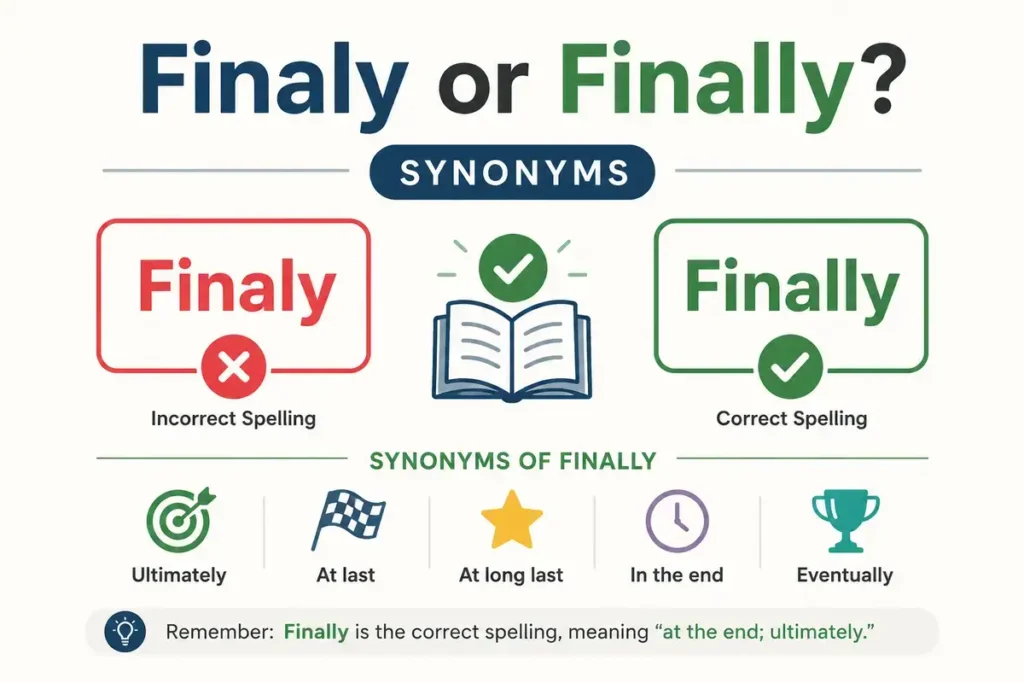
If you find yourself repeating finally, these alternatives can make your writing sound more natural.
Depending on the context, you can use:
- At last.
- Eventually.
- In the end.
- Ultimately.
- Afterward.
- At long last.
- As a final point.
- Last of all.
Each option carries a slightly different tone. For example, at last often expresses relief, while ultimately sounds more formal and analytical.
Writers who enjoy polishing their vocabulary may also find realist and realest explained useful for understanding how similar-looking words can have completely different meanings and uses.
Quick Quiz
Test your understanding with these simple questions.
Question 1
Which spelling is correct?
- Finaly.
- Finally.
Answer:
- Finally.
Question 2
Which sentence is correct?
- We finaly arrived home.
- We finally arrived home.
Answer:
- We finally arrived home.
Question 3
What part of speech is finally?
- Noun.
- Verb.
- Adverb.
- Adjective.
Answer:
- Adverb.
Question 4
Which sentence uses the word correctly?
- Finally, I would like to thank everyone for attending.
- Finaly, I would like to thank everyone for attending.
Answer:
- Finally, I would like to thank everyone for attending.
If you answered all four questions correctly, you’ve mastered one of the most common spelling mistakes in English.
Expert Language Insight
Professional editors pay close attention to small spelling errors because they can affect the credibility of an entire piece of writing. Although finaly differs from finally by only one letter, readers often notice the mistake immediately.
Experienced writers also understand that finally serves more than one purpose. It can show that something happened after a delay, introduce the last point in a discussion, or mark the conclusion of a process. Paying attention to the context helps you choose the most natural position for the word in a sentence.
Another useful habit is proofreading words that end with the suffix ly. Missing letters often slip past your eyes because your brain recognizes the overall shape of the word rather than every individual character. Reading your work slowly or aloud makes these mistakes much easier to catch.
Frequently Asked Questions
Is finally the correct spelling?
Yes. Finally is the only correct spelling in standard English. It appears in dictionaries, grammar guides, academic writing, and professional communication. Finaly is a misspelling and should always be corrected before publishing or submitting your work.
Why do people spell finally as finaly?
Most people make this mistake because they type quickly or spell the word the way it sounds. The second l is easy to overlook, especially during fast typing. Proofreading carefully helps catch this common error.
What does finally mean?
Finally usually means at last, in the end, or after a long wait. It can also introduce the last point in a speech, article, presentation, or discussion.
Is finaly a real word?
No. Standard English dictionaries do not recognize finaly as a valid word. If you see it in writing, it is almost always a spelling mistake.
Is finally an adverb?
Yes. Finally is an adverb because it modifies verbs or entire sentences by showing when something happens or by introducing the final point in a sequence.
Can I use finally at the beginning of a sentence?
Yes. Beginning a sentence with finally is grammatically correct when introducing the last point or describing the conclusion of an event.
Example:
Finally, everyone agreed on the proposal.
Is the spelling different in British and American English?
No. American English, British English, Australian English, and Canadian English all use the same spelling. Unlike some English words, there is no regional variation.
How can I remember the correct spelling?
Think of the adjective final first. Then add the suffix ly to create the adverb finally. Remembering how the word is formed is much easier than trying to memorize its spelling letter by letter.
Conclusion
If you’ve ever wondered about finaly or finally, the answer is straightforward. Finally is the correct spelling, while finaly is simply a misspelling that should be corrected in every type of writing.
The easiest way to remember the word is to start with final and add the suffix ly. That pattern follows the same spelling rule used in many other English adverbs. Once you understand how the word is formed, the correct spelling becomes much easier to recall.
Using the correct form improves more than your spelling. It also makes your writing look polished, professional, and trustworthy. A small detail like one missing letter may seem insignificant, but it can influence how readers judge the quality of your work.
If you still find yourself asking finaly and finally, remember one simple rule. Finally is always the correct spelling, and finaly is always a misspelling. Once you understand that finally comes from the word final plus the suffix ly, the confusion quickly disappears.