When a form asks for your location, address, or residential area, terms like subdivision vs village can create unexpected confusion. They may sound similar because both describe places where people live. However, they do not usually mean the same thing.
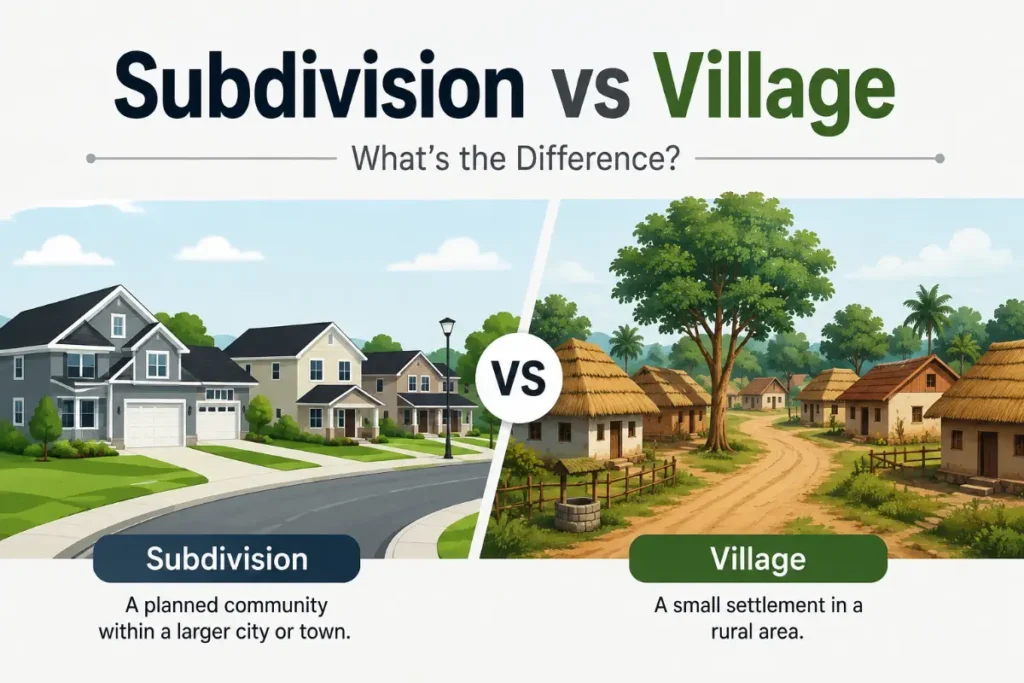
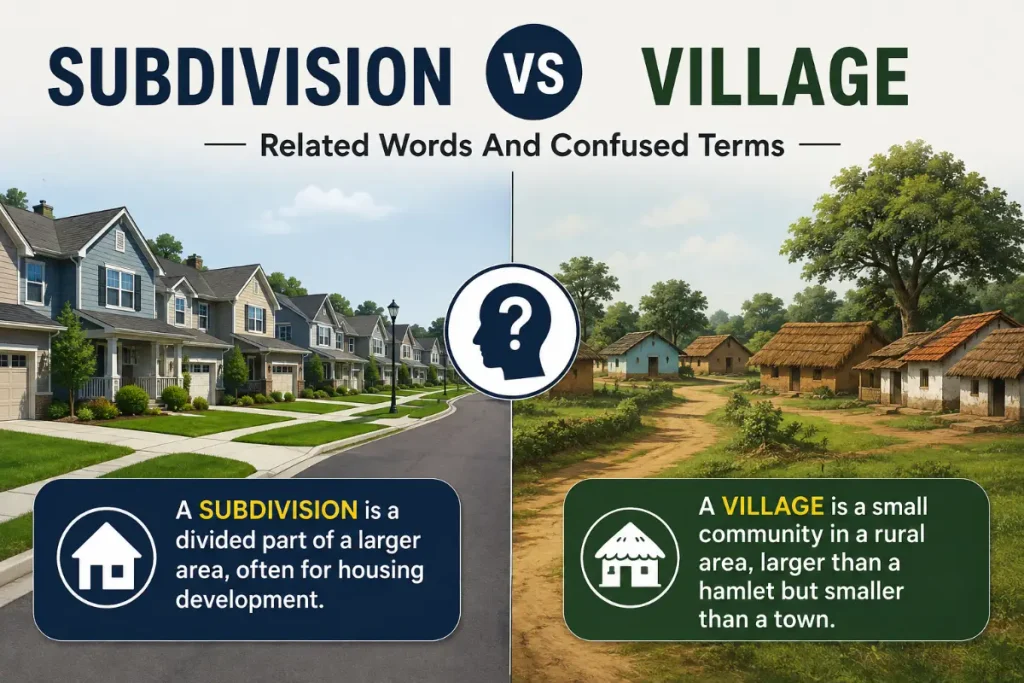
A village is traditionally a community or settlement where people live. It can be an official geographic area with its own identity, history, and population. A subdivision usually refers to a planned division of land into smaller residential lots or sections. In many places, a subdivision is a housing development rather than an independent community.
The difference becomes especially important when filling out official forms, registering a SIM card, describing your address, paying local taxes, or identifying your place of residence. The correct answer can also depend on your country because the terms carry different administrative meanings in places such as the United States and the Philippines.
This guide explains the meaning, usage, grammar, pronunciation, and real world differences between these terms. You will also learn how subdivisions relate to compounds, housing developments, local communities, and official address systems.
Quick Definition
A village is generally a small community or settlement where people live, while a subdivision is usually an area of land divided into smaller lots or residential sections. A subdivision may contain many homes, but it does not automatically function as a separate village or official community.
Quick Answer
The simplest way to understand the difference is to look at what each term describes.
- A village is a community or settlement.
- A subdivision is a division of land, often developed for housing.
- A subdivision can exist inside a larger town, city, municipality, or community.
- A village may have its own geographic or administrative identity.
- The exact meaning can change depending on local laws and address systems.
For most everyday situations, use village when referring to a community and subdivision when referring to a planned residential development or divided area of land.
Comparison Table
| Feature | Subdivision | Village |
|---|---|---|
| Part of speech | Noun | Noun |
| Basic meaning | Land divided into smaller sections or lots | A community or settlement |
| Origin | Related to dividing land | Related to a small settlement or community |
| Correct form | Standard English term | Standard English term |
| Formality level | Common in planning and legal contexts | Common in everyday and administrative contexts |
| Common contexts | Real estate, housing, land development, addresses | Geography, communities, local government, addresses |
| Usage | Common in property and planning discussions | Common in geographic and community discussions |
| Main focus | How land is organized | Where a community lives |
| Example | She bought a house in a new subdivision. | Her grandparents live in a small village. |
The most important distinction is simple. A subdivision describes the organization of land, while a village describes a community or place where people live.
English learners often face similar word-choice problems, such as another common spelling confusion between bachelor and batchelor, where one extra letter can make all the difference.
Meaning Of Subdivision
A subdivision is an area created by dividing a larger piece of land into smaller parts. The word appears in several contexts, so its exact meaning depends on the subject being discussed.
In real estate, a subdivision often refers to a planned residential area containing individual housing lots. A developer may purchase a large piece of land and divide it into smaller plots for houses, roads, parks, and shared facilities.
For example, a developer might divide a large property into 100 lots. Each lot can then be sold separately or used for building homes. The complete development may be known as a residential subdivision.
The term can also have an administrative meaning. A country, state, province, or municipality may divide a larger territory into smaller units. In that situation, a subdivision does not necessarily refer to a housing development.
Common uses include:
- Residential subdivisions.
- Land subdivisions.
- Administrative subdivisions.
- Political subdivisions.
- Property developments.
- Address descriptions.
The context matters. If you see the term on a housing advertisement, it probably refers to a residential development. If you see it in a government document, it may refer to an administrative division.
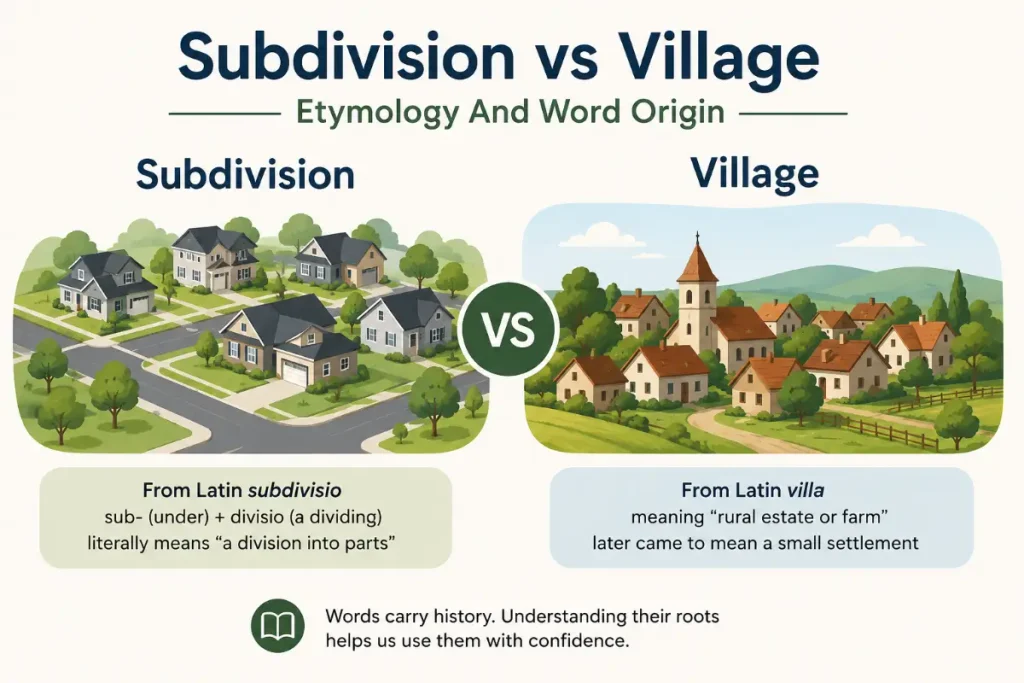
Subdivision Etymology
The word comes from the idea of dividing something that has already been divided. The prefix sub suggests a smaller or secondary part, while division refers to the act of separating something into sections.
In land development, the meaning is very literal. One large piece of land becomes several smaller pieces.
That connection to land division explains why the term is so common in real estate, city planning, surveying, and property law.
Meaning Of Village
A village is a place where people live as part of a community. Traditionally, a village is smaller than a town or city, although there is no single population size that applies everywhere.
The meaning can also depend heavily on local geography and government systems. In one country, a village may be an informal community. In another, it may be an officially recognized administrative unit with legal boundaries and local government responsibilities.
A village can include:
- Homes and residential areas.
- Families and community members.
- Local businesses.
- Schools or religious buildings.
- Public spaces.
- Roads and shared facilities.
The key idea is community. A village is usually understood as a place where a group of people live together within a recognizable geographic area.
Village Etymology
The English word village has roots connected to a settlement, estate, or group of dwellings. Over time, it became the standard English term for a small community larger than a simple collection of houses but generally smaller than a town or city.
Today, the word appears in both traditional and modern settings. Some villages have existed for centuries, while newer residential communities may also use village as part of their official name.
Key Differences Between The Two
The biggest difference lies in the purpose of each term. A subdivision describes the way land is divided, while a village describes a community or settlement.
A residential development can be carefully planned into lots, streets, and housing blocks. That makes it a subdivision. The people living there may still consider themselves part of a larger village, town, city, or municipality.
Here are the main differences.
- Meaning
A subdivision focuses on land organization. A village focuses on a community or settlement.
- Development
A subdivision is often created through property development. A village may grow naturally over time or exist as an officially established community.
- Administration
A village may have official administrative status in some countries. A residential subdivision usually does not operate as an independent local government.
- Location
A subdivision may exist inside a village, town, city, or larger municipality. A village can contain several neighborhoods or residential developments.
- Community Identity
People often identify a village as their community. People may identify a subdivision as their neighborhood or housing development.
- Land Ownership
Subdivisions are closely connected to property boundaries and individual lots. Villages are broader geographic communities and are not defined solely by how land is divided.
Which One Is Correct
Both words are correct. The right choice depends on the place you are describing.
Use subdivision when you mean a planned housing development, a group of residential lots, or a smaller section created from a larger area.
Use village when you mean a community or settlement.
For example, imagine a town called Greenfield. Inside Greenfield, a developer creates a new residential area called Maple Grove. Maple Grove may be a subdivision within the larger town. The town itself might also be considered part of a wider village or municipality depending on the country’s administrative system.
The terms are not simple alternatives for each other. One describes land organization, while the other describes a community.
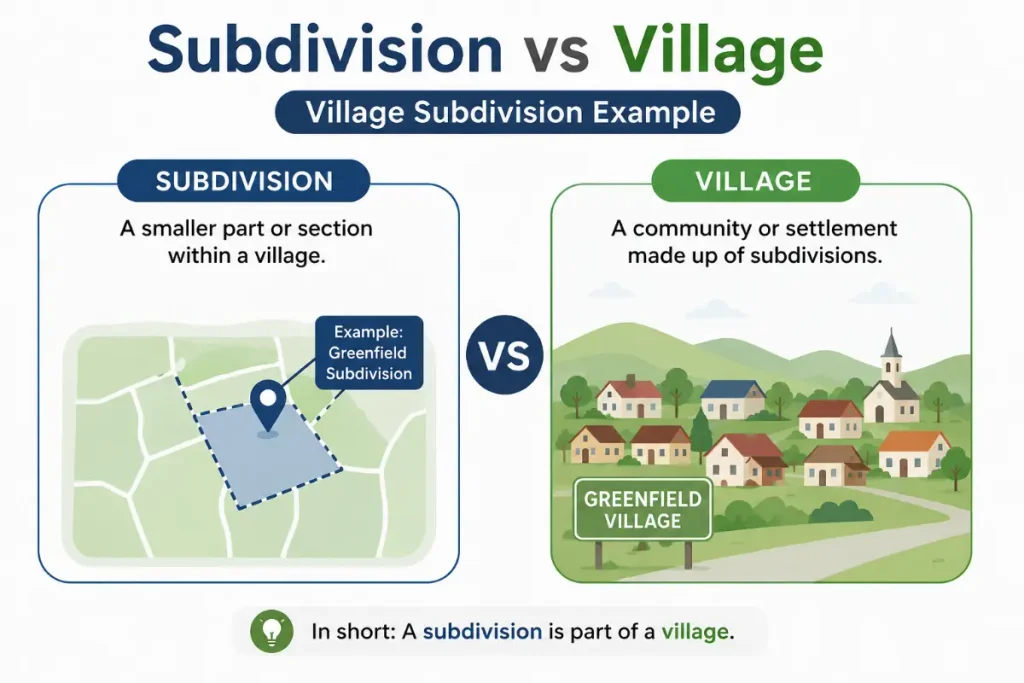
Village Subdivision Example
A simple example makes the relationship easier to understand.
Imagine a municipality called Riverside. Within Riverside is a community known as Oak Village. Oak Village contains several residential areas.
One developer builds a new housing project called Pine Hills. The developer divides the land into individual lots and builds homes, roads, and community facilities.
In this example:
- Riverside is the larger municipality.
- Oak Village is the community or settlement.
- Pine Hills is a residential subdivision.
- Individual houses occupy separate lots within the subdivision.
This example shows that a subdivision and a village can exist within the same geographic area without meaning the same thing.
Subdivision vs Village vs Compound
People also confuse subdivisions with compounds because both can describe residential areas. However, a compound has a different meaning.
A compound is usually a group of buildings or properties enclosed within a defined area. The area may have a wall, fence, gate, or controlled entrance. Compounds are common in residential, business, educational, military, and institutional settings.
A residential compound may contain several homes inside one enclosed property. A subdivision usually covers a larger area divided into separate lots and may contain many streets and individually owned properties.
A village is broader because it refers to a community rather than simply a specific type of property layout.
The relationship can look like this:
- A compound can contain several homes.
- A subdivision can contain many housing lots and streets.
- A village can contain neighborhoods, compounds, subdivisions, businesses, and public spaces.
The terms can overlap in casual speech, but they describe different ideas.
What Is My Village Or Subdivision
Many people encounter this question while filling out an online form.
The answer depends on the location information requested by the form. Start by checking your official address, property documents, utility records, or local government information.
If you live in a named residential development, gated community, or planned housing area, that name may be your subdivision.
If you live in a recognized small community or settlement, the name of that community may be your village.
Do not guess simply because one option sounds familiar. Address formats differ by country and even by local government area. When an official form requires this information, use the address format recognized by the relevant authority.
Pronunciation Guide
Both words are straightforward for many English speakers, but their length can make them difficult for learners.
Subdivision Pronunciation
The standard American pronunciation is approximately:
/ˌsʌb.dɪˈvɪʒ.ən/
The word has four syllables:
Sub di vi sion
The strongest stress usually falls on the vi sound.
A common mistake is stressing the first syllable too heavily and rushing through the rest of the word. Say it slowly at first, then connect the syllables naturally.
Village Pronunciation
The standard pronunciation is approximately:
/ˈvɪl.ɪdʒ/
The word has two syllables:
Vil lage
The stress falls on the first syllable.
A common pronunciation mistake is adding an extra syllable or pronouncing the final sound too slowly. In natural speech, native speakers usually say the word smoothly and quickly.
How To Remember The Difference
A simple memory method can help you keep the meanings separate.
Think of subdivision as a word connected to subdivide. If land is divided into smaller parts, you are dealing with a subdivision.
Think of village as a word connected to people and community. If you are describing a settlement where people live, village may be the better word.
Use this quick test.
- Are you talking about divided land or a planned housing development? Think subdivision.
- Are you talking about a community or settlement? Think village.
- Are you filling out an official form? Check the local address system before choosing.
- Are you describing a specific property development inside a larger community? The development may be the subdivision.
Once you connect each word to its central idea, the distinction becomes much easier to remember.
Clear Examples In Sentences
Examples make the difference easier to understand because the right word becomes clearer when you see it in a real situation.
Examples Using Subdivision
- The family bought a home in a new subdivision outside the city.
- The developer divided the property into residential lots for the subdivision.
- Our subdivision has its own entrance and community park.
- The local government approved plans for a large housing subdivision.
- She wrote the subdivision name on the delivery form.
- New roads are being built throughout the residential development.
- Property values increased after the subdivision added new facilities.
- The subdivision sits within the boundaries of a larger municipality.
- Residents attended a meeting about changes to the development rules.
- The map shows every lot and street in the subdivision.
These examples show that the word often relates to planned housing areas, land development, property boundaries, and addresses.
Examples Using Village
- My grandparents live in a quiet village near the mountains.
- The village has a small school and a local market.
- Visitors come to the village during the summer.
- Everyone in the village knew about the community celebration.
- The village government announced improvements to the main road.
- She grew up in a farming village.
- The village sits beside a river.
- Local families gathered in the village square.
- The village has grown steadily during the past decade.
- He returned to his childhood village after many years away.
These examples focus on people, community life, geography, and settlement rather than the way a piece of land is divided.
Common Mistakes
The confusion between these terms usually comes from the fact that both can describe places where people live. Still, using one word when you mean the other can make an address or explanation less accurate.
Treating Them As Exact Synonyms
A subdivision and a village may both contain homes, streets, and families. That does not make them the same thing.
A subdivision describes the organization or development of land. A village describes a community or settlement. One may exist inside the other.
Assuming Every Housing Development Is A Village
A new housing development can have hundreds or thousands of residents without being officially recognized as a village.
Developers sometimes include the word Village in a community name because it sounds welcoming or traditional. That name does not automatically give the area official village status.
Assuming Every Village Is A Subdivision
Villages can develop naturally over generations. They may contain farms, businesses, historic buildings, public spaces, and several separate neighborhoods.
A subdivision is generally created through a planned process of dividing land. These different origins matter.
Using The Wrong Term On An Official Form
Online forms can be confusing because they sometimes use terms that do not perfectly match local address systems.
If a form asks for your subdivision, enter the name of your residential development if that information applies to your address. If it asks for your village, use the recognized name of your local community.
When in doubt, check an official document rather than guessing.
Confusing A Neighborhood With A Subdivision
A neighborhood is a broad term for an area within a larger community. A subdivision may function as a neighborhood, but not every neighborhood is legally or physically a subdivision.
For example, an old part of a city may be known as a neighborhood even though it was never developed as a modern residential subdivision.
Assuming Internet Usage Defines The Official Meaning
People use location terms casually online, and social media discussions often mix them together. Address fields, government records, and property documents may use more specific definitions.
The safest approach is to follow the terminology used by your local authority or official address.
Building a strong vocabulary also means understanding subtle word differences, especially when two terms may describe change or development in very different ways.
Etymology And Word Origin
Understanding where the words come from helps explain why they describe different things.
The Origin Of Subdivision
The word subdivision combines the prefix sub with division. A division is a separation into parts, while a subdivision is a further division of one of those parts.
The word gradually became important in land administration, surveying, government, and real estate. As cities expanded and developers created new residential areas, the term became closely associated with planned housing developments.
The original idea remains easy to see today. A large piece of land is divided into smaller lots, streets, blocks, or sections.
The Origin Of Village
The word village entered English through older French and Latin language roots connected to a rural settlement or group of homes.
Its history reflects the social meaning of the word. A village was not simply a collection of divided lots. It was a place where people lived, worked, and formed a community.
Over time, the word became widely used for small settlements across the English speaking world. Its exact administrative meaning now varies from one country to another, but the central idea of a community remains.
Regional Usage
The meaning of these terms can change depending on the country’s planning system, government structure, and local address conventions.
American English
In the United States, a subdivision commonly refers to a residential development created by dividing land into individual lots. It may have its own roads, homeowners association, shared facilities, and development rules.
A village can refer to a small community. In some states, it is also an official form of local government with specific legal powers.
This means an American village can have an administrative meaning that goes beyond its general definition as a small settlement.
British English
In the United Kingdom, village usually refers to a small settlement or community. It often carries a strong geographic and social meaning.
Subdivision is used less often in everyday conversations about housing. British speakers may use terms such as housing estate, development, or residential area depending on the situation.
The technical meaning of subdividing land still exists, especially in planning and property contexts.
Australian English
In Australia, subdivision often appears in property development and land planning. A large parcel of land can be subdivided into smaller lots for residential or commercial use.
Village generally refers to a small settlement or community. It can also appear in the names of residential developments, retirement communities, and planned communities.
Canadian English
In Canada, subdivision commonly refers to a residential development or land that has been divided into separate lots.
Village can refer to a small community and may also have official municipal meaning depending on provincial laws.
Like the United States, Canada uses both words in everyday and administrative contexts.
Village vs Subdivision In The Philippines
This comparison can become more complicated in the Philippines because English is widely used alongside local administrative and address terms.
In everyday Philippine usage, a subdivision often refers to a planned residential development. It may be a gated community or housing area containing streets and individual homes.
A village can refer to a community in its ordinary English sense. However, people also use the word in residential development names, especially for established housing communities.
The most important official local unit is often the barangay, which should not automatically be treated as identical to either term.
For an address, a person might provide information in a structure such as:
- House or unit number.
- Street.
- Subdivision or residential development.
- Barangay.
- City or municipality.
- Province.
- Postal code.
The exact format depends on the address and the organization requesting the information.
Subdivision vs Village Taxes
Tax questions can create another layer of confusion because the responsibility for collecting taxes depends on local laws rather than the everyday meaning of the words.
A village with official local government status may have the authority to collect certain local taxes, fees, or assessments. The exact rules depend on the country, state, province, or municipality.
A residential subdivision usually does not function as a government simply because it is a housing development. Residents may still pay property taxes to the relevant city, municipality, county, or other government authority.
Some subdivisions also have homeowners associations. An association may collect dues or fees for services such as:
- Security.
- Road maintenance.
- Landscaping.
- Community facilities.
- Shared infrastructure.
These association fees are not automatically the same as government taxes.
The key difference is important. Taxes are generally imposed under legal government authority, while homeowners association fees usually come from property agreements or community rules.
Village Or Subdivision In SIM Registration
Some SIM registration systems ask for detailed address information. A form may include a field for village or subdivision to help identify a person’s residential location more accurately.
The correct entry depends on your actual address.
If your official address includes the name of a residential subdivision, enter that name when appropriate. If you live in a recognized village or settlement and the form uses that field, enter the official local name.
Do not invent a subdivision name because your area is residential. Likewise, do not assume that every community should be called a village.
Use documents such as your government issued identification, proof of address, utility records, or other information accepted by the registration authority.
Subdivision Vs Compound
A subdivision and a compound can both be residential, but their physical structures are usually different.
A subdivision is generally a larger development divided into separate lots. The lots may belong to different homeowners, and the development can include multiple streets.
A compound is often a more clearly enclosed property or group of buildings. A wall, fence, or controlled entrance may surround the area.
For example, a subdivision might contain 500 houses spread across several streets. One of those properties could be a private compound containing a main house and several smaller buildings.
This makes a compound more about an enclosed group of properties, while a subdivision is more about the planned division and development of land.
Grammar Rules
Both terms are countable nouns and follow standard English grammar rules.
Singular Forms
Use subdivision when referring to one divided area or housing development.
Use village when referring to one community or settlement.
Examples include:
- The subdivision is growing quickly.
- The village is located near the coast.
Plural Forms
The plural forms are regular.
- One subdivision becomes subdivisions.
- One village becomes villages.
Examples include:
- The city approved three new subdivisions.
- Several villages are located in the valley.
Using Articles
Both nouns work naturally with a, an, and the.
Examples include:
- We moved into a new subdivision.
- They visited a small village.
- The subdivision has a community park.
- The village has a historic church.
Common Sentence Structures
These words often appear after prepositions that describe location.
Examples include:
- She lives in a subdivision.
- He grew up in a village.
- The road leads through the subdivision.
- Visitors arrived from the nearby village.
They can also function as modifiers in compound phrases.
Examples include:
- Village residents.
- Village council.
- Subdivision map.
- Subdivision plan.
Real Life Usage Examples
Understanding dictionary definitions is useful, but real life situations show why choosing the correct term matters.
Daily Conversation
In everyday conversation, people often use village when talking about where someone grew up or the community where they live. The word creates an image of people, local life, and a shared place.
Subdivision is more likely to appear when discussing a house, a property, a new development, or directions to a residential area.
For example, someone might say they grew up in a small village but recently bought a house in a new subdivision.
Academic Writing
In geography, urban planning, sociology, and history, the difference can be important.
A researcher might study how villages develop over time, how communities form, or how population growth affects rural settlements. Another researcher might examine land subdivision, housing development, and urban expansion.
Using the wrong term can make the subject of the research unclear.
Professional Communication
Real estate agents, surveyors, architects, planners, and government employees often use subdivision in a technical sense.
The word may appear in planning applications, property documents, maps, construction records, and development agreements.
Village is more common in geographic descriptions, tourism materials, local government documents, and community discussions.
Literature And Media
Writers often use village to create a sense of place, community, history, or rural life. The word has a strong human and cultural association.
Subdivision creates a different image. It often suggests modern housing, organized streets, property development, and suburban growth.
A writer’s choice can therefore influence the picture readers create in their minds.
The same attention to correct usage is helpful when dealing with confusing spellings like platform and flatform and determining which spelling is actually correct in standard English.
Related Words And Confused Terms
Several related terms can make this topic more confusing because different countries and local authorities use different names for residential areas. Understanding these words helps you describe your location more accurately.
Neighborhood
A neighborhood is an area within a larger town or city where people live. It is a broad everyday term and does not necessarily describe a legal land division.
A subdivision can function as a neighborhood, but not every neighborhood is a subdivision. Older neighborhoods often developed gradually rather than through a single planned development process.
Community
A community focuses on people and their shared connection to a place. A village is usually a type of community, but a community can also be much larger.
For example, a residential development may be described as a community even if it is technically a subdivision.
Housing Development
A housing development is a broad term for an area where homes have been built as part of a planned project. A subdivision may be one type of housing development.
This term is often useful when you want to describe the physical nature of an area without making assumptions about its official administrative status.
Barangay
In the Philippines, a barangay is an official local administrative unit. It should not automatically be treated as the same thing as a village or subdivision.
A residential development may sit within a barangay. A person may therefore need to provide both the subdivision name and barangay when completing an address or official form.
District
A district is a larger area created for administrative, geographic, political, or planning purposes. It can contain many communities, neighborhoods, villages, or residential developments.
The size and purpose of a district depend on the country and local government system.
Compound
A compound usually refers to a group of buildings or homes located within a defined property. It may have walls, gates, or controlled access.
The main idea is enclosure. A compound can be part of a larger subdivision, neighborhood, or village.
Expert Language Insight
From an editorial perspective, these words should not be treated as interchangeable. The right choice depends on the exact idea you want to communicate.
Use village when the focus is a community, settlement, or recognized geographic place. The word naturally brings people and place together.
Use subdivision when the focus is land development, property lots, or a planned residential area. It sounds more technical because it often appears in real estate, planning, surveying, and legal documents.
Native speakers may use broader terms such as neighborhood or community in casual conversation when they do not need to describe the legal status of an area. That is often the most natural choice.
For official documents, accuracy matters more. Copy the location name exactly as it appears on your accepted proof of address or follow the terminology requested by the relevant authority. A person can live in a subdivision that sits inside a barangay, village, municipality, or city. Each label can describe a different level of the same address.
A useful editorial rule is simple.
- Describe the community as a village when that is its recognized name or function.
- Describe a planned housing development as a subdivision.
- Use the official local administrative term on government forms.
- Avoid replacing a precise address term with a casual synonym.
That approach keeps your writing accurate without making the language unnecessarily complicated.
Frequently Asked Questions
What is the difference between a subdivision and a village?
A subdivision usually refers to land divided into smaller lots, often as part of a planned residential development. A village is generally a community or settlement where people live. A subdivision can exist inside a larger village, town, city, or municipality, depending on local geography and administration.
Is a subdivision the same as a neighborhood?
Not always. A subdivision can become a neighborhood, but the terms describe different ideas. A subdivision usually refers to the planned development and division of land, while a neighborhood is a broader area where people live and identify as part of the same local community.
What should I write for my village or subdivision?
Use the location name that officially applies to your address. If you live in a named housing development, that may be your subdivision. If your address includes a recognized village or settlement, use that name. Check an official document when completing an important form.
Is a village bigger than a subdivision?
There is no universal size rule. Some villages cover large areas and contain several neighborhoods. Some subdivisions contain hundreds or thousands of homes. The main difference is not size. A village describes a community or settlement, while a subdivision describes how land has been organized.
What is a subdivision in an address?
In an address, a subdivision usually identifies a named residential development or housing area. It can help delivery services, government offices, and other organizations identify a more specific location within a larger city or municipality.
What is the difference between a subdivision and a compound?
A subdivision is generally a larger residential development divided into separate lots and streets. A compound is usually an enclosed property or group of buildings within a defined area. A compound can exist inside a larger residential development.
What should I enter for village or subdivision in SIM registration?
Enter the information that matches your official residential address and the form’s instructions. If your address includes a named subdivision, use that name when appropriate. If it includes a recognized village or settlement, enter that information. Use accepted address documents instead of guessing.
Is a subdivision part of a village in the Philippines?
It can be, depending on the location. In the Philippines, a subdivision may be a residential development located within a barangay or larger local government area. The word village may also appear in a development name. Check the official address structure instead of assuming the terms are identical.
Conclusion
The difference between these two terms becomes clear once you focus on the idea behind each word. A subdivision is mainly connected to land that has been divided and developed into smaller sections or residential lots. A village is mainly connected to a community or settlement where people live.
The two can exist in the same geographic area, which is why they sometimes cause confusion. A person may live in a subdivision located within a larger village, barangay, municipality, or city. Each term can describe a different part or level of the same location.
For everyday conversation, use the word that best matches what you mean. Talk about a village when describing a community. Use subdivision when discussing a planned housing development or divided residential land.
For addresses, SIM registration, taxes, property documents, and other official matters, local rules matter. Follow the address format used by the relevant government authority or organization. Do not guess simply because two terms seem similar.
The strongest takeaway is simple. A village describes a place and community. A subdivision describes how land has been divided and developed. Once you understand that distinction, choosing the right term becomes much easier.