Have you ever paused while writing an email or text because you couldn’t decide between any time vs anytime? You’re not alone. These two forms look almost identical, but they don’t always do the same job. A single space can change how the phrase works in a sentence.
The confusion comes from the fact that both forms are correct. The trick is knowing when each one fits. Many grammar checkers catch obvious mistakes, but they don’t always explain why one choice sounds natural while the other feels off.
This guide clears up the confusion in plain English. You’ll learn the difference between any time or anytime, see plenty of real examples, understand the grammar behind both forms, and discover how native English speakers actually use them in everyday conversation and professional writing. By the end, you’ll know which form belongs in every situation without second guessing yourself.
Quick Definition
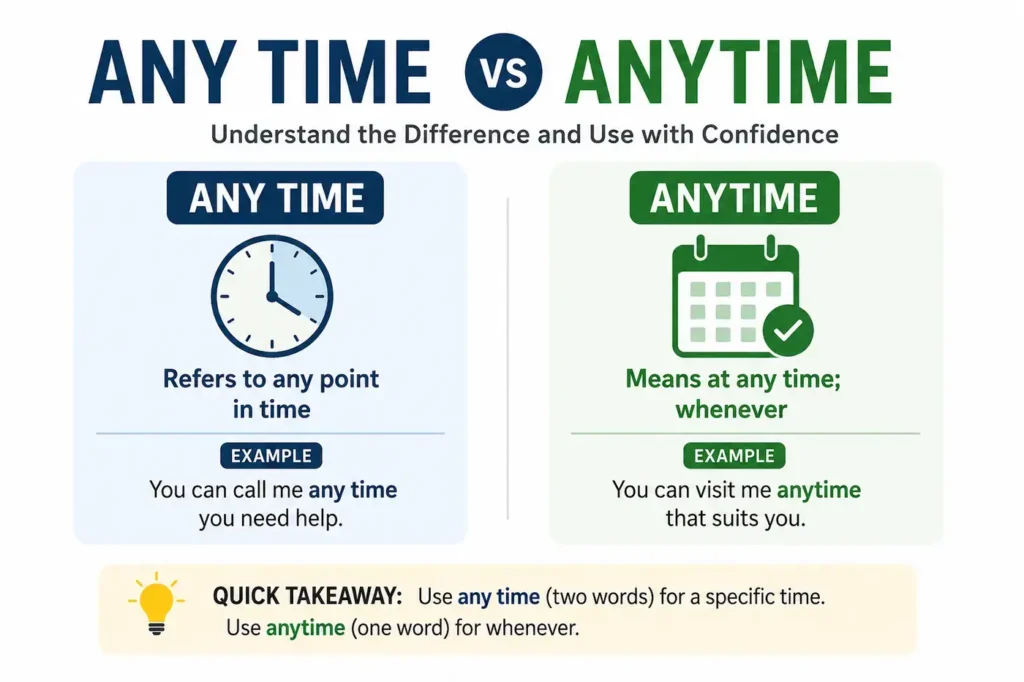
Any time is a two word phrase that usually means at any moment or whenever. Anytime is a one word adverb that means whenever and often modifies a verb directly. Both are correct, but they serve different grammatical purposes.
Quick Answer
If you’re comparing any time or anytime, remember this simple rule.
Use any time when you need a noun phrase that means any amount of time or any moment.
Use anytime as an adverb that means whenever.
Examples.
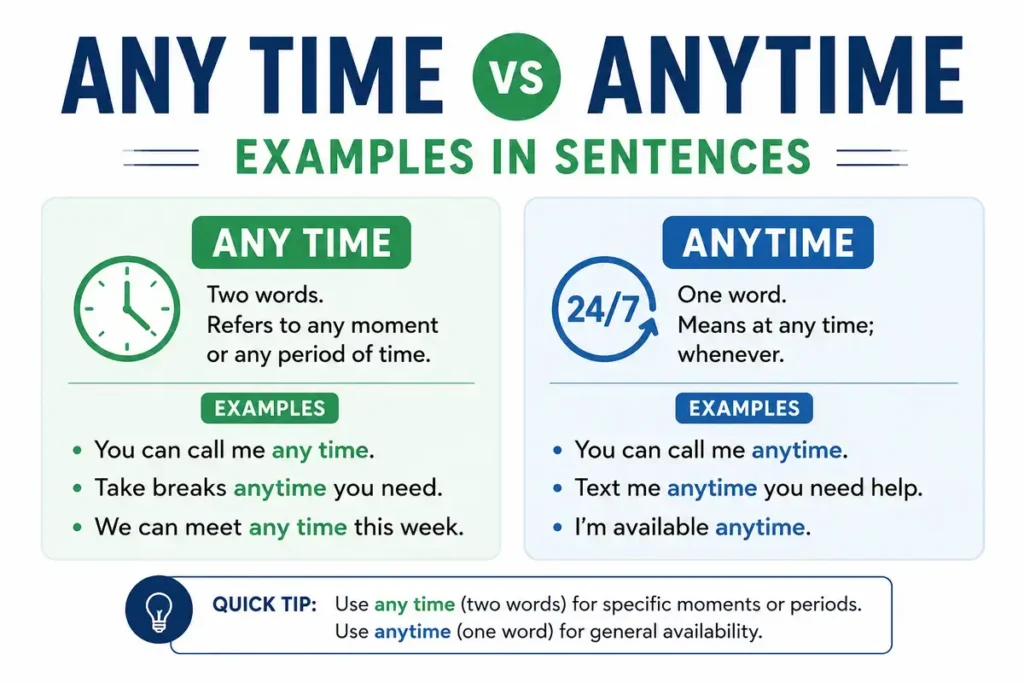
- You can call me any time.
- You can call me anytime.
Both sentences are accepted in modern American English. Even so, the two word form remains the safer choice in formal writing because it works in more situations and matches traditional grammar rules.
Any Time vs Anytime Comparison Table
| Feature | Any Time | Anytime |
|---|---|---|
| Part of speech | Noun phrase | Adverb |
| Origin | Traditional two word phrase | Later compound form |
| Correct form | Correct | Correct |
| Primary meaning | Any amount of time or any moment | Whenever |
| Formality | Works in all writing styles | Common in modern English and informal to neutral writing |
| Common contexts | Academic writing business writing formal documents everyday speech | Conversation emails text messages websites marketing copy |
| Usage frequency | Very common | Very common especially in American English |
| Can follow a preposition | Yes | Usually no |
| Example | I don’t have any time today. | Stop by anytime. |
Meaning of Any Time vs Anytime
What Does Any Time Mean
Any time is a noun phrase. It combines the adjective any with the noun time. Together they refer to an unspecified amount of time or an unspecified moment.
You’ll often see any time after prepositions such as at, for, or in.
Examples.
- Come by at any time.
- I don’t have any time this afternoon.
- You can visit us at any time during business hours.
- She didn’t spend any time worrying about it.
In each sentence the word time acts as a noun.
What Does Anytime Mean
Anytime is an adverb. It means whenever or at any time.
Instead of naming time as a thing it describes when an action can happen.
Examples.
- You can stop by anytime.
- Call me anytime you need help.
- They’re welcome anytime.
- Feel free to email anytime.
This one word form is especially common in American English and has become a natural part of everyday writing.
Any Time vs Anytime Key Differences
Although the meanings are closely related the grammar isn’t the same. That’s why writers sometimes choose the wrong form.
Grammar
- Any time functions as a noun phrase.
- Anytime functions as an adverb.
Meaning
- Any time refers to an amount or period of time.
- Anytime means whenever.
Formal Writing
- Any time fits every level of formality.
- Anytime is widely accepted in modern American English but some traditional style guides still prefer the two word form in highly formal documents.
Sentence Position
- Any time often appears after prepositions.
- Anytime usually appears directly after the verb it modifies.
Easy Memory Trick
If you can replace the phrase with whenever and the sentence still sounds natural anytime usually works.
If you’re talking about an amount of time or using a preposition choose any time.
Any Time vs Anytime Which One Is Correct
The short answer is simple.
Both are correct.
The right choice depends on how the words function in your sentence.
Choose any time when time is acting as a noun.
Examples.
- We don’t have any time left.
- Visit us at any time.
- I didn’t spend any time reading yesterday.
Choose anytime when you mean whenever.
Examples.
- Come anytime.
- You can call anytime.
- Stop by anytime this weekend.
Professional editors usually look at grammar first instead of counting words. If the phrase works as a noun they keep it as two words. If it acts as an adverb they often write it as one word.
That approach keeps the sentence natural and avoids awkward wording.
Any Time or Anytime in American English
American English accepts both forms, but usage has changed over the years.
Older style guides leaned toward any time in almost every situation. Modern dictionaries now recognize anytime as a standard adverb, so you’ll see it in newspapers, websites, books, business emails, and everyday conversation.
Even so, professional editors still use any time after prepositions because that’s the grammatically correct structure.
Examples.
- Correct. Meet me at any time.
- Correct. Call me anytime.
- Correct. Visit anytime after lunch.
- Correct. I don’t have any time today.
Knowing this pattern makes editing much easier because you can spot the role the phrase plays instead of guessing.
Any Time vs Anytime Examples in Sentences
The fastest way to remember the difference is to see both forms in real situations.
Ten Examples Using Any Time
- I don’t have any time to finish the report before lunch.
- You’re welcome to visit us at any time during office hours.
- She didn’t waste any time making her decision.
- We barely had any time to catch the train.
- Is there any time available on your schedule this Friday?
- The kids didn’t spend any time outside because it rained all day.
- I’ll make any time necessary to help with the project.
- They haven’t had any time to relax this week.
- You may contact customer support at any time.
- We couldn’t find any time to discuss the new proposal.
Ten Examples Using Anytime
- Call me anytime if you need advice.
- You can stop by anytime this weekend.
- Feel free to email me anytime.
- She’s welcome back anytime.
- We can grab coffee anytime after work.
- Let me know anytime you’re ready.
- You’re free to join us anytime.
- The store accepts online orders anytime.
- Reach out anytime you have questions.
- You’re invited anytime you want to visit.
Reading these examples side by side makes the pattern much easier to recognize. The two word form refers to time as a thing. The one word form simply tells you when something can happen.
Any Time vs Anytime Common Mistakes
Even experienced writers mix these forms up because they sound exactly alike. Most mistakes happen because people focus on pronunciation instead of grammar.
Using Anytime After a Preposition
Incorrect.
- Meet me at anytime.
Correct.
- Meet me at any time.
The preposition at needs the noun time, so the two word form is the right choice.
Using Any Time as an Adverb
Less natural.
- Call me any time.
More natural in everyday American English.
- Call me anytime.
Both versions appear in published writing, but the one word form sounds smoother in casual conversation.
Assuming One Form Is Always Correct
Some people think anytime is wrong. Others believe any time is outdated.
Neither idea is true.
Modern dictionaries accept both forms. The best choice depends on grammar and context.
Confusing Formal Style With Grammar
Formal writing doesn’t ban anytime. Many respected publications use it as an adverb.
Still, editors often prefer any time in legal documents, academic papers, and highly formal business writing because it follows traditional grammatical patterns.
Any Time or Anytime Pronunciation Guide
Both forms share the same pronunciation.
IPA Pronunciation
American English.
/ˈɛniˌtaɪm/
British English.
/ˈeniˌtaɪm/
Syllable Breakdown
Anytime.
En ee time
Any time.
En ee time
The pronunciation stays the same because the only difference is spelling and grammar.
Common Pronunciation Mistakes
- Stressing the second syllable too heavily.
- Pausing unnaturally between any and time.
- Assuming different spellings require different pronunciations.
Native speakers pronounce both forms almost exactly the same.
Any Time vs Anytime Etymology and Word Origin
The phrase any time has existed for centuries because it combines two common English words.
The adjective any comes from Old English and has long been used to describe an unspecified person, place, or thing.
The noun time also comes from Old English and refers to a period, moment, or duration.
Over time, English speakers began using any time so often that the words gradually merged into the compound adverb anytime. English has done this with many other words.
Some familiar examples include:
- Everyday.
- Maybe.
- Already.
- Nowadays.
- Somehow.
This process is common in English. Frequently used word combinations often become single words after years of everyday use.
Any Time vs Anytime Regional Usage
English isn’t identical around the world. Different countries have slightly different writing preferences.
American English
American English widely accepts anytime as a standard adverb.
You’ll see it in books, newspapers, company websites, blogs, emails, and everyday conversation.
Examples.
- Stop by anytime.
- Call anytime.
British English
British English still leans a little more toward any time, especially in formal writing.
The one word form also appears, but many editors remain more conservative.
Canadian English
Canadian English generally follows American usage while keeping some British influences.
Both forms are common, though many formal publications still favor any time.
Australian English
Australian English accepts both spellings.
Professional editors often choose the version that matches the publication’s style guide rather than treating one as universally better.
Any Time vs Anytime Grammar Rules
Understanding the grammar makes this topic surprisingly simple.
Any Time Is a Noun Phrase
The word time remains a noun.
Examples.
- We don’t have any time left.
- She spent any time she could with her family.
- You may arrive at any time.
In every sentence time names a thing.
Anytime Is an Adverb
The one word form modifies a verb by answering the question of when.
Examples.
- Come anytime.
- Visit anytime after dinner.
- Call anytime you need support.
Here anytime tells us when the action can happen.
Grammar Tip From Professional Editors
A simple editing trick works surprisingly well.
Replace the phrase with whenever.
If the sentence still sounds natural, anytime is usually the right choice.
If you’re referring to an amount or period of time, use any time instead.
Professional copy editors rely on this method because it’s quick, practical, and easy to remember.
Real Life Usage Examples
Grammar rules matter, but real writing tells the bigger story.
Daily Conversation
- Come over anytime.
- I don’t have any time right now.
- You can text me anytime.
Academic Writing
Academic writing usually prefers the two word form when referring to a period of time.
Example.
- Students may request extra support at any time during the semester.
Professional Communication
Business writing uses both forms naturally.
Examples.
- Contact our support team anytime.
- Employees may submit requests at any time.
Literature
Published authors regularly use both spellings because each serves a different purpose. Editors choose the form that matches the sentence instead of following a single rule.
Media And Digital Content
News websites, blogs, marketing pages, and social media posts often favor anytime because it reads smoothly and matches everyday speech.
Formal reports and policy documents still use any time more frequently in traditional grammatical structures.
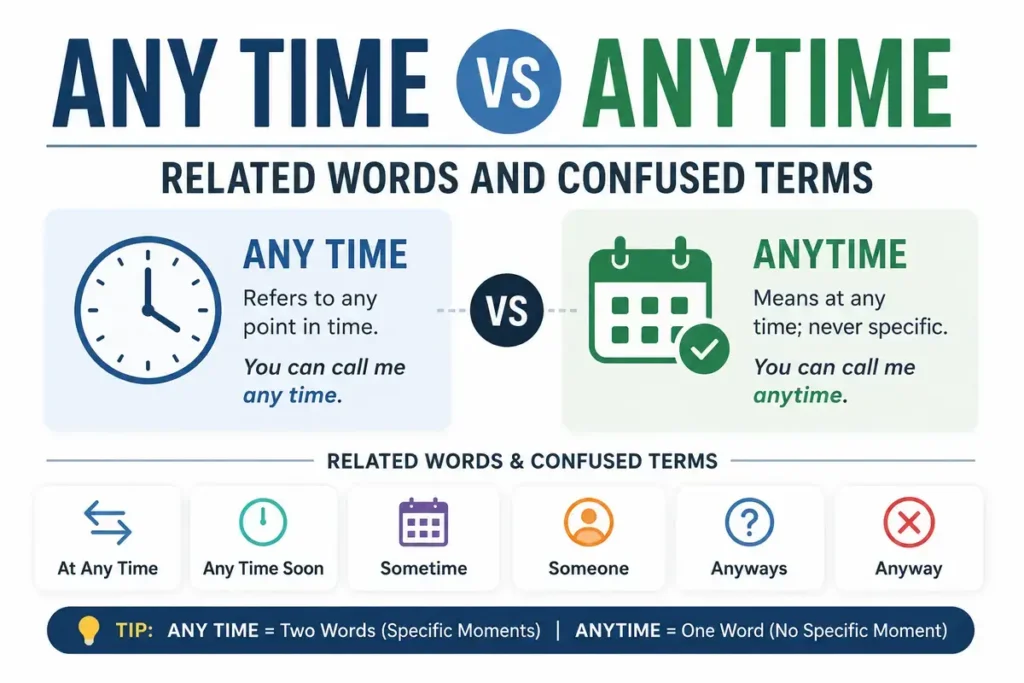
Any Time Or Anytime Related Words and Confused Terms
If you’ve struggled with any time vs anytime, you’re likely to run into similar word pairs. English has many expressions that changed from two words into one over time.
Here are some of the most common ones.
- Every day vs everyday
- Every day means each day.
- Everyday describes something ordinary or used daily.
- Some time vs sometime
- Some time means a period of time.
- Sometime means at an unspecified point in the future or past.
- Any more vs anymore
- Any more refers to an additional amount.
- Anymore usually means no longer in American English.
- Every one vs everyone
- Every one refers to each individual person or thing in a group.
- Everyone means all people.
- Any one vs anyone
- Any one points to a specific individual or item.
- Anyone means any person.
Learning these pairs helps you recognize a common pattern in English. Compound words often develop after years of frequent use, but they don’t replace the original two word form completely.
Any Time or Anytime Expert Language Insight
After editing thousands of pages, one pattern becomes clear. Most mistakes happen because writers focus on spelling instead of grammar.
Native speakers rarely stop to think about the rule while talking. They naturally choose the form that fits the sentence.
Professional editors take a different approach. They first ask what job the word is doing.
- If time is a noun, they write any time.
- If the word answers the question when, they usually choose anytime.
- This habit removes guesswork and creates smoother writing.
Another helpful observation comes from modern publishing. Websites, magazines, and online businesses often use anytime because it feels conversational and matches everyday American English.
Traditional publications, legal documents, and academic papers still lean more toward any time in many situations. That’s less about right or wrong and more about editorial style.
If you’re writing for a broad audience, this simple approach works well.
- Use any time after prepositions such as at, for, or in.
- Use anytime when you mean whenever.
- Read the sentence aloud. If it sounds natural, you’ve probably made the right choice.
Frequently Asked Questions About Any Time vs Anytime
Is Anytime One Word Or Two
Both spellings are correct. Anytime is a one word adverb that means whenever. Any time is a two word phrase that refers to an amount or moment of time. The correct choice depends on how the words function in your sentence.
Is It Better To Write Any Time Or Anytime
Neither form is better in every situation. Use any time when time acts as a noun. Use anytime when you mean whenever. Choosing the form that matches the grammar makes your writing sound natural.
Can I Use Anytime In Formal Writing
Yes. Modern dictionaries recognize anytime as a standard adverb. Even so, many editors still prefer any time in highly formal, legal, or academic writing because it follows traditional grammatical patterns.
Why Do Both Forms Sound The Same
The pronunciation doesn’t change because the difference is grammatical rather than phonetic. Native speakers pronounce both forms almost identically, which is one reason people often confuse the spelling.
Is Anytime More Common In American English
Yes. American English uses anytime more often in conversation, emails, websites, and everyday writing. The two word form also remains common, especially after prepositions and in formal documents.
How Can I Remember The Difference
Replace the word with whenever. If the sentence still makes sense, anytime usually fits. If you’re talking about a period or amount of time, choose any time.
Do Grammar Checkers Always Catch This Mistake
Not always. Some grammar tools accept both spellings without checking the sentence structure. Reading the sentence carefully and understanding the grammar is still the most reliable method.
Is Any Time Becoming Less Common
No. The two word form remains an important part of English because it serves a different grammatical purpose. Anytime has become more popular, but it hasn’t replaced any time.
Conclusion
The debate around any time vs anytime isn’t really about spelling. It’s about grammar. Both forms are correct, but they don’t do the same job.
Use any time when you’re referring to an amount, period, or moment of time. It’s also the correct choice after prepositions like at, for, and in. Use anytime when you mean whenever and the word works as an adverb.
Try replacing it with whenever if you’re still unsure. If the sentence still sounds natural, anytime is probably the better fit. If not, any time is usually the right answer.
That one simple test will help you make the correct choice in emails, essays, business documents, social media posts, and everyday conversations.