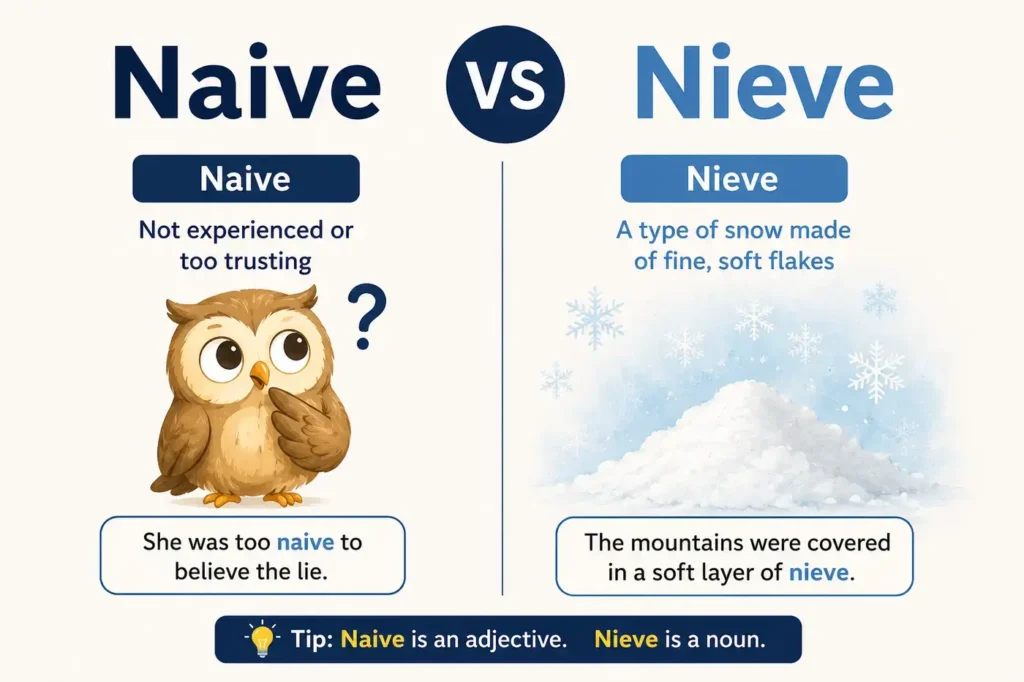
Have you typed naive vs nieve into a search engine because you were unsure which spelling is correct? It is a common question, and the confusion is understandable. The two words look almost identical, but only one belongs in standard English dictionaries.
The correct spelling is naive. The word nieve is almost always a misspelling of naive, although it does exist as a proper noun in some names and as a Spanish word that means snow. When English writers intend to describe someone who is innocent, trusting, or lacking experience, naive is the only correct choice.
Many spelling mistakes happen because English has countless words that follow the pattern of ie after certain letters. People often write the letters in the wrong order without realizing it. Autocorrect catches some mistakes, but not all of them. That is why questions about the correct spelling continue to appear in search results, online forums, and social media discussions.
This guide explains the difference in plain English. You will learn the meaning of each word, why the misspelling is so common, how native speakers use naive, how to pronounce it correctly, and how to avoid making the same mistake in your own writing.
Quick Definition
Naive is the correct English spelling for someone who is innocent, inexperienced, or too trusting. Nieve is not a correct English spelling for that meaning. In most cases, it is simply a spelling mistake. Outside English, Nieve may appear as a personal name or as a Spanish word with a different meaning.
Quick Answer
If your goal is to describe a person who is innocent or lacks experience, always use naive.
Here is the rule to remember.
- Naive is the correct English spelling.
- Nieve is a misspelling in standard English when referring to a person’s character.
- Spell checkers, dictionaries, and style guides recognize naive as the standard form.
- If you are writing for school, work, or publication, avoid using nieve unless you are referring to a name or the Spanish word.
A simple way to remember the spelling is to think of the word naivety, which comes from the same root. Since both words share the same base spelling, writing nieve becomes much easier to spot as an error.
Like many commonly confused word pairs, understanding the difference between bearer and barer can help you avoid subtle spelling mistakes that change the meaning of a sentence.
Comparison Table
| Feature | Naive | Nieve |
|---|---|---|
| Part of speech | Adjective | Not a standard English adjective |
| Meaning | Innocent inexperienced or too trusting | Usually a misspelling of naive |
| Origin | French via Latin | No English origin for this meaning |
| Correct English spelling | Yes | No |
| Formality | Standard in formal and informal writing | Incorrect in English writing |
| Common contexts | Everyday speech education journalism literature business | Typographical errors names Spanish language |
| Usage frequency | Very common | Rare outside names and Spanish |
| Example | She was too naive to recognize the scam. | Incorrect if referring to the adjective. |
Meaning Of Naive
The adjective naive describes someone who lacks experience, practical knowledge, or awareness of how people or situations really work. A naive person is usually sincere and well meaning, but that same trust can sometimes make them vulnerable.
The word does not always carry a negative meaning. In many situations, it suggests honesty, openness, or a fresh perspective rather than foolishness. Context determines how readers interpret it.
For example:
- A child may ask a naive question because they are still learning.
- A new employee might make a naive assumption about office politics.
- An artist can bring a naive style that feels original and authentic.
- Someone may sound naive because they believe everyone tells the truth.
- A traveler can seem naive when visiting an unfamiliar country for the first time.
Many people search for phrases like if a person is nieve or nieve foolish because they are unsure about the spelling. In each of those cases, the intended word is almost certainly naive.
Meaning Of Nieve
In standard English, nieve is not the correct spelling of the adjective naive.
However, the word does appear in other contexts.
- Nieve is a surname and a given name in some cultures.
- In Spanish, nieve means snow.
- You may also see it in place names, family names, or brand names.
These uses have nothing to do with describing someone’s personality or level of experience.
Because search engines often suggest similar spellings, many users look for phrases such as nieve meaning dumb, nieve ignorant, or how to spell nieve definition. The confusion comes from the incorrect spelling rather than a separate English word.
If you want to describe someone who is innocent or inexperienced, naive is always the correct choice.
Key Differences
Although these two spellings look similar, they are not interchangeable.
The biggest difference is that naive is an accepted English adjective, while nieve is not. One belongs in dictionaries and professional writing. The other usually appears because the letters have been reversed by mistake.
Here are the main differences.
| Naive | Nieve |
|---|---|
| Correct English spelling | Usually a misspelling |
| Found in dictionaries | Not listed as an English adjective |
| Used in formal writing | Avoid in English writing |
| Describes innocence or lack of experience | Does not carry this meaning in English |
| Common in books articles and conversations | Mostly appears in typing mistakes or non English contexts |
Another important point is that naive does not automatically mean someone is unintelligent. A person can be highly educated and still be naive about a specific topic because they have little real world experience.
Which Spelling Is Correct
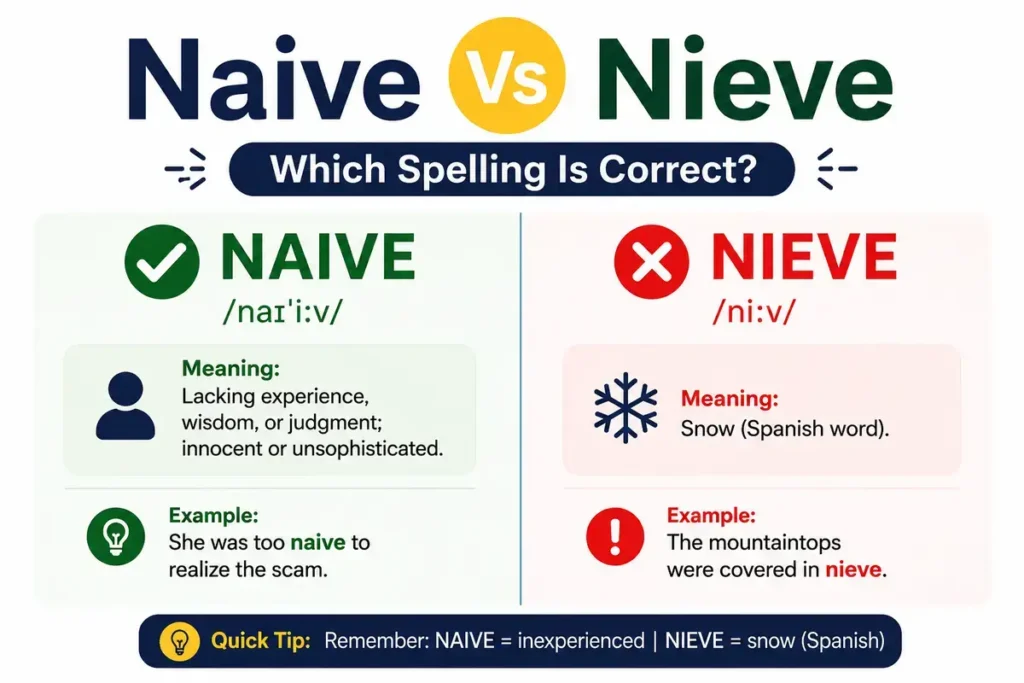
The answer is straightforward. If you are writing in English, naive is the correct spelling.
Professional editors, dictionaries, teachers, and grammar guides all recognize naive as the standard form. Using nieve in an essay, email, report, or article is considered a spelling mistake unless you are referring to a person’s name or using the Spanish word.
Before you write, keep these points in mind.
- Use naive for people who are innocent, trusting, or inexperienced.
- Do not replace it with nieve in English sentences.
- If spell check highlights nieve, review the sentence before ignoring the suggestion.
- When in doubt, look up the word in a trusted English dictionary.
Following this simple rule will help your writing appear more accurate and professional.
Pronunciation Guide
One reason people misspell naive is that its pronunciation does not clearly match its spelling. Hearing the word without seeing it written can make the letter order difficult to remember.
Naive
IPA pronunciation:
/naɪˈiːv/
Syllable breakdown:
Na ive
Pronounced naturally:
ny EEV
Common Pronunciation Mistakes
Some learners pronounce the word as one syllable or stress the wrong part of the word. Others leave out the second vowel sound completely.
To pronounce it correctly:
- Begin with the sound ny.
- Add a clear eev sound.
- Place the stress on the second syllable.
Saying the word aloud while reading its correct spelling is one of the fastest ways to remember it.
If you’ve ever wondered which spelling is correct for school transport, you’ll find that English follows similar usage patterns where context determines the preferred form.
Expert Language Insight
Experienced editors rarely confuse naive and nieve because they focus on meaning instead of appearance. When proofreading, they ask a simple question. Is the writer describing a person’s character, or are they referring to a name or another language?
If the sentence describes innocence, trust, or inexperience, naive is always the correct spelling. Reading the sentence aloud also helps. Native speakers instinctively recognize naive because it appears regularly in books, newspapers, academic writing, and everyday conversation. Once you connect the spelling with its meaning instead of trying to memorize the letters, the mistake becomes much less likely.
Examples In Sentences
The easiest way to remember the correct spelling is to see it in everyday situations. Notice how naive fits naturally into each sentence. Then compare those examples with the incorrect form so you can recognize the mistake immediately.
Examples Using Naive
These examples show the correct English spelling.
- She was too naive to believe the offer was genuine.
- His naive trust in strangers eventually caused problems.
- It would be naive to expect every investment to make a profit.
- The reporter asked a naive question, but it led to an important discussion.
- Their naive optimism helped them stay hopeful during difficult times.
- Many first time travelers make naive assumptions about local customs.
- The character begins the novel as a naive young student and grows wiser with experience.
- Calling someone naive is not always an insult because it can simply mean they lack experience.
- She admitted her earlier opinion had been naive after learning more about the situation.
- The company avoided making naive business decisions by researching the market carefully.
Examples Using Nieve
The following examples explain when nieve is acceptable and when it is not.
- Nieve is incorrect if you mean innocent or inexperienced.
- Writing She is nieve is a spelling mistake in English.
- Spell check will usually suggest changing nieve to naive.
- Nieve can appear as a family name.
- Some people have Nieve as a first name.
- In Spanish, nieve means snow.
- A travel guide written in Spanish may use the word nieve correctly.
- An English dictionary does not list nieve as the adjective meaning inexperienced.
- Many online searches for nieve spelling are actually looking for naive.
- If you are writing in English, avoid nieve unless you are referring to a proper noun or the Spanish language.
These examples highlight an important point. The spelling is not a matter of regional preference. One form is standard English, while the other belongs to an entirely different context.
Naive Vs Nieve Common Mistakes
Most spelling errors happen because the two words look so similar. Fortunately, once you understand why people make these mistakes, they become much easier to avoid.
Reversing The Letters
The most common mistake is swapping the positions of i and e.
Incorrect:
nieve
Correct:
naive
Many writers rely on memory instead of checking a dictionary, which is why this error appears so often online.
Assuming Both Spellings Are Correct
Some words have American and British spelling variations, but this is not one of them.
For example:
- Color and colour are both correct.
- Gray and grey are both correct.
However:
- Naive is correct.
- Nieve is not an alternative English spelling.
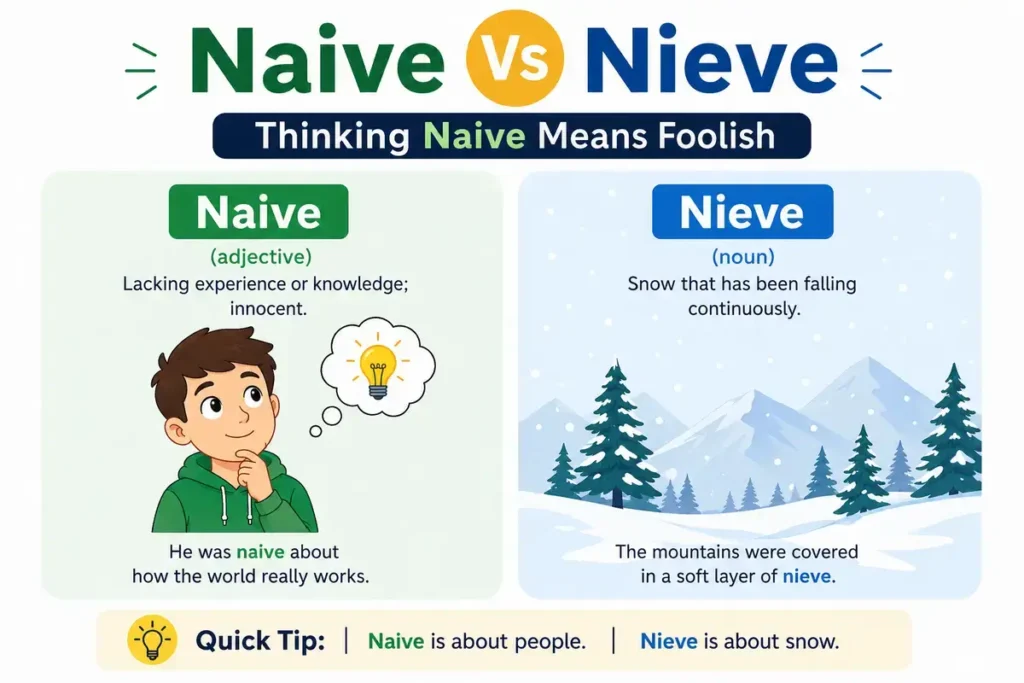
Thinking Naive Means Foolish
This misunderstanding is very common.
Someone who is naive is not automatically unintelligent. The word usually describes a person who lacks experience or has an innocent view of people or situations.
For example:
- A child may be naive because they have little life experience.
- A successful scientist can still be naive about business negotiations.
- A skilled athlete may be naive when managing personal finances.
Experience and intelligence are not the same thing.
Believing Nieve Has The Same Meaning
Searches such as nieve meaning dumb, nieve ignorant, and nieve foolish appear because people assume nieve is another English word.
It is not.
Those searches almost always refer to the misspelled form of naive.
Ignoring Spell Check
Modern writing tools usually recognize nieve as an error.
Instead of dismissing the suggestion, take a moment to confirm the intended meaning. A quick review can prevent an obvious spelling mistake from appearing in professional writing.
Etymology And Word Origin
The history of naive explains why its spelling feels unusual to many English speakers.
The word entered English from French. It comes from the French adjective naïf for the masculine form and naïve for the feminine form. Both trace back to the Latin word nativus, meaning natural, native, or inborn.
When English adopted the word, the spelling gradually became naive. Some dictionaries also show naïve with a diaeresis over the letter i. The two dots indicate that the vowels should be pronounced separately.
Today, both naive and naïve are accepted in English, although the version without the accent marks is much more common in modern writing, especially online.
The spelling nieve did not develop from this history. Instead, it comes from the Spanish language, where it means snow. Although the words look similar, they have completely different origins and meanings.
Understanding the history makes it easier to remember that naive belongs to English vocabulary, while nieve belongs to a different language.
Regional Usage
Unlike many spelling questions, this one has a simple answer.
The correct spelling does not change from one English speaking country to another.
American English
Writers in the United States use naive.
Some publishers also use naïve, particularly in literary or academic works, but naive is far more common in newspapers, business writing, and online content.
British English
British English also uses naive.
The accented spelling appears occasionally in books and magazines, but the meaning remains exactly the same.
Australian English
Australian publications follow the same pattern.
Both spellings may appear, although naive is the form most readers encounter in everyday writing.
Canadian English
Canadian English recognizes the same standard spelling.
Professional editors generally choose naive unless a publication has a style guide that prefers preserving the French accent marks.
Across all major English varieties, nieve is not accepted as the standard spelling of the adjective.
Grammar Rules
Understanding how the word functions in a sentence helps you use it naturally.
Part Of Speech
Naive is an adjective.
It describes a noun by explaining that someone or something lacks experience, awareness, or practical judgment.
Examples include:
- A naive investor.
- A naive assumption.
- A naive decision.
- A naive question.
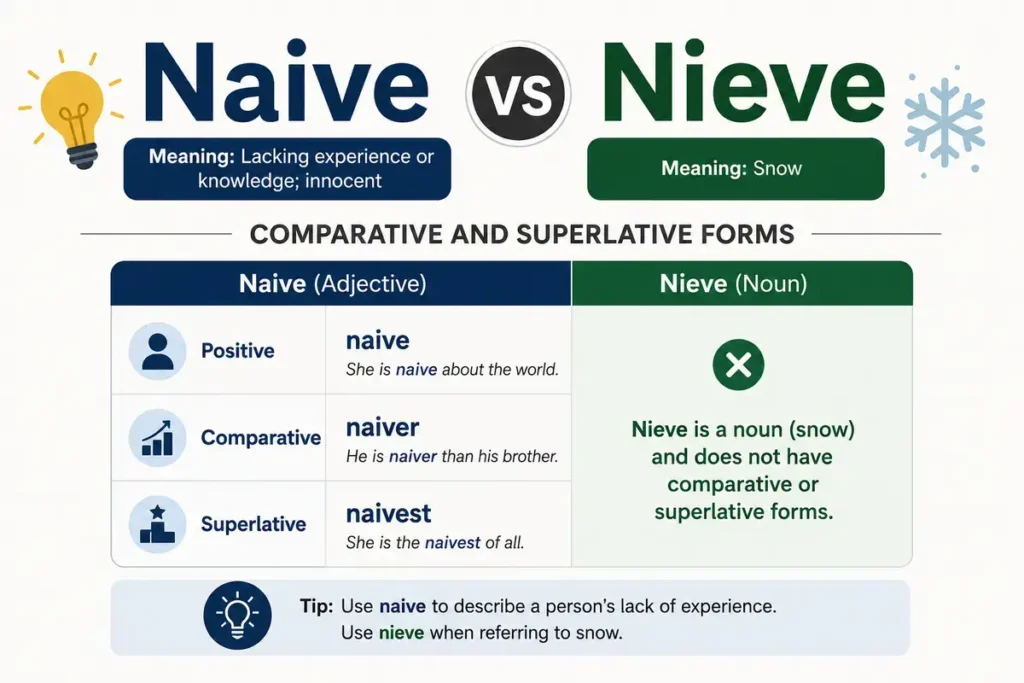
Comparative And Superlative Forms
Like many adjectives with two syllables, naive usually forms comparisons with more and most.
Examples:
- She was more naive than her older brother.
- He was the most naive member of the group.
Related Word Forms
Several words come from the same root.
- Naively.
- Naivety.
- Naivete.
- Naivety is more common in British English.
- Naivete is more common in American English.
Although the spelling differs slightly, both nouns describe the quality of being naive.
Real Life Usage
The word appears in many kinds of writing and conversation.
Everyday Conversation
People often use naive to describe unrealistic expectations or limited experience.
Examples include:
- That idea sounds a little naive.
- I was naive when I first started my career.
- They were naive about the cost of the project.
Academic Writing
Researchers and educators usually use the word carefully because it describes a person’s level of experience rather than intelligence.
For example, psychology papers may discuss naive participants who have not previously taken part in an experiment.
Professional Communication
Business professionals sometimes use the word when discussing planning or decision making.
For example:
- It would be naive to ignore customer feedback.
- Assuming every market behaves the same would be a naive strategy.
Literature And Media
Novelists often describe young or inexperienced characters as naive at the beginning of a story. As the plot develops, those characters gain knowledge and become more confident.
Journalists also use the word when discussing politics, economics, technology, or public opinion, especially when describing unrealistic expectations.
Related Words And Confused Terms
Many English words are confused because they sound alike, look alike, or have similar meanings. Learning these related terms helps you recognize the correct spelling and choose the right word with confidence.
Words Related To Naive
These words share a similar meaning or describe related qualities.
- Innocent.
- Trusting.
- Unsuspecting.
- Inexperienced.
- Gullible.
- Credulous.
- Unworldly.
- Idealistic.
- Childlike.
- Unassuming.
Although these words overlap, they are not exact substitutes. For example, gullible usually suggests someone is easily fooled, while naive often emphasizes limited experience or an innocent outlook.
Commonly Confused Words
Several words are often mistaken for one another because of spelling or pronunciation.
- Naive and naïve.
- Naive and native.
- Naive and novice.
- Naive and innocent.
- Naive and gullible.
- Naive and ignorant.
Each word has a different meaning.
A novice is someone who is new to a skill or activity. An ignorant person lacks knowledge about a subject. Someone who is naive may have plenty of knowledge but little practical experience in a particular situation.
Understanding these differences helps you choose more precise language.
Writers who deal with international audiences may also benefit from learning how to write large numbers correctly, especially when deciding between Indian English and other regional conventions.
Expert Language Insight
Professional editors rarely think about this as a spelling debate because there is no competing English spelling. The real question is recognizing a simple typing error before it reaches your readers.
Native speakers use naive naturally when describing someone who is honest, trusting, or inexperienced. The word often appears in news articles, novels, opinion pieces, academic writing, and everyday conversations. It does not automatically criticize a person’s intelligence. Instead, it usually describes their experience, expectations, or understanding of a situation.
Editors also pay close attention to context. Calling someone naive can sound gentle in one sentence and strongly critical in another. For example, describing a young child’s view of the world as naive may simply acknowledge their innocence. Describing an experienced executive’s business plan as naive carries a much sharper tone.
If you want your writing to sound natural, focus on the meaning rather than memorizing the spelling. Once you connect the word with the idea of innocence or limited experience, the correct spelling becomes much easier to remember.
Frequently Asked Questions
Is naive or nieve correct?
Naive is the correct English spelling. Nieve is usually a spelling mistake when someone wants to describe a person who is innocent, trusting, or inexperienced. The only exceptions are proper names and the Spanish word nieve, which means snow.
What does naive mean?
The word naive describes someone who lacks experience or has an innocent view of people or situations. It does not necessarily mean the person is unintelligent. In many cases, it simply reflects limited life experience or a trusting nature.
Is nieve a real word?
Yes, but not in the way many English writers expect. Nieve exists as a Spanish word meaning snow and also appears as a personal or family name. It is not the correct English adjective for describing an inexperienced person.
Does naive mean dumb?
No. These words have different meanings. Someone can be highly intelligent and still be naive about a subject they have never experienced. The word usually refers to innocence, trust, or limited practical experience rather than a lack of intelligence.
Why do people misspell naive as nieve?
The mistake usually happens because writers reverse the positions of the letters i and e. Since many English words follow different spelling patterns, this error is easy to make. Reading the word regularly and using spell check can help reinforce the correct spelling.
Is naive used in American and British English?
Yes. Naive is the standard spelling in both American and British English. Some publications also use naïve with the accent marks, particularly in academic or literary writing, but the meaning remains exactly the same.
Can I use naive in formal writing?
Yes. The word is appropriate in essays, reports, books, newspapers, and professional communication when it accurately describes someone’s outlook or level of experience. As with any descriptive word, make sure it fits the context and tone of your writing.
What is the difference between naive and gullible?
A naive person may trust others because they lack experience. A gullible person is easily deceived or persuaded to believe something false. Someone can be naive without being gullible, although the two qualities sometimes overlap.
Conclusion
The answer to the spelling question is straightforward. Naive is the correct English word for describing someone who is innocent, trusting, or lacking practical experience. Nieve is not an accepted English spelling for that meaning and should generally be treated as a spelling mistake unless you are referring to a person’s name or the Spanish word for snow.
Remembering the difference becomes much easier once you connect each word with its purpose. Naive belongs in everyday English writing, while nieve belongs in completely different contexts. Understanding that distinction will help you write with greater confidence and avoid one of the most common spelling errors people make.
If you are ever confused about naive vs nieve, take a moment to check a trusted dictionary before publishing your work. That small habit improves accuracy, strengthens your credibility, and helps your writing look polished in every setting.