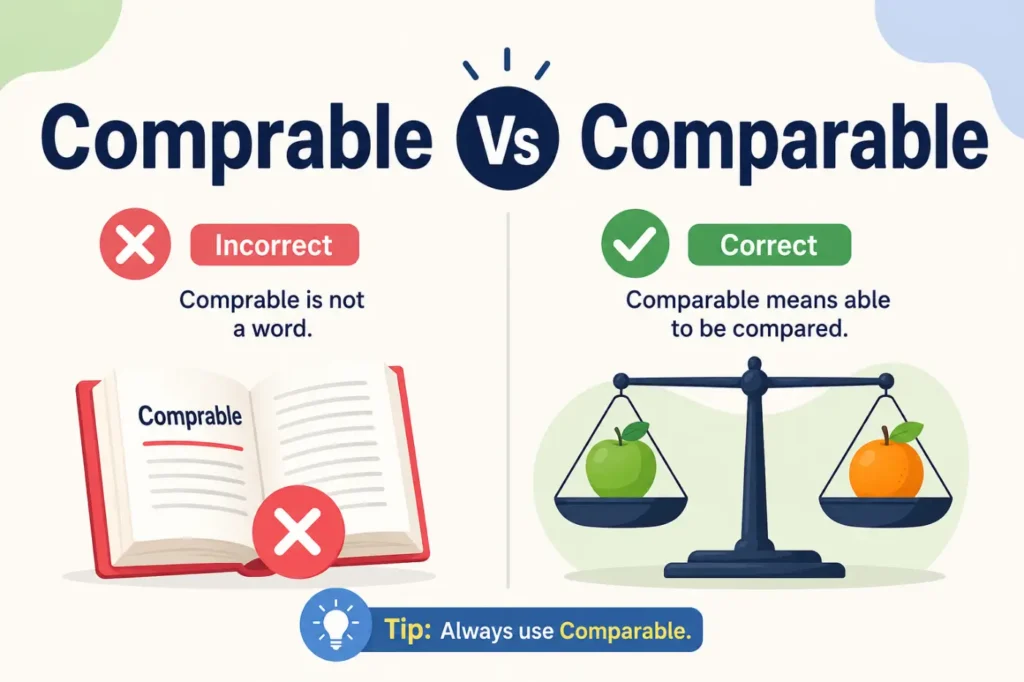
If you have searched for comprable vs comparable, you are probably trying to figure out if both spellings are correct or if one is simply a typo. It is a common question because the words look almost identical, and many people accidentally leave out a letter when typing quickly. Spell checkers, search engines, and online discussions can make the confusion even greater.
The good news is that the answer is straightforward. Comparable is the correct spelling in standard English. Comprable is a misspelling and is not recognized as a standard English word. You should use comparable in academic writing, business communication, professional documents, and everyday conversations.
This guide explains why the mistake happens, how to remember the correct spelling, and how native English speakers use the word naturally. You will also learn its pronunciation, meaning, grammar, origin, and common usage through practical examples. By the end, you will know exactly which spelling to choose and how to avoid making the same mistake again.
Quick Definition
Comparable is a standard English adjective that describes two or more things that are similar enough to be compared. Comprable is a spelling error created by accidentally omitting the second a. In formal and informal writing alike, comparable is always the correct choice unless you are quoting someone else’s original mistake.
Quick Answer
If you only need the answer, remember these key points.
- Comparable is the correct spelling.
- Comprable is not recognized by major English dictionaries.
- Use comparable in school assignments, business writing, emails, reports, and professional communication.
- If you see comprable, it is almost always a typing or spelling mistake.
Comprable Vs Comparable Comparison Table
| Feature | Comprable | Comparable |
|---|---|---|
| Part of speech | None in standard English | Adjective |
| Correct spelling | No | Yes |
| Meaning | None | Similar enough to compare |
| Dictionary status | Not recognized | Recognized by major dictionaries |
| Origin | Misspelling | Derived from compare |
| Formality | Incorrect | Standard in all writing |
| Common contexts | Typing errors | Business education science finance law and everyday English |
| Usage frequency | Very rare | Extremely common |
| Example | Incorrect spelling | The two offers are comparable in price. |
Just as understanding the difference between “grately” and “greatly” helps eliminate a common spelling mistake, choosing the correct form of comparable makes your writing more accurate and professional.
Meaning Of Both Terms
Although these spellings differ by only one letter, only one has a place in standard English.
What Does Comparable Mean
Comparable is an adjective that describes people, objects, situations, or ideas that share enough similarities to be compared meaningfully.
You will often see the word in discussions involving:
- Prices.
- Salaries.
- Products.
- Statistics.
- Research studies.
- Business performance.
- Academic analysis.
- Sports results.
Examples include:
- Comparable products.
- Comparable quality.
- Comparable experience.
- Comparable data.
- Comparable sales.
- Comparable performance.
The word does not mean two things are identical. Instead, it means they are similar enough to evaluate side by side.
Is Comprable A Word
No. Comprable is not a standard English word. It does not appear as an accepted spelling in major dictionaries or editorial style guides.
The mistake usually happens because writers type quickly and accidentally remove the second a from comparable. Since the pronunciation naturally flows together, the missing letter is easy to overlook.
Professional editors automatically correct this spelling before publication.
Comprable vs Comparable Key Differences
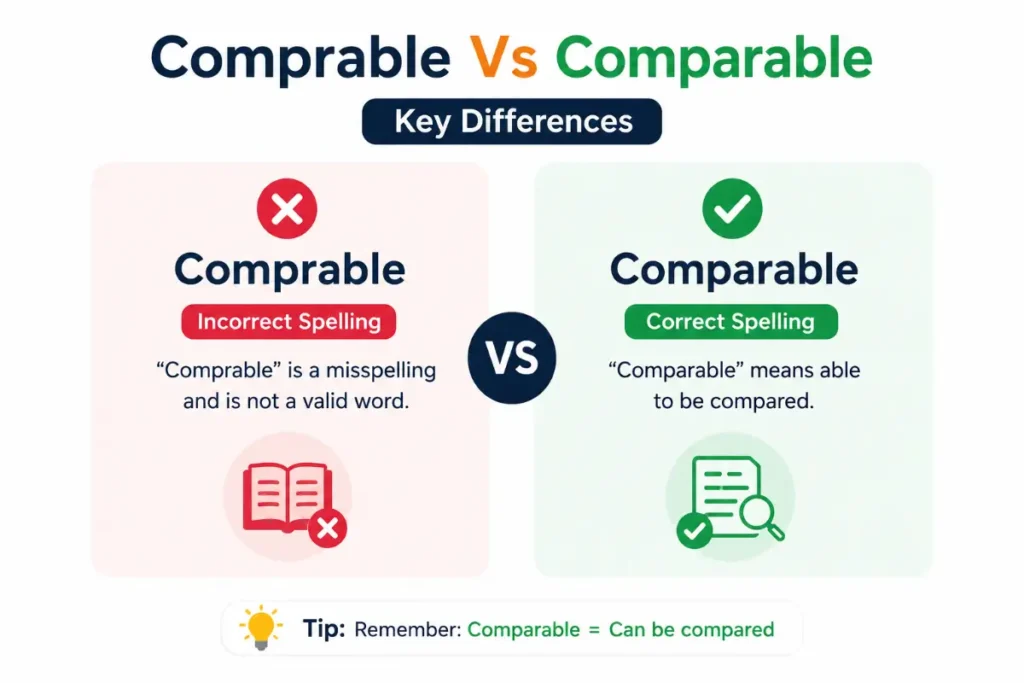
At first glance, these spellings appear almost identical, but they have one important difference. Comparable is a legitimate English word with a clear definition and a long history of use. Comprable is simply a spelling mistake.
Here are the main differences.
- Comparable appears in dictionaries and grammar references.
- Comprable is not accepted in standard English.
- Businesses, universities, publishers, and professional writers use comparable.
- Spell checking software usually flags comprable as an error.
- Search engines often suggest comparable when someone searches for the incorrect spelling.
If your goal is clear and professional writing, there is only one correct choice.
Which One Is Correct
The correct spelling is comparable. Every major English dictionary recognizes this form because it follows the established spelling of the adjective derived from the verb compare.
The incorrect spelling usually appears because people write the word the way they think it sounds. Since the middle syllables blend together during normal speech, the second a is easy to miss while typing.
Whenever you are writing emails, reports, blog posts, academic papers, or professional documents, always choose comparable.
The only time you should write comprable is when you are discussing the spelling mistake itself or quoting original text exactly as it appeared.
Pronunciation Guide
Correct pronunciation helps reinforce correct spelling.
IPA Pronunciation
Comparable
American English:
/ˈkɑːm.pɚ.ə.bəl/
British English:
/ˈkɒm.pər.ə.bəl/
Syllable Breakdown
The word has four syllables.
Com par a ble
Notice that the second a is still present in the spelling even though it receives very little stress during pronunciation.
Comparable Pronunciation UK
In British English, the first syllable has a slightly different vowel sound than in American English, but the overall pronunciation remains very similar.
Native speakers in both regions pronounce the word smoothly, which explains why some learners accidentally leave out one of the vowels while writing.
Common Pronunciation Mistakes
Most pronunciation mistakes come from rushing through the middle syllables.
Common errors include:
- Dropping the second vowel while spelling.
- Stressing the wrong syllable.
- Pronouncing the ending too strongly.
- Assuming the spelling should match the shortened spoken sound.
Reading the word slowly while writing helps prevent these mistakes.
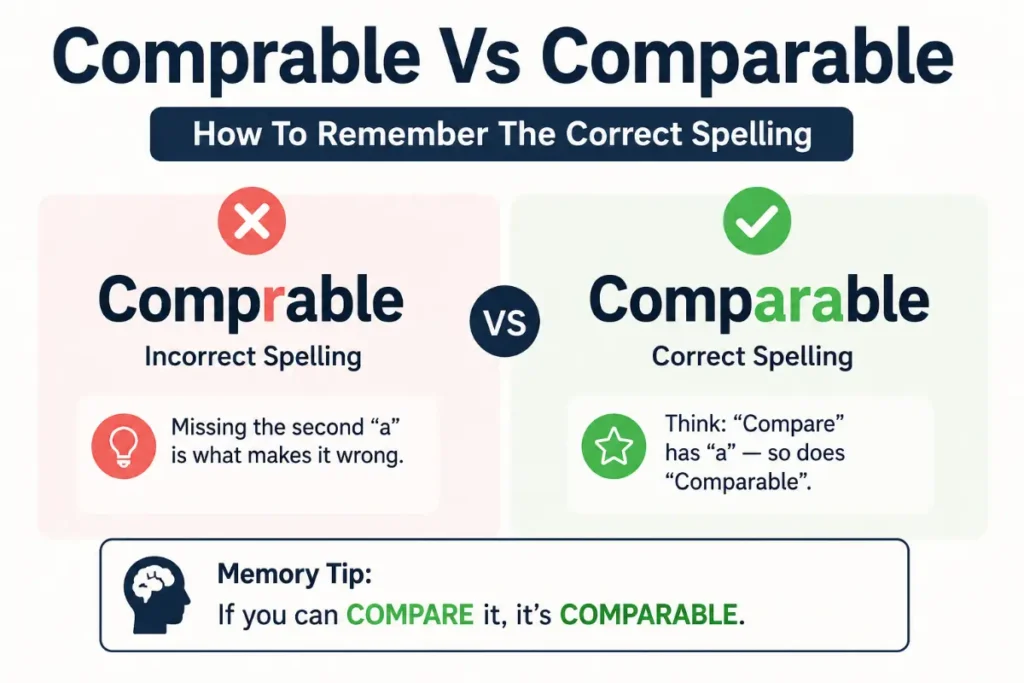
How To Remember The Correct Spelling
Spelling becomes much easier once you connect the word to its root. The adjective comes directly from the verb compare. If you can spell compare, you already know the foundation of comparable.
Here are a few simple memory tips.
- Think of compare first, then add able.
- Remember that every letter in compare stays in the longer word.
- Read the word one syllable at a time instead of typing it quickly.
- Let spell check confirm the spelling if you are unsure.
Many writers make this mistake only because they type too fast. Slowing down for a second is often enough to catch the missing letter before sending an email or publishing an article.
Examples In Sentences
Reading natural examples is one of the fastest ways to remember the correct spelling. The first set of examples shows how comparable appears in everyday English. The second set explains how the misspelled form is typically encountered.
Examples Using Comparable
These examples demonstrate the correct spelling in different contexts.
- The two smartphones are comparable in price and performance.
- Our latest sales figures are comparable to last year’s results.
- Both universities offer comparable academic programs.
- The quality of these materials is comparable to premium brands.
- The researchers compared two groups with comparable backgrounds.
- This apartment is comparable in size to the one we viewed yesterday.
- Their customer service is comparable to the industry’s best companies.
- The new policy produced results comparable to earlier studies.
- These job offers provide comparable salaries and benefits.
- Although the designs are different, their overall value is comparable.
Notice that the word always describes things that share enough similarities to make a fair comparison. It does not suggest they are exactly the same.
Examples Using Comprable
Since comprable is not a standard English word, the examples below show how it commonly appears as an error.
- The report mistakenly described the products as comprable instead of comparable.
- A spell checker highlighted comprable as a spelling mistake.
- The student corrected comprable before submitting the assignment.
- The editor replaced every instance of comprable with the correct spelling.
- Someone searching for how to spell comprable usually wants the correct form.
- The email contained a simple typing mistake that read comprable.
- Many search engines suggest comparable when users enter comprable.
- The proofreading software detected comprable immediately.
- The writer accidentally omitted the second letter a, creating the misspelling comprable.
- The document looked much more professional after the spelling was corrected.
These examples highlight an important point. The incorrect spelling only appears when discussing the mistake itself or correcting someone else’s writing.
Comprable vs Comparable Common Mistakes
Even experienced writers occasionally misspell longer words. Understanding why this happens makes the error much easier to avoid.
Leaving Out The Second Letter A
This is by far the most common mistake. Because the middle syllables blend together in normal speech, many people type the word as they hear it instead of following the correct spelling. A quick proofreading check usually catches the missing vowel.
Assuming Shorter Means Correct
Some writers believe dropping a letter creates an accepted alternative spelling. English does not work that way. Unlike words with regional spelling differences, this word has only one standard form.
Trusting Informal Online Writing
You may occasionally see the incorrect spelling in social media posts, comments, or discussion forums. That does not make it correct. Professional publishers, universities, businesses, and newspapers consistently use comparable.
Confusing Pronunciation With Spelling
Native speakers often pronounce the middle of the word very quickly. As a result, learners sometimes assume the spelling should also lose a vowel. English spelling does not always match spoken pronunciation exactly, so relying only on sound can lead to mistakes.
Ignoring Spell Check Suggestions
Modern writing tools usually recognize this error immediately. If your editor or browser suggests comparable, it is almost always providing the correct correction.
If you enjoy learning about confusing word forms, another commonly confused spelling pair explores why stich is incorrect and stitch is the proper spelling in standard English.
Etymology And Word Origin
The word comparable comes from the verb compare, which traces its history back through Middle English and Old French to the Latin verb comparare. The original Latin word meant to pair together, examine side by side, or evaluate similarities between things.
As English evolved, writers added the suffix able to create an adjective describing things that can be fairly compared. Over time, the word became common in law, business, economics, education, science, literature, and everyday conversation.
The misspelled version has no separate historical origin. It simply developed through typing errors and incorrect spelling rather than through language evolution.
Regional Usage
Unlike some English words that change spelling across countries, this one remains consistent throughout the English speaking world.
American English
American writers use comparable in business reports, academic papers, legal documents, journalism, and everyday communication. The incorrect spelling is treated as an ordinary typo.
British English
British English follows the same spelling. Style guides, dictionaries, and educational institutions all recognize comparable as the standard form.
Australian English
Australian English also uses comparable without variation. Professional editors correct the misspelled version in the same way they would correct any other spelling error.
Canadian English
Canadian English shares the same spelling. Although Canada combines some American and British spelling conventions, this word does not change between regions. No matter where your audience lives, the accepted spelling stays the same.
Grammar Rules
Understanding how the word functions in sentences helps you use it naturally.
Part Of Speech
Comparable is an adjective. It describes nouns by showing that they share meaningful similarities. Examples include:
- Comparable prices.
- Comparable quality.
- Comparable experience.
- Comparable products.
- Comparable performance.
Sentence Structure
The adjective usually appears before a noun or after a linking verb. Examples include:
- These results are comparable.
- The two plans offer comparable benefits.
- Their qualifications are comparable.
Both sentence patterns are common in spoken and written English.
Common Word Combinations
Native speakers frequently pair the word with certain nouns.
Examples include:
- Comparable value.
- Comparable cost.
- Comparable salary.
- Comparable evidence.
- Comparable standards.
- Comparable performance.
- Comparable data.
- Comparable quality.
- Comparable experience.
- Comparable results.
Learning these natural combinations helps your writing sound more fluent.
Comparable Definition
In simple terms, comparable means similar enough in quality, size, value, or characteristics to be fairly compared with something else.
The word does not imply complete equality. Instead, it indicates that the similarities are strong enough to support a meaningful comparison.
Real Life Usage Examples
This adjective appears in many professional and everyday situations because people constantly compare products, services, prices, and performance.
Daily Conversation
People often use the word while discussing purchases, travel, education, or personal experiences. Examples include:
- These two restaurants offer comparable service.
- The newer model has features comparable to the premium version.
- Both neighborhoods have comparable housing costs.
Academic Writing
Researchers frequently compare data sets, experiments, and study groups. Using comparable tells readers that the items being evaluated share similar characteristics, making the comparison reliable.
Professional Communication
Businesses rely on the word when discussing:
- Market research.
- Employee salaries.
- Financial performance.
- Product quality.
- Customer satisfaction.
- Industry benchmarks.
Because accuracy matters, the correct spelling is expected in reports, proposals, contracts, and presentations.
Literature And Media
Journalists, authors, and reviewers often describe books, films, products, or public figures as comparable when discussing similarities. This helps readers understand how one subject relates to another without suggesting they are identical.
Related Words And Confused Terms
Learning a few related words makes it easier to understand how comparable fits into everyday English. Some of these words are close in meaning, while others are commonly confused because they share a similar spelling or come from the same word family.
Comparable Synonyms
Depending on the context, you can often replace comparable with one of these words.
- Similar.
- Alike.
- Equivalent.
- Parallel.
- Corresponding.
- Resembling.
- Matching.
- Consistent.
- Analogous.
- Relative.
Each synonym has a slightly different meaning. For example, equivalent often suggests equal value, while similar simply points to shared characteristics. Choose the word that best matches your intended meaning.
Related Words
The following words belong to the same family and appear frequently in English.
- Compare.
- Comparison.
- Comparability.
- Comparably.
- Comparative.
- Comparatively.
Learning these forms helps expand your vocabulary and improves your writing.
Words People Often Confuse
These words sometimes appear in spelling searches because they look or sound similar.
- Comparable.
- Comparative.
- Comparison.
- Compare.
- Compatible.
- Compilable.
Although some share similar letters, they have different meanings and should not be used interchangeably.
Mastering comparable versus comprable is similar to avoiding the “dought” spelling mistake, where knowing the correct spelling prevents frequent writing errors.
Expert Language Insight
Experienced editors rarely hesitate when they see this spelling because standard English allows only one correct form.
The mistake usually happens during fast typing rather than because people misunderstand the meaning. Since the word is pronounced smoothly, the second a can easily disappear if you rely only on sound instead of checking the spelling.
Professional writers have a simple habit that prevents this error. They mentally connect comparable to its root word compare before they type. Once you remember that the adjective grows directly from compare, the correct spelling becomes much easier to recall.
Another useful editing technique is to read your writing slowly before publishing or sending it. Looking at each word instead of skimming the sentence often reveals small mistakes that your brain automatically overlooks.
Native speakers naturally expect the standard spelling in emails, reports, books, websites, academic papers, and business communication. Using the correct form helps your writing appear polished, accurate, and trustworthy.
Frequently Asked Questions
Is comprable a real word?
No. Comprable is not a recognized English word. It is a spelling mistake that usually happens when someone accidentally leaves out the second a in comparable.
Which spelling is correct?
The correct spelling is comparable. This is the form accepted by dictionaries, grammar guides, educational institutions, publishers, and professional editors.
Why do people misspell comparable?
The word contains several syllables, and the middle vowel receives very little stress during pronunciation. As a result, many people type the word the way they hear it and accidentally omit one of the letters.
What does comparable mean?
Comparable describes two or more things that are similar enough to be compared fairly. It does not mean they are exactly the same, only that they share meaningful similarities.
How do you pronounce comparable?
In American English, it is commonly pronounced /ˈkɑːm.pɚ.ə.bəl/. In British English, the pronunciation is usually /ˈkɒm.pər.ə.bəl/. Both versions contain four syllables.
Is the spelling different in the United States and the United Kingdom?
No. American English and British English both use comparable. Unlike some words that have regional spelling differences, this adjective keeps the same spelling across major English varieties.
What is the easiest way to remember the spelling?
Think of the root word compare and then add able. Since every letter in compare remains part of the longer word, this memory trick helps prevent the common typing mistake.
Can I use comprable in professional writing?
No. Always use comparable in reports, emails, research papers, business documents, blog posts, and academic writing. The incorrect spelling can distract readers and reduce your credibility.
Conclusion
The answer is simple. Comparable is the correct spelling, while comprable is a common misspelling caused by leaving out one letter.
Although the mistake appears in online searches and occasional drafts, it is not recognized by dictionaries or professional style guides. Using the standard spelling helps your writing look more polished and ensures readers focus on your message instead of a spelling error.
A helpful way to remember the correct form is to connect it with the verb compare. Once you recognize the shared root, the spelling becomes much easier to remember.
If you are writing for school, work, publication, or everyday communication, choose comparable every time. It is the accepted form across American, British, Australian, and Canadian English, making it the safest and most professional choice for any audience.