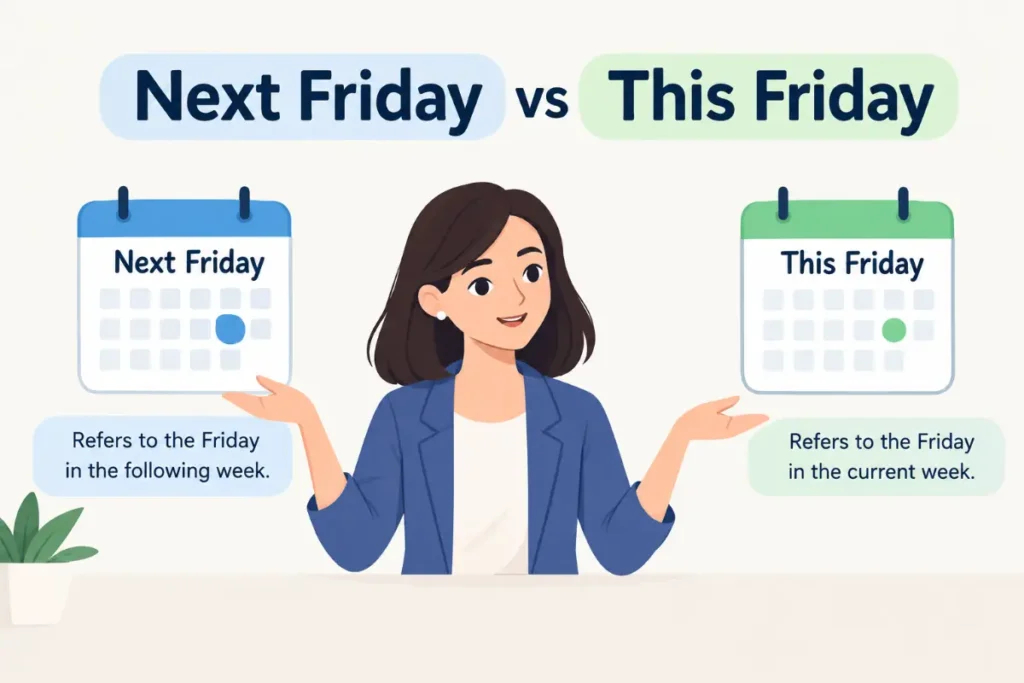
The difference between next Friday vs this Friday can be confusing because people do not always use these expressions the same way. In American English, this Friday usually refers to the Friday in the current week, while next Friday often refers to the Friday in the following week. However, the exact meaning can depend on the current day, the speaker’s habits, and the surrounding conversation.
For example, imagine someone says on Monday, “Let’s meet this Friday.” Most people will understand that the meeting is scheduled for the upcoming Friday. If the same person says, “Let’s meet next Friday,” many listeners will think they mean the Friday one week later. Still, some speakers use next Friday for the nearest upcoming Friday, which can create confusion.
The safest approach is to consider the calendar and make the date explicit when a misunderstanding would matter. This is especially useful when scheduling work meetings, making appointments, planning trips, or arranging social events. Understanding how these expressions work will help you interpret everyday conversations and communicate dates more clearly.
Quick Answer
This Friday usually means the Friday in the current calendar week. Next Friday often means the Friday in the following week, but some people use it for the upcoming Friday. Since the expressions can overlap, the clearest option for appointments and deadlines is to state the exact date.
Just as “next Friday” and “this Friday” can be interpreted differently depending on context, British and American English differences can also affect which word or expression sounds most natural.
What Does This Friday Mean?
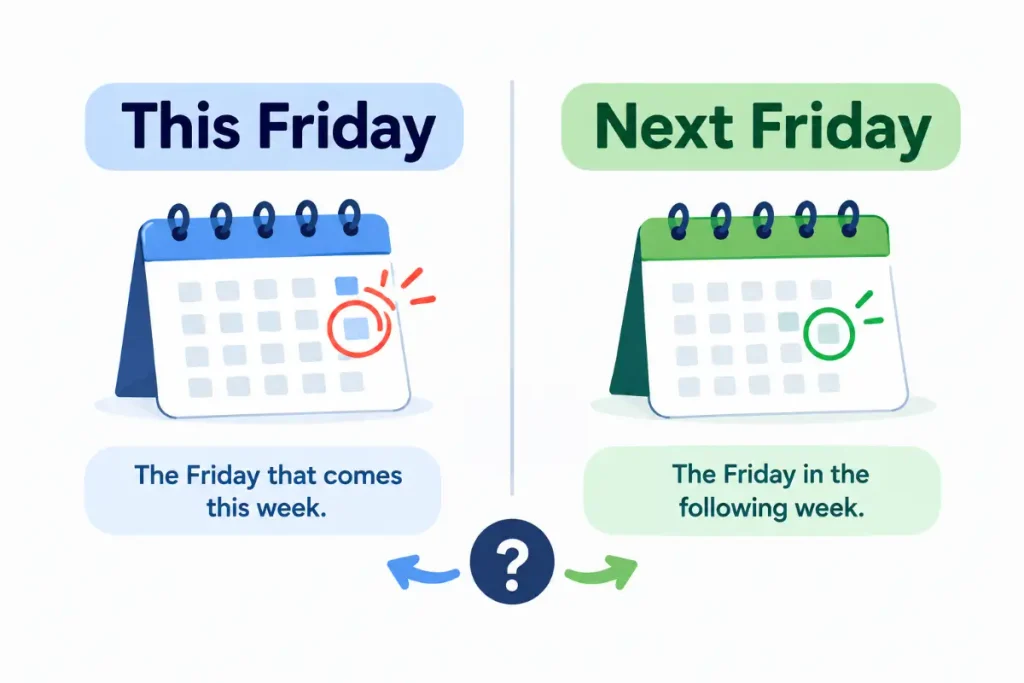
This Friday usually refers to the Friday associated with the current week. When someone uses the phrase earlier in the week, they generally mean the Friday that is coming up in the next few days.
For example, if today is Monday, October 12, and someone says, “The interview is this Friday,” they would normally mean Friday, October 16. The word this connects the event to the current week rather than suggesting that it belongs to a later week.
This expression is common in everyday American English. People use it when discussing school events, work deadlines, family gatherings, appointments, and weekend plans. It sounds natural in both casual conversation and professional communication.
Examples of This Friday
Consider these examples to see how the phrase works in different situations.
1. Workplace: “Our team meeting is this Friday at 10 a.m.” The speaker usually means the Friday coming up in the current week.
2. School: “The science project is due this Friday.” The student should normally plan to submit the project on the upcoming Friday.
3. Social plans: “Are you free this Friday for dinner?” The speaker is asking about availability for the nearest Friday in the current week.
4. Medical appointment: “Your follow up appointment is this Friday.” The patient would generally expect the appointment to happen that week.
5. Travel: “We are flying to Chicago this Friday.” The trip is expected to begin on the upcoming Friday.
6. Text message: “Movie night is this Friday. Can you make it?” The message usually refers to the Friday that is approaching soon.
The shared idea is that the speaker treats Friday as part of the current week’s plans. However, if the conversation happens very late in the week, the intended date may need clarification.
What Does Next Friday Mean?
Next Friday commonly refers to the Friday in the week after the current week. It often points to a date farther away than the Friday someone would describe as this Friday.
Suppose today is Monday, October 12, 2026. In a conversation where the speaker distinguishes the current week from the following week, next Friday would mean October 23, while this Friday would mean October 16. This interpretation is common, but it is not universal.
Some people use next Friday to mean the nearest Friday that has not yet arrived. Under that interpretation, a person speaking on Monday could use next Friday and this Friday to refer to October 16. That difference in personal usage is the main reason the phrase can cause scheduling problems.
Examples of Next Friday
The following examples show how people commonly use the expression.
1. Workplace: “We will review the proposal next Friday.” The speaker may mean the Friday in the following calendar week.
2. School: “The final presentation is next Friday.” The class may understand this as the Friday after the current week.
3. Social plans: “Let’s go to the concert next Friday.” The listener may assume the concert is scheduled for the following week.
4. Appointment: “The dentist can see you next Friday.” It is sensible to confirm the date before accepting the appointment.
5. Travel: “We are leaving next Friday, not this Friday.” The contrast makes it clear that the speaker means the later date.
6. Text message: “I cannot make it this Friday, but next Friday works.” This wording usually contrasts two different Fridays.
The last example is particularly clear because the speaker explicitly distinguishes the two dates. When people use both expressions together, the intended difference is often easier to understand.
Next Friday vs This Friday: Key Differences
Both expressions refer to Fridays, but they use different reference points. This Friday usually connects the date to the current week, while next Friday often points to the following week. The challenge is that speakers do not always follow the same interpretation of next Friday.
| Feature | This Friday | Next Friday |
|---|---|---|
| Typical meaning | Friday in the current week | Friday in the following week |
| Time reference | Current week | Often the next calendar week |
| Common use | Near term plans | Plans for a later Friday |
| Everyday tone | Casual and neutral | Casual and neutral |
| Main source of confusion | Unclear reference to the current week | Can mean the upcoming Friday to some speakers |
| Best use in scheduling | When the current week is clear | When the intended week is clear |
| Clearest alternative | Friday, October 16 | Friday, October 23 |
The table describes common usage rather than a strict rule that everyone follows. The meaning depends partly on when the conversation happens and how the speaker organizes the week mentally.
For instance, someone speaking on Thursday might call the following day this Friday. Another person might say next Friday because it is the next Friday on the calendar. Both speakers may believe their wording is clear, even though they are referring to different dates or using different conventions.
When Is This Friday?
The meaning of this Friday depends on the current date and the speaker’s reference to the current week. In ordinary American conversation, it usually means the Friday coming up within the current week.
Here is a practical example using Monday, October 12, 2026, as the starting date.
| Current day | Date | Usual meaning of this Friday |
|---|---|---|
| Monday | October 12 | October 16 |
| Tuesday | October 13 | October 16 |
| Wednesday | October 14 | October 16 |
| Thursday | October 15 | October 16 |
| Friday | October 16 | October 16 or a date needing clarification, depending on context |
| Saturday | October 17 | Often October 23 |
| Sunday | October 18 | Often October 23 |
The weekend examples deserve special attention. When Saturday or Sunday arrives, the current calendar week may be considered almost over or already complete, depending on the speaker’s convention. In that situation, this Friday can refer to the Friday that just passed or the Friday in the coming week.
That is why the phrase becomes less reliable around the weekend. If the date matters, ask the speaker to confirm the day and date rather than guessing from the expression alone.
When writing about upcoming events, clear wording matters just as much as avoiding common apostrophe and plural mistakes that can change the meaning of a sentence.
When Is Next Friday?
Next Friday often means the Friday in the following calendar week. However, some speakers use it to mean the next Friday that will occur, even if that date falls later in the current week.
Using Monday, October 12, 2026, as the starting point, the two common interpretations are:
| Interpretation | Meaning of next Friday |
|---|---|
| Following week interpretation | October 23, 2026 |
| Nearest upcoming Friday interpretation | October 16, 2026 |
Neither interpretation is guaranteed in every conversation. The surrounding words may provide clues, but they do not always settle the question.
If someone says, “We are meeting this Friday, and then again next Friday,” the two dates are likely different. If someone simply says, “See you next Friday,” the intended date may be less clear, particularly when the statement occurs early in the week.
For important arrangements, avoid relying on the phrase alone. A quick question such as “Do you mean October 16 or October 23?” can prevent a missed meeting or an unnecessary trip.
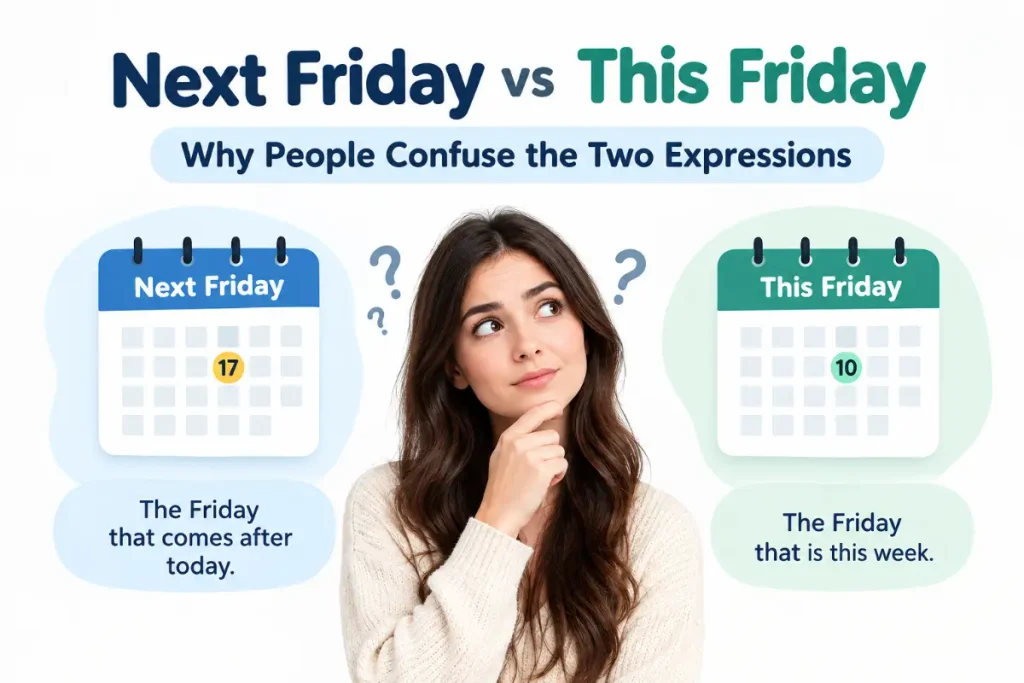
Why People Confuse the Two Expressions
The confusion comes from the flexible meaning of next. In some contexts, next means the item immediately following the current one. In other contexts, it means the item after the current period or sequence.
For example, if you are standing in a line, the next person is usually the person immediately after you. However, when people talk about next week, they generally mean the week after the current week. Applying those two ideas to next Friday can lead to different interpretations.
The word this creates its own challenge because it connects a date to a reference period. A person may think of the current week as Monday through Sunday, while another may mentally organize their week around workdays. As a result, a Friday near the weekend can be interpreted differently.
There is no need to assume that everyone who uses these phrases differently is making a grammatical mistake. The problem is often ambiguity rather than incorrect English. The best solution is to provide enough information for the other person to identify the intended date.
Is Next Friday Grammatically Correct?
Yes. Next Friday is grammatically correct American English. This Friday is also correct. The issue is not grammar, spelling, or punctuation. It is the possibility that different listeners may interpret the date differently.
Both expressions function as time expressions. They can appear at the beginning or end of a sentence, and they can also follow verbs that describe plans, events, or appointments.
For example, “We will submit the report next Friday” is correct. So is “We will submit the report this Friday.” The sentences are grammatically sound, but the intended dates may differ.
If you need precision, use a complete date. “We will submit the report on Friday, October 23” gives the reader a specific target without requiring them to interpret the speaker’s use of next.
This Friday vs These Friday
The correct expression is this Friday, not these Friday, when you mean one particular Friday. The word this is singular, and Friday is singular in this expression.
Use this Friday when you are referring to one specific date. For example, “The workshop is this Friday” refers to a single event scheduled for a particular Friday.
Use these Fridays only when you are referring to multiple Fridays, and usually when the sentence includes a plural or repeated meaning. For example, “These Fridays are reserved for staff training” refers to more than one Friday.
You can also say every Friday, on Fridays, or the next few Fridays when you want to describe a recurring event. The correct choice depends on the number of dates you mean and the sentence you are building.
How to Use These Expressions in Professional Communication
In professional communication, clarity matters more than choosing one expression over the other. A vague date can create confusion in meeting invitations, client emails, project deadlines, and appointment reminders.
If you are sending a work email, include the exact date whenever possible. Instead of writing, “We will review the contract next Friday,” write, “We will review the contract on Friday, October 23, 2026.” The second version makes the planned date explicit.
The same principle applies to calendar invitations and scheduling software. A calendar entry with a specific date and time gives everyone a shared reference point, even if they use next Friday differently in conversation.
When someone sends you an ambiguous message, do not hesitate to ask for clarification. A short question can save everyone time and prevent mistakes. For example, “Just confirming, do you mean Friday, October 16, or Friday, October 23?” is clear, polite, and professional.
How to Make Your Meaning Clear in Text Messages
Text messages often lack the context that helps people interpret spoken conversation. You cannot always hear the speaker’s tone or ask an immediate follow up question, so a vague date can easily be misunderstood.
Instead of texting, “Are we meeting next Friday?” you could write, “Are we meeting Friday, October 23?” This gives the other person a clear date to confirm.
If you are arranging a casual event, you can still sound natural without being vague. For example, “Dinner this Friday, October 16, at 7 p.m.?” is friendly and specific. The exact date is particularly useful when you are coordinating with people who have busy schedules.
If you are unsure what someone means by next Friday, ask directly. “Do you mean the upcoming Friday or the Friday after that?” is a simple way to resolve the confusion without making the conversation awkward.
Common Mistakes to Avoid
The most common mistake is assuming that everyone uses next Friday to mean the Friday in the following week. Many people do, but others use it for the nearest upcoming Friday. The expression is common and natural, yet it does not always provide enough information for precise scheduling.
Another mistake is assuming that this Friday always means a future date. If someone uses the expression on Friday itself, they may mean that day, while another person might use it to refer to the following Friday. Context can help, but a specific date removes the uncertainty.
A third mistake is treating the expressions as grammatically incorrect. Both are acceptable English. Their weakness is ambiguity in certain situations, not a grammatical problem.
Finally, avoid using these expressions alone when a missed date could cause a serious problem. Medical appointments, travel arrangements, work deadlines, and legal or financial commitments should always use an explicit date. Clear wording is more useful than relying on an assumption that the other person shares your interpretation.
Practical Examples of Both Expressions
The following examples show how context affects interpretation and how you can make each sentence more precise.
Examples With This Friday
1. “Our team meeting is this Friday at 9 a.m.” This usually means the Friday in the current week.
2. “The school concert is this Friday.” The speaker generally means the upcoming Friday.
3. “Can you send me the revised document this Friday?” The request usually sets a deadline for the current week.
4. “We are visiting my parents this Friday evening.” The plan is for the upcoming Friday evening.
5. “Your appointment is this Friday, October 16.” Adding the date removes uncertainty.
6. “The store is offering a discount this Friday only.” The expression identifies a specific Friday, although the exact date may be worth adding in an advertisement.
7. “Let’s talk this Friday after lunch.” The phrase usually points to the current week’s Friday.
8. “The application deadline is this Friday, so please submit everything by noon.” The date is close, and the message communicates urgency.
9. “I will call you this Friday to discuss the results.” The speaker is planning a call for the upcoming Friday.
10. “Are you available this Friday or would Saturday be better?” The question usually concerns the Friday in the current week.
Examples With Next Friday
1. “The next planning meeting is next Friday.” The speaker may mean the Friday in the following week.
2. “Can we move the appointment to next Friday?” The exact date should be confirmed if the schedule is unclear.
3. “Our new employee starts next Friday.” The statement often refers to the Friday after the current week.
4. “I will send the proposal next Friday.” This usually suggests a later deadline, but adding the date makes the plan precise.
5. “We are flying out next Friday, October 23.” The explicit date removes any uncertainty.
6. “The next training session takes place next Friday.” The phrase indicates a future session, though the date depends on context.
7. “Let’s meet next Friday instead of this Friday.” The contrast strongly suggests two separate Fridays.
8. “My car will be ready next Friday.” The speaker expects the car to be ready on a future Friday.
9. “The application window closes next Friday.” The deadline should be written with a calendar date in formal communication.
10. “I cannot attend this Friday, but I can join next Friday.” The sentence usually distinguishes the upcoming Friday from the one in the following week.
Whether you’re asking about one upcoming Friday or several possible dates, choosing the correct singular or plural form helps make your questions more precise and natural.
Frequently Asked Questions
Does next Friday mean this week or next week?
Next Friday often means the Friday in the following week, but some people use it to mean the nearest upcoming Friday. The intended meaning depends on the speaker and the conversation. If the date matters, ask for the calendar date instead of assuming that everyone follows the same convention.
Is this Friday the upcoming Friday?
Usually, yes. In American English, this Friday generally refers to the Friday in the current week, especially when someone speaks on Monday, Tuesday, Wednesday, or Thursday. Around the weekend, the reference can become less clear, so including the date is the safest option.
What is the difference between Friday and next Friday?
Friday can refer to a Friday identified by context, while next Friday usually identifies a future Friday. However, next Friday can mean either the nearest upcoming Friday or the Friday in the following week. When arranging an appointment, writing the full date avoids this ambiguity.
Is next Friday grammatically correct?
Yes. Next Friday is grammatically correct and widely used in American English. The phrase is not a spelling or grammar error, but its meaning can be ambiguous. For formal emails, work schedules, travel plans, and deadlines, use the exact date to ensure everyone understands the intended time.
Should I say this Friday or next Friday in an email?
Use the expression that best matches your intended date, but include the date in professional communication. For example, write “this Friday, October 16” or “next Friday, October 23.” This approach keeps your email natural while making the schedule clear to every recipient.
Is it correct to say these Friday?
No. When referring to one particular Friday, use this Friday. These is plural and normally needs a plural noun or a plural reference, as in “these Fridays are busy.” If you mean several upcoming Fridays, you can also say the next few Fridays or every Friday.
How can I avoid confusion when scheduling something?
State the weekday, full date, and time when necessary. Instead of saying, “Let’s meet next Friday,” write, “Let’s meet Friday, October 23, at 2 p.m.” This gives everyone a shared reference point and reduces the risk of missed appointments, incorrect calendar entries, and scheduling mistakes.
Why do people disagree about what next Friday means?
People may organize time differently in conversation. Some interpret next as the nearest upcoming occurrence, while others use it to mean the occurrence in the following week. Both interpretations are common enough to create confusion. Using a specific calendar date is the most reliable way to communicate your intention.
Conclusion
The difference between next Friday and this Friday depends on how the speaker refers to the current week. This Friday usually means the Friday in the current week, while next Friday often means the Friday in the following week. However, people sometimes use next Friday for the nearest upcoming Friday, so the expressions are not always unambiguous.
For casual conversation, context may be enough to make the intended date clear. For work meetings, school deadlines, appointments, travel, or other important plans, write the exact date instead. A phrase such as “Friday, October 23, 2026” leaves little room for confusion. When someone uses next Friday and you are unsure what they mean, ask for clarification rather than guessing.