
Passed and past sound alike in many varieties of American English, but they do different jobs in a sentence. That is why phrases such as I walked past the store, I passed the store, three years passed, and in the past can become confusing. The difference is mainly grammatical: passed is a form of the verb pass, while past can work as a noun, adjective, adverb, or preposition.
The easiest way to choose the right word is to look at what the sentence needs. If you are describing an action performed by someone or something, passed may be the correct verb. If you are talking about an earlier time, a position beyond something, or something that happened before now, past is usually the right choice. This distinction also explains why walked past is correct, while walked passed is not. The sections below explain the difference with practical examples involving time, movement, school, work, everyday conversation, and common expressions.
Quick Answer
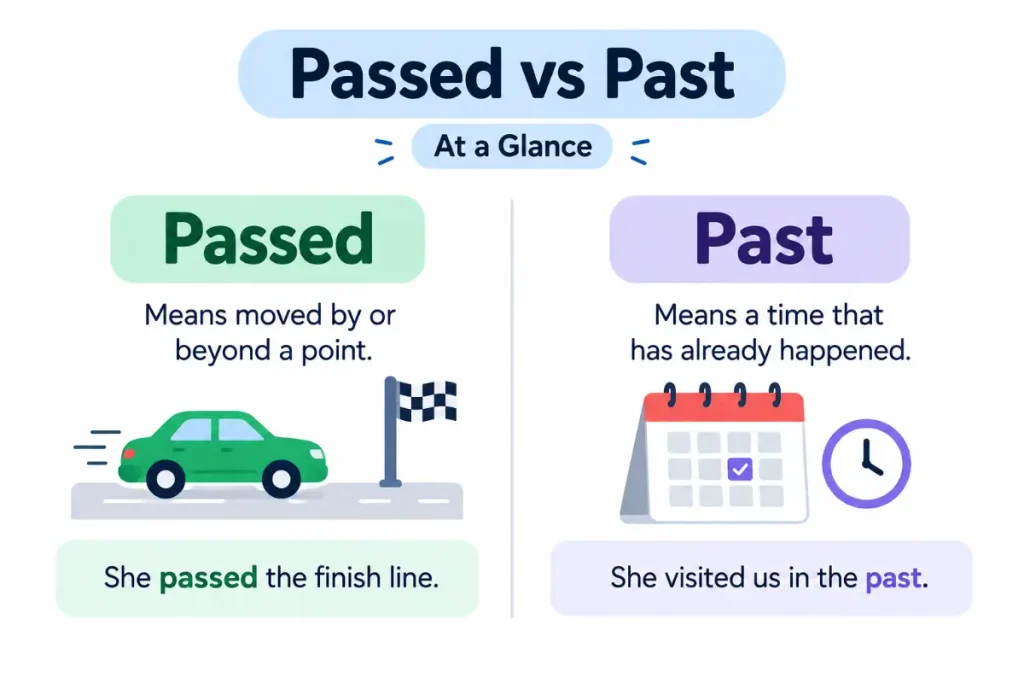
Passed is the past tense and past participle of the verb pass. Use it for actions such as moving beyond something, succeeding in an exam, handing something over, or allowing time to go by. Past refers to an earlier time or a position beyond something and can function as a noun, adjective, adverb, or preposition.
If you’re unsure whether someone is giving praise or describing how two things work well together, understanding compliment and complement explained can help you choose the right word.
Passed vs Past At a Glance
The most useful distinction is not pronunciation. It is grammatical function. Passed is a verb form. Past performs several other grammatical jobs.
| Feature | Passed | Past |
|---|---|---|
| Main grammatical role | Verb | Noun, adjective, adverb, or preposition |
| Basic idea | An action involving passing | Earlier time or a position beyond something |
| Example | She passed the exam. | She walked past the school. |
| Time example | Two hours passed. | We met in the past. |
| Movement example | The car passed us. | The car drove past us. |
| Exam example | He passed the test. | Not correct for this meaning |
| Location example | Not normally used as a location word | The store is past the bank. |
This table also shows why two sentences can describe almost the same event while using different words. The car passed the house uses passed as the main verb. The car drove past the house uses drove as the main verb and past to describe the car’s position in relation to the house. Both are grammatically sound, but the words have different functions.
What Does Passed Mean
Passed is the simple past and past participle of the verb pass. The verb has several meanings, so passed can appear in many kinds of sentences. It can describe movement, success in a test, transferring something, time going by, approval of a proposal, or an event coming to an end.
Consider these common uses:
- Movement: The runner passed the other competitor.
- Success: Maria passed her driving test.
- Transfer: He passed the salt to his sister.
- Time: Three hours passed quickly.
- Approval: Congress passed the bill.
- Change or disappearance: The storm passed during the night.
In every example, passed belongs to the verb pass. That is the central rule to remember. You can change the sentence into another tense by changing the verb form.
For example:
- Present: She passes the library every morning.
- Past: She passed the library yesterday.
- Present perfect: She has passed the library already.
The word changes because pass is functioning as a verb.
What Does Past Mean
Past has a much wider grammatical range. It can be a noun, adjective, preposition, or adverb. Its meanings usually involve time before now, something that happened earlier, or a position beyond a particular point.
As a noun, past means the time before the present.
We cannot change the past.
As an adjective, past describes something that happened or existed before now.
She learned from past mistakes.
As a preposition, past can indicate a position beyond something.
The pharmacy is just past the bank.
As an adverb, past can describe movement beyond a point.
The bus drove past.
It can also be used when telling time.
It is half past eight.
These different functions explain why you cannot simply treat past as another spelling of passed. The words overlap in meaning in some situations, but they do not perform the same grammatical job.
When to Use Passed
Use passed when you need the past form of the verb pass. One of its most common meanings is moving beyond a person, object, or point.
The car passed us on the highway.
Here, passed tells us what the car did. The sentence has one main movement verb.
You also use passed when someone succeeds in a test, course, examination, or similar requirement.
- She passed her final exam.
- He passed the driving test on his second attempt.
- All three students passed the certification exam.
Another common use involves giving or transferring something.
- She passed the microphone to the next speaker.
- Please pass the bread.
Time can also pass, so the past form is passed.
- Several weeks passed before we heard from them.
- The afternoon passed quickly.
The word is also common when discussing laws, proposals, or formal decisions.
The state legislature passed the bill.
In each case, passed represents an action or event associated with the verb pass. Cambridge lists movement, time, giving, succeeding in an exam, and approval among the major uses of pass.
When to Use Past
Use past when you are referring to an earlier period of time.
- In the past, people relied more heavily on printed maps.
- Her past experiences influenced her decision.
- The past few months have been unusually busy.
Use past for a location beyond a particular point.
- The restaurant is just past the intersection.
- Walk past the library and turn left.
- The hotel is past the gas station.
Notice an important pattern in the last example. The verb is walk, not past. In the past tense, the sentence becomes Walked past the library and turned left. The word past remains unchanged because it is not the verb.
You also use past in expressions involving time.
- It is ten past six.
- The meeting started at a quarter past nine.
- It was already past midnight when we left.
In these sentences, past indicates a point after a particular hour or time.
Why Walked Past Is Correct
I walked past the store is correct.
I walked passed the store is incorrect when the intended meaning is that you moved by the store.
This mistake is common because walked already tells us that the action happened in the past. The word that follows does not need to become another past tense verb.
Compare these sentences:
- I walked past the store.
- I passed the store.
Both can describe a person going beyond the store, but the grammar is different.
In the first sentence, walked is the verb and past tells us where the person moved.
In the second sentence, passed is the verb and directly expresses the movement beyond the store.
A useful substitution test is to replace past with by or beyond.
- I walked by the store.
- I walked past the store.
Because by works naturally, past is the appropriate choice. The same pattern appears in sentences such as She ran past me, We drove past the stadium, and They walked past the entrance.
Passed vs Past With Movement
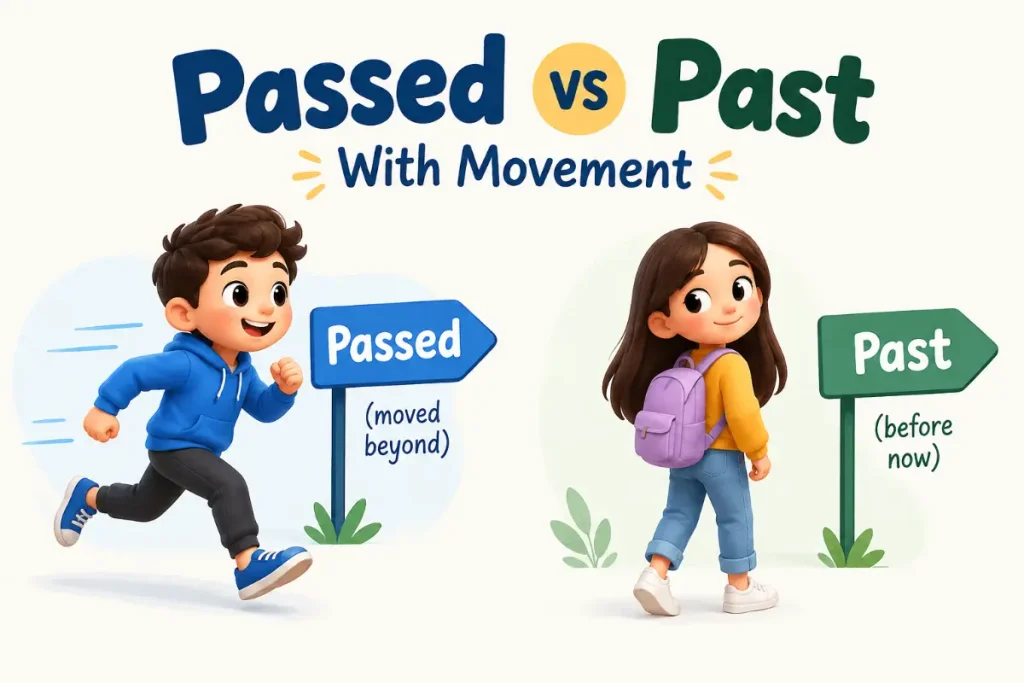
Movement is one of the areas where the distinction can feel especially confusing because both words can describe something going beyond another thing.
Compare:
- The car passed the house.
- The car drove past the house.
In the first sentence, passed is the verb. In the second sentence, drove is the verb and past indicates the car’s position relative to the house.
Here are more examples:
- The runner passed me near the finish line.
- The runner sprinted past me near the finish line.
- We passed the exit without noticing it.
- We drove past the exit without noticing it.
- She passed the school on her way home.
- She walked past the school on her way home.
The difference is not simply about whether something moved. It is about the grammatical structure used to describe that movement.
This distinction is particularly useful when editing your own writing. If another verb such as walked, ran, drove, rode, or jogged is already describing the movement, past will often be the word you need.
Passed vs Past With Time
Time creates another common source of confusion.
Use passed when time itself is performing the action of going by.
- Three hours passed before the meeting ended.
- A year passed without any major changes.
- The weeks passed quickly.
Use past when you are referring to time that has already happened or to a point after a particular time.
- We talked about the past.
- She has changed a lot over the past year.
- It is past midnight.
- In years past, the building was a library.
A simple comparison makes the difference clearer:
Two hours passed.
Here, passed is the verb.
It is two hours past noon.
Here, past indicates a time after noon.
The meanings are related, but the grammatical structures are different. Cambridge specifically lists pass as a verb for the movement of time and past as a word used for earlier periods and points beyond a particular time.
Passed Away or Past Away
The correct expression for the polite phrase meaning died is passed away.
- Her grandfather passed away last year.
- His father passed away peacefully.
- We were sorry to hear that she had passed away.
Past away is not the standard form for this meaning.
The reason is grammatical. Pass away is a verb phrase, so its past form is passed away. The word past cannot replace the verb form in this expression.
This distinction matters particularly in condolences, obituaries, announcements, and other sensitive writing. If you are writing a formal message about someone’s death, passed away is the conventional expression.
Passed vs Past in Everyday Examples
The easiest way to internalize the distinction is to see the words in different contexts.
Examples With Passed
- She passed the exam on her first attempt.
- The bus passed us before we reached the stop.
- Three months passed before he called again.
- Please pass the remote control.
- The proposal passed the committee’s review.
- The storm passed during the night.
- He passed the ball to his teammate.
- The runner passed two competitors in the final stretch.
- Several hours passed while we waited.
- She passed the driving test last Friday.
These examples all use passed as a form of the verb pass. The specific meaning changes, but the grammatical role stays connected to the verb.
Examples With Past
- We used to live there in the past.
- She has learned from past mistakes.
- Walk past the front desk and take the elevator.
- The bank is just past the traffic light.
- It is half past seven.
- The past year has been challenging.
- He ran past me without stopping.
- Those problems are now in the past.
- The museum preserves the city’s past.
- It was already past lunchtime when we arrived.
Here, past refers to time, position, or movement beyond a point rather than serving as the past tense of pass.
Like passed and past, another commonly confused pair is principal and principle, since the two words sound alike but have very different meanings.
Common Mistakes With Passed and Past
Because the two words sound similar, spelling mistakes are easy to make. The best correction is to identify the grammatical role of the word instead of relying on pronunciation.
Mistake With Movement
Incorrect: We drove passed the school.
Correct: We drove past the school.
Why: Drove is already the verb. Past tells us that the car moved beyond the school.
Mistake With Time
Incorrect: Three hours past before she arrived.
Correct: Three hours passed before she arrived.
Why: The sentence needs a verb describing time going by. The correct past tense of pass is passed.
Mistake With an Exam
Incorrect: She past the test.
Correct: She passed the test.
Why: Passing a test is an action expressed by the verb pass.
Mistake With an Earlier Period
Incorrect: We learned from the passed.
Correct: We learned from the past.
Why: The past is a noun meaning the time before the present.
Mistake With a Location
Incorrect: The store is passed the bridge.
Correct: The store is past the bridge.
Why: Past functions as a preposition showing the store’s position beyond the bridge.
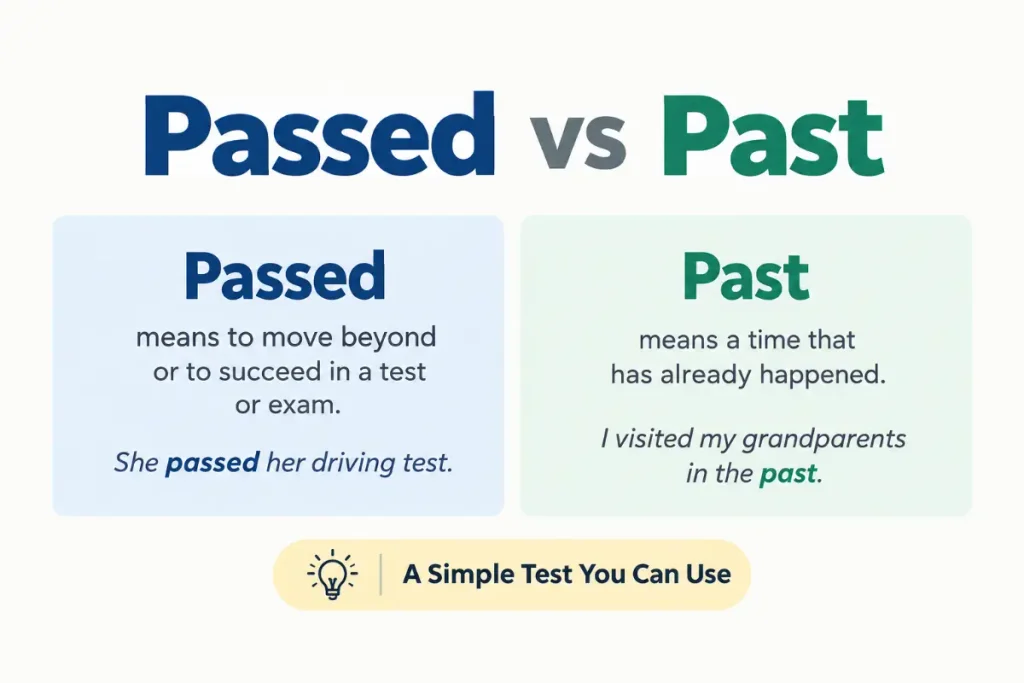
A Simple Test You Can Use
When you are unsure, ask what the word is doing in the sentence.
Question one: Is it the past form of the verb pass?
If yes, use passed.
- She passed the interview.
- The hours passed quickly.
- He passed the ball.
Question two: Are you talking about an earlier time?
If yes, use past.
- That happened in the past.
- I remember my past experiences.
Question three: Are you describing a position beyond something?
If yes, use past.
- The school is past the library.
- We walked past the house.
A second helpful test is substitution. If you can replace the word with by or beyond, past is often correct.
- We walked past the theater.
- We walked by the theater.
If the word needs to be replaced by another past tense verb such as moved, went, or succeeded, passed is more likely.
- She passed the exam.
- She succeeded on the exam.
This test is not a substitute for understanding grammar, but it is a practical editing trick for everyday writing.
Pronunciation of Passed and Past
In standard American English, passed and past are commonly pronounced alike or very similarly, which makes them homophones for many speakers.
The American pronunciation of past is commonly represented as /pæst/, while passed is represented as /pæst/. Cambridge gives the American pronunciation of past as /pæst/ and the American pronunciation of pass as /pæs/.
Because pronunciation does not reliably tell you which spelling to choose, spelling should follow the grammar and meaning.
That is why saying the sentence aloud will not necessarily solve the problem. You need to ask whether the word is the verb passed or the nonverb past.
Grammar Patterns to Remember
Several sentence patterns make the distinction especially easy to recognize.
Passed As the Main Verb
- Subject + passed + object
- The car passed the truck.
- She passed the exam.
- He passed the microphone.
- The bill passed the Senate.
Passed Without an Object
- Subject + passed
- The afternoon passed quickly.
- Several weeks passed.
- The storm passed.
Past Before a Noun
- past + noun
- past experience
- past mistakes
- past events
- past presidents
Past After a Movement Verb
- movement verb + past + object
- walked past the house
- drove past the school
- ran past the finish line
- rode past the park
Past With Time
- past + time reference
- past noon
- past midnight
- half past eight
- ten past five
Learning these patterns is more useful than memorizing isolated spelling rules because they show you why each word belongs in a particular sentence.
American English Usage
For American readers, the distinction between these words is grammatical rather than a major regional spelling difference. Passed is the past form of pass, while past has its own functions as a noun, adjective, preposition, and adverb.
British English uses the same fundamental distinction. You may notice some differences in pronunciation or preferred expressions across English varieties, but American writers should not treat passed and past as interchangeable regional spellings.
For standard US writing, use the word that fits the sentence’s grammar.
- She passed the exam.
- She walked past the school.
- The past year was difficult.
- Two years passed quickly.
These forms are appropriate in school assignments, workplace communication, professional writing, emails, and everyday communication.
Related Words People Confuse
The confusion becomes easier to manage when you separate related words by their grammatical role.
Pass is the base form of the verb.
I pass the store every morning.
Passed is the simple past and past participle of pass.
I passed the store yesterday.
Passing is the present participle or gerund form.
I am passing the store now.
Past is a separate word with several grammatical functions.
I walked past the store.
The same family can therefore appear in one sentence without the words being interchangeable.
I passed the store in the past.
Here, passed is the verb, while past refers to an earlier time.
Another useful contrast is:
- I passed the house.
- I walked past the house.
The first sentence makes passed the main verb. The second uses walked as the main verb and past to describe the route.
You can also avoid similar spelling mistakes by learning the difference between stationary and stationery, especially when writing about movement or office supplies.
Expert Usage Tips
The safest approach is to stop thinking of passed and past as competing spellings. They are different grammatical forms with overlapping ideas.
When editing, look at the word immediately before the confusing spot. If you already have a clear movement verb such as walked, drove, ran, or rode, ask if past is describing where that movement occurred.
Also remember that passed is not limited to physical movement. It can describe success, transfer, time, approval, and other meanings of pass. That is why the simple rule passed means movement and past means time is useful but incomplete.
A better rule is:
Passed is a form of the verb pass. Past is a separate word used mainly for earlier time, position beyond a point, or related descriptive meanings.
That rule handles far more sentences accurately.
Frequently Asked Questions
Which is correct passed or past
Both are correct words, but they are used differently. Passed is a form of the verb pass, as in She passed the test. Past can refer to an earlier time or a position beyond something, as in in the past or walked past the store.
Is it I walked past or I walked passed
The standard form is I walked past. In this sentence, walked is the verb, while past describes movement beyond a particular point. I walked passed the store is incorrect for this meaning. You can remember it by replacing past with by: I walked by the store.
Is it passed away or past away
The correct expression is passed away. It comes from the verb phrase pass away, so its past form is passed away. Past away is not the standard expression when referring politely to someone’s death.
Is it past time or passed time
The correct choice depends on the meaning. Past time can refer to time beyond a particular point, as in It is past time to leave. Passed time can describe time that has gone by or time that someone spent, although phrases such as time passed are often more natural. For example, Two hours passed means two hours went by.
Do you say past the store or passed the store
Both can be correct, depending on the sentence structure. We walked past the store uses past because walked is the verb. We passed the store uses passed as the main verb. The two sentences can describe similar movement, but their grammar differs.
Is it past the point or passed the point
Both forms can occur, but they have different grammatical structures. Past the point is common when past means beyond a point, as in The project is past the point of repair. Passed the point can be correct when passed is the verb, as in The car passed the point where the road narrowed.
Is past always about time
No. Past can refer to time, but it can also describe a position beyond something. For example, The library is past the bank uses past for location. It can also work as an adjective, as in past mistakes, or as a noun, as in the past.
What is the easiest way to remember the difference
Remember passed as the verb form of pass and past as the word for earlier time or a position beyond something. If you can naturally replace the word with by or beyond, past is often right. If you need the past tense of the action pass, use passed.
Conclusion
The difference between passed and past becomes much easier once you focus on grammar instead of sound. Passed is the past tense and past participle of the verb pass, so you use it for actions such as passing a test, moving beyond something, handing something over, or allowing time to go by. Past is a separate word that can refer to an earlier time, describe something from an earlier period, or show a position beyond a particular point.
For everyday writing, remember two useful examples: She passed the exam and She walked past the school. In the first sentence, passed is the verb. In the second, walked is the verb and past describes the route. Once you identify the grammatical role, choosing the correct word usually becomes straightforward.