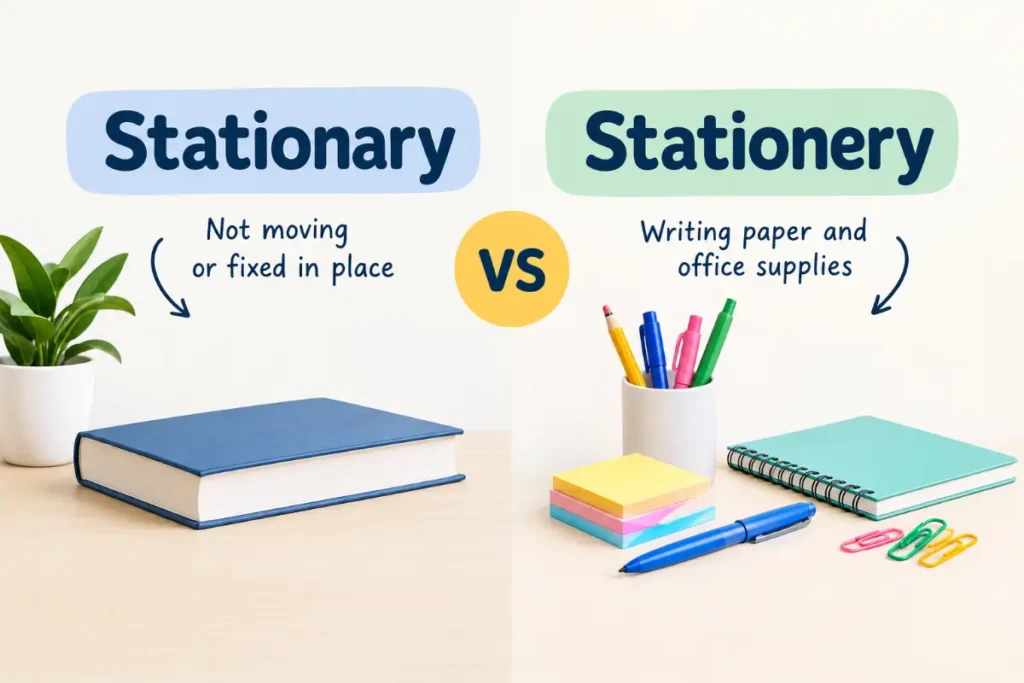
If you are unsure about stationary vs stationery, the difference comes down to meaning and spelling. Stationary describes something that is not moving or not changing, while stationery refers to writing materials such as paper, envelopes, pens, and pencils.
The two words sound the same in American English, which makes them easy to confuse in writing, but they have different grammatical roles and meanings. Understanding the connection between the words can make the spelling easier to remember. This guide explains the difference, shows how to use each word in natural sentences, covers pronunciation and word origins, and points out common mistakes.
You will also see examples from school, work, email, and everyday writing so you can quickly choose the right form when you need it.
Quick Answer
Stationary means not moving or not changing, as in a stationary car. Stationery means writing materials, such as paper, envelopes, pens, and pencils. They are pronounced the same in American English but have different meanings and spellings. A useful memory trick is that stationery contains e, like envelope.
Stationary vs Stationery Difference
The main difference is simple: stationary describes a state of being still, while stationery is a noun for writing supplies. Cambridge defines stationary as an adjective meaning not moving or not changing. Stationery is a noun referring to things used for writing, including paper, pens, pencils, and envelopes.
| Feature | Stationary | Stationery |
|---|---|---|
| Part of speech | Adjective | Noun |
| Core meaning | Not moving or not changing | Writing materials and office supplies |
| Main idea | Stillness or stability | Paper and writing supplies |
| Common context | Cars, objects, conditions, rates | Paper, envelopes, pens, business supplies |
| Example | The car remained stationary. | I ordered new stationery. |
| US usage | Standard American English | Standard American English |
| Pronunciation | Same | Same |
The spelling difference is important because you cannot normally substitute one for the other. You can say that a bus is stationary when it is not moving, but you cannot call paper stationary. Likewise, you can buy stationery for an office, but you would not describe a desk as stationery.
The words look almost identical because they share a historical connection through the word station, but their meanings developed in different directions. That history helps explain why the spellings are so close even though the modern meanings are unrelated in everyday use.
Just as common spelling mix-ups can make writing confusing, knowing the difference between stationary and stationery helps you avoid an easy-to-miss vocabulary mistake.
What Does Stationary Mean?
Stationary is an adjective that describes something that is not moving or not changing. It can describe a physical object that remains in one place, such as a parked vehicle, or something that remains stable instead of increasing or decreasing. Cambridge gives examples involving a stationary car, a stationary train, and a rate that has remained unchanged.
For physical movement, stationary usually means still or motionless.
- The bus remained stationary at the stop.
- The cyclist waited beside the stationary vehicle.
- The elevator stayed stationary between floors.
The word can also describe something that remains at the same level or condition. In that sense, it is not about physical movement at all.
- The company reported stationary sales during the quarter.
- The rate remained stationary for several months.
This broader meaning can be useful in formal or analytical writing. The central idea stays the same: something is not changing in the relevant sense.
As an adjective, stationary normally appears before a noun or after a linking verb.
- The stationary truck blocked the driveway.
- The truck was stationary for several minutes.
A useful synonym depends on the context. Words such as still, motionless, immobile, unchanging, and stable can overlap with stationary, but they are not always interchangeable. For example, stable can describe something that remains steady, while stationary emphasizes a lack of movement or change.
What Does Stationery Mean?
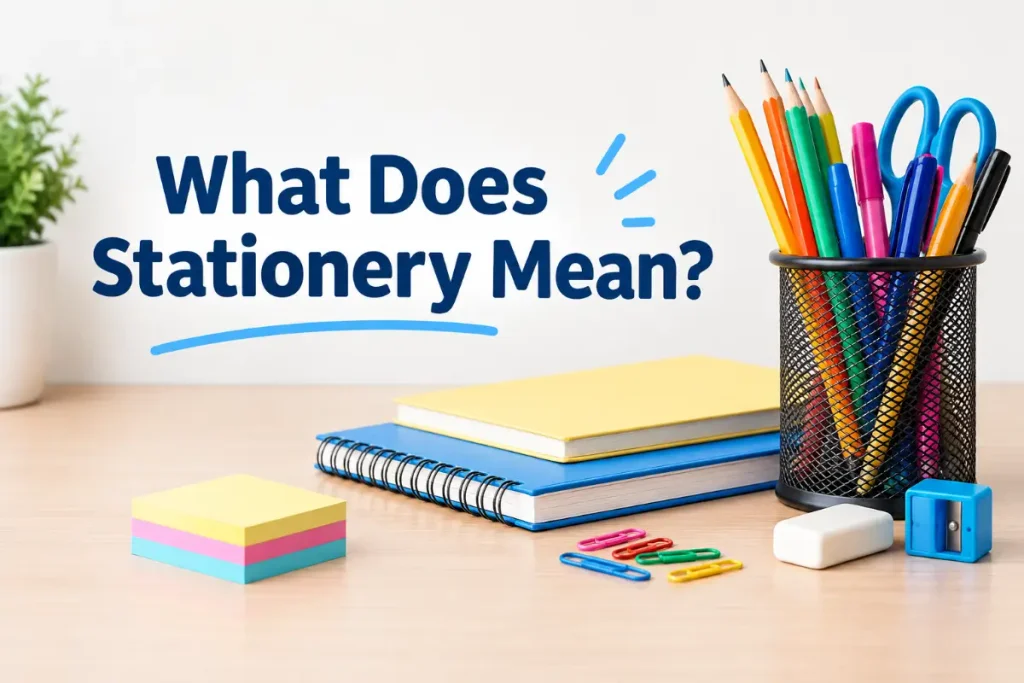
Stationery is a noun referring to materials used for writing and related office or correspondence tasks. It can include paper, envelopes, pens, pencils, notebooks, folders, and other writing supplies. Cambridge specifically defines stationery as things needed for writing, with examples such as paper, pens, pencils, and envelopes.
The word is especially common when discussing paper products, office supplies, business correspondence, and personal writing materials.
- I need to buy some stationery for school.
- The office ordered new stationery for the staff.
- She chose elegant stationery for her thank you notes.
Stationery can also refer specifically to personalized paper used for letters or business communication. For example, a company may have printed stationery featuring its name, address, logo, and contact information.
- The company uses branded stationery for formal letters.
- Please print the announcement on official stationery.
Unlike stationary, stationery is a noun, and it is generally treated as an uncountable noun when it means writing materials as a category. You would normally say some stationery or a piece of stationery, rather than treating stationery itself as a countable individual item.
You can, however, refer to individual items within that category.
- I bought some stationery.
- I bought three notebooks and several envelopes.
This distinction becomes particularly useful in professional writing because stationery can describe an entire collection of office or correspondence materials rather than one specific object.
Which One Should You Use?
Choosing the correct spelling becomes easy when you first identify the meaning of the sentence.
Use stationary when the subject is not moving or not changing.
Use stationery when you mean writing materials or paper products.
A quick test is to replace the word with still. If the sentence still makes sense, stationary may be the correct choice.
- The car was stationary.
- The car was still.
That works because both sentences describe a car that is not moving.
For stationery, think about paper, pens, envelopes, or office supplies.
The store sells stationery.
You could mentally replace stationery with writing supplies, and the meaning remains clear.
The store sells writing supplies.
That is a reliable way to separate the two forms without memorizing a complicated grammar rule.
Examples With Stationary
The following examples show how stationary works in everyday American English. Notice that the word describes something that remains still or unchanged.
- The train was stationary for several minutes before leaving the station.
- The parked car remained stationary while the driver made a phone call.
- Keep the camera stationary while taking the photograph.
- The truck was stationary at the intersection.
- The patient remained stationary during the scan.
- The airplane was stationary on the runway before takeoff.
- The traffic was barely moving, and several cars were completely stationary.
- The machine must remain stationary during the repair.
- The temperature remained stationary throughout the afternoon.
- The company reported stationary demand during the month.
In each example, the word communicates the idea of stillness or lack of change. The context tells you exactly what kind of movement or change is being discussed.
The word is also common in technical and professional contexts.
- The equipment must remain stationary during testing.
- The vehicle was stationary when the accident occurred.
- The graph shows a stationary level over the measured period.
These uses are different from stationery because they describe a condition rather than a collection of writing materials.
Examples With Stationery
Here are examples using stationery as a noun for writing materials and related office supplies.
- I need to buy stationery before the new semester begins.
- The office keeps extra stationery in the supply cabinet.
- She ordered personalized stationery for her home office.
- The company printed its address on official stationery.
- We need more paper and stationery for the meeting.
- He bought a set of stationery for writing letters.
- The school store sells notebooks, folders, and other stationery.
- She keeps her favorite stationery in a desk drawer.
- The business uses professional stationery for client correspondence.
- I found some colorful stationery at the local store.
The word can cover many kinds of writing supplies, so the exact items depend on context. Traditional stationery often brings paper and envelopes to mind, but modern office usage can include a broader range of supplies.
For example, a stationery store may sell pens, notebooks, folders, paper, envelopes, greeting cards, and other related products.
Similar confusion appears with pairs such as compliment and complement explained, where two words sound alike but have completely different meanings and uses.
Common Mistakes
The most common mistake is using stationary when you mean writing materials. This happens because the two words are pronounced alike and differ by only one letter.
Incorrect: I need to buy some stationary for my new office.
Correct: I need to buy some stationery for my new office.
The second common mistake goes in the opposite direction.
Incorrect: The car remained stationery at the traffic light.
Correct: The car remained stationary at the traffic light.
A simple substitution test can help. If the word means still, use stationary. If it means writing supplies, use stationery.
Another mistake is assuming that the ending ary or ery is interchangeable because the words sound identical. English spelling does not always provide a direct clue to pronunciation. In this case, the difference in spelling carries an important difference in meaning.
Autocorrect can also create confusion. A spelling checker may recognize both words as valid English words, so it may not flag the wrong one. If you type stationary when you mean paper and envelopes, the spelling itself is valid. The problem is the meaning.
That is why proofreading by meaning is more reliable than depending entirely on spell checking.
A Simple Way to Remember The Difference
The easiest memory trick is to connect stationery with envelope.
Both stationery and envelope contain the letter e. When you are talking about paper, envelopes, pens, or writing supplies, remember the e in stationery.
You can also remember the connection like this:
- Stationary = still
- Stationery = supplies
Another useful association is stationary car. A car that is stationary is not moving. If you are talking about something sitting in one place, the spelling with a is the one you want.
For writing materials, think of the e as standing for envelope.
These memory devices are not grammatical rules, but they make the spelling distinction easier to recall when you are writing quickly.
Pronunciation
In American English, stationary and stationery are pronounced the same way. They are homophones, meaning they have the same pronunciation but different meanings and spellings.
Cambridge gives the US pronunciation for both words as approximately /ˈsteɪʃəˌneri/.
A simple pronunciation guide is:
stationary: STAY shuh ner ee
stationery: STAY shuh ner ee
Because the pronunciation is identical, you cannot solve the spelling problem by listening to someone say the word. You need to use the context.
This is an important difference from some spelling comparisons where pronunciation provides a clue. Here, the spoken forms do not tell you which spelling is intended.
Word Origin And Etymology
The two spellings have a shared historical connection, but their modern meanings developed along different paths.
Stationary comes from historical forms related to Latin statio, associated with standing, a position, or a post. The English word originally developed with the sense of having no apparent movement and later acquired the broader meanings of being fixed, unmoving, or unchanged.
Stationery developed from stationer, a historical term for someone who sold books, paper, and related goods. The word stationery referred to the goods sold by such a person. Etymonline records the modern noun meaning writing materials, paper, and envelopes from the early eighteenth century.
This history explains why the two words are so similar. Their relationship is not simply a random spelling coincidence. Both are connected historically to the idea of a station or fixed place, but stationery eventually became associated with the goods sold by stationers.
The distinction in modern spelling is useful because it lets readers immediately tell two different meanings apart on the page.
Stationary And Stationery In American English
Both spellings are standard in American English, but they belong to different semantic categories.
American writers use stationary for things that are still or unchanged.
The vehicle remained stationary.
American writers use stationery for writing materials.
The company ordered new stationery.
There is no American versus British spelling difference that changes this basic distinction. The two words retain their separate spellings and meanings in standard English.
British English uses the same distinction as well. Canadian and Australian English also maintain the difference in ordinary standard usage. The important issue is therefore not regional spelling but choosing the word that matches your intended meaning.
Grammar And Word Function
The grammatical difference is straightforward.
Stationary is an adjective. It modifies a noun or follows a linking verb to describe a condition.
- The stationary vehicle was blocking the road.
- The vehicle was stationary.
Stationery is a noun. It names writing materials.
- The stationery arrived this morning.
- We need more stationery for the office.
This difference gives you another way to identify the correct word. If you are describing something as still, stationary is likely the adjective you need. If you are naming paper or writing supplies, stationery is the noun you need.
Stationery is generally uncountable when used to describe writing materials as a category.
We ordered some stationery.
It is more natural to identify individual pieces when you need a countable expression.
We ordered five notebooks and twenty envelopes.
The grammar therefore reinforces the meaning difference rather than creating a separate exception to memorize.
Stationery In Professional Writing
The word stationery is particularly useful in workplace communication. Businesses often use stationery for official letters, invoices, notices, envelopes, and other printed materials that carry the organization’s identity.
For example:
- Please use the company’s official stationery for the letter.
- The marketing team approved the new stationery design.
- We need to order more envelopes and printed stationery.
In modern offices, much business communication happens electronically, but stationery remains relevant for printed correspondence, branded materials, forms, cards, and formal documents.
Be careful not to confuse stationery with stationary in professional writing. Both spellings are legitimate English words, so a spell checker may not recognize the semantic mistake.
Stationary In Everyday And Professional Writing
Stationary is common in situations involving vehicles, equipment, people, physical objects, and conditions that remain unchanged.
In everyday writing, you might describe a car, train, bicycle, person, or machine as stationary.
The truck was stationary when the light changed.
In technical or professional writing, stationary can describe a value or condition that does not change.
The rate remained stationary during the observation period.
The exact meaning depends on what is being described, but the central idea remains stillness or lack of change.
If you are unsure, ask yourself a simple question: Am I describing something that is still, or am I naming writing supplies? The answer usually reveals the correct spelling immediately.
Related Words And Similar Confusions
These two words belong to a larger group of commonly confused English words. Their similar spelling and identical pronunciation make them especially easy to mix up, much like other pairs that differ in meaning despite sounding alike.
Some useful related words include:
- Still: Not moving or remaining in the same position.
- Motionless: Completely without movement.
- Immobile: Unable or unlikely to move.
- Unchanging: Remaining the same.
- Writing materials: Items used for writing.
- Office supplies: Materials used in an office, including some types of stationery.
- Stationer: A person or business historically associated with selling books, paper, and writing materials.
One especially important distinction is between stationer and stationery. A stationer is a person or business associated with selling stationery, while stationery refers to the materials themselves. The word stationer is historically connected with the development of stationery as a term for writing materials.
Knowing this relationship can make the spelling easier to understand instead of treating it as an arbitrary exception.
Expert Usage Tips
For clear American English, focus on meaning before spelling. If you are describing movement or stability, use stationary. If you are talking about paper, envelopes, pens, or related writing materials, use stationery.
A few practical habits can prevent mistakes:
- Think still: If you mean not moving or not changing, choose stationary.
- Think envelope: If you mean writing materials, choose stationery.
- Check the part of speech: Stationary is an adjective, while stationery is a noun.
- Do not trust spell check alone: Both spellings are valid, so context matters.
- Read the whole sentence: Ask what the word is supposed to mean before choosing the spelling.
For professional writing, this small distinction is worth checking because a wrong choice can change the meaning of an otherwise correct sentence.
If you enjoy sorting out tricky vocabulary differences, another tricky word pair worth learning is principal and principle, which are often confused because of their similar spelling and pronunciation.
Frequently Asked Questions
Which is correct stationary or stationery?
Both stationary and stationery are correct words, but they have different meanings. Stationary means not moving or not changing. Stationery means writing materials such as paper, envelopes, pens, and pencils. Choose stationary for stillness and stationery for writing supplies.
How do you spell stationery for paper?
The correct spelling for paper and other writing materials is stationery, with an e before the final ry. A useful memory trick is to connect the e in stationery with the e in envelope.
Is stationary the word for not moving?
Yes. Stationary is an adjective meaning not moving or not changing. You can describe a parked car as stationary, or you can describe a condition as stationary when it remains unchanged. For example, The vehicle remained stationary is correct.
Are stationary and stationery homophones?
Yes. In American English, stationary and stationery are pronounced the same, even though they have different spellings and meanings. This makes them homophones. Their pronunciation cannot tell you which spelling to use, so context is important.
What is the difference between stationery and stationary paper?
Stationery refers to writing materials, including paper and envelopes. Stationary does not describe paper in this sense. Stationary means still or unchanged, so stationary paper would normally mean paper that is not moving only if the context specifically requires that unusual interpretation.
Is stationery a noun or an adjective?
Stationery is a noun, usually an uncountable noun when it refers to writing materials as a category. You can say some stationery or a piece of stationery. Stationary, by contrast, is an adjective used to describe something that is not moving or changing.
Why are stationary and stationery spelled differently?
The different spellings reflect their separate historical developments. Stationary developed from words associated with standing or being fixed, while stationery developed from stationer, a term for a seller of books and writing materials. Their modern spellings help distinguish their different meanings in written English.
How can I remember the difference between stationary and stationery?
Use two simple associations. Think stationary = still when something is not moving. Think stationery = envelope when you mean paper and writing supplies. The shared letter e gives stationery a useful visual connection to envelope.
Conclusion
The difference between stationary vs stationery is easier to remember once you connect each spelling with its meaning. Stationary is an adjective for something that is not moving or not changing, such as a stationary car or stationary condition. Stationery is a noun for writing materials such as paper, envelopes, pens, and pencils.
Because the words sound the same in American English, context is the key. When you mean stillness, think stationary. When you mean writing supplies, think stationery. If you remember the e in stationery as a reminder of envelope, you can avoid one of the most common spelling mix ups in everyday and professional writing.