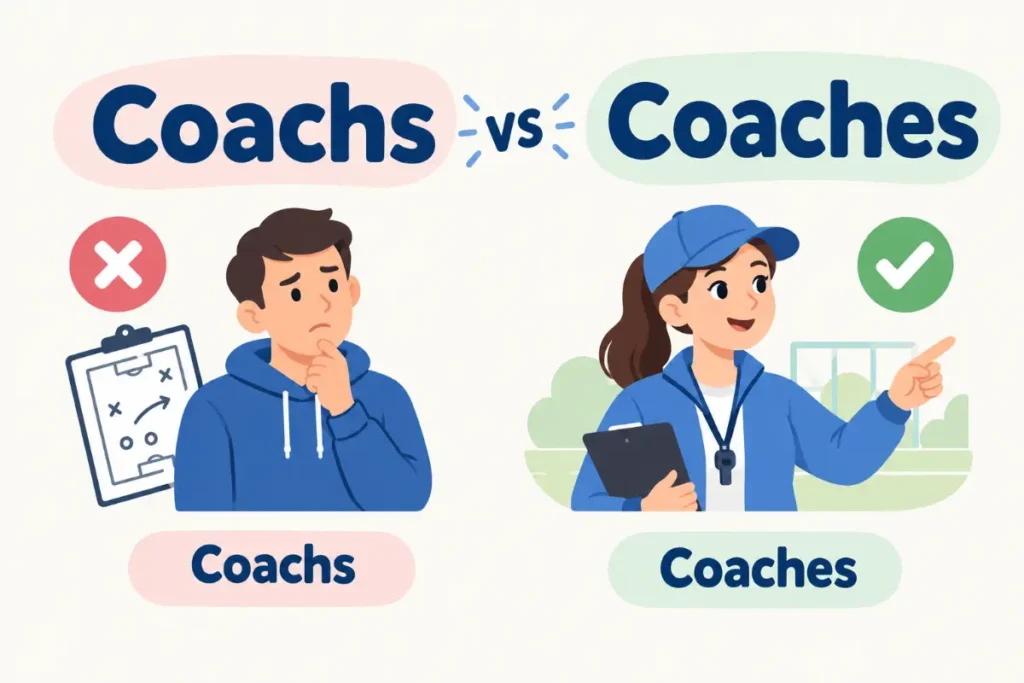
If you are wondering about coachs or coaches, the correct spelling in standard American English is coaches. The word coach becomes coaches when you are talking about more than one coach. You might use it to describe football coaches, basketball coaches, athletic trainers, or professionals who help people reach personal and career goals.
The confusion comes from a common spelling rule. Many nouns form their plurals by adding s, as in players or teachers. However, nouns ending in ch usually add es to form the plural. That is why coach becomes coaches instead of coachs.
There is another detail worth knowing. The apostrophe forms coach’s and coaches’ are also correct, but they serve different grammatical purposes. One usually shows ownership by a single coach, while the other shows ownership by multiple coaches. Understanding these forms will help you spell the word correctly in sports writing, school assignments, professional emails, and everyday conversations.
Quick Answer
Coaches is the correct plural of coach. The spelling coachs is incorrect in standard English because nouns ending in ch generally add es to form the plural. Use coach’s for something belonging to one coach and coaches’ for something belonging to multiple coaches.
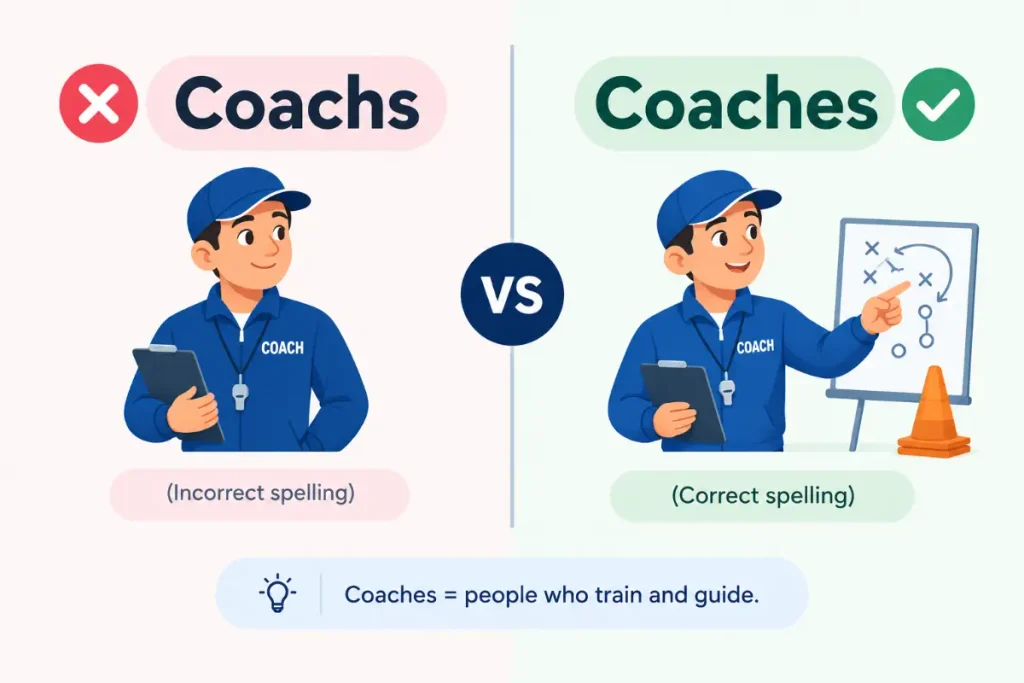
Coachs vs Coaches Meaning
The main difference is that coaches is the correct plural form, while coachs is a misspelling. The word coach can refer to someone who trains athletes, guides a team, teaches a skill, or helps another person improve performance.
For example, a school might employ several coaches to manage its athletic programs. A professional company might also hire career coaches to help employees develop leadership skills. In both situations, coaches is the correct word because it refers to more than one person.
The spelling follows a regular English pattern. When a noun ends in ch and the ending has the sound heard in coach, English generally adds es rather than just s. This creates the plural coaches, pronounced with an extra syllable.
Here is a quick comparison.
| Form | Correct | Meaning | Example |
|---|---|---|---|
| Coach | Yes | One coach | The coach arrived early. |
| Coaches | Yes | More than one coach | The coaches arrived early. |
| Coachs | No | Incorrect plural spelling | The coachs arrived early. |
| Coach’s | Yes | Possession by one coach | The coach’s office is open. |
| Coaches’ | Yes | Possession by multiple coaches | The coaches’ office is open. |
Remember that the correct form depends on what you want to communicate. Use coaches for a plural noun, coach’s for singular possession, and coaches’ for plural possession.
Just as “coach’s” and “coaches” have different grammatical meanings, commonly confused English expressions can be tricky to distinguish without understanding how each word is used.
Why Coaches Is the Correct Plural
English has several plural spelling rules, and the ending of a noun often determines which rule applies. Most nouns form their plurals by adding s. For example, player becomes players, teacher becomes teachers, and student becomes students.
However, nouns ending in certain sounds require es to make the plural easier to pronounce. Words ending in ch, sh, s, x, and z commonly follow this pattern.
Consider these examples.
- Church becomes churches.
- Brush becomes brushes.
- Class becomes classes.
- Box becomes boxes.
- Coach becomes coaches.
The extra vowel helps create a natural ending. Without it, coachs would not follow the standard plural spelling pattern for this word.
The rule is not limited to sports terminology. It applies to the noun coach in every common meaning, including a sports instructor, a personal development professional, and a person who trains others in a particular skill.
For example, a school may have several basketball coaches, a business may hire executive coaches, and a music program may work with vocal coaches. The plural remains coaches in every case.
How to Make Coach Plural
To form the plural of coach, add es to the end of the word. The spelling changes from coach to coaches, and the word refers to two or more people or things described as coaches.
The basic pattern is simple.
- Singular: one coach.
- Plural: two coaches.
- Singular with possession: the coach’s whistle.
- Plural with possession: the coaches’ whistles.
Notice that the plural form does not require an apostrophe. Apostrophes show possession or mark certain contractions, but they do not normally make nouns plural.
For example, “The coaches met after practice” is correct because coaches is simply the subject of the sentence. Writing “The coach’s met after practice” would be incorrect if you mean multiple coaches. That spelling suggests possession rather than a plural noun.
Coach’s vs Coaches vs Coaches’
These three forms often cause more confusion than the original spelling question. Although they look similar, each has a different grammatical purpose.
Coach’s
Coach’s usually shows that something belongs to one coach. It can also appear in a contraction such as coach’s going to the game, although that construction is less common than saying the coach is going to the game.
Examples include the coach’s whistle, the coach’s office, and the coach’s decision. Each phrase refers to one coach.
Consider this sentence: “The coach’s strategy helped the team win.” The apostrophe and s show that the strategy belongs to or is associated with one coach.
Coaches
Coaches is the regular plural form. It refers to two or more coaches and does not indicate possession by itself.
For example, “The coaches discussed the new training schedule.” This sentence describes multiple coaches taking part in a discussion. Nothing in the word coaches indicates that the schedule belongs to them.
Coaches’
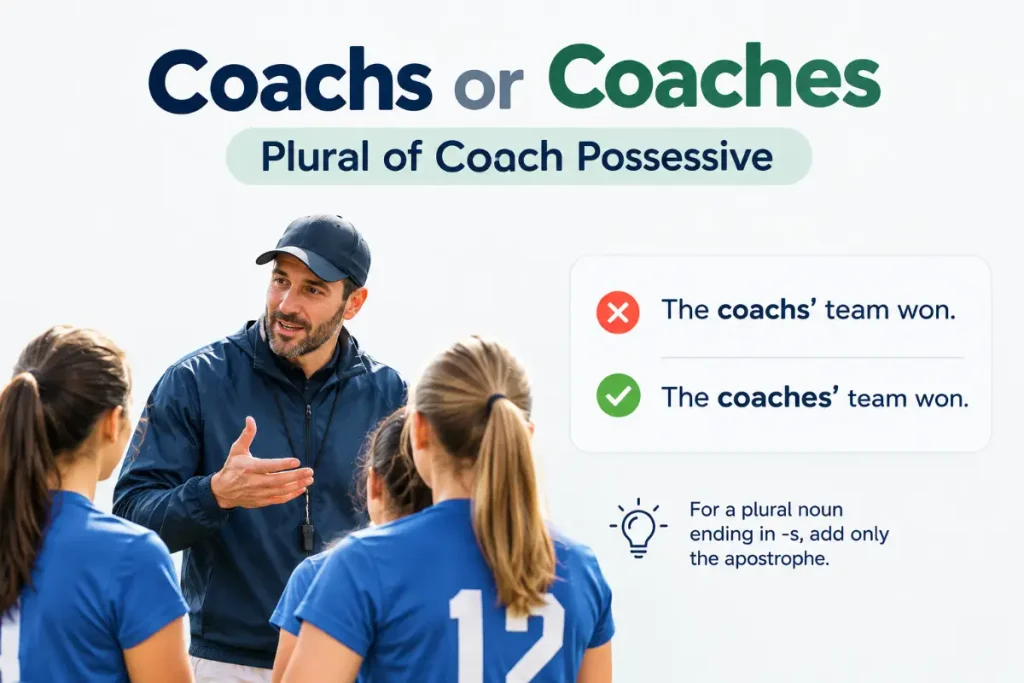
Coaches’ shows possession by multiple coaches. The plural already ends in s, so the apostrophe normally comes after the final s.
For example, “The coaches’ meeting starts at 3 p.m.” means that the meeting is associated with multiple coaches. Similarly, “The coaches’ uniforms arrived yesterday” refers to uniforms belonging to or assigned to the group of coaches.
The easiest way to distinguish the forms is to count the owners. One coach uses coach’s. Multiple coaches use coaches’ when possession is intended. If you are simply talking about more than one coach, use coaches without an apostrophe.
When deciding between “coach’s” and “coaches,” understanding how to choose the correct singular or plural form can help you avoid common grammatical mistakes.
Plural of Coach Possessive
The plural possessive of coach is coaches’. You use it when something belongs to, is used by, or is associated with multiple coaches.
For example, “The coaches’ office is next to the gym.” The apostrophe after the final s indicates that the office is associated with several coaches.
Here are more examples.
- The coaches’ schedules were posted online.
- The coaches’ decision surprised the players.
- The coaches’ uniforms arrived before the tournament.
- The coaches’ meeting lasted an hour.
- The coaches’ recommendations helped the athletic director.
In each example, coaches’ refers to multiple coaches. If only one coach were involved, you would generally write coach’s instead.
Compare these sentences: “The coach’s schedule is posted online” refers to one coach, while “The coaches’ schedules are posted online” refers to several coaches. The difference is only an apostrophe placement, but the meaning changes.
Plural of Coach in Sports
In sports, coaches is the standard plural spelling for people responsible for training athletes, developing strategies, and guiding teams. It applies to every major sport, including football, basketball, baseball, soccer, hockey, and tennis.
For example, a high school might employ several football coaches to manage different aspects of the program. A basketball team might have a head coach and assistant coaches. In both situations, coaches is the correct plural form.
The same spelling works when describing coaches across different teams. You might say, “The coaches met before the championship game” or “Several coaches attended the national training conference.”
Sports writing also uses the possessive forms frequently. “The coach’s decision” refers to one coach, while “the coaches’ decisions” refers to multiple coaches. These distinctions matter in game reports, interviews, team announcements, and school newsletters.
Coaches in Sentences
Seeing the word in different contexts can help you recognize the correct form naturally. The following examples demonstrate how coaches works in everyday communication, school settings, sports reporting, and professional environments.
Everyday Examples
- The coaches arrived early to prepare for the event.
- Several coaches helped organize the community sports program.
- The school hired two new coaches this year.
- Local coaches volunteered to teach children basic athletic skills.
- The coaches shared advice with the younger players.
Sports Examples
- The football coaches reviewed the game footage.
- Both basketball coaches agreed to change their defensive strategy.
- The soccer coaches organized an extra practice session.
- The baseball coaches evaluated the players before the tournament.
- The coaches congratulated the team after the championship win.
Professional Examples
- Executive coaches help managers strengthen their leadership skills.
- Career coaches offer guidance to people changing professions.
- The coaches helped employees prepare for their presentations.
- Several business coaches attended the leadership workshop.
- The coaches recommended a new approach to team communication.
These sentences all use coaches as a plural noun. None requires an apostrophe because the word does not indicate possession.
Common Mistakes With Coach and Coaches
The most common error is writing coachs instead of coaches. The mistake often happens when someone applies the basic plural rule of adding s without considering the final letters of the word.
Incorrect: The coachs attended the meeting.
Correct: The coaches attended the meeting.
The correction follows the standard plural rule for nouns ending in ch. Adding es produces the accepted spelling.
Another mistake involves using an apostrophe to form a plural.
Incorrect: Three coach’s arrived before the game.
Correct: Three coaches arrived before the game.
The incorrect version suggests possession by one coach or uses an apostrophe incorrectly. The correct version simply identifies three people.
A third mistake occurs when writers confuse singular and plural possession.
Incorrect: The coaches’s office is upstairs.
Correct: The coaches’ office is upstairs.
The plural coaches already ends in s, so the apostrophe normally follows that letter. Adding another s after the apostrophe is unnecessary in standard plural possessive writing.
Finally, remember that spelling and meaning work together. If you are describing a group, use coaches. If you are describing something belonging to one coach, use coach’s. If something belongs to several coaches, use coaches’.
Coaches Pronunciation
The word coaches is pronounced KOH chiz in American English. Its IPA pronunciation is commonly represented as /ˈkoʊtʃɪz/. The word has two syllables: coach and es, with the ending pronounced like “iz.”
The singular coach has one syllable and is pronounced /koʊtʃ/. When you add the plural ending, the word gains another syllable.
This pronunciation pattern appears in other English plurals ending in ch, such as churches and matches. The ending makes the plural easy to say and distinguishes it from the singular form.
When speaking, do not pronounce coaches as if it were simply coach with an s sound attached. The final syllable is important, and using the natural pronunciation can help reinforce the correct spelling.
Coach as a Noun and a Verb
The word coach can function as both a noun and a verb. As a noun, it refers to a person who trains, teaches, or guides others. As a verb, it means to train, instruct, or help someone improve.
For example, “The coach prepared the team for the season” uses coach as a noun. In “She will coach the new employees,” the word functions as a verb.
The plural coaches can also be a verb form. For example, “He coaches the varsity basketball team” means that he trains the team. In this sentence, coaches is not a plural noun. It is the present tense form used with the singular subject he.
This distinction is useful because the same spelling can serve different grammatical purposes. Compare “The coaches meet every Monday” with “She coaches every Monday.” In the first sentence, coaches refers to multiple people. In the second, coaches describes an action performed by one person.
Coachs or Coaches in American and British English
Coaches is the standard plural spelling in both American and British English. There is no regional spelling difference for this word. Writers in the United States, the United Kingdom, Canada, and Australia use coaches when referring to multiple coaches.
The word coach can have different meanings depending on context. In American sports, a coach typically trains athletes or manages a team. In British English, coach can also refer to a bus designed for longer journeys, and coaches can refer to multiple such vehicles.
These differences in meaning do not change the plural spelling. For example, “The coaches arrived at the stadium” could refer to sports instructors in an American context or long-distance buses in a British travel context. The surrounding sentence tells the reader which meaning applies.
For US focused writing, use coaches for multiple sports instructors, professional mentors, or other people who coach. The spelling remains the same regardless of the setting.
How to Remember the Correct Spelling
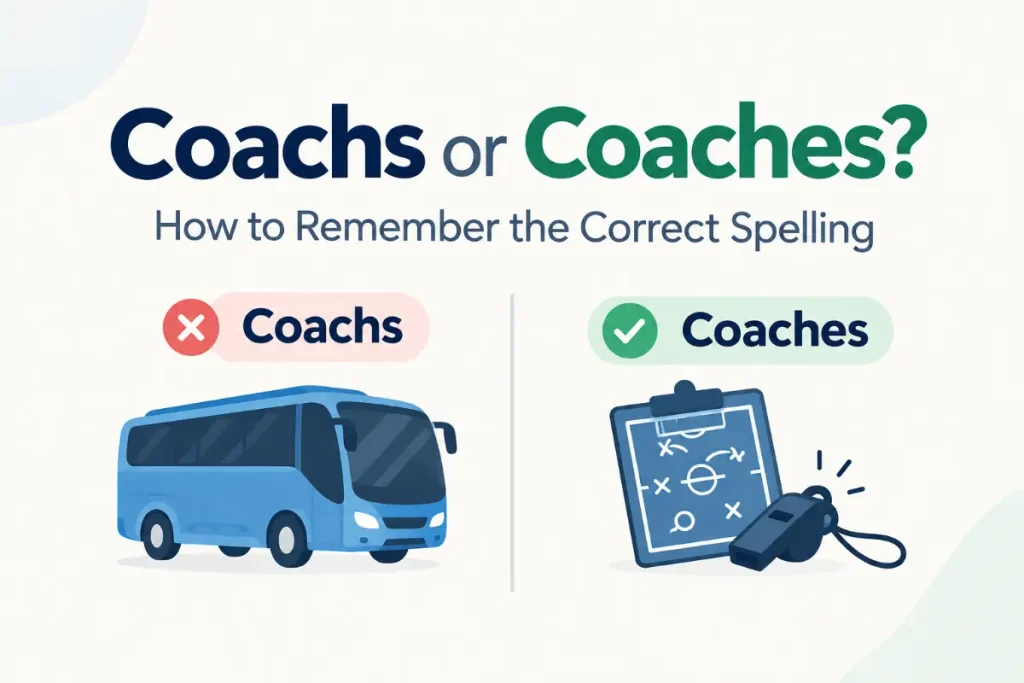
The easiest way to remember the plural is to focus on the ending of the singular noun. Because coach ends in ch, add es to form coaches. The same pattern appears in words such as churches, matches, and branches.
You can also remember the difference by saying the words aloud. Coach has one syllable, while coaches has two. Hearing the extra syllable can help you connect the plural pronunciation with the additional letters.
For possessives, count the owners before adding punctuation. One coach means coach’s. Multiple coaches means coaches’ when showing possession. Multiple coaches without possession simply means coaches.
These three patterns cover most situations you will encounter in school assignments, sports reports, professional writing, and everyday messages. Once you understand the difference, choosing the correct form becomes much easier.
Beyond apostrophes and plural forms, British and American English differences can also affect which spelling or word form sounds most natural in a particular context.
Frequently Asked Questions
Is coachs or coaches correct?
Coaches is correct. It is the standard plural form of coach in American English and other major varieties of English. The spelling coachs is incorrect because nouns ending in ch generally add es to form the plural. For example, you would write, “The coaches attended practice.”
What is the plural of coach?
The plural of coach is coaches. Use it when referring to two or more coaches, such as football coaches, career coaches, or fitness coaches. The word does not need an apostrophe unless you are showing possession. For example, “The coaches met after the game” is correct.
What is the plural possessive of coach?
The plural possessive is coaches’. It indicates that something belongs to or is associated with multiple coaches. For example, “The coaches’ meeting begins at noon” refers to a meeting involving the group. The apostrophe comes after the final s because coaches is already plural.
Is it coach’s award or coaches’ award?
Both forms can be correct, depending on the intended meaning. Coach’s award refers to an award belonging to or associated with one coach. Coaches’ award refers to an award belonging to or associated with multiple coaches. If the award recognizes several coaches collectively, coaches’ award may be appropriate.
How do you spell coach in sports?
The word is spelled coach when referring to one person who trains or guides a sports team. Its plural is coaches when referring to more than one. For example, “The coach prepared the team” refers to one person, while “The coaches prepared the teams” refers to multiple people.
How do you pronounce coaches?
Coaches is commonly pronounced KOH chiz, with two syllables. In IPA, the American English pronunciation is /ˈkoʊtʃɪz/. The plural ending adds a syllable, distinguishing coaches from the one syllable word coach. The same general pronunciation pattern appears in other plurals ending in ch.
Is coaches ever used as a verb?
Yes. Coaches can be the present tense form of the verb coach when the subject is he, she, it, or a singular noun. For example, “She coaches the school basketball team” describes an action. In “The coaches arrived early,” however, coaches is a plural noun.
Why does coach become coaches instead of coachs?
Coach becomes coaches because English nouns ending in ch generally add es to form their plurals. The extra ending also creates the natural two syllable pronunciation. Similar examples include church and churches, match and matches, and branch and branches. This is a standard spelling pattern rather than a regional preference.
Conclusion
The correct spelling is coaches, not coachs. When you are talking about more than one coach, add es to the singular word coach. This rule applies to sports coaches, career coaches, executive coaches, and anyone else who trains or guides others.
Remember the related forms as well. Use coach’s when something belongs to one coach and coaches’ when something belongs to multiple coaches. If you are simply referring to a group, write coaches without an apostrophe. Understanding these small differences will help you write clearly and avoid common spelling and grammar mistakes in American English.