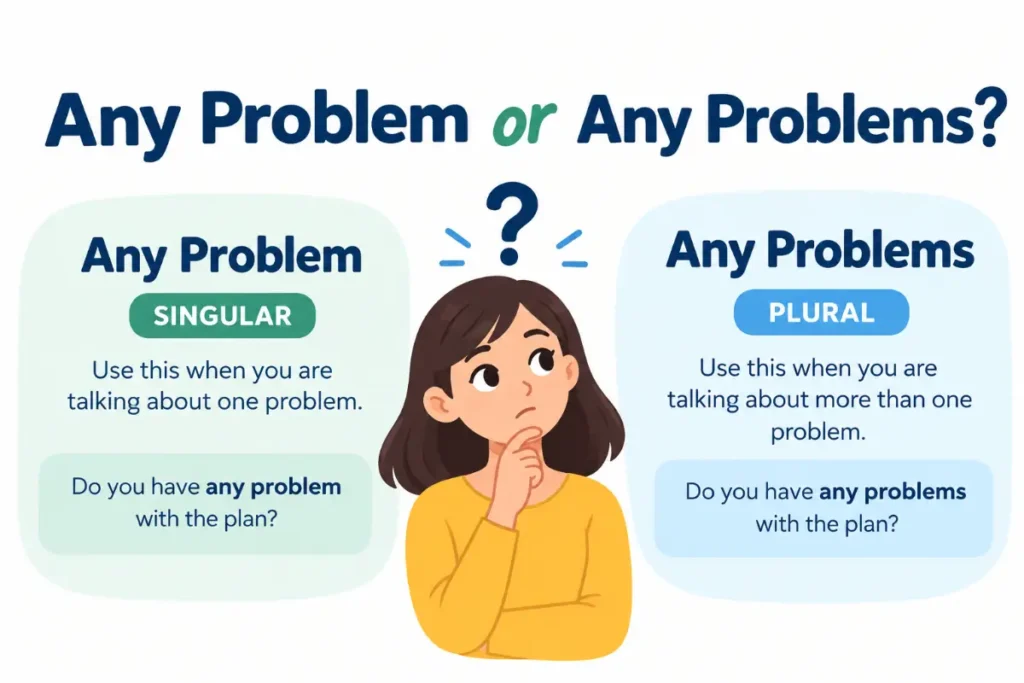
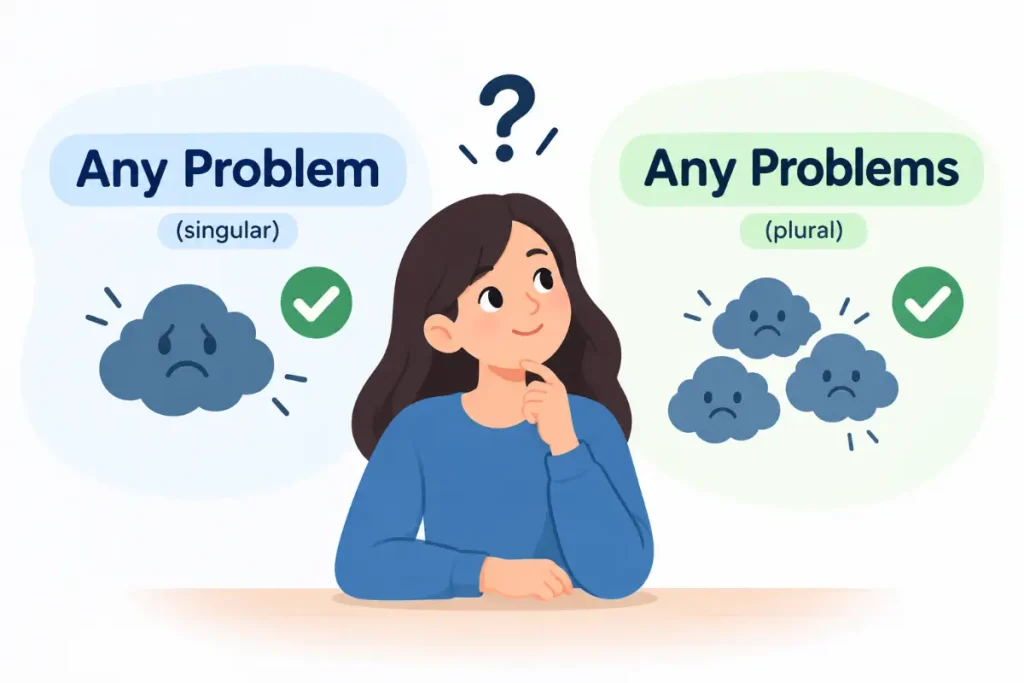
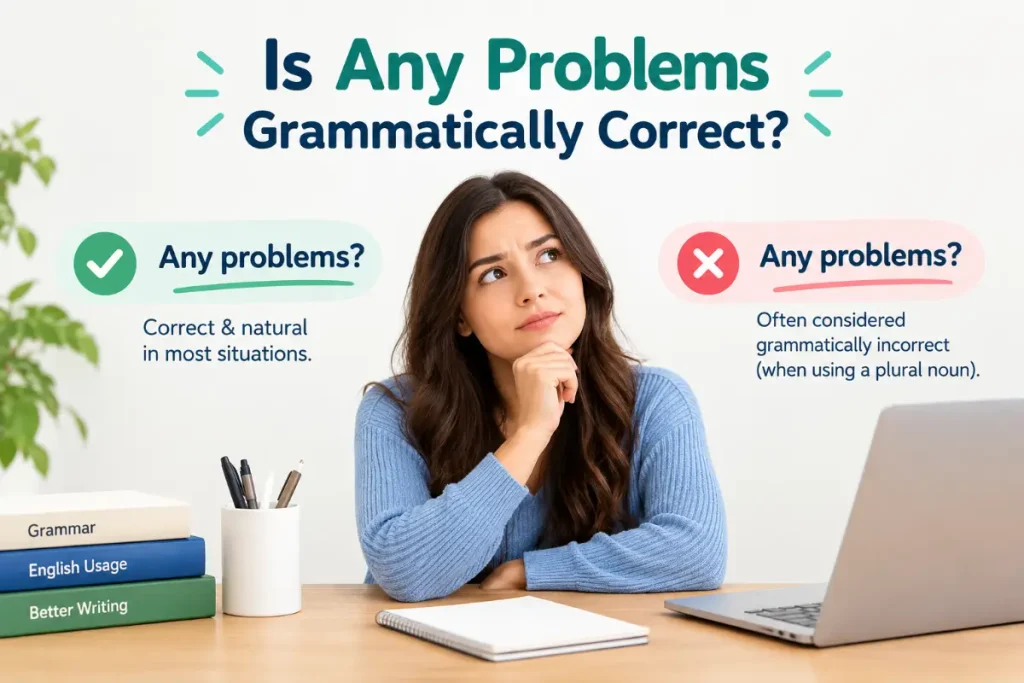
The choice between any problem or any problems depends on what you mean and how you use the phrase in a sentence. Both forms are grammatically correct in English, but they serve slightly different purposes. The singular form any problem usually refers to one possible issue or a problem considered in a general sense. The plural form any problems usually refers to multiple possible issues.
For example, you might ask, “Do you have any problem with this plan?” when asking about someone’s objection to a particular arrangement. However, “Do you have any problems with this plan?” is also correct and often sounds more natural in everyday American English when asking about possible concerns or difficulties.
The difference can feel confusing because any works with both singular and plural countable nouns, depending on the sentence structure and intended meaning. It also appears with uncountable nouns, such as time, money, and information. Once you understand these patterns, you can choose the right form for conversations, emails, workplace communication, and academic writing.
Quick Answer
Both any problem and any problems are grammatically correct. Use any problem when referring to one possible issue or asking about a specific objection. Use any problems when asking about possible difficulties or multiple issues. In everyday American English, “Do you have any problems?” is a common and natural question.
What Is the Difference Between Any Problem and Any Problems
The main difference is the number and meaning of the noun that follows any. Problem is a singular countable noun, while problems is its plural form. English allows any with both forms, so neither expression is automatically wrong.
The singular form often focuses on one possible difficulty, objection, or obstacle. For example, “Is there any problem with the new schedule?” asks if the schedule has an issue. The speaker may be checking for a specific concern rather than inviting a list of several different difficulties.
The plural form usually leaves room for multiple issues. For example, “Are there any problems with the new schedule?” asks about possible difficulties in general. The person answering could mention a scheduling conflict, a staffing shortage, or a deadline concern.
| Feature | Any Problem | Any Problems |
|---|---|---|
| Noun form | Singular | Plural |
| Basic meaning | One possible issue | One or more possible issues |
| Common question | Is there any problem? | Are there any problems? |
| Common use | A specific issue or objection | General difficulties or multiple issues |
| Auxiliary verb with there | Is there | Are there |
| Everyday American English | Correct | Correct and often natural for general concerns |
| Example | Is there any problem with my application? | Are there any problems with my application? |
The distinction is not always strict. Both questions can ask about the same situation, and the difference may be small. The plural version often sounds more open ended because it allows the other person to identify any number of difficulties.
Just as “any problem” and “any problems” differ in grammatical usage, understanding subtle differences in word meaning can help you choose the most natural expression for a particular context.
What Does Any Problem Mean
Any problem refers to a possible problem considered individually or as a general possibility. The phrase often appears when someone wants to know if a particular action, decision, arrangement, or situation causes an objection or difficulty.
For example, “Do you have any problem with me using your computer?” asks if the person objects to that action. The question is grammatically correct because any can appear before a singular countable noun in questions and other appropriate constructions.
You may also see the singular form in conditional sentences. Consider this example: “If you have any problem accessing your account, contact customer support.” Here, the phrase refers to a possible issue with account access. The sentence does not require the plural form because the writer is treating the difficulty as a single possible occurrence.
Examples of Any Problem in a Sentence
1. Is there any problem with the address on my application?
2. Do you have any problem with our meeting at noon?
3. If you have any problem opening the file, let me know.
4. Is any problem preventing you from completing the assignment?
5. I do not see any problem with your proposal.
6. If there is any problem with your order, contact our support team.
7. Do you have any problem following these instructions?
8. The manager did not identify any problem with the revised schedule.
9. Is there any problem with parking in this area?
10. Let me know if you have any problem using the new software.
These examples show that the singular form works well when the speaker is considering a possible issue or objection. Some sentences may sound more natural with any problems in casual American English, particularly when the question invites the other person to mention several difficulties.
What Does Any Problems Mean
Any problems refers to possible difficulties, concerns, or issues. The plural form is especially common when someone asks a broad question and does not know how many issues might exist.
For example, “Are there any problems with the report?” asks if the report contains errors, missing information, formatting issues, or other concerns. The speaker does not have to identify a particular problem in advance. The question leaves room for the other person to report one issue or several.
This form is common in everyday conversations, workplace discussions, customer service, and technical support. A manager might ask, “Are you having any problems with the new system?” because the employee could be experiencing several kinds of difficulty.
Examples of Any Problems in a Sentence
1. Are there any problems with the new schedule?
2. Do you have any problems understanding the assignment?
3. Let me know if you encounter any problems during installation.
4. Are there any problems with my payment?
5. We did not find any problems during the inspection.
6. If you have any problems logging in, reset your password.
7. The teacher asked if the students had any problems with the homework.
8. Are there any problems we should discuss before the meeting?
9. The technician checked the computer for any problems.
10. Please contact us if you experience any problems with your order.
The plural form works particularly well when several different issues are possible. However, it does not mean that multiple problems must actually exist. A question such as “Are there any problems?” is perfectly natural even when the answer is no.
Is Any Problem Grammatically Correct
Yes, any problem is grammatically correct in the right context. The word any does not always require a plural noun. English speakers use it with singular countable nouns, plural countable nouns, and uncountable nouns, depending on the meaning and grammatical structure.
For example, “Is there any problem?” is correct because there is agrees with the singular noun problem. Similarly, “I do not see any problem with this idea” can be correct when the speaker means that the idea has no identifiable issue.
However, context affects how natural the sentence sounds. In an ordinary conversation where someone is asking about possible difficulties in general, “Are there any problems?” may sound more natural than “Is there any problem?” Both can be correct, but the plural form often fits broad questions more comfortably.
When the Singular Form Works Best
Use any problem when the sentence focuses on a particular possible issue, one objection, or one general difficulty. It is also common in conditional statements, especially when the writer wants to explain what to do if a difficulty arises.
Examples include “If you have any problem with the instructions, ask your supervisor” and “I do not have any problem with your decision.” The first sentence refers to a possible difficulty, while the second communicates that the speaker does not object to the decision.
In some expressions, the singular form is especially natural. For example, “No problem” is a standard response to thanks or an apology in American English. The expression does not normally require no problems when used in this conversational sense.
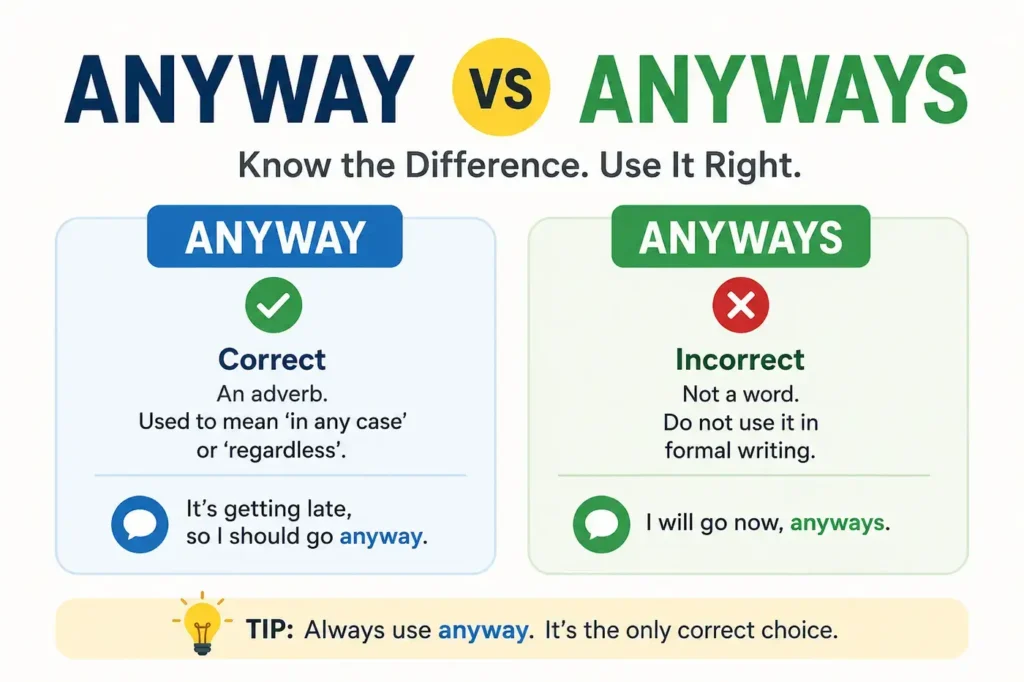
English has many examples of two words with different meanings that are easy to confuse, making context essential for clear and accurate communication.
Is Any Problems Grammatically Correct
Yes, any problems is grammatically correct and widely used in American English. The plural form is appropriate when the speaker is asking about possible difficulties in general or referring to multiple potential issues.
For example, “Are you having any problems with your internet connection?” is a natural question. The speaker does not know if the person is experiencing a slow connection, frequent disconnections, or another difficulty. The plural form comfortably covers all those possibilities.
The phrase also appears in negative statements and conditional sentences. You might say, “We did not encounter any problems during the move” or “Call me if you have any problems with the instructions.” Both sentences are grammatically correct.
When the Plural Form Works Best
Use any problems when you want to invite someone to mention difficulties without limiting the answer to one specific issue. It is particularly useful when several errors, obstacles, or concerns could arise.
For example, a project manager might ask, “Are there any problems with the launch plan?” A customer service representative might ask, “Are you experiencing any problems with your account?” In both cases, the plural form is natural because the person could be dealing with more than one issue.
The plural form also works well when checking the condition of something. For example, “Did the inspection reveal any problems?” asks about all potential defects or concerns found during the inspection. The answer might identify one issue, several issues, or none.
Is There Any Problem or Are There Any Problems
Both is there any problem and are there any problems are correct. The main grammatical difference is subject and verb agreement. Use is there with the singular noun problem and are there with the plural noun problems.
Consider these examples:
1. Is there any problem with my reservation?
2. Are there any problems with my reservation?
3. Is there any problem with the proposed change?
4. Are there any problems with the proposed changes?
The singular questions focus on a possible issue, while the plural questions invite the listener to identify any difficulties. Still, the questions can overlap in meaning, especially in casual conversation.
A common mistake is combining the singular noun with the plural verb or the plural noun with the singular verb. For standard English, write “Is there any problem?” rather than “Are there any problem?” Write “Are there any problems?” rather than “Is there any problems?”
Do You Have Any Problem or Do You Have Any Problems
Both forms are possible, but Do you have any problems? is often the more natural choice when asking someone about difficulties in general. The plural noun allows the person to mention one issue or several without making the question sound limited to a single concern.
For example, a coworker might ask, “Do you have any problems with the new software?” This question invites the other person to describe any difficulties they have experienced. It sounds natural in workplace conversations and technical support situations.
The singular form is also correct in suitable contexts. “Do you have any problem with my joining the meeting?” asks if the person objects to a specific action. In this sentence, any problem with means something close to any objection to.
The difference is subtle but useful. If you are asking broadly about someone’s experience, use any problems. If you are checking for a specific objection, any problem can be a good fit.
Any Problem or Any Problems in Questions
Questions are one of the most common places where people encounter this distinction. English uses any in questions when the speaker wants to find out if something exists, happens, or causes difficulty.
The noun can be singular or plural, depending on the intended meaning. “Is there any problem with this document?” checks for a possible issue. “Are there any problems with this document?” asks more broadly about possible errors or concerns.
In casual American English, the plural version is common when the speaker does not know what to expect. However, the singular version remains natural when the context focuses on one matter, one decision, or one potential objection.
Here are a few examples:
1. Is there any problem with the way I completed the form?
2. Are there any problems with the way I completed the form?
3. Do you have any problem with this arrangement?
4. Do you have any problems with this arrangement?
All four sentences can be grammatical. The best choice depends on the context and the shade of meaning the speaker wants to convey.
Any Problem or Any Problems in Negative Sentences
Both forms can appear in negative sentences, particularly with not, do not, does not, and did not. The singular form can mean that no issue or objection exists, while the plural form can indicate that no difficulties were found or experienced.
For example, “I do not have any problem with your decision” means that the speaker does not object to the decision. “I did not have any problems during the trip” means the trip did not involve difficulties.
The plural form often sounds natural when someone describes an experience involving several possible complications. The singular form often works when someone expresses acceptance of a particular choice or action.
Compare these sentences:
1. I do not have any problem with your proposal.
2. We did not encounter any problems during the inspection.
3. She does not have any problem working remotely.
4. The team did not experience any problems with the new system.
The grammar depends on the sentence structure and meaning, not on a rule that requires any to take a plural noun in negative sentences.
Any Problem or Any Problems in Professional Emails
In professional communication, both forms are useful. The best choice depends on the message you want to send and the tone you want to maintain. A clear sentence is usually more important than choosing the singular or plural form based on a rigid rule.
If you are asking a colleague about a general difficulty, you might write, “Please let me know if you experience any problems with the updated software.” This sounds natural because the colleague could encounter several kinds of trouble.
If you are asking for approval or checking an objection, the singular form may be better. For example, “Please let me know if you have any problem with the proposed meeting time” focuses on one arrangement.
Here are several useful professional examples:
1. Please let me know if you encounter any problems with the report.
2. Do you have any problem with moving the meeting to Thursday?
3. We did not identify any problems during the review.
4. If you have any problem accessing the shared folder, contact the IT team.
5. Are there any problems we need to resolve before launch?
For a polished email, choose the form that matches your purpose. When you want to sound neutral and invite feedback about possible difficulties, any problems is often a safe choice.
Common Mistakes With Any Problem and Any Problems
Most errors involve subject and verb agreement or choosing a noun form that does not fit the intended meaning. Some sentences are grammatically incorrect, while others are technically correct but less natural in the context.
Mistake 1: Using a plural verb with a singular noun.
Incorrect: Are there any problem with the report?
Correct: Is there any problem with the report?
Correct: Are there any problems with the report?
The verb must agree with the noun in the standard question structure.
Mistake 2: Using a singular verb with a plural noun.
Incorrect: Is there any problems with your account?
Correct: Are there any problems with your account?
The plural noun problems takes are in this construction.
Mistake 3: Assuming that any always requires a plural noun.
Incorrect rule: You must always write any problems.
Correct explanation: Both singular and plural nouns can follow any. The appropriate choice depends on the sentence and meaning.
Mistake 4: Treating every singular form as unnatural.
Sentence: I do not have any problem with that.
This sentence can be correct, especially when the speaker means that they have no objection. In some contexts, “I do not have any problems with that” may sound more conversational, but the singular version is not automatically wrong.
Mistake 5: Using problem when you mean problems in a broad question.
Sentence: Are you having any problem with your computer?
This is understandable and can be grammatical, but “Are you having any problems with your computer?” is often more natural when asking about general technical difficulties.
Which Form Sounds More Natural in American English
In everyday American English, any problems is a common choice when asking about general difficulties. Questions such as “Are you having any problems?” and “Do you have any problems with the new system?” sound natural because they invite the listener to mention any number of issues.
However, any problem is also natural in specific contexts. For example, “Do you have any problem with that?” often asks if someone objects to a suggestion or arrangement. The singular noun focuses attention on a possible objection rather than a collection of difficulties.
You should not assume that the plural form is always more correct or that the singular form sounds wrong. Native speakers use both, and context guides the choice. If you are uncertain, ask yourself if you mean one specific issue or possible difficulties in general.
Alternatives to Any Problem and Any Problems
Sometimes another phrase can make your meaning clearer. The best alternative depends on whether you are asking about difficulties, objections, concerns, or technical issues.
For general difficulties, you can use any issues, any difficulties, or any concerns. For a specific objection, you might use any objection or any concern about this decision. These expressions can sound more precise in professional communication.
Consider these examples:
1. Are there any issues with the new schedule?
2. Do you have any concerns about the proposal?
3. Is there any objection to changing the meeting time?
4. Let me know if you experience any difficulties accessing the website.
5. Are there any technical issues we need to address?
The word issue often sounds neutral and professional. Concern suggests worry or hesitation, while objection specifically indicates disagreement. Choose the alternative that best describes the situation rather than replacing problem mechanically.
Similarly, understanding subtle grammar differences can help you recognize when a particular sentence structure is correct and express your thoughts more naturally.
Frequently Asked Questions
Is any problem grammatically correct
Yes, any problem is grammatically correct when the context supports the singular noun. For example, “Is there any problem with the application?” is a standard question. The phrase can refer to one possible issue or a general objection. You do not have to use the plural form every time you use any.
Is any problems grammatically correct
Yes, any problems is grammatically correct and common in American English. It often appears in questions about general difficulties, such as “Are there any problems with the software?” It also works in negative sentences and conditional statements, such as “We did not encounter any problems” and “Call me if you have any problems.”
Should I say is there any problem or are there any problems
Both are correct, but the verb must agree with the noun. Use “Is there any problem?” with the singular noun and “Are there any problems?” with the plural noun. The plural version is common when asking broadly about possible difficulties, while the singular version can focus on a particular issue or objection.
Should I say do you have any problem or do you have any problems
Both forms can be correct. “Do you have any problems?” is often more natural when asking about difficulties in general. “Do you have any problem with this arrangement?” can be natural when asking if someone objects to a specific plan or action. The surrounding context determines the best choice.
Is any problem singular or plural
Problem is singular, while problems is plural. The word any can appear with either form, depending on the sentence. For example, “Is there any problem?” uses a singular noun, while “Are there any problems?” uses a plural noun. Both structures are grammatically correct.
Can I use any problem in a negative sentence
Yes, you can use any problem in a negative sentence. For example, “I do not have any problem with your decision” is correct when you mean that you do not object. You can also write “I did not have any problems during the trip” when describing an experience without difficulties.
Is any problems more natural in American English
Any problems is often more natural when asking about general difficulties. Americans commonly say “Are you having any problems?” when checking if someone needs help. However, any problem remains natural in contexts involving a specific issue or objection. Neither form is universally better because the intended meaning matters.
Can I say no problem or no problems
Yes, both expressions are used, but they serve slightly different purposes. No problem is a very common conversational response to thanks or an apology, as in “No problem. I can help you with that.” No problems can refer to an absence of difficulties, as in “We had no problems during the trip.”
Conclusion
Both any problem or any problems can be correct, so the choice depends on meaning and sentence structure. Use any problem when referring to one possible issue or asking if someone objects to a particular action. Use any problems when asking about difficulties in general or allowing for several possible issues.
Remember to match the verb to the noun in questions. Write “Is there any problem?” with the singular form and “Are there any problems?” with the plural form. In everyday American English, the plural version is often a natural choice for broad questions about difficulties, but the singular form remains useful in the right context. Focus on what you want to communicate, and the correct form will usually become clear.