If you have searched for nonresponsive vs unresponsive, you are probably trying to figure out if the two words mean the same thing or if one is more accurate. They appear in medical reports, technical documents, workplace communication, customer service emails, and everyday conversations. Because they often describe a similar situation, many people assume they are interchangeable.
The short answer is that both words are correct, but they are not always the best choice in the same context. Unresponsive is the more common and natural term in everyday English. It appears frequently in conversation, journalism, healthcare, technology, and business writing. Nonresponsive is also correct, but it is used more often in technical, scientific, medical, and formal writing where precision matters.
The difference is not about spelling or pronunciation. It is about usage, tone, and context. Choosing the right word helps your writing sound more natural and ensures your message is clear to your audience.
This guide explains the meaning of each word, how native speakers use them, where they overlap, and the situations where one is a better choice than the other. You will also find comparison tables, pronunciation guidance, practical examples, grammar tips, and expert editing advice that make the distinction easy to understand.
Quick Definition
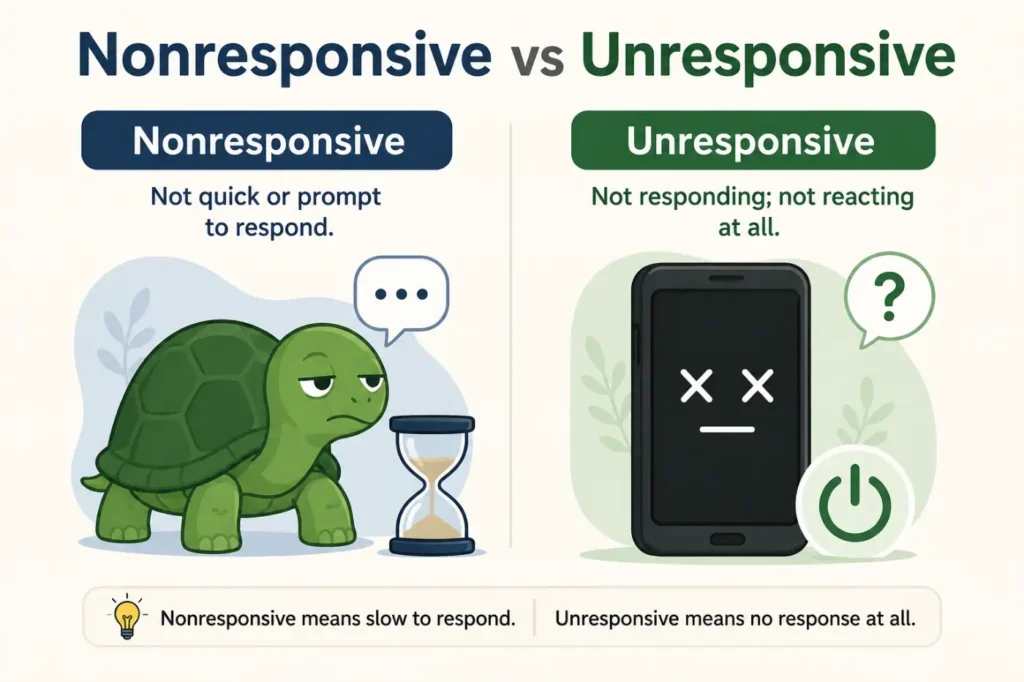
Both nonresponsive and unresponsive describe someone or something that does not respond. The difference is mainly one of usage. Unresponsive is the preferred choice in everyday English and most professional writing. Nonresponsive appears more often in medical, scientific, technical, and research contexts where precise terminology is important.
Quick Answer
If you only need the answer, remember these points.
- Both words are grammatically correct.
- Unresponsive is far more common in everyday English.
- Nonresponsive is more common in technical and medical writing.
- The meanings overlap, but the preferred word depends on the context.
- When you are unsure, unresponsive is usually the safer and more natural choice.
Comparison Table
| Feature | Unresponsive | Nonresponsive |
|---|---|---|
| Part of speech | Adjective | Adjective |
| Correct form | Yes | Yes |
| Origin | Prefix un plus responsive | Prefix non plus responsive |
| Meaning | Not reacting or replying | Not reacting or failing to respond |
| Formality | General English and professional writing | More technical and formal |
| Common contexts | Conversation healthcare business technology | Medicine research engineering scientific writing |
| Usage frequency | Very common | Less common |
| Typical tone | Natural and conversational | Precise and clinical |
| Example | The customer became unresponsive after several emails. | The patient remained nonresponsive during the examination. |
If you’re interested in other commonly confused word pairs, our guide on the correct spelling of “wholly” explains why one form is standard English and the other is a frequent misspelling.
Meaning Of Both Terms
Although these words share a similar definition, experienced writers choose them differently depending on the audience and the situation.
What Does Unresponsive Mean
Unresponsive describes a person, device, system, or organization that does not react, reply, or respond as expected.
It is the word most native speakers naturally choose because it fits both formal and informal communication.
You will commonly see it in situations involving:
- Medical care.
- Customer service.
- Workplace communication.
- Technology.
- Relationships.
- Emergency situations.
For example, a computer may become unresponsive, a customer may stop replying to emails, or a patient may not react to verbal instructions.
Because the word sounds natural across many situations, it has become the preferred choice in modern English.
What Does Nonresponsive Mean
Nonresponsive also means failing to respond, but it usually appears in more specialized writing.
Medical professionals, researchers, engineers, and technical writers often choose this term because it can sound more precise in formal documentation.
Common situations include:
- Medical records.
- Clinical research.
- Scientific reports.
- Laboratory studies.
- Technical documentation.
- Engineering reports.
Outside these fields, many native speakers naturally replace it with unresponsive because it sounds smoother in ordinary conversation.
Nonresponsive vs Unresponsive Key Differences
The meanings are almost identical, but the way people use the words is different.
Here are the most important distinctions.
- Unresponsive is more common in everyday English.
- Nonresponsive appears more frequently in technical and medical writing.
- Both describe a lack of response.
- Neither word is considered incorrect.
- Audience and context determine which choice sounds more natural.
Think about these examples.
A customer who ignores your emails is usually described as unresponsive.
A research paper discussing treatment outcomes may describe participants as nonresponsive to a particular therapy.
The meaning is similar, but the writing style changes with the audience.
Which One Is Correct
The answer depends on the situation because both words are accepted English adjectives.
If your audience is the general public, unresponsive is usually the better choice. It sounds more natural, is easier to understand, and appears much more frequently in newspapers, books, websites, and everyday conversation.
If you are writing a medical report, scientific paper, engineering document, or another highly technical publication, nonresponsive may be the preferred term because many professional fields have adopted it as part of their standard vocabulary.
When editing content for a broad audience, experienced editors often replace nonresponsive with unresponsive unless the technical context specifically calls for the more specialized term.
Pronunciation Guide
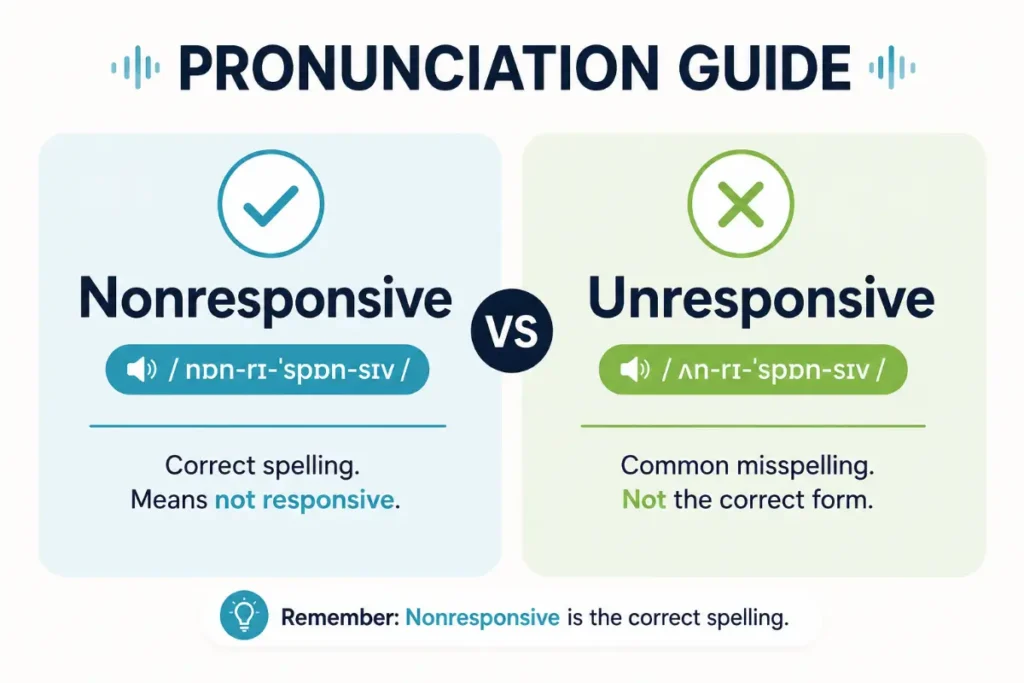
The similar meanings sometimes make people wonder if the words are pronounced differently. They are not difficult to distinguish once you know where the stress falls.
IPA Pronunciation
Unresponsive
/ˌʌn.rɪˈspɒn.sɪv/
Nonresponsive
/ˌnɒn.rɪˈspɒn.sɪv/
Syllable Breakdown
Unresponsive
Un re spon sive
Nonresponsive
Non re spon sive
The main stress falls on spon in both words.
Common Pronunciation Mistakes
Here are a few mistakes learners sometimes make.
- Stressing the first syllable instead of the third.
- Omitting the middle syllable during fast speech.
- Confusing the prefixes un and non while speaking.
Listening to native speakers quickly makes the distinction clear because the pronunciation pattern remains consistent.
How To Remember The Difference
A simple memory tip can help you choose the right word without stopping to think every time you write.
Think about the audience first.
- If you are writing for everyday readers, choose unresponsive.
- If you are writing a clinical, scientific, or highly technical document, nonresponsive may fit better.
- When editing general content, read the sentence aloud. The version that sounds more natural is usually the better choice.
Another helpful way to remember the difference is to think about the prefixes.
The prefix un appears in many everyday English adjectives such as unhappy, uncertain, and unavailable. That familiarity makes unresponsive feel more natural in ordinary communication.
The prefix non often appears in formal or technical vocabulary, including words such as nonessential, nonflammable, and nonverbal. That pattern explains why nonresponsive is more common in specialized writing.
Examples In Sentences
Reading examples in context is one of the easiest ways to understand how these adjectives differ. Although they share a similar meaning, one sounds more natural in everyday conversation, while the other is more common in technical writing.
Examples Using Unresponsive
The following examples reflect how native speakers typically use the word in daily life and professional communication.
- The customer became unresponsive after our second follow up email.
- My laptop turned unresponsive while I was updating the software.
- The support team tried calling, but the client remained unresponsive.
- The child appeared unresponsive for a few moments after the fall.
- The website became unresponsive because too many users were online.
- The employee was usually quick to reply but suddenly became unresponsive.
- The remote control was unresponsive after the batteries died.
- Doctors found the patient unresponsive and immediately began treatment.
- The manager grew concerned when the supplier stayed unresponsive for several days.
- The touchscreen became unresponsive after water damaged the device.
These examples show why unresponsive feels natural across a wide range of situations. It works equally well in everyday conversation, business writing, healthcare, and technology.
Examples Using Nonresponsive
The following sentences show where nonresponsive fits more naturally.
- The patient remained nonresponsive throughout the examination.
- Researchers classified several participants as nonresponsive to the treatment.
- The laboratory identified a nonresponsive sample during testing.
- The physician documented the patient as nonresponsive to verbal commands.
- Engineers investigated a nonresponsive control module.
- The clinical report described the tumor as nonresponsive to medication.
- The technician replaced the nonresponsive sensor during maintenance.
- Scientists continued studying the nonresponsive cells.
- The medical team monitored a nonresponsive patient overnight.
- The report concluded that the equipment remained nonresponsive after repeated testing.
Notice that these examples mostly come from medicine, science, engineering, and technical fields. In casual conversation, many native speakers would naturally choose unresponsive instead.
Nonresponsive vs Unresponsive Common Mistakes
The two words are so similar that writers often use them interchangeably without considering the audience. While this rarely changes the meaning, it can affect the tone of the writing.
Here are the mistakes people make most often.
Using Nonresponsive In Everyday Conversation
Although the word is correct, it can sound overly formal in ordinary situations.
For example:
Less natural:
The customer became nonresponsive after receiving the invoice.
More natural:
The customer became unresponsive after receiving the invoice.
The second version sounds smoother because it matches everyday English.
Assuming Only One Word Is Correct
Some people believe nonresponsive is wrong because they hear unresponsive more often.
That is not true.
Both words are recognized English adjectives. The difference lies in preferred usage rather than grammatical correctness.
Ignoring The Writing Context
A clinical report and a blog post serve different audiences.
Medical professionals may naturally write nonresponsive to treatment, while a news article aimed at the general public is more likely to say unresponsive to treatment.
Choosing the word that fits the audience makes your writing more effective.
Confusing Medical Meaning With Unconsciousness
Many people assume unresponsive always means unconscious.
It does not.
Someone may be awake but unresponsive because they are unable or unwilling to react. In healthcare, however, the term often describes patients who do not respond to verbal or physical stimulation.
The exact meaning depends on the context.
Assuming Search Results Determine Correct Usage
Online searches produce millions of results for both words.
That does not mean they are used equally.
Large language databases, dictionaries, newspapers, and published books consistently show that unresponsive appears much more frequently in general English.
Similar usage mistakes occur with verbs too, so learning when to use “tapping” or “taping” can help you avoid another common writing error.
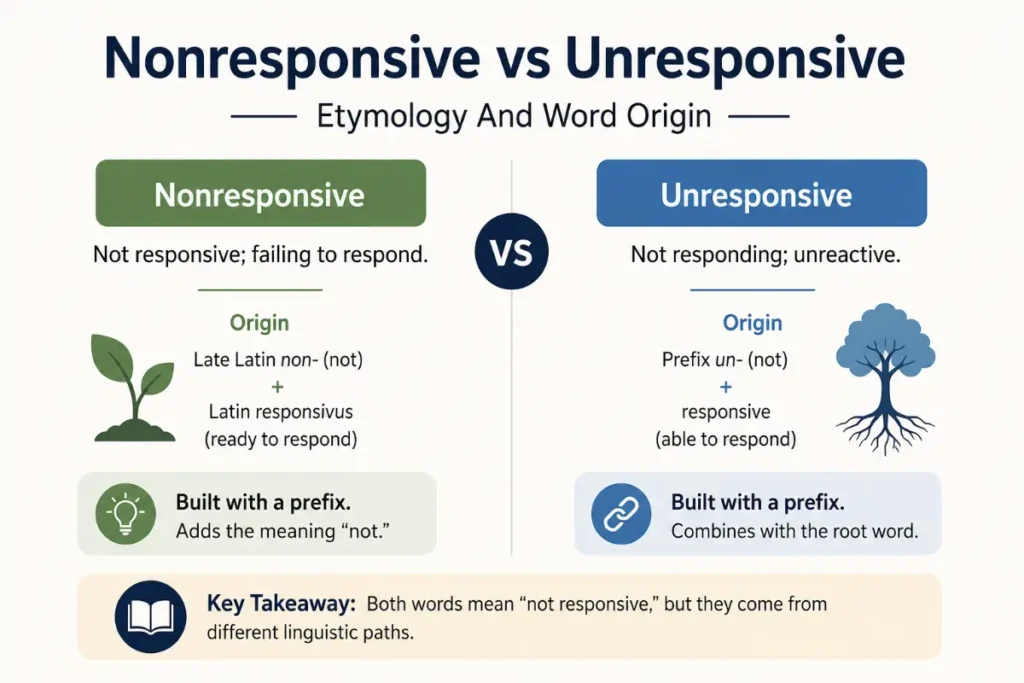
Etymology And Word Origin
Both adjectives developed from the word responsive, which means reacting appropriately or replying to something.
The prefix un comes from Old English and has been used for centuries to create words expressing the opposite meaning. Examples include unfair, unknown, and unfinished. Because English speakers encounter this pattern every day, unresponsive feels familiar and natural.
The prefix non entered English through Latin and French influences. It often appears in formal, scientific, legal, and technical vocabulary. Words such as nonverbal, nonessential, and nonflammable follow the same pattern.
As professional fields expanded during the twentieth century, technical writers increasingly adopted nonresponsive in medical research, engineering, and scientific literature. Meanwhile, unresponsive remained the dominant choice in general English.
Today, both words are well established, but each has developed its own preferred style and audience.
Regional Usage
Unlike spelling pairs such as color and colour, these words do not change from one English speaking country to another.
American English
American English uses both adjectives.
Unresponsive is much more common in newspapers, websites, business communication, and everyday speech. Nonresponsive appears more often in healthcare, scientific journals, and technical documentation.
British English
British English follows the same pattern.
Writers generally prefer unresponsive for ordinary communication, while nonresponsive appears in clinical and technical contexts.
Australian English
Australian publications also favor unresponsive in general writing. Medical professionals and researchers may choose nonresponsive when preparing formal reports or research papers.
Canadian English
Canadian English mirrors both American and British usage.
Across all major English varieties, the distinction is based on context rather than geography.
Grammar Rules
Understanding how these adjectives function in sentences helps you choose the most natural wording.
Part Of Speech
Both unresponsive and nonresponsive are adjectives.
They describe the condition of a person, object, system, or process.
Examples include:
- An unresponsive customer.
- A nonresponsive patient.
- An unresponsive application.
- A nonresponsive treatment group.
Common Sentence Structure
These adjectives usually appear after linking verbs such as:
- Is.
- Was.
- Became.
- Remained.
- Seemed.
Examples include:
- The patient remained unresponsive.
- The equipment became nonresponsive.
- The website was unresponsive throughout the afternoon.
They can also appear before nouns.
Examples include:
- An unresponsive employee.
- A nonresponsive participant.
- An unresponsive device.
- A nonresponsive sample.
Related Word Forms
Understanding related forms can improve your vocabulary.
- Respond.
- Response.
- Responsive.
- Responsiveness.
- Unresponsiveness.
- Nonresponsiveness.
These forms appear frequently in academic writing, healthcare, customer service, and technology.
Real Life Usage Examples
These adjectives appear in many areas of daily life. The context usually determines which one sounds most appropriate.
Daily Conversation
People commonly describe phones, computers, people, or services as unresponsive.
Examples include:
- My phone became unresponsive after the update.
- The restaurant was unresponsive to customer complaints.
- Our internet connection stayed unresponsive for several minutes.
Medical Settings
Healthcare professionals use both terms, but their choice often depends on institutional style guides and clinical documentation standards.
Examples include:
- The patient was unresponsive when emergency crews arrived.
- The patient remained nonresponsive despite treatment.
Professional Communication
Businesses usually prefer wording that is clear and familiar.
Examples include:
- The client became unresponsive during contract negotiations.
- The vendor remained unresponsive despite repeated reminders.
Technology
Software developers and technical support teams frequently describe systems that stop reacting to user input.
Examples include:
- The application became unresponsive after the latest update.
- Engineers replaced the nonresponsive control unit.
Literature And Media
Journalists generally choose unresponsive because it is immediately understood by a broad audience. Technical publications are more likely to use nonresponsive, particularly when discussing medical research or scientific studies.
Related Words And Confused Terms
Understanding similar words makes it easier to choose the right one for every situation. Some of these terms have related meanings, while others describe different conditions altogether.
| Term | Meaning | Common Context |
|---|---|---|
| Responsive | Reacting quickly or appropriately | Everyday English Business Technology |
| Unresponsive | Not reacting or replying | General English Medicine Technology |
| Nonresponsive | Not responding usually in technical contexts | Medicine Science Engineering |
| Unconscious | Not awake or aware | Medicine Emergency care |
| Inactive | Not operating or functioning | Technology Business |
| Silent | Not speaking or communicating | Conversation Communication |
| Inoperative | Not working properly | Engineering Equipment |
| Dormant | Temporarily inactive | Science Business Biology |
People also search for related terms such as:
- Lack of response.
- Failure to respond.
- No reply.
- Medical response.
- Clinical terminology.
- Device malfunction.
- System failure.
- Communication breakdown.
- Treatment resistant.
- Technical vocabulary.
Although these expressions are connected, they are not always interchangeable. The surrounding context determines which one fits best.
If you often encounter confusing spellings, the “plaque” spelling mistake explained is another useful guide that clears up a commonly misspelled word.
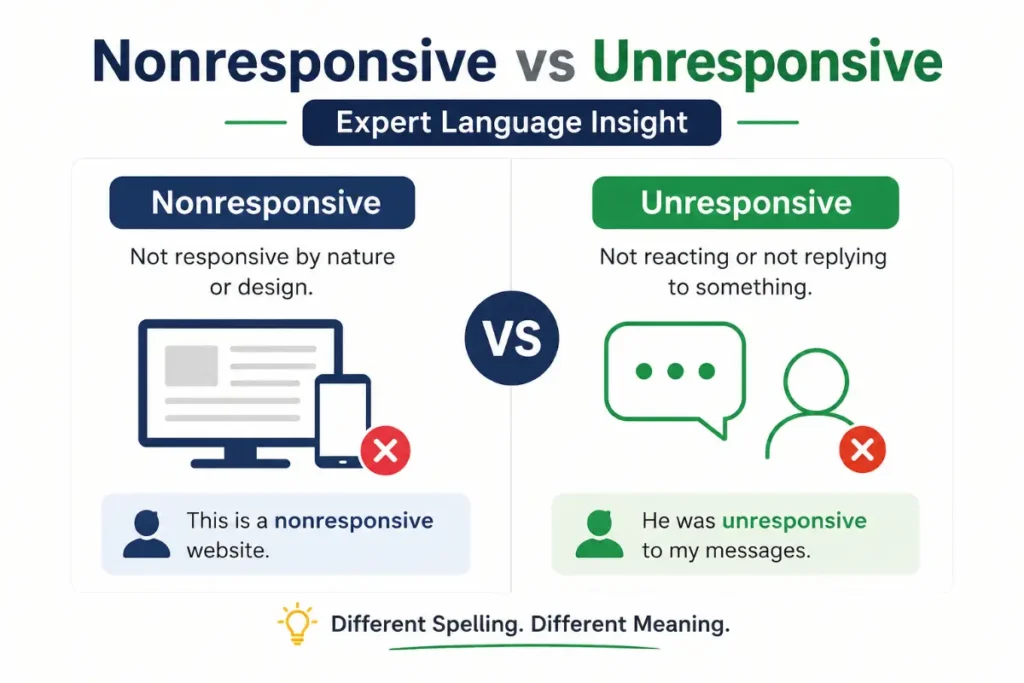
Expert Language Insight
From an editor’s perspective, the difference is less about grammar and more about audience expectations.
In articles, emails, blogs, news reports, and business communication, unresponsive usually sounds more natural. It is the word most readers expect to see because it has become the everyday choice across many industries.
Nonresponsive often appears in healthcare, scientific research, engineering, and technical documentation. In those fields, the word reflects established terminology and may even be preferred by internal style guides.
Medical writing provides a good example. A physician might document that a patient is nonresponsive to treatment, while a newspaper covering the same story may report that the patient was unresponsive. The core meaning remains similar, but the writing style changes to match the audience.
Another area that causes confusion is the comparison between unresponsive and unconscious. These terms are not synonyms.
An unconscious person is not awake and cannot be aware of their surroundings.
An unresponsive person does not react to verbal commands, touch, or other forms of stimulation. In some situations, that person may be unconscious. In others, they may still be awake but unable or unwilling to respond. Medical professionals determine the exact condition through examination rather than relying on the word alone.
Good writing is not just about choosing a correct word. It is about choosing the word your readers will understand immediately. In most situations, unresponsive achieves that goal.
Frequently Asked Questions About Nonresponsive vs Unresponsive
Is nonresponsive the same as unresponsive?
The meanings are very similar, but the preferred usage differs. Unresponsive is more common in everyday English, while nonresponsive appears more often in medical, scientific, and technical writing. Both words are grammatically correct.
Which word should I use in professional writing?
For most business documents, articles, websites, and emails, unresponsive is the better choice because it sounds more natural to a broad audience. Use nonresponsive when writing for technical or medical professionals who commonly use that terminology.
Is nonresponsive a real English word?
Yes. It is a recognized English adjective and appears in major dictionaries. Although it is less common than unresponsive, it is widely used in healthcare, research, engineering, and other specialized fields.
What does unresponsive mean in medical terms?
In medicine, unresponsive describes a patient who does not react to voice, touch, pain, or other forms of stimulation. The cause can vary widely, so the term describes an observed condition rather than a specific diagnosis.
Is an unresponsive person always unconscious?
No. An unresponsive person may be unconscious, but that is not always the case. Some medical conditions prevent a person from responding even though they still have some level of awareness. Healthcare professionals perform assessments to determine the underlying cause.
What is the difference between unresponsive and unconscious?
An unconscious person has lost awareness and cannot be awakened easily. Unresponsive describes the absence of a response to external stimulation. One condition may include the other, but the two terms are not identical.
Are there synonyms for nonresponsive and unresponsive?
Depending on the context, possible alternatives include inactive, silent, unreactive, inoperative, uncommunicative, and treatment resistant. The best choice depends on the situation because each word carries a slightly different meaning.
Which word is more common in everyday English?
Unresponsive is used much more frequently in newspapers, books, websites, business communication, and daily conversation. Most native speakers naturally choose it outside technical and medical settings.
Conclusion
Both unresponsive and nonresponsive are correct English words, but they are not used in exactly the same way. The main difference lies in context rather than meaning.
For most readers, unresponsive is the better choice. It sounds natural, appears more often in everyday English, and works well in conversations, business writing, journalism, and general content.
Nonresponsive has an important role in medicine, science, engineering, and other technical fields where precise terminology is expected. If you are writing for specialists, that wording may be the stronger option.
Nonresponsive vs unresponsive comes down to context, not correctness. Unresponsive is the better choice for most everyday and professional writing, while nonresponsive is more common in medical and technical contexts. Choose the word that best fits your audience and keep your usage consistent.