Understanding having vs having had can be tricky because both expressions use forms of the verb have, yet they describe different relationships between actions and time. The difference becomes easier once you understand how English uses participles to show an action in progress, a completed experience, or something that happened before another event.
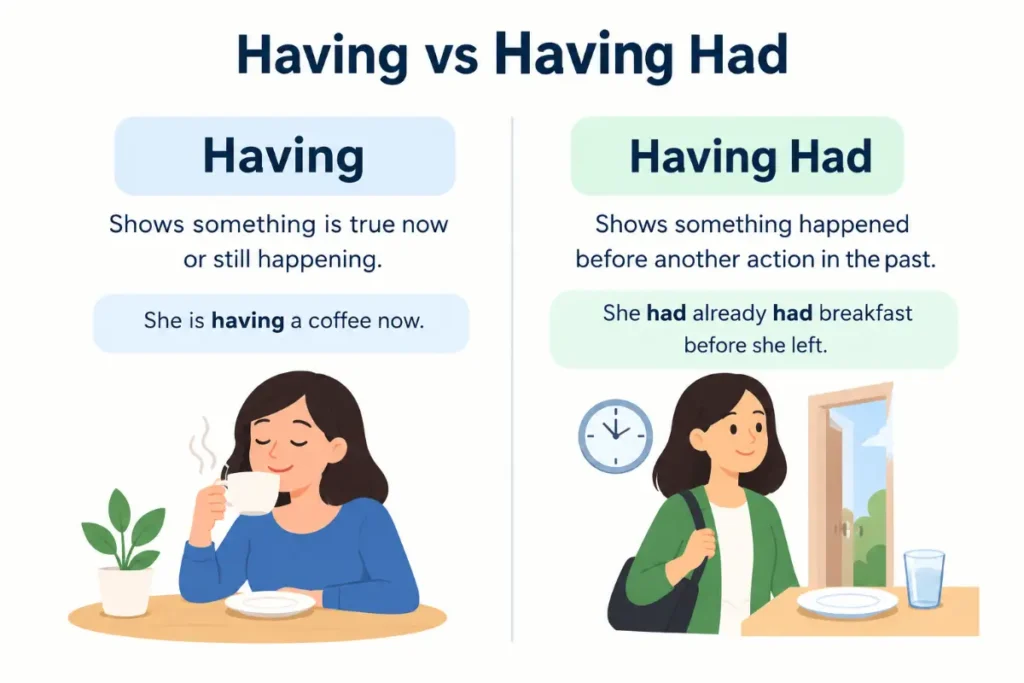
Having can describe an ongoing action, a current situation, or an action that happens before another action. Having had usually refers to an experience, possession, or situation that occurred before another point in time. For example, Having lunch, I checked my emails suggests that lunch and checking emails overlap, although the sentence may sound less natural than a clearer alternative. By contrast, Having had lunch, I returned to work means lunch was already finished before the person returned to work.
These expressions appear in everyday conversation, academic writing, professional emails, and formal explanations. They can also create confusion when writers try to use them with the wrong verb tense or treat them as interchangeable phrases. This guide explains their meanings, grammar rules, sentence patterns, common mistakes, and practical examples so you can choose the right form confidently.
Quick Answer
Having usually refers to an ongoing action, a current situation, or an action connected to another event. Having had generally refers to an experience, possession, or situation that was completed before another point in time. For example, Having a car makes commuting easier describes possession, while Having had a car before, she understood the costs refers to an earlier experience.
Just as “having” and “having had” express different time relationships, understanding subtle differences in meaning can help you choose the right words and communicate more clearly.
What Does Having Mean
Having is the ing form of the verb have. Depending on the sentence, it can function as a present participle, appear in a gerund phrase, or form part of a continuous verb construction. Its meaning depends on the context and the grammatical structure around it.
The verb have has several meanings in English. It can describe possession, experiences, relationships, activities, or situations. For instance, you can have a car, have a conversation, have a headache, have a meeting, or have an opportunity. The form having carries the relevant meaning into a sentence that uses an ing construction.
Consider these examples.
- Having a reliable car makes commuting easier.
- She is having lunch with her coworkers.
- Having enough time helps students prepare for exams.
- We are having a meeting at three.
- Having a good support system can make difficult situations easier.
Notice that having does not always mean an action is happening at this exact moment. In Having enough time helps students prepare for exams, the phrase describes a general condition rather than an action in progress. In She is having lunch, however, the present continuous construction describes an activity happening around the current time.
Having as a Gerund
A gerund is an ing form of a verb that functions like a noun. When having acts as a gerund, it can serve as the subject or object of a sentence.
For example, Having a quiet workspace improves concentration uses having a quiet workspace as the subject. The sentence describes the general benefit of possessing or accessing a suitable workspace.
You can also use having after certain verbs and prepositions. Consider She enjoys having time to read and They talked about having another meeting. In both examples, the phrase refers to an activity or situation being considered rather than an action that necessarily happened in the past.
Having in Continuous Verb Forms
Having can also appear in continuous verb forms, which describe activities or situations in progress.
For example, I am having trouble with my computer means I am experiencing a problem now. Similarly, They were having dinner when the power went out describes an activity that was in progress when another event occurred.
In these examples, the auxiliary verb determines the tense. Am having is present continuous, while were having is past continuous. The word having itself does not establish the tense independently.
What Does Having Had Mean
Having had combines having with the past participle had. It forms a perfect participle construction that usually places one experience, action, or situation before another event or point in time.
The first had is the past participle of have, while the second word in the sequence is also had because it is the past participle form of the same verb. Although the repetition may look unusual, the construction is grammatically correct.
For example, consider this sentence: Having had breakfast, Maria left for work. Maria finished breakfast before leaving. The opening phrase provides background information and establishes the order of events.
Having had can describe previous possession, experiences, opportunities, problems, meals, conversations, and many other situations. The exact meaning depends on what follows the phrase.
Consider these examples.
- Having had enough sleep, he felt ready for the exam.
- Having had a similar experience, I understood her concerns.
- Having had two interviews already, she felt more confident.
- Having had the opportunity to study abroad, he appreciated different perspectives.
- Having had several meetings that morning, the manager needed a break.
In each sentence, the experience or situation described by having had occurred before the main clause’s event or state. The construction helps connect the earlier experience to what happened next.
Having Had as a Perfect Participle
A perfect participle commonly uses the structure having + past participle. This construction shows that one action or situation came before another.
When the verb is have, its past participle is had, so the structure becomes having had. With other verbs, the form changes according to the verb’s past participle.
For example, Having finished the report, she sent it to her manager uses having finished. The report was finished before it was sent. Likewise, Having had the required training, he was ready to begin work indicates that the training occurred before he began.
This structure often appears in formal writing because it allows writers to connect related events without using two separate sentences. However, a shorter sentence may be clearer when the sequence is already obvious.
Having vs Having Had Meaning
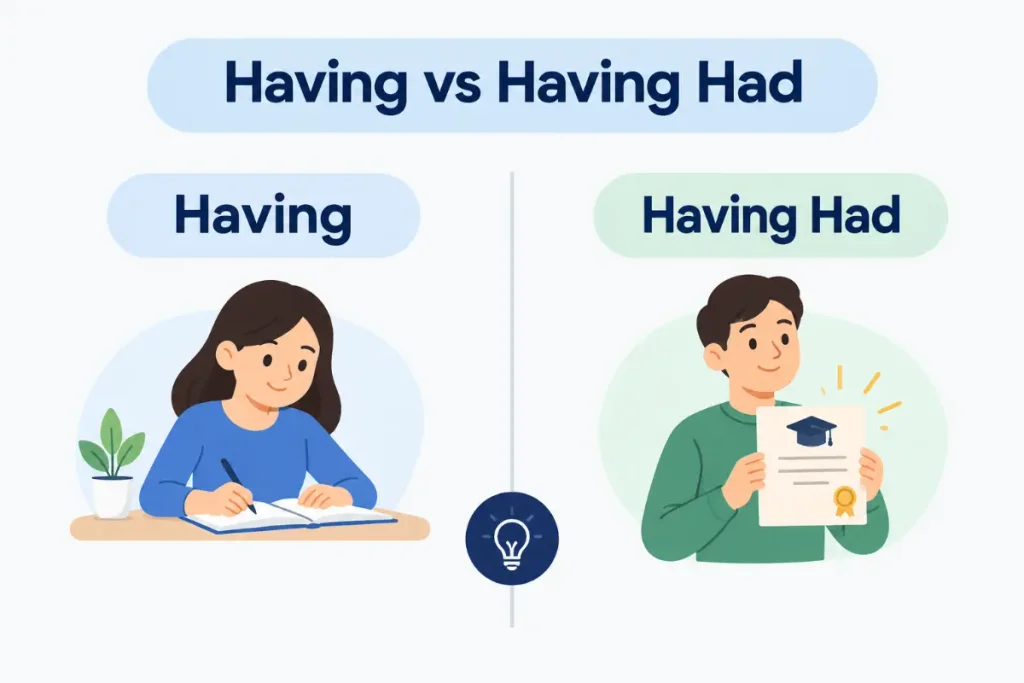
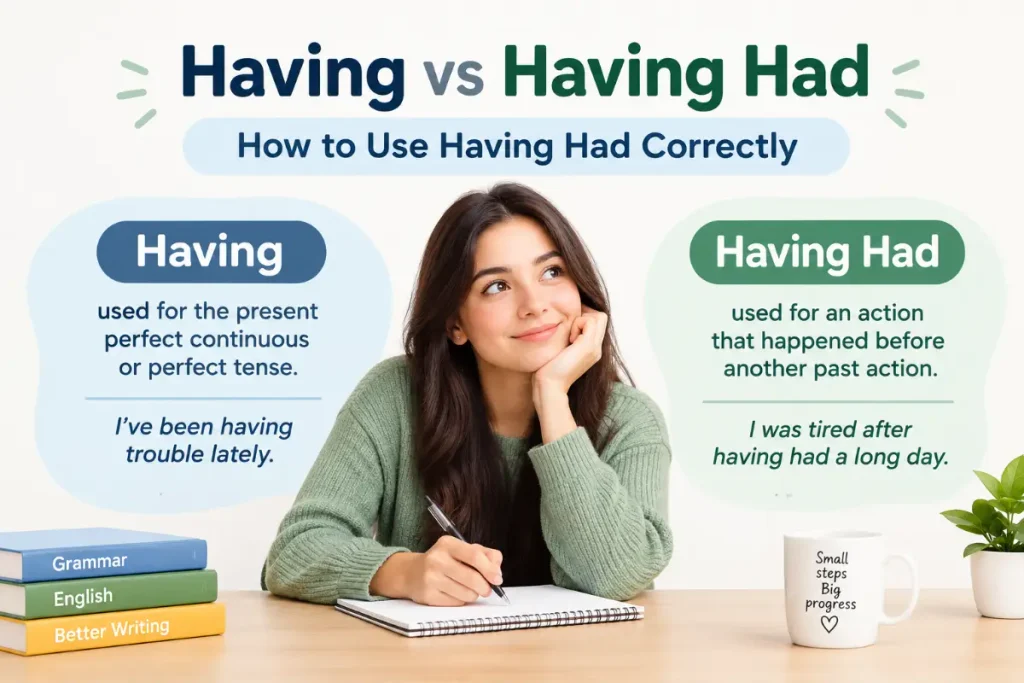
The main difference is the relationship between the experience and the surrounding sentence. Having can describe a situation or activity without presenting it as completed before another event. Having had usually emphasizes an earlier experience or condition that precedes another event or point in time.
Compare the following sentences.
Having a dog taught me responsibility. This sentence describes the experience of owning a dog as something that taught the speaker responsibility. It does not explicitly use a perfect participle to mark a completed experience before another event.
Having had a dog before, I knew how much care it required. This sentence emphasizes that the speaker had owned a dog previously. That earlier experience explains the speaker’s understanding.
The distinction becomes clearer when you compare their grammatical structures.
| Feature | Having | Having had |
|---|---|---|
| Structure | Having + noun or other complement, or having + past participle in a perfect construction | Having + had as the past participle of have |
| Main use | Describes an activity, condition, experience, or ongoing situation | Emphasizes an earlier experience or condition |
| Time relationship | Depends on the sentence and construction | Usually places the experience before another event |
| Example | Having a quiet room helps me focus. | Having had a quiet room before, I knew how useful it was. |
| Common contexts | Possession, activities, general conditions, continuous forms | Previous experiences, completed actions, earlier situations |
| Formality | Neutral and widely used | Neutral to formal, depending on context |
One important detail deserves attention. Having does not always describe an ongoing action, and having had does not automatically mean the situation happened a long time ago. The surrounding sentence establishes the exact time relationship.
How to Use Having Correctly
The best way to use having is to identify the role it plays in the sentence. It can describe possession, introduce an activity, function as a gerund, or form part of a continuous verb tense.
Having to Describe Possession
Use having when you want to discuss possession or access to something as a general situation.
Examples include Having a valid driver’s license is necessary for this job and Having reliable internet access helps remote employees work effectively. In both sentences, having describes a condition that provides a benefit or meets a requirement.
You can also use it to discuss personal circumstances. For instance, Having supportive friends made the transition easier describes the benefit of having that support. The sentence does not need to focus on the moment when the support began or ended.
Having to Describe Activities
Having can describe activities such as eating, meeting, talking, or experiencing a problem. In these cases, it often appears in continuous verb constructions.
For example, We are having dinner with our neighbors tonight describes a planned activity. She was having trouble opening the file describes a problem that existed at a particular time.
The meaning of have changes with the noun that follows it. Having lunch refers to eating lunch, while having trouble means experiencing difficulty. English uses have in many everyday expressions, so the noun often carries much of the meaning.
Having to Introduce an Earlier Action
Having can also appear in a perfect participle construction when followed by a past participle. The usual structure is having + past participle, as in Having finished the assignment, he went outside.
This form already communicates that one action happened before another. You do not need to add had unless the main verb itself is have. For example, Having completed the course, she applied for the job is correct, while Having had completed the course is incorrect in standard English.
English has many examples of two easily confused English words that look or sound similar but carry very different meanings, making context essential for accurate writing.
How to Use Having Had Correctly
Use having had when the verb have expresses an earlier experience, possession, condition, or activity and you want to connect that experience to another event.
For example, Having had a difficult morning, she decided to take a short walk. The difficult morning came first, and the decision followed. The opening phrase explains the reason for the later action.
Another example is Having had several chances to revise the essay, the student submitted the final draft. The phrase refers to opportunities that came before the submission. It also helps explain why the student was ready to turn in the work.
Having had often sounds natural in formal explanations, academic writing, and reflective statements. In casual conversation, speakers may prefer a simpler sentence such as I had a similar experience before, so I understood. Both versions can be correct, but the simpler one may sound more conversational.
Having Had to Describe Previous Experience
Having had is particularly useful when a previous experience explains a current opinion, decision, or reaction.
For example, Having had a bad experience with that airline, I booked a different carrier. The earlier experience influenced the later decision. Similarly, Having had the same teacher last year, Marcus knew what to expect connects previous familiarity with a current situation.
The construction can also refer to previous possession. Having had several different cars, she knew which features mattered most means that she had owned or used several cars before reaching the conclusion described in the main clause.
Having Had to Describe Completed Situations
You can use having had when a situation or condition existed before another event. It does not have to describe a deliberate action.
For example, Having had enough rest, the hikers continued their journey. The earlier condition of being well rested explains their readiness to continue. Likewise, Having had little time to prepare, the team kept the presentation simple explains why the team chose a straightforward approach.
The important point is the relationship between the two parts of the sentence. The earlier situation provides context for the main clause.
Having vs Having Had Examples
The following examples show how the two forms work in different contexts. Pay attention to the meaning of the opening phrase and the way it connects to the main clause.
Examples With Having
- Having a clear schedule helps me manage my workload.
- She is having lunch with her supervisor today.
- Having supportive coworkers makes a new job less stressful.
- We are having difficulty accessing the company website.
- Having enough savings gives the family more financial flexibility.
- Having a conversation with the teacher helped resolve the misunderstanding.
- He was having second thoughts about buying the house.
- Having reliable transportation makes commuting easier.
- They are having a small celebration after the graduation ceremony.
- Having patience is important when learning a new skill.
These examples demonstrate several functions. Some describe general conditions, some refer to activities in progress, and others use having as the subject of a sentence. The grammatical role depends on the full construction rather than on the word having alone.
Examples With Having Had
- Having had breakfast, she left for the office.
- Having had experience with similar projects, he knew where to begin.
- Having had enough time to prepare, the students felt confident.
- Having had several complaints about the product, the company revised its instructions.
- Having had a chance to review the contract, the client requested two changes.
- Having had little sleep the previous night, I struggled to concentrate.
- Having had the same instructor before, the students understood the expectations.
- Having had several interviews, she felt comfortable answering the questions.
- Having had a difficult conversation with his manager, he wanted time to reflect.
- Having had previous experience with the software, Nina helped train the new employees.
Each example presents an earlier experience or situation that relates to the main clause. The phrase usually gives a reason, background detail, or sequence of events.
Common Grammar Mistakes
The most common errors involve adding an unnecessary had, using the wrong participle, or creating a sentence in which the opening phrase does not match the person performing the main action.
Adding Had After the Wrong Verb Form
Incorrect: Having had finished the report, she emailed her supervisor.
Correct: Having finished the report, she emailed her supervisor.
The verb finish becomes finished in the perfect participle construction. Adding had after having had in this way creates an incorrect structure. Use having finished when the action is finishing the report, and use having had when the verb have itself is needed.
Confusing Having With Having Had
Incorrect: Having had a car makes commuting easier.
Correct: Having a car makes commuting easier.
The first sentence is awkward if the intended meaning is that car ownership generally makes commuting easier. Having had a car usually refers to previous ownership and normally needs a suitable main clause, such as Having had a car before, she understood the expenses involved.
Using the Wrong Past Participle
Incorrect: Having had ate breakfast, he left for work.
Correct: Having eaten breakfast, he left for work.
When you use the perfect participle construction with eat, the past participle is eaten. You do not need having had because the verb is eat rather than have. If you mean that someone ate breakfast before leaving, having eaten is the natural construction.
Creating a Dangling Modifier
Incorrect: Having had several delays, the airport was frustrating for passengers.
Correct: Having had several delays, the passengers were frustrated with the airport.
The opening phrase should logically describe the subject of the main clause. In the incorrect sentence, the airport appears to be the thing that had the delays, even though the intended meaning is that the passengers experienced them. Matching the opening phrase with the correct subject makes the sentence clearer.
The Difference Between Having Had and Had Had
Another form that can confuse learners is had had. Although it looks repetitive, it is grammatically correct because the first had is the auxiliary verb used to form the past perfect, while the second had is the main verb’s past participle.
For example, She had had breakfast before the meeting began. The past perfect places breakfast before another past event, the beginning of the meeting. In contrast, Having had breakfast, she joined the meeting uses a perfect participle phrase to connect the earlier meal with the later action.
Both constructions can express a similar time relationship, but they serve different grammatical roles. Had had forms a finite verb phrase that can serve as the main predicate of a clause. Having had is a nonfinite participle construction that usually depends on a main clause.
Compare these examples.
- She had had two interviews before receiving the offer.
- Having had two interviews, she felt prepared for the final round.
The first sentence uses the past perfect to locate one event before another past event. The second uses an opening phrase to provide background for the main clause.
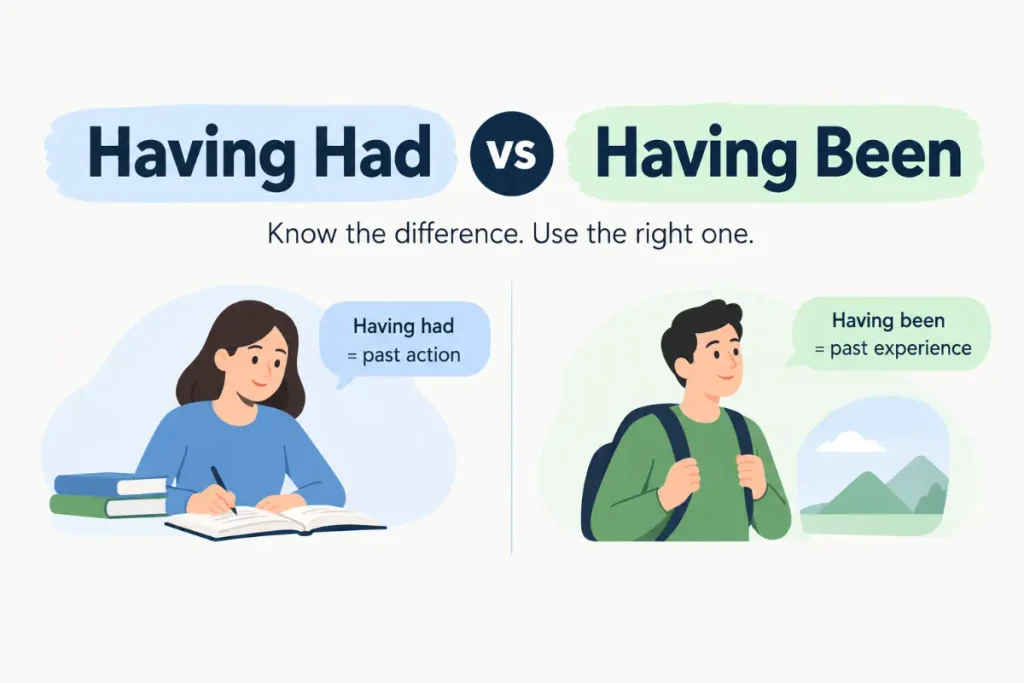
Having Had vs Having Been
Having had and having been are also different constructions. Having had uses the past participle of have, while having been uses the past participle of be. The choice depends on the meaning and the verb required by the sentence.
For example, Having had the flu last week, he stayed home to recover refers to a previous experience or condition. Having been sick last week, he stayed home to recover uses been to describe his earlier state of health.
The phrases can sometimes communicate similar background information, but they are not interchangeable in every sentence. Use having had when the idea involves having or experiencing something. Use having been when you need a form of be to describe a state, identity, location, or condition.
Formal and Casual Usage
Having and having had appear in both everyday and formal English. The main difference is that having had can sound more formal because it often introduces background information in a carefully structured sentence.
In a casual conversation, someone might say, I had a similar problem before, so I knew what to do. In a more formal account, the same idea could be expressed as Having had a similar problem before, I knew what to do. Both are grammatically acceptable, but the second version compresses the explanation into a participle phrase.
For professional emails and academic writing, having had can help connect an earlier experience with a later decision. However, clarity matters more than complexity. If the sentence becomes difficult to follow, use two shorter sentences instead.
How to Choose the Right Form
When deciding between having and having had, start by identifying the meaning of the verb have in your sentence. If you are describing possession, an activity, or a general condition, having may be enough. If you want to emphasize that a previous experience or condition came before another event, having had may fit better.
Next, check the rest of the sentence. Having had usually introduces background information and needs a main clause to complete the thought. For example, Having had enough time to prepare, the speaker answered the questions confidently is complete because the main clause explains what happened afterward.
Finally, consider the most natural wording for your audience. A sentence with having had may be precise and efficient, but a simpler construction can sometimes communicate the same meaning more clearly. Choose the form that accurately expresses the time relationship without making the sentence unnecessarily complicated.
Practice Exercises
Use these exercises to test your understanding. Choose having or having had to complete each sentence. Pay attention to the intended meaning and the relationship between the opening phrase and the main clause.
- ______ a reliable laptop makes remote work easier.
- ______ breakfast, Daniel left for school.
- ______ previous experience with the software, Maya helped the team.
- She is ______ trouble logging into her account.
- ______ enough time to prepare, the students felt confident.
- ______ a regular exercise routine can improve overall fitness.
- ______ several meetings that morning, the manager needed a break.
- They are ______ dinner with friends tonight.
Answers and Explanations
- Having. The sentence describes a general benefit of owning or accessing a reliable laptop.
- Having had. The phrase indicates that breakfast was finished before Daniel left.
- Having had. The sentence refers to Maya’s previous experience with the software.
- Having. The expression having trouble describes a problem she is experiencing now.
- Having had. The phrase presents preparation time as an earlier condition that explains the students’ confidence.
- Having. The phrase functions as the subject and describes the general benefit of maintaining an exercise routine.
- Having had. The meetings occurred before the manager needed a break.
- Having. The present continuous construction are having describes a planned or current activity.
These examples also show why context matters. Having is not automatically present tense, and having had is not simply another way to say had. The correct form depends on the grammatical structure and the relationship between events.
Learning the difference between “having” and “having had” can improve grammatical accuracy, just as choosing the correct verb depends on the direction of an action and the speaker’s perspective.
Frequently Asked Questions
What is the difference between having and having had?
Having can describe possession, an activity, a general condition, or an action connected to another event. Having had usually emphasizes an earlier experience, possession, or situation that came before another point in time. For example, having a car describes possession, while having had a car before refers to previous ownership.
Is having had grammatically correct?
Yes. Having had is grammatically correct when the verb have is used in a perfect participle construction. For example, Having had enough rest, she returned to work indicates that rest came before returning to work. The phrase is not redundant simply because it repeats forms of the same verb.
What does having had mean?
Having had usually means that someone experienced, possessed, or went through something before another event or point in time. In Having had a similar experience, I understood her concerns, the speaker’s earlier experience explains the understanding described in the main clause.
Can I start a sentence with having had?
Yes. You can begin a sentence with having had when the opening phrase logically connects to the subject of the main clause. For example, Having had several interviews, she felt ready for the final one is correct. The person who had the interviews is also the person who felt ready.
What is the difference between having had and had had?
Having had is a perfect participle construction that often introduces background information. Had had is the past perfect form of have and functions as a verb phrase in a clause. For example, Having had lunch, she returned to work differs in structure from She had had lunch before work began.
Is having had more formal than having?
Having had can sound more formal because writers often use it to connect earlier experiences with later events in a compact sentence. However, both forms are standard English. The best choice depends on meaning and context rather than formality alone.
Can having had describe possession?
Yes. Having had can refer to previous possession or access to something. For example, Having had several cars, he understood the cost of maintenance refers to his earlier experience with car ownership. Having, by contrast, can describe current or general possession, as in Having a car makes travel more convenient.
How can I practice using having and having had?
Practice by identifying the time relationship in each sentence. Use having for general conditions, activities, and appropriate participle constructions. Use having had when the verb have describes an earlier experience or situation that provides background for a later event. Reading your sentence aloud can also help you spot awkward or unnecessarily complicated phrasing.
Conclusion
The difference between having and having had comes down to grammar, meaning, and the relationship between events. Having can describe possession, activities, general conditions, and actions in participle constructions. Having had usually emphasizes an earlier experience or situation that helps explain something that happened later.
To choose correctly, look at the verb’s meaning and the sentence structure. Use having when it communicates your intended idea clearly, and use having had when you need to show that an experience or condition came first. Remember that had had is another valid construction with a different grammatical role. Once you understand these patterns, you can use both forms naturally in conversation, professional writing, and academic work.
Meta Description: