If you searched for dought vs doubt, you are probably trying to figure out which spelling is correct. The two words look similar, and because English contains many silent letters and unusual spelling patterns, it is easy to second guess yourself. Many people accidentally type dought when they really mean doubt, especially when writing quickly or relying on pronunciation.
The good news is that the answer is straightforward. Doubt is the correct spelling in modern English. It is the word recognized by dictionaries, style guides, schools, and professional writers. Dought is generally a misspelling of doubt, although it has a rare historical connection to older forms of English and should not be used in everyday writing.
This guide explains the difference in clear, practical language. You will learn the meaning of doubt, why the incorrect spelling appears so often, how to pronounce the word, how native speakers use it, and how to avoid common mistakes. By the end, you will know exactly which spelling belongs in emails, school assignments, business writing, and everyday conversations.
Quick Definition
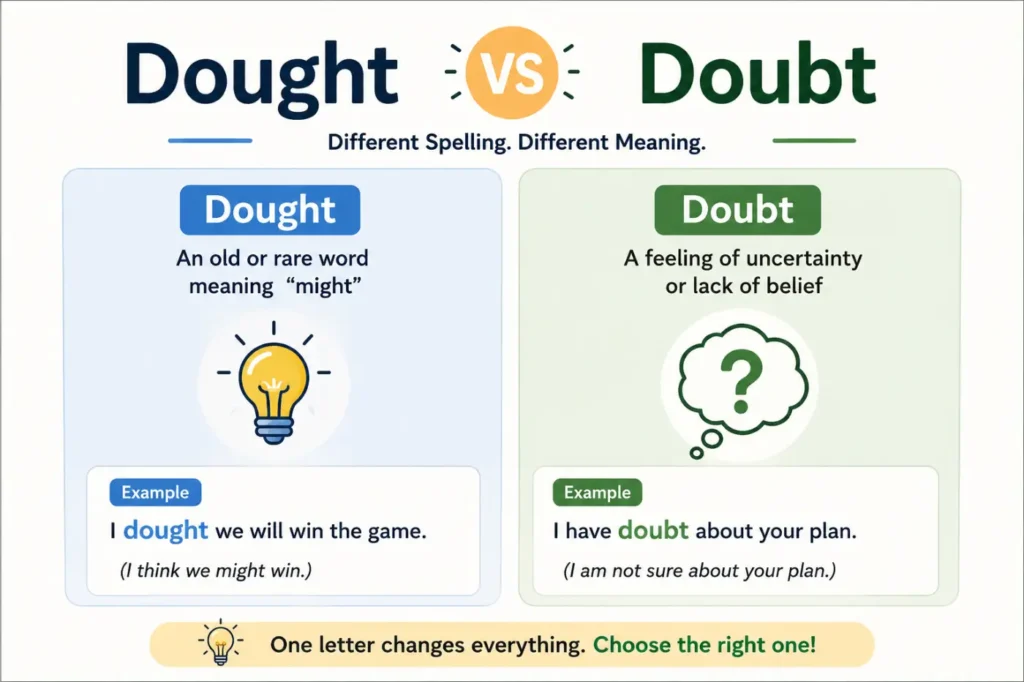
Doubt is the correct English word. It means a feeling of uncertainty or a lack of confidence about something. Dought is not a standard modern English word and is usually a spelling mistake. In almost every situation, you should use doubt when expressing uncertainty or questioning something.
Quick Answer
If you only need a quick answer, remember these key points.
- Doubt is the correct spelling.
- Dought is usually a misspelling.
- Use doubt in formal and informal writing.
- Dictionaries and style guides recognize doubt as the standard form.
- The spelling stays the same in American English, British English, Australian English, and Canadian English.
Just as understanding the difference between the difference between rugs and rags helps you choose the correct household term, knowing whether to use dought or doubt improves everyday writing accuracy.
Comparison Table
| Feature | Doubt | Dought |
|---|---|---|
| Part of speech | Noun Verb | Not a standard modern English word |
| Correct spelling | Yes | No in modern English |
| Meaning | Uncertainty or lack of confidence | Usually a misspelling of doubt |
| Origin | Old French and Latin | Rare historical form with different origins |
| Formality | Standard in all writing | Not used in standard writing |
| Common contexts | Everyday conversation education business literature | Typing errors historical references |
| Usage frequency | Extremely common | Very rare |
| Dictionary status | Recognized by major dictionaries | Generally not listed as a modern English word |
| Example | I doubt the report is accurate. | Dought is usually corrected to doubt. |
Meaning Of Both Terms
Although these spellings differ by only one letter, they are not interchangeable.
What Does Doubt Mean
Doubt refers to uncertainty, hesitation, or a lack of belief that something is true or will happen. It can function as both a noun and a verb, making it one of the most flexible words in everyday English.
As a noun, it describes a feeling.
Examples include:
- She had no doubt about her decision.
- His answer raised serious doubt.
- There is little doubt that the project will succeed.
As a verb, it expresses uncertainty.
Examples include:
- I doubt he will arrive on time.
- They doubted the accuracy of the results.
- We should not doubt her honesty without evidence.
The word appears frequently in conversation, journalism, academic writing, legal documents, and literature because uncertainty is a common part of everyday communication.
What Does Dought Mean
In modern English, dought is generally not considered a valid word for everyday writing. Most people who type it actually intend to write doubt.
You may occasionally encounter dought in discussions about historical language or older literary forms, but those cases are rare and unrelated to the modern meaning of doubt.
If your goal is clear and accurate communication, replace dought with doubt unless you are specifically discussing historical linguistics.
Key Differences
The difference between these spellings is much greater than it first appears. The first is a standard English word used every day. The second is almost always a spelling mistake.
Here are the main differences.
- Doubt is accepted by dictionaries and grammar guides.
- Dought is not standard modern English.
- Doubt can be used as both a noun and a verb.
- Dought should not replace doubt in normal writing.
- Professional editors automatically correct dought to doubt in nearly every context.
Understanding this distinction helps you avoid one of the more common spelling errors in English.
Which Spelling Is Correct
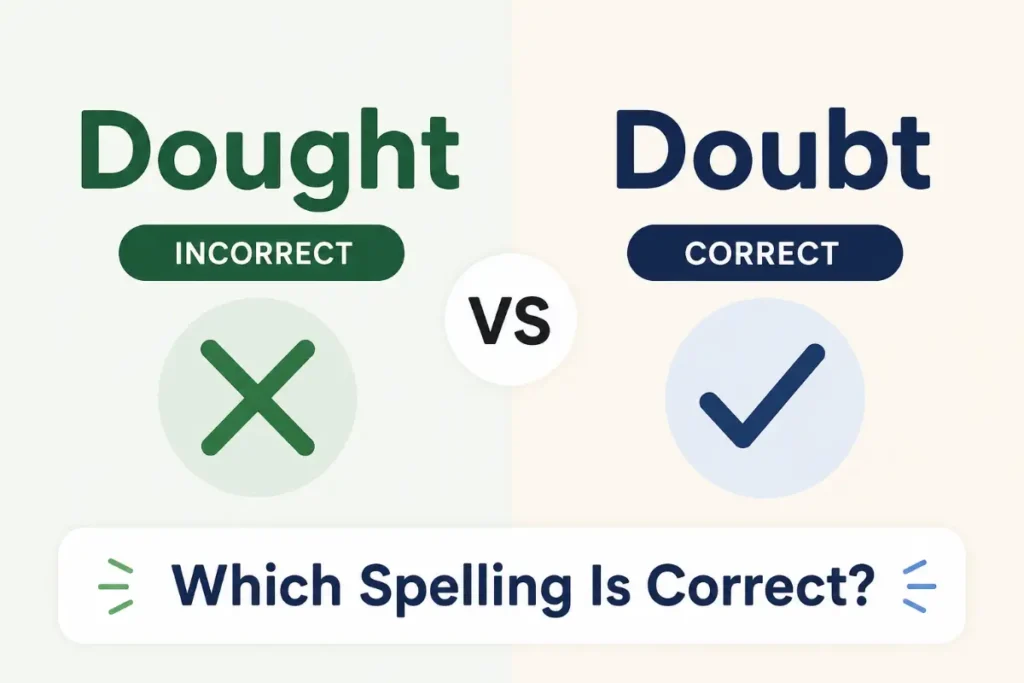
The correct spelling is doubt. This spelling appears in every major English dictionary and is used by schools, universities, newspapers, publishers, and professional editors around the world.
The incorrect spelling usually appears because English pronunciation can be misleading. The silent b is not pronounced, so some people assume another spelling may be acceptable.
It is not.
Whenever you want to express uncertainty, hesitation, suspicion, or a lack of confidence, write doubt. If you accidentally type dought, most spelling checkers will recommend changing it immediately.
Pronunciation Guide
One reason this mistake happens so often is that English spelling does not always match pronunciation.
IPA Pronunciation
Doubt
/daʊt/
Syllable Breakdown
The word has one syllable.
Doubt
Although the letter b appears in the spelling, it is completely silent.
Common Pronunciation Mistakes
Learners sometimes make these pronunciation errors.
- Pronouncing the silent b.
- Saying the word with two syllables.
- Confusing it with similar sounding words that end in ought.
Listening to native speakers quickly shows that the b is never spoken. This silent letter is one reason many people mistakenly write dought instead of doubt.
How To Remember The Correct Spelling
A simple memory trick can help you avoid this mistake for good. Think of the silent b as a hidden reminder that English spelling does not always match pronunciation. Even though you cannot hear it, the letter still belongs in the word.
Here are a few tips that make the spelling easier to remember.
- Think of the phrase without a doubt. You will almost always see the correct spelling in this common expression.
- Remember that doubt shares the silent b pattern with words like debt and subtle, where some letters remain in the spelling even though they are not pronounced.
- Read the word aloud while looking at the spelling. Repeating this habit helps connect the written form with its pronunciation.
- If your spell checker flags dought, treat it as a sign that you should replace it with doubt.
Most native speakers never question this spelling because they have seen it thousands of times in books, articles, and everyday writing. With a little practice, it becomes just as familiar.
Examples In Sentences
Reading real examples is one of the fastest ways to understand how a word should be used. Since doubt is the standard spelling, you will see it in everyday conversations, books, news articles, business emails, and academic writing. The spelling dought rarely appears outside typing mistakes or discussions about language.
Examples Using Doubt
These examples show the correct spelling in natural situations.
- I doubt the package will arrive before tomorrow.
- She had no doubt that she made the right decision.
- The teacher doubted the accuracy of the student’s answer.
- There is little doubt that regular practice improves your skills.
- He never doubted his friend’s honesty.
- The report raised doubt about the company’s claims.
- Scientists continue to test the theory without doubt or bias.
- We should not doubt the importance of good communication.
- Her confident explanation removed everyone’s doubt.
- If you have any doubt, ask for clarification before making a decision.
These examples demonstrate how naturally the word fits into both spoken and written English.
Examples Using Dought
The following examples show how the incorrect spelling often appears and how it should be corrected.
- I dought he will come today. → I doubt he will come today.
- She has no dought about the answer. → She has no doubt about the answer.
- They dought the results were accurate. → They doubted the results were accurate.
- My biggest dought was making the wrong choice. → My biggest doubt was making the wrong choice.
- We have no dought the project will succeed. → We have no doubt the project will succeed.
- He said he dought the story. → He said he doubted the story.
- There is some dought about the figures. → There is some doubt about the figures.
- I still dought their explanation. → I still doubt their explanation.
- The article contained the word dought several times. → The article should use doubt instead.
- My spell checker corrected dought immediately. → It suggested doubt as the correct spelling.
These comparisons make it clear that dought should normally be replaced with doubt.
Common Mistakes
The confusion between these spellings usually comes from pronunciation rather than grammar. Here are the mistakes people make most often.
Forgetting The Silent Letter
The b in doubt is silent. Because it is not pronounced, some writers accidentally replace the spelling with something that seems to match the sound. This is the most common reason the incorrect form appears.
Typing Too Quickly
Fast typing often produces spelling errors. When people rely on sound instead of memory, they may type dought without noticing the mistake. A careful proofread usually catches it.
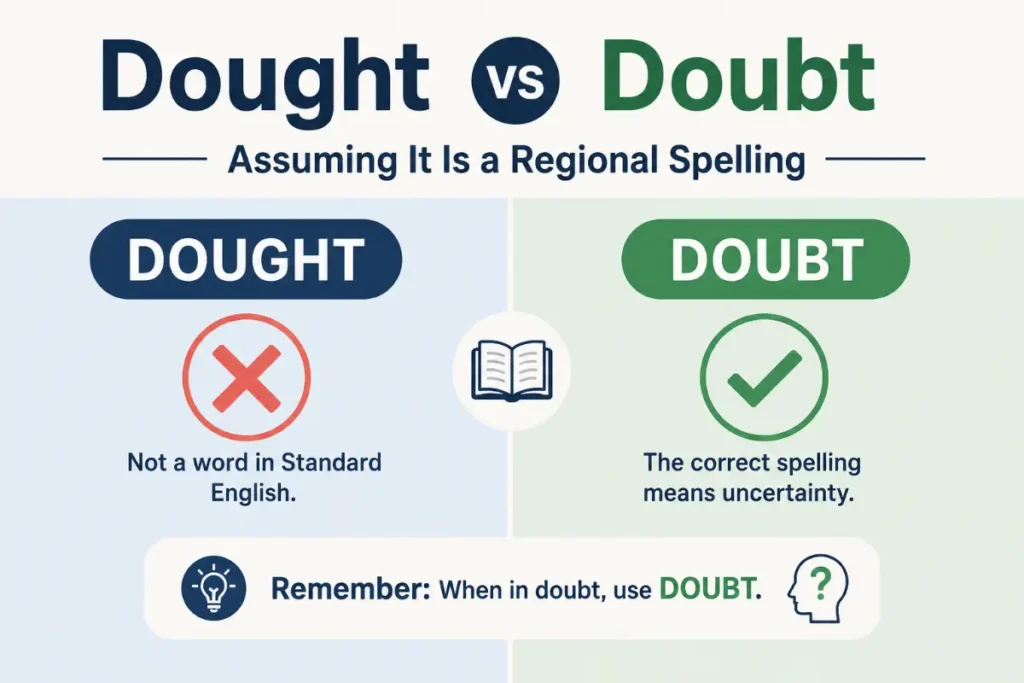
Assuming It Is A Regional Spelling
Some English words have American and British variations.
Examples include:
- Color and colour.
- Center and centre.
- Analyze and analyse.
That is not the case here. Doubt is the accepted spelling across all major varieties of English.
Trusting Internet Posts
Online forums and social media contain many spelling mistakes. Seeing the incorrect spelling repeatedly does not make it correct. Reliable dictionaries and professional publications consistently use doubt.
Ignoring Spell Check Suggestions
Modern writing tools usually recognize dought as an error. Instead of ignoring the suggestion, accept the correction unless you are quoting historical material.
If you enjoy clearing up spelling mistakes, another commonly confused spelling explains why grately is incorrect and when greatly should be used instead.
Etymology And Word Origin
The history of doubt stretches back many centuries. The word entered English from Old French doute, which came from the Latin verb dubitare, meaning to hesitate or be uncertain.
Over time, English kept the meaning while the spelling evolved. The silent b was added because of the word’s Latin origin, even though it was no longer pronounced.
This explains why modern spelling can seem confusing. The written form preserves part of the word’s history, while pronunciation has continued to change.
The spelling dought followed a different historical path and is not the modern descendant of doubt. Today, it survives mainly in discussions about historical language rather than everyday English.
Regional Usage
Unlike many spelling questions, this one has a simple answer.
American English
American English uses doubt in every situation, including education, journalism, business, government publications, and casual conversation.
British English
British English follows exactly the same spelling. You will find doubt in dictionaries, newspapers, universities, and published books throughout the United Kingdom.
Australian English
Australian English also recognizes doubt as the standard form. The alternative spelling does not appear in ordinary writing.
Canadian English
Canadian English follows the same convention. Although Canadian spelling sometimes combines American and British preferences, this word remains unchanged. No matter where English is spoken, the standard spelling is the same.
Grammar Rules
Understanding how doubt works in a sentence helps you write more naturally.
As A Noun
As a noun, the word refers to uncertainty or lack of confidence.
Examples include:
- There is no doubt about the result.
- Her answer removed every doubt.
- The decision created public doubt.
As A Verb
As a verb, it means to question or feel uncertain.
Examples include:
- I doubt that he forgot the meeting.
- They doubted the witness’s statement.
- Never doubt your ability to improve.
Common Expressions
Native speakers frequently use these expressions.
- Without a doubt.
- Beyond doubt.
- No doubt.
- Cast doubt on.
- In doubt.
Learning these phrases will help your writing sound more natural.
Common Sentence Patterns
You will often see structures like these.
- Doubt something.
- Doubt that plus a clause.
- Have doubts about something.
- Be in doubt.
- Leave no doubt.
These patterns appear regularly in everyday speech and professional writing.
Real Life Usage Examples
The word appears in almost every type of communication because people often express uncertainty, caution, or skepticism.
Daily Conversation
Friends and family use the word naturally.
Examples include:
- I doubt it will rain today.
- She has no doubt about her choice.
- We all doubted the rumor at first.
Academic Writing
Researchers and students use the word when discussing evidence, conclusions, or competing ideas.
Examples include:
- The findings leave little doubt.
- Scholars continue to debate the interpretation, but they do not doubt the authenticity of the manuscript.
Professional Communication
Business writing often uses the word carefully and objectively.
Examples include:
- There is some doubt about the proposed timeline.
- The audit raised doubt regarding the reported figures.
- We do not doubt your commitment to the project.
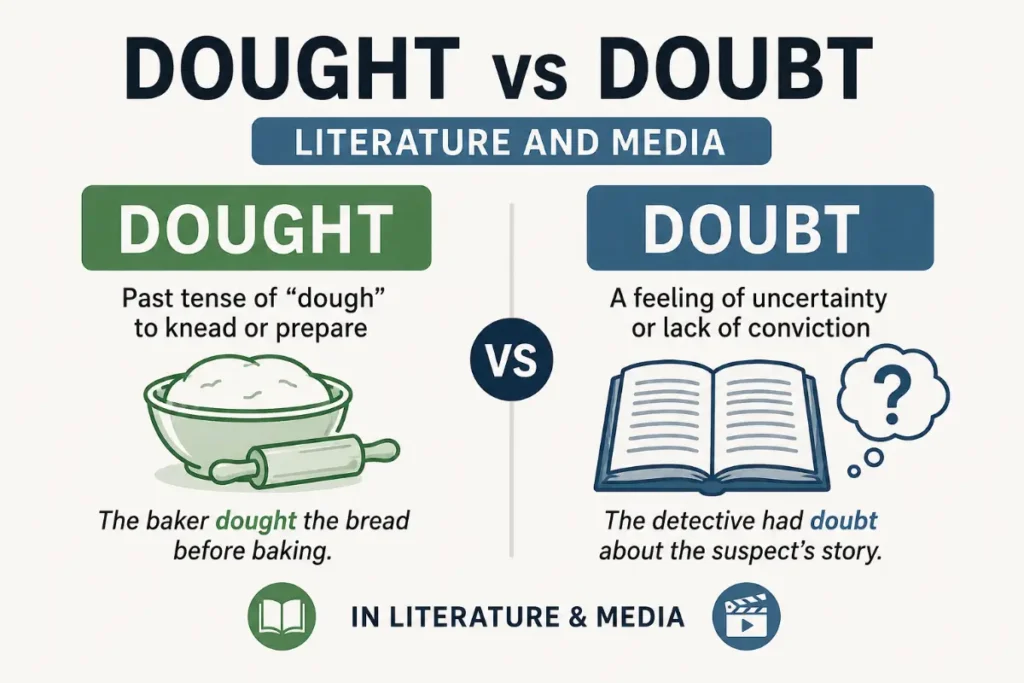
Literature And Media
Authors and journalists use doubt to describe uncertainty, conflict, or emotional tension.
Readers encounter the word in novels, newspapers, opinion pieces, biographies, and interviews because it communicates hesitation in a precise and familiar way.
Online Discussions
Questions about the spelling appear regularly on forums, Reddit, and language communities. Most discussions reach the same conclusion. Doubt is the correct modern spelling, while dought is almost always a typo or a misunderstanding caused by pronunciation.
Related Words And Confused Terms
English contains many words that are easy to mix up because of silent letters, similar pronunciation, or spelling patterns. Learning these related words helps you avoid common writing mistakes and improves your confidence.
| Word | Meaning | Standard English |
|---|---|---|
| Doubt | Uncertainty or lack of confidence | Yes |
| Doubtful | Feeling uncertain or unlikely | Yes |
| Doubtless | Almost certainly or probably | Yes |
| Undoubtedly | Without question | Yes |
| Skepticism | A questioning attitude | Yes |
| Uncertainty | A state of not being sure | Yes |
| Hesitation | A pause caused by uncertainty | Yes |
| Suspicion | A feeling that something may be wrong | Yes |
| Dought | Usually a misspelling of doubt in modern English | No |
You may also come across these related ideas when reading or writing about uncertainty.
- Confidence.
- Belief.
- Trust.
- Certainty.
- Conviction.
- Question.
- Verification.
- Evidence.
- Assumption.
- Reliability.
These words often appear alongside doubt because they describe different levels of confidence or uncertainty.
Writers who often mix up silent letters may also benefit from learning the correct spelling of stitch, another example of a frequently misspelled English word.
Expert Language Insight
From an editor’s perspective, this spelling question has one clear answer. In modern English, doubt is the correct word. If dought appears in an article, email, school assignment, or business document, it is almost always corrected during proofreading.
One reason this mistake is so common is that English spelling preserves historical forms even after pronunciation changes. The silent b in doubt is a good example. Although native speakers never pronounce it, they still recognize the standard spelling immediately because they have seen it throughout their lives.
Professional editors also pay attention to context. If a writer is discussing historical language, medieval texts, or older literary forms, dought may appear as part of that discussion. Outside those specialized contexts, using it instead of doubt creates confusion and reduces credibility.
A practical editing habit is to pause whenever you type the word and ask yourself if you are expressing uncertainty. If the answer is yes, doubt is almost certainly the spelling you need.
Frequently Asked Questions
Is dought a real word?
In modern English, dought is not considered a standard word. It occasionally appears in historical or linguistic discussions, but it should not replace doubt in everyday writing. If you are expressing uncertainty, always use doubt.
Which spelling is correct in American English?
American English uses doubt. The spelling is the same in newspapers, schools, universities, business writing, and government publications. There is no accepted American variant using dought.
Does British English use dought?
No. British English also uses doubt. Unlike words such as color and colour, this spelling does not change between major English varieties.
Why do people type dought instead of doubt?
The mistake usually happens because the silent b is not pronounced. Some writers spell the word the way they think it sounds, especially when typing quickly or learning English as a second language.
What are some synonyms for doubt?
Common synonyms include uncertainty, hesitation, skepticism, suspicion, and question. The best choice depends on the sentence because each word carries a slightly different meaning and tone.
How do you pronounce doubt?
The standard pronunciation is /daʊt/. It has one syllable, and the b is silent. Native speakers pronounce it as dout, which explains why learners sometimes misspell it.
Can I use dought in a sentence?
In normal English writing, you should avoid using dought. If you mean uncertainty or hesitation, use doubt instead. The only exception is when discussing historical language or quoting an old text that contains the word.
Why do people search for dought vs doubt?
Many people hear the word before they see it written. Because the silent b is invisible in speech, they naturally wonder if another spelling exists. Search engines receive this question regularly from students, English learners, and native speakers checking their spelling.
Conclusion
The answer is simple. Doubt is the correct spelling in modern English. It is recognized by dictionaries, educators, publishers, and professional editors, and it should be used whenever you want to express uncertainty, hesitation, or a lack of confidence.
The spelling dought is usually a mistake rather than an accepted alternative. Although it has rare historical connections, it does not belong in everyday communication. Replacing it with doubt will make your writing clearer, more accurate, and more professional.
If you remember only one rule, make it this one. The word includes a silent b, even though you cannot hear it. That small detail makes all the difference between a spelling error and polished writing.
With regular reading and practice, the correct spelling soon becomes second nature. Once you recognize the pattern, you will write doubt confidently in emails, essays, reports, and conversations without stopping to think about it.