Have you ever typed time flies and paused for a second, wondering if it should be time flys instead? It’s a common question because both words look possible at first glance. One follows a familiar spelling pattern, while the other seems like it could be the present tense of fly. That’s exactly where the confusion begins.
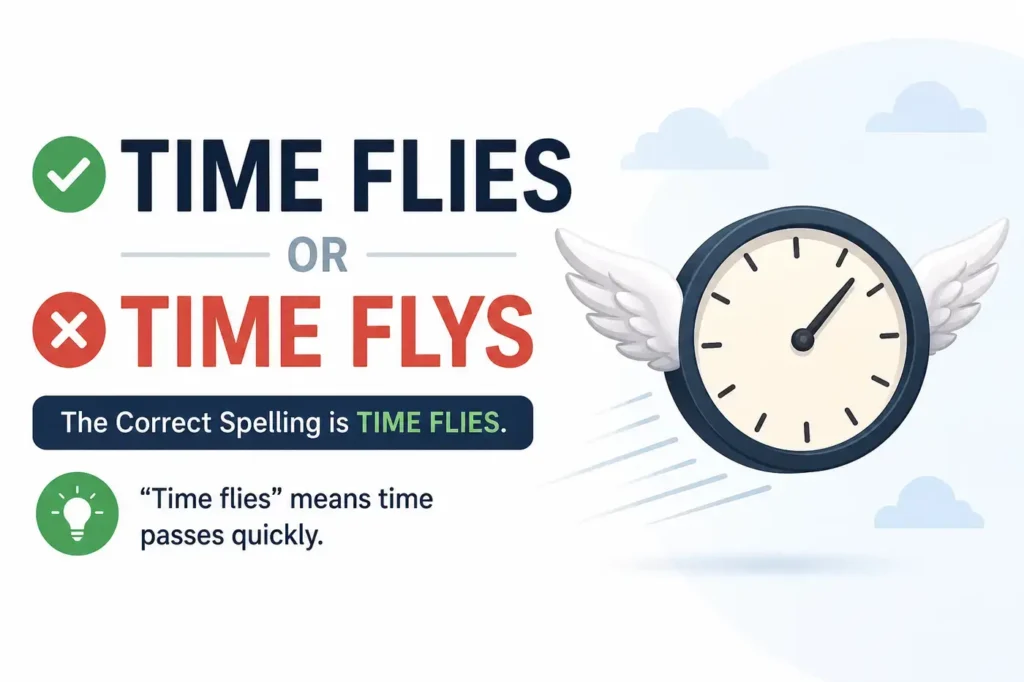
The correct phrase is time flies. In this expression, flies is the third person singular form of the verb fly, so it follows the standard grammar rule for present simple verbs. Time flys is a spelling mistake and isn’t accepted in standard English.
This phrase has been part of everyday English for generations because it captures a feeling almost everyone experiences. A busy week disappears in what feels like a moment. Childhood seems to pass in the blink of an eye. A vacation ends before you’re ready to go home. The saying reminds us that our sense of time often changes depending on what we’re doing.
In this guide, you’ll learn why flies is correct, why flys is incorrect, how the phrase developed, and how native speakers use it in everyday conversations. You’ll also find grammar explanations, pronunciation tips, real world examples, common mistakes, and expert writing advice to help you use the expression with confidence.
Quick Definition
The correct phrase is time flies because flies is the proper third person singular form of the verb fly. Time flys is a misspelling and isn’t grammatically correct. The expression means that time seems to pass quickly, especially during enjoyable or busy moments.
Quick Answer
If you’re looking for the correct spelling, the answer is straightforward. Always write time flies.
Here’s why.
- Time is the subject of the sentence.
- Flies is the correct present simple verb that agrees with the singular subject.
- Flys isn’t an accepted verb form in standard English.
- The phrase is used to express that time seems to pass more quickly than expected.
A simple way to remember it is this. If you can say he flies or she flies, you can also say time flies because all three subjects are singular.
Comparison Table
| Feature | Time Flies | Time Flys |
|---|---|---|
| Grammar | Correct | Incorrect |
| Part of Speech | Phrase with noun and verb | Misspelled phrase |
| Meaning | Time passes quickly | No accepted meaning |
| Standard English | Yes | No |
| Formal Writing | Appropriate | Incorrect |
| Informal Writing | Appropriate | Incorrect |
| Common Contexts | Conversation books speeches articles social media | Typographical error |
| Usage Frequency | Extremely common | Rare and considered a mistake |
| Example | Time flies when you’re having fun. | Time flys when you’re having fun. ❌ |
Meaning Of The Phrase
The expression time flies means that time seems to move very quickly. It doesn’t suggest that time literally flies through the air. Instead, it’s a figurative expression that describes our perception of time.
People often say it after realizing that days, months, or even years have passed faster than expected. The phrase is especially common during happy experiences, busy periods, holidays, and major life events.
For example, someone might say:
- I can’t believe we’ve been friends for ten years. Time flies.
- Time flies when you’re spending time with family.
- Looking through old photos reminds me how quickly life changes.
The saying reflects human experience more than the actual passage of time. Every hour contains the same number of minutes, but our minds don’t always experience them the same way.
Understanding Each Word
Looking at the individual words makes the grammar much easier to understand.
Time
Time is a singular noun. It refers to the ongoing progression of moments, events, and experiences. In this phrase, it acts as the subject of the sentence.
The word appears in countless English expressions because it’s one of the most fundamental ideas people talk about.
Examples include:
- Time heals many wounds.
- Time changes everything.
- Time waits for no one.
- Time is valuable.
- Time moves forward.
Flies
In this expression, flies is the present simple form of the verb fly.
English grammar follows a predictable pattern for most singular subjects.
- I fly.
- You fly.
- We fly.
- They fly.
- He flies.
- She flies.
- It flies.
Since time is singular, it follows the same rule as he, she, and it. That’s why flies is the correct verb form.
It’s worth noting that flies can also be the plural noun referring to flying insects. In the phrase time flies, however, it’s clearly functioning as a verb.
Key Differences
The confusion between these two forms comes down to grammar, not meaning. One is a correct verb form, while the other is simply a spelling mistake.
Here’s a closer look at the differences.
| Time Flies | Time Flys |
|---|---|
| Grammatically correct | Grammatically incorrect |
| Uses the correct third person singular verb | Uses an incorrect spelling |
| Accepted in dictionaries and style guides | Not accepted in standard English |
| Common in speech and writing | Usually appears as a typing or spelling error |
You can also remember the difference with these simple points.
- Add ies when the verb fly changes to the third person singular.
- Don’t write flys because that spelling doesn’t follow English verb rules.
- The same pattern appears in words like tries, cries, and replies.
Learning this rule will help you spell many other verbs correctly, not just this expression.
Which Form Is Correct
The only correct choice is time flies.
The reason comes from a standard grammar rule. When a singular subject ends with a verb like fly, the y changes to ies in the third person singular present tense.
Here are similar examples.
- He flies to New York every month.
- She tries her best every day.
- The baby cries at night.
- My neighbor replies quickly to emails.
- Time flies faster than we realize.
Notice that all of these verbs follow the same spelling pattern. Once you recognize the rule, the correct phrase becomes much easier to remember.
Pronunciation Guide
Although people often confuse the spelling, the pronunciation is rarely a problem.
Time
IPA pronunciation:
/taɪm/
Syllable breakdown:
Time
Flies
IPA pronunciation:
/flaɪz/
Syllable breakdown:
Flies
When spoken together, the phrase sounds smooth and natural.
/taɪm flaɪz/
Common pronunciation mistakes are uncommon because native speakers use this expression frequently. Most errors happen while writing, not while speaking.
Expert Language Insight
Professional editors rarely see time flys used intentionally. In almost every case, it’s a simple spelling mistake caused by applying the wrong rule to the verb fly.
The easiest way to avoid the error is to think about the subject instead of the phrase itself. Since time is singular, the verb must match it. That automatically gives you flies, just as you would write he flies or it flies.
Many learners remember the phrase time flies when you’re having fun, but they don’t always understand why it’s written that way. Learning the grammar behind the expression is far more useful than memorizing the phrase because the same rule applies to many other English verbs.
Time Flies Examples In Sentences
The best way to remember the correct phrase is to see it in everyday situations. These examples show how native English speakers naturally use the expression in conversations, writing, and daily life. Notice that time flies always expresses the feeling that time passes more quickly than expected.
Examples Using Time Flies
- Time flies when you’re having fun with friends.
- I can’t believe it’s already Friday. Time flies.
- Time flies during the holidays because everyone stays busy.
- Looking through old family photos reminds me that time flies.
- My children have grown so much. Time flies.
- We started this business ten years ago, and time flies.
- Summer vacation always feels too short because time flies.
- It feels like we graduated yesterday. Time flies.
- My grandparents always say that time flies as you get older.
- After working on the project all afternoon, we were surprised to see it was evening. Time flies.
Examples Using Time Flys
You’ll occasionally see time flys online, but every example below is incorrect because flys isn’t the proper verb form.
- ❌ Time flys when you’re having fun.
- ❌ Time flys so fast these days.
- ❌ I can’t believe how quickly time flys.
- ❌ Time flys after you become a parent.
- ❌ They say time flys during vacations.
- ❌ Time flys when you’re busy at work.
- ❌ It feels like time flys every weekend.
- ❌ My teacher wrote that time flys quickly.
- ❌ Time flys faster than I expected.
- ❌ I never realized how fast time flys.
Each sentence should use flies instead of flys.
Common Mistakes
Most people don’t write time flys because they misunderstand the meaning of the phrase. They usually make the mistake because of English spelling rules. Once you understand why the verb changes, the correct spelling becomes much easier to remember.
Here are the mistakes editors see most often.
Writing Flys Instead Of Flies
This is the most common mistake.
The verb fly changes to flies in the present simple tense when the subject is singular.
Examples:
- He flies every week.
- The bird flies south for the winter.
- Time flies when you’re having fun.
The spelling flys isn’t accepted as a present tense verb in standard English.
Forgetting The Y To IES Rule
Many English verbs ending in y follow the same spelling pattern.
Compare these examples.
| Base Verb | Correct Form |
|---|---|
| Fly | Flies |
| Try | Tries |
| Cry | Cries |
| Reply | Replies |
| Carry | Carries |
Once you learn this rule, you’ll avoid similar spelling mistakes in many other words.
Thinking The Phrase Is Informal Grammar
Some people assume time flies is only an informal saying. That’s not true.
The expression appears in books, newspapers, academic writing, speeches, and professional communication. It’s an established English idiom with correct grammar.
Confusing The Verb With The Noun
The word flies can be either a verb or the plural form of the insect fly.
Compare these examples.
- Time flies quickly. Verb
- Flies gathered around the fruit. Plural noun
The surrounding words make the meaning clear.
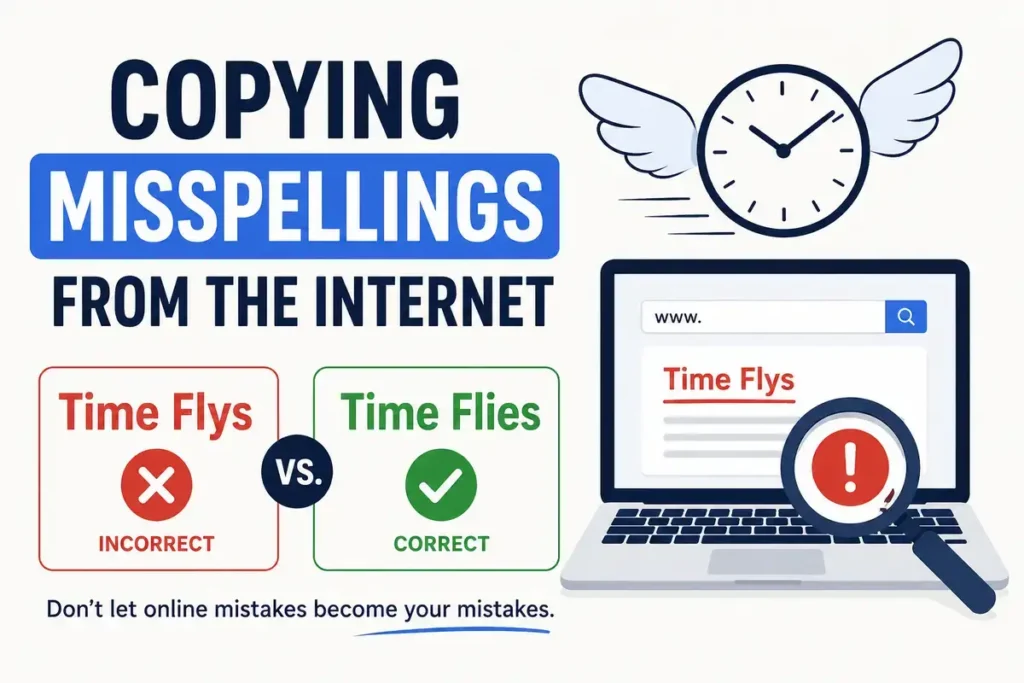
Copying Misspellings From The Internet
Search engines and social media often contain spelling mistakes because anyone can publish content online.
Before trusting a phrase, check a reliable dictionary or grammar reference instead of assuming the most repeated spelling is correct.
Word Origin And History
The phrase has been used in English for centuries. It reflects the idea that people experience the passing of time differently depending on what they’re doing.
The verb fly comes from Old English flēogan, meaning to move through the air. Over time, English speakers began using fly figuratively to describe anything that seemed to move very quickly.
That’s why we say:
- Time flies.
- The evening flew by.
- The weekend flew past.
- Summer flew by.
- The years have flown.
These expressions don’t describe physical movement. They describe our perception of time.
The famous Latin expression Tempus fugit, which means time flies, helped popularize the idea long before it became common in modern English. Writers, philosophers, and poets have used the expression for centuries to remind people that life passes quickly.
Regional Usage
Unlike some English words that have different spellings in different countries, this phrase stays the same across the major varieties of English.
American English
American English uses time flies in both spoken and written communication. You’ll hear it in conversations, television shows, books, classrooms, and business settings.
British English
British English uses exactly the same phrase. There isn’t an alternative spelling or grammatical variation.
Australian English
Australians also say time flies when talking about how quickly days, months, or years seem to pass.
Canadian English
Canadian English follows the same usage. Dictionaries and style guides consistently recognize time flies as the correct form.
Although vocabulary and spelling sometimes differ between these regions, this expression remains unchanged because it follows the same grammar rules everywhere English is spoken.
Grammar Rules
Understanding the grammar behind the phrase makes it much easier to remember the correct spelling.
Parts Of Speech
Each word has a different job.
- Time is a singular noun.
- Flies is a present simple verb.
Together they form a complete independent clause.
Subject And Verb Agreement
English verbs must agree with their subjects.
Compare these examples.
- I fly.
- You fly.
- We fly.
- They fly.
- He flies.
- She flies.
- It flies.
- Time flies.
Since time is singular, the verb changes to flies.
Present Simple Tense
The phrase uses the present simple tense because it expresses a general truth rather than a specific event.
Other examples include:
- Practice makes progress.
- Honesty builds trust.
- Experience teaches valuable lessons.
- Time flies.
These statements describe ideas that are generally true.
Common Sentence Patterns
Native speakers often use the phrase in patterns like these.
- Time flies when you’re busy.
- Time flies during the holidays.
- Time flies with good company.
- Time flies before you realize it.
- Time flies as children grow up.
Learning these patterns helps you sound more natural in both speaking and writing.
Real Life Usage Examples
The phrase appears in many different situations because almost everyone has experienced time passing more quickly than expected.
Daily Conversation
People often say it after noticing how quickly a period of time has passed.
Examples include:
- I can’t believe school starts next week. Time flies.
- We’ve lived here for five years already. Time flies.
Academic Writing
Teachers and researchers may use the expression in discussions about human perception, memory, and psychology, especially when explaining how people experience the passage of time differently.
Professional Communication
Managers sometimes use the phrase during retirement speeches, work anniversaries, or project celebrations.
For example:
- It’s hard to believe we’ve worked together for twenty years. Time flies.
Literature
Novelists and memoir writers frequently use the expression to show the passage of years or to create an emotional connection between events.
Media And Entertainment
You’ll hear the phrase in movies, television shows, interviews, podcasts, and songs because it’s familiar, memorable, and immediately understood by audiences around the world.
One of the best known versions is the saying Time flies when you’re having fun, which reminds us that enjoyable moments often seem much shorter than they really are.
Related Words And Commonly Confused Terms
Once you understand why flies is correct, you’ll notice that the same grammar rule appears in many other English verbs. Learning these related words makes it easier to avoid similar mistakes in the future.
Here are some verbs that follow the same spelling pattern.
| Base Verb | Correct Third Person Singular Form |
|---|---|
| Fly | Flies |
| Try | Tries |
| Cry | Cries |
| Reply | Replies |
| Carry | Carries |
| Hurry | Hurries |
| Study | Studies |
| Worry | Worries |
These verbs all end with a consonant followed by y. In the present simple tense, the y changes to ies when the subject is singular.
You might also come across expressions that describe the passage of time in different ways.
- Time passes quickly.
- Time goes by fast.
- Before you know it.
- In the blink of an eye.
- Like yesterday.
- Time waits for no one.
- The years slipped away.
- The days flew by.
Each expression carries a slightly different tone, but they all communicate the same basic idea that time seems to move faster than we expect.
Time Flies Meaning In Everyday English
Although the phrase has a simple definition, native speakers use it in many different situations. It usually expresses surprise, nostalgia, or appreciation after realizing how quickly a period of time has passed.
For example, parents often say time flies while watching their children grow up. Friends might use it during a reunion after many years apart. Retirees frequently mention it while reflecting on their careers, and travelers often say it at the end of a memorable vacation.
The phrase doesn’t describe time itself. Instead, it describes our perception of time. Moments filled with meaningful experiences often seem much shorter than they actually are.
Because of that, the expression works naturally in both casual conversations and formal writing.
Time Flies When You’re Having Fun
One of the most famous English sayings is:
Time flies when you’re having fun.
The expression means enjoyable experiences often seem shorter because we’re fully engaged in the moment. When we’re bored, a single hour can feel endless. During an exciting event, that same hour may disappear before we notice.
Although people sometimes shorten the saying to simply time flies, both versions communicate the same idea.
You’ll hear this expression in conversations such as these.
- Our vacation ended so quickly. Time flies when you’re having fun.
- The weekend disappeared before we knew it.
- The kids played outside all afternoon because time flies when you’re enjoying yourself.
It’s one of the most recognizable idioms in English and continues to appear in books, films, speeches, and everyday conversation.
Popular Time Flies Quotes
Writers, philosophers, and public speakers have reflected on the passage of time for centuries. These well known quotes capture that universal experience.
- Time flies over us, but leaves its shadow behind. Nathaniel Hawthorne
- Lost time is never found again. Benjamin Franklin
- The two most powerful warriors are patience and time. Leo Tolstoy
- Time is what we want most, but what we use worst. William Penn
- Time flies when you’re having fun.
Although each quote approaches time from a different perspective, they all remind us that every moment has value.
Funny Ways People Use The Phrase
Because almost everyone relates to the feeling of time passing quickly, the expression often appears in jokes and lighthearted conversations.
Here are a few examples.
- Time flies.., especially when deadlines are chasing you.
- Time flies until Monday morning arrives.
- My paycheck disappears so fast that time seems slow by comparison.
- Time flies at work, but somehow the last five minutes take forever.
- Time flies when someone else is doing the dishes.
Humor works because it exaggerates everyday experiences that people instantly recognize.
Expert Language Insight
From an editor’s perspective, time flys stands out immediately because it breaks a basic subject and verb agreement rule. Native speakers almost never write it intentionally. In most cases, it’s simply a typing mistake or a misunderstanding of how verbs ending in y change in the present tense.
Experienced writers don’t memorize the phrase on its own. They apply the grammar rule instead. Once you know that singular subjects take flies, the correct spelling becomes automatic in every sentence.
Another point worth remembering is that this expression functions as an idiom. Readers understand it instantly because it’s deeply rooted in everyday English. That makes it an excellent choice in conversations, essays, speeches, articles, and creative writing.
Frequently Asked Questions
Is time flies or time flys correct?
Time flies is the correct phrase. The word flies is the proper third person singular form of the verb fly. Time flys is a spelling mistake and isn’t accepted in standard English.
Why is it flies instead of flys?
English verbs ending with a consonant followed by y usually change the y to ies in the third person singular present tense. That’s why we write flies, tries, cries, and replies instead of flys, trys, crys, or replys.
What does time flies mean?
The phrase means time seems to pass very quickly. People often use it after realizing that days, months, or years have gone by faster than expected, especially during enjoyable or meaningful experiences.
Is time flies an idiom?
Yes. It’s one of the most common English idioms. The expression doesn’t describe time literally flying through the air. Instead, it uses figurative language to describe how quickly time appears to pass.
Can I use time flies in formal writing?
Yes. The phrase is appropriate in formal and informal writing when it fits the context. It’s commonly used in speeches, memoirs, magazine articles, essays, and books because it’s widely recognized and easy to understand.
What is the full saying?
The best known version is Time flies when you’re having fun. People often shorten it to Time flies, but both forms carry the same central idea.
Is the phrase used in British and American English?
Yes. The expression is standard in American English, British English, Australian English, Canadian English, and other major varieties of English. The spelling and meaning remain the same across all regions.
How can I remember the correct spelling?
Think of another singular subject like he or she. You naturally say he flies and she flies, so the same grammar rule gives you time flies. Remembering the rule is much more reliable than memorizing the phrase by itself.
Conclusion
The answer is simple. Time flies is the correct phrase, while time flys is a spelling mistake.
The difference comes from a basic grammar rule. Since time is a singular noun, it takes the third person singular form of the verb fly, which becomes flies. The same pattern appears in verbs like tries, cries, and replies, making the rule consistent across English.
Beyond grammar, the expression has become one of the most familiar idioms in the language. It captures a feeling everyone understands. Happy moments, busy schedules, family milestones, and memorable experiences often seem to disappear before we realize how much time has passed.
If you ever hesitate while writing, remember one simple comparison. You’d naturally write he flies or she flies, so the correct expression is time flies. Once that grammar rule becomes a habit, you’ll never second guess the phrase again.