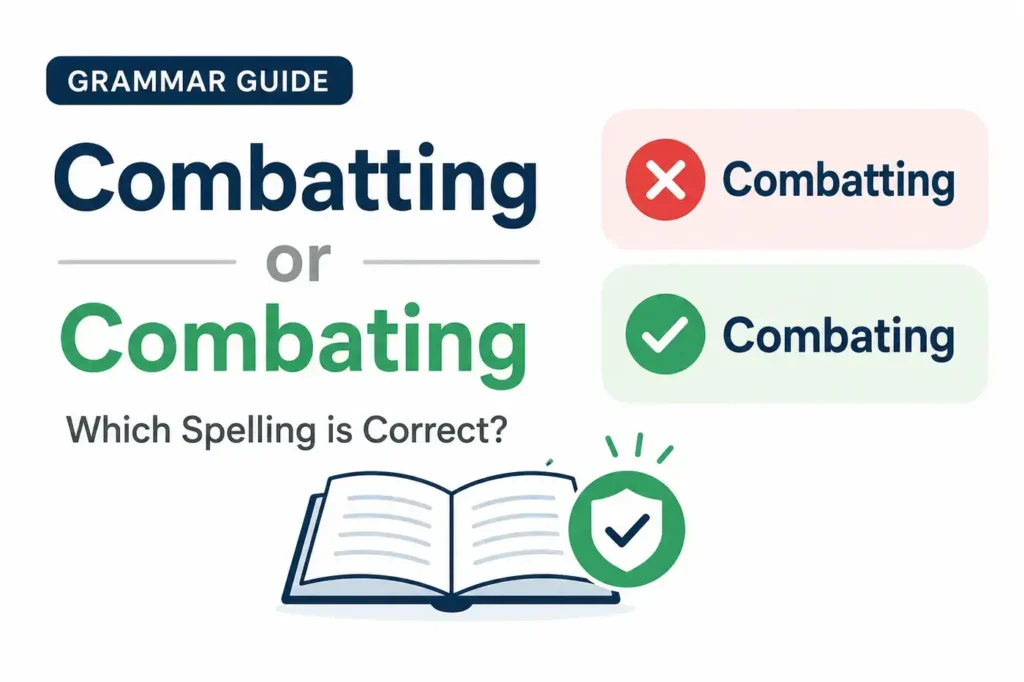
If you’ve searched combatting or combating, chances are you’ve seen both spellings and wondered which one is actually right. That’s a fair question because dictionaries, style guides, and online articles don’t always seem to agree at first glance. The confusion becomes even more noticeable when you compare American English with British English or read content from different publishers.
The short answer is simple. Combating is the standard and preferred spelling in modern English. You’ll find it in major dictionaries, newspapers, academic writing, business communication, and most professional publications. Combatting isn’t always considered wrong, but it’s much less common and usually appears because some writers apply the double consonant spelling rule to the verb combat.
In this guide, you’ll learn why combating is the form most editors recommend, when combatting may still appear, how major style guides treat both spellings, and what native speakers actually use. You’ll also find pronunciation tips, sentence examples, grammar explanations, common mistakes, regional differences, and practical advice that will help you choose the right spelling with confidence.
Quick Definition
Combating is the standard present participle and gerund form of the verb combat, meaning to fight against, prevent, reduce, or oppose something. Combatting is an uncommon spelling that occasionally appears but is rarely preferred in modern English. For most writing, combating is the recommended choice.
Quick Answer
If you’re writing for school, work, publishing, or online content, use combating.
Here’s why.
- It’s the preferred spelling in modern dictionaries.
- It’s the form most professional editors expect.
- It’s widely used in newspapers, academic writing, and business communication.
- It follows the spelling you’ll see in trusted language references.
You may still come across combatting, especially in older texts or informal online discussions. Even so, combating is the safer and more widely accepted choice for almost every situation.
Comparison Table
| Feature | Combating | Combatting |
|---|---|---|
| Part of speech | Present participle and gerund | Present participle and gerund |
| Base verb | Combat | Combat |
| Meaning | Fighting against or working to reduce something | Same meaning |
| Standard spelling | Yes | Rarely preferred |
| Formality | Standard in formal and informal writing | Rare in modern edited writing |
| Common contexts | News, business, education, healthcare, government | Occasional informal or historical usage |
| Usage frequency | Very high | Very low |
| Dictionary support | Widely recognized | Listed by some dictionaries as a variant |
| Example | The city is combating air pollution. | The city is combatting air pollution. |
Meaning of Each Spelling
Both forms come from the verb combat, which means to fight against, oppose, resist, or work to reduce something harmful. Although the spellings differ, they express the same action.
The difference isn’t about meaning. It’s about standard usage and editorial preference.
Combating Meaning
Combating is the present participle and gerund form that appears in most modern English writing. It describes actively fighting against a problem, disease, threat, habit, or challenge.
You’ll often see it in contexts such as:
- Combating climate change.
- Combating poverty.
- Combating misinformation.
- Combating cybercrime.
- Combating inflation.
- Combating discrimination.
- Combating infectious diseases.
The word doesn’t always describe physical fighting. More often, it refers to organized efforts to reduce or eliminate a problem.
Combatting Meaning
Combatting carries exactly the same meaning. The extra t doesn’t change the definition or pronunciation.
Some writers use this spelling because many English verbs double the final consonant before adding ing. That pattern works for verbs like:
- Sit becomes sitting.
- Run becomes running.
- Stop becomes stopping.
Since combat ends with the letter t, some people naturally assume the same rule applies.
However, modern English usage overwhelmingly favors combating, making it the spelling you’ll encounter far more often in professional writing.
Which Spelling Is Correct
For almost every situation, combating is the correct choice.
Professional editors, publishers, educators, and journalists generally recommend this spelling because it’s the standard form recognized across modern English. If you’re writing an essay, article, report, email, or website content, choosing combating is the safest option.
That doesn’t automatically make combatting incorrect. Some dictionaries acknowledge it as a variant spelling, and you’ll occasionally find it in older publications or informal writing. Still, it’s uncommon enough that many readers may assume it’s a typo.
A simple rule can save you from second guessing yourself.
- Use combating in academic writing.
- Use combating in professional communication.
- Use combating in online content.
- Use combating in business documents.
- Use combating unless a publisher or style guide specifically requests something different.
Following this approach keeps your writing consistent with current editorial standards.
Key Differences
At first glance, the extra t looks like a minor spelling variation. In practice, the difference matters because one form has become the clear standard.
Here are the biggest differences.
| Feature | Combating | Combatting |
|---|---|---|
| Modern preference | Strongly preferred | Rare |
| Meaning | Fight against or reduce | Same meaning |
| Pronunciation | Same | Same |
| Grammar | Standard present participle | Variant present participle |
| Professional writing | Recommended | Usually avoided |
| Reader familiarity | High | Low |
Although both spellings communicate the same idea, combating is the version most readers expect. Using the standard spelling also helps your writing appear more polished and consistent.
Pronunciation Guide
The pronunciation doesn’t change, regardless of which spelling you see.
IPA Pronunciation
/ˈkɒm.beɪ.tɪŋ/ in British English.
/ˈkɑːm.beɪ.tɪŋ/ in American English.
Syllable Breakdown
Com.
Bat.
Ing.
The stress falls on the second syllable.
Common Pronunciation Mistakes
Most pronunciation errors come from emphasizing the wrong syllable or pronouncing the ending too strongly.
To sound natural:
- Keep the stress on bat.
- Pronounce the ending ing smoothly.
- Don’t add an extra syllable because of the double t. The pronunciation stays exactly the same.
Whether you write combating or combatting, native speakers pronounce the word identically.

Expert Language Insight
One reason this spelling causes confusion is that English spelling rules aren’t always perfectly consistent. Many verbs double the final consonant before adding ing, so it’s understandable that some writers expect combat to become combatting.
Language usage, however, is shaped by more than spelling rules. It’s also influenced by dictionaries, publishers, newspapers, universities, and style guides. Over time, these sources have overwhelmingly settled on combating as the standard form.
Examples in Sentences
The easiest way to remember the correct spelling is to see it in everyday writing. Since combating is the standard form, you’ll notice it appears much more often in newspapers, business reports, research papers, and government publications.
Examples Using Combating
These examples reflect modern standard English.
- The city is combating air pollution by expanding public transportation.
- Doctors are combating seasonal flu through vaccination programs.
- Schools are combating bullying with stronger policies and awareness campaigns.
- Scientists are combating climate change through innovative research.
- The company is combating cyber threats by improving its security systems.
- Farmers are combating crop diseases with sustainable farming practices.
- Volunteers are combating hunger by organizing weekly food drives.
- The government is combating inflation through economic reforms.
- Parents are combating excessive screen time by encouraging outdoor activities.
- The nonprofit organization is combating homelessness with affordable housing programs.
These examples show that the verb often describes organized efforts to reduce, prevent, or eliminate a problem rather than physical fighting.
Examples Using Combatting
Although this spelling appears much less often, you may still encounter it in some publications or online discussions.
- The organization is combatting illegal wildlife trade.
- Researchers are combatting the spread of harmful bacteria.
- Local officials are combatting rising crime rates.
- The charity is combatting food insecurity in rural communities.
- Hospitals are combatting new strains of viruses.
- Environmental groups are combatting plastic pollution.
- Teachers are combatting misinformation through media literacy.
- Engineers are combatting infrastructure problems with modern technology.
- The campaign focuses on combatting discrimination in the workplace.
- Communities are combatting water shortages through conservation efforts.
Every sentence above would still be considered clearer and more consistent in modern edited English by replacing combatting with combating.
Common Mistakes
Most spelling mistakes happen because people apply general spelling rules without considering how the word is commonly used today. Understanding these common errors can help you avoid them in your own writing.
Assuming Every Verb Doubles The Final Consonant
Many English verbs double the final consonant before adding ing.
For example:
- Sit becomes sitting.
- Run becomes running.
- Stop becomes stopping.
- Get becomes getting.
Because of this pattern, many writers naturally expect combat to become combatting.
Modern dictionaries and style guides, however, overwhelmingly favor combating, making it the preferred spelling in contemporary English.
Treating Both Spellings As Equally Common
Some people believe both versions appear with the same frequency.
They don’t.
While both forms exist, combating is far more common in books, news articles, academic journals, business documents, and professional communication.
Following Online Discussions Without Verification
Forums and social media often contain conflicting advice about spelling.
Some users confidently recommend combatting, while others insist only combating is correct. Without checking trusted language references, it’s easy to leave with the wrong impression.
When in doubt, rely on established dictionaries and recognized editorial style guides instead of informal discussions.
Mixing Spellings In The Same Document
Consistency matters in professional writing.
Switching between combating and combatting within the same article makes the writing feel inconsistent and can distract readers.
Choose one spelling and use it throughout your document. For most situations, that choice should be combating.
Etymology And Word Origin
Understanding where the word comes from helps explain why the spelling causes confusion.
The noun and verb combat entered English from French, where combat referred to a fight or battle. The French word traces back to the Late Latin verb combattere, which combines elements meaning to fight together or to struggle against.
Over time, the meaning expanded beyond physical battles. Today, the verb commonly describes resisting or reducing anything harmful, including disease, poverty, crime, pollution, misinformation, and social problems.
As English spelling became more standardized, combating gradually emerged as the preferred present participle. Although combatting continued to appear from time to time, modern dictionaries, publishers, and style guides increasingly favored the simpler spelling.
This shift reflects a broader pattern in English, where actual usage often influences spelling conventions more than strict grammatical rules.
Regional Usage
Unlike some spelling differences, this one isn’t divided neatly between American English and British English.
American English
American publishers overwhelmingly prefer combating.
You’ll regularly see it in:
- Newspapers.
- Government publications.
- Academic journals.
- Business reports.
- Health organizations.
- Corporate communication.
The variant spelling appears only occasionally and is generally avoided in edited writing.
British English
British English also favors combating.
Although some older British publications contain combatting, modern dictionaries, newspapers, and educational resources generally recommend combating as the standard spelling.
Australian English
Australian English follows the same trend.
Major publishers, universities, and government agencies almost always use combating.
Canadian English
Canadian English aligns closely with other major English varieties.
Professional writing strongly favors combating, although the variant spelling may appear in older texts or individual writing styles.
Across all four regions, one pattern is clear. Combating has become the dominant spelling in modern English.
Grammar Rules
The spelling question becomes much easier once you understand how the word functions in a sentence.
Part Of Speech
Combating is the present participle and gerund form of the verb combat.
As a present participle, it works with helping verbs.
Examples include:
- The team is combating fraud.
- Scientists are combating antibiotic resistance.
As a gerund, it acts like a noun.
Examples include:
- Combating poverty requires long term planning.
- Combating misinformation takes consistent effort.
Verb Tenses
The base verb changes depending on the tense.
| Tense | Example |
|---|---|
| Present | They combat illegal fishing. |
| Past | They combated illegal fishing. |
| Present participle | They are combating illegal fishing. |
| Present perfect | They have combated illegal fishing for years. |
Notice that the past tense is combated, not combatted.
This pattern makes the preferred combating spelling feel more consistent across the verb’s different forms.
Sentence Structure
You’ll often find the verb followed by a noun that names a problem or challenge.
Common combinations include:
- Combating crime.
- Combating poverty.
- Combating inflation.
- Combating corruption.
- Combating pollution.
- Combating disease.
- Combating misinformation.
- Combating discrimination.
These combinations sound natural because they’re widely used in modern English.
Real Life Usage Examples
The verb appears in many kinds of writing because people frequently discuss solving problems rather than fighting physical battles.
Everyday Conversation
People often use the word when discussing personal challenges or community issues.
Examples include:
- We’re combating weeds in the garden this summer.
- She’s combating stress by exercising every morning.
- They’re combating rising grocery prices by planning meals more carefully.
Academic Writing
Researchers frequently use the verb to describe efforts to solve scientific, medical, or social problems.
Examples include:
- The study examines new methods for combating antibiotic resistance.
- Researchers are combating environmental damage through sustainable practices.
Professional Communication
Businesses often use the word in reports, policies, and presentations.
Examples include:
- The company is combating data breaches with stronger cybersecurity measures.
- Our strategy focuses on combating supply chain disruptions.

Journalism And Media
News organizations regularly use the verb when reporting on public issues.
You’ll often read headlines about combating:
- Wildfires.
- Inflation.
- Human trafficking.
- Organized crime.
- Public health emergencies.
- Climate change.
Across all these contexts, combating is the spelling readers expect to see, making it the safest choice for nearly every type of writing.
Related Words And Confused Terms
People searching for this spelling question often come across similar words that create confusion. Understanding how they’re connected makes it easier to choose the correct form and recognize common patterns in English.
Here are some closely related words.
| Word | Meaning |
|---|---|
| Combat | To fight against or oppose something. |
| Combated | Past tense of combat. |
| Combating | Present participle and gerund of combat. |
| Combatant | A person involved in fighting or conflict. |
| Combativeness | A tendency to argue or fight. |
| Counteract | To reduce or prevent the effect of something. |
| Prevent | To stop something from happening. |
| Resist | To oppose or withstand something. |
| Fight | To struggle against something. |
| Eliminate | To remove or get rid of something. |
Although these words are related, they aren’t always interchangeable. The best choice depends on the context.
Common Synonyms
If you want to avoid repeating the same verb, these alternatives often work well.
- Fight.
- Oppose.
- Resist.
- Prevent.
- Counter.
- Tackle.
- Address.
- Reduce.
- Eliminate.
- Suppress.
Each synonym carries a slightly different meaning. For example, fight often sounds stronger and more direct, while address usually suggests solving a problem through discussion or action instead of conflict.
Expert Language Insight
Professional editors almost never pause to decide between combating and combatting because modern editorial standards already favor one spelling.
When editing articles, books, reports, or website content, the goal isn’t simply to follow a spelling rule. It’s to choose the form readers recognize immediately. Familiar language improves readability and prevents unnecessary distractions.
Another point worth remembering is that English isn’t always perfectly logical. Some verbs double their final consonant before adding ing, while others don’t become standard despite appearing grammatically possible. That’s why experienced writers rely on established usage instead of applying spelling rules mechanically.
If you write professionally, a simple habit can save time and improve consistency.
- Check a trusted dictionary if you’re unsure.
- Follow your organization’s style guide.
- Use the spelling your audience expects.
- Stay consistent throughout the document.
Those habits matter far more than memorizing exceptions.
Frequently Asked Questions
Is combating a word?
Yes. Combating is a standard English word and the preferred present participle and gerund form of the verb combat. It’s widely used in dictionaries, newspapers, academic journals, government publications, and professional writing.
Is combatting also correct?
Some dictionaries recognize combatting as a variant spelling, but it’s much less common than combating. Most editors and style guides recommend using combating because it’s the established standard in modern English.
Which spelling does the Oxford Dictionary use?
Major dictionaries, including the Oxford English Dictionary, recognize combating as the standard form. Some dictionary entries may mention combatting as a variant, but combating is the spelling you’ll usually see in modern examples and editorial writing.
What does AP Style recommend?
Publications that follow AP Style generally use combating because it reflects standard contemporary usage. Journalists and news organizations typically avoid uncommon spelling variants unless there’s a specific reason to preserve them in quoted material.
Which spelling is used in the United Kingdom?
Modern British English also favors combating. Although you may occasionally find combatting in older publications or individual writing, combating is the form most readers expect in current British newspapers, books, and educational materials.
Why do some people write combatting?
Many writers assume the final t should double before adding ing, just as it does in words like running or stopping. While that reasoning seems logical, modern English usage has settled on combating as the preferred spelling.
What do online discussions say?
Questions about this spelling appear regularly on writing forums and discussion websites because both forms exist in published material. Most experienced editors and language enthusiasts ultimately recommend combating, since it’s supported by major dictionaries and appears far more often in professional writing.
Can I use combatting in formal writing?
It’s better not to. Even though some readers will recognize the spelling, combating is the version expected in academic papers, business communication, journalism, and online publishing. Choosing the standard form helps your writing look more polished and consistent.
Conclusion
The answer is straightforward. If you’re deciding between combatting and combating, choose combating in almost every situation. It’s the standard spelling recognized by modern dictionaries, widely accepted by editors, and consistently used across professional writing.
Although combatting occasionally appears as a variant, it’s much less common and may look unfamiliar to many readers. Since both spellings carry the same meaning, using the standard form is the easiest way to avoid confusion.
When you see the verb in news articles, research papers, business reports, or government publications, you’ll almost always find combating. Following that convention keeps your writing clear, professional, and aligned with modern English usage.
If you’re ever unsure, remember one simple rule. Trust established usage over assumptions about spelling patterns. That’s the same approach professional editors take every day, and it’s the easiest way to write with confidence.