If you have ever stopped while writing because you were unsure which form to use, you are not alone. There vs their vs they’re is one of the most common English usage questions because all three words sound alike in most varieties of American English. Their spellings are different, and each word has a different grammatical job.
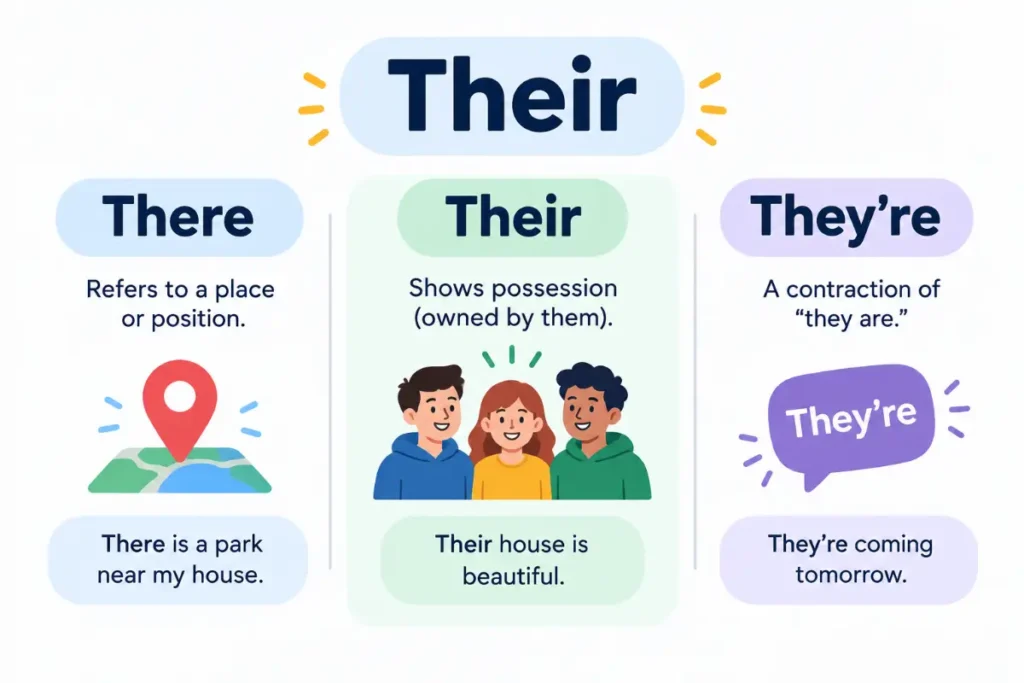
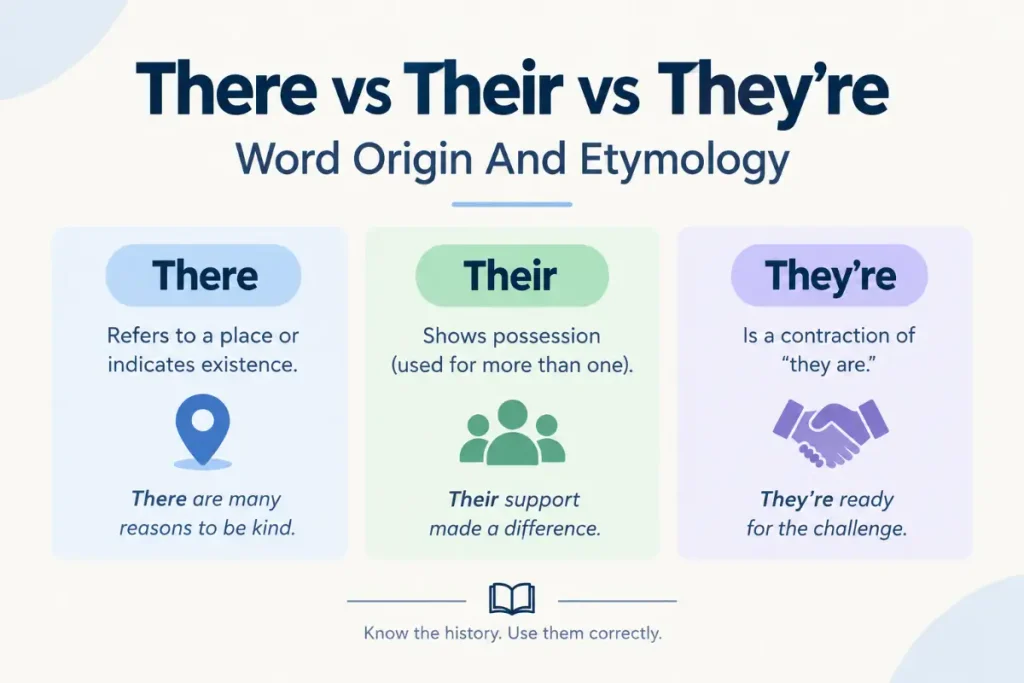
The easiest way to understand the difference is to focus on meaning and sentence structure. There usually refers to a place or introduces something that exists. Their shows possession or association with people. They’re is a contraction of they are. Once you know what the word needs to do in the sentence, choosing the correct spelling becomes much easier.
This guide explains the meaning, grammar, pronunciation, common mistakes, and everyday use of all three words. You will also learn simple memory tricks and practical examples that can help you choose the right form when writing emails, school assignments, messages, social posts, and professional content.
Quick Answer
There refers to a place or introduces something that exists. Their shows possession or association. They’re means they are. For example, The books are there, their books are new, and they’re reading them. The three words sound alike in most American English, but their meanings and grammatical functions are different.
Understanding the difference between a village and subdivision can also help when describing where a particular community or residential area is located.
What Does There Mean
There has several grammatical uses, but two are especially important. First, it can refer to a place that is different from the speaker’s or writer’s current location. For example, in The restaurant is over there, the word points to a specific location. You can use it in the same way when giving directions, identifying an object, or talking about a place that has already been mentioned.
Second, there can introduce a statement about something that exists or happens. In these sentences, it does not point to a physical location. Instead, it helps introduce the subject of the sentence.
- There is a problem with the computer.
- There are three students in the room.
- There was a long line outside the store.
- There were several messages on my phone.
This second use is important because the simple memory rule that there means a place does not explain every grammatical use. Think of there as a word that can point to a location or help introduce the existence of something.
There As A Place Word
When there refers to a location, it commonly answers the question where. It can appear after a verb, at the end of a sentence, or as part of a direction. The location can be very specific or simply understood from the conversation.
- Put the package there.
- Your shoes are over there.
- We parked the car there.
- I left my phone there.
- Look over there.
- The pharmacy is right there.
In each example, there identifies a place. A useful memory trick is to notice that there contains the word here with extra letters. That is not the historical reason the word developed, but it can be a helpful spelling reminder.
There In Existence Statements
Another common structure begins with there followed by a form of be. This construction tells the reader or listener that something exists, appears, occurs, or is present.
- There is a new restaurant downtown.
- There are several options available.
- There was a problem with the order.
- There were two seats left.
- There will be a meeting tomorrow.
- There has been a change in the schedule.
Notice that there does not mean a physical location in these sentences. The sentence is about the existence or presence of something. This is why replacing there with their or they’re would create a grammatical error.
What Does Their Mean
Their is a possessive word. It shows that something belongs to, is connected with, or is associated with someone or a group of people. It normally appears before a noun, so it is easy to identify by looking at the words around it.
For example, their house means the house belongs to them. Their teacher refers to a teacher connected with them, and their ideas refers to ideas associated with them. The word does not necessarily describe legal ownership. It can show a relationship, connection, responsibility, or association.
- Their car is parked outside.
- I like their new house.
- The students finished their homework.
- The team celebrated their victory.
- Their parents are visiting this weekend.
- We discussed their plans yesterday.
A simple way to remember their is to connect it with them. If the meaning is something like belonging to them or connected with them, their is usually the correct choice.
Their Before A Noun
One of the easiest ways to recognize their is to look at the word immediately after it. In normal possessive use, their comes before a noun or noun phrase.
Consider these examples:
- their house
- their dog
- their teacher
- their decision
- their children
- their new project
The noun tells you what is being possessed or associated with the people. You would not use there or they’re in these structures because those words cannot perform the same possessive function.
Their With Singular They
Modern standard English also uses their with singular they. This happens when a person’s gender is unknown, irrelevant, unspecified, or when the person uses they as a pronoun.
For example:
- Every student should bring their notebook.
- Someone left their umbrella in the office.
- If a customer has a question, they can contact their representative.
In these sentences, their refers to one person, even though the possessive form is traditionally associated with plural they. Singular they is widely used in contemporary English, including everyday and professional writing.
The important point is that their still shows possession. The number of people does not change its basic grammatical function.
What Does They’re Mean
They’re is a contraction of they are. The apostrophe shows that letters have been removed from the two words. This makes they’re shorter and more natural in many everyday sentences.
You can test they’re by replacing it with they are. If the expanded version makes sense, they’re is usually correct.
- They’re happy. → They are happy.
- They’re waiting outside. → They are waiting outside.
- They’re teachers. → They are teachers.
- They’re at home. → They are at home.
- They’re working on the project. → They are working on the project.
This substitution test is one of the most reliable ways to distinguish they’re from there and their.
They’re In Everyday Sentences
Because they’re means they are, it can appear anywhere the full phrase they are can appear. It can come before an adjective, noun, present participle, or phrase that describes a location or condition.
For example, They’re tired means They are tired, while They’re doctors means They are doctors. Similarly, They’re studying means They are studying, and They’re in the office means They are in the office.
If expanding the contraction produces a sentence that sounds grammatically correct, you have a strong clue that they’re is the form you need.
There vs Their vs They’re Comparison
The three words have different meanings even though they often sound the same. Looking at their grammatical functions side by side makes the distinction much easier.
| Word | Main function | Basic meaning | Example |
|---|---|---|---|
| There | Place word or introductory word | In that place or something exists | The keys are there. |
| Their | Possessive determiner | Belonging to them or associated with them | Their keys are missing. |
| They’re | Contraction | They are | They’re looking for the keys. |
The fastest way to remember the difference is to attach a short phrase to each word. There relates to a place or existence. Their relates to possession or association. They’re expands to they are.
How To Tell The Difference
When you are unsure which spelling belongs in a sentence, do not rely on pronunciation. Since the three words are homophones in most American English, saying the sentence aloud will not solve the problem. Instead, identify the grammatical job the word needs to perform.
Use these three questions:
- Does the word refer to a place or introduce something that exists? Use there.
- Does the word show possession or association? Use their.
- Can you replace the word with they are? Use they’re.
For example, look at the sentence The children left their shoes there because they’re going home. The first their shows that the shoes belong to the children. The second there refers to a location, while they’re can be expanded to they are.
A substitution test can make this even easier. Try changing the questionable word to they are. If the sentence still makes sense, use they’re. If it does not, ask if the word refers to a place or shows possession.
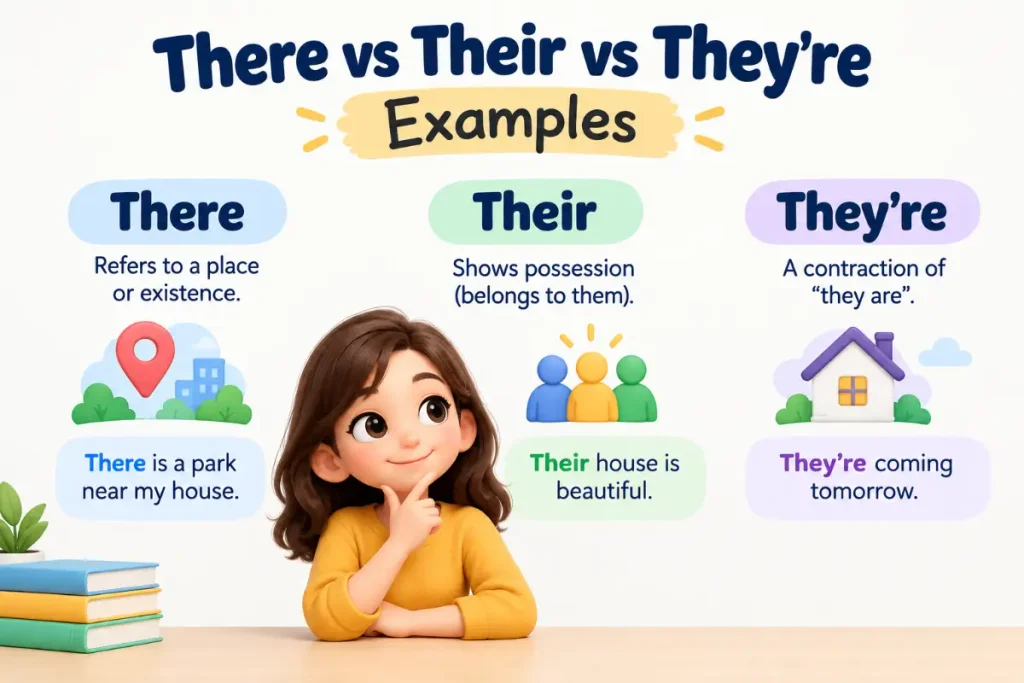
There vs Their vs They’re Examples
Seeing the three forms together is one of the best ways to understand how they work. The following examples cover common situations in everyday American English.
Examples With There
There can identify a location or introduce something that exists.
- Your coat is over there.
- I left my wallet there.
- There is a coffee shop near the station.
- There are two empty chairs.
- We went there after work.
- There was an unexpected delay.
- Look over there before you cross the street.
- There will be a test on Friday.
The meaning changes slightly depending on the structure. In Your coat is over there, the word identifies a place. In There are two empty chairs, it introduces the existence or presence of the chairs.
Examples With Their
Their shows possession, connection, or association.
- Their house is across the street.
- The players wore their new uniforms.
- I read their article yesterday.
- Their children attend the local school.
- The company changed their policy.
- The students submitted their assignments.
- Someone forgot their phone on the table.
- The neighbors invited us to their party.
In each sentence, their connects a person or group with the noun that follows. The word is possessive, not a location word and not a contraction.
Examples With They’re
They’re means they are.
- They’re waiting for the bus.
- They’re very excited about the trip.
- They’re our new neighbors.
- They’re working late tonight.
- They’re at the restaurant.
- They’re planning a surprise party.
- They’re ready to leave.
- They’re responsible for the project.
A quick check confirms each one. For example, They’re ready to leave becomes They are ready to leave. Since the expanded sentence works, the contraction is correct.
All Three In One Sentence
You can use all three forms in the same sentence because they perform completely different jobs.
They’re taking their books over there.
Here, they’re means they are, their shows that the books belong to them, and there identifies the destination or location.
Another example is:
They’re leaving their bags there while they eat.
The first word means they are, the second shows possession, and the third refers to a place. Looking at the grammatical role of each word makes the spelling much easier to choose.
Common Mistakes
The most common errors happen because there, their, and they’re sound alike. People often choose the spelling that feels familiar instead of checking what the sentence means. These mistakes are especially common in quick messages, social media posts, emails, and other informal writing.
Using There Instead Of Their
Incorrect: There house is beautiful.
Correct: Their house is beautiful.
The house belongs to them, so the possessive form their is required. A useful test is to replace their with belonging to them. If that matches the meaning, their is the right choice.
Using Their Instead Of There
Incorrect: I left my phone their.
Correct: I left my phone there.
The word refers to the location where the phone was left, so there is needed. You can ask Where did I leave it? The answer is there.
Using There Instead Of They’re
Incorrect: There going to the movies tonight.
Correct: They’re going to the movies tonight.
The intended meaning is They are going to the movies tonight. Since they are works, the contraction they’re is correct.
Using They’re Instead Of Their
Incorrect: They’re car is parked outside.
Correct: Their car is parked outside.
Here, the word modifies car and shows possession. You cannot expand they’re to they are and get a grammatical sentence. They are car is parked outside does not work.
Using Their Instead Of They’re
Incorrect: Their waiting for us.
Correct: They’re waiting for us.
The intended meaning is They are waiting for us, so the contraction is required.
Mixing All Three Forms
A sentence can contain all three words, which makes spelling mistakes easier to miss. Consider this example:
They’re taking their coats over there.
The structure gives you a clear test. They’re means they are, their shows possession, and there identifies the place.
Just as “there,” “their,” and “they’re” have different roles, learning to use affect and effect correctly can prevent common word-choice mistakes in everyday writing.
Grammar Rules For There Their And They’re
The three words belong to different grammatical categories, although there has more than one function. Understanding these categories helps you move beyond memorization.
There can work as an adverb of place. In The children are playing there, it identifies where the children are playing. It also appears in existential constructions such as There is a problem and There are several choices.
Their is a possessive determiner. It normally comes before a noun and identifies the person or group associated with that noun. Examples include their car, their opinion, their work, and their responsibility.
They’re is a contraction. It combines they and are. Because it contains a verb, it can form part of the predicate of a sentence.
One useful grammar check is to examine what comes after the word. A noun such as house, car, or ideas may signal a possessive structure requiring their. A word describing a condition, identity, action, or location may work after they’re because the phrase can represent they are.
There Is And There Are
A common grammar issue involves choosing between there is and there are. The form of be usually agrees with the noun that follows in standard formal English.
- There is one problem.
- There are three problems.
- There was a delay.
- There were several delays.
In everyday speech, you may hear variations, especially in informal conversation, but careful writing should follow standard subject and verb agreement.
Pronunciation
In most American English speech, there, their, and they’re are pronounced alike or very nearly alike. They are therefore classified as homophones in common usage. A typical General American pronunciation is represented approximately as /ðer/, although dictionaries can use slightly different phonetic notation.
The shared pronunciation explains why these mistakes occur so often in writing. If you only hear the sentence, you cannot normally determine which spelling the writer intends. Context and grammar provide the information that sound does not.
This is also why reading your writing aloud is useful for many grammar problems but not always enough for these three words. You need to look at the meaning and structure on the page.
Word Origin And Etymology
The three forms have different histories even though their modern pronunciations have converged.
There comes from Old English forms such as þær and is related to other Germanic words used to indicate location. Its basic connection with place has remained strong throughout the development of English.
Their developed through Middle English possessive forms and was influenced by Old Norse forms. It gradually replaced older English possessive forms and became the standard possessive form associated with they.
They’re is much easier to explain because it is a contraction of the two words they and are. The apostrophe marks the missing letters.
The different histories explain why the spellings are unrelated even though modern pronunciation makes the words sound the same.
American English And Regional Usage
American English uses there, their, and they’re with the same basic meanings described in this guide. British, Canadian, and Australian English also use the three forms with the same core grammatical functions.
Pronunciation can vary across regions and individual speakers, but the spelling distinction remains important. A writer in the United States should not treat one form as an American alternative to another. They are separate words with separate grammatical roles.
Singular they and their are also common in contemporary English. For example, Every employee should check their email uses their to refer back to the singular noun employee. Usage preferences can vary among individual style guides, but singular they has a long history and is widely used in modern standard English.
Formal And Casual Usage
All three forms are standard English. The choice depends on meaning, not on how formal the word itself is.
They’re is a normal contraction and is appropriate in conversation, messages, emails, and many forms of professional writing. Some highly formal documents may prefer they are because contractions can create a more formal tone, but using they’re is not a grammar mistake.
There and their are standard in every level of writing when their meanings fit the sentence. The important distinction is not formal versus informal. It is location or existence, possession or association, and the contraction they are.
If you often confuse possessive and contracted forms, reviewing your and you’re usage can make it easier to distinguish “their” from “they’re” as well.
There Or Their For A Person
When you are talking about a person, the correct form depends on what you are trying to say. Use their when you are showing possession or association. Use there when you are referring to a place. Use they’re when you mean they are.
Compare these sentences:
- Their name is Alex. The name is associated with the person.
- The person is over there. The word identifies a location.
- They’re waiting outside. The phrase means they are waiting outside.
A common mistake is assuming that there should be used simply because the sentence refers to a person. The subject of the sentence does not determine the spelling. The grammatical function does.
Related Words And Similar Confusions
English has many word pairs and groups that sound alike or look similar but perform different grammatical jobs. Learning the logic behind there, their, and they’re can make these other distinctions easier too.
Your And You’re
Your shows possession, as in your phone or your idea. You’re means you are, as in you’re ready.
The same substitution test works here. If you are fits, use you’re.
Its And It’s
Its is possessive, as in the company changed its policy. It’s is a contraction of it is or it has, as in it’s raining or it’s been a long day.
The apostrophe does not automatically mean possession. In these contractions, it signals omitted letters.
Who’s And Whose
Who’s usually means who is or who has, while whose shows possession.
- Who’s coming to dinner?
- Whose jacket is this?
Again, expanding the contraction helps identify the correct form.
To Too And Two
These three words sound alike in many varieties of English but have different functions. To commonly introduces a direction or infinitive, too can mean also or excessively, and two refers to the number 2.
These examples show why pronunciation alone cannot determine spelling.
Expert Language Insight
A common teaching shortcut says that there means a place, their means possession, and they’re means they are. That rule is useful, but it leaves out an important part of English grammar. There also appears in existential constructions such as there is and there are, where it does not refer to a physical location.
Another useful insight is that native speakers often recognize these words visually in writing rather than by sound. In conversation, context usually supplies the meaning automatically. On the page, the spelling has to carry that distinction, which is why proofreading matters.
The most reliable habit is to stop thinking about pronunciation and ask what the sentence is doing. If the word identifies a place or introduces existence, use there. If it shows possession or association, use their. If you can replace it with they are, use they’re.
This approach is more reliable than memorizing isolated examples because it works with sentences you have never seen before.
Frequently Asked Questions
What is the difference between there and their
There usually refers to a place or introduces something that exists, while their shows possession or association. Compare The books are there with Their books are on the table. In the first sentence, there identifies a location. In the second, their shows that the books belong to or are associated with them.
What does they’re mean
They’re is a contraction of they are. You can use it in sentences such as They’re tired, They’re working, or They’re at home. A simple way to check the spelling is to replace they’re with they are. If the expanded sentence works grammatically, they’re is the correct form.
How can I remember there their and they’re
Use three simple ideas. There connects with a place or existence. Their connects with possession or something belonging to them. They’re means they are. When you are unsure, expand they’re to they are and ask if their means something belonging to them. These tests quickly narrow down the correct choice.
Are there and their pronounced the same
In most American English speech, there, their, and they’re are pronounced the same or almost the same. That is why they are commonly treated as homophones. Their pronunciation does not tell you which spelling to use. You need to consider the meaning and grammatical structure of the sentence.
Is their used for one person
Yes. Their can refer to one person when used with singular they. For example, Every student should bring their laptop uses their for an individual student. This form is common in contemporary English when the person’s gender is unknown, unspecified, irrelevant, or when the person uses singular they.
Is they’re correct in formal writing
Yes. They’re is a standard English contraction of they are. It is grammatically correct in formal writing, although some highly formal documents may use they are instead to create a more formal tone. The choice is mainly about style and tone, not correctness.
How do I know if I should use there or their for a person
Use their if the word shows possession or association, such as their name, their car, or their family. Use there if it refers to a location, such as the person is standing there. The fact that a sentence talks about a person does not automatically determine the correct spelling.
Can a sentence use there their and they’re together
Yes. For example, They’re taking their bags over there uses all three correctly. They’re means they are, their shows possession, and there refers to a location. Seeing all three in one sentence is a useful way to understand why their meanings cannot be exchanged.
Conclusion
The difference between there, their, and they’re becomes much easier once you focus on grammar instead of pronunciation. There refers to a place or helps introduce something that exists. Their shows possession or association. They’re is simply the contraction of they are.
When you are unsure, use the three question test. Ask if the word refers to a place or existence, shows possession, or can be expanded to they are. With regular practice, these checks become automatic, and you will be able to use the correct form confidently in everyday messages, school writing, emails, and professional communication.