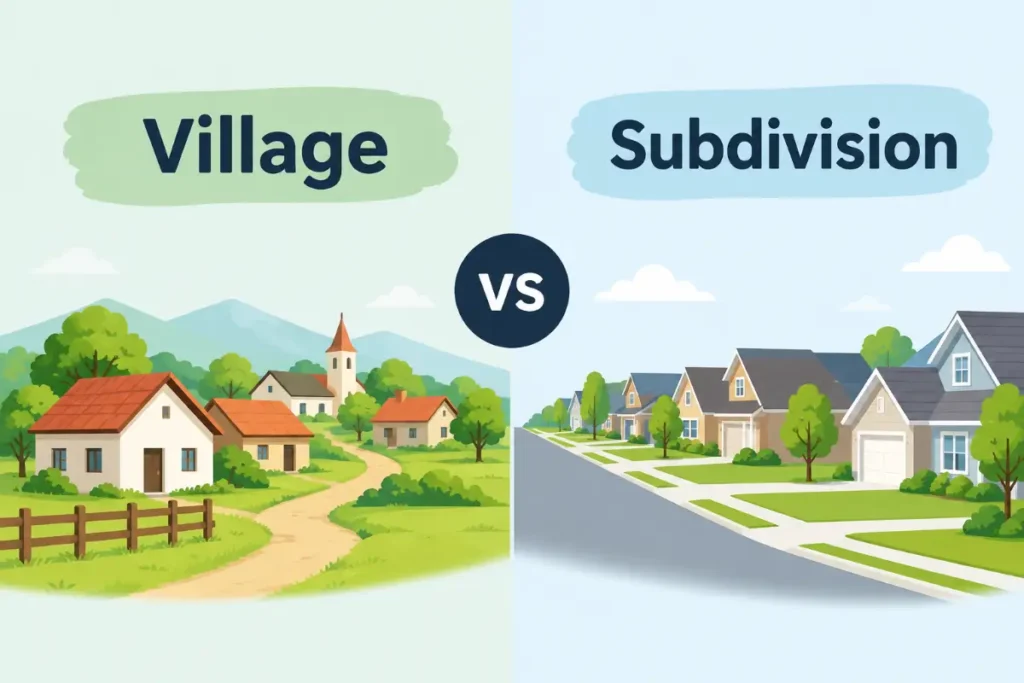
If you are filling out an address form, checking property records, comparing neighborhoods, or trying to describe where you live, village vs subdivision can be confusing. The two terms can describe places where people live, but they do not usually mean the same thing. A village generally refers to a settlement or community, while a subdivision usually refers to land that has been divided into multiple lots for development.
The confusion comes from the fact that a residential subdivision can be called a village, and a village can contain several residential developments. In some places, village is also an official governmental designation. In others, it is simply part of a community name or an informal description.
For most US readers, the key is to look at what the term describes. Subdivision usually describes how land was developed and divided. Village usually describes a community or settlement. The exact legal meaning can depend on local law.
This guide explains the difference, shows how the terms work in addresses, discusses property taxes and community organization, and explains what to enter when a form asks for your village or subdivision.
Quick Answer
A village usually describes a settlement, community, or named locality, and in some US states it can be an incorporated municipality. A subdivision usually describes a tract of land divided into individual lots for homes or other development. A subdivision can be located inside a village, but the terms are not automatically interchangeable.
Comparison Table
| Feature | Village | Subdivision |
|---|---|---|
| Basic meaning | A settlement or community | Land divided into separate lots |
| Typical use | Community or locality | Residential or land development |
| Can be official | Yes, depending on local law | Yes, as a recorded development |
| Main idea | Where a community is located | How property was divided |
| Usually has homes | Often | Usually |
| Can contain roads | Yes | Yes |
| Can have an HOA | Sometimes | Commonly |
| Property tax treatment | Depends on local government | Depends on the property’s jurisdiction |
| Common in addresses | Sometimes | Often |
| Meaning across the US | Varies by state and locality | More consistent in real estate |
| Example | A village named Pine Grove | Pine Grove Estates subdivision |
If you’re comparing easily confused words, similar-looking spelling pairs such as seal vs seel can also cause uncertainty about which form is correct in context.
What Does Village Mean
A village generally means a small community or settlement. In everyday American English, it can describe a place that is smaller or more community focused than a city, although there is no single nationwide population rule that makes a place a village.
The legal meaning is more complicated. Some states use village as a formal type of municipality. Other states may use the word in geographic names without giving it a separate legal status. A place called a village may therefore be an incorporated local government, an unincorporated community, a neighborhood, or simply a historical place name.
For example, a community might be known as:
Maple Village
That name alone does not tell you exactly how the community is governed. You need to look at the local jurisdiction and the official address information.
In ordinary conversation, people also use village in a more general sense. Someone might say:
We live in a small village outside the city.
Here, village describes the character or scale of the community rather than a particular type of real estate development.
Village As A Municipality
In some parts of the United States, village has a specific governmental meaning. A village may have elected officials, local services, ordinances, boundaries, and other responsibilities established by state law.
This is important because two places can both be called villages while having different legal structures.
A village in one state may be an incorporated municipality. A similarly named village in another state may simply be a community name.
That is why you should not assume that the word village automatically means a particular level of local government.
What Does Subdivision Mean
A subdivision is generally a parcel of land that has been divided into separate lots, usually for sale or development.
Imagine a developer owns a large piece of undeveloped land. Instead of selling the entire property as one parcel, the land may be divided into dozens or hundreds of smaller lots. Roads, drainage systems, utility access, easements, and other infrastructure may be planned as part of the development.
The resulting development is commonly called a subdivision.
For example:
Oak Ridge Subdivision
might contain 120 residential lots.
The term focuses on the physical and legal division of land. It does not necessarily tell you what type of local government serves the property.
A subdivision may be inside a city, county, township, village, or another local jurisdiction.
Subdivision In Real Estate
Real estate professionals commonly use subdivision to identify a planned collection of lots.
A property description may include information such as the subdivision name, lot number, block number, and county.
For example:
Lot 18, Block 2, Oak Ridge Subdivision
This tells you something about the property’s legal or recorded location.
A subdivision can also have a marketing name that sounds like a village, town, or estate. The name itself does not necessarily change the legal nature of the development.
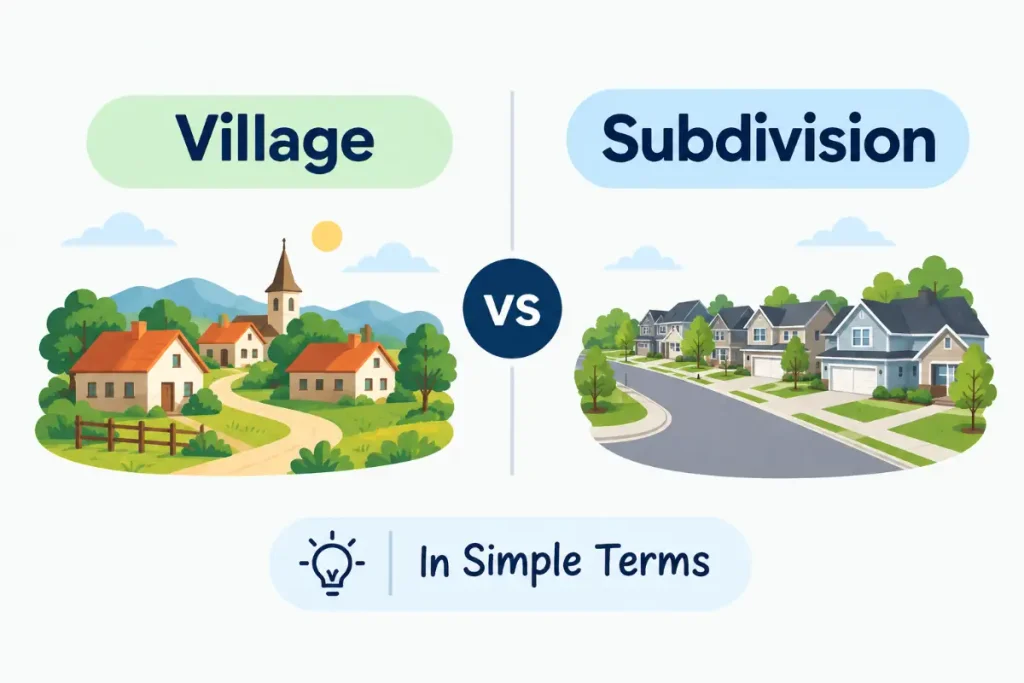
Village vs Subdivision In Simple Terms
The easiest way to remember the distinction is to focus on the question each word answers.
Village answers: What community or locality is this?
Subdivision answers: What development or divided tract of land is this?
Consider a fictional example.
A county contains a community called Riverside Village. Within that community is a residential development called Willow Creek Subdivision.
A home could therefore be located in Willow Creek Subdivision, inside Riverside Village, within the larger county.
The two terms describe different layers of location.
This is why asking which one is correct can sometimes be misleading. A person may legitimately live in both a village and a subdivision at the same time.
Key Differences Between A Village And A Subdivision
The biggest difference is the type of thing each word describes.
Community Versus Development
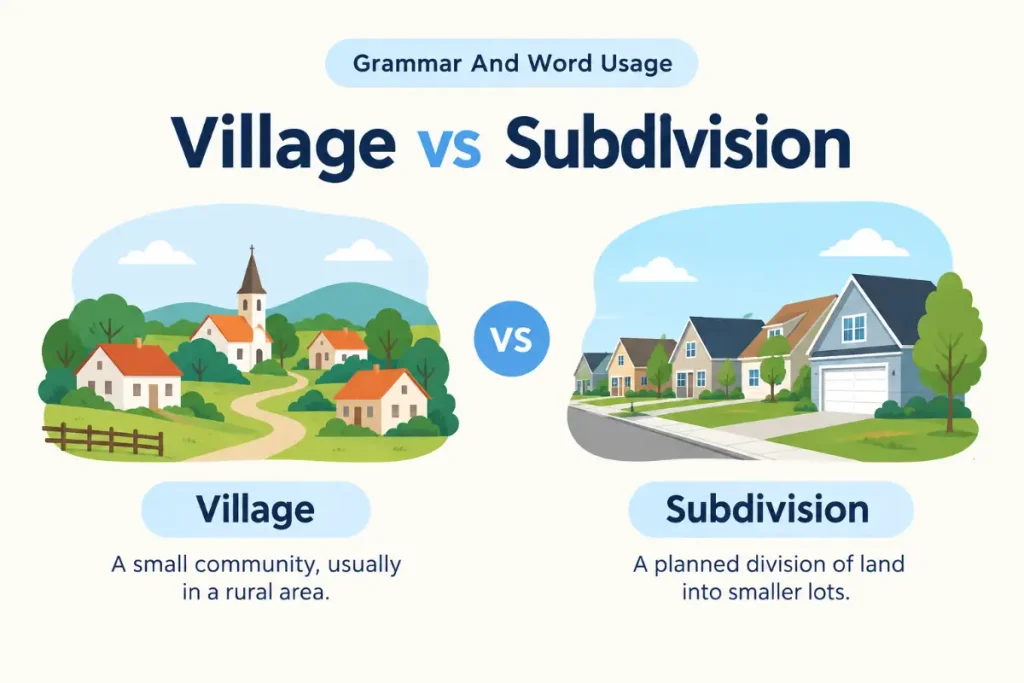
A village generally describes a community or settlement. A subdivision generally describes a planned division of land.
A village can have stores, schools, public buildings, parks, roads, houses, apartments, and other features. A subdivision may contain mostly residential lots and related infrastructure, although subdivisions can also be created for commercial, industrial, or mixed uses.
Government Versus Property Organization
A village may have governmental responsibilities if it is an incorporated municipality.
A subdivision does not become a municipality simply because it has a name, entrance sign, roads, or an HOA.
A subdivision may be governed by private covenants and an HOA while remaining under the authority of the surrounding city, county, township, or other public jurisdiction.
Legal Meaning
Village has different legal meanings across the United States.
Subdivision also has legal definitions that can vary by state and local land use rules, but its central concept is the division of land into separate parcels or lots.
For this reason, official property documents and local government records are more reliable than the name used in casual conversation.
Physical Scope
A village can cover a broader geographic area than a single residential development.
A subdivision can be relatively compact and consist of a defined collection of lots.
However, there is no universal size requirement for either term.
Name And Identity
Village may be part of the official or informal name of a community.
Subdivision names are also frequently used as development names.
For example, a developer might call a project The Villages at Cedar Creek. The use of the word villages does not automatically make the development a governmental village.
Which One Should You Use
Use village when you are referring to a community, settlement, or officially recognized village.
Use subdivision when you are referring to a specific real estate development made up of divided lots.
If you are completing a form, do not choose based only on which word sounds more familiar. Check the address records, property documents, local government information, or instructions provided by the organization.
For example, if a form has separate fields for city, village, subdivision, and street, it may expect different parts of your address in each field.
The correct entry depends on how the form defines those fields.
Village And Subdivision In Addresses
Address formats create much of the confusion surrounding these terms.
In the United States, a standard mailing address generally focuses on the recipient, street address, city or locality, state, and ZIP Code. A neighborhood or subdivision name may not be necessary for mail delivery.
For example:
125 Oak Street
Springfield, Illinois 62701
may be sufficient even if the home is inside a subdivision called Oak Ridge Estates.
However, online forms often ask for additional location details. A form may include a field labeled Village or Subdivision because it serves users from areas where these terms are commonly used in addresses.
That does not mean the form considers village and subdivision to be identical. It may simply use one field to collect a named local area.
What To Enter On A Form
If a form asks for your village or subdivision, look at your official address information first.
You can check:
- Your property documents.
- Your utility bill.
- Your lease.
- Your local government property record.
- A recognized address database.
- Instructions supplied by the organization requesting the address.
- If your property is inside a named subdivision and the form specifically requests the subdivision, enter the subdivision name.
- If your address uses a village as the locality, enter the village name.
- If the form combines the two into one field, follow its instructions rather than assuming you must provide both.
Just as village and subdivision describe different concepts, understanding the difference between busyness and business can help you choose the right word when two terms look or sound deceptively similar.
Village And Subdivision For Property Taxes
Searches about village vs subdivision taxes often come from homeowners who want to know if living in one type of community automatically changes their tax bill.
It generally does not work that way.
Property taxes are normally determined by the applicable taxing authorities, the assessed or taxable value of the property, local tax rates, exemptions, special assessments, and other rules established by state and local law.
A subdivision name by itself does not automatically create a special property tax rate.
Likewise, living in a village does not automatically mean that every property pays the same amount as a property in a subdivision elsewhere.
A property inside a subdivision can be subject to city, county, school district, special district, and other applicable taxes. An HOA may also charge separate fees, but HOA fees are not the same thing as property taxes.
Why Two Nearby Homes Can Have Different Bills
Two homes can be close together but have different tax obligations because of differences in:
- Assessed value.
- Property classification.
- Exemptions.
- Taxing districts.
- Special assessments.
- Local government boundaries.
- Improvements to the property.
The words village and subdivision alone do not provide enough information to calculate a property tax bill.
For an exact answer, local tax records are the appropriate source.
Do Subdivisions Have Their Own Government
Usually, a subdivision is not a separate government simply because it is a subdivision.
Many residential developments have homeowners associations. An HOA may enforce private community rules, maintain certain common areas, collect assessments, and manage amenities.
That role is different from municipal government.
A city or village can exercise public governmental authority under state law. An HOA operates under private governing documents and applicable law.
This distinction matters when people use phrases such as subdivision government or subdivision laws. A subdivision can have private rules, but those rules do not replace the authority of the surrounding public jurisdiction.
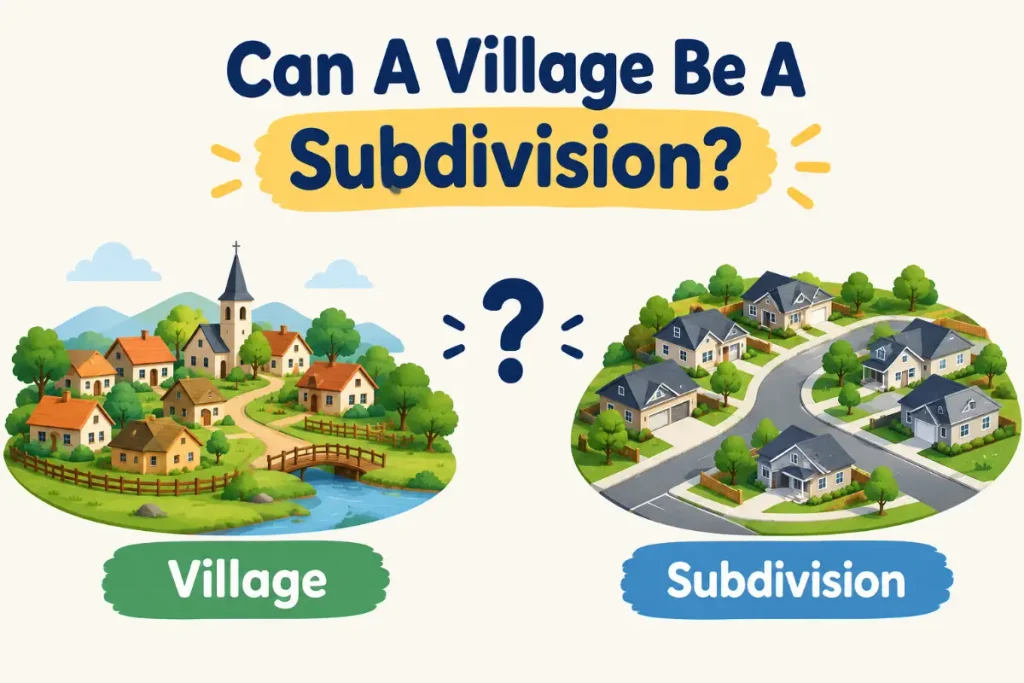
Can A Village Be A Subdivision
A place can be described as a village while also being developed as a subdivision, but the words still refer to different concepts.
For example, a developer might create a planned residential community and market it as Cedar Village. The development could be recorded as a subdivision even though residents casually call it a village.
In another situation, an established village may contain several separate subdivisions.
So the relationship can work in both directions:
Village → community that may contain subdivisions.
Subdivision → development that may be located within a village.
This is one reason the terms should not be treated as direct synonyms.
Village And Subdivision In The Philippines
The terms can have a somewhat different everyday role in the Philippines, where village and subdivision are common in residential addresses and property descriptions.
A subdivision often refers to a planned residential development. It may have named streets, gated entrances, security, shared facilities, and private community rules.
The word village is also frequently used in names for residential communities. In that context, village may be part of a development’s name rather than a legal description equivalent to the American concept of an incorporated village.
This distinction is important for anyone researching village vs subdivision Philippines. American municipal definitions should not automatically be applied to Philippine addresses.
For Philippine forms, including some address and SIM registration forms, the requested field may use village or subdivision to capture the named residential area associated with the person’s address.
If a form asks for this information, use the official or commonly recognized name of the residential area connected with your address.
Village Or Subdivision In SIM Registration
Some people encounter the terms while completing an address field for SIM registration or another online form.
If the form asks for village or subdivision, it is generally asking for the named local residential area rather than asking you to determine a legal distinction between the two concepts.
For example, if your home is in a development called Green Meadows Subdivision, that development name may belong in the village or subdivision field.
If your address is associated with a named village, the village name may be appropriate.
The safest approach is to follow the address information on your official documents and the instructions of the specific registration system. Do not invent a subdivision name simply because the form contains the field.
Village And Subdivision Versus Compound
Compound is another word that can cause confusion, particularly in international address discussions.
A compound generally refers to an enclosed area containing several buildings or facilities within the same property or controlled premises. The exact meaning depends on context.
For example, a residential compound might contain several homes occupied by members of the same family.
A subdivision is different because it normally involves the division of land into separate lots or parcels.
A village is different again because it generally describes a settlement or community.
A simple comparison looks like this:
| Term | Main idea |
|---|---|
| Village | Community or settlement |
| Subdivision | Divided land or planned development |
| Compound | Enclosed group of buildings or premises |
| Neighborhood | General local area |
| Municipality | Public local government area |
These terms can overlap in casual speech, but they are not interchangeable in every context.
Examples In Sentences
Here are natural examples showing how the terms work.
Village Examples
- The village has a small library and a public park.
- She grew up in a rural village near the state border.
- The village council approved the new ordinance.
- We drove through the village on our way to the lake.
- The village is surrounded by farmland.
- Their address is in the village of Oakwood.
- The historic village attracts visitors throughout the summer.
- Several local businesses operate in the center of the village.
Subdivision Examples
- They bought a house in a new subdivision.
- The subdivision has more than 200 residential lots.
- The developer submitted plans for another subdivision.
- Her home is located in the Oak Ridge subdivision.
- The subdivision has an HOA that maintains the community pool.
- Several new roads were built as part of the subdivision.
- The property records identify the subdivision by name.
- The neighborhood was originally developed as a residential subdivision.
Notice that the two groups describe different things. The village examples focus on a community or locality. The subdivision examples focus on land development, lots, property, or residential organization.
Common Mistakes
Treating Village And Subdivision As Exact Synonyms
This is the most common conceptual mistake.
A subdivision can be part of a village, but that does not make the two words identical.
Assuming Every Village Is A Municipality
The word village does not have one universal legal definition across the United States.
Always check the relevant state and local government structure if the legal status matters.
Assuming Every Subdivision Has An HOA
Many residential subdivisions have HOAs, but an HOA is not an automatic requirement of every subdivision.
The existence of an HOA depends on the development’s structure and governing documents.
Assuming The Name Proves The Legal Status
A development called Sunset Village may still legally be a subdivision.
Likewise, a community with the word Estates in its name is not necessarily a particular type of legal property development.
Names can be marketing terms, historical names, or official designations. The name alone is not enough.
Assuming Subdivision Determines Taxes
A subdivision name does not automatically determine property taxes.
Tax obligations depend on the property’s location and applicable taxing authorities.
Similar care is needed with another commonly confused word pair, channel vs chanel, where knowing the meaning and standard spelling makes the intended word clear.
Grammar And Word Usage
Both village and subdivision are countable nouns.
Their singular forms are:
a village
a subdivision
Their plural forms are:
villages
subdivisions
They can also function as modifiers before another noun.
Examples include:
- village council
- village government
- subdivision entrance
- subdivision rules
- subdivision development
When referring to a specific named place, capitalization depends on whether the name is a proper name.
For example:
We live in a village near Denver.
Here, village is a common noun.
We live in the Village of Oak Park.
Here, Village may be capitalized as part of an official name.
The capitalization of official place names should follow the organization’s or government’s established form.
Formal And Casual Usage
Both words are neutral in standard American English.
Village can sound geographic, historical, governmental, or community oriented depending on context.
Subdivision is strongly associated with real estate, property development, planning, and residential communities.
In casual conversation, Americans may say neighborhood instead of subdivision when talking about where they live.
For example:
I live in the Oak Ridge neighborhood.
A real estate document might instead say:
The property is located in Oak Ridge Subdivision.
Both statements can refer to the same general area, but the second uses more specific property terminology.
Which Word Should You Use
The best choice depends on what you are trying to identify.
- Use village when you mean a community, settlement, or officially designated village.
- Use subdivision when you mean a planned development or an area created through the division of land into separate lots.
- Use neighborhood when you simply want to describe the local area in everyday conversation and the formal property classification is not important.
For official forms, use the terminology that matches the requested address field. If the form asks for a subdivision, provide the subdivision name. If it asks for a village, provide the recognized village or locality.
Do not assume that one term must replace the other. A single property can have several valid geographic descriptions at different levels.
Frequently Asked Questions
Is A Village The Same As A Subdivision
No. A village generally describes a settlement or community, while a subdivision generally describes land that has been divided into separate lots for development. A subdivision can exist inside a village, and a village can contain several subdivisions. The exact legal meaning of village depends on the state or country.
What Is The Difference Between A Village And A Subdivision
A village usually identifies a community or locality. A subdivision usually identifies a planned land development made up of separate lots. Village can also be an official municipal designation in some US states. Subdivision is more closely connected with real estate development and property records.
Can A Subdivision Be Called A Village
Yes. A subdivision can have a name that includes the word village, such as a development marketed as a residential village. The name does not necessarily determine its legal status. A development can be legally recorded as a subdivision while residents or the developer use village as part of its name.
Does Living In A Village Mean You Pay More Taxes
Not automatically. Property taxes depend on the applicable local taxing authorities, property value, exemptions, assessments, and other local rules. Some villages may levy municipal taxes or receive revenue through local taxation, but the word village alone does not determine a property’s tax bill.
What Should I Put For Village Or Subdivision On An Address Form
Enter the recognized name of the village or residential subdivision associated with your address. Check your official address documents or the instructions provided by the form. If the form combines village and subdivision into one field, it may be designed to accept either type of local area name.
Is A Subdivision A Neighborhood
A subdivision can function as a neighborhood, but the terms are not exact synonyms. Subdivision is a more specific real estate term connected with divided land and lots. Neighborhood is a broader everyday term for an area where people live. One neighborhood can contain multiple subdivisions.
What Does Village Mean In A US Address
In a US address, village may refer to an incorporated municipality, a recognized locality, or part of a community name. Its exact meaning depends on the location. It should not automatically be interpreted as a subdivision or as a particular level of government.
What Is A Subdivision In Real Estate
A subdivision is land that has been divided into separate lots or parcels, often for residential, commercial, or other development. The process usually involves planning, surveying, legal recording, roads, utilities, easements, and other requirements established by the relevant jurisdiction.
Final Takeaway
The simplest distinction is this: a village describes a community or settlement, while a subdivision describes a division of land into separate lots or a planned development. The two can overlap, but they are not automatically interchangeable.
For US readers, village can have a formal governmental meaning in some places and a general geographic meaning in others. Subdivision is more closely tied to real estate development and property organization. A subdivision may sit inside a village, city, county, or another jurisdiction.
If you are trying to complete an address form, focus on the official information associated with your property instead of guessing from the names. If you are simply describing where you live, choose the word that matches your meaning. Understanding that distinction makes village vs subdivision much easier to handle in addresses, real estate, taxes, and everyday conversation.