Have you ever typed signer or signor into a search engine because you weren’t sure which word was correct? It’s a common question, especially since the two words look similar and sound somewhat alike. Despite their resemblance, they have completely different meanings and belong to different languages. Using the wrong one can make a legal document inaccurate or create confusion in everyday writing.
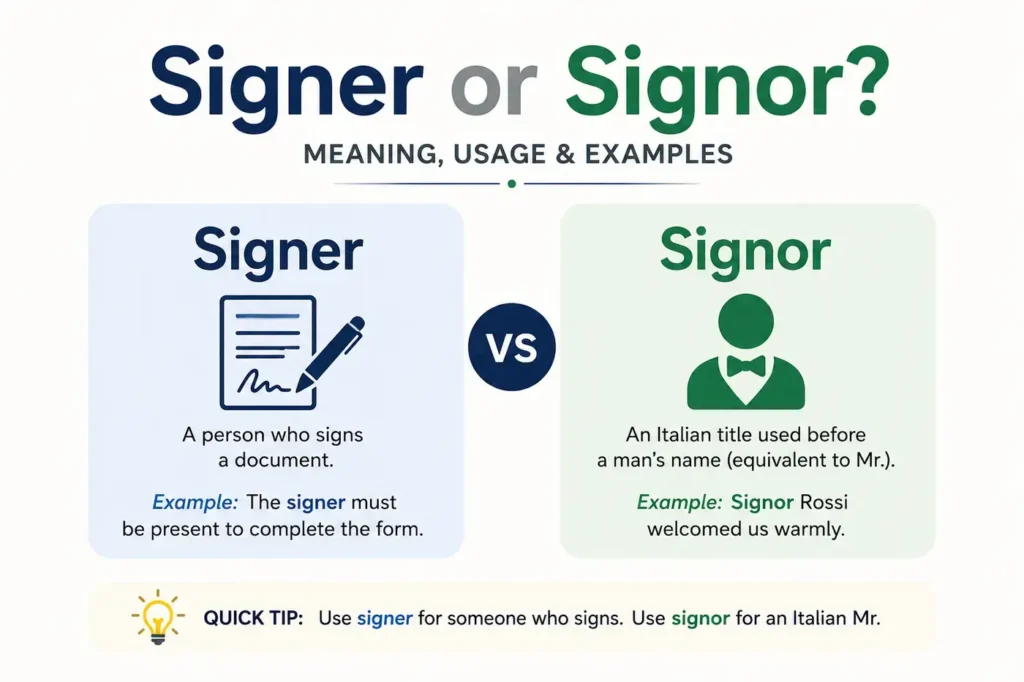
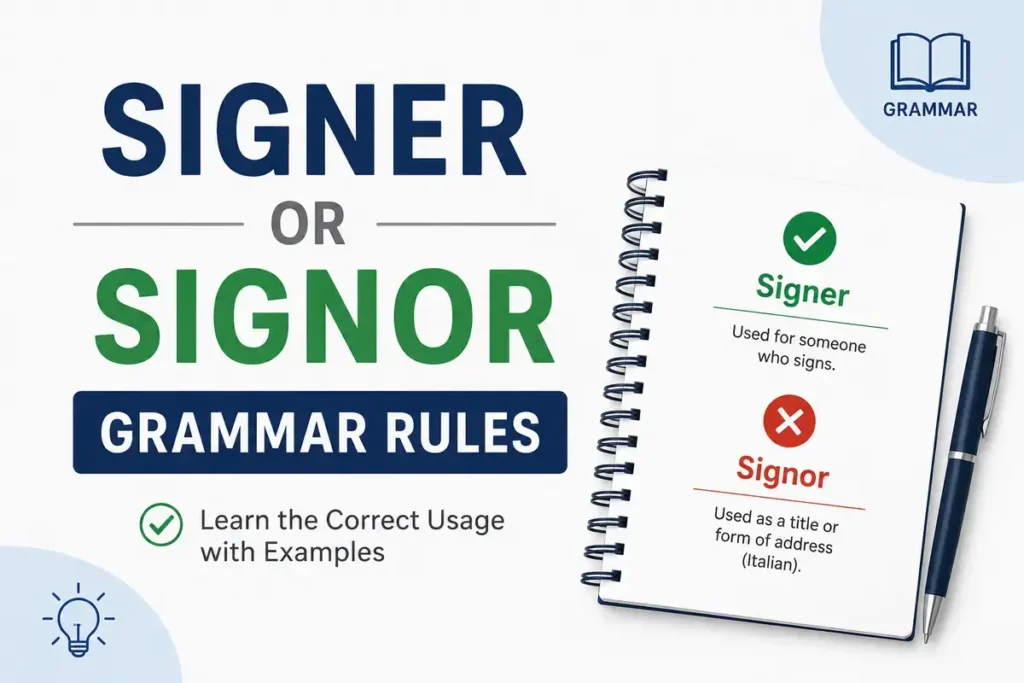
The short answer is simple. A signer is a person who signs a document, contract, agreement, or other official record. Signor is an Italian title of respect that means Mister or Sir in English. One is an English noun commonly used in legal and business settings, while the other is an Italian form of address.
In this guide, you’ll learn the meaning of each word, how they’re pronounced, where they’re used, and how to avoid mixing them up. You’ll also see practical examples, grammar tips, pronunciation guidance, and expert writing advice that will help you choose the right word with confidence.
Quick Definition
A signer is someone who signs a document or legal agreement. Signor is an Italian title used before a man’s name, similar to Mr. in English. These words are unrelated in meaning, origin, and usage, even though their spelling looks similar.
Quick Answer
If you’re referring to someone who signs paperwork, contracts, forms, or legal documents, signer is the correct word.
If you’re addressing or referring to an Italian man respectfully, Signor is the correct choice.
Here’s an easy way to remember the difference.
- Signer comes from the English verb sign.
- Signor comes from the Italian language and functions as a title.
- The words are never interchangeable.
- Choosing the wrong one changes the meaning of your sentence.
Just as it’s helpful to avoid confusing signer with signor, understanding clothing terms correctly can prevent similar mix-ups in everyday English.
Comparison Table
| Feature | Signer | Signor |
|---|---|---|
| Part of speech | Noun | Noun and title |
| Meaning | A person who signs a document | An Italian title meaning Mister or Sir |
| Origin | English | Italian |
| Correct use | Legal, business, banking, contracts, forms | Names, greetings, conversations in Italian |
| Formality | Neutral to formal | Formal and respectful |
| Common contexts | Agreements, applications, authorizations, government forms | Italian culture, travel, literature, conversations |
| Usage frequency | Very common in English | Limited in English, common in Italian |
| Example | The signer approved the contract. | Signor Rossi welcomed the guests. |
Meaning of Signer
A signer is a person who signs a document, letter, contract, petition, application, or another written record. The word comes directly from the English verb sign, making its meaning straightforward and easy to remember.
In legal and business writing, a signer accepts responsibility by adding a signature to a document. Depending on the situation, the signature may confirm identity, approval, agreement, or authorization.
You’ll commonly see signer in these situations.
- Legal contracts.
- Employment agreements.
- Bank forms.
- Government applications.
- Real estate transactions.
- Insurance documents.
- Digital signature platforms.
- Medical consent forms.
For example:
- The signer reviewed every page before signing the agreement.
- Each signer received a copy of the completed contract.
- The bank verified the identity of every authorized signer.
- The signer confirmed the information was accurate.
Signer Synonym
The exact replacement depends on the context, but these words often carry a similar meaning.
- Signatory.
- Endorser.
- Subscriber in legal contexts.
- Participant in an agreement.
- Applicant when signing official forms.
- Authorized representative in business documents.
Among these, signatory is usually the closest synonym in legal and professional writing.
Signer Plural
The plural form is simply signers.
Examples include:
- All signers must provide valid identification.
- The document requires two signers before it becomes effective.
- Every signer received a confirmation email after completing the form.
Meaning of Signor
Signor is an Italian title placed before a man’s surname or full name. It carries the same general meaning as Mr. or Sir in English and is used to show courtesy and respect.
Although English speakers sometimes encounter the word while traveling in Italy or reading literature, it isn’t used as a substitute for signer.
You’ll often find Signor in these situations.
- Italian conversations.
- Restaurant greetings in Italy.
- Historical novels.
- Classical opera.
- Travel guides.
- Italian films.
- Formal correspondence written in Italian.
Examples include:
- Signor Bianchi greeted everyone warmly.
- The waiter asked if Signor Rossi had a reservation.
- The letter was addressed to Signor Conti.
- Everyone thanked Signor Ferrari before leaving.
Signor Meaning
The Italian word comes from signore, which means lord, sir, or mister depending on the context. Today, Signor functions much like Mr. in English and appears before a man’s surname as a respectful title.
Key Differences
At first glance, the words look similar, but that’s where the similarity ends. Their meanings, origins, and everyday uses are completely different.
Here are the biggest differences.
- Signer is an English noun, while Signor is an Italian title.
- A signer performs an action by signing a document. A Signor identifies a person respectfully.
- Signer appears frequently in legal, financial, and business writing. Signor appears mainly in Italian language and cultural contexts.
- Signer comes from the English verb sign. Signor developed from Italian.
- One describes a role. The other serves as a title before a name.
A simple comparison makes the distinction even clearer.
| Signer | Signor |
|---|---|
| Person who signs documents | Respectful Italian title |
| English vocabulary | Italian vocabulary |
| Used in legal documents | Used before a man’s name |
| Common in contracts | Common in Italian conversation |
| Action based | Title based |
Once you connect each word with its purpose, choosing the correct one becomes much easier.
Which One Is Correct
The correct word depends entirely on what you’re trying to say.
If you’re talking about someone who signs a document, agreement, application, or contract, signer is always the right choice. This is the word you’ll find in legal documents, banking forms, employment paperwork, and business communication.
If you’re referring to an Italian man respectfully, use Signor before the person’s surname or full name. In that context, it functions just like Mr. does in English.
A quick check can prevent mistakes.
- Is the sentence about signing paperwork? Use signer.
- Is the sentence addressing an Italian man? Use Signor.
- If neither situation applies, the words probably don’t belong in the sentence.
Keeping that simple distinction in mind will help you avoid one of the most common mix ups involving these words.
Pronunciation Guide
Although the words look alike, their pronunciation is different enough that native speakers rarely confuse them in conversation.
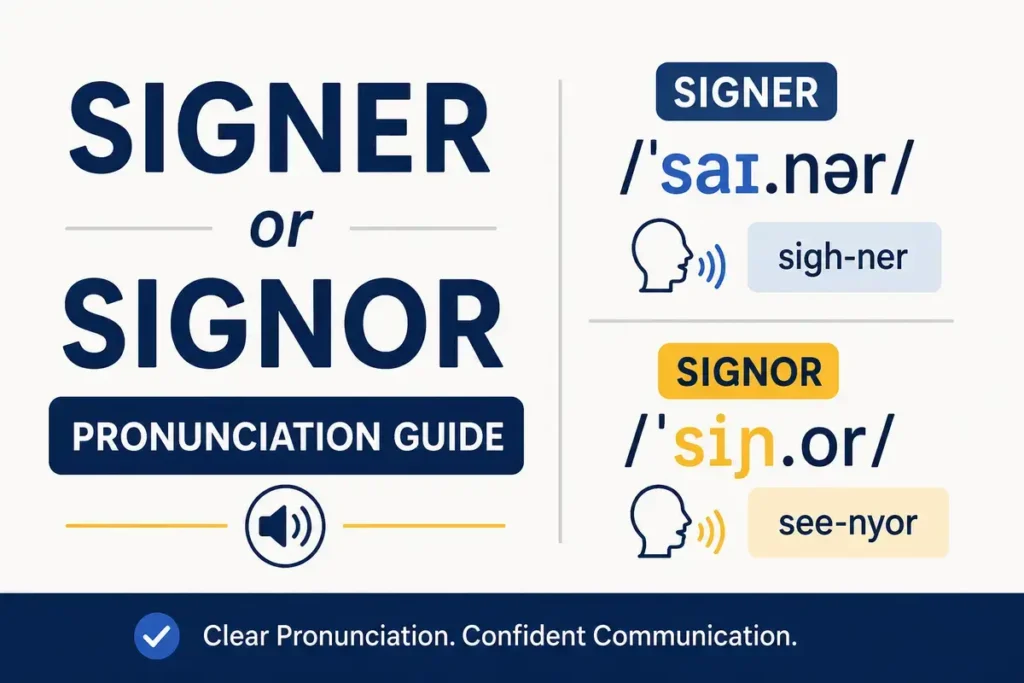
Signer
IPA pronunciation:
/ˈsaɪnər/
Syllable breakdown:
Sign er
It sounds like the word sign followed by er.
Signor
IPA pronunciation:
/siˈɲor/ in Italian.
A common English approximation is:
/siːnˈjɔːr/
Syllable breakdown:
Si gnor
The gn sound is pronounced differently from English and resembles the ny sound heard in words borrowed from Italian.
Common Pronunciation Mistakes
People unfamiliar with Italian sometimes pronounce Signor exactly like signer. That isn’t correct.
To avoid confusion:
- Pronounce signer with the English word sign.
- Pronounce Signor with an Italian style sound similar to seen yor.
Even if your Italian pronunciation isn’t perfect, keeping the two words distinct will make your speech much clearer.
If you enjoy learning about commonly confused words, you’ll also find the difference between bougie and boujee useful for avoiding another popular language mistake.
Why People Confuse These Words
Words that share similar spelling naturally catch people off guard, especially when they’re encountered outside their usual context. Someone filling out legal paperwork might accidentally type signor because of spell check or autocorrect. On the other hand, a reader of Italian literature may wonder if signer is simply another spelling of the same word.
The confusion also comes from pronunciation. In casual conversation, the endings can sound similar to English ears, leading people to assume they’re related. They aren’t. One belongs to modern English legal and business vocabulary, while the other has deep roots in the Italian language and culture.
A practical way to remember the difference is to think about the setting. If the sentence involves contracts, signatures, authorization, or paperwork, the word is signer. If it involves an Italian name, greeting, or cultural reference, the correct word is Signor. The context almost always gives you the answer.
Examples in Sentences
The easiest way to remember the difference is to see each word in context. Notice how signer appears in legal, business, and administrative situations, while Signor appears as a respectful title before an Italian man’s name.
Signer Examples
These examples show how signer is used naturally in English.
- Every signer must review the contract before adding a signature.
- The bank asked the authorized signer to present a valid photo ID.
- Each signer received a copy of the completed agreement.
- The insurance company contacted the signer to verify the information.
- A witness confirmed the signer signed the document voluntarily.
- The company requires every signer to initial each page of the contract.
- The signer accepted the terms by signing the electronic form.
- Only the authorized signer can approve financial transactions.
- The lawyer explained every clause before the signer completed the paperwork.
- The signer kept a copy of the agreement for future reference.
These examples highlight an important pattern. The word almost always appears in situations involving signatures, documents, approvals, or legal responsibility.
Signor Examples
These examples show how Signor functions as an Italian title.
- Signor Rossi greeted the visitors with a warm smile.
- The receptionist welcomed Signor Bianchi to the hotel.
- We thanked Signor Conti for his generous hospitality.
- The waiter asked if Signor Ferrari was ready to order.
- Everyone applauded after Signor Romano finished his speech.
- The letter was addressed to Signor Esposito.
- Signor Vitale owns a small family restaurant in Florence.
- Our guide introduced us to Signor Marchetti.
- Signor Moretti explained the history of the old village.
- The guests waited for Signor Ricci before dinner began.
In every example, Signor appears before a person’s name because it serves as a title rather than describing someone’s role.
Common Mistakes
Although these words have different meanings, people still mix them up. Most mistakes happen because the spellings look similar or because autocorrect changes one word into the other.
Here are the errors editors see most often.
Using Signor In Legal Documents
This is probably the most common mistake.
Incorrect:
The signor must sign on the final page.
Correct:
The signer must sign on the final page.
Legal documents require signer because the sentence refers to a person signing paperwork, not an Italian title.
Using Signer Before A Name
This mistake usually appears when someone writes about Italian people.
Incorrect:
Signer Rossi welcomed the guests.
Correct:
Signor Rossi welcomed the guests.
Since the word functions as a title, Signor is the correct choice.
Assuming The Words Are Alternative Spellings
Unlike words such as gray and grey, these are not regional spelling variations.
Each word has its own meaning, origin, and purpose.
Relying On Spell Check
Spell check programs identify spelling errors, but they don’t always understand context.
For example, both words are correctly spelled. If you accidentally choose the wrong one, the software may not flag the mistake because each exists in its own language.
That’s why proofreading matters.
Confusing Signer With Signatory
These words are closely related but not always interchangeable.
A signer is simply someone who signs a document.
A signatory usually refers to a person, organization, or country that has officially signed an agreement, treaty, or legal document.
Examples include:
- Every signer completed the application.
- All signatories agreed to the international treaty.
The second example sounds more natural because treaties commonly use signatory rather than signer.
Etymology And Word Origin
Looking at the history of each word makes the difference even clearer.
Origin Of Signer
The word signer developed from the English verb sign, which comes through Middle English from Latin roots connected with signum, meaning mark, symbol, or seal.
Over time, English added the ending er, creating a noun that means a person who performs the action.
The pattern appears in many familiar words.
- Teach becomes teacher.
- Drive becomes driver.
- Build becomes builder.
- Sign becomes signer.
This makes signer easy to understand because English uses this word formation every day.
Origin Of Signor
Signor comes from Italian and developed from signore, meaning lord, master, or respected gentleman.
Its roots trace back to the Latin word senior, meaning older or elder.
Over centuries, the word became a respectful title used before a man’s surname, much like Mr. in English.
Although the words have distant Latin connections, they evolved independently and now belong to different languages.
Regional Usage
Unlike some English spelling pairs, these words are not regional alternatives. Their usage depends on language rather than location.
American English
American English uses signer in legal, financial, business, and government documents.
Signor appears mainly when referring to Italian people, literature, travel, history, or culture.
British English
British English follows the same pattern.
Legal documents use signer, while Signor remains an Italian title.
Australian English
Australian English also distinguishes the two words by meaning rather than geography.
The choice depends entirely on context.
Canadian English
Canadian English treats the words exactly the same way.
Across all major English speaking countries, the distinction never changes.
- English documents use signer.
- Italian names use Signor.
This consistency makes the rule easy to remember.
Grammar Rules
Although these words are nouns, they perform different grammatical functions.
Signer
Signer is a common countable noun.
Examples include:
- The signer arrived early.
- Every signer submitted identification.
- Two signers completed the agreement.
Plural form:
Signers
Signor
Signor functions as a title placed before a proper noun.
Examples include:
- Signor Rossi entered the room.
- We spoke with Signor Mancini after lunch.
Plural form in Italian:
Signori
English writers often leave the Italian plural unchanged when referring to several Italian gentlemen.
Common Sentence Patterns
You’ll often see these structures.
For signer:
- Authorized signer.
- Primary signer.
- Required signer.
- Electronic signer.
- Contract signer.
For Signor:
- Signor plus surname.
- Signor plus full name.
- Dear Signor plus surname in correspondence.
Recognizing these patterns makes choosing the correct word almost automatic.
Likewise, knowing why “Natzi” is a misspelling can help you recognize and avoid another frequently confused spelling in English.
Real Life Usage Examples
Understanding where these words appear helps reinforce their meanings.
Daily Conversation
You may hear signer while discussing paperwork, banking, insurance, or employment.
You may hear Signor while traveling in Italy or speaking with Italian families.
Business Communication
Companies regularly use signer in contracts, employment agreements, vendor forms, banking documents, and compliance records.
An example might read:
The authorized signer must approve the purchase before payment is released.
Legal Documents
Lawyers frequently use signer because legal agreements identify everyone responsible for signing.
Terms like authorized signer, joint signer, and additional signer appear in many contracts and financial documents.
Literature And Media
You’ll often encounter Signor in novels, films, operas, biographies, and historical writing set in Italy.
For example, a novel might introduce a character as Signor Bellini, immediately signaling respect and Italian cultural context.
Travel
Visitors to Italy quickly become familiar with Signor because hotels, restaurants, and shops commonly use it when addressing male customers politely.
Recognizing the title makes travel experiences easier and helps visitors understand local customs.
Related Words And Commonly Confused Terms
People searching for these words often come across several similar terms. Some are closely related to signer, while others simply resemble Signor in spelling or pronunciation. Knowing the difference helps you avoid mistakes in professional writing and everyday communication.
Words Related To Signer
These words commonly appear in legal, business, and administrative contexts.
- Signatory refers to a person, organization, or country that has officially signed an agreement or treaty.
- Signature is the name or mark a person writes to approve a document.
- Signing authority describes the legal right to sign on behalf of a person or organization.
- Authorized signer is someone officially permitted to sign legal or financial documents.
- Co signer is a person who signs a document with another individual and shares legal responsibility.
- Endorser signs or approves a document, check, or financial instrument in specific situations.
Although these terms are related, they aren’t perfect substitutes. Always choose the word that matches the legal or professional context.
Words Related To Signor
Several Italian titles are closely connected with Signor.
- Signora is the Italian equivalent of Mrs.
- Signorina traditionally refers to an unmarried woman, although it is less common in modern Italian.
- Signore is the full Italian form from which Signor is derived.
- Signori is the Italian plural used when addressing or referring to more than one gentleman.
If you’re writing in English, these words usually appear only when referring to Italian people, places, or culture.
Expert Language Insight
From an editor’s perspective, this is one of those word pairs that should never be treated as interchangeable. The similarity in spelling causes confusion, but the meanings are completely unrelated.
When reviewing legal documents, editors pay close attention to the word signer because using the wrong term can affect clarity. Contracts, banking forms, insurance paperwork, and employment agreements all rely on precise language. Replacing signer with Signor would immediately stand out as an error.
The opposite is also true. If you’re writing about Italian history, travel, literature, or culture, Signor is the appropriate title. Replacing it with signer changes the meaning entirely and can make the writing appear careless.
A useful editing habit is to look at the sentence before choosing the word.
Ask yourself these questions.
- Is someone signing a document?
- Is this a legal or business context?
- Is the word being used as a respectful title before an Italian name?
If the answer to the first two questions is yes, signer is the correct choice. If the third question applies, use Signor.
This simple check prevents almost every mistake.
Frequently Asked Questions
Is signer or Signor correct?
Both words are correct, but they have different meanings. Signer refers to a person who signs a document, while Signor is an Italian title used before a man’s name. The correct choice depends entirely on the context.
What does signer mean?
A signer is someone who signs a document, contract, agreement, application, or another official record. The word is widely used in legal, financial, and business writing because it identifies the person responsible for providing a signature.
What does Signor mean?
Signor is an Italian title that means Mr. or Sir in English. It appears before a man’s surname or full name as a respectful form of address and is commonly used throughout Italy.
Is Signor a legal term?
No. Signor is not a legal English term. Legal documents use signer, signatory, or similar legal terminology. Signor appears only when referring to an Italian person by title.
What is an authorized signer?
An authorized signer is a person who has official permission to sign documents on behalf of an individual, company, or organization. Banks, businesses, and government agencies commonly use this term to identify people with signing authority.
What is the plural of signer?
The plural form is signers.
Example:
All signers must provide proof of identity before the agreement becomes effective.
Is signer the same as signatory?
Not always. Every signatory is a signer, but not every signer is described as a signatory. The word signatory usually appears in formal legal agreements, treaties, and official contracts, while signer has broader everyday use.
Why do people confuse signer and Signor?
The confusion happens because the words have similar spelling and somewhat similar pronunciation. Despite that resemblance, they come from different languages and serve completely different purposes. Looking at the context usually makes the correct choice obvious.
Conclusion
The difference between these two words becomes clear once you understand their purpose.
A signer is a person who signs a document, contract, application, or another official record. You’ll see the word in legal documents, banking forms, employment agreements, and business communication because it identifies the individual providing a signature.
Signor, on the other hand, is an Italian title of respect placed before a man’s name. It carries the same general meaning as Mr. in English and appears mainly in Italian language, culture, travel, literature, and formal conversation.
The easiest way to remember the distinction is to focus on the setting. If the sentence involves signatures, paperwork, authorization, or contracts, choose signer. If you’re addressing or referring to an Italian gentleman respectfully, Signor is the correct word.
Once you connect each word with its purpose instead of its spelling, the confusion disappears. That simple habit will help you write more accurately and confidently in both professional and everyday situations.