Have you ever typed journies or journeys into a search engine because one spelling looked right while the other didn’t? You’re in good company. This is one of the most common spelling questions in English, especially because many plural nouns ending in y follow different rules. It’s easy to see why people hesitate before pressing the send button or publishing an article.
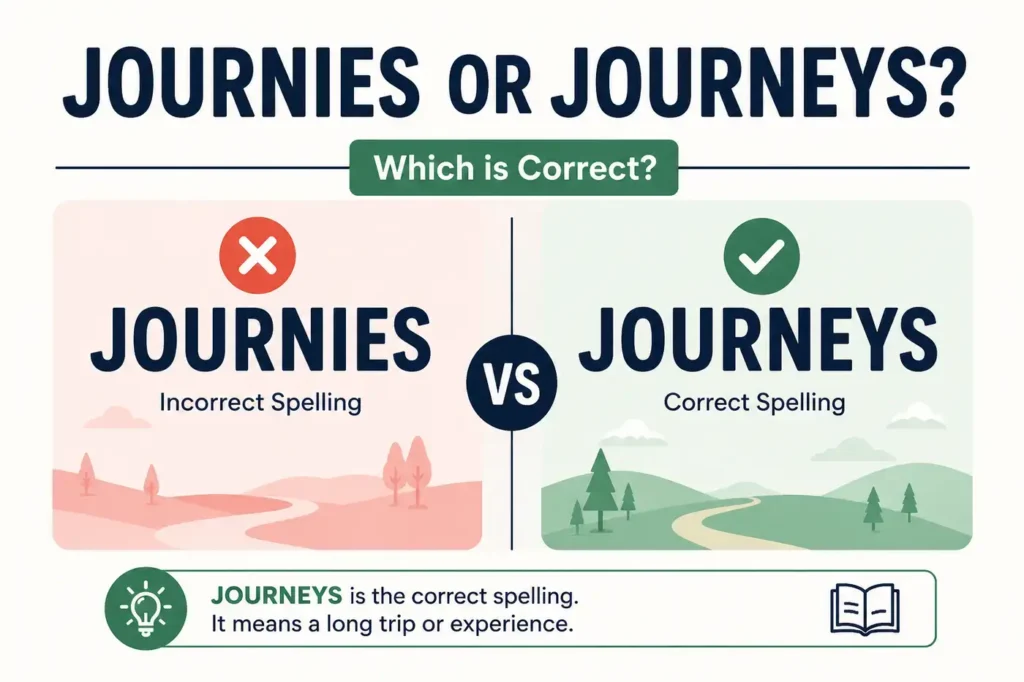
The correct spelling is journeys. The word journies is a misspelling and isn’t recognized as the standard plural form in modern English. The confusion usually comes from mixing up spelling rules for words ending in y. Some nouns change y to ies when they become plural, while others simply add s. Knowing which rule applies makes the answer easy to remember.
In this guide, you’ll learn why journeys is correct, why journies is incorrect, and how the plural form is created. You’ll also discover grammar rules, pronunciation, real examples, common mistakes, regional usage, and practical writing tips that professional editors use every day. By the end, you’ll know the correct spelling with confidence and understand the rule behind it instead of relying on memory alone.
Quick Definition
The correct plural of journey is journeys. The spelling journies is incorrect because journey ends with a vowel followed by y. In English, nouns that end in a vowel plus y usually form the plural by adding s, not by changing y to ies.
Quick Answer
If you’re looking for the correct plural form, the answer is straightforward.
- Journey is the singular noun.
- Journeys is the correct plural.
- Journies is a spelling mistake.
- The same rule applies in American English, British English, Australian English, and Canadian English.
A simple way to remember the rule is to look at the letter before y. Since journey ends with the vowel e followed by y, you simply add s to make it plural.
Journey And Journies Comparison Table
| Feature | Journey | Journies |
|---|---|---|
| Part of speech | Noun | Incorrect spelling |
| Meaning | A trip from one place to another or a personal experience over time | No accepted meaning |
| Plural form | Journeys | Not recognized |
| Correct spelling | Yes | No |
| Origin | Middle English | Misspelling of journeys |
| Formality | Standard English | Incorrect in formal and informal writing |
| Common contexts | Travel education literature business personal growth | Typing and spelling errors |
| Usage frequency | Very common | Extremely rare outside spelling mistakes |
| Example | Our journey begins today. | Incorrect usage |
Meaning Of Journey
Before learning the plural form, it’s helpful to understand what journey actually means.
A journey is the act of traveling from one place to another. It can also describe personal growth, learning, recovery, or any experience that unfolds over time. Because of its literal and figurative meanings, the word appears in everyday conversations, books, speeches, news articles, and business writing.
Here are the most common meanings.
- A trip from one location to another.
- A long process of learning or self improvement.
- Progress toward a goal.
- A series of experiences that happen over time.
You’ll often hear expressions such as:
- A journey across the country.
- A learning journey.
- A career journey.
- A health journey.
- Their journeys inspired everyone in the audience.
Although the context changes, the meaning always centers on movement, progress, or experience.
Just as many people confuse journies with journeys, it’s also common to mix up the difference between signer and signor, even though the two words have completely different meanings.
Why Journeys Is The Correct Plural
Many spelling mistakes happen because English plural rules aren’t all the same. Once you understand the rule, the correct spelling becomes much easier to remember.
The noun journey ends with the letters ey. Since the letter before y is a vowel, you create the plural by adding s.
For example:
- Journey becomes journeys.
- Monkey becomes monkeys.
- Valley becomes valleys.
- Donkey becomes donkeys.
- Key becomes keys.
Notice that none of these words change y to ies.
Now compare them with words that end in a consonant followed by y.
- City becomes cities.
- Baby becomes babies.
- Family becomes families.
- Story becomes stories.
- Country becomes countries.
In these words, the y changes because it’s preceded by a consonant instead of a vowel.
Learning this pattern is far more useful than memorizing individual words because it applies to hundreds of English nouns.
Key Differences Between The Two Spellings
At first glance, the two spellings look almost identical. The difference comes down to standard English spelling rules rather than pronunciation or meaning.
Here’s what sets them apart.
- Journeys is the accepted plural form found in dictionaries, style guides, books, and professional writing.
- Journies isn’t recognized as a correct English word.
- Both spellings are pronounced the same because the incorrect form is simply a misspelling.
- Native speakers almost always write journeys unless they make a typing error.
- Spell check tools automatically flag journies as incorrect.
The important point is that this isn’t a case like gray and grey, where both spellings are accepted in different regions. Only one spelling follows standard English grammar.
Which Spelling Should You Use
The answer is simple. Always use journeys when you need the plural form of journey.
Professional editors don’t treat this as a style preference because there isn’t an accepted alternative. Every major dictionary and English style guide recognizes journeys as the correct spelling.
If you’re writing an email, school assignment, business document, website article, or social media post, journeys is the only standard choice.
Keep these rules in mind.
- Use journey for one trip or experience.
- Use journeys for two or more trips or experiences.
- Avoid journies because it’s a spelling mistake.
- If you’re unsure, remember the vowel plus y rule before adding the plural ending.
Pronunciation Guide
One reason people question the spelling is that both versions sound exactly the same when spoken. English contains many words where pronunciation doesn’t clearly reveal the correct spelling.
Journey
IPA pronunciation:
/ˈdʒɝː.ni/ in American English.
/ˈdʒɜː.ni/ in British English.
Syllable breakdown:
Jour ney
Journeys
IPA pronunciation:
/ˈdʒɝː.niz/ in American English.
/ˈdʒɜː.niz/ in British English.
Syllable breakdown:
Jour neys
The plural simply adds a z sound at the end. The rest of the pronunciation stays the same.
Expert Learning Tip
Instead of asking yourself which spelling looks familiar, ask why the plural is formed that way. Once you recognize that journey ends with a vowel followed by y, the spelling rule becomes clear. You’re no longer guessing because you’re applying a grammar pattern that works across hundreds of English words.
That’s exactly how experienced editors approach spelling. They rely on grammar rules instead of memory, which leads to more accurate and consistent writing.
Examples In Sentences
Seeing a grammar rule in action makes it much easier to remember. The following examples show how the singular and plural forms are used in natural English. Pay attention to the context as well as the spelling.

Journey Examples
Use journey when you’re talking about one trip, experience, or process.
- My journey across the country lasted two weeks.
- Every learning journey begins with curiosity.
- Her recovery journey inspired the entire community.
- We started our journey before sunrise.
- The book follows one family’s journey through difficult times.
- His career journey has taken him around the world.
- The train journey was peaceful and relaxing.
- Each fitness journey looks different.
- Their journey taught them valuable life lessons.
- The company’s journey from a small startup to a global brand took years.
Notice that every sentence refers to one trip or one ongoing experience.
Journeys Examples
Use journeys when referring to two or more trips, experiences, or paths.
- Their journeys eventually led them to the same city.
- Many successful careers begin with unexpected journeys.
- The documentary explores the journeys of several immigrant families.
- Our journeys have shaped who we are today.
- The museum tells the journeys of early explorers.
- Students shared their learning journeys during the presentation.
- The novel follows the journeys of three close friends.
- Travelers often remember their longest journeys the most.
- Different journeys can lead to the same destination.
- The speaker encouraged everyone to appreciate their own journeys.
These examples show that the plural works naturally in both literal and figurative writing.
Journies Examples
Since journies is a misspelling, you shouldn’t use it in correct English writing. Still, seeing common errors can help you avoid repeating them.
Incorrect examples include:
- We enjoyed many journies together.
- Their journies changed their lives.
- She wrote about her journies abroad.
- The book describes several journies across Europe.
- Our journies taught us patience.
- They planned exciting journies for the summer.
- Every journies has a lesson.
- His journies inspired the audience.
- The children’s journies were unforgettable.
- These journies lasted for months.
In every case above, journies should be replaced with journeys.
Common Mistakes
Most people don’t misspell this word because they don’t know English. They usually apply the wrong plural rule.
Here are the mistakes editors see most often.
Changing Y To IES Automatically
Many learners assume every noun ending in y changes to ies.
That isn’t true.
Always look at the letter before y.
- If it’s a consonant, change y to ies.
- If it’s a vowel, simply add s.
This single rule explains why journeys is correct.
Mixing Similar Spelling Rules
English has many plural patterns, so it’s easy to mix them together.
Compare these examples.
| Singular | Correct Plural |
|---|---|
| Journey | Journeys |
| Monkey | Monkeys |
| Valley | Valleys |
| Key | Keys |
| Boy | Boys |
| Toy | Toys |
| City | Cities |
| Story | Stories |
| Family | Families |
| Country | Countries |
The first group ends with a vowel followed by y, so each word simply adds s. The second group ends with a consonant followed by y, so the y changes to ies.
Trusting Memory Instead Of The Rule
Many writers rely on what “looks right.” That approach often leads to mistakes because English spelling isn’t always predictable.
A better habit is to identify the spelling pattern before writing the plural.
Ignoring Spell Check Warnings
Modern writing tools usually recognize journies as an error. If your spell checker highlights the word, take a moment to review it instead of clicking past the suggestion.
Assuming There Are Regional Variations
Unlike some English words, this isn’t a regional spelling difference.
American English, British English, Australian English, and Canadian English all use the same plural form.
Etymology And Word Origin
The history of journey helps explain why the word has kept its spelling for centuries.
The word entered Middle English through Old French jornee, which originally referred to a day’s travel. That idea came from the Old French word jor, meaning day, which ultimately traces back to the Latin word diurnum, meaning daily.
Over time, the meaning expanded. Instead of describing only one day’s travel, it came to represent any trip from one place to another. Writers also began using it figuratively to describe personal growth, emotional experiences, education, careers, and life itself.
Although the meaning evolved, the plural formation remained regular. Since the word ends with a vowel followed by y, English naturally forms the plural by adding s.
Regional Usage
Many English words have different spellings around the world, but this isn’t one of them.
American English
American dictionaries, schools, publishers, and businesses all use journeys as the standard plural form.
British English
British English follows exactly the same spelling. You’ll find journeys in newspapers, books, academic writing, and official publications throughout the United Kingdom.
Australian English
Australian English also uses journeys without variation. The spelling remains consistent across schools, government documents, and media.

Canadian English
Canadian English agrees with both American and British English on this word. There isn’t a Canadian alternative.
This consistency makes the word easier to learn because you don’t need to adjust your spelling for different English speaking audiences.
English is full of commonly confused words and spellings, and modern slang can be just as tricky, especially if you’re unsure whether to use bougie or boujee in the right context.
Grammar Rules
Understanding the grammar behind the plural helps you apply the same pattern to many other words.
Part Of Speech
Journey is a countable noun. That means it has both singular and plural forms.
Examples.
- One journey.
- Two journeys.
- Several journeys.
Forming The Plural
The spelling rule is straightforward.
- If a noun ends with a vowel followed by y, add s.
- If a noun ends with a consonant followed by y, change y to ies.
Examples of the first rule include:
- Journey becomes journeys.
- Monkey becomes monkeys.
- Key becomes keys.
- Valley becomes valleys.
- Boy becomes boys.
Examples of the second rule include:
- Story becomes stories.
- Baby becomes babies.
- City becomes cities.
- Family becomes families.
- Country becomes countries.
What About Business
Many learners also search for the plural of business because they wonder if it follows a similar rule.
The answer is different.
The plural of business is businesses because the word ends with s. English adds es to make the pronunciation easier.
Examples.
- One business.
- Several businesses.
- Local businesses support the community.
This rule has nothing to do with words ending in y, but it’s another common plural pattern worth remembering.
Real Life Usage Examples
The word appears in almost every type of writing because it describes movement, progress, and experience.
Daily Conversation
People often use it when talking about travel or personal experiences.
Examples include:
- We enjoyed our journeys through the national parks.
- Their journeys brought them closer together.
- Every family has its own story.
Academic Writing
Teachers and researchers frequently use the word when discussing historical events, education, or learning experiences.
Examples include:
- The article compares the journeys of early settlers.
- Students reflected on their learning journeys throughout the semester.
Professional Communication
Businesses often use the word to describe customer experiences or employee development.
Examples include:
- We want to improve every customer’s journey.
- Employees shared their career journeys during the workshop.
Literature And Media
Authors use the word both literally and metaphorically.
Readers encounter it in travel books, biographies, novels, documentaries, speeches, and news articles because it captures the idea of movement and personal growth in a single word.
Related Words And Commonly Confused Terms
Learning one spelling rule often helps you master dozens of other words. That’s because English follows recognizable patterns when forming plurals. Once you understand those patterns, you’ll spend less time guessing and more time writing confidently.
Here are several nouns that follow the same vowel plus y rule.
| Singular | Plural |
|---|---|
| Journey | Journeys |
| Monkey | Monkeys |
| Valley | Valleys |
| Donkey | Donkeys |
| Key | Keys |
| Boy | Boys |
| Toy | Toys |
| Chimney | Chimneys |
| Turkey | Turkeys |
| Relay | Relays |
Now compare them with words that follow a different rule because they end with a consonant plus y.
| Singular | Plural |
|---|---|
| Story | Stories |
| City | Cities |
| Family | Families |
| Baby | Babies |
| Country | Countries |
| Lady | Ladies |
| Party | Parties |
| Library | Libraries |
| Cherry | Cherries |
| Penny | Pennies |
Seeing both groups side by side makes the grammar pattern much easier to understand. Instead of memorizing individual words, you can apply the rule whenever you come across a new noun ending in y.
You may also see these related terms while searching online.
- Plural noun.
- Singular noun.
- English spelling rules.
- Irregular plurals.
- Countable nouns.
- Word formation.
- Grammar rules.
- Common spelling mistakes.
- Vocabulary.
- Parts of speech.
Understanding these ideas builds a stronger foundation for English writing and editing.
If you enjoy learning the meanings and correct usage of everyday words, you might also find it helpful to explore what a camisole actually is and how it’s used in modern English.
Expert Language Insight
Professional editors rarely question the plural form of journey because the grammar rule is well established. Instead of relying on memory, they look at the spelling pattern first.
The key is identifying the letter before y. If it’s a vowel, they simply add s. If it’s a consonant, they replace y with ies. This approach works across hundreds of English nouns and eliminates the need to guess.
Another habit experienced writers develop is proofreading slowly instead of depending entirely on spell check. While modern writing tools usually catch obvious spelling errors, they aren’t a substitute for understanding grammar. Knowing the rule allows you to write confidently in emails, reports, articles, and academic papers without second guessing every plural noun.
If you’re learning English or helping a child improve their spelling, focus on the rule rather than the individual word. Once that pattern becomes familiar, similar nouns become much easier to spell correctly.
Frequently Asked Questions
Is journies a real word?
No. Journies isn’t recognized as a correct English word. Standard dictionaries and style guides list journeys as the proper plural form of journey. If you use journies, most spell check tools will identify it as a spelling error.
What is the correct plural of journey?
The correct plural is journeys. Since journey ends with a vowel followed by y, English forms the plural by adding s instead of changing y to ies.
Why doesn’t journey become journies?
The spelling rule depends on the letter before y. Because journey ends with the vowel e followed by y, the y stays in place and the word simply takes an s ending.
Do British and American English spell it differently?
No. American English, British English, Australian English, and Canadian English all use journeys. Unlike words such as color and colour, there isn’t a regional spelling difference.
What does journeys mean?
Journeys is the plural form of journey. It can describe several trips from one place to another or multiple experiences involving personal growth, learning, work, recovery, or life in general.
What are some synonyms for journey?
The best synonym depends on the context. Common alternatives include:
- Trip.
- Voyage.
- Expedition.
- Tour.
- Trek.
- Adventure.
- Excursion.
- Passage.
- Travel.
- Quest.
For personal development, words like path, experience, or progress may fit better.
Can journey describe more than travel?
Yes. Although the word originally referred to traveling from one place to another, it’s now widely used as a metaphor for growth and change. People often talk about a learning journey, career journey, healing journey, or creative journey.
How can I remember the correct spelling?
A quick way to remember it is to check the letter before y. If it’s a vowel, simply add s. If it’s a consonant, change y to ies. Using this rule is much more reliable than trying to remember individual words.
Conclusion
The answer is clear once you understand the grammar rule. Journeys is the only correct plural form of journey, while journies is simply a misspelling. The difference has nothing to do with regional English or personal preference. It comes from a standard plural rule that has been part of English for generations.
Instead of memorizing one word, remember the pattern. Nouns ending with a vowel followed by y usually form the plural by adding s, while nouns ending with a consonant followed by y typically change y to ies. That single rule applies to many common English words and makes spelling much more predictable.
As you continue improving your writing, pay attention to the grammar behind each word rather than relying on instinct alone. That’s the approach professional editors use every day, and it’s one of the easiest ways to write with greater accuracy and confidence.