Have you ever typed nosey or nosy into a search engine because you weren’t sure which spelling was right? You’re not the only one. This pair confuses plenty of English speakers because both versions appear in dictionaries, books, websites, and everyday conversations. At first glance, they seem interchangeable, but many people wonder if one spelling is more correct, more formal, or more widely accepted than the other.
The short answer is that nosy is the preferred modern spelling in most dictionaries and style guides. Nosey isn’t wrong, but it’s much less common and is often treated as a variant spelling. Both words describe someone who takes too much interest in other people’s private lives or business. The meaning, pronunciation, and grammar are the same. The main difference lies in spelling preference and usage.
This guide explains the difference in plain English. You’ll learn how each spelling developed, why dictionaries include both forms, which one professional editors recommend, how native speakers use the word, and where each spelling is most common. You’ll also find practical examples, pronunciation tips, grammar guidance, common mistakes, and expert language advice to help you choose the right spelling with confidence.
Quick Definition
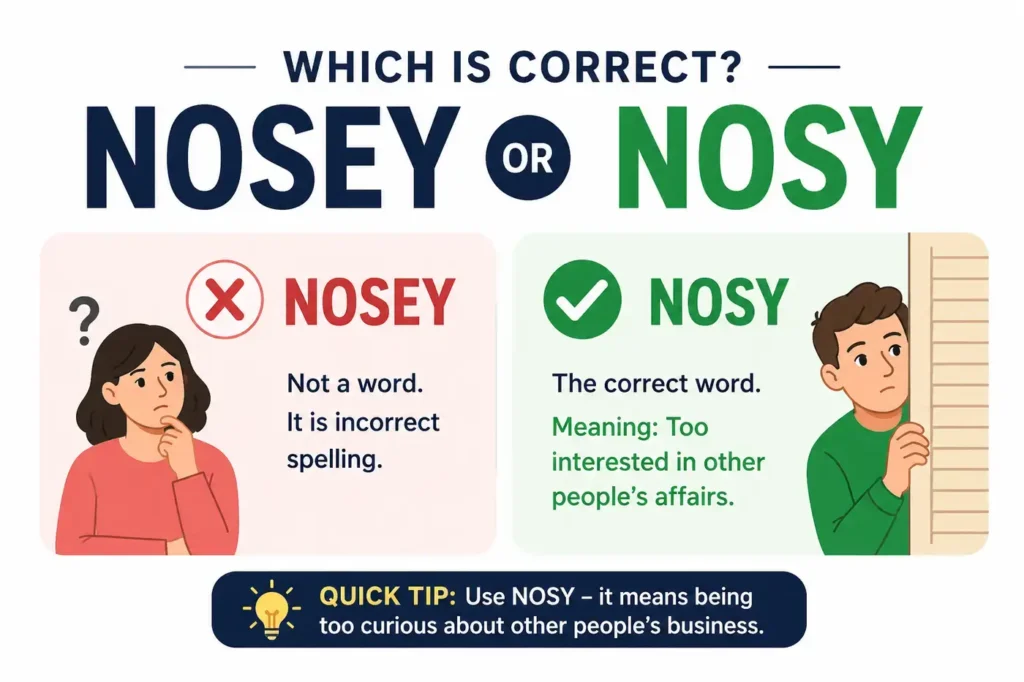
Nosy and nosey both describe someone who is overly curious about other people’s private matters. The words have the same meaning and pronunciation, but nosy is the preferred spelling in modern American and British English. Nosey remains an accepted alternative, though it appears far less often in published writing.
Quick Answer
If you’re writing for school, work, or publication, nosy is usually the better choice. It’s the spelling you’ll see in most modern dictionaries, newspapers, books, and style guides.
Keep these points in mind.
- Nosy is the standard spelling in modern English.
- Nosey is an accepted variant but is much less common.
- Both words have the same meaning and pronunciation.
- Choose one spelling and use it consistently throughout your writing.
Unless you’re following a publisher’s style guide that prefers nosey, using nosy is the safest option.
If you enjoy clearing up confusing word choices like nosey and nosy, you might also find other commonly confused spelling pairs helpful, especially those that trip up even experienced writers.
Comparison Table
| Feature | Nosy | Nosey |
|---|---|---|
| Part of speech | Adjective | Adjective |
| Meaning | Too interested in other people’s affairs | Too interested in other people’s affairs |
| Origin | Derived from the noun nose | Same origin |
| Modern preference | Preferred spelling | Variant spelling |
| Formality | Standard informal English | Standard informal English |
| Common contexts | Conversation, journalism, fiction, blogs | Conversation, older writing, regional use |
| Usage frequency | Very common | Less common |
| Pronunciation | /ˈnoʊzi/ | /ˈnoʊzi/ |
| Example | My nosy neighbor watches everyone. | My nosey neighbor watches everyone. |
Meaning and Definition
Although the spellings differ, they describe exactly the same personality trait. Both refer to someone who shows more interest in other people’s personal affairs than is appropriate.
What Does Nosy Mean
Nosy is an adjective used to describe a person who asks too many personal questions, listens to conversations that don’t involve them, or interferes in matters that aren’t their concern.
The word usually carries a mildly negative tone, though it can also be playful depending on the situation. Friends and family members sometimes use it jokingly, while in professional settings it often sounds like criticism.
Here are a few situations where the word fits naturally.
- A coworker keeps asking about everyone’s salary.
- A neighbor watches everything happening on the street.
- Someone reads messages that weren’t meant for them.
- A relative constantly asks personal questions about your relationships.
- A child keeps listening to adult conversations after being asked to leave the room.
In each case, the person shows curiosity that goes beyond normal interest.
What Does Nosey Mean
Nosey has the same definition. It describes someone who is overly curious or eager to know details about other people’s private lives.
You’ll still find this spelling in some dictionaries, novels, local publications, and online discussions. Some writers simply prefer it, while others keep it because it matches older editions or established house styles.
Even though nosey is accepted, professional editors generally choose nosy unless there’s a specific reason to keep the alternative spelling.
Key Differences
The biggest surprise for many learners is that there isn’t a difference in meaning. The distinction comes down to spelling preference and frequency of use.
Here’s how they compare.
- Meaning. Both words describe someone who is overly curious about other people’s personal matters.
- Pronunciation. They sound exactly the same when spoken.
- Grammar. Both function as adjectives and follow the same grammar rules.
- Tone. Neither spelling is more polite or more insulting than the other. The tone depends on the context.
- Usage. Nosy appears much more often in modern writing, while nosey is less common but still recognized.
If you’re writing for a broad audience, choosing nosy is usually the clearer and more familiar option.
Which Spelling Should You Use
Most writers never need to think about this question because dictionaries and style guides already point them in the right direction. If your goal is clear, modern English, nosy is the spelling to use.
Major dictionaries recognize both spellings, but they commonly list nosy as the main entry and nosey as a variant. That reflects how the word is used today rather than suggesting that one spelling is incorrect.
A simple rule works in almost every situation.
- Use nosy for school assignments, professional writing, websites, articles, and everyday communication.
- Keep nosey only if you’re quoting an original source, following a publisher’s preferred style, or preserving the spelling in a historical text.
This approach matches what professional editors do. They favor the spelling readers are most likely to expect unless there’s a compelling reason to do something different.
Pronunciation Guide
One reason this spelling pair causes confusion is that both versions sound identical. You can’t tell which spelling someone is using just by hearing the word.
IPA pronunciation
/ˈnoʊzi/
Syllable breakdown
No. sy
The first syllable rhymes with go and show, while the second sounds like zee in American English.
Common pronunciation mistakes include:
- Saying the word with three syllables.
- Stressing the second syllable instead of the first.
- Confusing it with noisy, which has a completely different meaning.
Reading the word aloud can also help you remember another common confusion. Nosy describes someone who is overly curious, while noisy describes something that makes a lot of sound. They look similar, but their meanings are completely different.
Expert Language Insight
Professional editors don’t spend much time debating nosy versus nosey because modern usage is already well established. Their priority is consistency and reader expectations.
When editing articles, books, or online content, editors usually replace nosey with nosy unless the original spelling serves a specific purpose. That keeps the writing aligned with current dictionaries and helps readers recognize the word immediately.
Native speakers rarely notice the difference unless they’re looking closely at the spelling. In conversation, both forms sound identical, so the choice only matters in writing. If you’re unsure which one to use, nosy is almost always the safer and more natural option.
Examples in Sentences
The easiest way to understand the difference between these spellings is to see them in context. Since they share the same meaning, the sentences below focus on natural, everyday situations. You’ll also notice that nosy appears more often because it’s the preferred modern spelling.
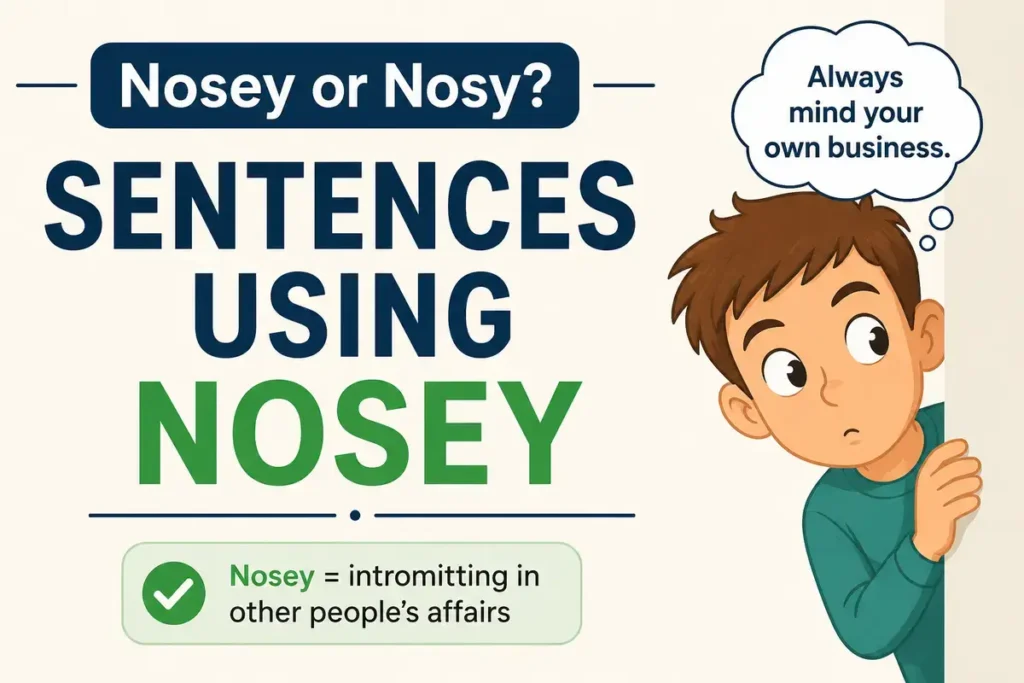
Sentences Using Nosy
These examples reflect the spelling you’ll see most often in modern English.
- My nosy neighbor always knows who visits our house.
- Don’t be so nosy. If someone wants to share something, they will.
- The reporter avoided asking nosy questions during the interview.
- Her little brother was too nosy to ignore the conversation.
- Everyone laughed when Grandpa admitted he could be a little nosy.
- A nosy coworker kept asking where I was applying for new jobs.
- The children peeked through the window because they were feeling nosy.
- She gave him a friendly smile instead of answering his nosy questions.
- My aunt isn’t trying to be rude. She’s just naturally nosy.
- Being curious is helpful, but being nosy can make people uncomfortable.
These examples show that the word often describes curiosity that crosses personal boundaries.
Sentences Using Nosey
Although less common, nosey still appears in some books, regional publications, and informal writing.
- My nosey neighbor notices every package delivered to the street.
- He admitted he was being nosey, then apologized.
- The children became nosey after hearing strange noises outside.
- Her nosey questions made everyone laugh.
- My grandmother still uses the spelling nosey because that’s how she learned it.
- A nosey stranger asked where we were going.
- The old novel described the shopkeeper as a nosey woman.
- Nobody likes a nosey guest who opens closed doors.
- The character’s nosey behavior created most of the comedy in the story.
- Some writers still prefer nosey, even though nosy appears more often today.
Common Mistakes
People usually don’t confuse the meaning of these words. Instead, they get confused about spelling, usage, or similar looking words.
Here are the mistakes that appear most often.
Assuming Nosey Is Wrong
This is probably the biggest misconception.
Nosey isn’t an incorrect spelling. It’s simply much less common than nosy. Most modern dictionaries include both forms, although they generally treat nosy as the preferred spelling.
Mixing Both Spellings
Some writers use nosy in one paragraph and nosey in the next.
That isn’t a grammar mistake, but it does make the writing look inconsistent. Professional editors choose one spelling and stick with it throughout the entire document.
Confusing Nosy With Noisy
These words look similar but have completely different meanings.
Nosy means overly curious.
Noisy means making a lot of sound.
Compare these examples.
- The nosy neighbor kept asking personal questions.
- The noisy neighbors played loud music all night.
Replacing one with the other completely changes the meaning.
Thinking The Word Is Always Offensive
Calling someone nosy can sound critical, but context matters.
Friends and family sometimes use the word jokingly.
For example:
Stop being so nosy. You’ll find out soon enough.
In other situations, especially at work or with people you don’t know well, it may sound rude or disrespectful.
English is full of words that look alike but have completely different meanings, and the difference between similar-looking words is often what separates accurate writing from common mistakes.
Etymology And Word Origin
The story behind these spellings is more interesting than many people realize.
Both words come from the noun nose. The idea is easy to picture. Someone with a figurative “nose” in other people’s business became known as nosy or nosey.
The adjective began appearing in English during the nineteenth century. Early publications showed several spelling variations before nosy gradually became the preferred form.
Language doesn’t always develop in a perfectly straight line. Many English words existed with multiple accepted spellings before one became more common. That’s exactly what happened here.
Today, dictionaries still recognize nosey, but most modern publishers, newspapers, educational resources, and style guides favor nosy because it’s the form readers expect.
Regional Usage
Unlike some spelling pairs, this one doesn’t create a sharp divide between American and British English. The preferred spelling is largely the same across major English speaking countries.
American English
American dictionaries, newspapers, and educational publishers overwhelmingly prefer nosy.
You’ll see it in novels, magazines, websites, and everyday writing.
British English
British English also favors nosy, although nosey appears occasionally in older books, regional publications, and personal writing.
Because both spellings are recognized, British readers generally understand either form without hesitation.
Australian English
Australian publications usually follow the same pattern.
Nosy appears much more frequently than nosey, especially in newspapers and educational materials.
Canadian English
Canadian English also leans toward nosy.
Since Canadian writing blends influences from both American and British English, you’ll occasionally encounter nosey, but it’s far less common.
Across all four regions, the difference isn’t about meaning or pronunciation. It’s simply a matter of spelling preference, and modern usage strongly favors nosy.
Grammar Rules
Understanding the grammar is straightforward because both spellings work exactly the same way.
Part Of Speech
Both nosy and nosey are adjectives.
They describe a person or behavior.
Examples include:
- A nosy neighbor.
- A nosy coworker.
- A nosey child.
- A nosey relative.
Comparative And Superlative Forms
Like many short adjectives, the word can change to compare people.
- Nosier.
- Nosiest.
If you’re using the alternative spelling, you’ll also see:
- Noseier.
- Noseiest.
The forms built from nosy appear more often because the base spelling is more common.
Common Sentence Patterns
You’ll regularly find the adjective in patterns like these.
- Be nosy.
- Sound nosy.
- Seem nosy.
- Look nosy.
- Ask nosy questions.
These combinations appear naturally in conversation, fiction, journalism, and everyday writing.
Real Life Usage Examples
The word isn’t limited to casual conversation. It appears in many different situations.
Daily Conversation
People often use the adjective playfully with family and friends.
Examples include:
- My sister is so nosy that she always knows everyone’s plans.
- Stop asking so many questions. You’re being nosy.
Professional Communication
The word is less common in formal workplaces because it can sound personal or critical.
Instead of saying someone is nosy, people often choose softer expressions such as:
- Overly curious.
- Too inquisitive.
- Asking personal questions.
These alternatives sound more professional in emails, meetings, and performance discussions.
Literature
Novelists frequently use the word to describe memorable characters.
A nosy neighbor, relative, detective, or shopkeeper often helps create humor, suspense, or conflict.
Media
News articles and entertainment websites sometimes describe celebrities, paparazzi, or online commentators as nosy when discussing privacy or public attention.
Because the word is familiar and easy to understand, readers immediately recognize the behavior it describes.
Related Words And Confused Terms
People searching for this spelling question often come across several similar words and expressions. Some are closely related, while others look alike but have completely different meanings.
Nosy And Noisy
This is one of the most common spelling mix ups.
Although the words differ by just one letter, they describe completely different things.
| Word | Meaning | Example |
|---|---|---|
| Nosy | Too interested in other people’s private affairs | My nosy neighbor knows everyone’s schedule. |
| Noisy | Making a lot of sound | The noisy crowd kept us awake all night. |
A quick way to remember the difference is to think about the letter e in noise. If the word relates to sound, noisy is the correct choice. If it describes someone’s curiosity, use nosy.
Nosy Parker
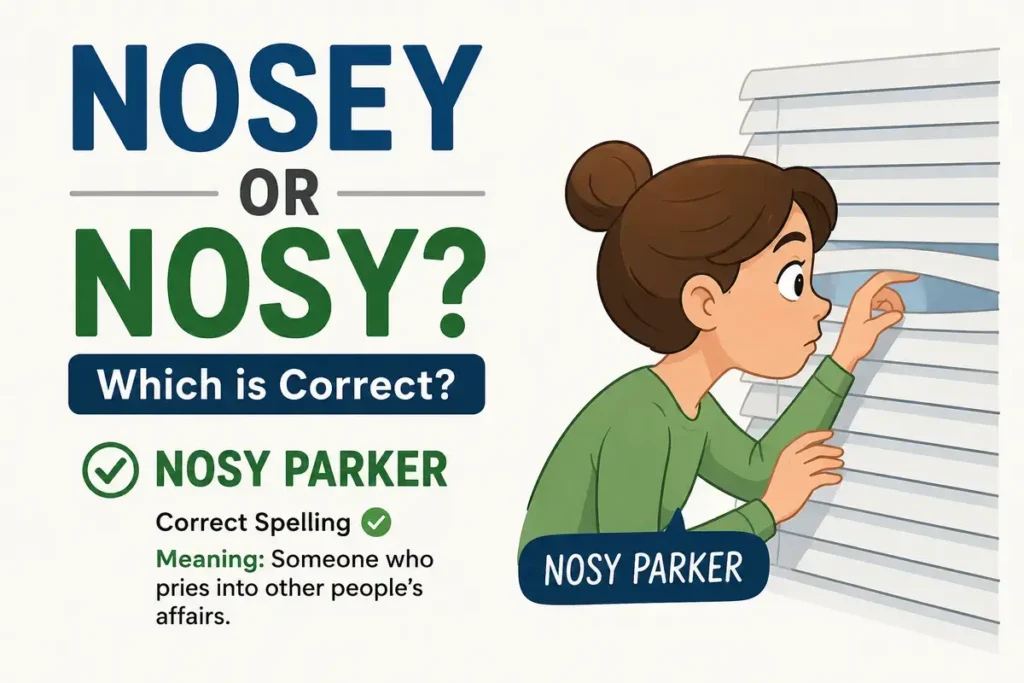
You may have heard someone called a Nosy Parker. This expression describes a person who constantly interferes in other people’s affairs or asks questions that aren’t their business.
Although the exact origin isn’t completely certain, the phrase has been part of British English for well over a century. Today, it’s usually used in a lighthearted or humorous way rather than as a serious insult.
For example:
- Don’t be such a Nosy Parker. They’ll tell us when they’re ready.
- Everyone laughed because Uncle Mike admitted he was the family’s Nosy Parker.
The expression remains much more common in the United Kingdom than in North America.
Synonyms
Sometimes another word fits the situation better than nosy.
Here are several common alternatives.
- Inquisitive.
- Curious.
- Prying.
- Meddlesome.
- Intrusive.
- Snooping.
- Interfering.
- Officious.
- Busybody.
- Prying into other people’s business.
Each synonym carries a slightly different tone.
For example, curious is often positive, while prying and intrusive usually suggest behavior that crosses personal boundaries.
Context is everything in English, so knowing what a camisole actually is can be just as useful as understanding when nosy is the correct spelling.
Expert Language Insight
From an editor’s perspective, choosing between nosy and nosey is surprisingly simple. Modern dictionaries, newspapers, publishing houses, and educational resources overwhelmingly favor nosy, making it the safest choice for almost every type of writing.
That doesn’t mean nosey has disappeared. You’ll still find it in older books, regional publications, personal blogs, and informal conversations. Some writers simply prefer the traditional spelling because that’s how they first learned the word.
Native speakers rarely notice the difference unless they’re reading closely. Since both spellings sound identical, the choice only affects written English. If you’re writing for a wide audience, using nosy helps your content match current language expectations without distracting readers.
One final point is worth remembering. The word describes behavior, not personality. Someone can ask a single nosy question without being a permanently nosy person. Context often shapes the meaning more than the word itself.
Frequently Asked Questions
Is nosy or nosey correct?
Both spellings are correct. However, nosy is the preferred spelling in modern English and appears more often in dictionaries, newspapers, books, and online writing. Nosey is still accepted, but it’s considered a less common variant.
Why do dictionaries include both spellings?
English often preserves older spelling variations even after one form becomes more popular. Dictionaries include nosey because it has a long history of legitimate use, but they generally identify nosy as the preferred modern spelling.
Which spelling does the Oxford dictionary prefer?
The Oxford English Dictionary recognizes both spellings. In modern usage, nosy is generally treated as the main spelling, while nosey is listed as a variant. That reflects how the word is commonly written today rather than suggesting that nosey is incorrect.
Is nosey more common in the United Kingdom?
Not really. British English also uses nosy more frequently in modern writing. Although nosey still appears from time to time, especially in older texts or informal writing, nosy remains the more common choice across most published sources.
How do you pronounce nosy?
Both spellings share the same pronunciation.
IPA:
/ˈnoʊzi/
The word has two syllables, with the stress on the first one. It sounds the same regardless of how it’s spelled.
Is calling someone nosy rude?
It depends on the situation. Among friends or family, it can be playful and affectionate. In formal settings or during disagreements, the word may sound critical because it suggests someone is interfering in matters that don’t concern them.
Can I use nosey in professional writing?
You can, but nosy is usually the better choice. Since it’s the preferred spelling in modern English, it matches the expectations of most readers and aligns with current editorial standards.
What is the difference between nosy and inquisitive?
Both words describe curiosity, but they carry different tones. Inquisitive often suggests a healthy desire to learn and discover new information. Nosy, on the other hand, implies unwanted interest in someone else’s private life or personal affairs.
Conclusion
Choosing between nosy and nosey is easier than it first appears. Both spellings have the same meaning, the same pronunciation, and the same grammatical role. The real difference is usage.
Today, nosy is the spelling most readers expect. It’s the version you’ll find in modern dictionaries, newspapers, websites, educational materials, and professional writing. Nosey is still accepted and has a long history in English, but it appears far less often.
If you’re writing for school, work, or a general audience, nosy is the safest and most natural choice. Save nosey for situations where you’re following an older source, preserving an author’s original spelling, or matching a specific style guide.
Understanding this small spelling difference won’t just improve your writing. It will also help you communicate more clearly and confidently, especially when choosing words that readers recognize immediately.