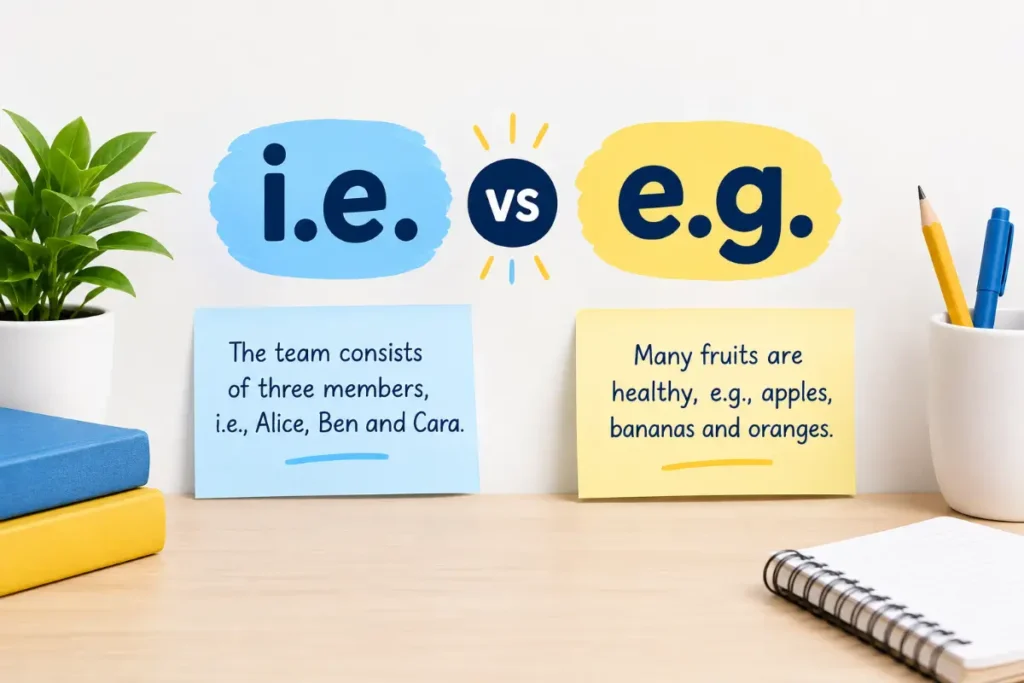
The difference between i.e. vs e.g. is simple once you know what each abbreviation stands for. i.e. means that is or in other words, and it introduces a clarification, restatement, or more precise explanation. e.g. means for example, and it introduces one or more examples that illustrate a broader idea. The two abbreviations come from Latin, which is one reason their meanings can be difficult to remember at first.
The confusion usually comes from the fact that both appear inside sentences to add information. They can also look similar on the page, especially in emails, academic writing, business documents, and online content. The key is to ask what you are trying to do. If you are explaining exactly what you mean, use i.e. If you are giving an example without defining the entire idea, use e.g.
This guide explains the difference between the two forms, their meanings, grammar, punctuation, pronunciation, American usage, common mistakes, and practical examples. You will also learn a simple memory trick that makes the distinction much easier to remember.
Quick Answer
I.e. means that is or in other words and introduces a clarification or restatement. E.g. means for example and introduces one or more examples. Use i.e. when you mean exactly what you just described, and use e.g. when you are giving an example of a broader category.
What Does I.e. Mean
I.e. is an abbreviation of the Latin phrase id est, which means that is. In modern English, it is used to clarify, define, narrow, or restate something that has already been mentioned. It tells the reader that the information following the abbreviation explains more precisely what the writer means.
For example, consider this sentence:
The meeting is for senior staff, i.e., department managers and directors.
The phrase department managers and directors is being presented as a clarification of senior staff. The writer is not simply listing random examples. The following words explain the specific group intended by the original phrase.
You can often replace i.e. with that is, in other words, or namely without changing the basic meaning.
- The store closes early on weekdays, i.e., at 6 p.m.
- We need a renewable energy source, i.e., one that can naturally replenish itself.
- The project needs immediate attention, i.e., it cannot wait until next month.
- She chose the simplest option, i.e., the one with the fewest steps.
The important idea is precision. I.e. narrows or clarifies the statement that came before it.
When To Use I.e.
Use i.e. when the information that follows explains exactly what you mean or provides a more precise version of the previous statement. It is especially useful when a broad phrase could be interpreted in several ways.
For example:
The office is closed on federal holidays, i.e., days such as Thanksgiving and Christmas when the company does not operate.
The second part explains what the writer means by the relevant holidays in this particular context. The purpose is clarification rather than simply giving a random selection of examples.
A useful test is to replace i.e. with that is. If the sentence still expresses the intended meaning, i.e. may be appropriate.
Just as writers need to distinguish between i.e. and e.g., understanding the difference between a possessive vs contraction can prevent common punctuation and grammar mistakes.
What Does E.g. Mean
E.g. comes from the Latin phrase exempli gratia, which means for the sake of example. In English, it means for example. Use it when you want to introduce one or more examples of a larger group, category, idea, or possibility.
For example:
Bring something to read, e.g., a book or magazine.
The words a book or magazine are examples of things someone could bring to read. They do not define every possible reading item. Other choices could also fit the category.
Here are several natural examples:
- You can use a mobile device, e.g., a phone or tablet.
- Some citrus fruits, e.g., oranges and lemons, are rich in vitamin C.
- We sell office supplies, e.g., pens, notebooks, and folders.
- Try a low impact activity, e.g., walking or swimming.
The key idea is illustration. E.g. introduces examples rather than a complete definition.
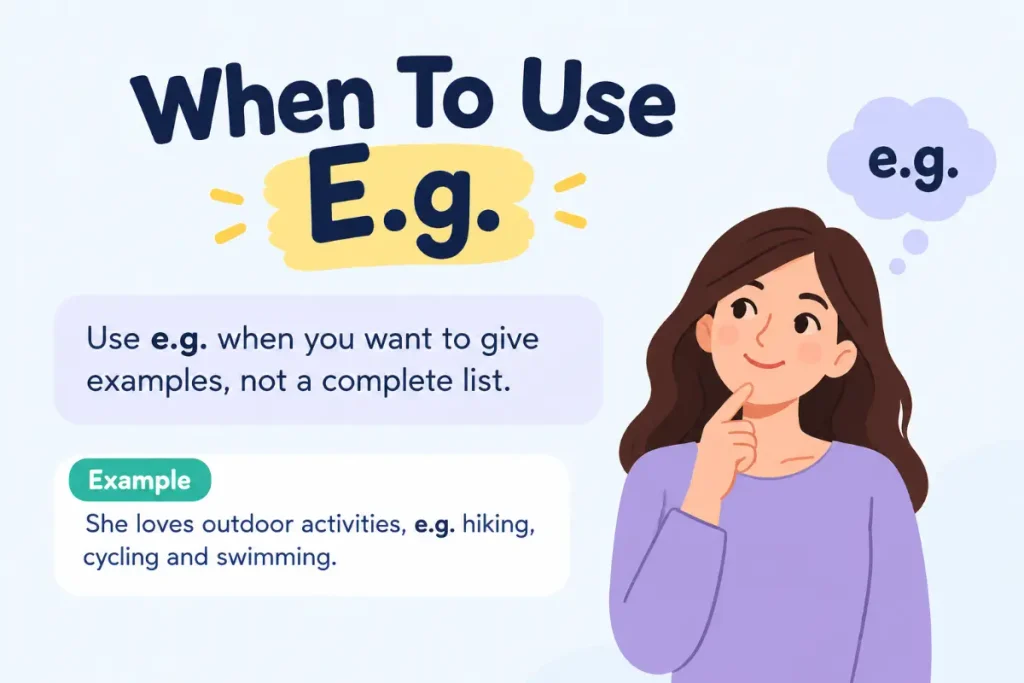
When To Use E.g.
Use e.g. when you want to give readers one or more examples that help them understand a broader idea. The examples do not need to represent every possibility.
For example:
Several programming languages, e.g., Python, JavaScript, and Java, are used in web development.
The sentence does not claim that Python, JavaScript, and Java are the only programming languages used in web development. They are simply examples.
A useful test is to replace e.g. with for example. If the sentence still makes sense, e.g. is likely the correct abbreviation.
I.e. vs E.g. Comparison
The central difference is the relationship between the original statement and the information that follows.
| Feature | I.e. | E.g. |
|---|---|---|
| Latin phrase | Id est | Exempli gratia |
| Basic meaning | That is | For example |
| Main purpose | Clarification | Illustration |
| Following information | More precise explanation | One or more examples |
| Scope | Usually narrows the meaning | Usually shows some possibilities |
| Common replacement | That is, in other words | For example |
| Example | Bring one form of ID, i.e., a passport. | Bring identification, e.g., a passport or license. |
The easiest distinction is this: i.e. explains exactly what you mean, while e.g. shows an example of what you mean.
Consider the difference between these two sentences:
I enjoy citrus fruit, e.g., oranges and lemons.
This gives examples of citrus fruit.
I enjoy citrus fruit, i.e., oranges and lemons.
This wording suggests that the writer is defining the intended meaning of citrus fruit as oranges and lemons. It is much narrower.
That difference is small in appearance but important in meaning.
The Easiest Way To Remember The Difference
The most useful memory trick is to connect the abbreviations with their English meanings.
Think of i.e. as in explanation. This is not the literal Latin translation, but it can help you remember that i.e. introduces a clarification.
Think of e.g. as example given. Again, this is only a memory aid, not the actual origin of the abbreviation.
An even better method is to remember the actual English replacements:
I.e. = that is
E.g. = for example
If you can identify which phrase belongs in your sentence, the correct abbreviation becomes much easier to choose.
Use The Expansion Test
When you are unsure, mentally expand the abbreviation.
If that is works, use i.e.
The store is closed tomorrow, i.e., Sunday.
If for example works, use e.g.
The store is closed on some holidays, e.g., Christmas Day.
This test is especially useful because it focuses on meaning instead of spelling.
I.e. vs E.g. Examples
Examples make the distinction much clearer because both abbreviations can appear in similar types of sentences.
Examples With I.e.
Use i.e. when the second part clarifies the first statement.
- The appointment is in the afternoon, i.e., after noon.
- We need a local supplier, i.e., a company based in this city.
- He wants a vegetarian meal, i.e., a meal without meat or fish.
- The deadline is next Friday, i.e., September 25.
- She chose the larger room, i.e., the one with two windows.
- The company needs one primary contact, i.e., a person responsible for communication.
- The test measures basic literacy, i.e., reading and writing skills.
- The event is for current members, i.e., people who already belong to the organization.
In each example, the information after i.e. narrows or explains the meaning of the earlier phrase.
Examples With E.g.
Use e.g. when the second part provides examples.
- Bring a form of identification, e.g., a passport or driver’s license.
- We sell baked goods, e.g., cookies, muffins, and cakes.
- Try a relaxing activity, e.g., reading or walking.
- Some common pets, e.g., dogs and cats, need regular exercise.
- You can store files online, e.g., using a cloud storage service.
- Several fruits, e.g., apples and bananas, work well in this recipe.
- Wear comfortable shoes, e.g., sneakers or walking shoes.
- Some social platforms, e.g., Instagram and TikTok, are popular with younger users.
The examples illustrate the broader category without claiming to define every possible option.
I.e. And E.g. In Everyday Writing
You can encounter both abbreviations in many forms of writing, including emails, reports, instructions, academic papers, business documents, websites, and professional communication. Their usefulness depends on the type of information you need to add.
For example, a manager might write:
Please bring one form of identification, e.g., a driver’s license or passport.
The manager is giving examples of acceptable identification.
The same manager could write:
The meeting will include only department heads, i.e., the managers responsible for each department.
Here, the second phrase clarifies exactly who counts as a department head for the meeting.
The difference is not about formality alone. It is about the relationship between the original statement and the information that follows.
Common Mistakes With I.e. And E.g.
Many mistakes happen because writers remember that both abbreviations introduce additional information but forget the difference between clarification and example.
Using E.g. When You Mean I.e.
Consider:
The deadline is the end of the month, e.g., December 31.
If December 31 is the exact date being discussed, i.e. is more appropriate:
The deadline is the end of the month, i.e., December 31.
The second version makes the date a clarification of the original phrase rather than one possible example.
Using I.e. When You Mean E.g.
Consider:
You can bring a snack, i.e., an apple or granola bar.
If the writer means that an apple and granola bar are simply two possible snacks, e.g. is clearer:
You can bring a snack, e.g., an apple or granola bar.
The category snack contains many possibilities, so the writer is providing examples.
Treating E.g. As A Complete List
E.g. does not normally mean that the items listed are the only possibilities.
For example:
You can visit several cities, e.g., Chicago, Boston, or Seattle.
This does not necessarily mean those are the only cities available. They are examples of cities someone could visit.
If you intend to provide a complete and limited list, simply write the list directly or explain that the list is exhaustive.
Using The Wrong Expansion
A common memory error is confusing the Latin abbreviations because they do not resemble their English meanings very closely. Do not try to memorize the Latin phrases unless you find them useful. For most writers, remembering i.e. = that is and e.g. = for example is enough.
When making comparisons in academic writing, avoiding common comparison mistakes is just as important as choosing the correct abbreviation.
Punctuation With I.e. And E.g.
In American English, i.e. and e.g. are commonly written with periods after each letter. They are usually followed by a comma when they introduce a parenthetical clarification or example within a sentence.
For example:
Several vegetables, e.g., carrots and broccoli, contain important nutrients.
The meeting is limited to managers, i.e., employees with supervisory responsibilities.
Style guides differ on some punctuation details, including comma placement and italicization, so you may see variations in published writing. The most important point is to follow the style guide used by your school, employer, publication, or organization when one is required.
Should You Use A Comma After E.g.
In American English, a comma after e.g. is common:
Bring a writing tool, e.g., a pen or pencil.
You may encounter styles that omit the second comma or use different punctuation based on sentence structure. Consistency matters more than trying to apply one punctuation rule to every possible sentence.
Should You Use A Comma After I.e.
The same general principle applies to i.e.:
The office closes early, i.e., at 4 p.m.
The comma helps separate the parenthetical clarification from the surrounding sentence. In more complex constructions, punctuation may vary according to the structure of the sentence.
Parentheses With I.e. And E.g.
Both abbreviations can appear inside parentheses.
For example:
Several employees work remotely (e.g., from home or a coworking space).
You can also use i.e. inside parentheses when adding a clarification:
The payment must be made electronically (i.e., by card or bank transfer).
Parentheses are useful when the information is supplementary. If the clarification or example is central to the sentence, commas can often create a smoother structure.
Avoid combining too many layers of parentheses, commas, and abbreviations. Clear writing should make the relationship between the main statement and the additional information easy to follow.
I.e. And E.g. In Professional Writing
Both forms can be useful in professional writing, but they should not replace plain English when a simpler phrase would be clearer.
For example, instead of writing:
We accept several forms of payment, e.g., credit cards and electronic transfers.
you can simply write:
We accept several forms of payment, such as credit cards and electronic transfers.
Likewise:
The service is available to existing customers, i.e., customers with an active account.
could be written as:
The service is available to existing customers, meaning customers with an active account.
The abbreviations are standard, but plain English is often easier for a broad audience. In customer communication and public facing content, for example, such as, that is, and in other words can sometimes be more immediately understandable.
I.e. And E.g. In Academic Writing
Both abbreviations appear in academic writing, research papers, textbooks, and scholarly material. Their use can make complicated explanations more concise, especially when the writer needs to clarify a technical term or provide examples.
For example:
The study examined social variables, e.g., income, education, and employment status.
The writer is giving examples of social variables.
By contrast:
The study focused on one demographic group, i.e., adults over the age of 65.
The second phrase defines the group more precisely.
Academic writers should still follow the style guide required by their institution or publication. Some styles favor spelling out for example and that is, particularly when the audience may not be familiar with Latin abbreviations.
I.e. And E.g. In Business Communication
In business writing, both abbreviations can save space when used correctly. They can appear in reports, internal documents, presentations, project instructions, and emails.
For example:
Please include relevant documents, e.g., invoices, receipts, and contracts.
This gives examples of relevant documents.
A clarification might look like this:
The report covers operational costs, i.e., expenses directly related to running the business.
Here, the writer defines what is meant by operational costs in the context of the report.
For customer facing writing, however, simpler wording is often preferable. For example and that is are immediately understood by almost every reader and can make the message feel more natural.
American English Usage
American English commonly uses i.e. and e.g. in edited writing. The abbreviations retain their Latin origins, but they function as established English writing conventions.
British English also uses both forms, so this is not a simple US versus UK spelling distinction. Differences can instead arise from individual style guides, punctuation preferences, academic conventions, or editorial policies.
For American readers, the safest practical approach is to focus on meaning first. Use i.e. for clarification and e.g. for examples. Then apply the punctuation and formatting rules required by the style guide relevant to your document.
Formal And Casual Usage
I.e. and e.g. are generally more common in edited or formal writing than in casual conversation. People do not normally say i.e. aloud in everyday speech. They are more likely to say that is, in other words, or for example.
In a casual text message, you might write:
You can bring any dessert, like cookies or brownies.
In a formal report, you might write:
Several desserts, e.g., cookies and brownies, were available.
Both communicate the same basic idea, but the second version has a more formal written style.
For general audiences, do not use Latin abbreviations simply to sound more sophisticated. Clear language is usually the better choice.
Pronunciation Of I.e. And E.g.
Because these are abbreviations, their pronunciation varies depending on context and speaking style. In ordinary speech, people generally pronounce the English meanings rather than saying the letters exactly as they appear on the page.
- I.e. is usually read aloud as that is or that is to say.
- E.g. is usually read aloud as for example.
The Latin phrases behind the abbreviations are not normally used in everyday American conversation. Their Latin pronunciation is mainly relevant in historical, academic, or language focused discussions.
Word Origin And Etymology
Both abbreviations come from Latin.
I.e. comes from id est, literally meaning that is. The phrase developed into a common abbreviation in English writing because Latin was historically important in European education, scholarship, law, science, and formal writing.
E.g. comes from exempli gratia, meaning for the sake of example. English adopted the abbreviation as a concise way to introduce examples.
The Latin origins explain why the abbreviations do not immediately reveal their modern English meanings. The easiest approach for modern readers is to learn the English equivalents rather than relying on the Latin.
Related Terms And Similar Expressions
Several English expressions can replace these abbreviations depending on the sentence.
For i.e., useful alternatives include:
- that is
- in other words
- namely
- specifically
- meaning
For e.g., useful alternatives include:
- for example
- for instance
- such as
- including
These alternatives are often clearer for general audiences. Namely and specifically tend to introduce more precise information, while for example and such as usually introduce examples.
One important distinction is that such as often fits naturally into a sentence without interrupting the flow.
Bring warm clothing, such as a jacket or sweater.
This can sound more natural than using an abbreviation in some forms of public facing writing.
Clear academic writing also depends on choosing the right pronoun, especially when deciding whether who or whom fits the sentence.
Expert Usage Tips
The strongest way to distinguish the two forms is to focus on the relationship between the information before and after the abbreviation.
If the second part tells the reader exactly what the first part means, use i.e.
If the second part gives the reader some examples of the first part, use e.g.
Compare these:
She lives in a large city, i.e., New York City.
The second part identifies the exact city.
She has lived in several large cities, e.g., New York, Chicago, and Los Angeles.
The second part gives examples of the larger category.
Another useful editing habit is to replace the abbreviation with its full English meaning. If the sentence sounds natural with that is, you probably need i.e. If it sounds natural with for example, you probably need e.g.
When writing for a broad audience, also consider replacing the abbreviation altogether. There is no requirement to use Latin abbreviations simply because they are available. Clear communication should come first.
Frequently Asked Questions
What is the difference between i.e. and e.g.
I.e. means that is and introduces a clarification or more precise statement. E.g. means for example and introduces examples of a broader idea. If you are defining exactly what you mean, use i.e. If you are giving some possible examples, use e.g.
What does e.g. mean
E.g. means for example. It comes from the Latin phrase exempli gratia. Writers use it before one or more examples that illustrate a broader category or idea. For example, Some pets, e.g., dogs and cats, need regular exercise uses the abbreviation to introduce examples of pets.
What does i.e. mean
I.e. means that is or in other words. It comes from the Latin phrase id est. Use it when the information that follows clarifies or narrows the meaning of the statement before it. It is different from e.g., which introduces examples rather than a precise clarification.
Does i.e. mean in essence
Not exactly. I.e. literally comes from the Latin id est, meaning that is. In some contexts, you could replace it with in other words or a phrase that gives the essential meaning, but in essence is not the direct translation. For clarity, remember i.e. = that is.
Should I use i.e. or e.g. for examples
Use e.g. for examples. The abbreviation means for example. Use i.e. when you are clarifying exactly what you mean. For instance, Bring fruit, e.g., apples or bananas gives examples. Bring one specific fruit, i.e., an apple identifies the exact item intended.
Is it better to write for example instead of e.g.
For a general audience, for example can be clearer and more natural than e.g. Both are correct, but the full phrase does not require readers to remember a Latin abbreviation. In academic or professional writing, follow the style guide that applies to your document.
Are i.e. and e.g. used in American English
Yes. Both abbreviations are established in American English and appear in edited writing, including academic, professional, and general publications. Their basic meanings are the same in British English. Differences are more likely to involve punctuation or individual style preferences than the meanings of the abbreviations.
How can I remember i.e. and e.g.
Remember two simple replacements: i.e. = that is and e.g. = for example. If you are clarifying exactly what you mean, choose i.e. If you are giving an example of a broader idea, choose e.g. Expanding the abbreviation mentally is usually the fastest way to check your choice.
Conclusion
The difference between i.e. vs e.g. comes down to one basic question: are you clarifying the exact meaning or giving an example? I.e. means that is and is used to clarify, define, or restate something. E.g. means for example and introduces one or more examples of a broader idea.
When you are unsure, replace the abbreviation with its full English meaning. If that is fits, use i.e. If for example fits, use e.g. For general readers, you can also write the full phrases instead of using abbreviations. The goal is not to sound formal. The goal is to make your meaning immediately clear.