Using ensure vs insure correctly can make your writing sound polished and professional. These two words look similar, share a common history, and even overlap in some situations. That is exactly why so many writers pause before choosing one. The confusion becomes even more common in emails, business documents, school assignments, and everyday conversations where both words seem like they could fit.
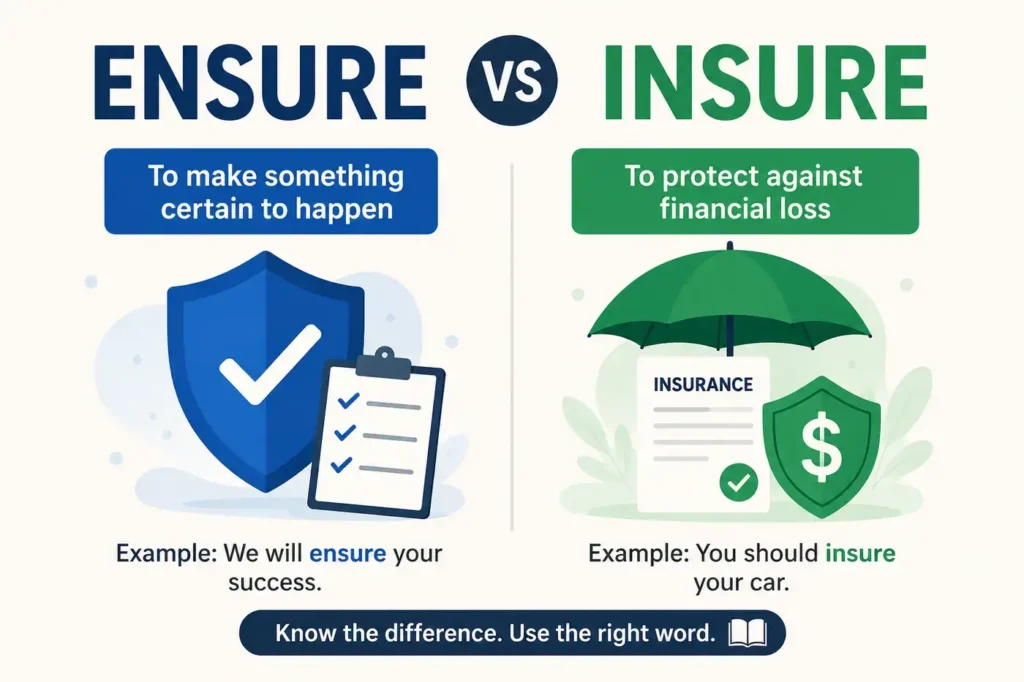
The short answer is simple. Ensure means to make certain that something happens, while insure usually means to protect a person, property, or financial interest through an insurance policy. Although some dictionaries acknowledge limited overlap, modern style guides and professional editors recommend using each word in its primary sense to avoid confusion.
In this guide, you will learn the meaning of each word, how they differ, when they can and cannot replace each other, and the grammar behind their usage. You will also find practical examples, pronunciation tips, regional preferences, common mistakes, and expert editing advice that helps you choose the right word with confidence every time.
Quick Definition
Ensure means to make certain or guarantee that something happens. Insure means to provide or obtain insurance against financial loss or damage. In modern English, ensure is the preferred word for guaranteeing an outcome, while insure is mainly reserved for insurance related contexts.
If you’re unsure whether a word is the right choice, it’s worth checking whether chef is spelled correctly before assuming a similar-looking version is valid.
Quick Answer
If you only remember one rule, make it this one.
- Use ensure when you mean to make certain, to guarantee, or to make sure.
- Use insure when you’re talking about insurance, financial protection, or insurance policies.
- If an insurance company is involved, insure is almost always the correct choice.
- If you’re talking about making something happen, ensure is usually the right word.
For example:
- We checked the equipment to ensure everyone stayed safe.
- They decided to insure their new house against flood damage.
Following this simple distinction will keep your writing clear and consistent in almost every situation.
Comparison Table
| Feature | Ensure | Insure |
|---|---|---|
| Part of speech | Verb | Verb |
| Primary meaning | To make certain or guarantee | To provide insurance or financial protection |
| Origin | Derived from Anglo French and Latin roots | Derived from the same historical root with a specialized meaning |
| Correct use | Guaranteeing an outcome | Protecting against financial loss |
| Formality | Standard in formal and informal writing | Standard in legal financial and insurance writing |
| Common contexts | Everyday communication business education instructions | Insurance contracts finance property vehicles health |
| Usage frequency | Very common | Common in insurance related contexts |
| Example | Please ensure the door is locked. | They insured the building against fire. |
Understanding Ensure
The verb ensure means to make certain that something happens or that a condition is met. Whenever your goal is to guarantee a result or prevent a problem, this is usually the word you need.
You’ll see ensure in many kinds of writing because it applies to countless situations. Teachers use it in classroom instructions, businesses include it in policies, journalists use it in news reports, and people say it naturally in everyday conversation.
Here are some common situations where ensure fits perfectly.
- Giving instructions.
- Explaining safety procedures.
- Describing quality checks.
- Confirming plans.
- Guaranteeing an outcome.
Consider these examples.
- Double check the address to ensure the package arrives on time.
- The coach reviewed the strategy to ensure every player understood the plan.
- Regular maintenance helps ensure the machine operates safely.
- We arrived early to ensure we found good seats.
- The editor carefully reviewed the article to ensure every fact was accurate.
Notice that none of these examples involve insurance. They all focus on making something happen or preventing a problem.
Understanding Insure
The verb insure has a much more specific meaning. It refers to protecting someone or something financially through an insurance policy. In most modern writing, you’ll see it used in legal documents, financial discussions, and conversations about insurance coverage.
Whenever an insurance company provides protection against loss, damage, theft, or accidents, insure is almost always the correct choice.
Here are some common situations where insure is used.
- Buying auto insurance.
- Protecting a home.
- Covering business property.
- Purchasing travel insurance.
- Insuring valuable belongings.
Examples include.
- They decided to insure their home before hurricane season.
- The company insures commercial vehicles across the country.
- We insured our cameras before leaving for vacation.
- Many banks require borrowers to insure the property.
- She chose to insure her jewelry against theft.
In each example, the word refers to financial protection rather than guaranteeing a result.
Key Differences
At first glance, these verbs appear interchangeable because both relate to protection in some way. In modern English, however, professional editors recommend keeping their meanings separate. Doing so makes your writing more precise and easier to understand.
The biggest difference is the purpose of each word. Ensure focuses on making something certain, while insure focuses on protecting something through insurance.
The comparison becomes much clearer when you look at them side by side.
| Ensure | Insure |
|---|---|
| Means to make certain | Means to provide insurance |
| Focuses on results | Focuses on financial protection |
| Used in general writing | Used in insurance and legal contexts |
| Common in everyday communication | Common in financial documents |
| Often replaced by make sure | Closely connected to insurance policies |
Another easy way to remember the difference is to think about the noun connected to each verb.
- Ensure relates to certainty, confidence, and successful outcomes.
- Insure relates to insurance, policies, premiums, claims, and financial protection.
That simple connection helps many writers choose the correct word without stopping to think every time.
Which Word Is Correct
Neither word is more correct than the other. The right choice depends entirely on what you’re trying to say.
If your sentence is about guaranteeing that something happens, ensure is the correct verb.
Examples include.
- Please ensure everyone receives the updated schedule.
- The technician tested the system to ensure it worked properly.
- Careful planning helped ensure the event ran smoothly.
If your sentence is about purchasing or providing insurance, insure is the correct choice.
Examples include.
- We decided to insure the new office building.
- The family insured their car against theft.
- Every business should insure valuable equipment.
When you’re unsure, ask yourself one simple question.
Am I talking about certainty or insurance?
If the answer is certainty, choose ensure.
If the answer is insurance, choose insure.
That simple habit will help you make the correct choice in almost every situation.
Pronunciation Guide
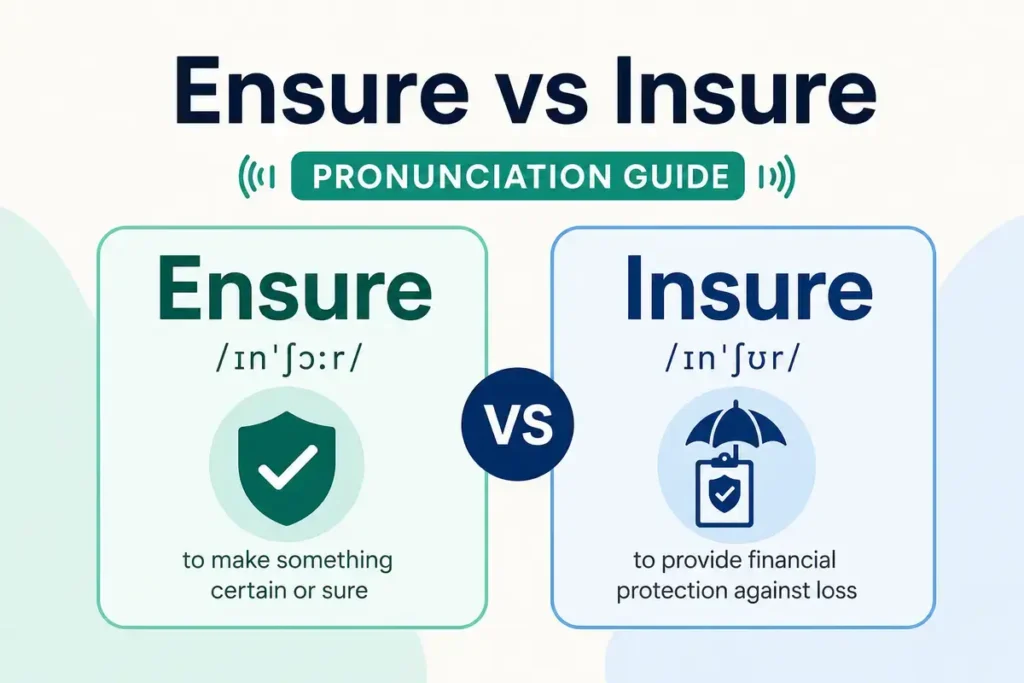
Although these verbs have different meanings, they sound very similar. Their pronunciation is one reason people confuse them in writing.
Ensure
IPA: /ɪnˈʃʊr/
Syllable breakdown:
en • sure
Insure
IPA: /ɪnˈʃʊr/
Syllable breakdown:
in • sure
In standard American and British English, the pronunciation is usually identical. Native speakers rely on context, not pronunciation, to understand which word is intended.
Here are two examples.
- We worked hard to ensure customer satisfaction.
- They chose to insure the business against fire damage.
Although they sound the same, the surrounding words immediately reveal the intended meaning.
Expert Language Insight
Professional editors rarely choose between these words based on personal preference. They choose the verb that communicates the most precise meaning.
In everyday writing, ensure has become the standard choice for expressing certainty or guaranteeing an outcome. Insure has gradually developed a more specialized role connected with insurance and financial protection. Keeping these meanings separate removes ambiguity and makes your writing easier to understand.
Many style guides also recommend avoiding unnecessary overlap. Even though some dictionaries note that insure has occasionally been used to mean ensure, that usage is much less common today. Choosing the more specific word helps readers understand your message immediately without stopping to interpret your meaning.
Examples Using Ensure and Insure
Reading real sentences is one of the fastest ways to understand the difference between these verbs. As you go through the examples below, pay attention to the purpose of each word instead of simply memorizing the spelling. You’ll quickly notice that one focuses on certainty, while the other relates to insurance and financial protection.
Examples With Ensure
Use ensure when you mean to make certain, guarantee, or make sure something happens.
- Please ensure every guest receives a welcome packet before the meeting begins.
- The teacher reviewed the instructions to ensure every student understood the assignment.
- We left home early to ensure we arrived before the ceremony started.
- Regular inspections help ensure workplace safety.
- The editor checked every source to ensure the article was accurate.
- Good communication helps ensure projects stay on schedule.
- The chef tasted the soup to ensure the seasoning was balanced.
- Double check your email address to ensure you receive the confirmation message.
- Exercise and a healthy diet help ensure better overall health.
- The company updated its security system to ensure customer information remained protected.
These examples all describe actions taken to achieve a desired result or prevent a problem. None of them involve an insurance policy.
Examples With Insure
Use insure when the topic involves insurance, financial coverage, or protection against loss.
- They decided to insure their home before moving into the neighborhood.
- The business insured its office equipment against theft.
- Many landlords require tenants to insure valuable personal belongings.
- We insured the rental car before starting our road trip.
- The company insures commercial buildings across several states.
- Farmers often insure their crops against severe weather.
- She chose to insure her engagement ring because of its value.
- The museum insured the artwork before transporting it overseas.
- Every driver should insure their vehicle according to local laws.
- The family insured their vacation home against storm damage.
Notice that every example involves financial protection provided through insurance.
Good writing often comes down to choosing the correct spelling for the context rather than relying on words that simply look right.
Common Mistakes in Ensure vs Insure
Because these words sound the same and share a similar history, writers often mix them up. Fortunately, most mistakes follow predictable patterns and are easy to avoid once you understand the difference.
Using Insure Instead of Ensure
This is the mistake editors see most often.
Incorrect:
Please insure everyone signs the attendance sheet.
Correct:
Please ensure everyone signs the attendance sheet.
The sentence isn’t talking about insurance. It’s talking about making certain that something happens.
Using Ensure When Talking About Insurance
The opposite mistake also appears from time to time.
Incorrect:
We need to ensure the building before hurricane season.
Correct:
We need to insure the building before hurricane season.
Since the sentence refers to purchasing insurance coverage, insure is the correct choice.
Assuming The Words Always Mean The Same Thing
Some dictionaries mention older usage where insure could mean ensure. While that usage exists historically, modern writing favors a clearer distinction.
Most publishers, universities, businesses, and style guides recommend using:
- Ensure for certainty.
- Insure for insurance.
Following this distinction makes your writing clearer and more professional.
Forgetting The Audience
Professional documents, contracts, insurance policies, and financial reports almost always use insure in its specialized meaning.
General articles, emails, reports, manuals, and academic writing usually use ensure when describing certainty or guaranteeing an outcome.
Thinking about your audience helps you choose the right word naturally.
Etymology And Word Origin
Understanding the history of these verbs explains why they still confuse so many people today.
Both words trace their roots to the Latin word securus, meaning safe or secure. From Latin, the idea passed into Old French before entering Middle English. For centuries, several related spellings appeared in English, and their meanings often overlapped.
As the language evolved, writers gradually assigned more specific roles to each verb. Ensure became associated with making something certain, while insure developed a specialized connection with insurance and financial protection.
Today, most dictionaries recognize this distinction, and major style guides encourage writers to maintain it because it improves clarity.
Although they share the same linguistic ancestry, modern English treats them as separate verbs with different purposes.
Regional Usage
One question many learners ask is if American and British English use these verbs differently. The answer is yes, but the difference is smaller than many people expect.
American English
In American English, the distinction is usually very clear.
- Ensure means to make certain.
- Insure means to provide insurance.
Most newspapers, publishers, universities, and businesses follow this approach because it reduces confusion.
British English
British English generally follows the same pattern.
Some older British sources occasionally used insure in the broader sense of guaranteeing an outcome, but modern usage strongly favors ensure for certainty.
Australian English
Australian English also prefers keeping the meanings separate.
You’ll usually see ensure in general writing and insure in financial or legal contexts.
Canadian English
Canadian English follows a similar convention.
Government publications, educational institutions, and professional organizations typically reserve insure for insurance related situations while using ensure in everyday writing.
Although small regional differences exist, readers across English speaking countries understand and expect this distinction.
Grammar Rules
Both verbs share similar grammatical behavior because they’re regular verbs. The difference lies in meaning rather than grammar.
Part Of Speech
Both ensure and insure are verbs.
Examples:
- We ensure quality through careful testing.
- They insure valuable artwork.
Verb Forms
Both verbs follow regular conjugation patterns.
| Base Form | Past Tense | Past Participle | Present Participle |
|---|---|---|---|
| Ensure | Ensured | Ensured | Ensuring |
| Insure | Insured | Insured | Insuring |
Common Sentence Patterns
You’ll often see ensure followed by a clause beginning with that.
Examples include:
- Please ensure that every form is completed.
- The manager ensured that everyone understood the new policy.
It also appears naturally without that.
Examples:
- We ensured everyone arrived safely.
- Good planning ensures success.
The verb insure is commonly followed by the object receiving insurance.
Examples:
- They insured the building.
- She insured her car.
- The company insures homes across the state.
Tense Usage
Both verbs work in every standard tense.
Examples:
- We ensure quality every day.
- We ensured everything was ready.
- We have ensured customer satisfaction.
- The company insures thousands of vehicles.
- They insured the property last year.
- The agency has insured homes for decades.
The grammar changes naturally with the tense, but the core meaning of each verb remains the same.
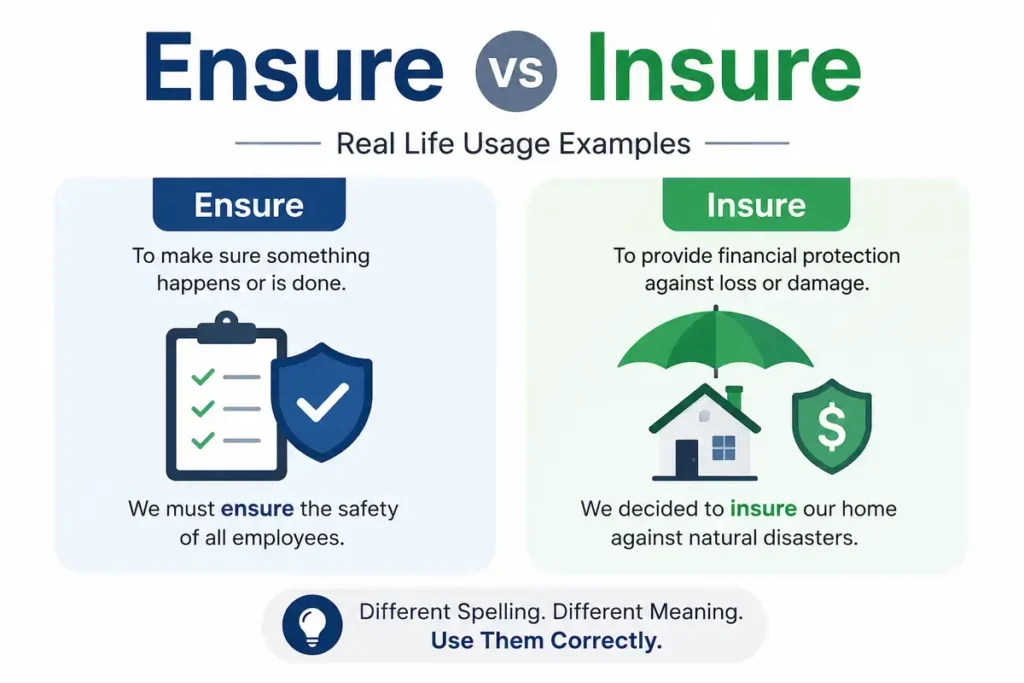
Real Life Usage Examples of Ensure vs Insure
These verbs appear in many different situations, making it useful to understand how professionals use them.
Daily Conversation
People often use ensure when giving advice or making plans.
Examples include:
- Ensure the kids buckle their seat belts.
- Please ensure the lights are turned off before leaving.
Insurance conversations naturally use insure instead.
Examples include:
- We should insure the boat before summer.
- Did you insure your new laptop?
Academic Writing
Teachers and researchers frequently use ensure because academic writing often discusses procedures, accuracy, and reliability.
Examples include:
- Researchers followed strict guidelines to ensure accurate results.
- The experiment was repeated to ensure consistency.
Professional Communication
Businesses rely on both words depending on the situation.
Examples include:
- Managers ensure projects stay on schedule.
- Companies insure offices, equipment, and company vehicles.
Literature And Media
Journalists, authors, and editors almost always reserve insure for insurance related stories. In every other context, ensure remains the preferred choice because it communicates the intended meaning more clearly.
Professional editors value precision. Choosing the correct verb helps readers understand your message immediately without stopping to interpret your wording.
Related Words And Commonly Confused Terms
Once you understand the difference between ensure and insure, another verb often enters the conversation. That word is assure. Since all three words share similar origins and sound alike, many writers assume they are interchangeable. In modern English, each one has its own role.
A simple way to remember them is to focus on the object of the sentence.
- Ensure relates to an outcome or result.
- Insure relates to insurance or financial protection.
- Assure relates to a person by giving confidence or reassurance.
Compare these examples.
- We reviewed the checklist to ensure everything was ready.
- The family decided to insure their vacation home.
- The manager assured the employees that their jobs were secure.
Another easy memory trick is to think about the first letter.
- E in ensure can remind you of the expected result.
- I in insure connects with insurance.
- A in assure reminds you of a person receiving assurance.
You may also come across these related words while reading grammar guides or dictionaries.
- Guarantee.
- Confirm.
- Verify.
- Secure.
- Protect.
- Cover.
- Promise.
- Certify.
- Reassure.
- Safeguard.
Each word has its own nuance, so choosing the most precise verb makes your writing clearer and more natural.
Learning to distinguish ensure from insure can help you avoid common writing mistakes like writen and improve your overall accuracy.
Expert Language Insight
Professional editors rarely stop to think about these verbs because the distinction has become second nature. Instead of asking which word sounds better, they ask what the sentence is trying to communicate.
If the goal is achieving a result, ensure is almost always the strongest choice. If the sentence discusses an insurance policy or financial coverage, insure is the natural fit. When the goal is calming another person or giving confidence, assure is the better option.
This approach improves clarity because every verb carries a specific meaning. Readers do not have to pause and interpret your intention.
Style guides used by newspapers, publishers, universities, and businesses generally encourage writers to keep these meanings separate. Although older dictionaries mention some overlap, modern usage strongly favors precision.
Native speakers naturally follow this pattern in everyday communication. They might not think about the grammar behind their choice, but they instinctively use the verb that best matches the context.
If you develop the same habit, your writing will sound more confident and professional without feeling forced.
Frequently Asked Questions
What is the difference between ensure and insure?
The main difference is their purpose. Ensure means to make certain that something happens, while insure means to provide protection through an insurance policy. One focuses on certainty, and the other focuses on financial protection.
Can ensure and insure be used interchangeably?
In modern English, they usually should not be used interchangeably. Although some historical usage allowed overlap, most dictionaries and style guides recommend using ensure for guaranteeing results and insure only for insurance related situations.
What is the difference between ensure and assure?
Ensure refers to making something certain. Assure refers to giving confidence to a person. You ensure an outcome, but you assure someone.
How do I remember the difference?
Think about what receives the action.
- Ensure an outcome.
- Insure property or valuables.
- Assure a person.
This simple rule works in nearly every situation.
Which word is more common in everyday writing?
Ensure appears far more often because people regularly write about making sure something happens. Insure has a narrower role and is mostly used in financial, legal, and insurance related writing.
Are the words pronounced differently?
In most American and British accents, ensure and insure are pronounced the same. Context tells listeners which word is being used rather than pronunciation alone.
Is one spelling American and the other British?
No. Both words exist in American English, British English, Australian English, and Canadian English. The distinction depends on meaning rather than regional spelling preferences.
Which word should I use in professional writing?
Choose the verb that accurately reflects your meaning. Use ensure when guaranteeing a result and insure when discussing insurance. This approach matches the recommendations found in most professional style guides and helps readers understand your message immediately.
Conclusion
Once you understand ensure vs insure, choosing the right word becomes much easier. The key is to focus on what each word is designed to communicate rather than how similar they look or sound. Ensure is the right choice when you want to make certain that something happens or guarantee a result. Insure belongs in situations involving insurance, financial protection, or coverage against loss.
Although the words share a common history and sound almost identical, modern English gives each one a distinct purpose. Keeping those meanings separate makes your writing clearer, more accurate, and easier to understand.
When you’re uncertain, ask yourself one question. Are you talking about certainty or insurance? If you’re guaranteeing an outcome, choose ensure. If you’re discussing an insurance policy or financial protection, choose insure.
Making this small distinction will improve everything from emails and academic papers to business documents and professional communication. Once you start paying attention to context instead of spelling alone, choosing the correct word becomes second nature.