You may have seen someone describe a luxury hotel as bougie while another person calls the same place boujee. That leaves many people wondering which spelling is correct or if the words mean different things. The short answer is that both spellings appear in modern English, but they aren’t always used in exactly the same way.
The confusion comes from slang, social media, music, and pop culture. Over the years, the word has taken on new meanings and spellings, making it harder to know which version fits your conversation. Add platforms like TikTok, Reddit, and Instagram to the mix, and it’s easy to see why people search for the difference.
This guide explains the meaning, history, pronunciation, grammar, and real world usage of both spellings in clear, everyday language. You’ll also learn how native speakers actually use these words, where each spelling is most common, and which one makes the most sense in different situations. By the end, you’ll know exactly when to use each version with confidence.
Quick Definition
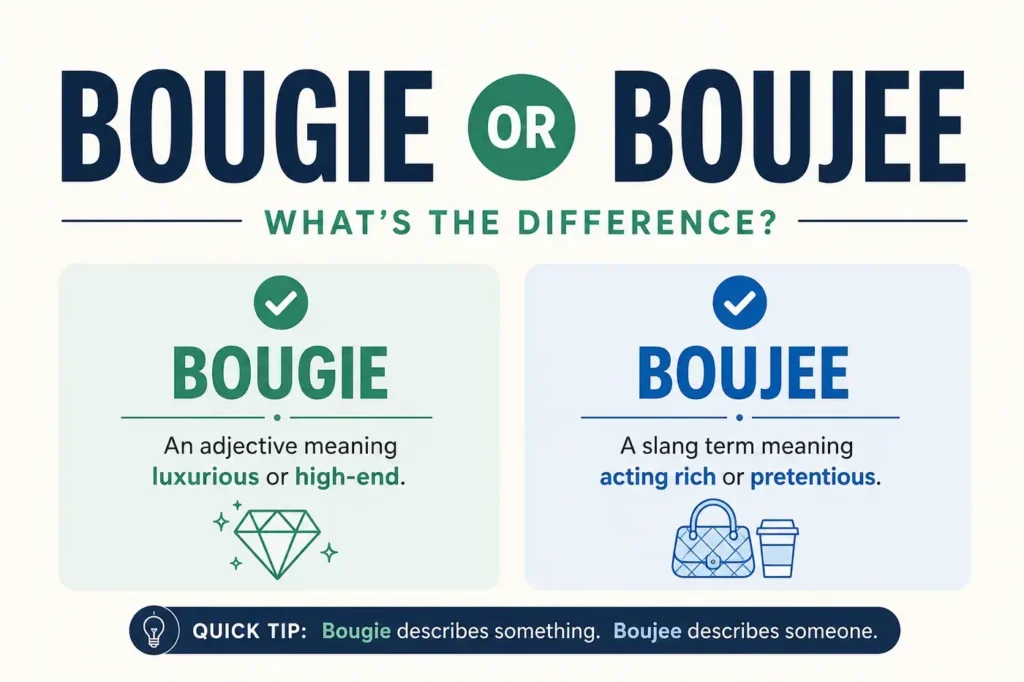
Both bougie and boujee are accepted modern spellings used to describe someone or something that appears luxurious, stylish, expensive, or associated with an upscale lifestyle. Bougie is the older and more widely recognized spelling, while boujee became popular through music, internet culture, and social media. The intended meaning usually depends on context rather than spelling.
Quick Answer
If you’re looking for the safest spelling, bougie is usually the better choice. It’s the original form, appears in dictionaries, and has been used for decades.
That said, boujee isn’t a mistake. It’s a popular alternative that gained momentum through hip hop culture, viral content, and everyday online conversations. Many younger speakers use it intentionally because it matches the modern pronunciation and style they want to convey.
A simple way to remember the difference is this.
- Use bougie in general writing, articles, and most everyday situations.
- Use boujee when referring to internet slang, song lyrics, memes, or modern social media culture.
- Pick one spelling and stay consistent throughout your writing unless you’re explaining the difference between both forms.
For more grammar and usage tips, check out the difference between drier and dryer to avoid another pair of commonly confused English words.
Comparison Table
| Feature | Bougie | Boujee |
|---|---|---|
| Part of speech | Adjective Informal noun | Adjective Informal noun |
| Origin | Shortened form of bourgeois | Modern phonetic spelling of bougie |
| Core meaning | Stylish luxurious or pretending to have expensive taste | Similar meaning with stronger internet and pop culture influence |
| Formality | Informal | Very informal slang |
| Common contexts | Daily conversation fashion lifestyle articles | Social media music memes TikTok |
| Usage frequency | More common in general English | More common online and in youth culture |
| Dictionary recognition | Widely recognized | Limited recognition depending on the dictionary |
| Example | That café feels bougie. | That vacation looked boujee. |
Meaning of Both Terms
Although the spellings look different, they share the same roots. Understanding how each word developed makes it much easier to choose the right one.
What Does Bougie Mean
Bougie is an informal adjective that describes someone or something associated with luxury, elegance, or expensive tastes. Depending on the situation, it can be playful, complimentary, or slightly sarcastic.
Someone might call a restaurant bougie because it serves gourmet food, has elegant décor, and charges premium prices. A friend might jokingly describe another friend as bougie because they only drink specialty coffee or insist on staying in luxury hotels.
Today, the word often suggests a lifestyle that feels polished, fashionable, or a little extravagant. It doesn’t always imply wealth. Sometimes it simply reflects refined preferences or an interest in premium products.
You’ll commonly hear bougie in conversations about:
- Fashion and personal style.
- Food and fine dining.
- Travel and luxury hotels.
- Home décor and interior design.
- Beauty products and skincare.
- Lifestyle content.
What Does Boujee Mean
Boujee carries almost the same meaning, but it has a slightly different personality.
The spelling became popular because it mirrors the way many people pronounce the word. It gained widespread attention through hip hop lyrics, internet memes, and viral social media posts. As a result, it often feels trendier, younger, and more playful than bougie.
People commonly use boujee to describe luxury experiences, designer brands, upscale vacations, or someone enjoying a glamorous lifestyle. In many cases, the word is used with humor or exaggeration rather than as a serious description.
For example, someone might post a photo of an expensive brunch and caption it with a joke about living a boujee life. The tone is usually lighthearted rather than formal.
You’ll frequently see this spelling on:
- TikTok videos.
- Instagram captions.
- Reddit discussions.
- Music playlists.
- Pop culture blogs.
- Viral memes.
Key Differences
At first glance, the two spellings appear interchangeable. In everyday conversation, they often are. Still, there are subtle differences worth understanding.
The biggest difference is history. Bougie developed as a shortened form of bourgeois, a French word that originally referred to the middle class. Over time, English speakers gave the word a broader meaning, using it to describe people with refined or expensive tastes.
Boujee came later as a phonetic spelling that reflected modern pronunciation. Its popularity grew rapidly through music and social media, giving it a more contemporary feel.
Here are the main differences.
| Bougie | Boujee |
|---|---|
| Older spelling | Newer slang spelling |
| Derived from bourgeois | Based on pronunciation |
| More common in dictionaries | More common online |
| Suitable for general informal writing | Best known in internet culture |
| Widely understood across age groups | Especially popular among younger audiences |
Even with these differences, native speakers often switch between the two without changing the intended meaning.
Which Spelling Is Correct
Many people expect one clear winner, but language doesn’t always work that way.
If your goal is accuracy, bougie is generally considered the standard spelling because it comes directly from the original word bourgeois. It’s the version you’ll find in more dictionaries, editorial writing, and language references.
That doesn’t make boujee incorrect. Language evolves as people use it, and slang often develops alternative spellings that better match everyday pronunciation. That’s exactly what happened here.
Before choosing a spelling, think about your audience.
- Writing an article or blog post. Bougie is usually the safer option.
- Posting on TikTok or Instagram. Either spelling will feel natural, although boujee appears more often in social media.
- Referring to song lyrics or internet memes. Keep the spelling that matches the original source.
- Writing for a general audience. Bougie is more likely to be recognized by readers of different ages.
Instead of asking which spelling is right, it’s more useful to ask which spelling fits the situation.
Pronunciation Guide
One reason people spell the word differently is that both versions share the same pronunciation.
IPA Pronunciation
/ˈbuːʒi/
Syllable Breakdown
Bou gie
Two syllables.
How To Say It
The first syllable sounds like boo.
The second syllable sounds like zhee, similar to the ending in words borrowed from French.
Say it smoothly as BOO zhee.
Common Pronunciation Mistakes
These mistakes are easy to avoid once you’ve heard the correct pronunciation.
- Pronouncing the middle sound like gee in geese.
- Saying the ending like jee instead of zhee.
- Overemphasizing the second syllable.
- Treating the word as three syllables instead of two.
Listening to native speakers in interviews, podcasts, or everyday conversations can help you become comfortable with the natural pronunciation.
Expert Language Insight
From an editor’s perspective, this isn’t simply a spelling question. It’s a question of audience and tone.
Language changes because people change the way they communicate. Social media, music, and online communities often introduce new spellings that eventually become part of everyday English. Some remain informal forever, while others gradually earn broader acceptance.
That’s why experienced writers don’t automatically replace boujee with bougie. Instead, they consider the context. An article about slang or internet culture might intentionally keep the newer spelling, while a lifestyle magazine or dictionary style guide is more likely to prefer the traditional form.
Understanding that difference helps you write more naturally because you’re choosing the word that fits the conversation instead of following a rule without considering the audience.
Examples in Sentences
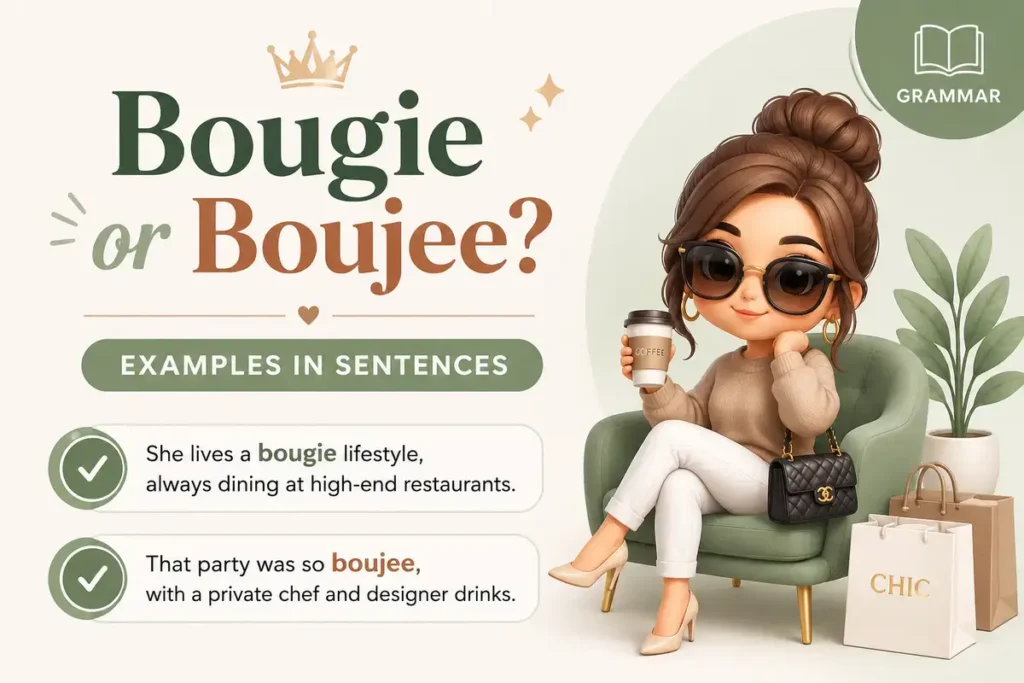
Reading natural examples is one of the easiest ways to understand how these words work. Notice that the meaning stays very similar in both sets of examples. The biggest difference is the tone and the audience.
Bougie Examples
These examples use the more established spelling that appears in many dictionaries and style guides.
- She turned her small apartment into a bougie space with elegant lighting and fresh flowers.
- That coffee shop feels bougie because every drink comes with handcrafted artwork.
- We laughed because he ordered sparkling water at a roadside diner just to be bougie.
- The neighborhood has become much more bougie over the past few years.
- Her skincare routine is surprisingly bougie for a college student.
- They booked a bougie resort for their anniversary trip.
- My sister loves shopping at boutique stores because she enjoys that bougie style.
- The rooftop restaurant has a bougie atmosphere without feeling unwelcoming.
- His taste in watches is definitely bougie.
- The party looked simple at first, but the decorations gave it a bougie touch.
These examples show that the word can describe people, places, products, or experiences. Depending on the speaker, it can express admiration, humor, or gentle teasing.
Boujee Examples
The following examples reflect the spelling that became popular through music, memes, and social media.
- That brunch looked so boujee on Instagram.
- She joked that buying imported chocolate made her feel boujee.
- Their vacation photos gave off serious boujee vibes.
- The hotel lobby looked incredibly boujee with its marble floors and crystal chandeliers.
- He posted a funny video about living the boujee life on a tight budget.
- My friends call me boujee because I won’t drink instant coffee.
- The picnic turned unexpectedly boujee after everyone brought gourmet food.
- That outfit looks expensive, stylish, and completely boujee.
- We laughed about our boujee grocery list after buying artisan cheese and fresh pastries.
- The birthday celebration wasn’t expensive, but the decorations made it feel boujee.
Most native speakers would understand every one of these examples, even if they personally prefer the other spelling.
Common Mistakes
People rarely struggle with the meaning. The confusion usually comes from spelling, pronunciation, and context.
Here are the mistakes editors see most often.
Assuming One Spelling Is Always Wrong
Many people believe only one spelling is acceptable.
That’s not true.
Bougie is the traditional spelling, while boujee is a modern variation that has become widely recognized in informal communication.
Using The Wrong Tone
Although the meanings are nearly identical, the tone can feel different.
Using boujee in a formal article or academic paper may seem too casual. In contrast, using bougie in a lighthearted social media caption often feels more natural.
Think about your audience before choosing a spelling.
Confusing The Word With Wealth
Someone doesn’t need to be rich to be described this way.
The word often refers to appearance, taste, or lifestyle rather than actual income. A person enjoying homemade coffee in a decorative mug might jokingly call the experience bougie, even if it costs very little.
Forgetting The Word Is Usually Informal
These words belong to casual English.
You’ll hear them in conversations, online discussions, entertainment, and lifestyle content far more often than in business reports or academic writing.
Assuming The Meaning Never Changes
Context matters.
Sometimes the word is a compliment that suggests elegance or refined taste.
Other times it’s playful teasing about someone acting a little too fancy.
Pay attention to the speaker’s tone before deciding how the word is being used.
Etymology And Word Origin
The history behind these words is far more interesting than many people expect.
The original source is the French word bourgeois, which referred to the middle class. Over time, the term developed social and cultural meanings beyond economic status. Writers and speakers began using it to describe people associated with conventional middle class values, material comfort, or an interest in status.
English speakers eventually shortened bourgeois to bougie, making the word easier to pronounce and use in everyday conversation.
As internet culture grew, another spelling appeared.
Boujee developed as a phonetic version that matched the way many English speakers naturally pronounced the word. Its popularity increased dramatically through music, celebrity culture, and social media, where creative spellings often spread quickly.
Today, both forms exist side by side. One reflects the word’s historical roots, while the other reflects modern language trends.
Regional Usage
Unlike many spelling differences, this isn’t a case of American English versus British English. Both spellings can appear in several English speaking countries, although their popularity varies.
American English
The United States is where both spellings are most widely recognized.
Bougie appears in magazines, blogs, podcasts, and everyday conversation.
Boujee is especially common on TikTok, Instagram, Reddit, and in discussions influenced by music and pop culture.
Many younger speakers switch between the two without thinking much about the difference.
British English
British speakers are familiar with the word, particularly through social media and entertainment.
The traditional spelling appears more often in writing, while the newer version is mostly associated with internet culture and music.
Australian English
Australians generally understand both spellings because of the influence of American entertainment and online platforms.
The word remains informal and is used more often in conversation than in formal writing.
Canadian English
Canadian usage closely resembles American English.
You’ll see both spellings online, but bougie still appears more frequently in articles and editorial content.
Across all four regions, the meaning remains remarkably consistent. The biggest difference is the setting in which each spelling appears.
Writers who often mix up similar-looking words may also find it helpful to learn when to use “filed” or “filled” in everyday writing and professional documents.
Grammar Rules
Although these words began as slang, they follow familiar English grammar patterns.
Part Of Speech
They most commonly function as adjectives.
Examples include:
- That’s a bougie restaurant.
- She has a boujee style.
In casual conversation, people also use them as informal nouns to describe a person.
For example:
- He’s such a bougie.
- Don’t be so boujee.
This noun usage is conversational and isn’t appropriate for formal writing.
Comparative Forms
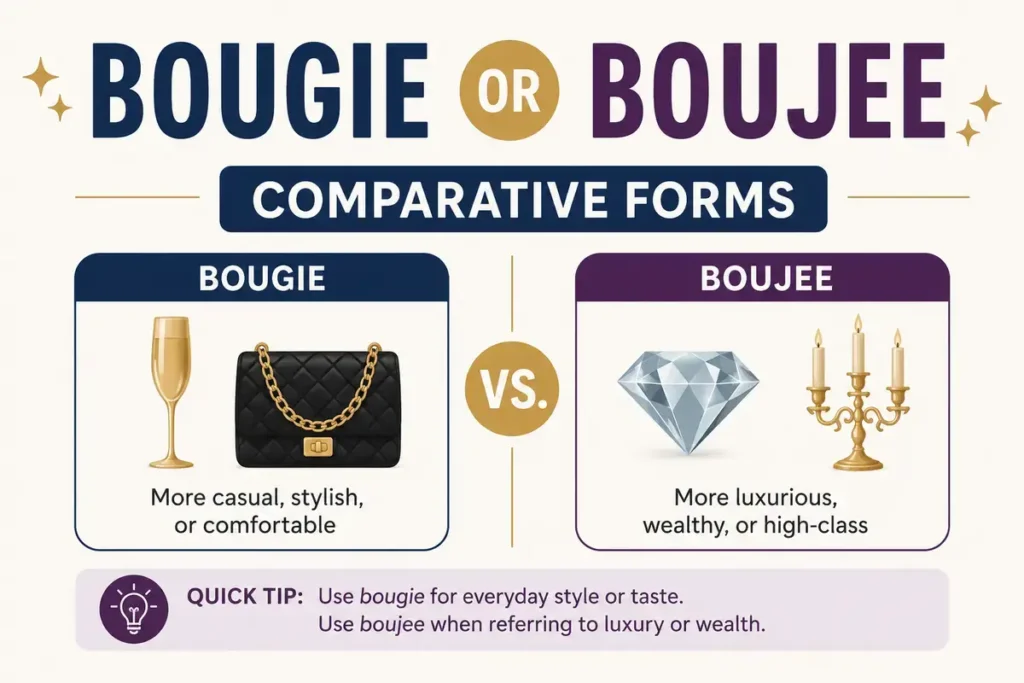
Native speakers rarely use traditional comparative forms like bougier or boujeer.
Instead, they naturally say:
- More bougie.
- Less bougie.
- Most bougie.
This structure sounds smoother and matches everyday speech.
Plural Forms
When used as adjectives, the words don’t change.
Examples:
- Bougie cafés.
- Boujee outfits.
- Bougie apartments.
- Boujee vacations.
When used as informal nouns, plural forms occasionally appear in casual conversation, although they’re much less common.
Sentence Placement
These words usually appear before the noun they describe.
Examples include:
- A bougie hotel.
- A boujee party.
- A bougie neighborhood.
- A boujee vacation.
They can also follow linking verbs.
For example:
- That restaurant is bougie.
- The event felt boujee.
Both sentence patterns sound natural to native speakers.
Real Life Usage Examples
One reason these words became so popular is that they fit many everyday situations.
Daily Conversation
Friends often use the words jokingly.
Someone who orders gourmet coffee every morning or insists on premium products may be called bougie without any negative intent.
Social Media
Platforms like TikTok and Instagram helped introduce the newer spelling to millions of users.
Captions about luxury vacations, designer fashion, expensive meals, and aesthetic home décor often include one of these words.
Professional Communication
These words rarely appear in formal business writing.
Lifestyle brands, fashion companies, and entertainment websites may use them in marketing because they create a relaxed and modern tone.
Entertainment And Media
Music, television, podcasts, and online creators have played a major role in spreading both spellings.
Many people first encounter the word through pop culture before hearing it in everyday conversation.
Lifestyle Writing
Food bloggers, travel writers, beauty creators, and interior design influencers often use the word to describe stylish experiences without sounding overly formal.
That flexibility explains why it has become part of everyday vocabulary for many English speakers.
Related Words And Confused Terms
Learning a few related words makes it easier to understand how these slang terms fit into modern English. Some share a similar meaning, while others are often confused because they describe luxury, style, or social status.
Here are some closely related words and expressions.
- Bourgeois. The original French word that inspired the modern slang.
- Upscale. Describes something high quality or luxurious.
- Fancy. A common everyday word for something elegant or expensive.
- Luxurious. Refers to comfort, quality, or high end living.
- High end. Often used for premium products or services.
- Affluent. Describes people or communities with significant wealth.
- Elegant. Suggests refined taste and sophistication.
- Posh. A British English term for something stylish or upper class.
- Pretentious. Sometimes used when someone appears to be showing off their lifestyle.
- Aesthetic. Popular on social media to describe a carefully styled appearance or theme.
Although these words overlap in meaning, they are not perfect substitutes. Context still matters. For example, calling a restaurant elegant sounds much more formal than calling it bougie, even if both describe an upscale experience.
Expert Language Insight
From an editor’s perspective, this is less about choosing the right spelling and more about choosing the right voice.
If you’re writing a lifestyle article, travel guide, or fashion blog, bougie is usually the safer option because it’s the older and more established spelling. Readers of different ages are more likely to recognize it, and many dictionaries include it as the standard informal form.
The newer spelling has its place too. It reflects how language changes through music, social media, and online communities. On platforms like TikTok or Reddit, it often feels more natural because that’s the version many users have adopted in everyday conversation.
Native speakers don’t usually stop to debate the spelling. Instead, they choose the version that fits the audience and the tone of the conversation. That’s a good habit for writers as well. Think about who you’re writing for, stay consistent, and let context guide your choice.
If you’re interested in other commonly confused spellings, the correct spelling of Nazi is another example where a single misplaced letter can completely change the intended word.
Frequently Asked Questions
Is bougie or boujee correct?
Both spellings are correct in informal English. Bougie is the original and more widely recognized spelling, while boujee became popular through music, internet culture, and social media. The intended meaning is usually the same, so the best choice depends on your audience and the tone of your writing.
What does bougie mean?
The word describes someone or something that appears stylish, luxurious, refined, or associated with expensive tastes. Depending on the situation, it can be a compliment, a playful joke, or a lighthearted way of describing an upscale lifestyle.
Why do people spell it boujee?
Many people prefer boujee because it closely matches the way the word is pronounced. Its popularity grew through hip hop, viral videos, and social media, where creative spellings often become part of everyday language.
How do you pronounce bougie?
The standard pronunciation is /ˈbuːʒi/. It has two syllables and sounds like BOO zhee. Both spellings share the same pronunciation, so saying the word doesn’t reveal which version someone prefers to write.
What is the origin of the word?
The word comes from the French term bourgeois, which originally referred to the middle class. English speakers later shortened it to bougie, and the newer spelling developed as a phonetic variation influenced by modern speech and internet culture.
Is bougie a negative word?
Not always. The meaning depends on the context and the speaker’s tone. It can express admiration for someone’s style, gently tease a friend with expensive tastes, or describe a fashionable lifestyle without any criticism.
Which spelling is more common on Reddit and TikTok?
Online discussions use both spellings, but boujee appears more often in memes, trending videos, and casual social media posts. Bougie is still widely used across Reddit, blogs, and lifestyle websites, especially in longer discussions.
Is there a medical meaning?
Not in standard medical terminology. Occasionally, people search for a medical connection because of the similarity to the word bougie, which is also the name of a medical instrument used to widen or guide passages during certain procedures. That technical term has a completely different origin and meaning from the slang word discussed in this article, so the two should not be confused.
Conclusion
If you’ve been wondering which spelling to use, the answer is simpler than it first appears. Both forms are part of modern informal English, and both describe someone or something that feels stylish, luxurious, or connected with an upscale lifestyle.
The traditional spelling has a longer history and remains the better choice for most articles, blogs, and general writing. The newer version has become closely tied to internet culture, music, and social media, giving it a more playful and contemporary feel.
Instead of treating them as competing words, think about the audience you’re writing for. A lifestyle magazine may naturally favor the traditional spelling, while a TikTok caption or meme can comfortably use the newer version. Choosing the form that matches the setting makes your writing sound more authentic.
Language is always evolving, especially online. Understanding where these spellings came from and how native speakers use them today helps you communicate with confidence instead of second guessing every sentence.