
If you have ever paused while writing an essay or research paper because you could not remember footnote before or after period, you are not alone. This small punctuation detail causes confusion for students, researchers, lawyers, and professional writers every day. Different citation styles also add to the uncertainty, making it easy to second guess yourself.
The short answer is simple. In most academic and professional writing, the footnote reference mark appears after the period at the end of a sentence. However, some citation styles have specific rules for quotations, legal writing, or other punctuation marks. Knowing which style guide you are following is the key to placing footnotes correctly.
This guide explains the rules in plain English. You will learn where to place footnote numbers with periods, commas, quotation marks, semicolons, and other punctuation. You will also see how major style guides such as Chicago, APA, Bluebook, and OSCOLA handle footnotes. Along the way, you will find practical examples, expert editing tips, and common mistakes to avoid so you can write with confidence.
Quick Definition
A footnote reference mark is usually placed after the punctuation mark at the end of a sentence. Most style guides, including the Chicago Manual of Style, recommend placing the superscript number after the period or other closing punctuation. Some legal and academic citation systems have exceptions, so always follow the rules of the required style guide.
Quick Answer
If you only remember one rule, make it this one.
- Place the footnote number after the period in most academic writing.
- Keep the superscript close to the text it supports.
- Follow the citation style required by your school, publisher, or organization.
- Stay consistent throughout the document.
For example:
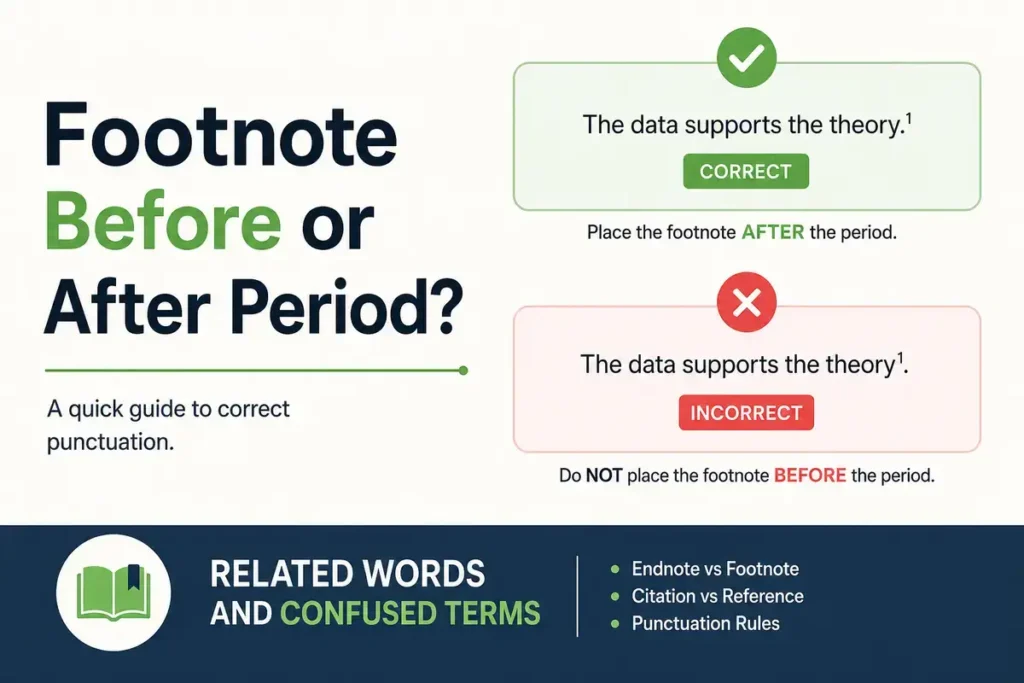
Correct:
The experiment produced reliable results.^1
Incorrect:
The experiment produced reliable results^1.
Although this rule looks minor, correct placement improves readability and follows accepted editorial standards.
This mistake is similar to the difference between these commonly confused expressions, where two nearly identical phrases have very different origins and meanings.
Comparison Table
| Situation | Recommended Placement | Common Practice |
|---|---|---|
| End of a sentence | After the period | Chicago Bluebook OSCOLA |
| End of a quotation | After the closing quotation mark and any required punctuation | Most style guides |
| After a comma | Usually after the comma when a note is needed there | Less common |
| After a semicolon | Usually after the semicolon | Style guide dependent |
| Inside a sentence | Immediately after the relevant word or phrase if necessary | Used sparingly |
| Academic writing | After punctuation | Standard practice |
| Legal writing | Usually after punctuation | Bluebook rules |
| Books and journals | After punctuation | Editorial standard |
What Is A Footnote
A footnote is a note placed at the bottom of a page that provides additional information or cites a source. Instead of interrupting the flow of the main text, it gives readers a simple way to find supporting details without leaving the page.
Footnotes serve several purposes.
- Credit the original source of information.
- Provide extra explanation without making the paragraph too long.
- Add historical or technical details.
- Clarify a statement or translation.
- Direct readers to additional resources.
A footnote consists of two parts.
- A superscript reference number in the main text.
- The matching note at the bottom of the page.
The superscript acts like a bridge between the sentence and the supporting information.
What Is A Period In Writing
A period is the punctuation mark that ends a complete declarative sentence. It tells readers that one thought has finished before another begins.
Periods also appear in abbreviations, initials, and some citation formats, although modern style guides use fewer periods in abbreviations than they once did.
Because both periods and footnote markers appear at the end of sentences, writers often wonder which one should come first. That question has led to years of confusion, especially for students using different citation styles.
The general editorial rule is straightforward. Finish the sentence with the period first, then place the superscript footnote number immediately after it.
Why Footnote Placement Matters
At first glance, moving a tiny superscript one character to the left or right may seem unimportant. In reality, publishers and academic institutions care about consistency because it helps readers understand where supporting information belongs.
Correct placement offers several benefits.
- It follows established editorial standards.
- It makes citations easier to locate.
- It improves the appearance of academic writing.
- It prevents confusion about which sentence the note supports.
- It demonstrates attention to detail.
Small formatting mistakes rarely change the meaning of a paper, but they can affect professionalism, especially in university assignments, journal submissions, dissertations, and legal documents.
Which Placement Is Correct
The correct placement depends on the citation style, but the general rule is remarkably consistent across most academic disciplines.
Complete the sentence with the appropriate punctuation first. Then place the superscript footnote number immediately afterward. This keeps the sentence visually clean and clearly shows that the note refers to the completed statement rather than a single word.
For example:
Correct:
The results confirmed the original hypothesis.^1
Incorrect:
The results confirmed the original hypothesis^1.
There are situations where a note belongs to a specific word or phrase instead of the entire sentence. In those cases, the superscript may appear immediately after that word or phrase. Even then, editors recommend using this approach only when necessary because sentence level references are usually easier for readers to follow.
Pronunciation Guide
Understanding the terminology makes it easier to follow style guides and communicate with teachers, editors, and colleagues.
Footnote
IPA: /ˈfʊtˌnoʊt/
Syllable breakdown:
Foot.
Note.
Period
IPA: /ˈpɪriəd/
Syllable breakdown:
Per.
I.
Od.
When discussing citations aloud, editors typically say:
- Place the footnote after the period.
- Insert the superscript after the closing punctuation.
- Add the reference marker at the end of the sentence.
Using these standard expressions makes conversations about editing and academic writing much clearer.
If you’re interested in other everyday spelling debates, it’s also worth learning which spelling is actually preferred when writing about something that costs a lot.
Expert Editor Insight
Many writers spend too much time memorizing punctuation rules without understanding why those rules exist. Professional editors approach the problem differently. They ask a simple question.
What should the reader understand at first glance?
When the sentence ends before the superscript appears, readers immediately recognize that the note supports the complete statement. That is one reason respected style guides continue to recommend placing footnote markers after closing punctuation in most situations.
Once you understand that principle, remembering the rule becomes much easier than trying to memorize isolated formatting instructions.
Examples Of Correct Footnote Placement
Rules become much easier to remember when you see them in context. The following examples show how footnote reference marks are used with different punctuation marks. Although most style guides follow similar principles, always check the guide required for your assignment or publication.
Examples With A Period
In most academic writing, the superscript reference appears after the period because the note supports the entire sentence.
Correct examples:
- The study included more than 500 participants.^1
- The author reached a similar conclusion in a later publication.^2
- Climate data has improved significantly over the last decade.^3
- The committee approved the proposal without changes.^4
- This method produced the most consistent results.^5
- The report was published in 2024.^6
- Researchers repeated the experiment three times.^7
- The findings matched earlier studies.^8
- The project finished ahead of schedule.^9
- The survey included responses from every department.^10
Incorrect examples:
- The study included more than 500 participants^1.
- The committee approved the proposal^2.
These examples place the reference mark before the period, which goes against the recommendation of most editorial style guides.
Examples With Quotation Marks
Many writers wonder about footnote before or after quotation mark because punctuation rules can seem confusing at first.
In most cases, the closing quotation mark comes first, followed by the period if required, and then the footnote reference.
Examples:
- The professor described the discovery as groundbreaking.^1
- She called the results completely unexpected.^2
- The article referred to the policy as a turning point.^3
- The witness said the evidence was incomplete.^4
- The editor wrote that clarity always improves credibility.^5
If the quotation itself ends the sentence, the footnote normally follows the final punctuation rather than appearing inside the quotation.
Examples With Commas
Questions like is footnote before or after comma appear frequently because writers occasionally need to cite part of a sentence instead of the entire statement.
When a note belongs after a comma, the superscript usually follows the comma.
Examples:
- The first survey,^1 however, produced different results.
- Smith,^2 one of the lead researchers, disagreed with the conclusion.
- The proposal,^3 although promising, required additional funding.
- The second experiment,^4 unlike the first, showed measurable improvement.
- The revised edition,^5 published five years later, corrected several errors.
Sentence ending citations remain much more common because they create cleaner and easier to read prose.
Examples With Semicolons
Another common question is footnote before or after semicolon.
When a citation belongs with the clause before the semicolon, the superscript generally follows the semicolon according to the style guide being used.
Examples:
- The first trial succeeded;^1 the second did not.
- Several experts agreed with the recommendation;^2 others remained skeptical.
- Funding increased last year;^3 enrollment also grew.
- The evidence supported the theory;^4 additional research confirmed it.
- Sales improved dramatically;^5 profits followed the same trend.
Because punctuation rules can vary slightly among publishers, always check the required style guide before submitting formal work.
Style Guide Differences
Most confusion comes from switching between citation styles. Fortunately, the major guides agree on many of the basic principles, even though each has its own formatting requirements.
Chicago Manual Of Style
The Chicago Manual of Style is one of the most widely used systems for books, history, and many humanities subjects.
Its recommendation is straightforward.
- Place superscript note numbers after periods.
- Place them after commas.
- Place them after quotation marks when they appear at the end of a sentence.
- Keep formatting consistent throughout the document.
Chicago strongly favors footnotes over in text citations in many disciplines, making correct placement especially important.
Bluebook
Legal writing follows Bluebook rules, which are designed for court documents, law reviews, and legal scholarship.
If you’re searching for footnote before or after period bluebook, the general answer is that footnote reference numbers normally appear after the punctuation mark. Legal writing also includes detailed rules for citations, abbreviations, and case references, so consistency with the Bluebook is essential.
APA Style
Many students search for footnote before or after period APA, but APA uses footnotes much less often than Chicago.
Instead, APA primarily relies on author date citations within the text.
When footnotes are necessary for additional explanation, the reference mark generally follows sentence ending punctuation.
OSCOLA
For legal writing in the United Kingdom, OSCOLA provides detailed citation rules.
If your question is footnote before or after period OSCOLA, the answer is similar to other major style guides. Reference numbers normally follow the punctuation mark and appear as superscripts.
Always consult the latest edition because legal citation rules receive periodic updates.
Common Mistakes
Most formatting errors happen because writers combine rules from different citation styles or rely on memory instead of checking the style guide.
Here are the mistakes editors see most often.
Placing The Footnote Before The Period
This is the most common mistake.
Incorrect:
The article explained the rule^1.
Correct:
The article explained the rule.^1
Mixing Citation Styles
Some writers begin with Chicago formatting and later switch to APA or another style without realizing it.
Choose one style guide and follow it from beginning to end.
Placing References In Different Positions
If one footnote appears after the period and another appears before it without a clear reason, readers may think the formatting is inconsistent.
Consistency makes academic writing easier to read and more professional.
Adding Too Many Footnotes
Footnotes should support your writing, not overwhelm it.
Instead of adding a note after every sentence, cite thoughtfully and only when additional information or source documentation is needed.
Forgetting To Match Footnote Numbers
Every superscript number in the text should match a corresponding note at the bottom of the page.
Double check numbering before submitting your work, especially after making revisions.
Grammar And Punctuation Rules
Footnotes are closely connected with punctuation because they show exactly where supporting information belongs.
Keep these principles in mind.
- Finish the sentence before adding the superscript note.
- Place the reference after the period in most situations.
- Put the superscript after commas and semicolons when the citation belongs there.
- Keep the note close to the information it documents.
- Use one citation style consistently throughout the document.
Following these simple habits helps readers understand your writing without being distracted by formatting inconsistencies.
Real World Usage
Footnote placement matters in many kinds of writing, not just university assignments.
Academic Writing
Professors expect students to follow the required citation style accurately. Correct footnote placement demonstrates attention to detail and respect for academic standards.
Books And Journals
Professional publishers rely on copy editors to ensure every citation follows the house style. Even small punctuation mistakes are corrected before publication.
Legal Writing
Law firms, courts, and legal journals follow strict citation rules because precision is essential. A misplaced reference can create confusion when readers verify legal authorities.
Research Reports
Researchers often include dozens or even hundreds of citations. Consistent placement makes the document easier to navigate and improves credibility.
Business And Professional Documents
Although many business reports use in text citations instead of footnotes, organizations that include notes still follow established editorial conventions to maintain a polished appearance.
By learning the basic principles now, you’ll be able to apply them confidently across school assignments, research papers, professional reports, and published work.
The correct choice may also depend on regional conventions, just as British and American spelling differences influence whether certain words are spelled differently across English varieties.
Related Terms And Commonly Confused Rules
Learning the rule for footnote placement becomes easier when you understand the punctuation marks and citation terms that often appear alongside it. These related concepts are closely connected, and knowing the difference helps you apply the correct formatting with confidence.
Here are some terms you are likely to encounter while working with academic citations.
- Footnote.
- Endnote.
- Superscript.
- Citation.
- Reference.
- Bibliography.
- Works Cited.
- Reference List.
- In text citation.
- Source note.
You may also wonder how footnotes relate to other punctuation marks. The table below summarizes the most common situations.
| Punctuation | Typical Footnote Placement | Notes |
|---|---|---|
| Period | After the period | Standard in most style guides. |
| Comma | After the comma | Used when the note belongs to that part of the sentence. |
| Semicolon | After the semicolon | Common in formal academic writing. |
| Colon | After the colon | Follow the required style guide. |
| Closing quotation mark | After the quotation mark and any closing punctuation | Standard practice in most citation systems. |
| Parenthesis | After the closing parenthesis if the note applies to the entire statement | Check the style guide for exceptions. |
Although these guidelines work in most situations, your instructor, publisher, or organization always has the final say. If their style guide differs, follow those instructions consistently throughout the document.
Expert Language Insight
Professional editors do not think about footnote placement as an isolated punctuation rule. They think about clarity, consistency, and helping readers understand the text without interruption.
When reviewing a manuscript, an editor first looks at the sentence itself. If the footnote supports the entire sentence, the reference mark belongs after the closing punctuation. If the note explains only one word or a short phrase, placing the superscript immediately after that element may be appropriate. Even then, experienced editors avoid doing this too often because it can interrupt the natural flow of reading.
Another habit shared by skilled editors is consistency. Readers should never have to guess why one footnote appears before a punctuation mark while another appears after it. Following the same style throughout the document creates a polished and professional result.
Think of footnotes as signposts rather than decorations. Their job is to guide readers to supporting information as smoothly as possible without distracting them from the main text.
Frequently Asked Questions
Should a footnote come before or after a period?
In most academic and professional writing, the footnote reference mark comes after the period. This placement is recommended by major style guides, including the Chicago Manual of Style. It clearly shows that the note applies to the complete sentence instead of a single word.
Should a footnote come before or after a quotation mark?
The footnote reference usually appears after the closing quotation mark and any sentence ending punctuation. This approach keeps the quotation intact while showing that the note relates to the quoted material or the sentence as a whole.
Does the Chicago Manual of Style place footnotes after punctuation?
Yes. Chicago generally places superscript footnote numbers after periods, commas, and quotation marks. This formatting has become the standard for many humanities disciplines and academic publishers.
Does APA use footnotes the same way?
Not exactly. APA relies primarily on in text author date citations rather than footnotes. When explanatory footnotes are used, the reference mark is normally placed after the sentence ending punctuation.
What does Bluebook recommend?
Bluebook follows its own detailed citation rules for legal writing. In most situations, the footnote reference appears after the punctuation mark. Because legal documents require precise formatting, always consult the latest Bluebook edition for special cases.
How does OSCOLA handle footnotes?
OSCOLA uses footnotes extensively in legal writing. Superscript reference numbers generally appear after punctuation, including periods and quotation marks. Following the official OSCOLA guide helps ensure your citations meet academic and professional standards.
Can I place a footnote in the middle of a sentence?
Yes, but only when the note applies to a specific word or phrase rather than the entire sentence. Most editors recommend limiting this practice because sentence ending references are usually easier for readers to follow.
Why is consistent footnote placement important?
Consistent formatting improves readability, supports academic credibility, and helps readers connect each reference with the correct part of the text. Small formatting details may seem minor, but they contribute to a professional and trustworthy document.
Conclusion
Knowing where to place a footnote reference is easier once you understand the guiding principle behind the rule. In most academic, professional, and legal writing, the superscript number appears after the closing punctuation because it refers to the completed statement.
Different citation systems have their own formatting requirements, but they share the same goal of making sources clear and easy to follow. Chicago, Bluebook, and OSCOLA all place a strong emphasis on consistency, while APA uses footnotes only in limited situations and relies mainly on in text citations.
Whenever you begin a new paper, identify the required citation style before you start writing. Following one style guide from beginning to end will save time, reduce editing, and produce a document that looks polished and professional.
If you have ever wondered footnote before or after period, this guide will give you a clear answer along with practical examples you can use in every paper you write.