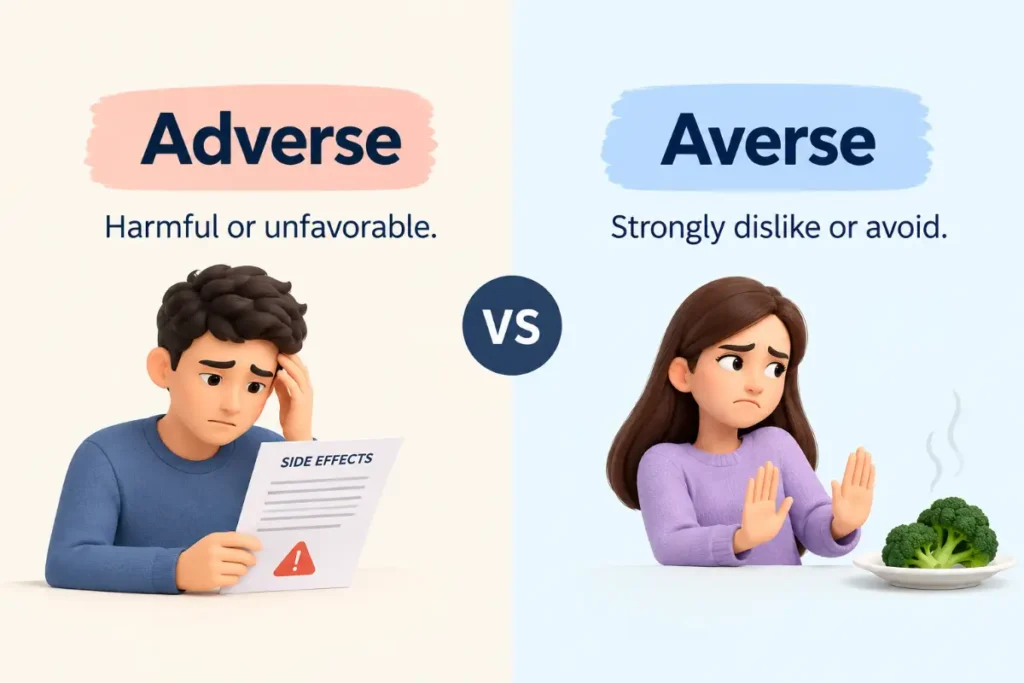
Adverse vs averse is a common word choice problem because both words describe something negative and both sound almost identical. The important difference is simple once you focus on what each word modifies. Adverse usually describes an unfavorable condition, effect, result, or circumstance. Averse describes a person’s strong dislike or unwillingness to do something.
For example, a medication can have adverse effects, but a patient can be averse to taking that medication. A business may face adverse economic conditions, while an investor may be averse to unnecessary risk. The words can appear in similar conversations, but they do different jobs in a sentence.
The confusion becomes especially common with phrases such as risk averse, adverse conditions, and not averse. You may also see people use the words interchangeably online, even though standard English keeps their meanings separate. This guide explains the distinction, pronunciation, grammar, sentence patterns, common mistakes, synonyms, and practical usage so you can choose the right word confidently in American English.
Quick Answer
Adverse means unfavorable, harmful, or negative, and it usually describes a condition, effect, result, or circumstance. Averse means strongly disliking or being unwilling to do something, and it normally describes a person or attitude. You can have adverse weather conditions or be averse to driving in bad weather.
What Does Adverse Mean
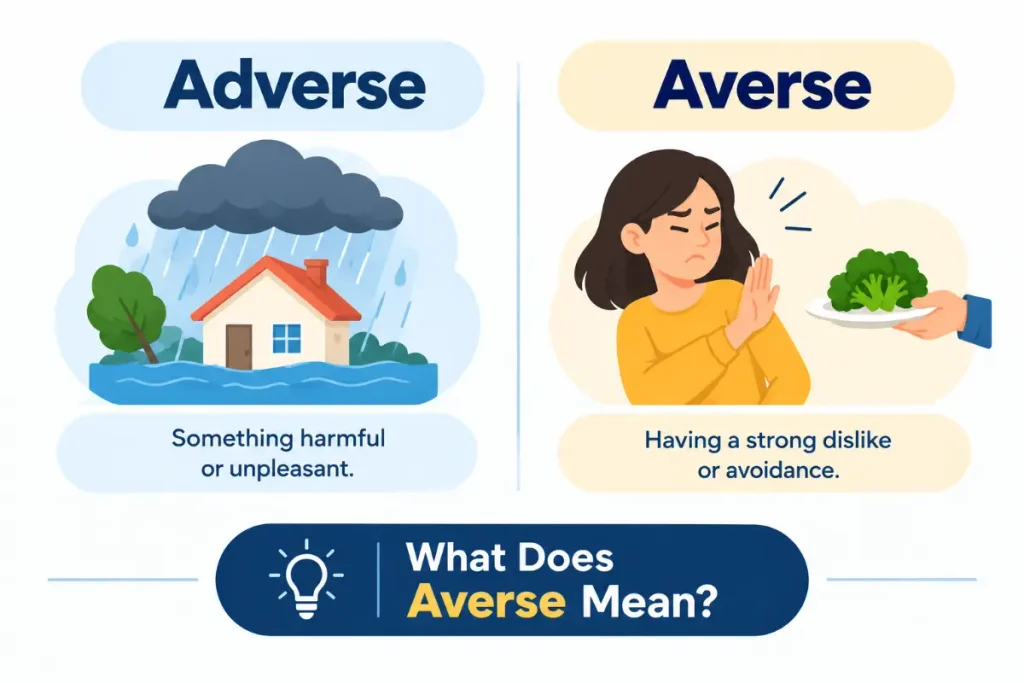
Adverse is an adjective that means unfavorable, harmful, negative, or working against a desired result. It commonly describes circumstances, conditions, effects, outcomes, reactions, and situations. The word focuses on something outside the person that creates difficulty, harm, opposition, or an undesirable result.
You will often encounter adverse in professional, medical, legal, financial, academic, and formal writing. Common expressions include adverse effects, adverse conditions, adverse reaction, adverse outcome, adverse consequences, and adverse circumstances. The word has a formal tone, but it is completely standard in American English.
Consider the sentence, “The medication caused an adverse reaction.” The reaction itself is unfavorable or harmful, so adverse is the appropriate word. The sentence does not tell us that the patient personally disliked the medication, although that could also be true.
Another example is, “The team continued working despite adverse weather conditions.” Here adverse describes the weather because the conditions make the work more difficult. It does not describe the team’s feelings about the weather.
Adverse in Simple Terms
A useful way to remember adverse is to associate it with negative circumstances or effects. If something produces a bad result, creates difficulty, or works against what you want, adverse may be the right adjective.
For example, a company can experience adverse market conditions. A patient can experience adverse effects from a drug. A student can face adverse circumstances at home. In all three examples, the word describes an unfavorable situation or consequence rather than a person’s personal dislike.
Here are several natural examples:
- The policy could have adverse effects on small businesses.
- The hikers faced adverse weather conditions during the trip.
- The treatment produced several adverse reactions.
- The company struggled because of adverse economic conditions.
- The decision could lead to adverse consequences for customers.
The common thread is clear. Adverse describes something unfavorable that happens or exists.
Like “adverse” and “averse,” another easily confused pair is “eminent” and “imminent,” which differ significantly in meaning despite their similar appearance.
What Does Averse Mean
Averse is an adjective that describes a person’s strong dislike, reluctance, or unwillingness to do something. It usually refers to an attitude or preference rather than an external condition. The most common grammatical pattern is averse to, followed by a noun or a gerund ending in ing.
For example, “She is averse to taking unnecessary risks.” The phrase tells us about her attitude toward risk. She dislikes or avoids unnecessary risk.
Another example is, “He is averse to change.” This means he has a strong dislike of change or tends to resist it. The word does not mean that change itself is harmful. It describes his reaction to it.
Averse often appears in phrases involving preferences, habits, choices, and personal attitudes. You might be averse to confrontation, averse to debt, averse to public speaking, or averse to spending money unnecessarily.
Averse in Simple Terms
Think of averse as meaning strongly unwilling or opposed. It tells readers how someone feels about an action, idea, situation, or choice.
The preposition to is especially important. In standard usage, you normally say “averse to” rather than simply “averse” followed directly by an activity.
For example:
- She is averse to borrowing money.
- He is averse to taking unnecessary risks.
- The manager is averse to changing the schedule.
- Many consumers are averse to paying hidden fees.
- The child is averse to trying unfamiliar foods.
The word describes a person’s attitude toward something.
Adverse vs Averse Meaning
The central distinction is easier to remember when you separate conditions from attitudes. Adverse describes something unfavorable or harmful. Averse describes a person’s dislike, reluctance, or opposition.
| Feature | Adverse | Averse |
|---|---|---|
| Core meaning | Unfavorable or harmful | Strongly disliking or unwilling |
| Main focus | Conditions, effects, results, or circumstances | Personal attitude or preference |
| Part of speech | Adjective | Adjective |
| Common pattern | Adverse effects | Averse to change |
| Common contexts | Medical, financial, legal, professional | Personal preferences and attitudes |
| Tone | Formal and neutral | Formal and neutral |
| Typical example | Adverse weather | Averse to driving in bad weather |
| Related noun | Adversity | Aversion |
The easiest question to ask yourself is this: Am I describing a negative situation or someone’s reaction to something? If you are describing a negative situation, effect, or condition, choose adverse. If you are describing someone’s reluctance or dislike, choose averse.
The Grammar Difference
The words differ not only in meaning but also in how they behave grammatically. Adverse usually appears directly before a noun. Averse normally describes a person or group and is commonly followed by to.
For example, “adverse conditions” is a standard noun phrase. You would not normally say “averse conditions” when you mean unfavorable conditions. Averse needs an attitude holder, such as a person, organization, or group that has a particular dislike or reluctance.
The standard structure is:
adverse + noun
Examples include adverse effects, adverse conditions, adverse results, and adverse circumstances.
The common structure for averse is:
person or group + be + averse to + noun or ing form
Examples include “She is averse to conflict” and “They are averse to spending more money.”
This grammatical distinction can help you choose the correct word even when the meanings initially feel confusing.
Why Risk Averse Is Correct
The phrase risk averse is one of the most common places where people encounter averse. A risk averse person prefers to avoid unnecessary risk and usually favors safer options.
For example, “The investor is risk averse.” This means the investor tends to avoid risky investments. The word averse describes the investor’s attitude toward risk.
You can also say, “The investor is averse to taking unnecessary risks.” The longer form makes the grammar especially clear because averse is followed by to and then the gerund taking.
It would be incorrect to use adverse in the same way when you mean a person’s reluctance. “The investor is risk adverse” is a common error. The standard expression is risk averse.
The distinction becomes even clearer when you compare the two:
“The investor is risk averse because the market is unstable.”
Here averse describes the investor’s attitude. Adverse could describe the market conditions if you wanted to say they are unfavorable.
English contains many similar-sounding words that can be easy to mix up, particularly when their spellings and pronunciations are closely related.
Risk Averse and Its Opposite
A risk averse person prefers to minimize uncertainty and avoid unnecessary danger. The opposite idea is often expressed with risk seeking or risk tolerant, depending on the context.
Someone who is risk tolerant may accept a certain level of uncertainty without strongly avoiding it. A risk seeking person may actively pursue opportunities that involve greater risk because of the possibility of greater rewards.
These terms are useful in finance, business, economics, management, and everyday decision making. They describe attitudes toward risk rather than claiming that the risk itself is good or bad.
For example, “She is risk averse, so she prefers conservative investments.” The phrase describes her preference. By contrast, “The investment carries adverse risks” would not express the same idea and sounds unnatural.
Adverse vs Averse Examples
The quickest way to understand the distinction is to see the words used in varied contexts. The following examples show how each word works naturally in American English.
Examples With Adverse
- The medication caused several adverse effects during the first week of treatment.
- The company struggled under adverse economic conditions.
- Heavy rain created adverse driving conditions.
- The decision could have adverse consequences for local businesses.
- The patient reported an adverse reaction after taking the medication.
- The team continued working despite adverse circumstances.
- The policy may have an adverse impact on low income families.
- The business was forced to respond to adverse market conditions.
- The researchers found no significant adverse effects during the trial.
- The construction project faced adverse weather for several days.
Each example describes something unfavorable. The word does not express personal dislike.
Examples With Averse
- She is averse to taking unnecessary risks.
- He is averse to borrowing money from friends.
- The manager is averse to making major changes without evidence.
- Many investors are averse to losing their principal.
- I am not averse to trying a different approach.
- The company is averse to making promises it cannot keep.
- She has always been averse to confrontation.
- The committee is averse to increasing costs without a clear benefit.
- He is strongly averse to driving in heavy traffic.
- The customer was averse to paying an additional service fee.
Each example describes an attitude, preference, reluctance, or dislike.
Adverse vs Averse in Everyday Writing
In everyday communication, adverse often appears when people describe conditions or consequences. You might use it in an email about a delayed project, a workplace discussion about market conditions, or a medical conversation about side effects.
For example, a manager might write, “The project experienced delays because of adverse weather.” The sentence sounds professional and precise. In casual conversation, someone might simply say, “The bad weather delayed the project.”
Averse is more likely to appear when discussing personal preferences or decision making. Someone might say, “I’m averse to paying that much for something I won’t use often.” The word communicates stronger resistance than simply saying, “I don’t really want to.”
That distinction also helps explain why the two words should not be treated as interchangeable synonyms. Adverse concerns the nature of a situation or result. Averse concerns someone’s response to something.
Adverse vs Averse Synonyms
The best synonym for adverse depends on context. Useful alternatives include unfavorable, harmful, negative, damaging, undesirable, difficult, and hostile. These words are not interchangeable in every sentence, but they can help clarify the basic meaning.
For example, “adverse conditions” can often become “unfavorable conditions.” “Adverse effects” can become “harmful effects” or “undesirable effects.” The most natural replacement depends on the type of noun that follows.
Averse has a different group of synonyms. Useful alternatives include reluctant, unwilling, opposed, resistant, disinclined, and opposed to. For example, “She is averse to confrontation” could become “She is reluctant to confront people” or “She is opposed to confrontation.”
A key point is that averse is not simply another word for bad. It describes a person’s attitude toward something. That is why reluctant and unwilling are often better mental substitutes than negative or harmful.
Not Averse or Not Adverse
The phrase not averse is grammatically correct and has a useful meaning. It generally means someone is not opposed to something or is reasonably willing to consider it.
For example, “I’m not averse to trying the new restaurant.” This does not necessarily mean the speaker is enthusiastic. It means the speaker does not strongly object to the idea.
This phrase can sometimes sound more formal or indirect than ordinary speech. In casual conversation, someone might simply say, “I’m fine with trying the new restaurant.” In professional writing, however, “not averse to” can be appropriate when a measured or cautious tone is useful.
Not adverse has a different meaning because adverse describes unfavorable conditions or effects. For example, “The treatment produced no adverse effects” means the treatment did not produce harmful or undesirable effects.
Compare these sentences:
“I’m not averse to the proposal.”
This describes a person’s attitude toward the proposal.
“The proposal had no adverse effects.”
This describes the proposal’s lack of harmful consequences.
The difference is subtle at first but becomes clear once you identify the subject of the description.
Common Mistakes With These Words
The most common error is writing risk adverse instead of risk averse. Since adverse also means something negative, the incorrect phrase can seem logical. Standard English uses risk averse because the phrase describes a person’s attitude toward risk.
Another mistake is using averse to describe an unfavorable situation. For example, “We faced averse weather conditions” is incorrect. The correct phrase is “We faced adverse weather conditions” because the weather itself is unfavorable.
A third mistake involves leaving out the preposition after averse. “She is averse change” is incorrect. The natural construction is “She is averse to change.”
You may also see writers use adverse when they actually mean reluctant. “He is adverse to speaking in public” is generally incorrect if the intended meaning is that he dislikes or avoids public speaking. The better sentence is “He is averse to speaking in public.”
Autocorrect and online usage can reinforce these mistakes because both words are legitimate English forms. Always check the meaning and grammatical pattern rather than relying on how familiar a word looks.
Incorrect and Correct Examples
The following corrections show the most common problems in a practical way.
- Incorrect: She is risk adverse.Correct: She is risk averse.Averse describes her attitude toward risk.
- Incorrect: The company faced averse weather.Correct: The company faced adverse weather.Adverse describes the unfavorable weather conditions.
- Incorrect: He is adverse to confrontation.Correct: He is averse to confrontation.Averse describes his reluctance or dislike.
- Incorrect: The medication caused averse effects.Correct: The medication caused adverse effects.Adverse is the standard word for harmful or undesirable effects.
- Incorrect: She is averse change.Correct: She is averse to change.Averse normally takes the preposition to.
- Incorrect: The policy created averse consequences.Correct: The policy created adverse consequences.The consequences are unfavorable, so adverse is appropriate.
These patterns are worth learning because they cover most real world mistakes involving the two words.
Adverse and Averse in Professional Writing
Precision matters more in professional writing because a small word choice can affect how clearly readers understand a statement. Adverse is especially common in medical, financial, legal, insurance, business, and regulatory communication.
For example, a medical report might refer to adverse effects or adverse reactions. A financial document might discuss adverse market conditions. A business report might describe adverse consequences associated with a proposed decision.
Averse is useful when describing preferences or strategic attitudes. A report might say, “The company is averse to taking on additional debt.” An investment discussion might say, “The client is strongly risk averse.”
For workplace emails, both words can be useful, but simpler alternatives may sometimes sound more natural. Instead of writing “We are averse to changing the process,” you could write “We are reluctant to change the process.” Instead of “The project faced adverse circumstances,” you could write “The project faced difficult circumstances.”
Good professional writing is not about choosing the most formal word. It is about choosing the clearest accurate word.
Formal and Casual Usage
Both adverse and averse are standard and generally formal or neutral words. Neither is slang. Their frequency tends to increase in professional, academic, technical, legal, financial, and medical contexts.
In casual American conversation, people often use simpler alternatives. Instead of saying “The trip was affected by adverse weather,” someone might say, “The bad weather affected the trip.” Instead of saying “I’m averse to spending that much,” someone might say, “I don’t want to spend that much.”
Still, there is nothing unnatural about using adverse or averse in everyday speech when the context fits. The words simply have a more polished and formal feel than many basic alternatives.
If your goal is clarity, choose the word that expresses the exact meaning without making the sentence unnecessarily complicated. Averse is particularly useful when you want to communicate strong reluctance without sounding emotional or informal.
Pronunciation
Adverse and averse are pronounced differently even though they look related. In American English, adverse is commonly pronounced AD vurss, with the stress on the first syllable. Its IPA pronunciation is commonly represented as /ˈædvɝːs/.
Averse is commonly pronounced uh VURSS, with the stress on the second syllable. Its IPA pronunciation is /əˈvɝːs/.
The difference in stress is useful when speaking. Adverse begins with a stronger first syllable, while averse puts the main stress on the second syllable.
Because the words can sound similar in fast speech, context remains important. In writing, the different spellings provide the clearest distinction.
Word Origins and Etymology
The histories of the words help explain why they developed related but separate meanings. Adverse ultimately comes from Latin roots associated with turning against or facing in an opposing direction. English developed the word in the sense of unfavorable, hostile, or contrary conditions.
Averse also traces back to Latin roots associated with turning away. Its modern meaning developed around the idea of being disinclined or having a strong dislike toward something.
The shared historical idea of opposition helps explain the similarity between the words. Their modern meanings have separated enough that they now serve different grammatical and semantic purposes.
You do not need to memorize their Latin roots to use them correctly. The practical distinction is more useful: adverse describes something unfavorable, while averse describes someone’s unwillingness or dislike.
Adverse Versus Clothing
You may occasionally encounter the phrase adverse versus clothing in searches or online discussions because the word pair can appear in unrelated search contexts. There is no standard English usage in which adverse or averse refers specifically to clothing.
If you are describing clothing that creates an unfavorable effect, adverse could work in a suitable phrase such as “adverse effects from poorly designed clothing.” If you mean that someone dislikes wearing a certain type of clothing, averse could describe that attitude, as in “She is averse to wearing formal clothing.”
The words themselves do not have a clothing related meaning. Context determines how they can be applied.
Understanding “adverse” and “averse” can also help you avoid a common meaning mix-up like confusing “wary,” meaning cautious, with “weary,” meaning tired.
Regional Usage in English
Adverse and averse are standard in American English and do not have different American and British spellings. The basic distinction also remains consistent in British, Canadian, and Australian English.
You may see differences in preferred phrasing across regions, but there is no major regional rule that changes adverse into averse or vice versa. A risk averse investor is described with averse in standard English varieties. Unfavorable conditions are described with adverse.
For US readers, there is no special spelling adjustment to make. The main task is choosing the word according to meaning and grammar.
How to Choose the Right Word
When you need to choose between these words, identify what the adjective describes. If the noun is a condition, effect, result, consequence, reaction, or circumstance that is unfavorable, adverse is usually correct.
If you are describing a person’s dislike, reluctance, resistance, or unwillingness, averse is usually correct. The preposition to is a strong clue because averse commonly appears in the construction “averse to.”
You can also substitute a simpler phrase. If you could say unfavorable, choose adverse. If you could say reluctant or unwilling, choose averse.
For example, “The weather was adverse” is better expressed as “The weather conditions were adverse,” while “She was averse to traveling” means she was reluctant or unwilling to travel. These simple substitutions make the distinction much easier.
Expert Usage Tips
One useful editing habit is to look at the noun or person immediately connected to the adjective. If you are describing an external condition or consequence, adverse will usually fit. If you are describing an attitude held by a person or group, averse will usually fit.
Pay particular attention to the phrase averse to. If your sentence means that someone dislikes, avoids, or resists something, this construction will often solve the problem. For example, “The committee is averse to increasing the budget” is clear and grammatically natural.
Also remember that adverse does not mean simply serious. An adverse condition is unfavorable or harmful, while averse does not mean simply cautious. A risk averse person has a preference for avoiding risk, but the word itself does not say that the risk is objectively dangerous.
Finally, do not force formal vocabulary into casual writing. “I’m not averse to it” is correct, but “I’m fine with it” may sound more natural in a casual conversation. In professional or academic writing, the more precise vocabulary can be useful when it improves clarity.
Frequently Asked Questions
What is the difference between adverse and averse
Adverse means unfavorable, harmful, or negative and usually describes a condition, effect, result, or circumstance. Averse means strongly disliking or being unwilling to do something and usually describes a person’s attitude. You can have adverse weather conditions, but you can be averse to traveling in bad weather.
Is it risk averse or risk adverse
The standard expression is risk averse. It describes a person, investor, organization, or decision maker that prefers to avoid unnecessary risk. Risk adverse is a common mistake caused by confusion between the two words. Since averse describes an attitude toward something, it fits the meaning of risk averse.
What does adverse mean
Adverse means unfavorable, harmful, negative, or undesirable. It commonly describes conditions, effects, reactions, consequences, outcomes, and circumstances. For example, “The medication caused adverse effects” means the medication caused unwanted or harmful effects.
What does averse mean
Averse means strongly unwilling, reluctant, or opposed to something. It normally describes a person’s attitude and commonly appears in the phrase “averse to.” For example, “She is averse to taking unnecessary risks” means she strongly prefers not to take them.
Is not averse correct
Yes. Not averse is correct and usually means not opposed to something or reasonably willing to consider it. For example, “I’m not averse to trying the new approach” means the speaker does not strongly object to the approach. The phrase can sound more formal than simply saying “I’m open to it.”
Is not adverse correct
Yes, but it has a different meaning. “Not adverse” generally means something is not unfavorable or harmful. For example, “The treatment produced no adverse effects” means the treatment did not produce harmful or undesirable effects. It does not describe a person’s willingness or preference.
What is the opposite of risk averse
The opposite of risk averse can be described as risk seeking or risk tolerant, depending on the intended meaning. A risk tolerant person accepts a certain amount of uncertainty, while a risk seeking person may actively pursue opportunities involving greater risk. The best term depends on the context.
Can adverse and averse be used interchangeably
No. Standard English gives them different meanings and grammatical patterns. Adverse describes something unfavorable, while averse describes a person’s reluctance or dislike. Replacing one with the other can produce an incorrect or confusing sentence, especially in professional writing.
Conclusion
The difference between adverse vs averse comes down to one clear distinction. Adverse describes something unfavorable, harmful, or undesirable, while averse describes a person’s strong dislike, reluctance, or opposition. Think of adverse as describing a negative condition and averse as describing an attitude toward something.
The phrase risk averse is a useful example because it shows the pattern clearly. An investor can be averse to risk, while an investment can produce adverse results. If you are unsure which word to choose, replace it with unfavorable or harmful for adverse, and reluctant or unwilling for averse. That simple test will help you make the right choice in everyday, academic, and professional American English.