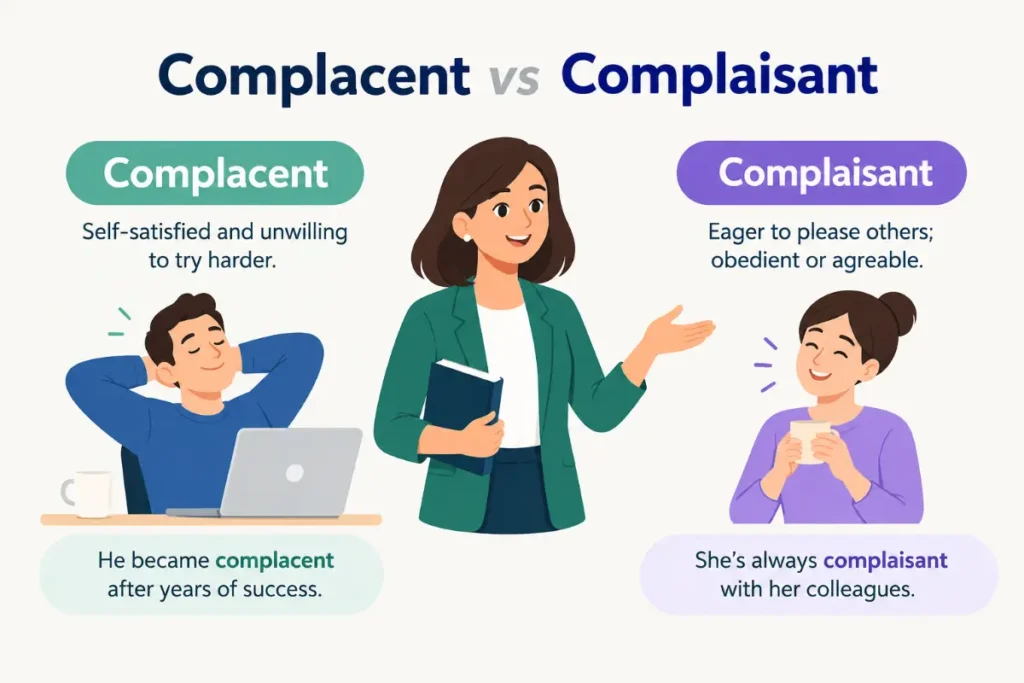
If you’ve ever stopped at complacent vs complaisant and wondered which word belongs in your sentence you’re dealing with two easily confused adjectives that have very different meanings. Complacent describes someone who feels too satisfied with a situation and doesn’t see a need to improve or take action. Complaisant describes someone who is willing to please others or readily agrees with their wishes. One usually suggests an unhealthy lack of concern. The other describes a cooperative or accommodating attitude.
The confusion comes partly from their similar spelling and pronunciation. Both words also have connections to satisfaction or pleasing behavior that developed through their French and Latin roots. Yet modern English gives them distinct jobs. Understanding that distinction matters in workplace writing academic work everyday conversation and professional communication because calling someone complacent can sound sharply critical while calling someone complaisant can describe a person’s willingness to accommodate others.
This guide explains the difference in plain American English. You’ll learn the meanings pronunciation word origins sentence patterns common mistakes related words and practical ways to remember which word fits your meaning.
Quick Answer
Complacent means overly satisfied with yourself or a situation and therefore not alert to problems or the need for improvement. Complaisant means willing to please or accommodate others. Calling an employee complacent is criticism. Calling someone complaisant usually means they readily cooperate or try to satisfy other people’s wishes.
What Does Complacent Mean
Complacent is an adjective that describes someone who has become too satisfied with a situation and has stopped paying enough attention to possible problems or improvement. The word often carries a negative meaning because complacency suggests that a person or group has become comfortable when they should remain alert.
Imagine a company that has enjoyed strong sales for years. Its leaders assume customers will always remain loyal so they stop improving the product and ignore new competitors. If the company fails because of that attitude you could say its leaders became complacent.
The important idea is not simply being happy or content. A complacent person is satisfied to the point of becoming careless or overly confident. There is usually some reason to remain watchful but the person doesn’t recognize the need to act.
For example, “The team became complacent after winning three championships.” The sentence suggests that success made the team too comfortable. The players may have stopped working as hard because they assumed another victory would come easily.
Complacent can describe individuals teams organizations and even societies. It often appears when people have achieved success and then fail to prepare for changing circumstances.
Is Complacent Negative or Positive
Complacent is generally negative. It suggests that someone has become too comfortable or self satisfied and is no longer giving enough attention to risks responsibilities or improvement.
Being satisfied with an accomplishment isn’t automatically complacency. You can be proud of your work while still looking for ways to improve. The problem begins when satisfaction turns into carelessness or false security.
Compare these ideas:
- “She was satisfied with her performance.” This simply says she felt good about how she did.
- “She was complacent about her performance.” This suggests she became too satisfied and stopped recognizing areas that needed attention.
That distinction is useful because complacent is sometimes mistakenly treated as a stronger synonym for satisfied. It isn’t. The word carries a critical judgment about an attitude.
Like “complacent” and “complaisant,” another easily confused word pair can look and sound similar while carrying distinctly different meanings.
What Does Complaisant Mean
Complaisant is an adjective that describes someone who is willing to please other people or accommodate their wishes. A complaisant person may readily agree to requests or adjust their behavior to keep others satisfied.
The word is less common in everyday American English than words such as agreeable accommodating cooperative or obliging. Still it remains a valid English word and can be useful when you need a precise description of someone’s willingness to please.
For example, “The manager was unusually complaisant when employees requested changes to the schedule.” The sentence suggests that the manager was willing to accommodate their requests.
Complaisant can sometimes carry a negative or critical shade depending on context. Someone who constantly gives in to others may be described as too complaisant. In other situations the word simply describes a cooperative attitude.
That flexibility makes context important. Unlike complacent, complaisant does not inherently mean careless or overly satisfied.
Complaisant in Simple Terms
Think of complaisant as being eager or willing to please. The word focuses on how someone responds to other people’s wishes.
A complaisant employee may readily accept a supervisor’s request. A complaisant host may happily adjust plans for guests. A complaisant negotiator may make concessions to reach an agreement.
The word doesn’t mean that the person is necessarily weak or careless. It simply highlights a willingness to accommodate.
Complacent vs Complaisant Meaning
The central difference is simple.
| Feature | Complacent | Complaisant |
|---|---|---|
| Part of speech | Adjective | Adjective |
| Core meaning | Too satisfied and insufficiently concerned about problems | Willing to please or accommodate |
| Usual tone | Negative | Neutral or sometimes negative |
| Main focus | Attitude toward one’s situation | Attitude toward other people’s wishes |
| Common contexts | Work performance safety success personal growth | Cooperation requests social situations negotiation |
| Related noun | Complacency | Complaisance |
| Simple synonym | Self satisfied | Accommodating |
| Example | The team became complacent | The manager was complaisant |
The easiest distinction is this: complacent is about being too satisfied with the way things are, while complaisant is about being willing to satisfy other people.
That difference becomes especially clear in a workplace. An employee who stops learning because they believe their job is secure may be complacent. An employee who readily adjusts to a coworker’s reasonable request may be complaisant.
The Key Difference Between Satisfaction and Accommodation
One reason these words cause trouble is that both have a connection to satisfaction. Their modern meanings have moved in different directions though.
Complacent concerns self satisfaction. The person feels sufficiently comfortable with their own position or circumstances and therefore may overlook problems.
Complaisant concerns pleasing others. The person is inclined to accommodate another person’s wishes or preferences.
Consider this sentence: “The director was complacent about the company’s declining sales.” The director is too comfortable with the situation and isn’t responding properly.
Now consider: “The director was complaisant when customers requested changes.” Here the director is willing to accommodate customers.
The same person could theoretically be both. A manager might be complacent about poor performance while being complaisant toward employees who ask for easier deadlines. The words describe different aspects of the person’s behavior.
Complacent vs Complaisant Examples
Seeing the words in different contexts makes the distinction easier to apply.
Examples With Complacent
- The team became complacent after several successful quarters.
- Don’t become complacent just because the project is ahead of schedule.
- The company grew complacent and failed to respond to changing customer needs.
- His early success made him complacent about improving his skills.
- The coach warned the players not to become complacent after the easy victory.
- The employee became complacent once he received a promotion.
- Years without serious problems had made the community complacent about emergency preparation.
- The manager worried that the department had become complacent.
- She refused to become complacent after reaching her sales goal.
- Strong grades can sometimes make students complacent about future exams.
Each example contains the same underlying idea. Someone has become too comfortable and may therefore stop paying attention to improvement or potential problems.
Examples With Complaisant
- The host was complaisant and changed the dinner time to suit her guests.
- The manager remained complaisant when the team requested a different meeting schedule.
- His complaisant nature made him easy to work with.
- The negotiator was surprisingly complaisant during the final discussion.
- She was so complaisant that she accepted nearly every suggestion from the committee.
- The customer appreciated the restaurant’s complaisant response to the special request.
- His complaisant attitude helped the group reach an agreement.
- The assistant was helpful and complaisant when the schedule changed.
- The landlord was complaisant about the tenant’s reasonable request.
- A complaisant attitude can make cooperation easier in some situations.
These examples focus on willingness to accommodate other people rather than excessive satisfaction with one’s own circumstances.
Understanding subtle differences in meaning can help you choose the right word when two terms seem similar but are used in different contexts.
How to Use Complacent Correctly
Complacent commonly appears with verbs such as become, grow, remain, and seem. It often describes a change in attitude after success or a period without problems.
You might write:
“The department became complacent after meeting its annual target.”
“The company grew complacent during a period of steady growth.”
“The team must not become complacent.”
“The safety staff remained alert instead of becoming complacent.”
The word also commonly appears with about.
For example, “The company became complacent about cybersecurity.” This means the company became too comfortable and failed to take the issue seriously enough.
Another natural pattern is complacent with in contexts involving one’s circumstances or success. However, complacent about is often the clearest construction when the sentence identifies a specific issue.
Complacent can also describe an entire organization or group. This is common in business writing because organizations can become too comfortable after repeated success.
How to Use Complaisant Correctly
Complaisant is usually used to describe a person’s willingness to accommodate or please someone else. It often works naturally with nouns such as attitude nature behavior response or manner.
For example:
“The receptionist was remarkably complaisant about the scheduling change.”
“The manager’s complaisant attitude helped resolve the dispute.”
“The negotiator was complaisant during the final stage of the talks.”
The word can sound formal because it isn’t especially common in casual American speech. In many everyday situations, accommodating, agreeable, cooperative, or willing to help will sound more natural.
That doesn’t make complaisant incorrect or outdated. It simply means you should consider your audience. If your readers may not know the word, a simpler alternative can communicate the same basic idea with less effort.
Complacent vs Complaisant Pronunciation
The pronunciation difference is subtle but worth learning.
Complacent is commonly pronounced /kəmˈpleɪsənt/ in American English. A simple pronunciation guide is kuhm PLAY suhנט with the main stress on the second syllable.
Complaisant is commonly pronounced /kəmˈpleɪzənt/ in American English. A simple guide is kuhm PLAY zuhנט. The most noticeable difference is the consonant sound in the middle.
Complacent has an s sound after the stressed syllable. Complaisant has a z sound there. Their close pronunciation contributes to the confusion but their meanings provide the strongest clue when you hear them in conversation.
Complacent vs Content
Complacent and content are not interchangeable. Content means satisfied or happy with a situation. It doesn’t automatically suggest carelessness or a failure to improve.
For example, “She was content with her decision” is neutral. The sentence simply says she felt satisfied with the decision.
“She was complacent about her decision” suggests something different. It implies that she may have become too satisfied and stopped thinking carefully about possible problems.
This distinction is important because content can be positive or neutral while complacent is usually negative.
You can think of the relationship this way:
Content: “I’m satisfied with where I am.”
Complacent: “I’m so satisfied that I don’t need to pay attention anymore.”
The second attitude carries a warning that the first one doesn’t.
Complacent vs Complacent vs Complicit
The phrase complacent vs complacent vs complicit appears to contain a repeated word but the useful comparison is really between complacent and complicit. These words look and sound somewhat alike but their meanings are unrelated.
Complicit means involved in or associated with wrongdoing or an improper action. It usually describes someone who helps participates in or knowingly allows something wrong to happen.
For example, “The manager was complicit in the fraud.” This means the manager was involved in the wrongdoing.
By contrast, “The manager was complacent about the fraud” means the manager was too unconcerned or self satisfied to recognize or respond appropriately to the problem. A person could potentially be both complacent and complicit but the words describe very different behavior.
The distinction can be summarized clearly:
- Complacent means overly satisfied or unconcerned.
- Complicit means involved in wrongdoing.
Don’t use complacent when you mean someone participated in misconduct. Complicit is the precise word for that idea.
Is Complaisant Always Positive
Complaisant can be positive, neutral, or mildly negative depending on context. It generally describes a willingness to please or accommodate others, which can be useful in customer service, teamwork, negotiation, and social situations.
However, too much willingness to accommodate can become a weakness. If someone agrees with every request simply to avoid disagreement, calling that person complaisant may suggest excessive agreeableness.
For example, “The customer service representative was complaisant and quickly adjusted the reservation” sounds positive. The employee was willing to help.
By contrast, “His complaisant nature made it difficult for him to reject unreasonable demands” carries a negative implication. His willingness to please others has become a problem.
This is one reason context matters more with complaisant than with complacent. Complacent is generally critical. Complaisant depends more heavily on how the behavior affects the situation.
Common Mistakes With These Words
The most common mistake is using complaisant when you mean complacent.
Incorrect: “The company became complaisant after years of success.”
Correct: “The company became complacent after years of success.”
The company is being criticized for becoming too comfortable and failing to remain alert. That idea requires complacent.
The opposite mistake is also common.
Incorrect: “The manager was complacent and agreed to every reasonable request.”
Correct: “The manager was complaisant and agreed to every reasonable request.”
The manager is being described as willing to accommodate other people. Complaisant fits that meaning.
Another error occurs when writers use complacent as a synonym for content. The words overlap around satisfaction but they don’t carry the same judgment. Content is often neutral or positive. Complacent normally suggests that satisfaction has gone too far.
Finally, don’t confuse complacent with complicit. Someone who is complacent may fail to act because of overconfidence or excessive comfort. Someone who is complicit is involved in wrongdoing. Those are very different accusations.
Common Sentence Patterns
Learning common patterns can help you recognize the correct word naturally.
With complacent, these structures are especially useful:
- Become complacent after success.
- Grow complacent over time.
- Become complacent about a problem.
- Remain complacent despite warning signs.
- Avoid becoming complacent.
With complaisant, these structures are useful:
- Be complaisant toward customers.
- Have a complaisant attitude.
- Remain complaisant during negotiations.
- Be complaisant about a request.
- Take a complaisant approach to other people’s preferences.
The grammar is straightforward because both words are adjectives. You can place them before a noun or use them after a linking verb such as be, become, seem, remain, or appear.
Word Origin and Etymology
The history of these words explains some of their similarity. Complacent comes from Latin roots connected with being pleasing or satisfying. English developed the modern sense around being self satisfied and overly pleased with one’s own situation.
Complaisant came into English through French and ultimately traces back to Latin roots associated with pleasing. Its meaning developed around a willingness to please other people.
That shared historical background helps explain why the spellings look so alike. The meanings separated as English developed distinct uses for the two forms.
The easiest modern distinction isn’t based on etymology though. Remember the direction of the satisfaction. Complacent points inward toward one’s own satisfaction. Complaisant points outward toward pleasing someone else.
Formal and Casual Usage
Complacent is common enough to appear naturally in both everyday speech and formal writing. Americans use it in conversations about work, sports, school, safety, relationships, finances, and personal goals.
Complaisant is less common in casual American speech. You may encounter it more often in formal prose, literary writing, criticism, professional commentary, or situations where the writer wants to emphasize a person’s willingness to accommodate others.
For everyday communication, simpler alternatives often sound more natural. Instead of “The employee was complaisant,” you might write “The employee was accommodating” or “The employee was willing to help.”
Complacent usually doesn’t need simplification because it has a familiar meaning for many American readers. You might naturally hear someone say, “Don’t get complacent.”
“Complacent” and “complaisant” are not the only terms that cause confusion; a common vocabulary mix-up like “wary” and “weary” can also lead to incorrect word choice.
Real Life Usage in American English
In the workplace, complacent often describes organizations or employees that stop improving after achieving success. A manager might warn a successful team not to become complacent because competitors can catch up quickly.
In school, a student can become complacent after earning several good grades. The student may assume future exams will be easy and stop preparing. Here the problem isn’t confidence itself. The problem is confidence that leads to reduced effort.
In customer service, complaisant can describe someone who willingly accommodates reasonable requests. Still, accommodating is usually more natural in everyday American communication.
In personal relationships, complacent can describe someone who takes a relationship for granted and stops making an effort. Complaisant can describe someone who readily gives in to a partner’s preferences. Again, the words describe different behaviors.
Expert Usage Tips
The safest way to choose between these words is to identify who is being pleased and where the satisfaction is directed. If the person is too satisfied with their own situation, use complacent. If the person is trying to satisfy or accommodate someone else, use complaisant.
This distinction also helps when editing professional writing. If a sentence says that an organization became comfortable after years of success, complacent will usually express the intended criticism. If the sentence says that a person readily accepts another person’s wishes, complaisant may be technically precise, although accommodating or agreeable may sound more natural to a general US audience.
Don’t use complicated vocabulary simply because it sounds formal. A word is useful when it communicates the intended meaning clearly. In many casual situations, accommodating is easier for readers than complaisant, while complacent remains a natural and familiar choice.
A Simple Memory Trick
Use this mental picture: complacent looks inward while complaisant looks outward.
A complacent person is too pleased with their own situation. They may think everything is fine and stop paying attention.
A complaisant person is focused on pleasing someone else. They may agree, cooperate, adjust, or accommodate.
Another useful trick is to connect complacent with comfort. Both begin with a similar sound, and comfort can lead to complacency when it becomes excessive.
For complaisant, think of please. The word describes someone inclined to please others.
These aren’t dictionary definitions or etymological rules. They’re memory aids that can help you make the distinction quickly.
Frequently Asked Questions
What is the difference between complacent and complaisant
Complacent means overly satisfied with yourself or a situation and therefore insufficiently concerned about problems or improvement. Complaisant means willing to please or accommodate other people. Complacent is generally negative because it suggests carelessness or false confidence. Complaisant can be positive, neutral, or mildly negative depending on how that willingness to accommodate affects the situation.
Is complacent negative or positive
Complacent is generally negative. It describes satisfaction that has gone too far and resulted in reduced attention, effort, or concern. Being content with an achievement can be perfectly healthy, but becoming complacent suggests that someone has stopped looking for problems or opportunities to improve.
Is complaisant a positive word
Complaisant can be positive when it describes someone who is cooperative, accommodating, or willing to help. It can become negative when the person’s willingness to please leads them to accept unreasonable demands or avoid necessary disagreement. Context determines the tone, but the word itself doesn’t carry the strongly negative meaning associated with complacent.
What is a synonym for complacent
Common synonyms for complacent include self satisfied, smug, unconcerned, overconfident, and uncritical. The best choice depends on the context. Self satisfied is often closest in meaning, while smug can add a stronger sense of excessive pride. Unconcerned may work when the sentence emphasizes a lack of attention to a problem.
What is a synonym for complaisant
Useful synonyms for complaisant include accommodating, agreeable, obliging, cooperative, and willing to please. Accommodating is often the most natural choice for everyday American English. Agreeable emphasizes willingness to agree, while obliging suggests readiness to do something helpful for another person.
How do you pronounce complaisant
In American English, complaisant is commonly pronounced /kəmˈpleɪzənt/. A simple guide is “kuhm PLAY zuhנט.” The stressed syllable is the second syllable, and the middle consonant has a z sound. Its pronunciation is close to complacent, which uses an s sound in that position.
What is the difference between complacent and complicit
Complacent means overly satisfied or unconcerned, while complicit means involved in wrongdoing. A manager can be complacent about unethical behavior by failing to take it seriously. A manager can be complicit if the manager knowingly participates in that behavior. The two words may appear in similar discussions but they describe very different actions.
Is complacent the same as content
No. Content means satisfied with a situation and is usually neutral or positive. Complacent suggests excessive satisfaction that causes someone to overlook problems, risks, or the need for improvement. You can be content with your progress while continuing to work hard. Becoming complacent suggests that you have stopped paying enough attention.
Conclusion
The difference between complacent vs complaisant becomes much easier once you focus on the direction of the behavior. Complacent describes someone who is too satisfied with a situation and may therefore become careless, passive, or overconfident. Complaisant describes someone who is willing to please or accommodate other people. One usually carries a negative meaning while the other can be positive, neutral, or mildly critical depending on context.
If you mean self satisfaction that has gone too far, choose complacent. If you mean willingness to accommodate another person’s wishes, choose complaisant. When you keep that distinction in mind, the similar spellings stop being a trap and become much easier to handle.