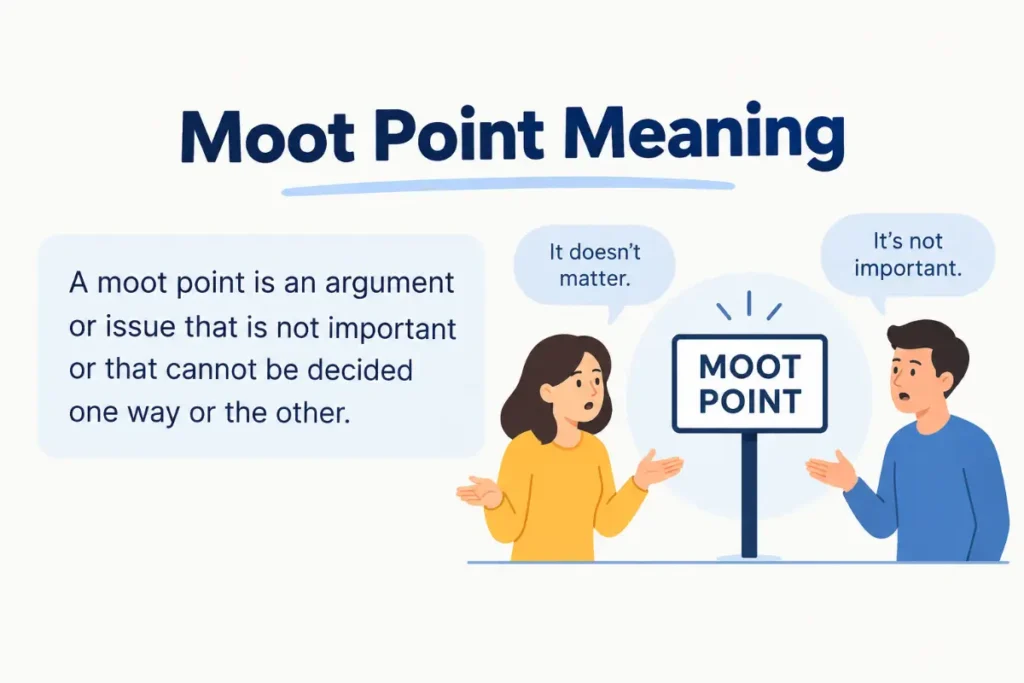
The phrase moot point meaning can be confusing because people use it in everyday conversations, workplace discussions, and legal settings, sometimes with different meanings. In American English, a moot point usually refers to an issue that no longer matters because the circumstances have changed or the issue cannot affect the outcome. In other contexts, especially British English and legal discussions, a moot point can refer to a question that remains open for debate or has not been settled.
For example, if your team has already chosen a different vendor, arguing about the price of the rejected vendor may be a moot point. The discussion no longer changes the decision. However, a legal scholar might call a question moot because it raises an issue that a court does not need to decide in the current case.
Understanding the context helps you use the phrase naturally and avoid confusion. This guide explains what moot point means, how to pronounce it, where it comes from, how lawyers use it, and which synonyms work best in everyday American English. You will also find practical examples that show how the expression fits into conversations, emails, academic writing, and professional communication.
Quick Answer
A moot point is an issue that is no longer relevant to a decision or outcome, especially in American English. It can also mean a question that remains open for debate or has not been settled. The intended meaning depends on context, particularly in legal discussions and British English.
What Does Moot Point Mean
A moot point is a question, issue, or argument that has little practical effect on the situation being discussed. In everyday American English, the phrase most often describes something that no longer matters because the circumstances have changed or the decision has already been made.
Imagine that you and your coworkers spend an hour comparing two office locations. Before the team reaches a conclusion, management announces that the company will remain in its current building. The discussion about which new location would have been better has become a moot point because the company will not move.
The issue might still be interesting, and people might still disagree about the best choice. However, resolving the disagreement will not change what happens next. That lack of practical consequence is the key to the expression’s everyday American meaning.
A moot point does not necessarily mean that an argument is wrong, foolish, or unimportant in every possible situation. It simply means that the issue no longer affects the decision at hand. A question can be intellectually interesting while still being irrelevant to the immediate outcome.
A Simple Definition of Moot Point
In plain English, a moot point is a question that no longer matters for the decision being made.
For example, suppose a restaurant plans to open at 6 p.m., but a power outage forces it to close for the entire evening. Debating which menu items should have been promoted that night becomes a moot point because the restaurant cannot serve customers.
The discussion may still be useful later when the restaurant reviews its marketing strategy. In the immediate situation, though, the answer will not change the outcome. Context determines how relevant the question remains.
Like “moot point,” many commonly confused words can be tricky because similar-looking terms may have completely different meanings and uses.
What Does Moot Mean
The word moot has several related meanings. It can describe an issue that is open to debate, a question that has lost its practical importance, or a subject raised for discussion rather than immediate action.
In everyday American conversation, moot often appears in the expression moot point. Someone might say, “That is moot now,” meaning the issue no longer matters because something has changed. For instance, if your friend offers advice about an application after you have already accepted another job, you might explain that the advice is moot.
Moot can also function as a verb, although this use is less common in everyday conversation. To moot an idea or proposal means to raise it for discussion. A manager might moot the possibility of changing the office schedule during a planning meeting, meaning the manager introduces the idea for consideration rather than announcing a final decision.
The meaning therefore depends on how the word is used. In the phrase moot point, the central question is usually whether the issue remains relevant or is still open for consideration.
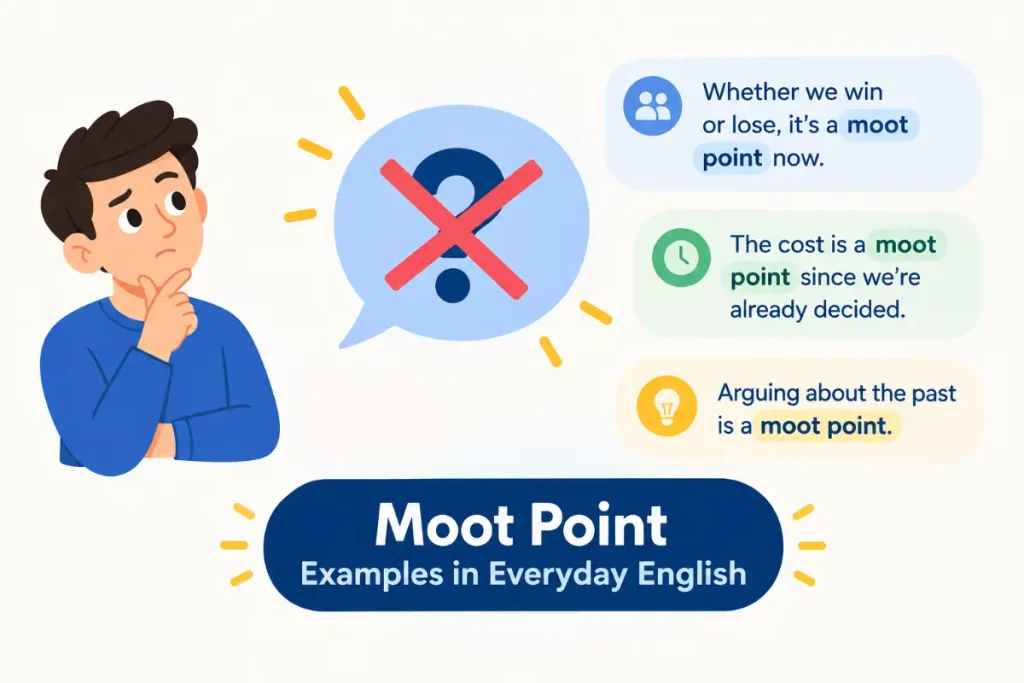
Moot Point Examples in Everyday English
The easiest way to understand the expression is to see how it works in familiar situations. In American English, speakers often use it when a change in circumstances makes an earlier question irrelevant.
Consider these examples.
1. Workplace: The company has already selected a new supplier, so comparing the other bids is a moot point.
2. School: Since the teacher canceled the assignment, discussing the original deadline is a moot point.
3. Travel: Our flight has already departed, so arguing about when we should have left home is a moot point.
4. Shopping: The store has sold the last item, making the debate about which color to buy a moot point.
5. Family plans: Everyone agreed to stay home, so deciding which restaurant to visit is now a moot point.
6. Technology: The software update has fixed the problem, so the earlier debate about a temporary workaround is a moot point.
7. Customer service: The company has issued a full refund, making the argument about a small price adjustment a moot point.
8. Sports: The game has ended, so debating the lineup for the final quarter will not change the result.
9. Scheduling: The meeting has been canceled, so discussing the best presentation time is a moot point.
10. Everyday conversation: I already renewed my subscription, so comparing the available plans is a moot point for this year.
In each example, the issue may have mattered earlier. A later decision or change in circumstances has removed its immediate practical importance.
How to Use Moot Point in a Sentence
The phrase usually functions as a noun phrase. It commonly appears after the verb is, as in “That is a moot point,” or after a verb such as make or render, as in “The new decision made the argument a moot point.”
You can also use moot point with an article and a descriptive word. For example, “The entire debate became a moot point after the policy changed.” The phrase fits naturally into both casual conversation and formal writing.
Here are several sentence patterns worth remembering.
1. That is a moot point. Use this when an issue no longer affects the discussion.
2. The decision made the question a moot point. Use this when a change removes the issue’s practical importance.
3. The argument is now moot. Use this when the issue itself has become irrelevant.
4. Whether the plan would have worked is a moot point. Use this when an alternative outcome can no longer affect what happens.
5. The court considered the issue moot. Use this in a legal context where a dispute may no longer require a decision.
The expression often sounds natural when the reason for its irrelevance is clear. If your listener does not know what changed, briefly explain why the issue no longer matters.
Moot Point Meaning in Law
In law, the word moot has a more specialized meaning. A dispute may be considered moot when the parties no longer have a live controversy that a court can resolve through a meaningful decision. The exact rules depend on the legal system, the type of case, and the circumstances.
For example, imagine that a person challenges a temporary government restriction that expires before the court reaches the case. If the restriction is no longer in effect and the ruling would have no practical consequence for the parties, the court may consider the dispute moot.
However, expiration does not automatically make every legal dispute moot. Courts recognize exceptions in some circumstances, including certain disputes that are capable of repetition but likely to evade review. The legal analysis depends on the applicable law and the facts of the case.
A moot issue is not necessarily an issue that lacks merit. A claim can raise a serious legal question but still become moot because the court can no longer provide meaningful relief. Conversely, an issue that remains unresolved is not automatically moot simply because the parties disagree about it.
Understanding words with subtle differences can help you choose the right expression when two terms seem similar but convey different ideas.
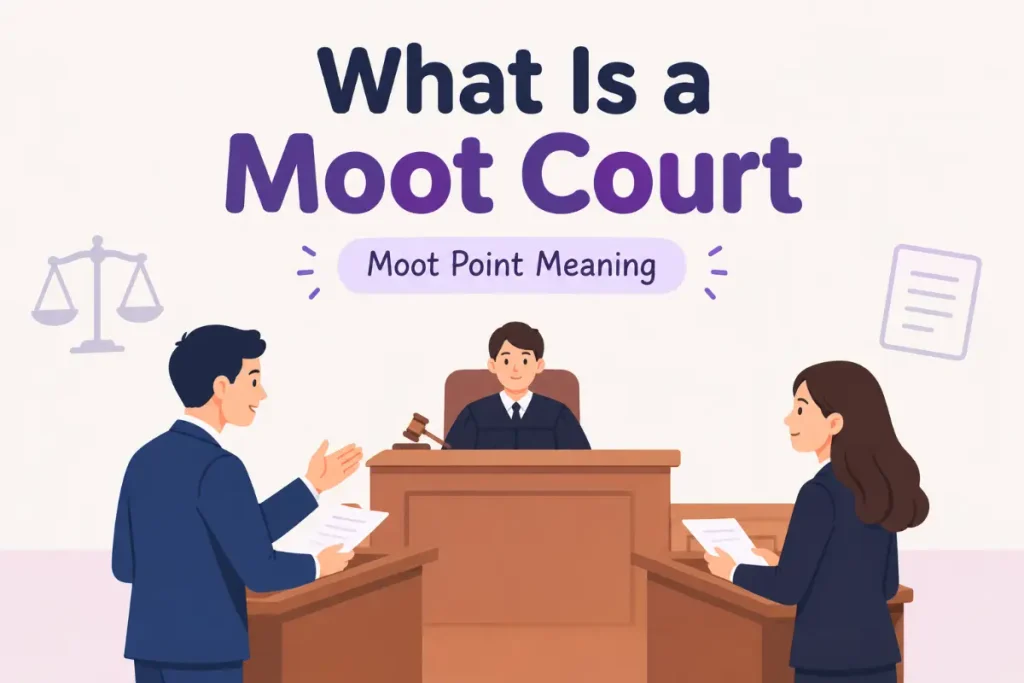
What Is a Moot Court
The expression moot court refers to a practice exercise in which law students or other participants argue a hypothetical or simulated legal case. Participants usually prepare written arguments and present oral arguments before judges or evaluators.
The purpose is to practice legal reasoning, research, advocacy, and courtroom presentation. A moot court exercise allows participants to examine legal questions without requiring an actual dispute between real parties.
This use connects with the broader idea of discussing or debating a question. It does not mean that every argument presented in moot court is irrelevant or pointless. The exercise has a practical educational purpose even though the case itself is simulated.
Moot Point Meaning in British English
The phrase can carry a different emphasis in British English. In the United Kingdom, moot point can refer to a question that is open to discussion, debatable, or not yet settled. This meaning is closer to the idea of raising an issue for argument.
For example, a British speaker might say, “It is a moot point if the proposed policy will achieve its intended result.” The speaker may mean that the answer remains debatable rather than that the question no longer matters.
American English more commonly uses moot point to describe an issue that has become irrelevant or has no practical effect on the outcome. Still, American speakers also encounter the debate-related meaning, particularly in legal, academic, or formal contexts.
The distinction is not an absolute rule that every British speaker follows one definition and every American speaker follows another. Usage overlaps, and the surrounding sentence usually reveals the intended meaning. When writing for a US audience, it is often clearer to use irrelevant or no longer relevant if that is what you mean, and debatable or open to discussion if you mean that the issue remains unsettled.
Moot Point Pronunciation
In American English, moot point is pronounced /muːt pɔɪnt/. A simple pronunciation guide is MOOT POINT, with the first word rhyming with “boot” and the second word rhyming with “joint.”
The word moot has one syllable. The vowel sound is the long oo sound, as in moon or food. The final t is pronounced, so the word should not sound like “moo.”
The pronunciation is generally straightforward, but the phrase can be unfamiliar to English learners because its meaning is not always obvious from the individual words. Hearing the expression in context can help connect its pronunciation with its practical use.
Moot Point Synonyms
The best synonym depends on the meaning you want to communicate. In everyday American English, moot point often means that a question is no longer relevant to the outcome. In other contexts, it can mean that a question remains open to debate.
When you mean that an issue no longer matters, useful alternatives include:
1. Irrelevant issue. An issue that does not affect the current situation.
2. Pointless discussion. A discussion that is unlikely to achieve anything useful.
3. Nonissue. Something that does not present a meaningful problem or concern.
4. Beside the point. Something that does not address the main issue.
5. No longer relevant. A direct phrase that makes the change in circumstances clear.
6. Academic question. A question that may be interesting in theory but has little immediate practical application.
When you mean that a question remains open to debate, consider alternatives such as debatable issue, unresolved question, open question, or contested point. These phrases can be more precise when you do not want readers to assume that the issue has lost its relevance.
For example, “The question is debatable” clearly indicates that people can disagree about the answer. “The question is a moot point” may suggest that resolving it would not affect the outcome, especially to an American reader.
Moot Point vs Pointless
Moot point and pointless are related, but they are not interchangeable in every sentence. A moot point is an issue whose relevance or practical effect is limited in the current context. Pointless describes something that has no useful purpose or is not worth doing.
Suppose your team has already approved a budget. Continuing to debate a rejected budget proposal may be a moot point because the decision has been made. Calling the entire meeting pointless would go further by suggesting that the meeting itself has no useful purpose.
A question can also be moot while remaining intellectually interesting. Historians might debate what would have happened if a historical event had unfolded differently. That discussion may have no effect on present events, but it can still offer educational value.
Use pointless when you want to emphasize the lack of purpose or value in an action. Use moot point when you want to explain that an issue no longer affects the decision or outcome.
Common Mistakes When Using Moot Point
One common mistake is assuming that moot point always means pointless. In American English, the phrase often suggests that an issue has become irrelevant, but it does not automatically mean that the discussion has no value at all. A question can be moot for one decision and still be useful for future planning.
Another mistake is using the expression without explaining why the issue no longer matters. For example, saying “That is a moot point” during a complicated meeting may leave listeners unsure what you mean. A clearer version might be, “That is a moot point now because management has already approved the budget.”
Writers also sometimes confuse the debate-related meaning with the no-longer-relevant meaning. If you intend to say that a question has no settled answer, debatable or unresolved may communicate your point more clearly to an American audience. If you intend to say that the answer will not change the outcome, moot point is often appropriate.
Finally, avoid treating the expression as a universal way to dismiss an argument. Someone may still have a valid concern even if one part of the discussion no longer affects the decision. Good communication explains the specific issue that has become irrelevant instead of using the phrase to shut down every disagreement.
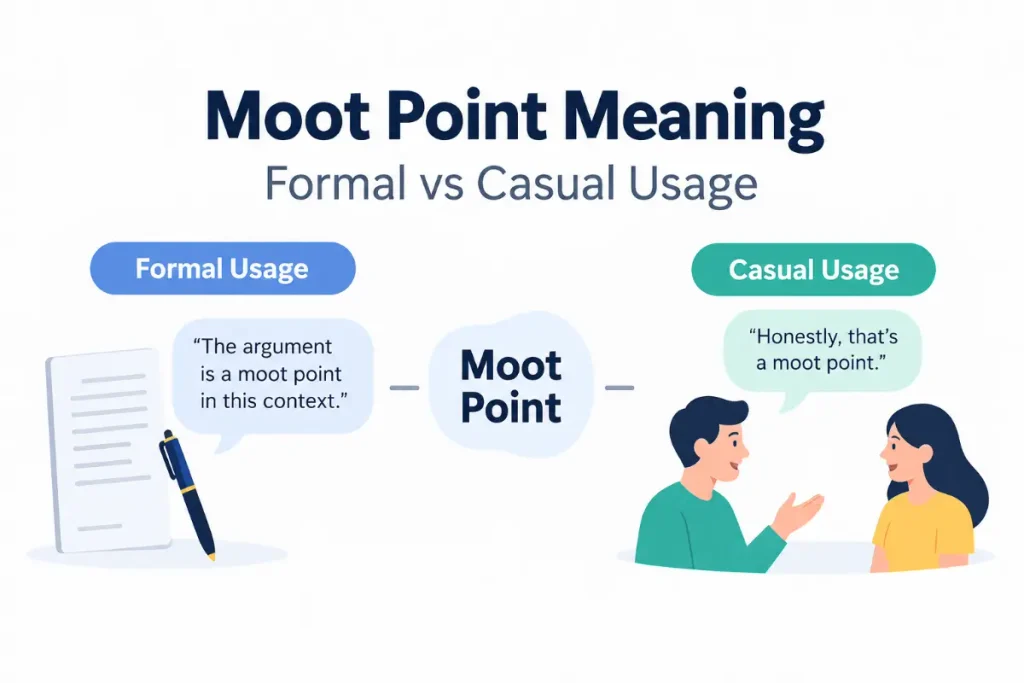
Formal vs Casual Usage
Moot point works in both casual conversation and formal writing. In everyday speech, someone might say, “That is a moot point now,” after a decision makes further debate unnecessary. The phrase is familiar enough for ordinary conversation, although some people may interpret it differently depending on their experience with American or British usage.
In professional communication, the phrase can help summarize why a particular question no longer needs attention. For example, “Since the client approved the revised proposal, the earlier discussion about the original design is now a moot point.” This sentence gives the reader both the conclusion and the reason.
For formal documents, legal writing, or communication with an international audience, consider using a more specific alternative when clarity matters. Phrases such as no longer relevant, unresolved, or open to debate can eliminate ambiguity. The goal is not to avoid moot point but to make sure readers understand the intended meaning.
The Origin of Moot Point
The word moot has a long history connected with meetings, discussions, and debate. It comes from an Old English word associated with a meeting or assembly, where people gathered to discuss matters or settle disputes.
Over time, moot developed associations with raising a question for discussion. This history helps explain why the word can still describe an issue that is open to debate. The modern American meaning developed along another path, emphasizing a question that no longer has practical relevance to the outcome.
The expression moot point reflects these overlapping ideas. A point can be raised for debate, but it can also lose its practical importance when circumstances change. The historical development helps explain why the phrase can carry more than one meaning in modern English.
“Moot point” is not the only example of potentially confusing vocabulary; another easily confused pair is “complacent” and “complaisant,” which differ significantly in meaning.
Frequently Asked Questions
What does moot point mean in simple terms
A moot point is usually an issue that no longer matters to a decision or outcome in American English. For example, if a company has already selected a vendor, debating the rejected proposals may be a moot point. In other contexts, especially British English, the phrase can refer to a question that remains open for discussion.
Does moot point mean pointless
Not exactly. A moot point is generally an issue that has become irrelevant to the current decision, while pointless describes something that has no useful purpose. A moot question can still be interesting or useful for future planning. The distinction depends on the issue being discussed and the practical consequences of resolving it.
Is moot point grammatically correct
Yes, moot point is a standard English expression. It functions as a noun phrase, as in “That is a moot point” or “The decision made the question a moot point.” You can also say that an issue is moot. Both forms are natural in American English.
What is another word for moot point
If you mean that an issue no longer matters, you can use irrelevant issue, nonissue, or no longer relevant. If you mean that the question remains open to discussion, alternatives include debatable issue, unresolved question, or open question. Choose the phrase that communicates your intended meaning most clearly.
What does moot point mean in law
In legal contexts, a moot issue may be one that no longer presents a live controversy for a court to resolve. A court may find that a case is moot if its decision would no longer provide meaningful relief, although exceptions can apply. The precise meaning depends on the legal system and the circumstances of the case.
What is the difference between moot and debatable
Moot can mean that an issue no longer affects the outcome, especially in American English. Debatable means that people can reasonably disagree about the answer. A question can be debatable without being moot, and a moot question may still have an answer that people could debate.
What is the difference between moot point in American and British English
In American English, moot point most often means an issue that has become irrelevant or has no practical effect on the outcome. In British English, it can also mean a question that is open to debate or has not been settled. These meanings overlap, so context is important when communicating with an international audience.
How do you pronounce moot point
Moot point is pronounced /muːt pɔɪnt/ in American English. The word moot rhymes with boot, while point rhymes with joint. Moot has one syllable and ends with a clearly pronounced t sound. The phrase is commonly used in conversation, professional communication, and legal discussions.
Conclusion
The phrase moot point usually describes an issue that no longer matters to a decision or outcome in American English. It can also refer to a question that remains open to debate, particularly in British English and certain legal or academic contexts. The surrounding situation helps determine the intended meaning.
When using the expression, make sure the issue really has lost its practical relevance if that is the meaning you want. If you simply mean that people disagree, words such as debatable or unresolved may be clearer. Understanding this distinction will help you use moot point naturally in everyday conversations, workplace emails, academic discussions, and formal writing.