Have you ever seen a sentence like fewer people, fewer mistakes, or fewer hours and wondered why English uses one form in some sentences and a different form in others? The confusion usually starts when fewer and less appear to have almost the same meaning. Both words describe a smaller quantity, but English uses them in different grammatical situations.
The simple rule is easier than it first appears. Use fewer with things you can count individually, such as books, cars, students, cookies, and questions. Use less with things you normally treat as a mass or amount, such as water, money, time, traffic, and patience. Once you learn that basic distinction, most everyday choices become much easier.
This guide explains the rule in plain American English and then goes deeper into the exceptions that cause the most confusion. You will also find real examples, common mistakes, a comparison table, a quick quiz, pronunciation guidance, and answers to questions people often ask about countable and uncountable nouns.
Quick Answer: The meaning of fewer is a smaller number of people or things that can be counted individually. It is the comparative form of few. Use it with plural countable nouns such as fewer books, fewer students, and fewer mistakes. Use less with uncountable amounts such as less water, less money, and less time.
What Is The Meaning Of Fewer
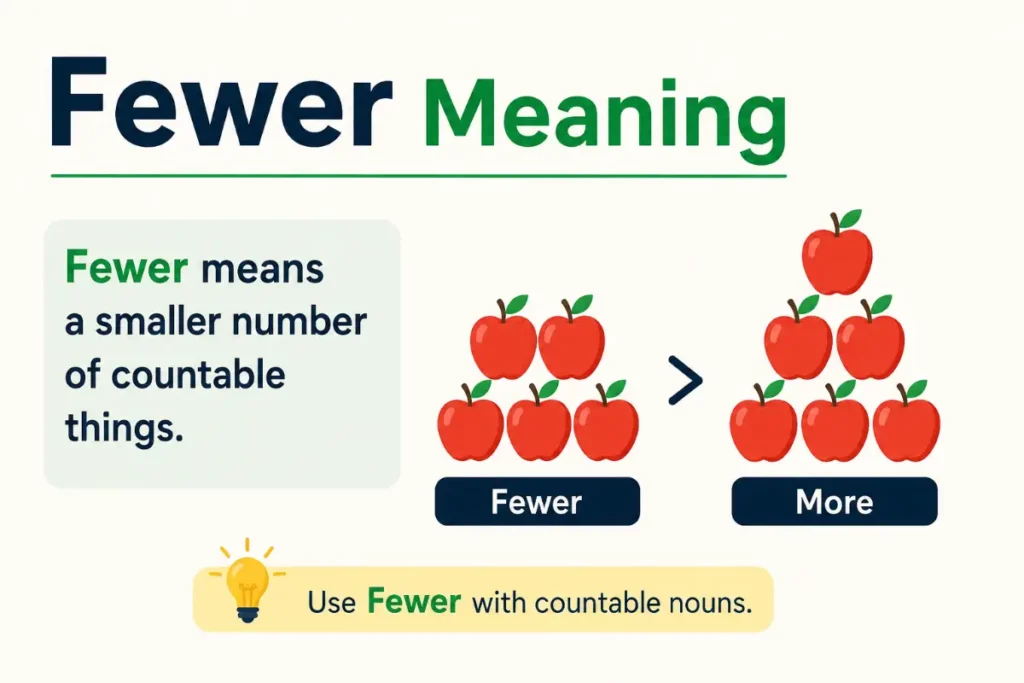
Fewer means a smaller number of people or things. It is the comparative form of few, so it compares one number with another.
If you can point to individual items and count them as 1, 2, 3, fewer is usually the right choice. You can have fewer apples, fewer chairs, fewer emails, fewer customers, or fewer problems.
The word normally appears before a plural countable noun. For example, We have fewer meetings this week means the number of meetings is smaller than it was before or smaller than another number being discussed.
You can also use fewer without repeating the noun when the meaning is already clear. For example, I made fewer than I expected could refer to mistakes, cookies, calls, or another countable group mentioned earlier.
The important point is that fewer deals with number rather than an undivided amount. If the noun answers the question How many?, you are usually dealing with the type of quantity that takes fewer.
Fewer As A Comparative Word
English uses fewer to compare quantities.
Consider these examples:
- This class has fewer students than last year.
- I made fewer mistakes on the second test.
- We received fewer complaints this month.
Each sentence compares a smaller number with another number. The comparison may be stated directly with than, or it may simply be understood from context.
For example, There are fewer cars on the road today does not explicitly say fewer than what. The comparison is still understood. The speaker probably means fewer cars than usual, fewer than yesterday, or fewer than expected.
This is common in natural conversation. English speakers often leave the second side of an obvious comparison unstated.
If you’re unsure which phrase is correct when comparing amounts, our guide to more than or more then explains the difference with clear examples.
The Core Rule Fewer Vs Less
The easiest way to remember the difference is to ask one question before choosing the word.
How many? Usually takes fewer.
How much? Usually takes less.
Here is the basic comparison.
| Word | Used with | Question | Example |
|---|---|---|---|
| Fewer | Plural countable nouns | How many? | Fewer books |
| Less | Uncountable nouns | How much? | Less water |
| Fewer | Individual people | How many people? | Fewer people |
| Less | General amounts | How much money? | Less money |
| Fewer | Separate objects | How many chairs? | Fewer chairs |
| Less | Substances | How much sugar? | Less sugar |
The rule works because countable nouns represent separate units. You can count three books, seven chairs, or twenty students. Uncountable nouns describe material, substance, concepts, or amounts that are normally treated as a whole.
You do not usually count water as individual waters. You measure it in cups, bottles, gallons, or liters. That is why less water sounds natural.
The same idea applies to less information, less traffic, less noise, and less stress. These things can have different amounts, but English normally treats them as uncountable nouns.
How To Use Fewer With Countable Nouns
Use fewer when the noun refers to separate items or individuals that can be counted.
Common examples include:
- There are fewer cars on the highway this morning.
- We need fewer chairs for the smaller meeting.
- She made fewer errors in her final draft.
- The store has fewer customers today.
- I bought fewer apples this week.
- Our team has fewer meetings now.
- The new system requires fewer steps.
Notice that every noun can be counted as separate units. You can count cars, chairs, errors, customers, apples, meetings, and steps.
This makes fewer especially common in everyday comparisons involving people and objects.
You might say fewer employees, fewer students, fewer visitors, fewer emails, or fewer messages. In each case, you are talking about a number of individual things or people.
How To Use Less With Uncountable Nouns
Use less when the noun describes an amount rather than separate countable units.
Here are some natural examples:
- I need less sugar in my coffee.
- We have less time than we expected.
- She drinks less water at night.
- The new plan requires less money.
- There is less traffic after eight o’clock.
- He showed less interest in the project.
- Try to use less salt in the recipe.
You cannot normally count sugar, water, traffic, money, interest, or salt as individual units. You can measure them, but their basic grammatical treatment is different.
This distinction becomes much clearer when you change the noun.
- Fewer bottles means a smaller number of bottles.
- Less water means a smaller amount of water.
You could also say fewer cups of water because cups are countable. The word changes because the noun being measured has changed.
The Exceptions To The Main Rule
The countable versus uncountable rule is useful, but English has some established exceptions. This is where many otherwise careful writers become unsure.
The most important exception involves measurements of time, money, distance, and weight when the measurement is treated as one complete amount or period.
For example, English commonly uses less in expressions such as:
- Less than ten minutes.
- Less than twenty dollars.
- Less than five miles.
- Less than fifty pounds.
- Less than three years.
At first glance, these numbers seem countable. You can count ten minutes as individual units, after all. However, English often treats a measurement such as ten minutes as a single amount or span.
That is why less than ten minutes sounds completely natural to native speakers.
You might also hear fewer than ten minutes in some contexts where the speaker is emphasizing individual units. However, in ordinary expressions of duration, distance, money, and measurement, less is strongly established.
Why Measurements Behave Differently
Imagine saying I spent less than twenty dollars. You are not normally focusing on twenty separate dollar bills. You are describing a total amount of money.
Likewise, The trip took less than three hours treats three hours as one duration.
This is a useful way to understand the exception instead of trying to memorize dozens of isolated rules. English often uses less when the measurement is perceived as one combined quantity.
The Supermarket Dilemma 12 Items Or Less
Few grammar questions create as much everyday debate as the checkout sign that says 12 Items or Less.
If you are applying the traditional grammatical rule strictly, 12 items or fewer is the expected form because items are individual countable things.
So why does 12 items or less appear everywhere?
The answer is usage.
The phrase became extremely common in public signs and everyday speech. Many English speakers accept it as a normal expression even though it does not follow the traditional countable noun rule.
This is an important lesson in language. Grammar is not always a clean collection of rules followed perfectly by every native speaker. Real English develops through repeated usage, regional habits, professional conventions, advertising, conversation, and cultural patterns.
For formal writing, 12 items or fewer is the safer choice when you want to follow the traditional distinction closely.
In casual conversation, you may hear 12 items or less frequently. That does not mean the speaker is unable to understand the distinction. It shows that actual usage can be broader than textbook rules.
Fewer Than And Less Than
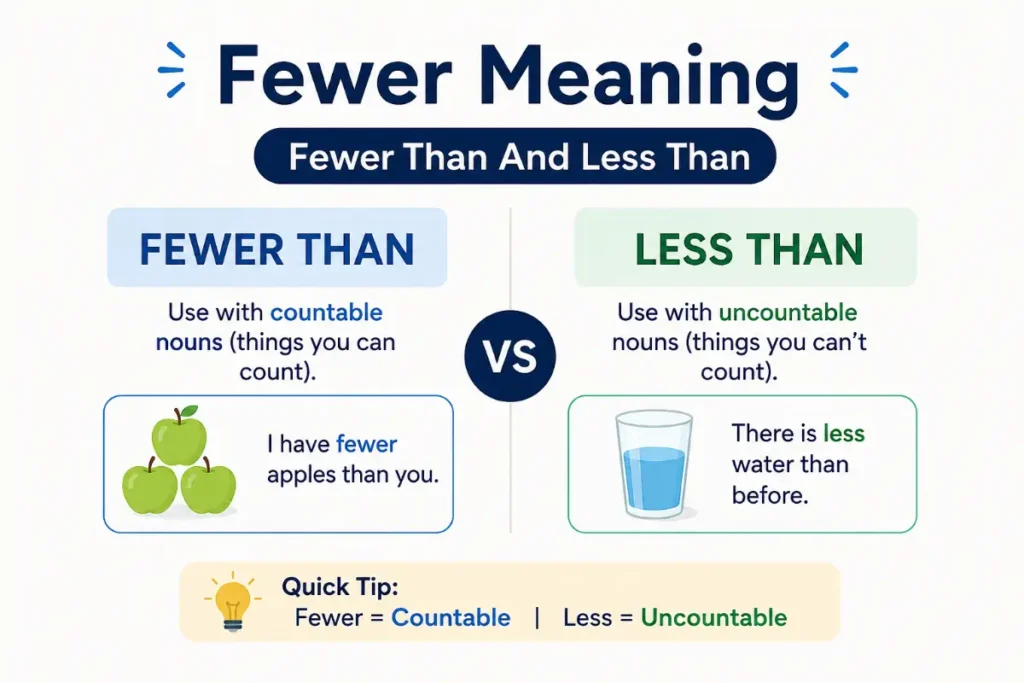
The phrase fewer than normally introduces a smaller number of countable things.
Examples include:
- Fewer than ten students attended the meeting.
- Fewer than twenty people responded.
- The article contains fewer than five errors.
- Fewer than one hundred tickets remain.
The phrase less than normally introduces an amount or measurement.
Examples include:
- The package weighs less than five pounds.
- The trip takes less than an hour.
- The repair costs less than fifty dollars.
- The bottle contains less than one liter.
The tricky part is that numbers can appear after both phrases.
The number itself does not decide the choice. The noun or measurement that follows it does.
- Fewer than ten books focuses on countable books.
- Less than ten minutes focuses on a duration.
That distinction solves many common grammar questions.
Fewer People Or Less People
The standard choice is fewer people.
People are countable individuals, even though people refers to a group. You can have one person, two people, ten people, or one hundred people.
For example:
- There were fewer people at the event this year.
- Fewer people are using the old system now.
- The restaurant was quieter because fewer people came in.
You may hear less people in informal speech, but fewer people is the standard form in careful writing.
This is one of the most useful phrases to remember because it appears frequently in journalism, academic writing, workplace communication, and everyday conversation.
Fewer Things Or Less Things
The standard form is fewer things because things are countable.
You can have one thing, two things, or several things.
For example:
- I have fewer things to finish today.
- She owns fewer things than she used to.
- There are fewer things on the desk now.
The form less things appears in informal speech, but it does not follow the traditional countable noun rule.
Fewer Money Or Less Money
The correct standard expression is less money. Money is treated as an uncountable noun when you mean the general amount.
For example:
- I have less money this month.
- We need less money than we expected.
- The new option will cost less money.
However, you can use fewer with countable units of money.
I have fewer dollars than you.
Here, dollars are individual countable units, so fewer fits.
This example shows why looking at the noun matters more than looking at the idea behind it.
Fewer Time Or Less Time
The standard form is less time.
Time is generally uncountable when you mean duration or an amount of available time.
For example:
- I have less time today.
- The new process takes less time.
- We spent less time waiting.
However, when you are counting specific periods or units, the noun can become countable.
We spent fewer hours on the project this week.
The distinction is clear once you notice the unit being discussed.
- Less time means a smaller amount of time.
- Fewer hours means a smaller number of individual hours.
Fewer Hours Or Less Hours
The standard form is fewer hours because hours are countable units. You can count one hour, two hours, three hours, and so on.
For example:
- I work fewer hours on Fridays.
- She slept fewer hours last night.
- The new schedule gives employees fewer hours.
Compare that with less time.
I have less time to finish the project.
Both sentences discuss duration, but one treats time as an amount and the other treats hours as individual units.
Fewer Examples Or Less Examples
The standard form is fewer examples.
Examples are separate items that can be counted.
You can write:
- The teacher gave us fewer examples this time.
- This explanation needs fewer examples and more detail.
- I found fewer examples than I expected.
The same pattern works with sentences, paragraphs, questions, exercises, chapters, and pages.
Common Grammar Mistakes
Most mistakes with these words come from applying the main rule too broadly or ignoring the noun that follows.
Using Less With Countable Plural Nouns
A common error is:
Less people attended.
Standard English uses:
Fewer people attended.
The same correction applies to less cars, less books, less problems, and less mistakes.
Using Fewer With Uncountable Nouns
Another common mistake is:
Fewer money was available.
The standard form is:
Less money was available.
You would use fewer if you changed the noun to a countable unit.
Fewer dollars were available.
Confusing Numbers With Countability
A number does not automatically require fewer.
Consider:
Less than five minutes.
The expression contains the number five, but minutes here describe a duration.
Now compare:
Fewer than five meetings.
Meetings are separate countable events.
The surrounding meaning matters.
Assuming Every Rule Is Absolute
Language rules describe patterns. They do not erase established usage.
Expressions such as 12 items or less demonstrate that common English can sometimes move beyond the traditional classroom rule.
For formal writing, follow the standard distinction when practical. In everyday speech, recognize that people may use these forms more flexibly.
Fewer And Few
Few and fewer are closely related.
Few means a small number.
Fewer means a smaller number in comparison.
Compare:
Few students finished early.
This means only a small number finished early.
Fewer students finished early this year.
This compares the number with another period or group.
The difference is subtle but important.
You can think of the forms like this:
Few describes a small number.
Fewer compares numbers.
The same pattern appears with little and less.
Little refers to a small amount.
Less compares amounts.
Fewer And Fewest
There is also a superlative form.
Few describes a small number.
Fewer describes a smaller number.
Fewest describes the smallest number.
For example:
This class has few students.
This class has fewer students than the other class.
This class has the fewest students in the school.
The pattern is useful because it shows how English builds comparisons around quantity.
Fewer And Less In Everyday American English
American English follows the traditional countable and uncountable distinction in careful writing, but everyday speech is flexible.
You will regularly hear native speakers use less in places where a strict grammar guide might recommend fewer.
This does not mean the distinction has disappeared.
In edited writing, professional communication, academic work, and formal documents, the traditional pattern remains useful because it gives readers a clear and familiar structure.
At the same time, good editors understand that language lives in real conversations. A grammar guide should help people communicate rather than make ordinary speakers feel as if every casual sentence is a test.
When comparing quantities, understanding less-than and greater-than symbols can make mathematical relationships much easier to express clearly.
How To Remember The Rule
If you keep forgetting the difference, use this simple mental test.
Ask How many?
If the answer is a number of separate things, use fewer.
Ask How much?
If the answer is an amount or quantity treated as a whole, use less.
For example:
- How many books? Fewer books.
- How many people? Fewer people.
- How many mistakes? Fewer mistakes.
- How much water? Less water.
- How much money? Less money.
- How much time? Less time.
There will always be exceptions and gray areas, but this test handles most everyday sentences.
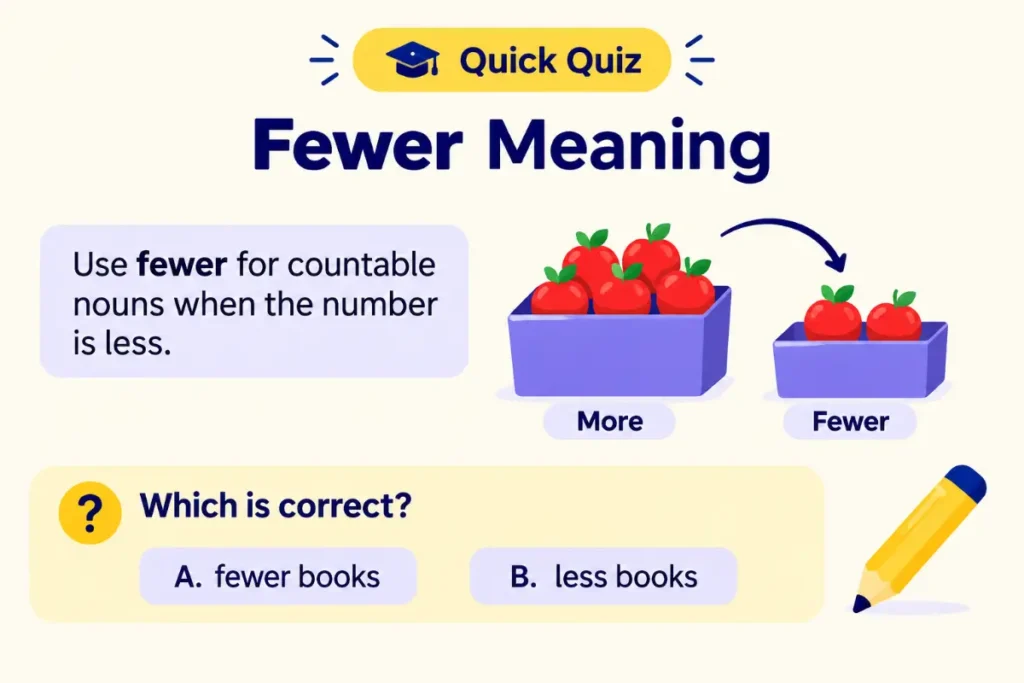
Quick Quiz
Try these sentences before checking the answers.
- There are ___ students in the afternoon class.
- I need ___ sugar in my coffee.
- We spent ___ than twenty dollars.
- The company received ___ complaints this month.
- She has ___ time to finish the assignment.
- The new road has ___ cars during rush hour.
- The package weighs ___ than ten pounds.
Answer Key
- Fewer students.
- Less sugar.
- Less than twenty dollars.
- Fewer complaints.
- Less time.
- Fewer cars.
- Less than ten pounds.
The fastest way to check each answer is to identify the noun and ask how it behaves grammatically. If it is a collection of separate countable units, fewer is usually the answer. If it is an amount, substance, concept, or measurement treated as a whole, less is usually the better choice.
A Practical Editor Test
When I edit a sentence involving these words, I do not start by memorizing a long list of exceptions. I look at the noun first.
Take this sentence:
We need less employees.
The problem becomes obvious when you ask what is being counted. Employees are individual people, so the standard form is:
We need fewer employees.
Now consider:
We need less staff.
Here the meaning is different. Staff can function as a collective or mass noun referring to the workforce as a whole, so less staff can be appropriate depending on the intended meaning.
This is why context matters.
Grammar is not just about individual words. It is about how those words function in a sentence.
That is also why copying a rule mechanically can sometimes produce awkward writing. A strong editor looks at meaning, noun type, context, register, and established usage together.
Countable And Uncountable Nouns
Understanding countable and uncountable nouns makes the entire topic easier.
Countable nouns represent individual units. They can usually have singular and plural forms.
Examples include:
- Book and books.
- Chair and chairs.
- Person and people.
- Car and cars.
- Question and questions.
- Mistake and mistakes.
Uncountable nouns usually describe substances, materials, concepts, activities, or amounts that are not normally divided into individual units in ordinary grammar.
Examples include:
- Water.
- Money.
- Information.
- Advice.
- Traffic.
- Patience.
- Equipment.
- Knowledge.
These nouns normally work with less.
For example:
Less information.
Less traffic.
Less advice.
Less equipment.
If you need a countable unit, English often provides one.
Instead of fewer information, say fewer pieces of information.
Instead of fewer advice, say fewer pieces of advice.
The meaning stays similar, but the grammar changes because pieces are countable.
Why Some Nouns Feel Confusing
Some nouns can be countable or uncountable depending on meaning.
Consider experience.
She has less experience than I do.
Here experience means general knowledge gained through life or work. It is treated as an uncountable concept.
Now consider:
She has had fewer experiences like this.
Here experiences means individual events. They can be counted.
The same idea appears with words such as time, work, light, paper, and business.
Context can change the grammatical treatment.
That is one reason native English usage can seem inconsistent to learners. The language is responding to meaning rather than simply following the shape of the word.
Pronunciation Of Fewer
Fewer is pronounced /ˈfjuːər/ in many varieties of English.
It generally has two syllables:
few er
The first part sounds like few. The second part is a light unstressed sound.
Do not confuse fewer with fewer as a completely different spoken form. The pronunciation stays consistent even when the word appears in different grammatical structures.
The related word few is pronounced /fjuː/.
The pronunciation of less is /les/.
For learners, the bigger challenge is usually not pronunciation. It is choosing the correct word based on the noun that follows.
The idea of “fewer” can also be understood more creatively through a powerful metaphor for time, especially when describing how moments or experiences seem to pass.
Fewer In Professional Writing
In workplace communication, the distinction can make writing sound more polished.
Compare:
We received less applications this quarter.
with:
We received fewer applications this quarter.
The second sentence follows the standard rule because applications are countable.
You can use the same pattern in reports, emails, presentations, and business documents.
Fewer customers reported problems.
Fewer employees requested schedule changes.
Fewer orders were delayed.
Clear grammar helps readers process information quickly. That matters especially when the sentence contains statistics, comparisons, or operational details.
Fewer In Academic Writing
Academic writing often requires careful comparison.
Examples include:
The study included fewer participants than the previous trial.
Students made fewer errors after the intervention.
The revised method required fewer steps.
At the same time, academic writers use less for uncountable concepts.
The revised method required less energy.
The participants reported less stress.
The experiment produced less waste.
Notice how the grammar changes according to the noun rather than the subject of the research.
Fewer In Everyday Conversation
In ordinary conversation, you might say:
I have fewer errands today.
There are fewer people here now.
We have fewer dishes to wash.
I made fewer trips to the store this week.
These sentences sound natural because the nouns refer to separate countable units.
You do not need formal language to use the distinction correctly. It fits naturally into ordinary American English.
Fewer In Formal And Informal Contexts
The word itself is neutral. It is not unusually formal.
You can use fewer in a text message, a school essay, a business report, or a conversation.
What changes is the amount of attention people pay to the distinction.
In a casual conversation, people may say less where traditional grammar recommends fewer.
In edited writing, the standard distinction is more likely to be maintained.
That makes fewer a useful word to know well because it works across different levels of communication.
Related Grammar Terms
Several concepts connect directly to this topic.
Comparative adjective refers to a form used to compare quantities or qualities. Fewer belongs to this group because it compares numbers.
Countable noun refers to something that can be treated as separate units. Examples include books, people, cars, and questions.
Uncountable noun refers to something normally treated as an amount or mass. Examples include water, money, information, and traffic.
Quantifier is a word that expresses quantity. Words such as few, fewer, fewest, little, less, and least can function as quantity expressions.
Understanding these terms can make grammar explanations easier, but you do not need to memorize them to use the rule correctly.
Frequently Asked Questions
Is It Fewer People Or Less People
The standard form is fewer people because people are countable individuals. You can count one person, two people, ten people, or one hundred people. For careful writing, use fewer people when you mean a smaller number of individuals. Less people occurs in informal speech, but it does not follow the traditional countable noun rule.
What Is The Opposite Of Fewer
The opposite of fewer is usually more. If you have fewer books, you have a smaller number of books. If you have more books, you have a larger number. Fewer belongs to the quantity pattern involving few, fewer, and fewest, while more works as the comparative opposite for a larger quantity.
Can I Use Fewer For Percentages
You can use fewer with a percentage when the percentage refers to a countable group or number of people and the construction clearly focuses on individuals. For example, Fewer than 20 percent of employees responded is standard because employees are countable. The important point is the noun or group being measured, not simply the presence of a percentage.
Is It Fewer Than Or Less Than
Use fewer than with countable plural nouns and less than with amounts and many measurements. For example, fewer than ten students refers to a number of students, while less than ten minutes refers to a duration. Less than twenty dollars is also standard because money is treated as an amount in that expression.
Is It Fewer Hours Or Less Hours
The standard form is fewer hours because hours are countable units. You can count one hour, two hours, and three hours. However, use less time when you are discussing time as a general amount. Compare I work fewer hours with I have less time. The noun determines the grammatical choice.
Is Fewer A Comparative Word
Yes. Fewer is the comparative form associated with few. It indicates a smaller number in comparison with another number or an understood reference point. For example, This year we had fewer visitors means the number of visitors was smaller than in another period or situation. The comparison does not always need to be stated directly.
Is It Fewer Money Or Less Money
The standard expression is less money because money is normally treated as an uncountable amount. You can say I have less money than before. However, if you count individual monetary units, use fewer: I have fewer dollars than you. The noun being counted determines the form.
Is Twelve Items Or Less Grammatically Correct
The traditional grammatical form is 12 items or fewer because items are countable. However, 12 items or less is extremely common in everyday English, especially on checkout signs. The widespread expression is accepted by many speakers because of established usage. For formal or carefully edited writing, 12 items or fewer remains the safer traditional choice.
Final Takeaway
The easiest way to remember the distinction is simple: fewer normally goes with things you can count, while less normally goes with amounts you cannot divide into individual units in ordinary use.
Use fewer books, fewer people, fewer mistakes, and fewer questions. Use less water, less money, less time, less traffic, and less information.
Then remember the common measurement exception. English normally says less than ten minutes, less than twenty dollars, and less than five miles, even though the measurements contain numbers.
Do not let the famous 12 items or less sign convince you that the basic rule is useless. It is a good example of how everyday usage can differ from traditional grammar.
The most reliable habit is to stop looking at the number and look at the noun instead. Ask How many? for countable things and How much? for amounts. That small check will solve most of the confusion.