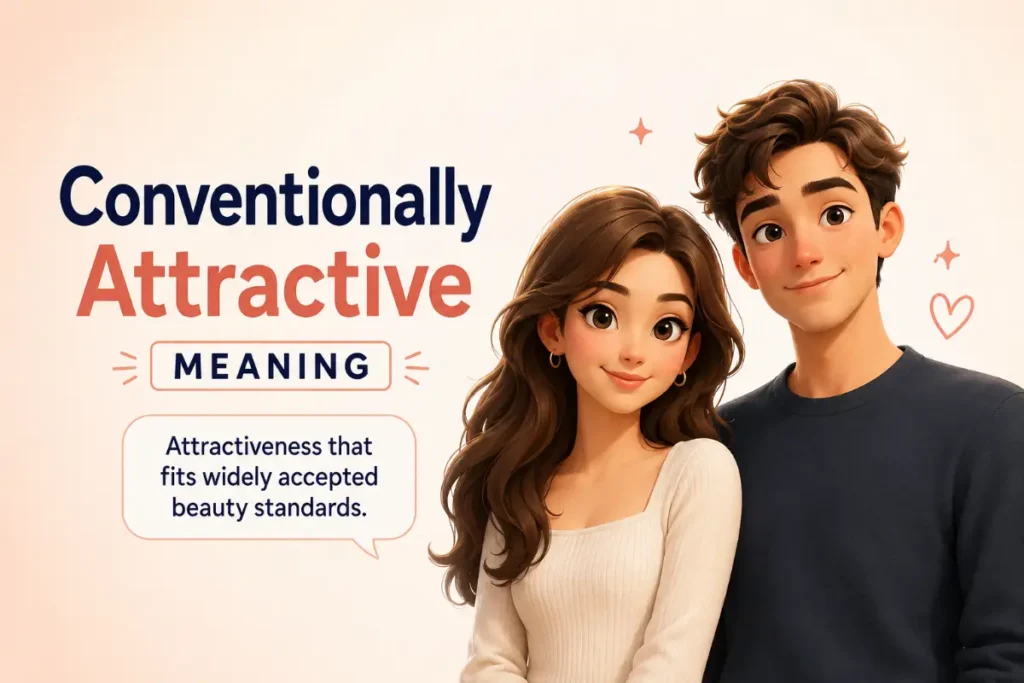
When someone searches for the conventionally attractive meaning, they are usually asking what the phrase means when it describes a person’s appearance. The term refers to someone who fits widely recognized beauty standards within a particular culture or society. It does not mean everyone will personally find that person attractive. Instead, it suggests that their appearance matches physical traits that many people commonly associate with beauty or handsomeness.
The conventionally attractive meaning often causes confusion because attractiveness is deeply personal. You may find someone beautiful for reasons that have little to do with popular beauty standards. At the same time, a person can match those standards and still not be your personal type.
This distinction matters. Conventional attractiveness describes a broad social perception. Personal attraction describes an individual response. The two can overlap, but they are not the same thing.
This guide explains the phrase in simple terms, explores the psychology behind beauty standards, compares conventional and unconventional attractiveness, and provides real examples for women and men. It also looks at how culture, media, fashion, and changing social values shape what people consider attractive.
Quick Answer
Conventionally attractive means having physical features that generally match widely accepted beauty standards within a particular society or culture. Commonly admired traits may include facial symmetry, clear skin, balanced features, and a healthy appearance. However, personal attraction remains subjective, and beauty standards change across cultures and time.
What Does Conventionally Attractive Mean
Conventionally attractive describes someone whose appearance fits the beauty ideals commonly recognized by a large group of people within a particular culture. The word conventionally is important because it refers to conventions, or standards that society has widely accepted over time.
In simple terms, the phrase means something close to this: many people would probably recognize the person as physically attractive based on familiar social standards.
That does not mean everyone agrees. Attraction has many layers. Personality, confidence, voice, humor, style, body language, familiarity, and emotional connection can all influence how attractive someone appears to another person.
For example, a person may have facial features commonly associated with mainstream beauty standards. People might describe that person as conventionally attractive even if they personally prefer a different appearance.
The phrase is often used to separate social standards from individual taste. Someone might say:
He is conventionally attractive, but he is not my type.
This sentence makes a useful distinction. The speaker recognizes that many people may consider him handsome while also expressing a personal preference for something different.
If you are decoding online slang, understanding what ASL means in texts can also help you make sense of common abbreviations used in casual conversations.
What Does Conventionally Mean
To understand the full phrase, it helps to examine the first word.
Conventionally means according to a commonly accepted convention, tradition, standard, or usual way of doing something.
In the context of appearance, conventionally means according to the beauty standards that are widely recognized within a society or cultural setting.
Those standards are not universal laws. They are social patterns. A beauty standard can become popular through many influences, including:
- Culture.
- History.
- Fashion.
- Film and television.
- Advertising.
- Social media.
- Celebrity culture.
- Local traditions.
- Economic conditions.
- Changing ideas about health and identity.
That is why the definition should never be treated as fixed forever. What one generation praises may become less fashionable later. A feature admired in one country may receive less attention in another.
The phrase describes a social pattern, not an objective measurement of human worth.
What Does Attractive Mean
Attractive means pleasing, appealing, or capable of drawing someone’s interest. The word can describe physical appearance, personality, ideas, opportunities, or objects.
For example:
- She has an attractive smile.
- He found the job offer attractive.
- The house has an attractive design.
When people discuss physical appearance, attractive usually means visually appealing or sexually appealing.
However, personal attraction is broader than appearance alone. Someone may become more attractive to you because they are funny, intelligent, kind, confident, creative, or emotionally warm.
This is one reason the phrase conventionally attractive is more specific than simply saying attractive.
Attractive can describe your personal reaction. Conventionally attractive usually describes how closely someone appears to match commonly recognized beauty ideals.
Conventionally Attractive Vs Attractive
These phrases are related, but they do not mean exactly the same thing.
| Term | Basic Meaning | Main Focus |
|---|---|---|
| Attractive | Appealing or desirable to someone | Personal or general appeal |
| Conventionally attractive | Matches widely accepted beauty standards | Socially recognized appearance |
| Unconventionally attractive | Appealing in a way that does not strongly match mainstream beauty ideals | Distinctive or nontraditional appeal |
A person can be attractive without being conventionally attractive. A person can also be conventionally attractive without being personally attractive to everyone.
Imagine two people walking into the same room. One may have features commonly celebrated in movies, fashion, and advertising. The other may have unusual facial features, a distinctive look, or a strong personal style.
The first person might be described as fitting mainstream beauty standards. The second person might be described as striking, distinctive, charismatic, or unconventionally attractive.
Neither description determines who is more attractive in any absolute sense. Human attraction does not work like a math equation.
Conventionally Attractive Vs Unconventionally Attractive
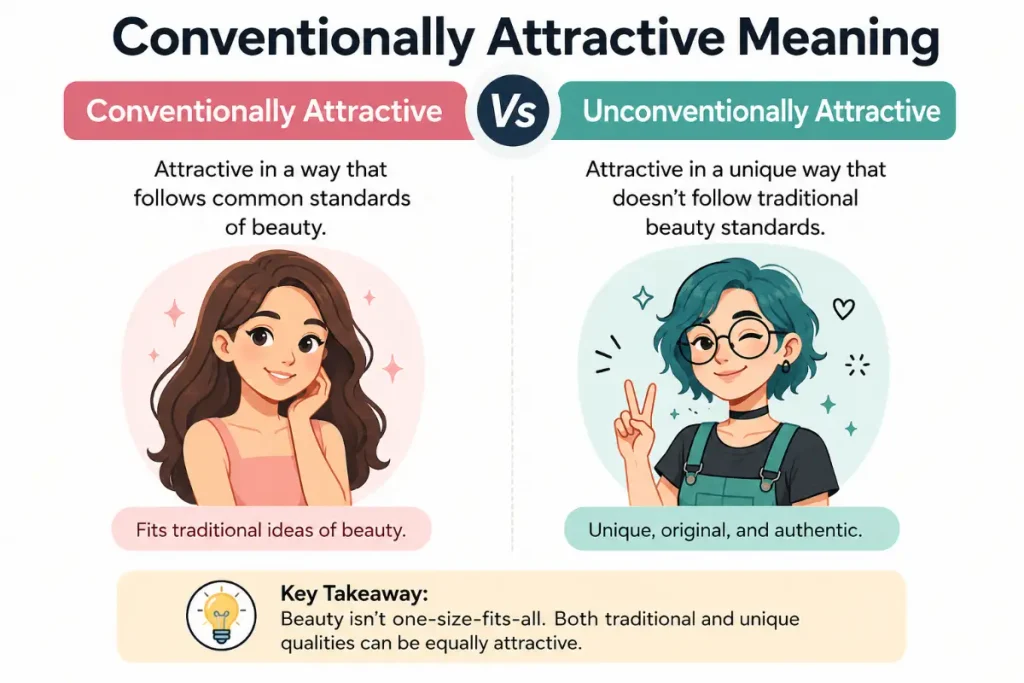
The difference usually comes down to familiarity with established beauty standards. A conventionally attractive person is often perceived as fitting commonly recognized ideals of beauty or handsomeness.
An unconventionally attractive person may have features that do not perfectly fit those standards but still create a strong sense of appeal.
For example, someone may have an unusual nose, distinctive facial proportions, prominent features, or a style that stands apart from mainstream expectations. Those traits may make the person memorable and attractive in a different way.
The term unconventionally attractive meaning is often searched because people want to understand this contrast. The phrase usually suggests that someone is attractive, but their appeal does not depend entirely on traditional beauty standards.
Here is a simple comparison.
| Conventional Appeal | Unconventional Appeal |
|---|---|
| Often matches familiar beauty ideals | Often stands apart from familiar beauty ideals |
| May feel immediately recognizable | May become more noticeable over time |
| Commonly celebrated in mainstream media | Often associated with distinctive features |
| Can receive broad social approval | Can inspire strong individual preferences |
| Often described as classic or traditionally beautiful | Often described as striking or unique |
Neither category is better. They simply describe different ways people talk about appearance.
Common Features Associated With Conventional Beauty
Beauty standards differ, but some physical traits are frequently associated with conventional attractiveness in many modern media environments.
These can include:
- Facial symmetry or an overall sense of balance.
- Clear and healthy looking skin.
- Features that appear proportionate to one another.
- Good grooming.
- A healthy looking appearance.
- Features that match popular cultural ideals.
- A style that reflects current standards of beauty or fashion.
It is important to understand that these are general patterns, not requirements for beauty. People can be considered beautiful without possessing every trait on this list.
In fact, many memorable faces in art, film, music, and fashion stand out because they are distinctive rather than perfectly symmetrical.
Beauty can be familiar, but it can also be surprising.
Conventionally Attractive Meaning For Women
When people discuss conventional beauty standards for women, the conversation often focuses on traits that have been widely promoted through fashion, entertainment, and advertising.
Depending on the culture and period, these standards may include:
- Facial symmetry or balanced facial proportions.
- Clear skin.
- Well groomed hair.
- Features currently considered feminine within that culture.
- A body shape that matches popular beauty ideals.
- A polished or fashionable appearance.
However, these expectations change dramatically over time.
One era may favor a particular body type while another celebrates something different. Hairstyles, makeup trends, facial preferences, and fashion standards also shift.
This is why describing a woman as conventionally attractive should not be confused with making a universal judgment about beauty. It simply means that her appearance closely resembles standards that many people in a particular social environment recognize as traditionally desirable.
A woman can also be beautiful because of her presence, style, confidence, warmth, intelligence, or individuality. Those qualities do not fit neatly into a checklist.
Conventionally Attractive Meaning For Men
The phrase can also describe men whose appearance fits common social standards of handsomeness.
Depending on the culture, these traits may include:
- Facial balance.
- Healthy looking skin.
- A well groomed appearance.
- A physique associated with popular ideals of masculinity.
- Features often celebrated in film, fashion, and media.
- A confident physical presence.
Again, these standards are not universal.
Some people prefer softer features. Others prefer rugged features. Some are attracted to highly polished appearances, while others like a more natural or unconventional look.
That variety is exactly why conventional attractiveness and personal attraction should not be treated as identical.
A man may receive widespread recognition for fitting popular standards and still not appeal to every individual.
Why Do People Use This Phrase
People often use the phrase because they want to be precise.
Simply calling someone attractive can suggest a personal opinion. Saying someone is conventionally attractive often signals that the speaker is talking about broader social standards.
For example:
She is conventionally attractive, so I understand why people notice her quickly.
The speaker is not necessarily saying that everyone finds her beautiful. Instead, the sentence recognizes that her appearance aligns with traits commonly praised in mainstream culture.
People also use the phrase during conversations about dating, beauty standards, celebrity culture, privilege, and social behavior.
It has become especially common online because internet discussions often try to separate three different ideas:
- Personal preference.
- Social beauty standards.
- Perceived physical attractiveness.
Those ideas overlap, but they are not interchangeable.
The Psychology Behind Conventional Attractiveness
Psychology offers several ways to understand why some physical traits become widely recognized as attractive.
One area involves familiarity. People often feel comfortable with patterns they have seen repeatedly. Media exposure can make certain looks feel more familiar, desirable, or socially valued.
Another factor is perceived health. In many societies, people may associate clear skin, physical vitality, and certain facial characteristics with health. These perceptions can influence judgments about attractiveness.
Facial symmetry and proportion have also received attention in discussions about beauty perception. However, human attraction is far more complicated than symmetry alone.
People do not fall in love with a ruler and a measuring tape.
Emotional connection can change how a face appears to us. Someone may initially seem ordinary and later become deeply attractive because of personality, humor, kindness, intelligence, or shared experiences.
This shows the difference between quick visual judgments and lasting attraction.
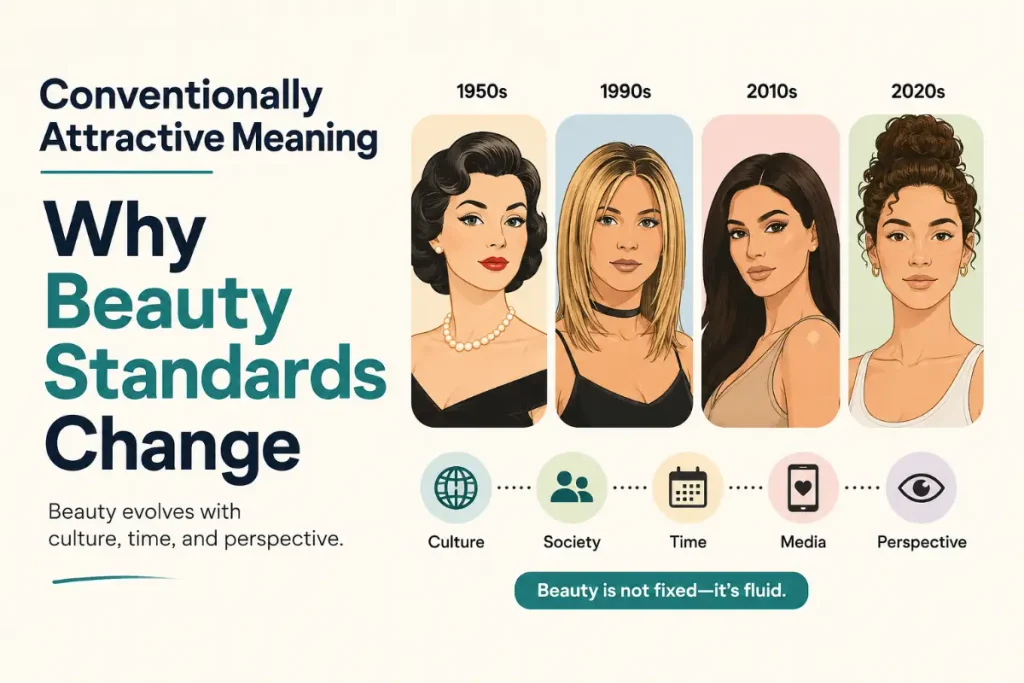
Why Beauty Standards Change
Beauty standards can feel permanent while you are living inside them. History tells a different story. Fashion changes. Media changes. Social values change. New generations develop different ideas about appearance.
A feature considered highly desirable in one period may receive less attention decades later. Clothing, body ideals, hairstyles, makeup, and grooming habits can all move in cycles.
Cultural differences also matter.
An appearance strongly associated with beauty in one country may not carry the same meaning elsewhere. Even within the same country, beauty ideals can differ across communities, generations, and social groups.
That is why conventional attractiveness is best understood as a social concept.
It describes what is commonly recognized in a particular environment. It does not create a universal ranking of human beauty.
Examples Of Conventionally Attractive People
The easiest way to understand the phrase is through ordinary examples rather than trying to create a strict checklist.
Example One
A person has features that closely match the appearance often promoted by mainstream fashion magazines and popular films. Many strangers describe that person as beautiful or handsome almost immediately.
Someone might say:
He is conventionally attractive and has the kind of appearance that fits traditional leading actor standards.
Example Two
A woman has clear skin, balanced facial features, a polished appearance, and a style that closely matches popular beauty trends.
A friend might say:
She is widely seen as conventionally attractive, although beauty is still a matter of personal taste.
Example Three
A person has a distinctive face with unusual proportions but a powerful presence and strong personal style. Some people find that person far more appealing than someone with a traditionally polished appearance.
You might describe that person as:
Unconventionally attractive and incredibly memorable.
These examples show that the categories describe social perceptions rather than objective facts.
Real Life Sentence Examples
Here are some natural ways the phrase appears in conversation and writing.
- He is conventionally attractive, but personality matters more to me.
- She fits many of the beauty standards that popular media promotes.
- The actor has a traditionally handsome appearance.
- I understand why people think he is attractive, but he is not my personal type.
- Her look is more distinctive than traditionally beautiful.
- Some people are immediately recognized as fitting mainstream beauty standards.
- She has an unconventional appearance that many people find striking.
- Attractiveness depends partly on culture and personal preference.
- He became more attractive to me after I got to know his personality.
- Beauty standards have changed significantly across different periods of history.
These examples sound natural because they avoid treating appearance as an objective score.
Similar expressions appear frequently in digital conversations, including another popular texting abbreviation that can change meaning depending on the context.
Does Conventionally Attractive Mean Beautiful
It can mean that many people are likely to consider someone beautiful or handsome based on common social standards.
However, the phrase does not mean beautiful in exactly the same way.
Beautiful is often a direct expression of admiration.
Conventionally attractive is more analytical. It places the person’s appearance within a larger set of social expectations.
For example:
I think she is beautiful.
This is personal.
She is conventionally attractive.
This often sounds like an observation about broader social standards.
The second sentence can sound more detached. It may communicate recognition without personal attraction.
Is Conventionally Attractive A Compliment
Usually, yes, but context matters.
Calling someone conventionally attractive generally recognizes that they fit commonly admired standards of physical appearance. Many people would interpret that positively.
Still, the phrase can sometimes sound clinical or emotionally distant.
For example:
You are beautiful.
This sounds personal and warm.
You are conventionally attractive.
This can sound analytical, as if someone is describing a category rather than expressing personal admiration.
That does not make the phrase insulting. The tone depends on the situation and relationship between the people involved.
Is Being Conventionally Attractive The Same As Being Hot
Not exactly.
Hot is an informal word that usually refers to strong physical or sexual attraction.
Conventionally attractive refers more specifically to fitting widely recognized beauty standards.
A person can be conventionally attractive without being described as hot by everyone. Likewise, someone can be intensely attractive to a particular person without fitting mainstream standards.
The words focus on different things.
One describes a social pattern.
The other often expresses a stronger personal reaction.
Conventionally Attractive Vs Pretty
Pretty usually suggests a pleasing or appealing appearance. It is often used for women, girls, objects, or places, although language use continues to change.
Conventionally attractive is broader and more analytical.
A person can be pretty without matching every mainstream beauty standard. The word pretty also carries a more personal and immediate tone.
Compare:
She is pretty.
This is a direct observation.
She is conventionally attractive.
This describes her appearance in relation to broader social expectations.
Conventionally Attractive Vs Beautiful
Beautiful often carries emotional weight. It can describe something that creates admiration, pleasure, or a strong emotional response.
Conventionally attractive usually sounds more neutral and socially focused.
Someone may say:
She is conventionally attractive, but I find her friend more beautiful.
The sentence shows how personal taste can differ from mainstream standards.
One person may fit a familiar idea of beauty.
Another may create a stronger personal emotional response.
Why Personal Attraction Is Different
Personal attraction often develops through more than appearance.
You may become attracted to someone because of:
- Their humor.
- Their voice.
- Their confidence.
- Their kindness.
- Their intelligence.
- Their creativity.
- Their mannerisms.
- Their style.
- Shared memories.
- Emotional chemistry.
This explains why two people can look at the same person and have completely different reactions.
One may say the person is attractive but not their type.
Another may feel an immediate connection.
Attraction is not a public vote with a final score.
Social standards influence perception, but individual experience still matters.
The Role Of Culture In Beauty Standards
Culture has a major influence on what people describe as attractive.
Different societies can value different:
- Facial features.
- Skin tones.
- Body types.
- Hairstyles.
- Clothing styles.
- Grooming habits.
- Signs of age.
- Expressions of masculinity or femininity.
These preferences can also change within a culture over time.
Global media has created some widely shared beauty trends, but local traditions and communities continue to shape personal ideals.
This makes it difficult to create one universal definition of attractiveness.
A better approach is to ask what standards are being discussed and who created those standards.
Media And Conventional Beauty
Movies, television, advertising, fashion, and social media can strongly influence beauty standards.
When audiences repeatedly see a particular type of face or body presented as desirable, successful, romantic, or glamorous, that image can become closely associated with attractiveness.
This does not mean media controls every personal preference.
People still develop their own tastes.
However, repeated exposure can influence what seems familiar and socially valued.
Social media has added another layer to this process. Filters, photo editing, cosmetic trends, celebrity culture, and algorithm driven content can repeatedly promote certain appearances.
As a result, beauty standards can spread quickly.
They can also change quickly.
The Problem With Treating Beauty As A Score
Online discussions sometimes treat attractiveness as if every person can be placed on a fixed scale.
That approach misses a great deal.
People experience faces differently. Culture matters. Personal history matters. Emotional connection matters.
Someone may be considered average looking by one group and exceptionally attractive by another.
A numerical score can also encourage people to think of themselves and others as objects competing in a permanent ranking system.
Human appearance is more complex than that.
The idea of conventional attractiveness can be useful when discussing social beauty standards. It becomes less useful when it is treated as a measure of a person’s value.
How To Use The Phrase Correctly
The phrase works best when you are discussing social perceptions rather than making an absolute statement.
You can use it in sentences such as:
- She is conventionally attractive, but her style is very individual.
- He fits many mainstream standards of male attractiveness.
- The character is written as conventionally attractive.
- The conversation explores how conventional beauty affects social treatment.
- She has a more unconventional and distinctive type of appeal.
In formal writing, the phrase can be useful when discussing:
- Psychology.
- Sociology.
- Media studies.
- Fashion.
- Film and television.
- Dating culture.
- Beauty standards.
- Social perception.
Common Mistakes
Treating It As An Objective Fact
A person is not universally attractive because a culture considers certain features desirable.
The phrase describes a widespread perception, not a scientific fact.
Confusing It With Personal Attraction
You can recognize that someone fits mainstream beauty standards without being personally attracted to them.
Assuming Beauty Standards Never Change
Conventions are social patterns. They can change with culture and time.
Assuming Unconventional Means Unattractive
This is one of the biggest misunderstandings.
Unconventionally attractive still means attractive. It simply suggests that the person’s appeal does not depend entirely on mainstream beauty ideals.
Using The Phrase To Rank Human Worth
Physical attractiveness can affect social experiences, but it does not determine intelligence, kindness, creativity, character, or personal value.
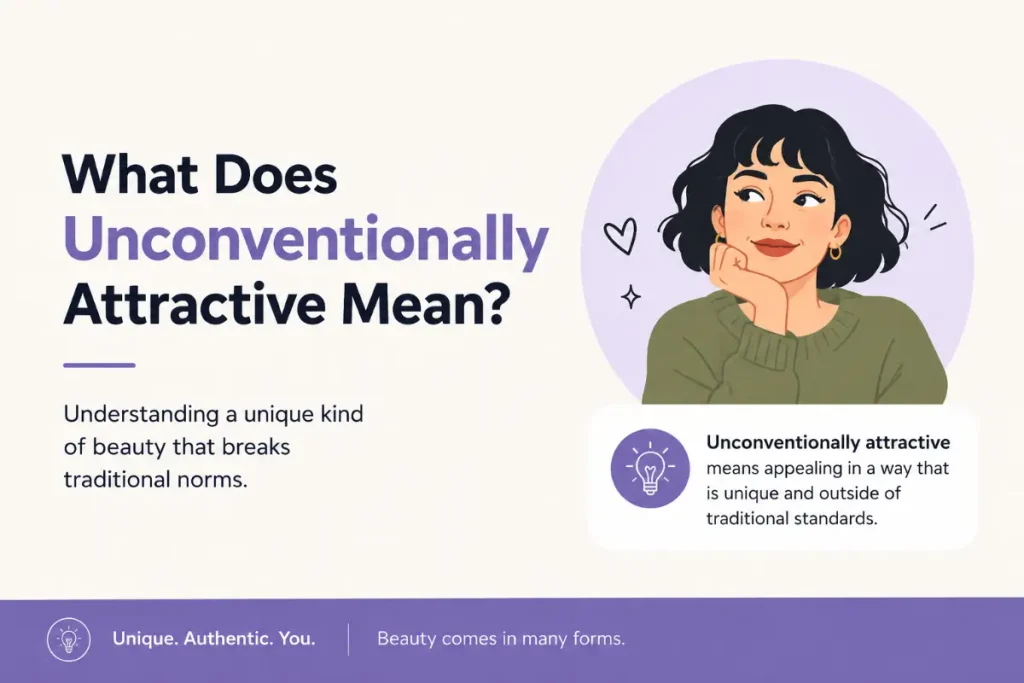
What Does Unconventionally Attractive Mean
An unconventionally attractive person is generally someone who is considered appealing despite not closely fitting traditional or mainstream beauty standards.
Their attractiveness may come from distinctive features, strong presence, unusual style, charisma, or a combination of qualities that create a memorable appearance.
For example, a face with unusual proportions may stand out more than a face that closely matches a traditional beauty template.
The appeal can also grow over time.
Some faces are immediately familiar and easy to categorize.
Others become more interesting the longer you look at them.
That difference helps explain why some people develop strong preferences for distinctive appearances.
Psychology And The Halo Effect
Psychology discussions about attractiveness often mention the halo effect.
The halo effect refers to a tendency to allow one positive quality to influence judgments about other qualities.
For example, people may sometimes assume that an attractive person is also more successful, friendly, confident, or capable.
These assumptions are not always accurate.
A person’s appearance can influence first impressions, but appearance does not provide a complete picture of character or ability.
This topic matters when discussing conventional beauty because socially valued appearance can affect how people are initially perceived.
At the same time, first impressions can change quickly as people learn more about each other.
Does Conventional Attractiveness Create Advantages
Research and social observation have long suggested that appearance can influence first impressions and social treatment.
People who fit popular beauty standards may sometimes receive positive attention more easily. This idea is often discussed through concepts such as attractiveness bias or the halo effect.
However, real life is not a simple formula.
Social success depends on many factors, including communication skills, opportunity, personality, resources, confidence, social networks, and context.
It is also important to avoid assuming that every attractive person has an easy life or that appearance explains every social outcome. The subject is more complicated than a simple advantage or disadvantage.
Learning TTM and its texting use is another useful way to understand how short forms and abbreviations shape modern online communication.
How Beauty Standards Affect Self Image
Beauty standards can influence how people evaluate themselves. When a narrow appearance becomes heavily promoted as ideal, people who do not resemble that image may feel pressure to change.
This can create unnecessary comparison.
It helps to remember that popular standards are often shaped by trends and commercial interests. They are not permanent truths about human beauty.
A healthier approach is to recognize the difference between social ideals and personal worth.
You can appreciate style, appearance, grooming, and fashion without believing that one physical template represents the only valid form of beauty.
Expert Language Insight
From an editorial perspective, conventionally attractive is useful because it adds precision to a conversation about appearance.
- If you simply say someone is attractive, readers may assume you are sharing your personal opinion.
- If you say someone is conventionally attractive, you signal that you are discussing a broader social perception.
That distinction is especially useful in analytical writing. However, avoid using the phrase too often in the same paragraph. Repeating it can make the writing sound mechanical.
You can naturally vary the language with phrases such as:
- Mainstream beauty standards.
- Traditional standards of beauty.
- Socially recognized attractiveness.
- Widely admired physical traits.
- A traditionally handsome appearance.
- A look that fits popular beauty ideals.
The best choice depends on context.
Frequently Asked Questions
What Does Conventionally Attractive Mean In Simple Words
It means a person has physical features that match beauty standards widely recognized in a particular culture or society. The phrase describes common social perceptions rather than universal personal preference. Someone can fit mainstream standards and still not be attractive to every individual.
Does Conventionally Attractive Mean Everyone Finds You Attractive
No. The phrase suggests that many people may recognize someone as fitting popular beauty standards. Personal attraction is different because every person has individual preferences, experiences, and emotional responses. Broad social approval and personal attraction can overlap, but they are not the same thing.
What Is The Difference Between Attractive And Conventionally Attractive
Attractive can describe a personal or general sense of appeal. Conventionally attractive specifically refers to someone whose appearance fits widely accepted beauty standards. You may personally find someone attractive even if they do not closely match mainstream ideals.
What Does Unconventionally Attractive Mean
It describes someone who is attractive in a distinctive way that does not strongly depend on traditional beauty standards. Their appeal may come from unusual features, charisma, personal style, presence, or characteristics that make them memorable and visually interesting.
Can A Person Be Attractive But Not Conventionally Attractive
Yes. This happens often because attraction is subjective. Someone may have features that do not fit popular beauty standards and still be deeply appealing to many people. Personality, confidence, style, and emotional chemistry can also influence attraction.
Is Conventionally Attractive A Compliment
Usually, yes. The phrase generally recognizes that someone fits commonly admired standards of physical appearance. However, it can sound more analytical and less personal than simply calling someone beautiful or handsome. Tone and context affect how the statement feels.
What Makes A Woman Conventionally Attractive
The answer depends on the culture and time period. Mainstream standards often emphasize traits such as balanced facial features, clear skin, grooming, and a fashionable appearance. These ideals are social standards rather than universal rules, and they change over time.
What Makes A Man Conventionally Attractive
Cultural standards for men often include traits associated with popular ideas of handsomeness, health, grooming, facial balance, and physical presence. However, individual preferences vary widely, and many people find distinctive or unconventional appearances equally attractive.
Is Conventional Beauty The Same Around The World
No. Different cultures can value different physical traits, styles, body types, and forms of presentation. Global media has created some shared trends, but local culture and personal preference continue to shape ideas about beauty and attractiveness.
Is Conventionally Attractive A Psychology Term
The phrase is commonly used in everyday language and discussions about psychology, media, dating, and social behavior. It describes perceived alignment with widely recognized beauty standards. Related psychological topics include beauty perception, social comparison, attractiveness bias, and the halo effect.
Final Thoughts
The phrase describes a simple idea that often gets misunderstood. A conventionally attractive person is generally seen as fitting beauty standards that are widely recognized within a particular social or cultural setting.
That does not mean everyone finds the person attractive. It also does not mean people outside those standards are less beautiful.
Personal attraction is much broader than a list of physical features. Chemistry, personality, confidence, humor, kindness, style, culture, and individual preference all shape how people see one another.
The most useful distinction is this: conventional beauty describes a social pattern, while attraction remains a deeply personal experience.
Beauty standards may influence first impressions, but they do not get the final word. Human attraction is far too varied for that.