Have you ever written touchbase or touch base and paused because you were not sure if it should be one word or two? This confusion is especially common in business communication because people hear the phrase constantly in meetings, emails, and workplace conversations. The pronunciation makes the two forms sound like a single word, but standard written English treats them differently.
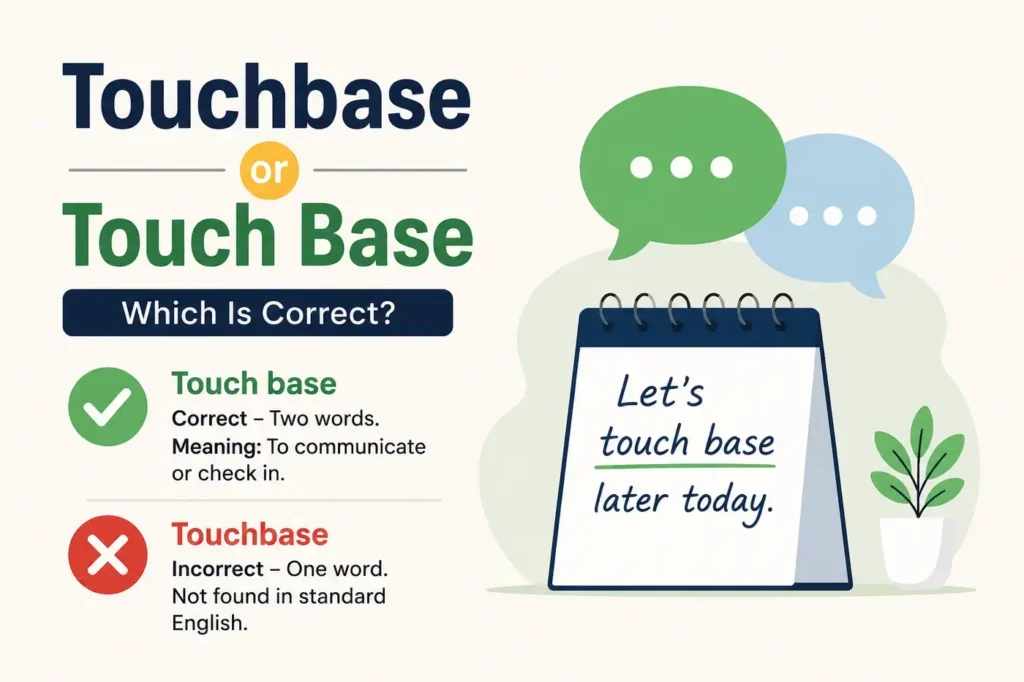
The correct form depends on how you are using the expression. Touch base is the standard two word phrase when you mean to contact someone briefly, check in, or discuss an update. Touchbase is not the standard spelling of that verb phrase, although it can appear as a brand name, company name, software name, or other proper name.
The phrase is common in professional English, but that does not mean every use sounds equally polished. Some readers consider it a familiar business expression while others see it as workplace jargon. This guide explains the difference clearly. You will learn the meaning, grammar, pronunciation, history, correct spelling, formal alternatives, natural examples, common mistakes, and the best way to use the expression in professional communication.
Quick Definition
Touch base is the standard two word phrase meaning to contact someone briefly or communicate with them to exchange information, discuss progress, or arrange a later conversation. Touchbase is generally not the standard spelling when used as a verb phrase. It may appear as a brand name or proper name.
Quick Answer
The correct form is touch base when you are using the expression as a verb.
For example:
Let’s touch base next week.
This means Let’s contact each other or speak again next week.
Use touch base in business emails, workplace conversations, messages, and ordinary writing. Touchbase as one word is usually a mistake unless it is part of an official name or brand.
A useful rule is simple:
- Use touch base when you mean to check in or communicate.
- Use touchbase only when a specific company, product, platform, or proper name officially uses that spelling.
- Use a more precise phrase such as contact, discuss, follow up, or speak when you want your writing to sound more direct and less like business jargon.
Comparison Table
| Feature | Touch Base | Touchbase |
|---|---|---|
| Standard spelling | Yes | No as a normal verb phrase |
| Part of speech | Verb phrase | Usually a proper name when written as one word |
| Meaning | Contact someone briefly or communicate | No standard independent meaning in ordinary English |
| Origin | Idiomatic phrase with a sports connection | Creative closed spelling |
| Formality level | Common in professional and casual communication | Usually branded or nonstandard |
| Common contexts | Emails meetings workplace conversations follow ups | Company names software names product names |
| Usage frequency | Common | Much less common in standard writing |
| Example | I will touch base with the team tomorrow. | Touchbase may be an official product name. |
The central point is easy to remember. Touch base is the normal English expression. The two words work together as a verb phrase. Writing them as one word usually changes the expression into a nonstandard form.
If you’re also unsure about terms that describe different kinds of pressure, our guide on legal pressure vs emotional distress explains when each word is appropriate.
Meaning Of Both Terms
The difference becomes clearer when you look at each form separately.
What Touch Base Means
Touch base means to contact someone briefly or communicate with them to exchange information. The conversation may be short or detailed, depending on the situation, but the phrase usually suggests a check in rather than a major formal discussion.
For example, if a colleague says, I will touch base with you tomorrow, they usually mean they will contact you tomorrow to discuss an update or see how things are progressing.
The phrase can describe several common actions.
- Checking in with a colleague.
- Following up on a project.
- Sharing new information.
- Confirming a plan.
- Arranging a future discussion.
- Reconnecting with someone after a period of silence.
The expression is especially common in workplace English. You may hear it in meetings, emails, project updates, sales conversations, customer service, and team communication.
What Touchbase Means
Touchbase written as one word is generally not the standard form of the ordinary expression. If you write I will touchbase with you tomorrow in a professional email, most editors would correct it to I will touch base with you tomorrow.
The closed form can still appear in legitimate contexts. A company might call itself Touchbase, or a software product might use that name. In that situation, the spelling is a proper name and should be preserved.
This distinction matters because brand names do not always follow ordinary dictionary spelling. Companies often combine words, remove spaces, or create unusual spellings to develop a distinctive identity. That creative choice does not make the same spelling correct in ordinary English.
Touchbase Vs Touch Base Key Differences
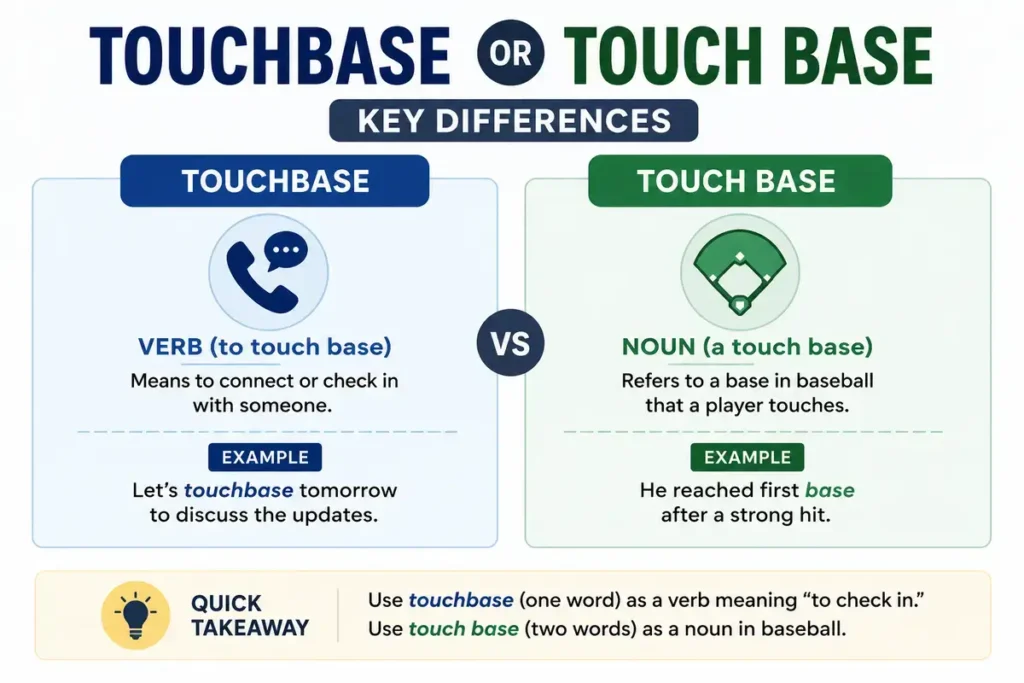
The main difference is grammatical rather than semantic. Touch base is a standard verb phrase. Touchbase is usually a closed spelling that appears in names or as an error.
The expression normally works as a phrasal verb. The verb touch combines with the noun base to create a meaning that is different from simply touching a physical base.
For example:
I need to touch base with Sarah about the schedule.
This does not mean that the speaker physically touches a base. It means the speaker wants to communicate with Sarah.
The key differences are:
- Touch base is the standard written form.
- Touchbase is usually nonstandard when used as an ordinary verb.
- The two forms are pronounced the same in normal speech.
- The phrase is common in business English but also appears in casual communication.
- The expression can sound less direct than alternatives such as contact, call, or discuss.
- A closed spelling may be correct when it is part of an official name.
The phrase also has a subtle tone difference depending on context. I will touch base with you tomorrow sounds familiar and workplace oriented. I will contact you tomorrow sounds more direct and neutral. I’ll discuss the schedule with you tomorrow gives the reader more information about the purpose of the conversation.
Which One Is Correct
Touch base is the correct form for the ordinary expression.
Write it as two separate words when you mean to contact someone, check in, or communicate about a topic.
Correct:
I will touch base with the client tomorrow.
Incorrect in standard usage:
I will touchbase with the client tomorrow.
The reason is grammatical. Touch base functions as a verb phrase rather than as a single standard verb. The verb is touch, while base forms part of the expression.
This is similar to many other English phrases that contain two words but function together as a unit. The fact that people pronounce the expression smoothly does not mean the words should be combined in writing.
There is one important exception. If Touchbase is the official name of a company, product, app, service, or organization, preserve the official spelling. Proper names can use creative forms that ordinary English does not.
Touch Base Formal Usage
Many people searching for this phrase are really asking a second question: Is touch base formal enough for professional writing?
The answer depends on the situation.
Touch base is widely accepted in workplace English. It is not grammatically incorrect or inherently unprofessional. You can use it in a business email, team message, meeting invitation, or professional conversation.
However, it is also a familiar workplace expression that some readers consider business jargon. If you want your message to sound especially precise, choose a verb that tells the reader exactly what you plan to do.
For example:
- I will touch base with you tomorrow.
- I will contact you tomorrow.
- I will follow up with you tomorrow.
- I will discuss the proposal with you tomorrow.
- I will send you an update tomorrow.
The first sentence is perfectly acceptable, but the others may communicate more specific information.
Experienced editors do not automatically remove every familiar business phrase. They consider the audience, purpose, and tone. If the phrase fits the relationship and context, there is no grammatical reason to avoid it. If the message needs precision, a more specific verb may be stronger.
Touchbase or Touch Base Pronunciation Guide
Both spellings are normally pronounced the same way when people say the phrase aloud.
IPA Pronunciation
Touch base
/tʌtʃ beɪs/
Syllable Breakdown
The phrase contains two main spoken words.
Touch
One syllable.
Base
One syllable.
Together:
Touch base
The phrase is usually pronounced naturally without a strong pause between the two words. That smooth pronunciation may explain why some people assume the expression should be written as touchbase.
Common Pronunciation Mistakes
Most speakers pronounce the phrase correctly, but learners sometimes make a few mistakes.
- Pronouncing touch with a long vowel sound instead of the sound in much.
- Pronouncing base like bass in every context. The word base in this phrase rhymes with face.
- Adding an extra syllable between the two words.
- Assuming the spoken rhythm tells you how to spell the phrase.
English contains many expressions that sound like a single unit while remaining separate words in writing. Pronunciation alone cannot always reveal the correct spelling.
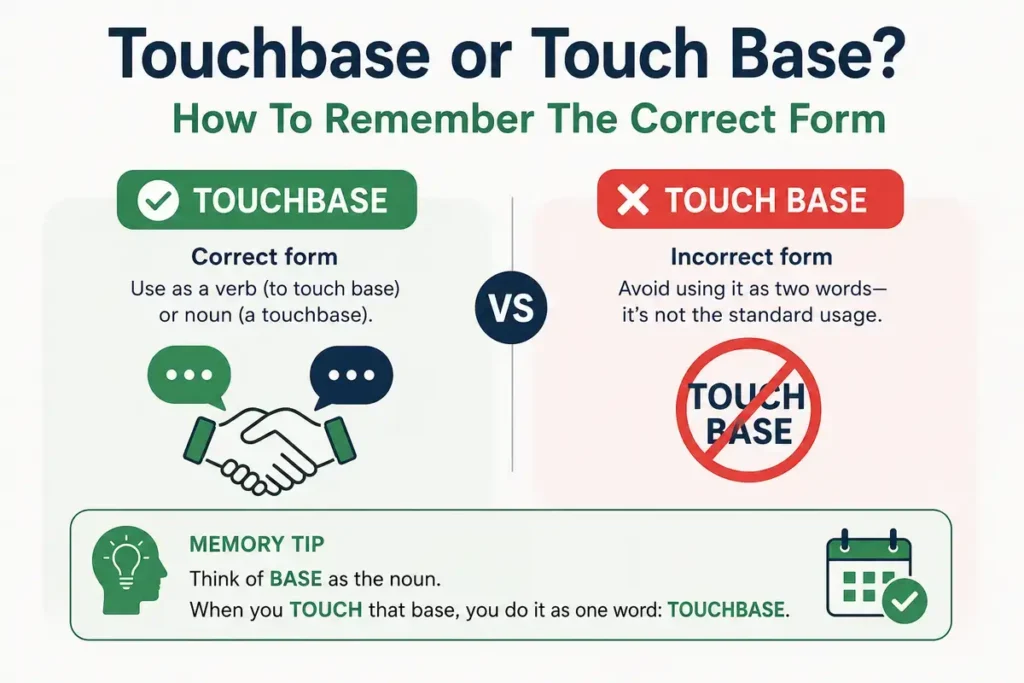
How To Remember The Correct Form
The easiest way to remember the spelling is to think about the phrase as an action involving two parts.
Touch is the action.
Base is the object connected to the expression.
Together they form the verb phrase touch base.
You can also replace the phrase with contact in your mind.
I will touch base with Maria tomorrow.
Becomes:
I will contact Maria tomorrow.
If the phrase is performing the action of contacting someone, write it as touch base.
A second useful test is to look at the word that follows it. The expression commonly appears in structures such as:
- Touch base with someone.
- Touch base about a project.
- Touch base on a question.
- Touch base before a meeting.
- Touch base after the presentation.
These patterns reinforce the fact that the expression functions as a phrase rather than a single standard verb.
You can also remember the contrast through a simple editing rule. Touchbase may be a name. Touch base is the ordinary English expression.
Touch Base Examples In Sentences
The best way to understand this expression is to see how people actually use it. The phrase usually describes a brief conversation or message intended to check progress, share information, or reconnect with someone.
Examples With Touch Base
- I will touch base with the design team after the client meeting.
- Can we touch base tomorrow about the revised schedule?
- I wanted to touch base and see how the project is going.
- Let us touch base next week once you have reviewed the proposal.
- The manager asked me to touch base with the supplier before placing the order.
- I will touch base with you after I hear back from the legal department.
- We should touch base before the presentation so everyone knows their role.
- She reached out to touch base about the changes to the contract.
- I am just touching base to confirm that you received my email.
- The two teams touched base regularly during the product launch.
These examples show the flexibility of the expression. It can introduce a quick check in, a follow up conversation, or a broader discussion. The surrounding words usually reveal the purpose of the contact.
Touchbase and Touch Base Common Mistakes
The most common mistake is combining the two words into one when using the expression as a verb.
Incorrect:
I will touchbase with you later.
Correct:
I will touch base with you later.
This error is understandable because the phrase is often spoken quickly. It also appears frequently in workplace conversations, where familiar expressions can begin to sound like single words.
Mistake One Combining The Words
The standard verb phrase contains two words.
Correct:
We should touch base next week.
Not standard:
We should touchbase next week.
The second version may be understood, but it does not follow the conventional spelling used in professional English.
Mistake Two Adding An Unnecessary Preposition
The usual structure is touch base with someone.
Correct:
I need to touch base with the client.
A common awkward construction is:
I need to touch base to the client.
The preposition with is normally used when identifying the person you want to contact.
Mistake Three Using The Phrase Without A Clear Purpose
The expression is often vague. Saying I will touch base with you tells someone that you plan to communicate, but it does not explain why.
In a casual message, that may be enough. In a professional email, a more useful version might be:
I will touch base with you tomorrow to review the final figures.
Adding the purpose makes the sentence more informative.
Mistake Four Assuming It Always Means A Short Conversation
The phrase often suggests a brief check in, but the actual conversation can become longer. The expression does not guarantee a specific length of time.
Someone might say:
Let us touch base about the project.
The conversation could last five minutes or an hour depending on the situation.
Mistake Five Treating Every Online Spelling As Standard
People encounter unusual spellings on social media, in company names, and in product branding. Repeated exposure can make a nonstandard form look familiar.
That is why context matters. A company called Touchbase may use that spelling intentionally. An ordinary business email should generally use touch base.
Etymology And Word Origin
The expression has a connection to baseball. The original idea involves a player touching a base during a game as part of moving safely around the field.
The exact development of the modern idiom is connected to the idea of returning to or making contact with a base. From there, the expression developed a figurative meaning related to making contact with another person.
The phrase became especially common in American English during the twentieth century. Its use expanded from sports related language into general communication. Today, people use it in offices, schools, sales conversations, customer service, project management, and everyday speech.
The original physical image still helps explain the modern meaning. Someone who says I will touch base with you is signaling a return to a point of contact. The phrase suggests reconnecting, checking progress, or making sure two people are aligned.
This is a common pattern in English. Many everyday expressions began with a literal action and later developed a figurative meaning.
Examples include:
- Get the ball rolling.
- Move the goalposts.
- Hit a roadblock.
- Keep someone in the loop.
- Touch base.
The sports connection is one reason the expression has remained particularly familiar in American business English.
Touch Base Regional Usage
The expression appears across major varieties of English, but its frequency and tone can vary.
American English
The phrase is especially common in American business communication. You may hear it in meetings, sales calls, project discussions, emails, and workplace conversations.
Examples include:
- Let us touch base after lunch.
- I will touch base with the client later today.
- We should touch base before the deadline.
American speakers often use it as a general synonym for check in or follow up.
British English
British speakers understand the expression and use it, especially in business settings. However, some speakers may prefer alternatives such as get in touch, catch up, speak, or follow up depending on the context.
The phrase is not incorrect in British English. Its use may simply feel more associated with international business language for some readers.
Australian English
Australian English also uses the expression in professional communication. The same standard spelling applies.
In informal situations, speakers may choose more conversational alternatives such as catch up or get in touch.
Canadian English
Canadian English uses the phrase in business and workplace settings as well. The Canadian professional communication may reflect both American and British influences, but the spelling remains the same.
Across all four varieties, the key spelling rule does not change. The standard expression is written as two words.
Touch base is just one of many expressions that cause confusion, much like common spelling mix-ups like laser, where one version is correct and the other is a frequent misspelling.
Touch Base Grammar Rules
Understanding the grammar behind the phrase helps prevent awkward sentences.
Part Of Speech
Touch base functions as a verb phrase.
The verb is touch. The word base forms part of the idiomatic expression.
For example:
I will touch base with the team.
The phrase touch base acts as the main verb in the sentence.
Present Tense
Use touch base for current or regular communication.
Examples:
- I touch base with my manager every Friday.
- We touch base before each major presentation.
- She touches base with the research team regularly.
Notice the third person singular form:
She touches base.
The verb touch receives the standard s ending.
Past Tense
The past tense is touched base.
Examples:
- I touched base with the client yesterday.
- We touched base after the conference.
- The teams touched base before the launch.
Only the verb changes. The word base remains unchanged.
Future Tense
Use will touch base or another future construction.
Examples:
- I will touch base with you tomorrow.
- We will touch base after the meeting.
- She is going to touch base with the supplier later.
Present Continuous
You can also use the phrase in the present continuous tense.
Examples:
- I am touching base with the team now.
- She is touching base with the client this afternoon.
- We are touching base with several departments this week.
Common Prepositions
The most common structure is:
Touch base with someone.
Examples:
- Touch base with the manager.
- Touch base with the customer.
- Touch base with your team.
You can also add a topic.
Touch base with someone about something.
Example:
I need to touch base with Alex about the budget.
Another common pattern is:
Touch base on something.
Example:
Let us touch base on the final details tomorrow.
The phrase touch base about is also widely used.
Can You Say Touch Bases
Yes, but only when grammar requires the verb to agree with a singular third person subject.
Correct:
She touches base with the team every Monday.
The word bases is not normally used as a plural noun in the idiom.
Incorrect:
We touch bases every week.
Correct:
We touch base every week.
The difference is important. The verb changes to touches in the third person singular, but the phrase itself does not become touch bases.
Touch Base In Real Life Usage
The expression appears in many areas of communication. Its meaning remains similar, but the tone changes slightly depending on the setting.
Daily Conversation
Friends and family members may use the phrase to mean reconnect or check in.
I will touch base with you later about the weekend plans.
In casual speech, talk, call, or catch up may sound more natural.
Business Communication
This is probably the most common modern context.
A manager might write:
I wanted to touch base about the new project timeline.
A salesperson might say:
I will touch base with the client after the demonstration.
A colleague might send:
Just touching base to see if you need anything from me.
The phrase is useful because it communicates the intention to reconnect without specifying the exact form of communication.
Touch Base Meeting
A touch base meeting is a short meeting intended to exchange updates, discuss progress, or identify issues.
For example:
We have a touch base meeting every Monday morning.
The meeting may be informal or structured. It can involve a manager and employee, a project team, a client, or several departments.
Still, the phrase can be vague. If the meeting has a specific purpose, a more descriptive name may be better.
Instead of:
Weekly Touch Base Meeting
You might write:
- Weekly Project Update.
- Client Progress Review.
- Marketing Planning Meeting.
- Budget Discussion.
- Team Check In.
Clear titles help people understand why they are attending.
Academic Writing
The expression is understood in academic environments, but formal academic writing often benefits from more precise alternatives.
Instead of:
The researchers touched base about the results.
A formal paper might say:
The researchers discussed the results.
Or:
The researchers communicated about the findings.
The phrase is not grammatically wrong in academic writing, but it may sound conversational. The best choice depends on the publication and audience.
Professional Emails
The phrase works well in many business emails.
For example:
I wanted to touch base regarding the updated proposal.
This is polite and familiar. However, if the purpose is clear, a direct sentence may be stronger.
I am writing to confirm the updated proposal.
The second version tells the reader immediately why the message exists.
Media And Popular Culture
The phrase appears in television dialogue, films, podcasts, news discussions, and online content. Its popularity comes partly from its usefulness as a general expression for reconnecting.
Because the phrase is strongly associated with work, some writers use it deliberately to create a corporate or office related tone.
Touch Base Synonyms
The best synonym depends on what you actually mean. No single replacement works perfectly in every sentence.
Contact
Use contact when you simply mean to communicate with someone.
I will contact the supplier tomorrow.
This is direct and neutral.
Check In
Use check in when you want to see how someone or something is progressing.
I will check in with the team tomorrow.
This often sounds more conversational.
Follow Up
Use follow up when you are continuing an earlier conversation or action.
I will follow up with the client after the meeting.
This is often more precise in professional writing.
Speak With
Use speak with when you specifically plan to have a conversation.
I need to speak with the manager about the schedule.
Catch Up
Use catch up when reconnecting with someone or sharing recent news.
Let us catch up next week.
This sounds more informal and personal.
Reach Out
Use reach out when you want to emphasize initiating contact.
I will reach out to the supplier this afternoon.
This phrase is common in business English, although some editors consider it overused.
Discuss
Use discuss when the topic matters more than the act of contacting someone.
We need to discuss the budget before Friday.
This is often the clearest option.
Choosing a synonym based on your exact meaning improves your writing. Instead of automatically using a familiar workplace phrase, ask yourself what action you actually want the reader to understand.
Related Words And Confused Terms
The expression sits within a larger group of words connected to communication, contact, follow up, and collaboration. Understanding these related terms helps you choose the most accurate phrase instead of using the same workplace expression for every situation.
Touch Base And Check In
These phrases are close in meaning, but they are not always identical.
Check in often suggests asking about someone’s progress, condition, or situation.
I will check in with the team tomorrow.
This sentence suggests that the speaker wants an update.
Touch base is broader. It can mean reconnecting, exchanging information, confirming a plan, or discussing an issue.
Touch Base And Follow Up
Follow up usually refers to a later action connected to an earlier conversation, request, or event.
I will follow up with the customer after the demonstration.
This sentence clearly indicates that something happened before.
Touch base does not always require previous contact. You can say:
I wanted to touch base about the new project.
The speaker may be starting a conversation rather than continuing one.
Touch Base And Reach Out
Reach out emphasizes the act of initiating communication.
I will reach out to the supplier this afternoon.
The phrase touch base emphasizes contact or reconnection more generally.
In many business situations, the two expressions can replace each other. However, contact is often the clearest choice when you want simple, direct language.
Touch Base And Catch Up
Catch up usually has a more personal and informal tone.
Let us catch up over coffee next week.
The purpose is often to share news and reconnect.
Touch base can be used in a similar way, but it carries a stronger workplace or professional flavor.
Touch Base And Connect
Connect is another common alternative.
I would like to connect with you about the proposal.
This sounds professional and flexible. It can refer to a phone call, video meeting, email exchange, or in person conversation.
NLP And Semantic Relationships
From a semantic perspective, this expression belongs to a cluster of terms related to communication and coordination.
Important related concepts include:
- Contact.
- Communication.
- Follow up.
- Check in.
- Reconnect.
- Coordinate.
- Discuss.
- Confer.
- Consult.
- Collaborate.
- Update.
- Confirm.
These terms share a broad semantic field, but each carries a slightly different meaning. Strong writing depends on choosing the word that best describes the action you intend.
If you’re interested in confusing word pairs and famous expressions, explore the meaning behind ballot or bullet to understand its historical context and proper usage.
Expert Language Insight
The most important editorial point is simple. Touch base is grammatically correct, but it is not always the strongest phrase.
Experienced editors look beyond correctness. They also consider precision, audience, tone, and purpose.
For example:
I wanted to touch base about the report.
This sentence is perfectly acceptable, but it leaves the purpose somewhat open.
A more specific version might be:
I wanted to discuss the final changes to the report.
Or:
I wanted to confirm the deadline for the report.
The second and third versions give the reader more useful information.
That does not mean you should remove the expression from every email. Language is not a list of banned and approved phrases. If you are writing a quick message to a colleague, I will touch base tomorrow sounds natural. If you are writing a formal proposal, academic paper, or important client communication, a more specific verb may create a stronger impression.
There is also an important difference between formal and professional language. A phrase can be widely accepted in the workplace without being especially formal. This expression falls into that category. It is standard, familiar, and grammatically correct, but it often carries a recognizable business tone.
My practical editing advice is to use the phrase when the idea of reconnecting or checking in is genuinely what you mean. Replace it when a more precise verb would tell the reader exactly what will happen.
Frequently Asked Questions
Is touchbase or touch base correct?
Touch base is the standard form when you mean to contact someone, check in, or communicate about a topic. The phrase is written as two words because it functions as a verb phrase. Touchbase is generally not standard in ordinary writing, although it may be correct as the official name of a company, product, service, or organization.
What does touch base mean in business?
In business communication, touch base usually means to contact someone briefly to exchange information, discuss progress, confirm details, or continue a conversation. For example, I will touch base with the client tomorrow means the speaker plans to communicate with the client tomorrow. The phrase is common in emails, meetings, sales, and project management.
Is touch base formal?
Touch base is acceptable in professional communication, but it is not especially formal. It is a familiar workplace expression that some editors consider business jargon. In formal writing, alternatives such as contact, discuss, follow up, or communicate with may sound more precise. The best choice depends on your audience and the exact meaning you want to express.
What is a good touch base synonym?
Good alternatives include contact, check in, follow up, speak with, connect, reach out, catch up, and discuss. The best synonym depends on the situation. Use follow up for a later action, check in for an update, catch up for informal reconnection, and discuss when the topic itself is the main focus.
How do you use touch base in a sentence?
You can use the phrase as a verb followed by with when identifying the person you want to contact. For example, I will touch base with the manager tomorrow means I will contact the manager tomorrow. You can add a topic with about, on, or regarding, depending on the sentence.
Is touch base one word or two words?
The standard expression is written as two words: touch base. Writing touchbase as one word is generally considered nonstandard when you are using the ordinary verb phrase. A closed form may still be correct if it appears in an official brand name, product name, company name, or other proper name.
What is a touch base meeting?
A touch base meeting is usually a short meeting held to exchange updates, discuss progress, confirm information, or identify issues. The phrase is common in workplaces, but it can be vague. A title such as Weekly Project Update or Client Progress Review may communicate the purpose more clearly.
Is touch base appropriate in an email?
Yes. Touch base is common and acceptable in professional emails. For example, I wanted to touch base about the updated proposal sounds natural. However, a more specific phrase may be stronger when you know exactly what you want to do. I wanted to confirm the updated proposal gives the reader more information and removes unnecessary vagueness.
Conclusion
The correct form is touch base when you are using the expression to mean contact, check in, reconnect, or communicate with someone. The two words should normally remain separate.
Touchbase as one word is generally not the standard spelling of the ordinary expression. It may still appear as a company name, product name, service name, or other official title. In those cases, follow the official spelling of the proper name.
The phrase is common in business English and works well in emails, meetings, workplace conversations, and professional messages. It is grammatically correct and widely understood. Still, it can sometimes sound vague or like familiar office jargon. If you want greater precision, choose a more specific alternative such as contact, follow up, check in, discuss, or speak with.
The strongest practical rule is easy to remember. Write touch base for the ordinary English expression. Use touchbase only when it is an intentional part of an official name. Then choose your wording based on the message you actually want to send.
A clear phrase beats a fashionable phrase every time. If contact, discuss, or follow up says exactly what you mean, use it. If you simply want to reconnect or check in, touch base remains a perfectly natural choice.