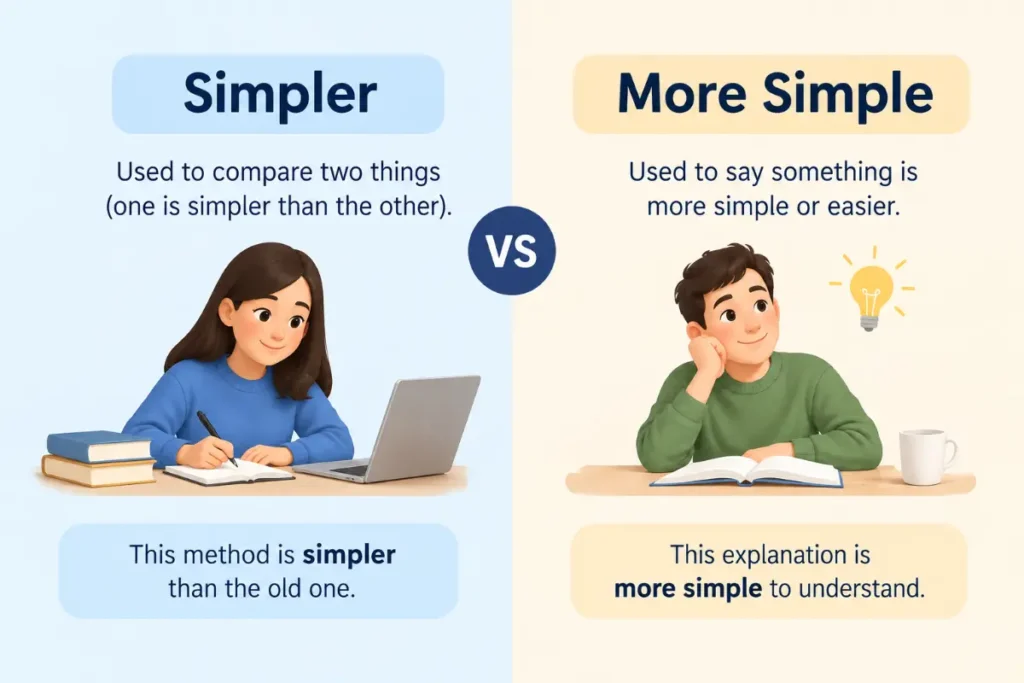
When comparing simpler or more simple, the main question is which form sounds natural and follows standard English grammar. Both forms are grammatically correct, but simpler is usually the more natural and concise choice in American English. You can say, “This explanation is simpler” or “This explanation is more simple,” and both sentences communicate the same basic idea.
The difference comes from how English forms comparative adjectives. Simpler is the comparative form of simple, created by adding the ending -er. More simple uses the word more before the adjective to express the same comparison. Although the two forms can overlap in meaning, they do not always sound equally natural in every sentence.
For everyday conversations, school assignments, workplace emails, and most professional writing, simpler is generally the better option. More simple can still work when a writer wants a particular emphasis or a deliberate contrast. Understanding the grammar behind both forms will help you choose the wording that sounds clear and natural.
Quick Answer
Simpler is usually the preferred choice, but more simple is also grammatically correct. Both mean less complicated or easier to understand. Use simpler for most everyday and professional writing because it is concise and natural. Choose more simple when the sentence benefits from a particular emphasis or contrast.
What Simpler Means
Simpler is the comparative form of the adjective simple. It describes something that has less complexity, fewer complications, or an easier structure than something else. It can also describe an explanation that is easier to understand or a process that requires less effort.
For example, “The new application has a simpler design” means the new design is less complicated than the previous one. The sentence compares two designs, even though the second design is not explicitly mentioned. Readers understand the comparison from context.
You can use simpler when discussing instructions, ideas, plans, technology, writing, daily routines, and many other subjects. The word is common in both spoken and written American English because it expresses a comparison directly without adding unnecessary words.
Simpler in Everyday English
Imagine that a teacher explains a difficult mathematical concept in two different ways. If the second explanation is easier to follow, you can say, “The second explanation is simpler.” The word tells the reader that one explanation requires less effort to understand than the other.
The same principle applies to ordinary situations. A simpler recipe may require fewer ingredients, a simpler schedule may involve fewer activities, and a simpler email may communicate its message more clearly. The exact meaning depends on the noun being described, but the central idea is reduced complexity.
Here are a few examples.
1. This version of the report is simpler than the original.
2. We need a simpler way to organize these files.
3. Her explanation made the science lesson simpler.
4. The new checkout process is simpler for customers.
5. I prefer a simpler approach to solving the problem.
In each sentence, simpler compares one thing with another or suggests a reduction in complexity.
Just as choosing the correct word form matters when deciding whether to use scrapped or scraped, understanding when to use simpler instead of more simple helps make your writing clearer and more natural.
What More Simple Means
More simple uses the adverb more before the adjective simple. This construction also expresses a comparison. It can mean less complicated, easier to understand, or less elaborate, depending on the context.
For example, “The design is more simple than the previous version” communicates that the design has become less complicated. The sentence is grammatically acceptable, although many American English speakers would find “The design is simpler than the previous version” more natural.
The phrase more simple may be useful when a writer wants to emphasize the quality of simplicity or create a deliberate contrast. It can also appear in literary, philosophical, or stylistic writing, where the rhythm and emphasis of a sentence matter.
However, you should not assume that more simple is always the better choice simply because it contains the word more. English often uses established comparative forms such as simpler, faster, smaller, and clearer. In ordinary prose, these forms are generally more concise.
Simpler vs More Simple
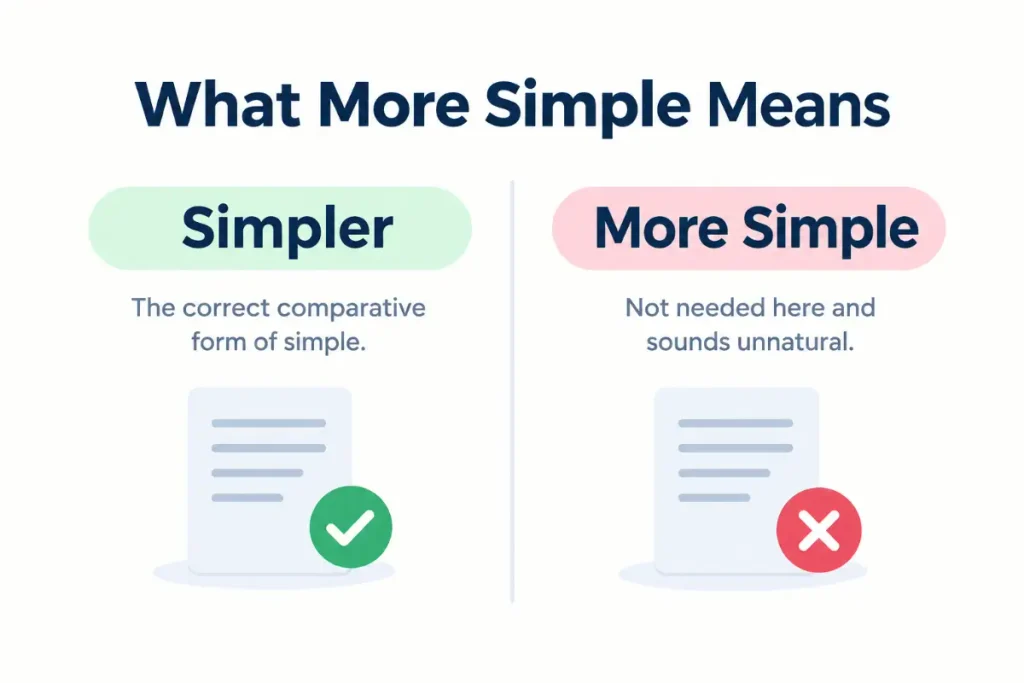
The main difference is not grammatical correctness. It is naturalness, concision, and emphasis.
| Feature | Simpler | More simple |
|---|---|---|
| Grammatical status | Correct | Correct |
| Structure | Simple + -er | More + simple |
| Meaning | Less complicated | Less complicated |
| Typical use | Everyday and professional writing | Special emphasis or stylistic contrast |
| Concision | Shorter | Longer |
| American English preference | Usually preferred | Less common in ordinary comparisons |
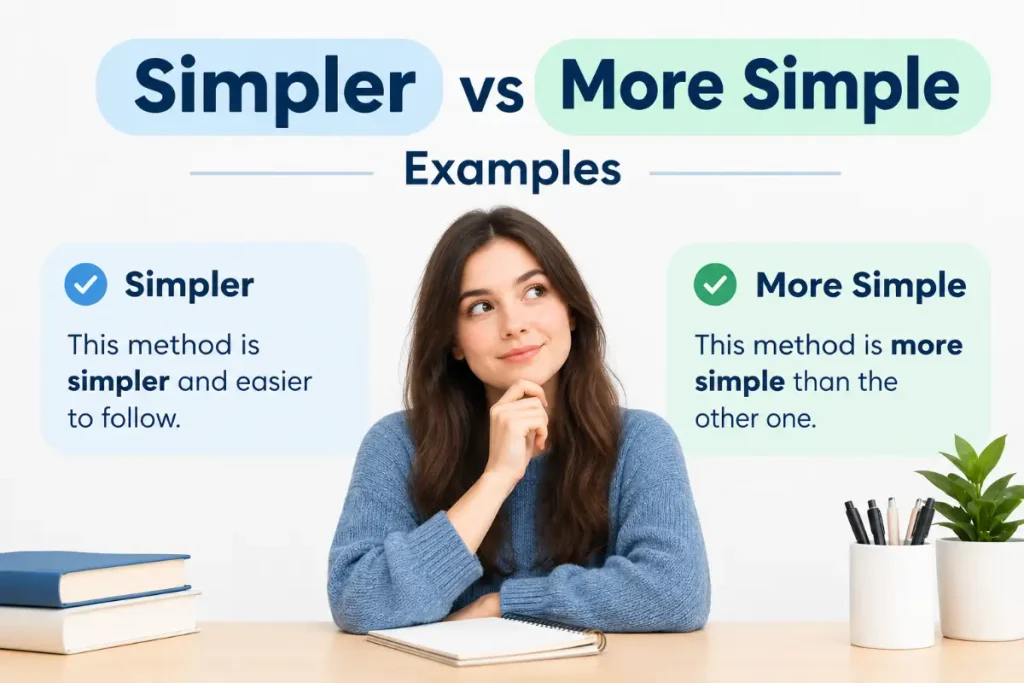
| Example | This method is simpler. | This method is more simple. |
Both forms can communicate the same idea, so the choice rarely changes the basic meaning. In most cases, simpler sounds more direct because English speakers commonly use the -er form with short adjectives such as simple.
Consider these sentences.
“The instructions are simpler now.”
“The instructions are more simple now.”
Both are understandable and grammatically acceptable. The first is generally more natural in everyday American English, while the second may sound slightly more deliberate or less idiomatic to some readers.
Is More Simple Grammatically Correct
Yes, more simple is grammatically correct. It is not automatically an error simply because simpler is more common. English allows some adjectives to form comparisons with -er or with more, and simple is one of the adjectives that can appear in both constructions.
However, grammatical correctness and natural usage are not exactly the same thing. A phrase can follow the rules of English and still sound less natural in a particular sentence. That is why editors often prefer simpler even when more simple is technically acceptable.
For example, “We need a simpler solution” is concise and idiomatic. “We need a more simple solution” is understandable, but it may sound unnecessarily wordy in the same context.
The best rule is straightforward. Use simpler by default, and use more simple when you have a clear reason to prefer that construction. You do not need to avoid the phrase entirely, but you should understand that it is less common as the ordinary comparative form.
Why Simpler Usually Sounds Better
English speakers often prefer shorter comparative forms when they are well established. Adding -er to simple creates a compact word that expresses the comparison without requiring an extra word. That makes simpler easy to read and natural to use in conversation.
Concise wording also helps in professional communication. A sentence such as “We developed a simpler onboarding process” communicates the improvement directly. Writing “We developed a more simple onboarding process” adds a word without making the meaning clearer.
This preference is especially useful in emails, reports, instructions, website copy, and educational material. Readers generally benefit from straightforward comparisons that do not require extra mental effort. Unless the context calls for a particular stylistic effect, simpler is the safer editorial choice.
How Comparative Adjectives Work
Comparative adjectives help you compare two people, objects, ideas, or situations. English forms these comparisons in different ways, depending partly on the adjective’s length and established usage.
Short adjectives often take -er. For example, small becomes smaller, fast becomes faster, and clear becomes clearer. Longer adjectives commonly use more, as in more interesting, more complicated, and more expensive.
Simple can use the comparative ending -er, giving us simpler. It can also appear after more, producing more simple. Because both patterns are possible, the choice involves conventional usage and style rather than a strict rule that makes one form incorrect.
The Role of More
The word more functions as an adverb when it modifies an adjective to express a greater degree of a quality. In “more interesting,” for example, it indicates a greater degree of interest. In “more simple,” it indicates a greater degree of simplicity relative to another thing.
The construction is common with many adjectives, but it is not necessary whenever you want to express a comparison. If an adjective already has a natural and widely used comparative form, that form often makes the sentence more concise.
Compare “This task is easier” with “This task is more easy.” The first is the standard natural choice for most contexts, even though the second can be understood. Simple follows a similar pattern, with simpler usually preferred over more simple.
Learning to avoid common English spelling mistakes can improve your writing, just as knowing when simpler is more natural than more simple helps you communicate more fluently.
Simpler or More Simple Examples
Seeing both forms in different contexts helps you understand how they work. The examples below show why simpler is generally preferred while more simple remains a possible alternative.
Examples Using Simpler
1. The teacher gave us a simpler explanation of the assignment.
2. We need a simpler way to track our monthly expenses.
3. The updated website has a simpler navigation menu.
4. This recipe is simpler than the one I tried last weekend.
5. Her second draft uses simpler language.
6. The new software makes the reporting process simpler.
7. Can you suggest a simpler solution to this problem?
8. The instructions became simpler after we removed unnecessary steps.
9. I want a simpler phone with fewer features.
10. The revised policy is simpler for employees to understand.
These examples demonstrate how simpler works in everyday, academic, and professional settings. It can describe a reduction in complexity, a clearer explanation, or a process that requires less effort.
Examples Using More Simple
1. The design is more simple than the original concept.
2. We wanted a more simple presentation for the meeting.
3. Her writing style became more simple over time.
4. The artist chose a more simple arrangement for the final piece.
5. The second proposal offers a more simple structure.
6. The room would look better with a more simple color scheme.
7. The instructions need a more simple explanation for younger students.
8. He prefers a more simple lifestyle with fewer possessions.
9. The editor requested a more simple introduction to the report.
10. The team discussed using a more simple format for the survey.
These sentences are generally understandable, but many would sound more natural with simpler instead. For example, “The design is simpler than the original concept” is more concise than “The design is more simple than the original concept.”
When to Use Simpler
Use simpler when you want a natural, direct comparison. It is the best default for most American English writing, including casual conversation, schoolwork, professional emails, and published content. The word communicates the idea efficiently without making the sentence feel unnecessarily formal or wordy.
For example, if you are giving feedback on a colleague’s report, you might write, “Could you make the introduction simpler?” This sounds polite and natural. You could also say, “The revised version is simpler and easier to follow.”
Simpler works particularly well when the comparison concerns clarity, organization, effort, or complexity. It is also useful when you want readers to understand the point quickly. In most cases, you do not need to explain why you chose simpler over more simple because the shorter form already fits standard usage.
When More Simple May Work
More simple can work when you want to place extra emphasis on the quality of simplicity or when the rhythm of a sentence makes the longer phrase suitable. Writers may also choose it in contrastive constructions where they want to highlight the degree or nature of a quality.
For example, a writer discussing design philosophy might say, “The goal is not merely to make the product cheaper but to make it more simple in its overall structure.” Even here, simpler would usually be a cleaner choice, but the longer wording may fit a deliberate stylistic approach.
In ordinary communication, avoid choosing more simple just to sound formal. The phrase does not automatically make a sentence more professional, sophisticated, or precise. If both forms work and you have no special reason to use the longer version, simpler is generally the better choice.
Is Simpler a Word
Yes, simpler is a standard English word. It is the comparative form of the adjective simple and is widely used in American English. It does not need a separate definition unrelated to simple because its meaning follows the normal comparative pattern.
For example, “This explanation is simpler than the previous one” means the current explanation is less complicated or easier to understand. The comparison can be explicit, as in this example, or understood from the surrounding conversation.
You may encounter people questioning the word because they assume that simple should always be compared with more. That assumption is incorrect. English regularly forms comparative adjectives with -er, and simpler is the established form for this adjective.
Is It the Simplest or the Most Simple
The simplest is generally the preferred superlative form. It identifies one item as having the least complexity among three or more options. Most American English writers would choose the simplest rather than the most simple in ordinary sentences.
For example, “This is the simplest solution to the problem” means that the solution is less complicated than the alternatives being considered. The phrase most simple can also be grammatically possible, particularly in certain stylistic or emphatic contexts, but it is less common and often sounds unnecessarily wordy.
Compare these examples.
1. This is the simplest explanation in the textbook.
2. She selected the simplest design for the new website.
3. Of the three methods, the simplest requires the least preparation.
In these cases, simplest is natural and concise. When you are comparing several choices, it is usually the clearest form to use.
Simpler vs Simplest
Simpler and simplest serve different grammatical purposes. Simpler is the comparative form, used to compare two things or to describe a change toward less complexity. Simplest is the superlative form, used to identify the least complicated option among a group.
For example, “This version is simpler than the original” compares two versions. “This is the simplest version available” identifies the option with the least complexity among all available versions.
The distinction matters because the words are not interchangeable in every sentence. Use simpler when making a comparison, often with than. Use simplest when identifying the top or bottom end of a quality among a group, often with the.
Is More Simply Grammatically Correct
Yes, more simply is grammatically correct, but it serves a different purpose from more simple. Simply is an adverb, while simple is an adjective. More simply describes how an action is performed or how something is explained, while simpler describes a person, thing, or situation.
Consider these examples.
“The teacher explained the concept more simply.”
“The teacher gave us a simpler explanation.”
In the first sentence, more simply modifies the verb explained. It describes how the teacher performed the action. In the second, simpler modifies the noun explanation and describes the explanation itself.
This distinction is useful in professional and academic writing. If you are describing an action, more simply may be appropriate. If you are describing a noun, simpler is usually the natural comparative form.
Simpler or More Simple in British English
Both simpler and more simple are understandable in British English, just as they are in American English. The basic grammatical distinction does not change between the two varieties. Simpler is generally the more natural and concise comparative form in both.
There is no special British spelling rule that requires more simple instead of simpler. The choice is mainly a matter of grammar, conventional usage, and style rather than regional spelling. Canadian and Australian English follow the same general pattern.
If you are writing for a US audience, choose simpler by default. If you are writing for British readers, simpler is still a safe and natural choice. Use more simple only when it fits the intended emphasis or style.
Common Mistakes to Avoid
One common mistake is assuming that more simple is always incorrect. It is not. The phrase can be grammatically acceptable, although simpler is generally more idiomatic in ordinary writing.
Another mistake is using more simple in every sentence because the writer thinks more automatically makes a comparison clearer. For example, “The new process is more simple and more efficient” would usually read better as “The new process is simpler and more efficient.” The shorter wording improves the sentence without changing the intended meaning.
A third mistake is confusing simpler with more simply. These forms serve different grammatical roles, so you should choose based on what you are describing.
Incorrect: The teacher explained the topic simpler.
Correct: The teacher explained the topic more simply.
The correction works because simply modifies the verb explained. If you want to describe the topic itself, you could write, “The topic is simpler than the one we studied yesterday.”

Formal and Casual Usage
In casual conversation, simpler is the most natural choice for most comparisons. You might tell a friend, “This route is simpler,” or ask a coworker, “Can we use a simpler format?” Both sentences sound direct and conversational.
In professional communication, simpler is also effective because it avoids unnecessary wording. A manager might write, “Please provide a simpler explanation for the client,” while an editor might request, “Use simpler language in the introduction.” These examples are clear without sounding overly formal.
More simple is not prohibited in formal writing, but it can sound awkward when simpler would express the same idea. Formality does not require extra words. The best professional writing is precise, readable, and appropriate for its audience.
Practical Editing Tips
When editing a sentence, first identify what you want to compare. If you mean that something has fewer complications or is easier to understand, simpler is usually the right starting point. Then check if the sentence communicates the comparison clearly.
For example, “We need a more simple process for customer support” can become “We need a simpler customer support process.” The revised sentence is shorter and puts the important idea closer to the noun it describes. It also sounds more natural in an American workplace.
You should not automatically replace every instance of more simple, however. If the phrase appears in dialogue, a quotation supplied by a writer, or a passage where its rhythm matters, the longer form may be worth retaining. In ordinary informational writing, though, simpler is generally the most effective option.
Understanding English word endings, including the correct plural spelling of potatoes, can strengthen your grammar skills and help you make more confident choices between comparative forms such as simpler and more simple.
Frequently Asked Questions
Is simpler or more simple correct
Both forms are grammatically correct, but simpler is usually the preferred choice in American English. It is shorter, more natural, and widely used in everyday and professional writing. More simple can work in particular contexts, but it often sounds wordier without adding meaning.
Does simpler mean more simple
Yes, simpler and more simple generally mean the same thing. Both express a comparison involving reduced complexity or greater ease of understanding. Simpler is the established comparative form that most writers prefer, while more simple is an alternative construction that can sound less natural.
Is more simple grammatically correct
Yes, more simple is grammatically acceptable. However, simpler is usually the more concise and idiomatic choice. If you are writing an email, report, essay, or website page, simpler will generally sound more natural unless you have a specific reason to emphasize the longer form.
When should I use simpler
Use simpler for most everyday and professional comparisons. It works when describing an explanation, design, process, plan, or system that is less complicated than another. For example, “The revised instructions are simpler” is clear and natural. Choose the shorter form unless the sentence calls for a particular stylistic effect.
Is simpler a word
Yes, simpler is a standard comparative adjective formed from simple. It means less complicated or easier to understand than something else. You can use it in sentences such as “This approach is simpler than the previous one” or “We need a simpler way to complete the task.”
Is it the simplest or the most simple
The simplest is generally the preferred form. It identifies the least complicated option among three or more choices. Most writers would say, “This is the simplest solution,” rather than “This is the most simple solution.” The longer alternative may appear in special stylistic contexts, but it is not usually necessary.
Is more simply grammatically correct
Yes, more simply is correct when you need an adverbial comparison. It describes how someone performs an action, as in “She explained the process more simply.” Simpler is an adjective and describes a noun, as in “She provided a simpler explanation.” Choose the form that fits the sentence’s grammar.
Do British English speakers say simpler or more simple
British English speakers use both forms, but simpler is generally the more natural choice. There is no regional rule that requires more simple in British English. American, British, Canadian, and Australian writers can all use simpler as the standard comparative form.
Conclusion
When choosing simpler or more simple, remember that both forms are grammatically acceptable, but simpler is usually the better choice. It is concise, natural, and widely preferred in American English. Use it when comparing explanations, designs, processes, ideas, or anything else that can be less complicated than an alternative.
More simple can work when you want a particular emphasis or stylistic effect, but it often adds an unnecessary word. Also remember that simpler is an adjective, while more simply is an adverbial phrase used to describe how an action happens. For most everyday, academic, and professional writing, simpler will help you express your meaning clearly and naturally.