If you have ever typed partys vs parties into a search engine, you are probably trying to figure out which spelling is correct. It is a common question because many English words ending in y change their spelling when they become plural. Some simply add s, while others replace the y with ies. Unless you know the grammar rule, it is easy to make a mistake.
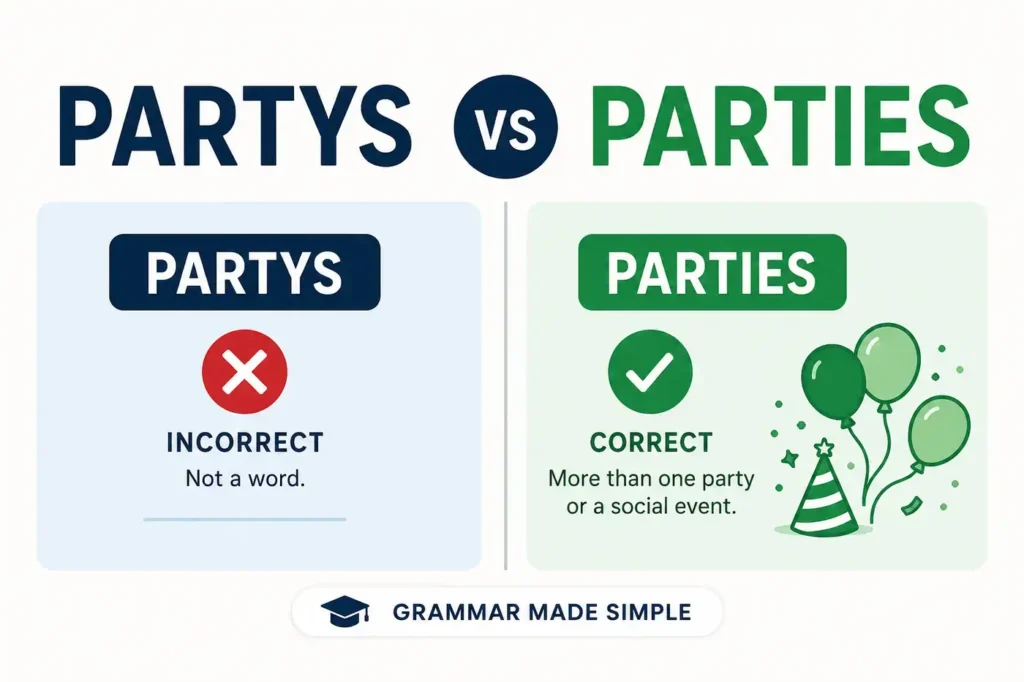
The short answer is simple. Parties is the correct plural form of party, while partys is incorrect in standard English. This rule applies in everyday writing, school assignments, business communication, legal documents, and professional publishing. Once you understand why the spelling changes, you will be able to apply the same rule to hundreds of similar nouns.
In this guide, you will learn the grammar behind the plural form, see plenty of natural examples, understand the difference between parties and party’s, discover common mistakes, and explore how native speakers use these words in real life. By the end, choosing the correct spelling will feel automatic instead of confusing.
Quick Definition
Parties is the correct plural form of the noun party. The spelling partys is not accepted in standard English because nouns ending in a consonant followed by y form their plural by changing y to ies. This grammar rule applies in American English, British English, Australian English, and Canadian English.
Quick Answer
If you only need the answer, here it is.
- Party refers to one celebration, gathering, organization, or group.
- Parties refers to more than one party.
- Partys is an incorrect spelling in standard English.
- Party’s is the possessive form that shows ownership, not the plural.
Here are a few examples.
- We attended three parties last month.
- Several political parties participated in the debate.
- The birthday party’s decorations matched the theme.
- The spelling partys should be avoided in formal and informal writing.
If you’re interested in other commonly confused spellings, our guide on the correct spelling of clutz explains why one version is standard English while the other is not.
Comparison Table
| Feature | Party | Parties | Partys |
|---|---|---|---|
| Part of speech | Noun | Plural noun | Incorrect spelling |
| Meaning | One celebration or group | More than one celebration or group | No accepted meaning |
| Correct form | Yes | Yes | No |
| Grammar | Singular noun | Regular plural noun | Incorrect plural |
| Common contexts | Birthdays meetings politics contracts | Birthdays meetings politics contracts | Grammar mistakes |
| Formality | Standard | Standard | Not accepted |
| Usage frequency | Very common | Very common | Extremely rare and usually an error |
| Example | The party starts at six. | The parties ended late. | Incorrect usage |
Meaning Of Each Word
Although only one spelling is correct as a plural noun, understanding each form helps prevent future mistakes.
Party
A party is a singular noun with several meanings depending on the context. It may describe a social event, a political organization, a group involved in a legal agreement, or a collection of people traveling together.
Common meanings include:
- A birthday celebration.
- A holiday gathering.
- A political organization.
- A legal participant in a contract.
- A travel group.
Examples:
- The birthday party was a huge success.
- Every political party presented its campaign plans.
- Each party signed the agreement.
The word comes from Old French and has been part of English for centuries. Its meaning expanded over time to cover social, political, and legal contexts.
Parties
Parties is the correct plural form of party. It refers to two or more celebrations, organizations, legal participants, or groups.
Examples include:
- We attended several parties during the holiday season.
- The two political parties disagreed on the proposal.
- All parties accepted the terms of the contract.
- Three parties competed for the city council seats.
- Family parties often bring relatives together.
Notice that the meaning changes only in number. The spelling follows a standard English grammar rule.
Partys
You may occasionally see partys online, but it is considered a spelling mistake rather than an accepted English word.
This error usually happens because writers assume every noun becomes plural by adding s. That rule works for many words, but nouns ending with a consonant followed by y follow a different pattern.
Examples include:
- Party becomes parties.
- City becomes cities.
- Country becomes countries.
- Baby becomes babies.
- Lady becomes ladies.
Learning this single grammar rule helps you spell hundreds of English nouns correctly.
Key Differences Between Parties Vs Partys
Many learners compare these spellings because they look similar, but their grammar is very different.
The most important difference is that parties is the correct plural noun, while partys is not recognized in standard English dictionaries or style guides. Another common source of confusion is party’s, which is not plural at all. Instead, it shows possession or ownership.
Here is an easy way to remember the difference.
- Party means one.
- Parties means more than one.
- Party’s shows ownership.
- Partys is incorrect.
Thinking about the purpose of each word before you write makes the correct choice much easier.
Which Form Is Correct
The correct plural form is parties.
English follows a predictable spelling rule for singular nouns ending in a consonant followed by y. Instead of simply adding s, you remove the y and add ies.
For example:
- Party becomes parties.
- Story becomes stories.
- Country becomes countries.
- Library becomes libraries.
- Family becomes families.
This pattern appears throughout English and is taught in schools because it applies to many common nouns.
If a noun ends with a vowel followed by y, the rule changes.
Examples include:
- Toy becomes toys.
- Boy becomes boys.
- Key becomes keys.
- Journey becomes journeys.
Looking at the letter before the y tells you which plural rule to use.
Pronunciation Guide
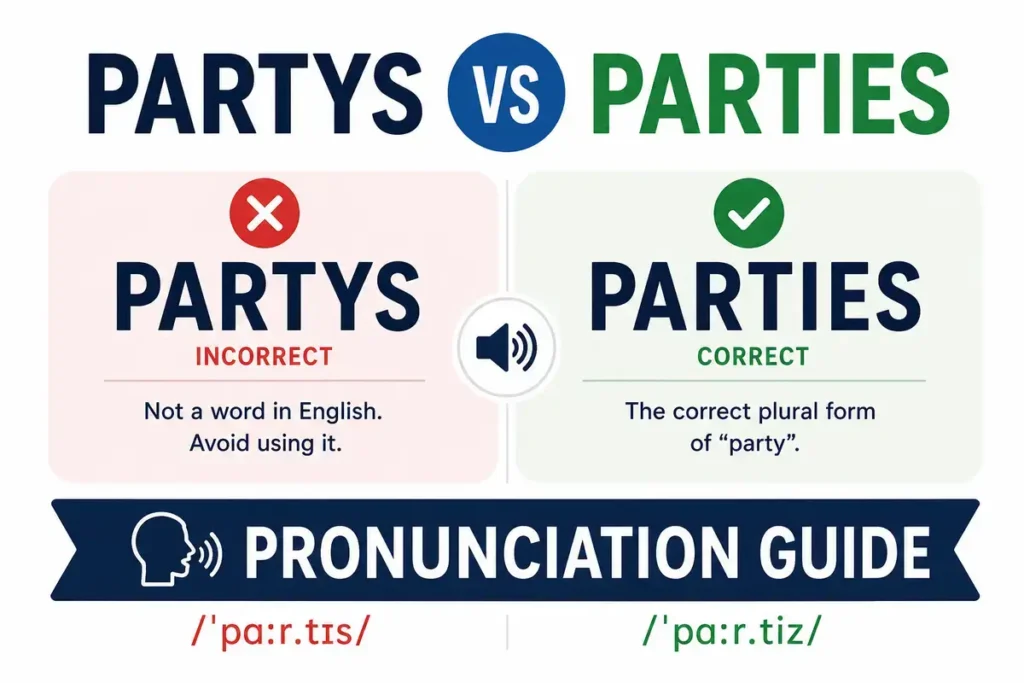
Although the spelling changes, the pronunciation remains straightforward.
Party
IPA pronunciation:
/ˈpɑːrti/
Syllable breakdown:
Par ty
Parties
IPA pronunciation:
/ˈpɑːrtiz/
Syllable breakdown:
Par ties
Most learners pronounce both words correctly without difficulty. The biggest mistake is usually spelling, not pronunciation.
When speaking naturally, native speakers pronounce parties with a clear eez sound at the end.
Examples:
- We went to several parties this summer.
- Both political parties announced new policies.
Listening to native speakers and reading aloud helps reinforce both the pronunciation and the correct spelling.
Expert Grammar Tip
Many spelling mistakes happen because writers try to memorize individual words instead of learning the grammar pattern behind them. Once you understand that nouns ending in a consonant followed by y change to ies in the plural, dozens of words become much easier to spell.
Instead of asking yourself if partys looks right, ask a better question.
What letter comes before the y?
If it is a consonant, replace the y with ies. If it is a vowel, simply add s. This single habit eliminates one of the most common spelling mistakes in English writing.
Examples in Sentences
The easiest way to remember the correct plural is to see it used naturally. The examples below cover everyday conversations, school writing, business communication, and formal contexts. Reading them aloud can also help reinforce the correct spelling pattern.
Examples Using Party
These sentences use the singular noun correctly.
- The birthday party starts at seven this evening.
- Every party needs a good playlist.
- She organized a surprise party for her best friend.
- The political party announced its new leader.
- Each party signed the final agreement.
- Our office plans one holiday party every December.
- The farewell party brought everyone together.
- The wedding party arrived before the guests.
- A retirement party is scheduled for next Friday.
- Every successful party begins with careful planning.
Examples Using Parties
These examples show the correct plural form.
- We attended three parties during the holiday weekend.
- The children enjoyed all the birthday parties this month.
- Several political parties participated in the national debate.
- Both parties agreed to settle the dispute peacefully.
- The neighborhood hosts outdoor parties every summer.
- Our family celebrates with parties for every major milestone.
- Local parties raised money for the community project.
- The travel company arranged welcome parties for visitors.
- Different parties expressed their opinions during the meeting.
- The city approved permits for several street parties.
Examples Using Party’s
Many people confuse party’s with parties, but the two forms have completely different purposes. Party’s is possessive and shows ownership.
Examples include:
- The party’s theme was inspired by the ocean.
- Everyone admired the party’s decorations.
- The party’s organizer welcomed every guest.
- We enjoyed the party’s relaxed atmosphere.
- The party’s success surprised the entire team.
Notice that none of these sentences refer to more than one party. They describe something that belongs to a single party.
Common Mistakes
Most spelling errors happen because writers apply the wrong plural rule or confuse plural nouns with possessive forms. Fortunately, these mistakes are easy to avoid once you understand the grammar.
Here are the errors that appear most often.
Adding Only S
Many learners assume every noun becomes plural by adding s.
Incorrect:
- Partys.
- Citys.
- Babys.
Correct:
- Parties.
- Cities.
- Babies.
Whenever a noun ends with a consonant followed by y, replace the y with ies.
Confusing Plural And Possessive Forms
Another common mistake is using an apostrophe to create a plural.
Incorrect:
- Birthday party’s.
- Political party’s.
- Holiday party’s.
Correct:
- Birthday parties.
- Political parties.
- Holiday parties.
Remember this simple rule.
- Parties means more than one.
- Party’s shows ownership.
- Partys is not a correct English spelling.
Using The Wrong Form In Legal Writing
Legal documents often mention multiple people or organizations involved in an agreement.
Correct examples include:
- Both parties signed the contract.
- The parties accepted the settlement.
- The agreement protects all parties.
Using partys in legal writing would be considered a spelling error.
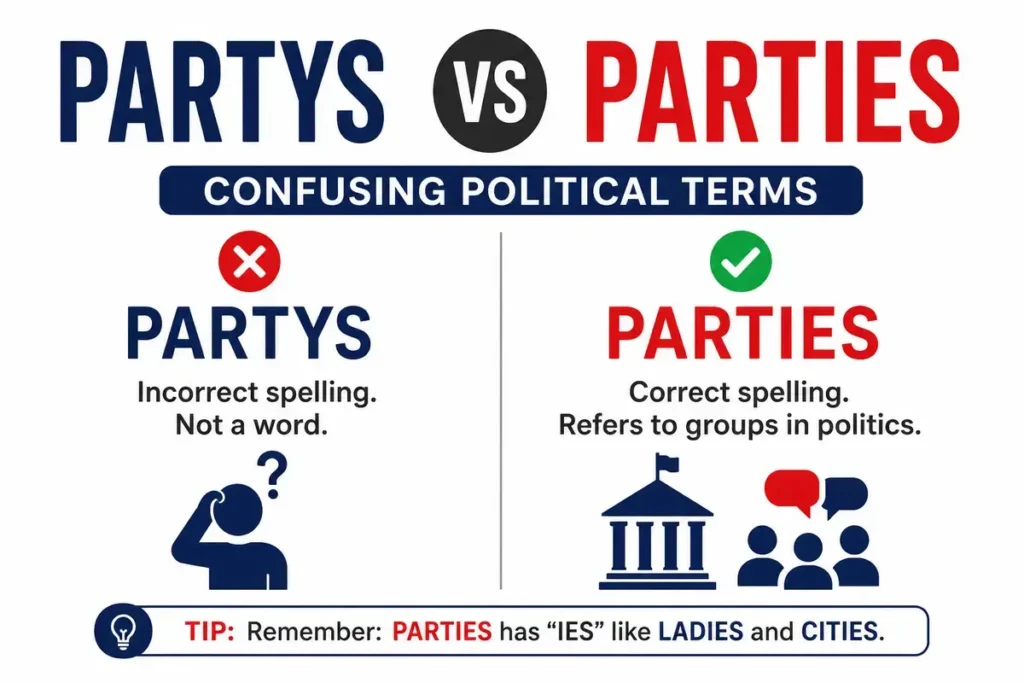
Confusing Political Terms
The same grammar rule applies when discussing politics.
Correct:
- Political parties.
- Major parties.
- Opposition parties.
Incorrect:
- Political partys.
Because this phrase appears frequently in news articles and textbooks, learning the correct spelling is especially important.
Etymology And Word Origin
The word party has a long history that stretches back hundreds of years.
It entered English through Old French, where it described a division, group, or side. The word originally referred to people separated into different groups before gradually expanding to include celebrations, organizations, and legal participants.
As English spelling became more standardized, nouns ending in a consonant followed by y adopted the familiar ies plural pattern. That is why party became parties, just as city became cities and country became countries.
Although the meanings of party have expanded over time, the plural spelling rule has remained consistent across modern English.
Writers who often mix up similar-looking words may also find it helpful to learn when to use planning correctly, another spelling pair that causes frequent mistakes.
Regional Usage
One reason this grammar rule is easy to learn is that it does not change from one English speaking country to another.
American English
American English always uses parties as the plural form. You’ll find it in schools, newspapers, business documents, government publications, and everyday communication.
British English
British English follows exactly the same grammar rule. Writers use parties in both formal and informal contexts, including political reporting and legal writing.
Australian English
Australian English also follows the standard plural rule. The spelling remains parties in education, journalism, and professional communication.
Canadian English
Canadian English uses parties as well. Although Canadian spelling sometimes blends American and British conventions, the plural form of party is identical in both systems.
Unlike words such as color and colour, there is no regional variation here. Every major English style guide recognizes parties as the only correct plural spelling.
Grammar Rules
Understanding the grammar behind this spelling makes it much easier to remember.
Rule For Plural Nouns Ending In Y
When a singular noun ends with a consonant followed by y, remove the y and add ies.
Examples include:
- Party becomes parties.
- Baby becomes babies.
- City becomes cities.
- Family becomes families.
- Country becomes countries.
- Lady becomes ladies.
This is one of the most reliable spelling rules in English.
Rule For Nouns Ending With A Vowel And Y
If the letter before the y is a vowel, simply add s.
Examples include:
- Toy becomes toys.
- Boy becomes boys.
- Key becomes keys.
- Journey becomes journeys.
- Monkey becomes monkeys.
Looking at the letter before the y helps you choose the correct plural almost instantly.
Understanding Party’s
The apostrophe changes the meaning completely.
Party’s is the singular possessive form.
Examples:
- The party’s music kept everyone dancing.
- The party’s host greeted every guest.
- The party’s budget stayed within the limit.
In each sentence, something belongs to one party.
Understanding Parties’
The apostrophe after parties creates the plural possessive form.
Examples:
- The parties’ lawyers finalized the agreement.
- The parties’ representatives met again.
- The parties’ responsibilities were clearly explained.
This form shows ownership by more than one party.
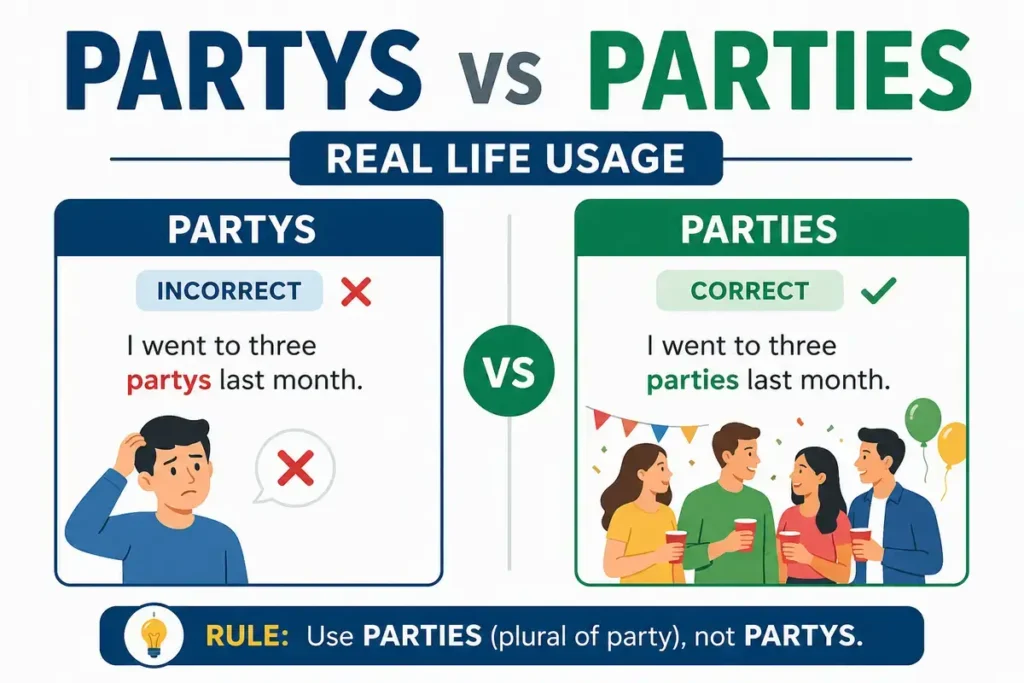
Real Life Usage
The word appears in many situations beyond birthday celebrations. Understanding the context helps you choose the correct form naturally.
Daily Conversation
People commonly use party and parties when talking about celebrations.
Examples include:
- Birthday parties.
- Graduation parties.
- Holiday parties.
- Retirement parties.
- Anniversary parties.
Academic Writing
Students use the word in essays, reports, and research papers.
Examples include:
- Political parties.
- Historical parties.
- Social gatherings.
- Cultural celebrations.
Using the correct plural form improves clarity and demonstrates good grammar.
Professional Communication
Businesses frequently use the word in emails, invitations, and reports.
Examples include:
- Company parties.
- Client parties.
- Networking parties.
- Office parties.
Legal Documents
Legal professionals use parties almost every day because contracts usually involve more than one participant.
Common phrases include:
- The parties agree to the following terms.
- Both parties signed the contract.
- The parties resolved the dispute through mediation.
News And Media
Journalists regularly write about:
- Political parties.
- Election campaigns.
- International parties to an agreement.
- Community parties and public celebrations.
Across every context, the spelling rule remains exactly the same. Once you learn it, you can apply it confidently in almost any type of writing.
Curious about informal English spellings? Explore which blanket nickname is correct to see why one affectionate term is preferred over the other.
Related Words And Commonly Confused Terms
Once you understand why parties is correct, it becomes much easier to spell other nouns that follow the same grammar pattern. English has hundreds of words that change from y to ies when they become plural.
Here are some common examples.
- Baby becomes babies.
- City becomes cities.
- Country becomes countries.
- Family becomes families.
- Lady becomes ladies.
- Story becomes stories.
- Library becomes libraries.
- Company becomes companies.
- Penny becomes pennies.
- Cherry becomes cherries.
These words all follow the same spelling rule because each ends with a consonant followed by y.
You may also come across related forms that serve different grammatical purposes.
- Party refers to one celebration, organization, or participant.
- Parties refers to more than one.
- Party’s shows that something belongs to one party.
- Parties’ shows that something belongs to multiple parties.
Knowing the difference between these four forms will help you avoid many common writing mistakes.
Expert Language Insight
Professional editors rarely stop to think about the plural of party because the spelling follows one of English’s most dependable grammar rules. Instead of memorizing individual words, experienced writers recognize the pattern and apply it automatically.
When editing documents, I often notice that mistakes happen because writers confuse plural nouns with possessive forms. They know an apostrophe exists somewhere, but they are unsure where it belongs. The easiest way to solve this problem is to decide what you want the word to do before you write it.
Ask yourself these questions.
- Am I talking about one party or several?
- Am I showing ownership?
- Am I simply making the noun plural?
If you are talking about more than one celebration, political organization, or legal participant, parties is almost always the correct choice. Use party’s if something belongs to one party . If something belongs to multiple parties, use parties’.
This simple thought process removes the guesswork and helps you write with confidence.
Frequently Asked Questions
Is partys ever correct?
No. Partys is not an accepted English spelling. Standard dictionaries, grammar guides, and style manuals recognize parties as the correct plural form of party.
Why does party become parties?
The word party ends with a consonant followed by y. English grammar says you should remove the y and add ies to form the plural. This same rule applies to many other common nouns.
What is the difference between parties and party’s?
Parties is the plural form, meaning more than one party. Party’s is the singular possessive form, showing that something belongs to one party. Although they look similar, they have completely different grammatical functions.
Is birthday parties correct?
Yes. Birthday parties is the correct phrase because it refers to more than one celebration. If you are talking about something that belongs to one birthday party, write the birthday party’s decorations or the birthday party’s theme.
Is political parties correct?
Yes. Political parties is the correct plural form and is widely used in news articles, textbooks, government publications, and academic writing. The spelling political partys is incorrect.
Which form is used in legal documents?
Legal writing almost always uses parties when referring to the people or organizations involved in an agreement. When showing ownership, lawyers use party’s for one participant and parties’ for multiple participants.
Is the spelling different in British and American English?
No. American English, British English, Australian English, and Canadian English all follow the same grammar rule. Every major variety of English uses parties as the correct plural spelling.
How can I remember the rule?
Look at the letter before the y. If it is a consonant, replace the y with ies to make the word plural. If it is a vowel, simply add s. Practicing this rule with several common nouns helps it become second nature.
Conclusion
Choosing between partys vs parties is much easier once you understand the grammar rule. Parties is the correct plural form because party ends with a consonant followed by y. In English, nouns that follow this pattern form their plural by replacing y with ies. That is why partys is considered a spelling mistake in standard English.
It is also important to distinguish plural nouns from possessive forms. Party’s shows ownership by one party, while parties’ shows ownership by multiple parties. Keeping these forms separate will make your writing clearer and more accurate.
Whenever you are unsure, remember one simple rule. Check the letter before the y. If it is a consonant, change y to ies. If it is a vowel, add s. This single rule works for hundreds of English words and will help you avoid one of the most common spelling mistakes in everyday writing.