Have you ever typed ninth vs nineth into a search engine because you were unsure which spelling was correct? You are not alone. This is one of the most common spelling questions in English, especially for students, writers, and anyone learning ordinal numbers. At first glance, nineth looks logical because words like five become fifth and nine ends with the letter e. That makes it easy to assume the extra e should stay in place.
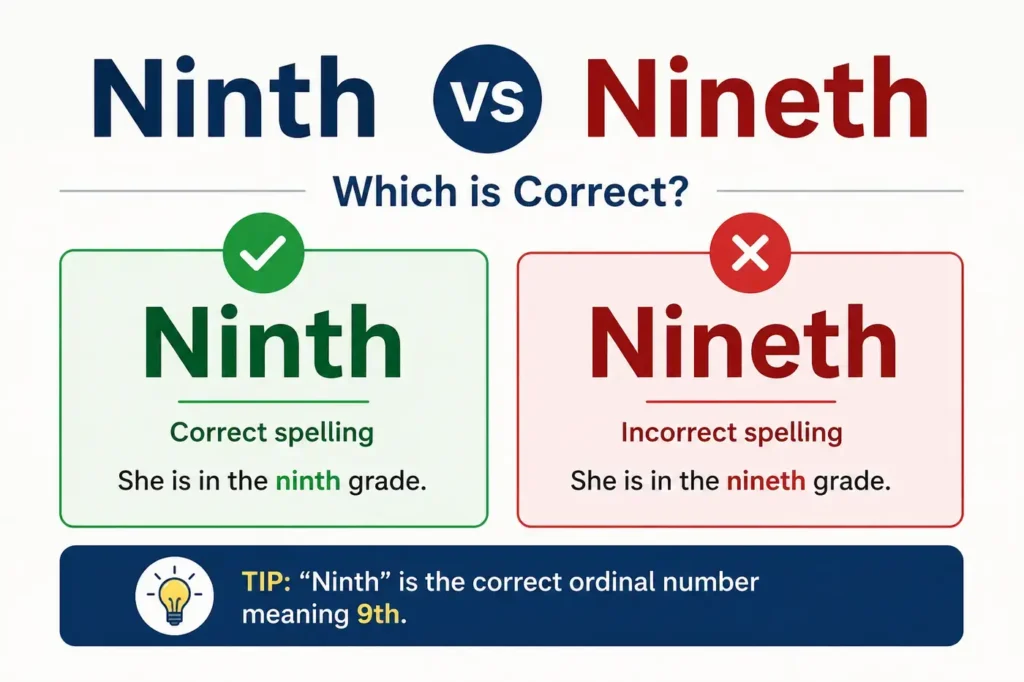
The correct spelling is ninth. The word nineth is a common misspelling and is not accepted in standard English. Dictionaries, style guides, teachers, editors, and professional writers all recognize ninth as the correct ordinal form of nine.
In this guide, you will learn why the spelling changes, how the word developed over time, how to pronounce it correctly, and where people often make mistakes. You will also see plenty of natural examples, practical writing tips, and expert explanations that make the rule easy to remember. By the end, you will know exactly why ninth is correct and feel confident using it in everyday writing.
Quick Definition
Ninth is the correct ordinal form of the number nine and means something in position number nine. Nineth is an incorrect spelling that appears because many people assume the base word nine should keep its final letter e. Standard English removes that letter before adding the ending th.
Quick Answer
If you only need a quick answer, remember this simple rule.
- Ninth is the correct spelling.
- Nineth is a spelling mistake.
- Use ninth in school assignments, business writing, professional communication, and everyday English.
- The rule is the same in American English, British English, Canadian English, and Australian English.
Whenever you write about the number that comes after eighth and before tenth, ninth is the only correct choice.
Comparison Table
| Feature | Ninth | Nineth |
|---|---|---|
| Part of speech | Ordinal adjective Noun | Misspelling |
| Meaning | Position number nine | No accepted meaning |
| Correct form | Yes | No |
| Dictionary status | Accepted by major dictionaries | Not recognized as a standard word |
| Formality | Standard in all writing | Incorrect in formal and informal writing |
| Common contexts | Mathematics education dates rankings competitions | Typing mistakes spelling errors |
| Usage frequency | Extremely common | Very rare except as an error |
| Example | She finished in ninth place. | Incorrect spelling |
Meaning And Usage
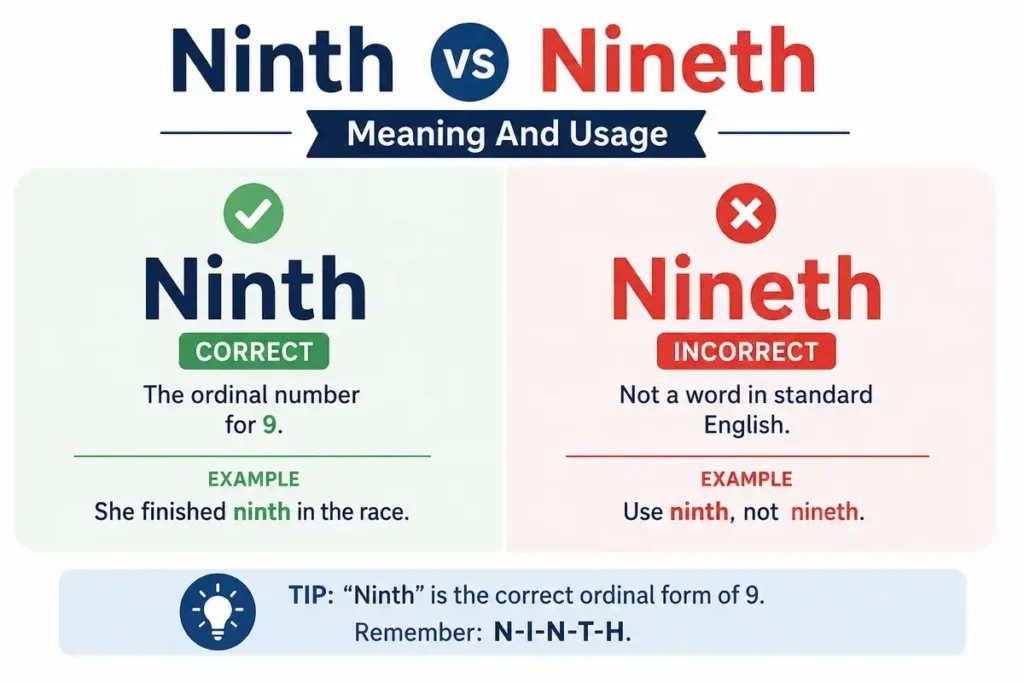
Understanding the meaning of ninth is simple because it follows the same pattern as other ordinal numbers like first, second, third, and tenth. It describes the position of something in a sequence rather than the quantity itself.
For example, the number nine tells you how many items there are. The word ninth tells you the position of one item within that group.
Here are a few examples.
- She celebrated her ninth birthday.
- He finished ninth in the race.
- Today is the ninth day of the month.
- Their team reached the ninth round of the competition.
- We sat in the ninth row at the concert.
The word nineth does not have an accepted meaning because it is not part of standard English. When it appears in writing, it is almost always the result of a spelling mistake rather than a different word with its own definition.
If you also get confused about the correct plural form of common words, our guide on the plural of party explains why one spelling is correct and the other isn’t.
Why Do People Write Nineth Instead Of Ninth
Many spelling mistakes happen because English is full of patterns that seem logical but do not always follow the same rules. This is one of those cases.
People often look at the word nine and assume they should simply add th to create the ordinal form. That produces nineth, which looks reasonable but is not correct.
The confusion becomes even stronger when you compare it with other ordinal numbers.
- Five becomes fifth.
- Twelve becomes twelfth.
- Eight becomes eighth.
Because these words change slightly before adding th, learners expect nine to follow a similar pattern. Instead, English drops the final e, producing ninth.
This spelling has been part of standard English for centuries, so it is not a modern preference or an editorial style choice. It is simply the established form of the word.
Which Spelling Is Correct
The answer is clear. Ninth is the only correct spelling in modern English.
Every major dictionary, educational institution, grammar guide, and professional publisher uses ninth. You will see it in books, newspapers, academic papers, business documents, government publications, and everyday communication.
If you accidentally write nineth, most spelling checkers will immediately suggest changing it to ninth because the incorrect version is not recognized as a standard English word.
To remember the correct spelling, keep these points in mind.
- Start with the word nine.
- Remove the final e.
- Add th.
- The final result is ninth.
Following this simple pattern will help you avoid one of the most common spelling mistakes involving ordinal numbers.
Pronunciation Guide
Although many people misspell the word, its pronunciation is usually easier than its spelling.
IPA Pronunciation
/naɪnθ/
Syllable Breakdown
Ninth
One syllable.
The letters th create the same sound found in words like think rather than the sound heard in this.
Common Pronunciation Mistakes
Some learners pronounce the word as two separate syllables because they focus on its spelling instead of its sound. Others soften or skip the th sound at the end.
Here are a few tips that make pronunciation easier.
- Say nine first.
- Add a clear th sound without adding another vowel.
- Keep the word to one syllable.
- Practice slowly before saying it at normal speed.
Listening to native speakers and repeating the word aloud can also help build confidence.
Why Ninth Looks Different From Nine
Many English spelling rules developed over hundreds of years, and ordinal numbers are no exception. While some words simply add a suffix, others change slightly to make pronunciation smoother and writing more consistent.
The word nine belongs to the second group. Before adding th, the final e disappears, creating ninth instead of nineth.
English has several similar changes.
- Five becomes fifth.
- Twelve becomes twelfth.
- Twenty becomes twentieth.
Notice that the spelling changes before the ending is added. These changes may seem unusual at first, but they follow long established patterns that native speakers learn naturally through reading and writing.
Expert Writing Insight
Experienced editors rarely think about ninth because the spelling has become automatic through years of reading. The mistake nineth usually appears when someone writes quickly or relies on sound instead of spelling.
One habit that professional writers use is connecting ordinal numbers with their written forms instead of spelling them from memory. The more often you read words like ninth, eighth, twelfth, and fortieth, the easier they become to recognize instantly.
Instead of memorizing isolated spelling rules, expose yourself to well edited books, newspapers, and trusted websites. Over time, the correct forms become familiar, making common mistakes much less likely.
Examples In Sentences
Reading natural examples is one of the fastest ways to remember the correct spelling. Notice how ninth fits naturally into different types of sentences. Then compare those examples with the incorrect spelling to understand why editors always replace it.
Correct Examples Using Ninth
The word ninth refers to something in position number nine.
- She celebrated her ninth birthday with a picnic in the park.
- Our team finished ninth in the state tournament.
- The meeting is scheduled for the ninth of October.
- He lives on the ninth floor of the apartment building.
- The author published her ninth novel last year.
- We stopped at the ninth exit on the highway.
- My daughter is in the ninth grade this year.
- The runner crossed the finish line in ninth place.
- Today marks the ninth anniversary of the company.
- The recipe appears on the ninth page of the cookbook.
Each example sounds natural because ninth is the accepted ordinal form of nine.
Incorrect Examples Using Nineth
The following examples show a common spelling mistake. These sentences are included only to help you recognize and avoid the error.
- She celebrated her nineth birthday.
- He finished in nineth place.
- Today is the nineth of May.
- They reached the nineth level.
- Our office is on the nineth floor.
- She won the nineth round.
- The book begins in the nineth chapter.
- My son started nineth grade this fall.
- We visited on the nineth day of the trip.
- The team earned nineth position.
Every sentence above becomes correct by replacing nineth with ninth.
Common Mistakes
Most people do not write nineth because they do not know English. They write it because English spelling often follows historical patterns instead of perfectly logical ones.
This is another example of a common spelling mix-up, much like deciding whether clutz or klutz is the correct form.
Here are the mistakes editors see most often.
Keeping The Final Letter E
Many writers start with nine, add th, and end up with nineth.
The correct process is different.
- Remove the final e.
- Add th.
- Write ninth.
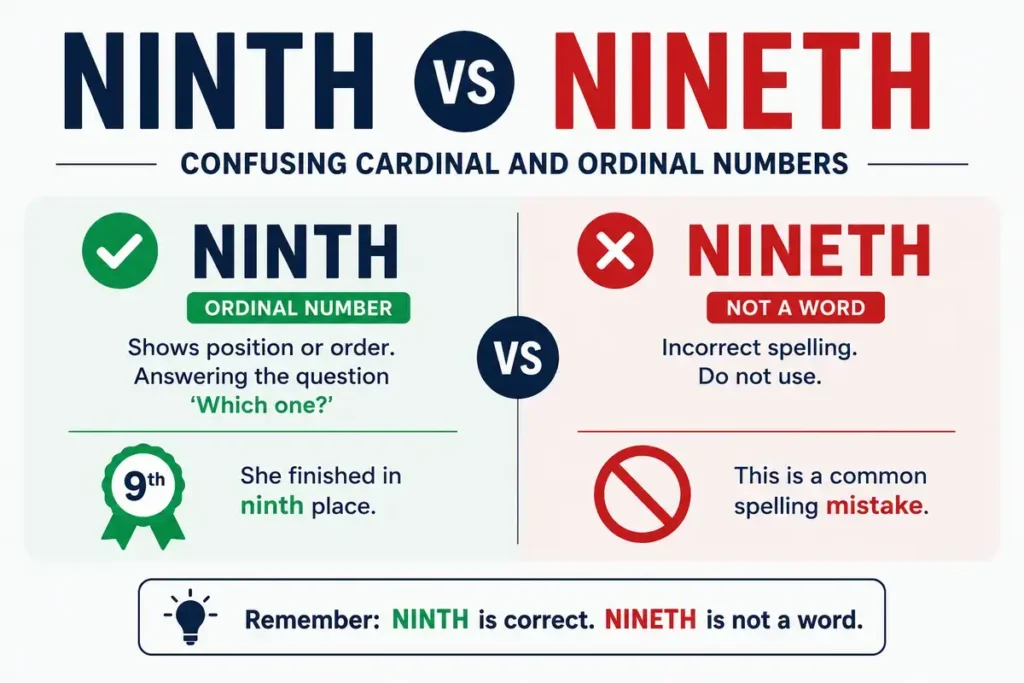
Confusing Cardinal And Ordinal Numbers
Remember the difference between the two forms.
- Nine tells how many.
- Ninth tells the position in a sequence.
For example:
- There are nine students in the class.
- Emma sits in the ninth seat.
Although the words are closely related, they serve different purposes.
Relying Only On Pronunciation
The pronunciation does not clearly reveal the spelling. Many learners hear the word and naturally assume the letter e should remain because the base word is nine.
This is one reason spelling mistakes continue to appear online.
Copying Misspelled Content Ninth Vs Nineth
The internet contains both accurate and inaccurate information. If a misspelled word appears on social media, forums, or user generated websites, people sometimes repeat it without checking a reliable dictionary.
When writing school assignments, articles, or professional documents, always verify spellings with trusted language references.
Word Origin And History
Understanding the history of ninth helps explain why the spelling looks different from the base word.
The word comes from Old English, where ordinal numbers developed alongside cardinal numbers but often followed their own spelling patterns. Over time, pronunciation changed, written forms became standardized, and many spellings were simplified.
Rather than keeping the final e from nine, English gradually settled on ninth. By the time dictionaries and grammar books established consistent spelling rules, ninth had already become the accepted form.
This is not unusual in English. Several common words change spelling when suffixes are added.
Examples include:
- Five becomes fifth.
- Twelve becomes twelfth.
- Twenty becomes twentieth.
- Forty drops the letter u found in four.
These changes reflect the historical development of English instead of modern spelling logic.
Regional Usage
Many English words have different spellings in different countries. Words like color and colour are good examples. Some learners wonder if ninth and nineth follow the same pattern.
They do not.
American English
American English uses ninth in every context. Dictionaries, schools, universities, publishers, and businesses all recognize it as the correct spelling.
British English
British English follows the same rule. You’ll find ninth in newspapers, books, government publications, and educational materials throughout the United Kingdom.
Australian English
Australian English also uses ninth. The spelling does not change across formal or informal writing.
Canadian English
The Canadian English follows the standard form as well. Canadian dictionaries and educational resources recognize ninth as the only correct spelling.
No major variety of modern English accepts nineth as the standard spelling.
Grammar Rules
Ordinal numbers describe order or position rather than quantity. They answer questions such as Which one or What position.
Part Of Speech
The word ninth most often functions as an adjective because it modifies a noun.
Examples include:
- The ninth chapter.
- The ninth player.
- The ninth attempt.
It can also function as a noun in certain contexts.
Examples include:
- She finished in the ninth.
- A ninth of the class participated.
Although this use is less common, it is grammatically correct.
Dates
Ordinal numbers frequently appear in dates.
Examples include:
- The meeting is on the ninth of July.
- His birthday falls on the ninth every year.
Fractions
The word also appears in fractions.
Examples include:
- One ninth of the cake remained.
- Three ninths equal one third after simplification.
Larger Ordinal Numbers
The same spelling pattern appears in compound ordinal numbers.
Examples include:
- Twenty ninth.
- Thirty ninth.
- Forty ninth.
- Ninety ninth.
Notice that every one of these compound forms keeps ninth rather than nineth.
Real Life Usage
Ordinal numbers appear far beyond classrooms. Once you start noticing them, you will find them almost everywhere.
Daily Conversation
People regularly use ninth when talking about birthdays, anniversaries, addresses, school grades, and dates.
Examples include:
- My office is on the ninth floor.
- She finished ninth in the race.
- Our vacation starts on the ninth.
Academic Writing
Schools use ordinal numbers in textbooks, assignments, examinations, and research papers.
Students encounter ninth in mathematics, history, literature, geography, and science.
Professional Communication
Businesses often use ordinal numbers when organizing reports, meetings, presentations, and schedules.
Examples include:
- The ninth item on today’s agenda.
- The ninth quarterly report.
- The ninth customer survey.
Literature And Media
Authors and journalists use ordinal numbers to describe chapters, historical events, rankings, competitions, and timelines.
Because ninth is the standard spelling, readers rarely stop to think about it. It blends naturally into everyday English, while nineth immediately stands out as an error.
Related Words And Commonly Confused Terms
Learning related words makes it easier to remember the correct spelling and recognize similar patterns. Many ordinal numbers change slightly from their cardinal forms, so they deserve a closer look.
Here are some words that people commonly compare with ninth.
| Cardinal Number | Correct Ordinal Form |
|---|---|
| One | First |
| Two | Second |
| Three | Third |
| Five | Fifth |
| Eight | Eighth |
| Nine | Ninth |
| Twelve | Twelfth |
| Twenty | Twentieth |
| Twenty nine | Twenty ninth |
| Ninety nine | Ninety ninth |
Notice that several ordinal numbers do not simply add th. English changes the spelling of some words before adding the ending, which is why memorizing patterns works better than guessing.
You may also come across these related language terms.
- Cardinal number.
- Ordinal number.
- Sequence.
- Position.
- Numerical order.
- Ranking.
- Spelling rule.
- Suffix.
- Word formation.
- English morphology.
Understanding these ideas helps explain why English sometimes changes a word’s spelling instead of simply adding a suffix.
Expert Language Insight
One question editors hear surprisingly often is, If the word is nine, why is the ordinal form ninth instead of nineth?
The answer lies in the history of English rather than modern spelling rules. English has never been a perfectly predictable language. Many common words developed through centuries of pronunciation changes, regional influences, and spelling standardization. As a result, several ordinal numbers changed their written forms instead of keeping the exact spelling of the original number.
Professional editors rarely think about this rule because they recognize ninth instantly. Years of reading books, newspapers, and well edited publications make the correct spelling feel natural. The incorrect form usually appears when someone writes the word from memory instead of recognizing it as a familiar vocabulary word.
If you want to improve your spelling, spend more time reading high quality English. Frequent exposure to correctly written text trains your brain to recognize standard spellings without consciously applying grammar rules every time you write.
Similar spelling rules apply when doubling the final letter, which is why many writers wonder whether planing or planning is correct.
Frequently Asked Questions
Is ninth or nineth correct?
Ninth is the correct spelling in standard English. Nineth is a common misspelling that appears because people expect the word nine to keep its final letter e. Every major dictionary and style guide recognizes ninth as the accepted form.
Why is it ninth and not nineth?
English drops the final e from nine before adding th. This follows a historical spelling pattern that has existed for centuries. Although nineth may seem logical, it has never become part of standard English.
What does ninth mean?
Ninth describes something in position number nine within a sequence. It can refer to dates, birthdays, floors, grades, rankings, chapters, anniversaries, and many other ordered lists.
How do you pronounce ninth?
The IPA pronunciation is /naɪnθ/. It has one syllable and ends with the same th sound heard in the word think. Native speakers pronounce it smoothly without adding an extra vowel.
Is nineth used in British English?
No. British English uses ninth, just like American English, Canadian English, Australian English, and other major varieties of English. Nineth is considered a spelling error across all standard forms of the language.
How do you write the ordinal form of 9?
The numeral is written as 9th, while the word form is ninth. Both represent the same ordinal number and are used depending on the style of writing.
Is twenty ninth correct?
Yes. The correct written form is twenty ninth. Since the second word is ninth, every larger ordinal number built from it follows the same spelling pattern.
Examples include:
- Twenty ninth.
- Thirty ninth.
- Fifty ninth.
- Ninety ninth.
Why do so many people spell it nineth?
Most people write nineth because they assume the spelling should match the base word nine. English spelling does not always follow simple patterns, so mistakes like this are common. Reading well edited content and practicing ordinal numbers helps reinforce the correct form.
Conclusion
The debate between ninth vs nineth has a straightforward answer. Ninth is the only correct spelling in modern English, while nineth is a common misspelling that appears because the word seems to follow a logical pattern.
Although the spelling may look unusual at first, it becomes much easier to remember once you understand how English forms certain ordinal numbers. The final e in nine is removed before adding th, creating the standard form used in dictionaries, classrooms, books, newspapers, and professional writing.
Whenever you need to describe something in position number nine, choose ninth with confidence. This rule stays the same in American English, British English, Canadian English, Australian English, and every other major variety of English.
A simple habit can help you avoid this mistake for good. Read the word regularly, use it in your own writing, and think of it as a complete vocabulary word instead of trying to build it from nine each time. Before long, the correct spelling will feel completely natural.