If you’ve searched for clutz or klutz, you’re probably trying to figure out which spelling is correct. The two words look similar, sound exactly the same, and often appear in online discussions. That makes it easy to assume both are accepted English spellings. In reality, only one of them is recognized as the standard spelling in modern English.
The confusion usually starts because people hear the word in conversation long before they see it in writing. Since English includes many words that begin with both C and K, it’s understandable why someone might write clutz instead of klutz. Search engines, social media, and informal posts add to the uncertainty because you’ll occasionally find both versions online.
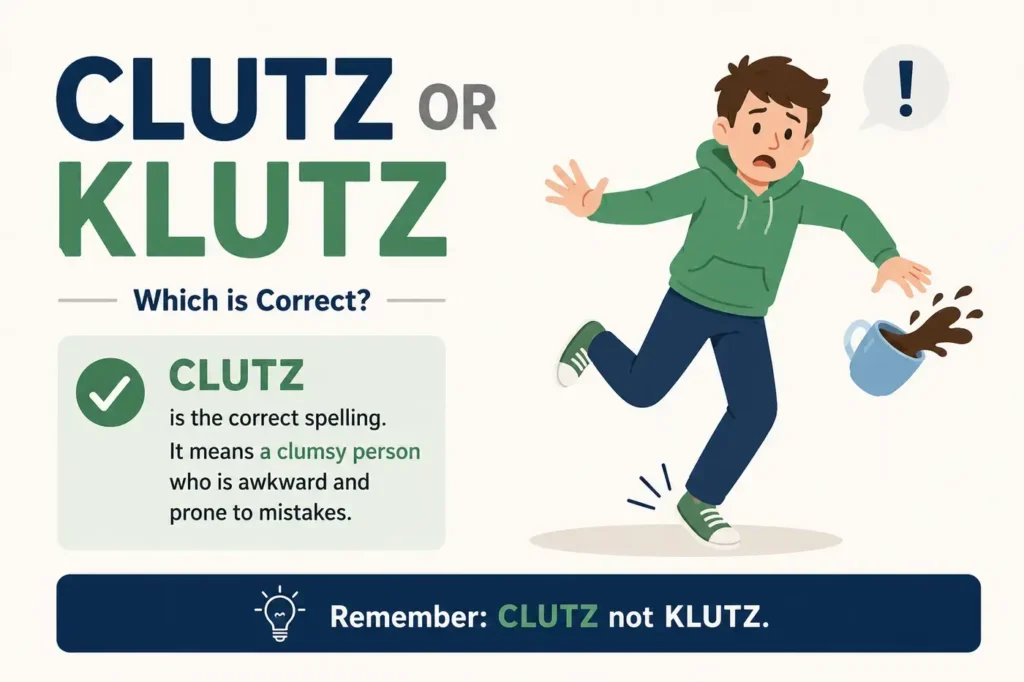
The short answer is simple. Klutz is the correct spelling. It refers to a person who is awkward, clumsy, or frequently drops, bumps, or breaks things by accident. Clutz is considered a misspelling and does not appear as the standard entry in major English dictionaries.
This guide explains the difference in plain English. You’ll learn the meaning of the word, its pronunciation, history, grammar, real world usage, common mistakes, and the situations where native speakers naturally use it. By the end, you’ll know which spelling to choose with confidence and why it became the accepted form.
Quick Definition
Klutz is the correct English spelling for a person who is unusually clumsy or awkward. Clutz is a common misspelling that appears in informal writing but is not recognized as the standard form in major dictionaries. Both spellings refer to the same idea, but only klutz is considered correct.
If you enjoy learning about common spelling mix-ups, you’ll also appreciate our guide comparing brite and bright, where we explain when each form is appropriate.
Quick Answer
If you only need a fast answer, here it is.
- Klutz is the correct spelling.
- Clutz is a misspelling.
- The word is an informal noun used to describe someone who is clumsy or awkward.
- Native English speakers almost always write klutz in books, newspapers, dictionaries, and professional writing.
- You may see clutz online, but it is not the accepted standard.
A simple way to remember the spelling is to think of other English words that came from German or Yiddish. Many of them begin with the letter K, and klutz follows the same pattern.
Comparison Table
| Feature | Clutz | Klutz |
|---|---|---|
| Part of speech | Noun | Noun |
| Meaning | Intended to mean a clumsy person | A clumsy or awkward person |
| Standard spelling | No | Yes |
| Dictionary status | Misspelling | Accepted entry |
| Origin | Modern spelling variation | From Yiddish |
| Formality | Informal if used | Informal noun |
| Common contexts | Online typos informal posts | Everyday conversation books media |
| Usage frequency | Rare | Very common |
| Example | He wrote clutz by mistake. | He is such a klutz that he spilled his coffee again. |
Meaning Of Each Word
Although these spellings point to the same idea, they are not treated equally in English.
What Does Klutz Mean
A klutz is someone who regularly trips, drops objects, bumps into things, or seems naturally awkward in physical movements. The word is usually playful rather than insulting. Friends and family often use it with affection after a harmless accident.
For example, someone who spills a drink, knocks over a chair, or drops their phone might laugh and say they are a klutz.
You’ll commonly hear the word in situations like these.
- Friendly conversations.
- Family discussions.
- Comedy shows.
- Movies and television.
- Casual storytelling.
The word describes a person’s behavior, not their intelligence or personality.
What Does Clutz Mean
The spelling clutz usually appears because people write the word based on how it sounds. English contains many words that begin with Cl, so this spelling can seem reasonable at first glance.
However, major dictionaries do not list clutz as the standard spelling. When it appears in writing, editors generally correct it to klutz.
If you’re writing an essay, article, email, or any professional document, always choose the accepted spelling.
Key Differences
At first glance, these two spellings appear interchangeable because they sound identical. The real difference comes from spelling, dictionary recognition, and accepted usage.
Here are the main distinctions.
- Klutz is the correct spelling.
- Clutz is considered a misspelling.
- Both words describe a clumsy or awkward person.
- Only klutz appears as the standard dictionary entry.
- Professional writers, editors, and publishers use klutz.
The pronunciation never changes. The meaning stays the same. Only the spelling determines which form is considered correct.
Which One Is Correct
The correct choice is klutz.
Every major English dictionary recognizes klutz as the standard spelling. It’s the version you’ll find in books, newspapers, magazines, educational materials, and professional writing. If your goal is clear and accurate English, this is the spelling you should use.
The spelling clutz continues to appear online because people often write words the way they hear them. That happens with many English words, especially ones borrowed from other languages. While readers will usually understand what you mean, using the accepted spelling makes your writing look more polished and trustworthy.
To remember the correct form, keep these tips in mind.
- Use klutz in school assignments and professional writing.
- Choose klutz when writing articles, emails, or social media posts.
- Treat clutz as a spelling mistake rather than an alternative spelling.
- If you’re unsure, check a trusted dictionary instead of relying on search results.
Pronunciation Guide
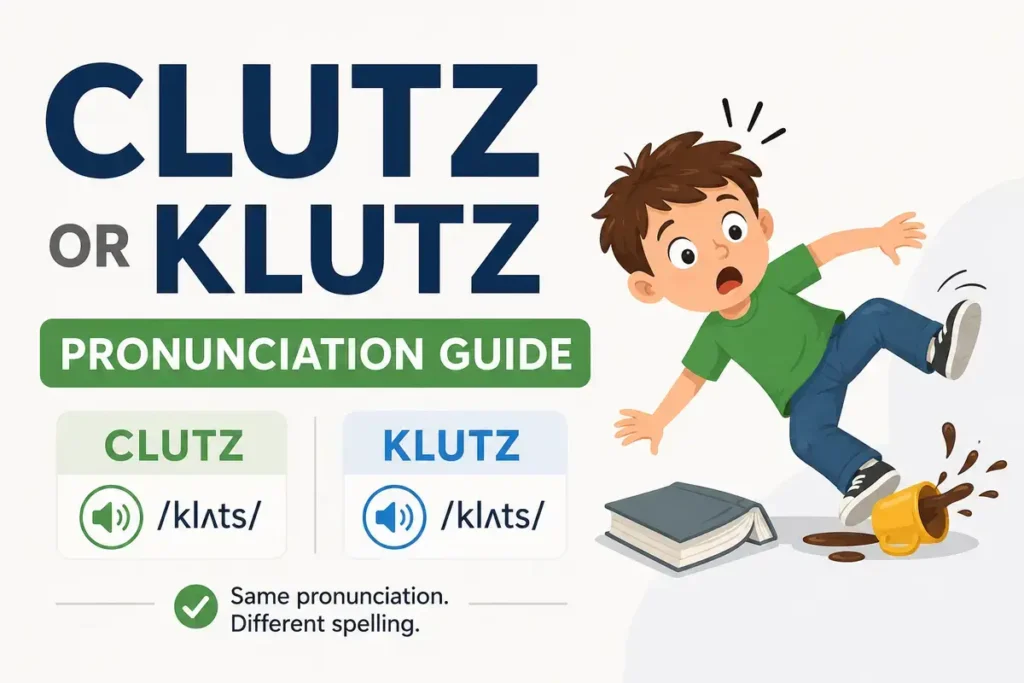
One reason people confuse these spellings is that they sound exactly the same when spoken.
IPA Pronunciation
/klʌts/
Syllable Breakdown
Klutz
Klutz.
The word has one syllable.
How Native Speakers Say It
The beginning sounds like the kl in clock, followed by the short u sound heard in cup, and it ends with a clear ts sound.
Common Pronunciation Mistakes
Most pronunciation mistakes happen because speakers soften the final sound or pronounce the word too quickly.
To pronounce it naturally.
- Say the K sound clearly.
- Keep the vowel short.
- Finish with a crisp ts sound.
Listening to native speakers and repeating the word aloud a few times usually makes the pronunciation feel natural.
Expert Language Insight
Words borrowed from other languages often keep spellings that look unusual in English. Klutz is a good example. Since many English words begin with Cl, it’s easy to assume that clutz must also be correct. That’s a logical guess, but language doesn’t always follow patterns.
Professional editors rarely hesitate when they see this word. They automatically use klutz because it’s the established dictionary spelling. The same principle applies to many borrowed words. Once a spelling becomes standardized through dictionaries and publishing, that’s the version writers should use consistently.
If your goal is to write clear, accurate English, following standard dictionary spellings is always the safest choice. It builds credibility and helps readers focus on your message instead of noticing spelling errors.
Examples In Sentences
Seeing a word in context is one of the fastest ways to remember how to use it correctly. The examples below show how the accepted spelling fits naturally into everyday English. They also demonstrate why the alternative spelling should be avoided in standard writing.
Klutz Examples
These sentences use the correct spelling.
- Emma is such a klutz that she spilled her coffee before the meeting even started.
- My brother calls himself a klutz because he is always dropping his phone.
- Everyone laughed when Jake tripped over his own backpack and joked that he was a klutz.
- Do not worry about breaking the vase. Even the biggest klutz has an accident now and then.
- The movie’s main character is a lovable klutz who somehow saves the day.
- Sarah felt like a klutz after walking into the glass door.
- He is not careless. He is simply a klutz who has poor coordination.
- The coach reminded the team that every athlete starts out looking like a klutz while learning new skills.
- My friend admitted she was a klutz after knocking over three shopping bags.
- The novel describes the detective as a charming klutz with a kind heart.
Clutz Examples
The following examples show how the misspelling appears in real life. They are included for learning purposes only.
- He wrote clutz in his homework, but the teacher corrected it to klutz.
- I searched for clutz before realizing it was spelled differently.
- Some social media posts still use clutz, even though dictionaries do not.
- The blog article mistakenly referred to the character as a clutz.
- Spell check highlighted clutz as an error.
- My friend thought clutz was correct because it matched the pronunciation.
- Several online comments used clutz, but none cited a reliable dictionary.
- The editor replaced clutz with klutz before publication.
- Many English learners type clutz the first time they use the word.
- Learning the correct spelling helps you avoid writing clutz by mistake.
Clutz is just one example of a word people often misspell, much like another frequently confused spelling involving planing and planning.
Common Mistakes
People usually understand the meaning of the word, but they still make mistakes when spelling or using it. Most of these errors happen because the pronunciation gives very few clues about the correct spelling.
Here are the mistakes editors see most often.
Using The Wrong Spelling
This is by far the most common mistake.
Incorrect:
Clutz
Correct:
Klutz
If you’re writing for school, work, or publication, always choose the dictionary spelling.
Assuming Both Spellings Are Accepted
Many English words have two accepted spellings, especially across American and British English. That is not the case here.
Unlike words such as color and colour, only one spelling is considered standard.
Believing The Word Is Offensive
Some people avoid using the word because they think it is always an insult.
In reality, tone depends on the situation. Friends and family often use it playfully after a harmless accident. Used kindly, it usually carries a lighthearted meaning rather than a harsh criticism.
Overusing The Word
Calling someone a klutz after every small mistake can sound repetitive or insensitive.
Like any descriptive word, it works best when used naturally and in the right context.
Trusting Every Online Source
Search engines often display user generated content, forums, and social media posts. These sources may contain spelling mistakes.
Before accepting an unfamiliar spelling, check a respected dictionary or style guide.

Etymology And Word Origin
The history of klutz helps explain why its spelling looks unusual.
The word entered American English from Yiddish, where it described someone who was awkward, clumsy, or foolish in movement. The Yiddish word itself developed from an older Germanic root associated with a block or lump, creating an image of someone moving without much grace.
As Yiddish expressions became part of everyday American speech during the late nineteenth and early twentieth centuries, klutz gained popularity outside Jewish communities. Writers, comedians, and filmmakers embraced the word because it was short, memorable, and easy to understand from context.
Over time, it became a familiar part of informal English. Although its origins are rooted in Yiddish, today’s speakers often use it without realizing where it came from.
The spelling remained unchanged throughout its history, which explains why the initial K is still used today.
Regional Usage
The meaning stays the same across English speaking countries, but the frequency of use varies from one region to another.
American English
The word is most common in American English. You’ll hear it in everyday conversations, television shows, books, magazines, and online articles.
Because of its long history in the United States, most American readers recognize the word immediately.
British English
British speakers understand the word, especially through American movies, television, and books. However, it appears less frequently in everyday conversation than it does in the United States.
Words such as clumsy or awkward are often preferred in formal contexts.
Australian English
Australian English also recognizes the word, although speakers may choose local expressions depending on the situation. It generally appears in informal conversation rather than professional writing.
Canadian English
Canadian English follows a pattern similar to American English. The word is widely understood and appears in conversation, entertainment, and media.
Regardless of the country, the accepted spelling remains exactly the same.
Grammar Rules
Understanding how the word functions in a sentence makes it easier to use naturally.
Part Of Speech
Klutz is a noun.
It names a person who tends to be clumsy or physically awkward.
Examples include:
- He is a klutz.
- My cousin can be a real klutz.
Singular And Plural Forms
The singular form is:
Klutz
The regular plural is:
Klutzes
Examples:
- Two klutzes tried to carry the large mirror together.
- Even experienced athletes can look like klutzes while learning a new sport.
Common Sentence Patterns
The word appears naturally in structures like these.
- She is a klutz.
- He feels like a klutz today.
- Everyone called him a klutz after the accident.
- Nobody wants to look like a klutz in front of friends.
Notice that the word almost always refers to a person rather than an action.
Curious about other everyday word variations? Our guide on nickname spelling explained explores whether blankie or blanky is the more widely accepted form.
Real Life Usage Examples
Although klutz is informal, you’ll hear and read it in many everyday situations.
Daily Conversation
Friends often use the word after harmless accidents to keep the mood light.
Examples include spilling a drink, dropping keys, tripping over a rug, or bumping into a chair.
Academic Writing
The word appears occasionally in language discussions or literature analysis, but formal academic writing usually prefers more neutral terms such as clumsy or uncoordinated unless quoting dialogue.
Professional Communication
Most workplaces avoid informal labels in official documents.
Instead of calling someone a klutz, professional writing focuses on the specific event or behavior.
For example:
- The equipment was dropped during transport.
- The employee accidentally knocked over the display.
These descriptions sound more objective and respectful.
Literature And Entertainment
Authors often use the word to build memorable characters. A lovable klutz can create humor, reveal personality, and make a story feel more relatable.
Television sitcoms, family movies, and romantic comedies frequently include characters whose awkward moments become part of their charm.
The word succeeds because it describes a familiar human experience. Almost everyone has dropped a glass, tripped over a step, or bumped into a doorway at some point. That shared experience makes the term easy to understand and memorable.
Related Words And Confused Terms
Learning similar words helps you understand when klutz is the best choice and when another word fits the situation better. While these terms share certain similarities, each one has its own meaning and tone.
Here are some common related words.
- Clumsy describes someone who often drops things, stumbles, or has poor coordination.
- Awkward refers to someone who feels uncomfortable socially or moves without confidence. It does not always mean the person is physically clumsy.
- Uncoordinated is a more neutral word that often appears in medical, educational, or sports settings.
- Accident prone describes a person who frequently has minor accidents.
- Bungler refers to someone who performs a task poorly because of mistakes or lack of skill.
- Oaf describes a large or awkward person, but it has a much stronger negative tone.
- Goof usually refers to someone who makes silly mistakes. It focuses more on behavior than physical coordination.
- Fumbler describes a person who struggles to handle objects smoothly or confidently.
If you’re looking for a klutz synonym, words such as clumsy, awkward, uncoordinated, and accident prone are often the closest choices. The best option depends on the context and the tone you want to create.

Expert Language Insight
Professional editors rarely stop to think about the spelling of klutz because dictionaries and style guides have settled the question for decades. The more important decision is knowing when the word fits the situation.
In casual conversation, calling yourself a klutz is often a lighthearted way to laugh at a small mistake. It can make a story feel more relatable and add a touch of humor. However, using the same word to describe someone else requires a little more care. Even playful words can sound unkind if the other person does not share the joke.
Experienced writers also think about their audience. If an article has a formal tone, words such as clumsy, awkward, or uncoordinated may be a better fit. In a personal story, novel, or friendly conversation, klutz feels more natural because it reflects the way many native speakers actually talk.
This balance between accuracy, tone, and audience is what separates good writing from great writing.
Frequently Asked Questions
Is it clutz or klutz?
Klutz is the correct spelling. It is the standard form recognized by major English dictionaries. Clutz is a common misspelling that appears because many people spell the word the way it sounds.
What does klutz mean in English?
In English, a klutz is a person who is unusually clumsy or physically awkward. The word is informal and often used in a friendly or humorous way after someone has a minor accident or drops something.
Is klutz considered slang?
The word is informal, but it is not just slang. It appears in major dictionaries and has been part of everyday English for many years. While it is common in casual conversation, writers usually avoid it in highly formal or technical documents.
How do you pronounce klutz?
The standard pronunciation is /klʌts/. It has one syllable and begins with a clear K sound. Many people spell the word incorrectly because the pronunciation does not make the unusual spelling obvious.
What is the plural of klutz?
The regular plural form is klutzes.
For example:
- The two klutzes managed to knock over the same table.
- Even talented athletes can look like klutzes while learning a new skill.
Can I use klutz in professional writing?
You can, but only if the tone is informal or conversational. In business reports, academic papers, or legal documents, more neutral words such as clumsy or uncoordinated are usually a better choice.
Why do people spell it clutz?
Most people write clutz because they have heard the word spoken but have never seen it written. Since many English words begin with Cl, the misspelling feels natural even though it is incorrect.
Does Urban Dictionary define clutz?
You’ll find entries for both spellings on crowd sourced websites, including Urban Dictionary. However, those sites reflect user submissions rather than standard English usage. If you want the accepted spelling, rely on respected dictionaries and established style guides instead.
Conclusion
Choosing between these two spellings is easier than it first appears. Klutz is the accepted English spelling, while clutz is simply a common misspelling. Although both forms point to the same idea, only one is recognized by major dictionaries and used in professional writing.
The word describes someone who is naturally clumsy or awkward, often in a playful and affectionate way. It has a long history in English, comes from Yiddish, and continues to appear in everyday conversations, books, movies, and media. Understanding its origin also makes the unusual spelling much easier to remember.
If you’re writing for school, work, or publication, choose klutz every time. Pair it with the right context, use it thoughtfully, and your writing will sound both natural and accurate. When in doubt, trust established dictionaries instead of informal online sources.