If you have ever paused while writing transferred or transfered, you are not alone. This spelling mistake appears in emails, school assignments, business documents, and social media every day. Since both versions sound exactly the same, many people wonder if they are simply regional variations or if one is actually incorrect.
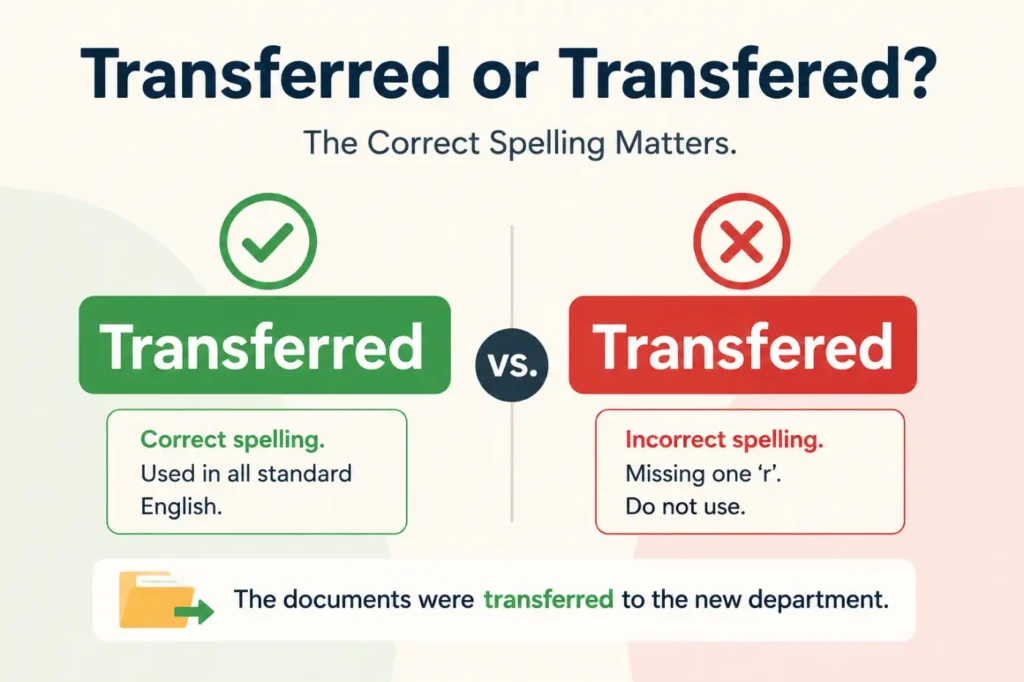
The answer is clear. Transferred is the correct spelling in both American English and British English. Transfered is a misspelling and should not appear in formal or everyday writing. The confusion comes from an English spelling rule that requires the final consonant to double before adding certain suffixes.
Once you understand that rule, the correct spelling becomes much easier to remember. You will no longer need to guess each time you write the word.
This guide explains the difference in simple language. You will learn the meaning of the word, why the extra r is necessary, how native speakers use it, how to pronounce it correctly, and how to avoid one of the most common spelling mistakes in English. You will also find practical examples, grammar tips, and expert guidance that you can apply to similar words.
Quick Definition
Transferred is the correct past tense and past participle of the verb transfer. It means that something or someone has been moved from one place, person, account, department, or situation to another. Transfered is an incorrect spelling caused by leaving out one of the two required r letters.
Quick Answer
If you only need a quick answer, remember these points.
- Transferred is the correct spelling.
- Transfered is always considered a spelling mistake.
- The spelling is the same in American English and British English.
- The extra r follows a standard English spelling rule for many verbs ending in a stressed consonant.
If you’re unsure whether a document has been successfully transferred, understanding the difference between the two spellings of kinesthesiology vs kinesiology can help you recognize how language variations appear in professional and academic writing.
Comparison Table
| Feature | Transferred | Transfered |
|---|---|---|
| Part of speech | Past tense and past participle verb | Misspelling |
| Correct spelling | Yes | No |
| Meaning | Moved from one place or person to another | Intended to mean transferred but spelled incorrectly |
| Origin | From the verb transfer | Error based on dropping one letter |
| Formality | Standard in all writing | Not accepted |
| Common contexts | Banking education employment technology healthcare | Typing mistakes and informal writing |
| Usage frequency | Extremely common | Rare except as an error |
| Dictionary status | Recognized by all major dictionaries | Not recognized as the standard form |
| Example | She transferred the files yesterday. | She transfered the files yesterday. ❌ |
Meaning Of Both Terms
Although these spellings look similar, only one belongs to standard English.
What Does Transferred Mean
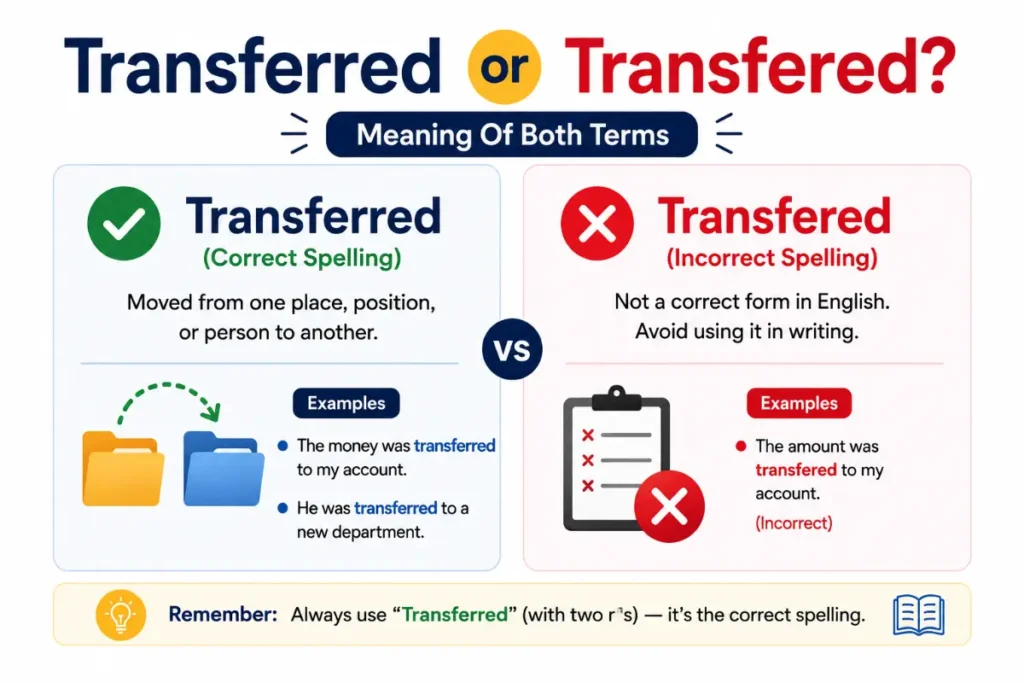
Transferred is the past tense and past participle form of the verb transfer. It describes the completed action of moving something from one place, owner, account, department, or condition to another.
The word is widely used in everyday life because people transfer many different things.
Common examples include:
- Transferred money between bank accounts.
- Transferred files to another computer.
- Transferred a student to another school.
- Transferred an employee to a different office.
- Transferred ownership of property.
- Transferred medical records.
- Transferred phone data to a new device.
The exact meaning depends on the context, but the central idea always involves moving or passing something from one place to another.
What Does Transfered Mean
Transfered is not a standard English word. It appears because writers forget to double the final r before adding ed.
This mistake is understandable because English spelling rules are not always obvious. However, dictionaries, grammar guides, spell checkers, publishers, and professional editors all recognize transferred as the only correct spelling.
If you see transfered in a document, it should be corrected to transferred unless it appears exactly that way as part of a unique username or another intentionally altered name.
Key Differences
The difference between these spellings is not about meaning, pronunciation, or regional preference. It is simply a matter of correct spelling.
Here are the main differences.
- Transferred follows standard English spelling rules.
- Transfered leaves out a required r.
- Both forms are pronounced the same way.
- Only transferred appears in dictionaries and professional writing.
- American English and British English both use the same spelling.
One missing letter may seem like a small detail, but it changes the word from correct English into a spelling error. In academic, professional, and business writing, using the accepted spelling improves clarity and credibility.
Which Spelling Is Correct
The correct spelling is transferred. This applies to virtually every type of writing, including emails, reports, essays, legal documents, news articles, and everyday messages. Major dictionaries and style guides consistently recognize transferred as the standard form.
The spelling transfered should be avoided because it does not follow English spelling conventions. Modern spell checkers usually flag it immediately, and editors routinely correct it before publication.
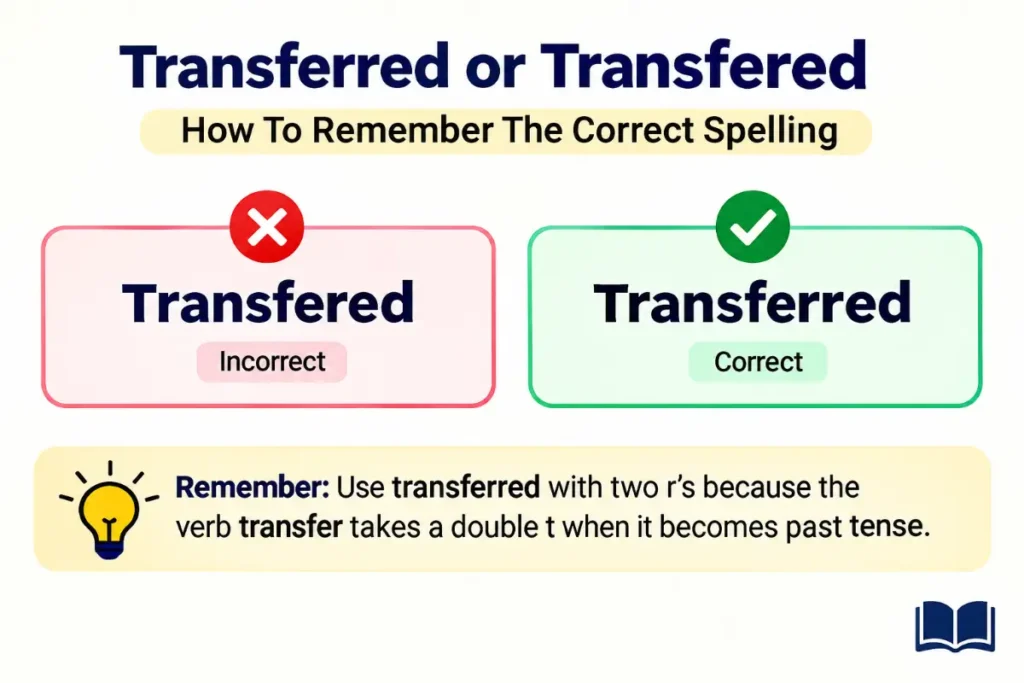
The reason is simple. The base verb transfer ends with a stressed syllable followed by a single consonant. According to English spelling rules, the final consonant doubles before adding ed.
The same pattern appears in many familiar verbs.
- Prefer becomes preferred.
- Refer becomes referred.
- Infer becomes inferred.
- Transfer becomes transferred.
Recognizing this pattern makes similar words much easier to spell correctly.
Pronunciation Guide
Although the spellings differ, the pronunciation remains exactly the same.
IPA Pronunciation
Transferred
/trænsˈfɜːrd/ in British English.
/trænsˈfɝːd/ in American English.
Syllable Breakdown
The word has two spoken parts.
Trans ferred
The stress falls on the second part of the word.
Common Pronunciation Mistakes
Most spelling confusion comes from writing rather than speaking, but learners sometimes make these mistakes.
- Stressing the first syllable instead of the second.
- Omitting the final d sound in rapid speech.
- Assuming the spelling changes the pronunciation.
Remember that both spellings sound alike. The difference exists only in writing.
The same proofreading habits that help you choose transferred over transfered are useful for avoiding common spelling slips like commit vs comit before you submit any piece of writing.
How To Remember The Correct Spelling
A simple spelling rule can save you from making this mistake again. When a verb ends with a stressed syllable followed by a single consonant, double the final consonant before adding ed.
Think about these examples.
- Refer becomes referred.
- Prefer becomes preferred.
- Transfer becomes transferred.
Notice the pattern. Each word keeps the extra r because the stress falls on the final syllable of the base verb.
Another easy way to remember the spelling is to focus on the word transfer itself. Before adding ed, ask yourself if the final sound is stressed. If it is, the last consonant usually doubles.
The more examples you read and write, the more natural this rule becomes. After a little practice, the correct spelling will look familiar, while the incorrect version will stand out immediately.
Examples In Sentences
Seeing the word in real situations is one of the easiest ways to remember the correct spelling. The examples below show how it appears in everyday English across different contexts.
Examples Using Transferred
These sentences use the correct spelling.
- She transferred the money to her savings account before the weekend.
- The hospital transferred the patient to a larger medical center.
- Our teacher transferred the files to the classroom website.
- He transferred ownership of the vehicle after completing the paperwork.
- The university transferred my academic credits without any problems.
- We transferred the photos to an external hard drive for backup.
- The company transferred several employees to its new office.
- My mobile provider transferred my number within a few hours.
- The coach transferred the player to a different training group.
- They transferred the documents securely through an encrypted system.
These examples show that the word is used whenever something moves from one place, person, or system to another.
Examples Using Transfered
The spelling without the second r is incorrect, but it is useful to recognize it because you may come across it online.
- She transfered the payment yesterday. ❌
- The student transfered schools last year. ❌
- He transfered the files to a new computer. ❌
- They transfered ownership of the property. ❌
- The bank transfered the funds overnight. ❌
- We transfered our photos to the cloud. ❌
- My employer transfered me to another department. ❌
- The clinic transfered the medical records. ❌
- She transfered her phone data to a new device. ❌
- The airline transfered our reservation. ❌
Every example above should use transferred instead.
Transferred or Transfered Common Mistakes
Most people do not confuse the meaning of the word. The problem is almost always spelling. Here are the mistakes editors see most often.
Leaving Out The Second R
This is by far the most common mistake.
Incorrect:
Transfered
Correct:
Transferred
The final r must double before adding ed because of the English spelling rule for stressed final syllables.
Assuming American And British English Use Different Spellings
Some words have different spellings in different countries, but this is not one of them. Both American English and British English use transferred.
Forgetting The Base Word Rule
Many writers focus only on the ending instead of looking at the original verb.
Start with transfer.
Then apply the spelling rule by doubling the final r before adding ed.
Trusting Incorrect Online Examples
Search engines, forums, and social media sometimes display the incorrect spelling because anyone can publish content online.
Instead of copying what you see, rely on trusted dictionaries, educational resources, and professional writing.
Confusing The Past Tense With Other Forms
The verb has several forms.
- Transfer.
- Transfers.
- Transferring.
- Transferred.
Each form has its own purpose. Learning them together helps reduce spelling mistakes.
Etymology And Word Origin
The verb transfer entered English through Latin.
It comes from the Latin verb transferre, which means to carry across or to move from one place to another. The word combines two parts.
- Trans, meaning across or beyond.
- Ferre, meaning to carry or bear.
Over time, the word passed through French before becoming part of English vocabulary. Although its meaning expanded, the central idea stayed the same. It always described moving something from one place, person, or condition to another.
As English spelling rules developed, the past tense adopted the doubled r, giving us transferred.
Regional Usage
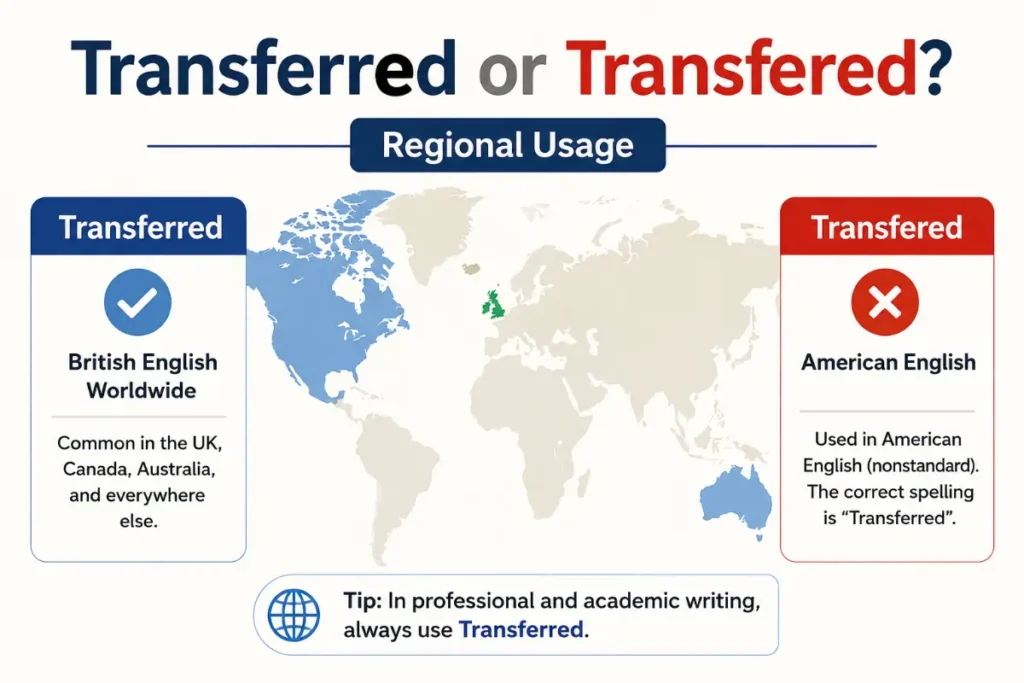
Unlike words such as organize and organise, this spelling does not change from one English speaking country to another.
American English
American English uses transferred in schools, businesses, government publications, banking, journalism, and everyday communication.
Examples include:
- Transferred money.
- Transferred ownership.
- Transferred files.
British English
British English follows the same spelling. Universities, newspapers, legal documents, and official publications all use transferred.
Australian English
Australian English also follows the standard spelling rule. You will see the word in education, healthcare, government documents, and professional writing.
Canadian English
Canadian English uses the same spelling as well. Although Canadian English combines some American and British conventions, transferred remains unchanged. No major English variety accepts transfered as the standard spelling.
Grammar Rules
Understanding the grammar behind the word makes it much easier to use correctly.
Part Of Speech
Transferred is the past tense and past participle form of the verb transfer.
Examples include:
- She transferred the payment yesterday.
- They transferred the patient immediately.
Past Tense
Use the word to describe an action completed in the past.
Examples:
- He transferred the documents last night.
- We transferred the reservation this morning.
Past Participle
The word also appears with helping verbs.
Examples:
- The funds have been transferred.
- My records were transferred successfully.
- The ownership has already been transferred.
Passive Voice
The word frequently appears in passive constructions because attention often focuses on what was moved rather than on who performed the action.
Examples include:
- The patient was transferred to another hospital.
- The files were transferred securely.
- The money was transferred overnight.
Related Forms
Learning all forms of the verb helps build confidence.
- Transfer.
- Transfers.
- Transferring.
- Transferred.
Notice that transferring also doubles the final r, following the same spelling rule.
Real Life Usage Examples
This verb appears in many areas of daily life because moving information, people, money, or property is a common activity.
Banking And Finance
Banks use the word every day.
Examples include:
- I transferred money to my checking account.
- The payment was transferred instantly.
- The bank transferred the funds after verification.
Education
Schools and universities regularly use the term.
Examples include:
- The student transferred to another university.
- Her academic credits were transferred successfully.
- The school transferred her records electronically.
Employment
Businesses often move employees between locations or departments.
Examples include:
- He was transferred to the Chicago office.
- The manager transferred her to a new team.
- Several employees were transferred during the restructuring.
Technology
The word is common in computing and digital communication.
Examples include:
- The files were transferred through a secure connection.
- I transferred my contacts to a new phone.
- The software transferred all settings automatically.
Healthcare
Hospitals frequently use this word when patients or records move between facilities.
Examples include:
- The doctor transferred the patient to intensive care.
- Medical records were transferred electronically.
- The ambulance transferred the patient safely.
Everyday Conversation
People naturally use the word in ordinary situations.
Examples include:
- I transferred the photos to my laptop.
- She transferred the tickets to my account.
- We transferred the reservation to another date.
These examples show why the word is so common. It applies to money, technology, travel, education, healthcare, work, and countless other situations where something moves from one place to another.
If you enjoy learning about spelling patterns, another frequently confused spelling pair is prooving vs proving, which follows similar English spelling rules and common writing mistakes.
Related Words And Confused Terms
People searching for this spelling question often encounter similar words that cause confusion. Some are different forms of the same verb, while others are related in meaning.
The table below explains the most common ones.
| Word | Meaning | Correct |
|---|---|---|
| Transfer | Base form of the verb | Yes |
| Transfers | Third person singular present tense | Yes |
| Transferring | Present participle and gerund | Yes |
| Transferred | Past tense and past participle | Yes |
| Transfered | Misspelling | No |
| Transmission | The act of sending or passing something | Yes |
| Transportation | The movement of people or goods | Yes |
You may also come across these related words and phrases.
- Move.
- Relocate.
- Shift.
- Deliver.
- Send.
- Hand over.
- Assign.
- Convey.
- Carry.
- Pass on.
The best synonym depends on the context. For example, transferred money can often become sent money, while transferred an employee may be better expressed as relocated an employee or reassigned an employee.
Expert Language Insight
From an editor’s perspective, transfered is one of the easiest spelling mistakes to spot because it breaks a well established English spelling rule.
The confusion usually comes from pronunciation. Since both spellings sound identical, many writers assume a single r is enough. English does not always work that way. The written form follows spelling patterns rather than pronunciation alone.
Professional editors often recommend looking at the base verb before adding a suffix. If the final syllable is stressed and the word ends with a single consonant after a vowel, that consonant usually doubles before adding ed or ing.
Compare these examples.
- Refer becomes referred.
- Prefer becomes preferred.
- Transfer becomes transferred.
Once you recognize this pattern, many similar words become much easier to spell correctly.
Another useful habit is to read your writing slowly before publishing it. Small spelling mistakes often hide in familiar words because your brain focuses on meaning instead of individual letters. A careful proofread or spell checker can catch these errors before someone else notices them.
Frequently Asked Questions
Is transferred or transfered correct?
Transferred is the correct spelling. It is the accepted past tense and past participle of transfer in both American English and British English. Transfered is a spelling mistake and should be corrected in formal and everyday writing.
Why does transferred have two r letters?
The final r doubles because transfer ends with a stressed syllable followed by a single consonant. English spelling rules require doubling the consonant before adding ed or ing in words that follow this pattern.
Is transfered ever correct?
No. Standard English dictionaries and style guides do not recognize transfered as the correct spelling. The only exception would be if it appeared intentionally as part of a username, fictional name, or another creative title.
Is the spelling different in the United States and the United Kingdom?
No. Both American English and British English use transferred. This is not one of the words that changes spelling between the two varieties of English.
What does transferred mean?
The word means that something or someone has been moved from one place, person, account, department, or situation to another. It is commonly used when talking about money, files, employees, students, medical records, and ownership.
How do you pronounce transferred?
The standard pronunciation is /trænsˈfɝːd/ in American English and /trænsˈfɜːrd/ in British English. The stress falls on the second syllable, and both pronunciations use the same spelling.
What is a synonym for transferred?
Several words can replace transferred, depending on the context. Common synonyms include moved, sent, relocated, shifted, reassigned, delivered, and conveyed. Choose the one that best matches the situation.
How can I remember the correct spelling?
Remember the spelling rule instead of memorizing the word by itself. Verbs like transfer, refer, and prefer all double the final r before adding ed because the last syllable receives the primary stress.
Conclusion
The correct spelling is transferred, and that rule stays the same in American English, British English, Australian English, and Canadian English. The form transfered is a common spelling mistake caused by leaving out one of the two required r letters.
The easiest way to avoid this error is to remember the spelling pattern. When a verb ends with a stressed syllable followed by a single consonant, English usually doubles that consonant before adding ed or ing. Once you understand this rule, it becomes much easier to spell related words correctly as well.
You will encounter this verb in banking, education, healthcare, technology, employment, legal writing, and everyday conversation. Using the correct spelling helps your writing appear polished, accurate, and professional regardless of the subject.
Whenever you feel uncertain, think of similar words like preferred and referred. They follow the same pattern and reinforce the rule. With a little practice, transferred will quickly become the spelling that looks and feels right every time.