If you searched for commit vs comit, you are probably wondering if both spellings are acceptable or if one is simply a typo. It is an easy mistake to make because the two words look almost identical, and many people accidentally leave out one of the letters while typing. The confusion becomes even more common when writing quickly, using a phone keyboard, or working with technical terms like Git commit.
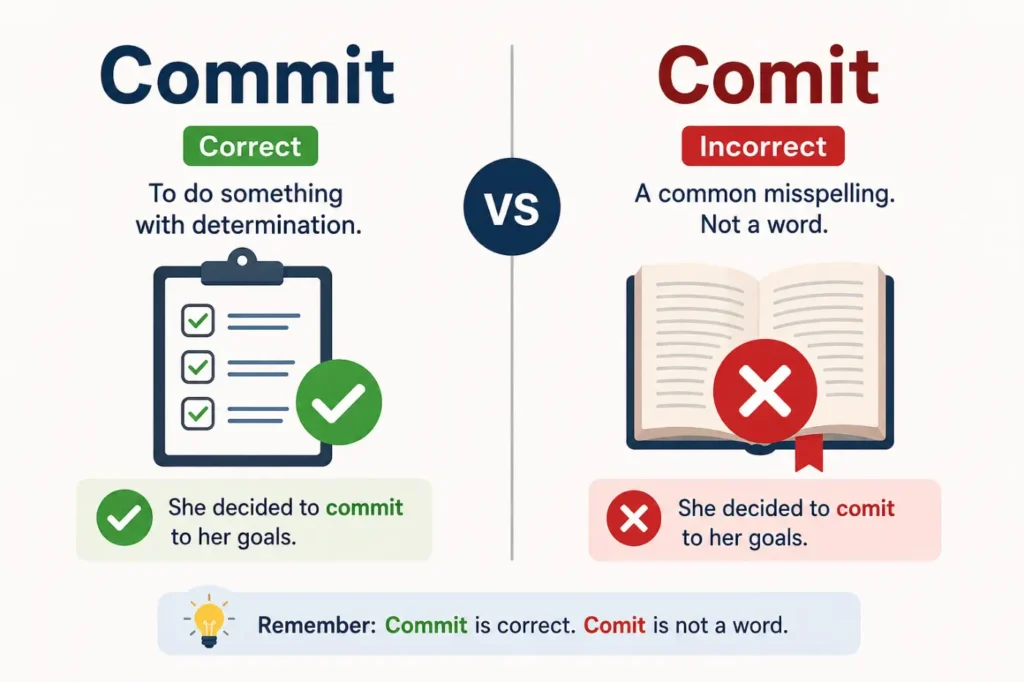
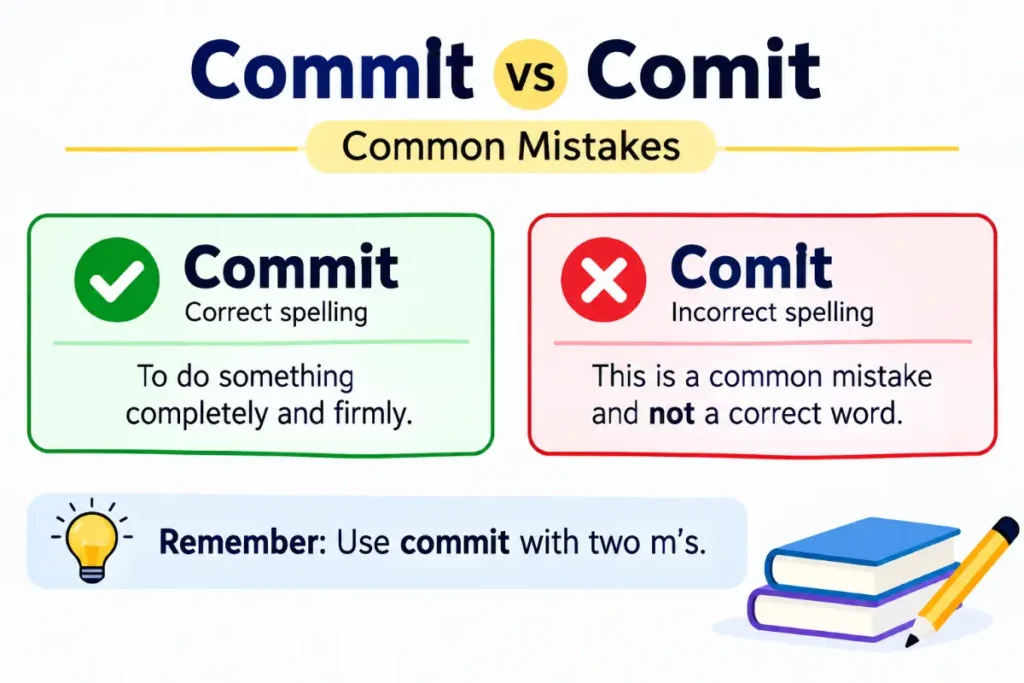
The answer is straightforward. Commit is the correct spelling in standard English. Comit is not recognized as an English word and is almost always a misspelling. Dictionaries, grammar guides, educational institutions, and professional editors all use commit as the accepted form.
This guide explains why the spelling matters and how to avoid common mistakes. You will learn the definition, pronunciation, grammar, origin, and real world usage of the word. You will also see practical examples, understand how it is used in relationships, technology, and everyday communication, and discover why the incorrect spelling continues to appear online.
Quick Definition
Commit is the correct English spelling. It means to dedicate yourself to a person, goal, action, or responsibility. It can also mean to carry out an action, such as committing a crime or making a Git commit in software development. Comit is not a standard English word and is considered a spelling mistake.
Quick Answer
If you only need a fast answer, remember these points.
- Commit is the correct spelling.
- Comit is a common typing error.
- Use commit in formal, academic, business, and everyday writing.
- Keep the double m when writing the word in any context, including technology and software development.
Comparison Table
| Feature | Commit | Comit |
|---|---|---|
| Part of speech | Verb Noun in technical contexts | Not a standard English word |
| Correct spelling | Yes | No |
| Meaning | To dedicate perform or carry out an action | None in standard English |
| Origin | From Latin through Old French | Misspelling of commit |
| Formality | Standard in all writing | Incorrect |
| Common contexts | Relationships business education law software development | Typing mistakes internet searches |
| Usage frequency | Extremely common | Very rare |
| Dictionary status | Recognized by major dictionaries | Not recognized |
| Example | She decided to commit to the project. | Comit is incorrect in this sentence. |
Meaning Of Both Terms
Although these spellings differ by only one letter, only one belongs to standard English.
What Does Commit Mean
Commit is a versatile verb with several related meanings. At its core, it describes taking action or making a serious promise.
Depending on the situation, it can mean:
- To dedicate yourself to a goal or responsibility.
- To promise loyalty to a person or cause.
- To perform an action.
- To officially record changes in software development.
- To place someone in an institution through legal or medical procedures.
Because the word has several meanings, context helps readers understand exactly what the writer intends.
Common examples include:
- Commit to a decision.
- Commit to someone.
- Commit to something.
- Commit a crime.
- Commit changes in Git.
- Commit resources to a project.
What Does Comit Mean
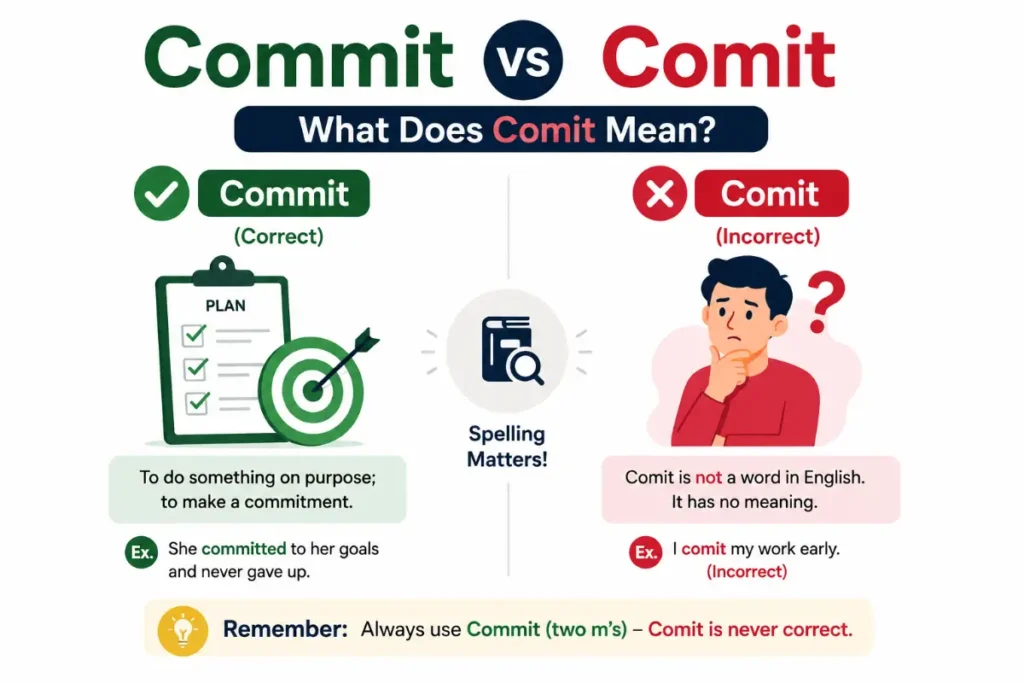
Comit is not an accepted English word. In nearly every case, it appears because someone accidentally omitted one of the letters while typing. Spell checkers, dictionaries, and grammar tools usually flag it as an error and suggest commit as the correction.
Occasionally, you may see Comit as part of a company name, surname, username, or product title. In those situations, it is treated as a proper name rather than a vocabulary word.
Key Differences
The difference between these spellings is much more important than it first appears.
The first word is a legitimate English verb with several established meanings. The second is almost always a spelling mistake.
Here are the main differences.
- Commit appears in dictionaries and grammar references.
- Comit is not recognized as standard English.
- The correct spelling contains two consecutive m letters.
- Professional editors automatically correct comit in ordinary writing.
- Search engines often interpret comit as a search for commit because the intended word is usually obvious.
Understanding this distinction helps improve both writing accuracy and credibility.
If you’re ever unsure whether a word is missing a letter or simply misspelled, our comparable spelling explained guide shows how to avoid one of the most common writing mistakes.
Which Spelling Is Correct
The correct spelling is commit.
This spelling is used in education, journalism, law, business communication, publishing, and everyday English. It is also the accepted spelling in technical fields such as software development, where developers regularly create a Git commit to save changes in a version control system.
The spelling comit should be avoided unless it is part of an official name or trademark.
A simple way to remember the correct form is to think about the word commitment. Since commitment contains two consecutive m letters, the base verb follows the same pattern.
Pronunciation Guide
Although people sometimes misspell the word, its pronunciation is consistent across major varieties of English.
IPA Pronunciation
Commit
/kəˈmɪt/
Syllable Breakdown
The word has two syllables.
kuh mit
The stress falls on the second syllable.
Common Pronunciation Mistakes
Most native speakers pronounce the word correctly, but English learners occasionally make these mistakes.
- Stressing the first syllable instead of the second.
- Pronouncing the first vowel too strongly.
- Confusing the ending with similar sounding verbs.
Listening to native speakers and reading the word aloud can help reinforce both the pronunciation and the correct spelling.
How To Remember The Correct Spelling
Many spelling mistakes happen because people type quickly instead of thinking about the structure of the word. Fortunately, this one is easy to remember with a few simple techniques.
The first trick is to connect the word with commitment. Since commitment clearly contains two consecutive m letters, it becomes much easier to remember that the verb does as well.
Another helpful strategy is to think about common expressions you already know. Phrases such as commit to someone, commit to something, and commit a crime appear so often that repeated exposure naturally reinforces the correct spelling.
If you work in software development, the phrase Git commit can serve as another memory aid. Developers see the command every day, making the correct spelling second nature over time.
Rather than memorizing individual letters, focus on recognizing the complete word. The more you read and write it in real situations, the less likely you are to drop one of the letters by mistake.
Examples In Sentences
Reading a word in context is one of the quickest ways to remember its spelling and meaning. The examples below show how commit is used in everyday English, professional communication, relationships, and technology. They also explain why comit should be avoided in normal writing.
Examples Using Commit
These sentences use the correct spelling.
- She decided to commit to the project before the deadline.
- They promised to commit more time to volunteer work.
- He was ready to commit to a long term relationship.
- The company committed additional resources to customer support.
- The judge explained the legal consequences of committing a crime.
- Our team will commit the final changes after testing the software.
- She refused to commit without reading the agreement first.
- Good leaders commit to continuous learning throughout their careers.
- The coach encouraged every player to commit fully during practice.
- I forgot to create a Git commit before switching to another branch.
These examples show that the word fits naturally into many different situations, from personal relationships to software development.
Examples Using Comit
The spelling comit is almost always incorrect in standard English. The examples below show common mistakes and their corrections.
- Incorrect: I will comit to the new schedule.
Correct: I will commit to the new schedule. - Incorrect: Please comit your code today.
Correct: Please commit your code today. - Incorrect: She wants to comit to the relationship.
Correct: She wants to commit to the relationship. - Incorrect: They forgot to comit the document.
Correct: They forgot to commit the document. - Incorrect: Never comit the same mistake twice.
Correct: Never commit the same mistake twice. - Incorrect: The developer forgot to comit the update.
Correct: The developer forgot to commit the update. - Incorrect: He refused to comit to the plan.
Correct: He refused to commit to the plan. - Incorrect: They did not comit enough effort.
Correct: They did not commit enough effort. - Incorrect: We should comit the configuration changes.
Correct: We should commit the configuration changes. - Incorrect: She does not want to comit yet.
Correct: She does not want to commit yet.
If you see comit in ordinary writing, it is almost certainly a typing error.
Common Mistakes
The spelling mistake is simple, but it appears surprisingly often because the word contains two identical letters.
Here are the mistakes editors encounter most frequently.
Dropping One Letter
The most common error is removing one m.
Incorrect:
Comit
Correct:
Commit
When proofreading, pay special attention to double letters because they are easy to overlook.
Confusing Spelling With Pronunciation
The word is pronounced with a single m sound, even though it is written with two. This difference leads some writers to remove one letter when typing.
English contains many words that use double letters without changing the pronunciation.
Forgetting The Correct Form In Technical Writing
Software developers often type quickly while writing code or documentation.
Commands, commit messages, and documentation should always use the standard spelling because it is part of the official Git command.
Mixing Up Related Words
Some writers confuse commit with related words such as:
- Commitment.
- Committed.
- Commission.
- Committee.
Although these words share similar letters, each has a different meaning and spelling.
Trusting Typing Speed Instead Of Proofreading
Fast typing increases the chance of missing one of the letters. A quick review before sending an email, publishing an article, or saving a document usually catches this mistake.
Similar spelling patterns can be confusing, and understanding why developed has one “p” makes it easier to avoid errors in everyday writing.
Etymology And Word Origin
The word commit has a long history that reaches back to Latin.
It comes from the Latin verb committere, which meant to bring together, entrust, perform, or place into someone’s care. The word later passed into Old French before becoming part of Middle English.
As English developed, the meaning expanded to include several related ideas.
- Making a promise.
- Performing an action.
- Entrusting something to another person.
- Carrying out a legal or official act.
Although the meanings have broadened over time, they all share the central idea of taking responsibility for an action or decision.
The incorrect spelling developed much later as a simple typing mistake rather than through any historical change in the language.
Commit vs Comit Regional Usage
Unlike some English words, this spelling does not change from one English speaking country to another.
American English
American English consistently uses commit in education, journalism, business, law, and software development.
British English
British English follows exactly the same spelling. Dictionaries, publishers, and universities all recognize commit as the standard form.
Australian English
Australian English also uses commit in both formal and informal writing.
Canadian English
Canadian English follows the same convention. The spelling remains unchanged across government publications, schools, and professional writing. No major variety of English treats comit as a correct alternative.
Grammar Rules
Understanding how the word functions in sentences helps you use it naturally.
Part Of Speech
Commit is primarily used as a verb.
Examples include:
- Commit to a goal.
- Commit a mistake.
- Commit resources.
- Commit changes.
Verb Forms
Here are the most common forms.
| Form | Example |
|---|---|
| Base verb | Commit |
| Third person singular | Commits |
| Present participle | Committing |
| Past tense | Committed |
| Past participle | Committed |
Notice that the final consonant is doubled before adding endings such as ing and ed.
Common Sentence Patterns
Native speakers frequently use these structures.
- Commit to someone.
- Commit to something.
- Commit a crime.
- Commit an error.
- Commit resources.
- Commit changes.
- Commit yourself to a goal.
These expressions appear naturally in both spoken and written English.
Real Life Usage Examples
The word appears in many different areas of daily life, making it one of the most versatile verbs in English.
Daily Conversation
People often use the word when discussing promises, responsibilities, or long term decisions.
Examples include:
- I am ready to commit to this opportunity.
- She does not want to commit until she has more information.
- They committed to helping their neighbors every weekend.
Relationships
One of the most common meanings involves emotional commitment.
Examples include:
- He finally decided to commit to someone he truly loved.
- They were not ready to commit to a serious relationship.
- Trust grows when both people commit to each other.
In this context, the word means making a serious long term promise rather than simply expressing interest.
Professional Communication
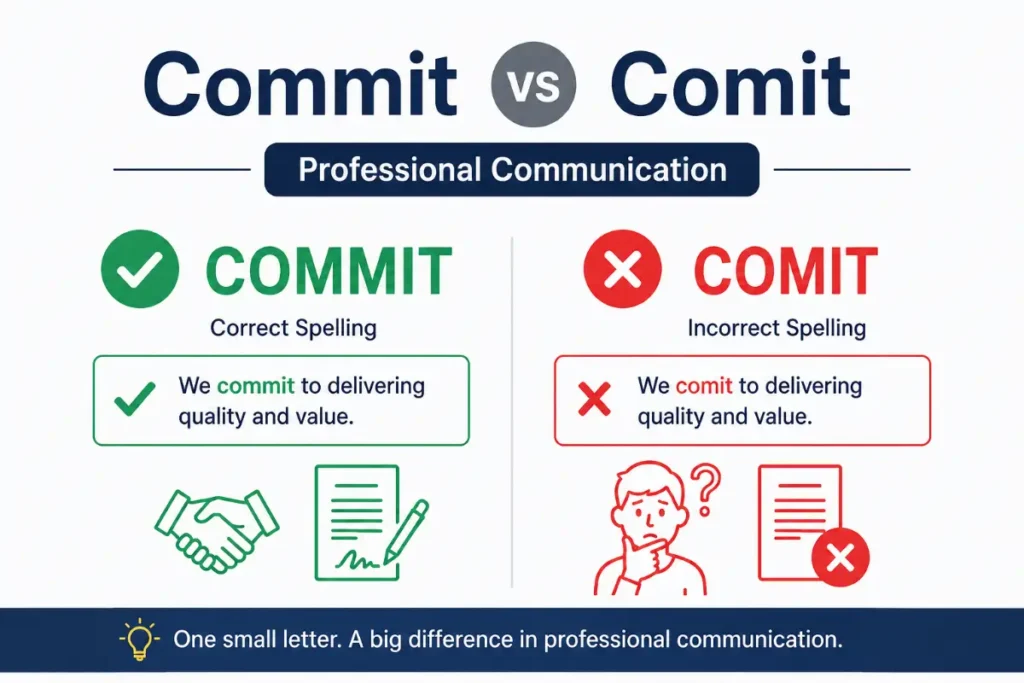
Businesses often use the word when discussing responsibilities, deadlines, budgets, and strategic goals.
Examples include:
- The company committed additional funding to the project.
- Every department must commit to meeting the new standards.
- Leaders should commit to honest communication with their teams.
Software Development
Developers use the word every day when working with version control systems.
A Git commit records a snapshot of changes in a repository. Each commit creates a history that allows developers to track progress, review updates, and restore earlier versions when necessary. Because the command is part of Git itself, the spelling should never be changed.
Legal Usage
The word also has a legal meaning.
For example:
- Commit a crime.
- Commit fraud.
- Commit perjury.
In these situations, commit means to carry out or perform an unlawful act.
The same verb can describe positive commitments, neutral actions, or illegal acts, making context essential for understanding the intended meaning.
Related Words And Confused Terms
Because commit has several meanings, people often confuse it with words that look or sound similar. Learning the differences helps you avoid spelling mistakes and choose the right word for the situation.
| Word | Meaning | Common Confusion |
|---|---|---|
| Commit | To dedicate yourself or carry out an action | Correct spelling |
| Commitment | A promise or obligation | Derived noun |
| Committed | Dedicated or devoted | Past tense and adjective |
| Committee | A group formed for a specific purpose | Similar spelling but different meaning |
| Commission | An official task or payment | Similar beginning but unrelated meaning |
| Admit | To acknowledge or allow entry | Different verb ending |
| Permit | To allow or authorize | Different meaning |
| Submit | To present something for approval | Often confused because of a similar pattern |
You may also come across these related expressions.
- Commit fully.
- Commit yourself.
- Commit resources.
- Commit funds.
- Commit to change.
- Commit to learning.
- Commit code.
- Version control.
Recognizing these common combinations will make your writing sound more natural and help you understand the word in different contexts.
If you also enjoy exploring commonly confused words, the difference between these two terms offers a clear explanation of another pair that often causes uncertainty.
Expert Language Insight
Experienced editors rarely question the spelling of commit because it follows a consistent pattern across every major variety of English. The real challenge is choosing the correct meaning for the context.
For example, the sentence She committed to the project describes dedication or responsibility. In contrast, He committed a crime refers to performing an illegal act. Meanwhile, Create a Git commit before pushing your changes belongs to the language of software development.
Although these meanings seem different, they all share the same underlying idea of taking action or accepting responsibility.
One useful editing habit is to read the sentence aloud after writing it. If the word refers to a promise, an action, or recording changes in Git, commit is almost certainly the correct choice. If you see comit, it is usually a spelling error that should be corrected before publishing.
Professional writers also pay attention to consistency. Once you choose the correct spelling, keep it the same throughout the document. Consistent spelling improves readability and strengthens your credibility with readers.
Frequently Asked Questions
Is commit or comit correct?
Commit is the correct spelling in English. It appears in dictionaries, style guides, and educational resources. Comit is generally a typing mistake and should not be used in standard writing unless it is part of a proper name.
What does commit mean?
The word has several meanings depending on the context. It can mean making a promise, dedicating yourself to a person or goal, carrying out an action, or recording changes in a Git repository.
Why do people spell commit as comit?
The mistake usually happens because writers accidentally remove one of the two m letters while typing. Since the pronunciation does not emphasize the double letter, the error is easy to make but also easy to correct.
What does commit mean in a relationship?
In relationships, commit means making a serious and lasting promise to another person. It often describes choosing loyalty, trust, and long term dedication instead of keeping the relationship casual.
What does commit to something mean?
To commit to something means to devote your time, effort, or energy to a goal, responsibility, or decision. It suggests genuine dedication rather than temporary interest.
What is a Git commit?
A Git commit records a snapshot of changes in a version control repository. Each commit creates a point in the project’s history, making it easier to track progress, review edits, and restore previous versions if necessary.
What does commit a crime mean?
The phrase commit a crime means to carry out an illegal act. It is a standard legal expression used in court documents, news reports, and everyday English.
What are some synonyms for commit?
The best synonym depends on the meaning. Common alternatives include:
- Dedicate.
- Devote.
- Promise.
- Pledge.
- Perform.
- Carry out.
- Execute.
- Record.
Choose the synonym that matches the context instead of replacing the word automatically.
Conclusion
The answer to commit vs comit is clear. Commit is the correct spelling and the only form accepted in standard English. It appears in dictionaries, academic writing, business communication, legal documents, and software development. Comit is almost always a typing mistake rather than a valid alternative.
The word itself is highly versatile. It can describe making a promise, accepting responsibility, carrying out an action, recording changes in Git, or expressing dedication in a relationship. Understanding the context helps you choose the right meaning while keeping your writing clear and accurate.
If you ever hesitate, remember one simple rule. The correct spelling always contains two m letters. Thinking of related words such as commitment, committed, and committing makes it much easier to remember.
Using the standard spelling consistently gives your writing a polished, professional appearance and helps readers focus on your message instead of your spelling.