If you’ve searched for bellies vs bellys, you’re probably trying to figure out which spelling is correct. This question comes up often because many English words ending in y follow different plural rules. Some simply add s, while others change the y to ies. Without knowing the rule, it is easy to second guess yourself.
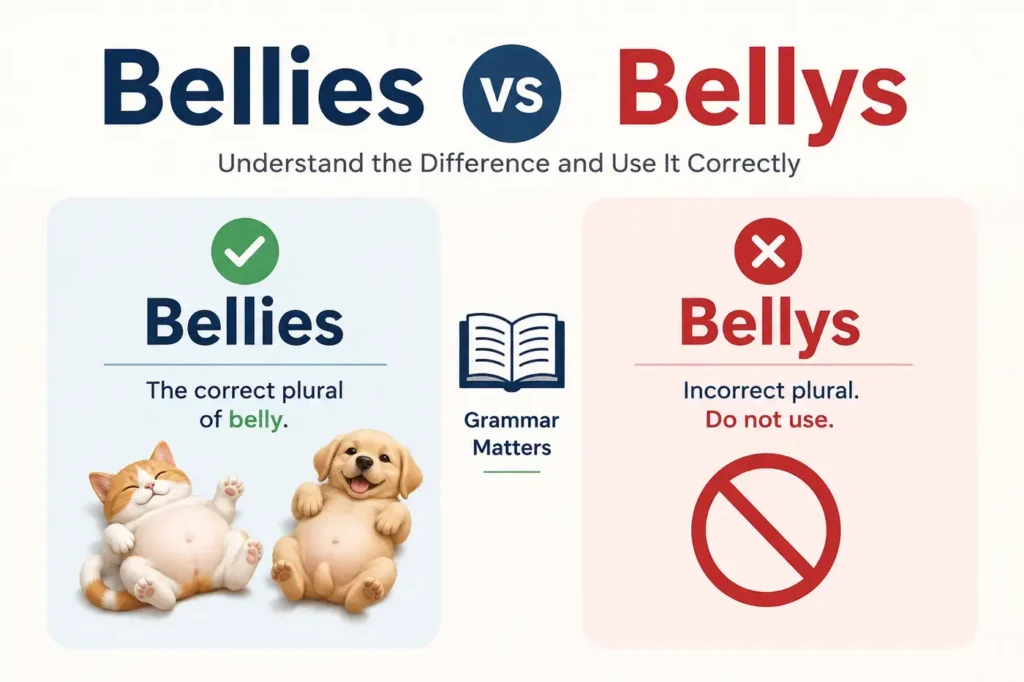
The short answer is simple. Bellies is the correct plural form of belly. Bellys is not a standard English spelling and is considered incorrect in formal writing, academic work, professional communication, and most dictionaries.
The confusion becomes even more understandable when you compare belly with words like toy, key, or monkey, which become toys, keys, and monkeys instead of changing to ies. English spelling rules depend on the letter that comes before the final y, and that small detail makes all the difference.
This guide explains the correct plural form, the grammar rule behind it, pronunciation, word origin, regional usage, real life examples, common mistakes, and related words. By the end, you will know exactly when to use bellies with confidence and why bellys should be avoided.
Quick Definition
Bellies is the correct plural of belly. The singular noun ends with a consonant followed by y, so English grammar changes the y to ies when forming the plural. Bellys is not recognized as a standard English plural and should not be used in formal or everyday writing.
Quick Answer
If you only need the answer, here it is.
- Belly is the singular noun.
- Bellies is the correct plural noun.
- Bellys is an incorrect spelling.
- Use bellies in American English, British English, Australian English, and Canadian English.
- The same spelling rule applies to many other English nouns ending in a consonant followed by y.
Once you understand the pluralization rule, choosing the correct spelling becomes much easier.
Similar spelling mistakes happen in other everyday words too, such as the difference between putty and “puddy”, where one form is standard English and the other is usually a misspelling.
Bellies vs Bellys Comparison Table
| Feature | Bellies | Bellys |
|---|---|---|
| Part of speech | Plural noun | Incorrect plural spelling |
| Base word | Belly | Belly |
| Correct form | Yes | No |
| Meaning | More than one belly | Intended to mean more than one belly |
| Grammar status | Standard English | Nonstandard English |
| Formality | Accepted in all contexts | Should be avoided |
| Common contexts | Everyday speech writing literature medicine fashion | Rare and considered an error |
| Usage frequency | Very common | Extremely uncommon |
| Example | The babies rubbed their bellies after dinner. | Incorrect spelling |
Meaning Of Both Words
Although these two spellings look similar, only one belongs to standard English. Understanding what each form represents helps explain why dictionaries and style guides recognize one but reject the other.
What Does Bellies Mean
Bellies is the plural form of belly, which refers to the front part of the human body below the chest. It can also describe the underside of an animal or the lower surface of certain objects.
Depending on the context, the word carries both literal and figurative meanings.
Common uses include:
- The stomach area of a person.
- The underside of an animal.
- A rounded or swollen shape.
- A figurative reference to appetite or hunger.
- The lower surface of an aircraft, ship, or other object.
Examples include:
- The children laughed as they held their bellies after hearing a funny joke.
- The puppies rolled onto their bellies in the sunshine.
- The mechanic inspected the belly of the aircraft before takeoff.
The word also appears in many familiar expressions, such as belly laugh, belly flop, and go belly up.
What Does Bellys Mean
Bellys is an incorrect plural spelling of belly.
People usually write it because they assume every noun forms its plural by adding s. That works for many English words, but not for nouns ending with a consonant followed by y.
You may occasionally see bellys in online comments, social media posts, or typing mistakes. Its appearance does not make it grammatically correct.
Professional editors, dictionaries, grammar books, and language teachers consistently recommend using bellies instead.
Key Differences
The difference between these spellings is based entirely on English grammar rather than meaning.
Here are the main distinctions.
| Bellies | Bellys |
|---|---|
| Correct plural of belly | Incorrect plural spelling |
| Found in dictionaries | Not accepted in standard dictionaries |
| Used in formal and informal writing | Considered a spelling mistake |
| Follows English plural rules | Breaks English plural rules |
| Accepted worldwide | Should be avoided |
Another way to understand the difference is to remember the spelling rule instead of memorizing individual words.
When a singular noun ends in a consonant followed by y, the y changes to ies before adding the plural ending.
Examples include:
- Belly becomes bellies.
- Baby becomes babies.
- City becomes cities.
- Lady becomes ladies.
- Story becomes stories.
Learning this pattern helps you spell hundreds of English nouns correctly.
Which Form Is Correct
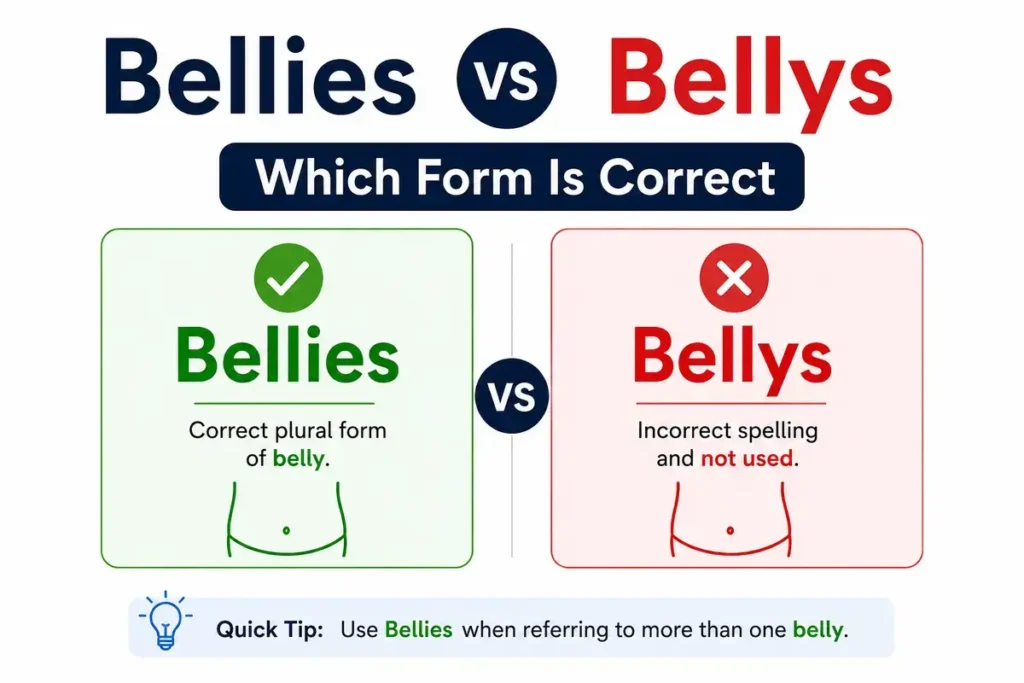
The correct plural form is bellies.
This spelling follows one of the most common pluralization rules in English. Since belly ends with the consonant l followed by y, the final y changes to ies.
To apply the rule correctly:
- Start with the singular noun belly.
- Remove the final y.
- Add ies.
- The result is bellies.
Compare that with words ending in a vowel followed by y.
- Toy becomes toys.
- Key becomes keys.
- Boy becomes boys.
- Monkey becomes monkeys.
Notice the difference. Those words keep the y because a vowel comes before it.
This is why understanding the spelling rule is more useful than memorizing individual examples.
Pronunciation Guide
Correct pronunciation is just as important as correct spelling. Fortunately, the singular and plural forms are easy to pronounce once you understand the ending.
Belly
IPA pronunciation:
/ˈbɛl.i/
Syllable breakdown:
Bel ly
Bellies
IPA pronunciation:
/ˈbɛl.iz/
Syllable breakdown:
Bel lies
The plural ending adds a z sound rather than a separate syllable.
Common pronunciation mistakes include:
- Pronouncing the ending like ice instead of iz.
- Adding an extra syllable.
- Confusing bellies with similar sounding words.
Reading the word aloud in complete sentences helps reinforce both the pronunciation and the correct spelling.
Expert Grammar Tip
Many spelling mistakes happen because writers depend on memory instead of understanding the rule.
Experienced editors rarely ask themselves if bellies looks right. They recognize that belly ends with a consonant followed by y, so changing y to ies becomes automatic.
Whenever you are unsure, look at the letter immediately before the final y.
- If it is a consonant, change y to ies.
- If it is a vowel, simply add s.
This single rule applies to countless English nouns and makes plural spelling much easier.
Examples In Sentences
Seeing a word in context is one of the easiest ways to remember its correct spelling. The following examples show how the plural form is used naturally in everyday English. They also highlight why the incorrect spelling should be avoided.
Correct Examples Using Bellies
These sentences reflect standard English and can be used in conversation, writing, or professional communication.
- The children rubbed their bellies after enjoying a big dinner.
- The puppies rolled onto their bellies while playing in the yard.
- Penguins have white bellies that help them blend into their surroundings.
- The dancers balanced books on their bellies during practice.
- The chef prepared roasted pork bellies for the evening menu.
- The babies slept peacefully on their bellies.
- The swimmers floated on their bellies before turning over.
- The seals rested on their bellies along the beach.
- The hikers laughed as they filled their bellies with warm soup after a long walk.
- The cartoon characters held their bellies while laughing.
Notice that every sentence follows the same grammar rule. The plural always ends with ies.
Incorrect Examples Using Bellys
The following examples are intentionally incorrect. They show mistakes that sometimes appear online or in informal writing.
- The babies lay on their bellys. Incorrect.
- The children rubbed their bellys after lunch. Incorrect.
- The puppies slept on their bellys. Incorrect.
- The dancers touched their bellys during rehearsal. Incorrect.
- The swimmers floated on their bellys. Incorrect.
- The hikers filled their bellys before leaving. Incorrect.
- The bears scratched their bellys. Incorrect.
- The seals rested on their bellys. Incorrect.
- The babies laughed while patting their bellys. Incorrect.
- The cartoon characters held their bellys. Incorrect.
These examples demonstrate a common spelling error. Replacing y with ies fixes every sentence.
Common Mistakes
Most people who write bellys are not making a random mistake. They are applying the wrong plural rule. Once you understand why that happens, it becomes much easier to avoid the error.
Here are the mistakes editors see most often.
Adding Only S
Many English nouns become plural by adding s, so learners naturally assume the same rule applies here.
Incorrect:
- Belly → Bellys.
Correct:
- Belly → Bellies.
Always check the letter before the final y before adding a plural ending.
Forgetting The Consonant Plus Y Rule
The most important rule is simple.
- If a noun ends with a consonant followed by y, change y to ies.
- If a noun ends with a vowel followed by y, simply add s.
Compare these examples.
- Belly → Bellies.
- Lady → Ladies.
- Story → Stories.
- Boy → Boys.
- Toy → Toys.
- Key → Keys.
Learning this pattern will help you spell hundreds of nouns correctly.
Mixing Singular And Plural Forms
Some writers accidentally switch between singular and plural nouns in the same sentence.
Incorrect:
The baby rubbed their belly.
Correct:
The babies rubbed their bellies.
Matching singular and plural nouns with the correct subject improves clarity and grammar.
Trusting Every Online Source
Not every website follows proper grammar rules. You may occasionally find bellys in forum posts, social media comments, or user generated content.
Reliable dictionaries, educational resources, publishers, and professional editors consistently recognize bellies as the correct plural.
Etymology And Word Origin
The word belly has a long history in the English language. It comes from the Old English word belig, which referred to the abdomen, stomach, or a swollen object. The word is closely related to similar Germanic terms that describe something rounded or inflated.
Over time, the meaning expanded beyond the human body. Today, belly can describe the underside of an animal, the rounded section of an aircraft or ship, the curved body of a musical instrument, or even the central portion of everyday objects.
As English spelling became more standardized, the plural followed the regular consonant plus y rule. That is why bellies became the accepted plural and has remained the standard form for centuries.
If you’re interested in avoiding similar spelling mistakes, it’s also worth learning why “offerred” is incorrect and how doubling consonants works in English verbs.
Regional Usage
One interesting fact about this word is that its spelling does not change between major varieties of English. Unlike words such as color and colour, the plural form remains the same around the world.
American English
American English uses bellies in schools, newspapers, books, and everyday conversation. The spelling follows standard grammar rules taught from an early age.
British English
British English also uses bellies. Dictionaries, publishers, and educational institutions follow the same pluralization rule.
Australian English
Australian English prefers the same spelling. Whether you’re reading a novel, newspaper, or educational textbook, you’ll find bellies used consistently.
Canadian English
Canadian English also follows the standard rule. The plural form remains bellies, making it one of the many nouns whose spelling stays consistent across English speaking countries.
Because every major variety of English uses the same plural, you never need to change the spelling based on your audience.
Grammar Rules
Understanding the grammar behind this word helps you avoid similar mistakes with many other nouns.
Parts Of Speech
Belly is primarily used as a noun. It refers to the stomach area of a person or animal or the rounded underside of an object.
Examples include:
- The baby’s belly was full.
- The fish has a silver belly.
The plural noun is bellies.
Forming The Plural
Follow this rule whenever a noun ends with a consonant followed by y.
- Remove the final y.
- Add ies.
Examples include:
- Belly → Bellies.
- Baby → Babies.
- City → Cities.
- Family → Families.
- Puppy → Puppies.
- Lady → Ladies.
When The Rule Changes
If the y follows a vowel, simply add s.
Examples include:
- Boy → Boys.
- Toy → Toys.
- Monkey → Monkeys.
- Key → Keys.
- Journey → Journeys.
Recognizing the letter before y is the easiest way to choose the correct plural.
Real Life Usage Examples
The word appears in many situations beyond everyday conversation. Understanding these contexts helps you use it naturally.
Daily Conversation
People often use belly as a friendly, informal word instead of abdomen or stomach.
Examples include:
- My belly is finally full.
- The children held their bellies after laughing so hard.
- The puppy wanted a belly rub.
Academic Writing
Medical and scientific writing usually prefers abdomen because it is more precise. Still, belly may appear when discussing common language or quoting participants.
Professional Communication
Writers in healthcare, fitness, parenting, and pet care often use belly because it sounds more approachable than technical terminology.
Literature
Authors frequently use the word to create vivid descriptions.
Examples include:
- The dragon’s belly shimmered in the sunlight.
- The horse rolled onto its belly before standing again.
Media And Entertainment
The word also appears in familiar expressions and titles.
Examples include:
- Belly laugh.
- Belly dance.
- Belly flop.
- Belly rub.
Bellies vs Bellys Related Search Topics
People searching for the plural often have related questions. Here are some quick answers.
Bellies For Women
In several countries, especially South Asia, bellies refers to comfortable flat shoes worn by women. The name comes from fashion rather than grammar and has become a common retail term.
Bellies Shoes
Bellies shoes are closed toe flat shoes designed for everyday comfort. They are available in casual, formal, and office styles and are especially popular because they combine comfort with a simple appearance.
Bellies Drink
In some regions and online discussions, Bellies drink is used as a mistaken spelling for Baileys, the well known Irish cream liqueur. The correct brand name is Baileys, not Bellies.
Belly Plural
The plural of belly is bellies. This follows the standard English rule for nouns ending in a consonant followed by y.
What Is The Plural Of Trolley
The plural of trolley is trolleys, not trollies in standard modern English. Because trolley ends with a vowel followed by y, you simply add s instead of changing the y to ies.
Related Words And Commonly Confused Terms
Learning one plural rule often helps you spell dozens of other words correctly. Once you understand why bellies is correct, you’ll recognize the same pattern in many everyday nouns.
Here are some common nouns that follow the same grammar rule because they end with a consonant followed by y.
- Baby → Babies.
- City → Cities.
- Lady → Ladies.
- Family → Families.
- Story → Stories.
- Cherry → Cherries.
- Country → Countries.
- Puppy → Puppies.
- Party → Parties.
- Penny → Pennies.
Some words look similar but follow a different rule because the y comes after a vowel.
- Boy → Boys.
- Toy → Toys.
- Key → Keys.
- Monkey → Monkeys.
- Journey → Journeys.
- Trolley → Trolleys.
Comparing these two groups makes the rule much easier to remember. Instead of memorizing every plural separately, pay attention to the letter before the final y.
Another common confusion involves the correct spelling of “shaky”, which follows standard adjective formation rules rather than phonetic assumptions.
Expert Language Insight
Professional editors rarely memorize individual plurals. Instead, they rely on grammar patterns that apply across hundreds of words. This approach is faster, more accurate, and far more useful than trying to remember isolated spellings.
When editing a document, the first thing an experienced proofreader notices is the letter before the final y. If it is a consonant, changing y to ies becomes almost automatic. If it is a vowel, adding s is usually the correct choice.
Native English speakers may not think about this rule consciously because they have seen words like babies, families, and cities throughout their lives. English learners, however, benefit from understanding the pattern rather than relying on guesswork.
Another useful habit is reading your sentence aloud. If something looks unusual, checking a trusted dictionary takes only a few seconds and helps you avoid repeating the same mistake in future writing.
Frequently Asked Questions
Is bellies or bellys correct?
Bellies is the correct plural form of belly. The spelling bellys does not follow standard English grammar and is considered incorrect in formal and everyday writing.
Why does belly become bellies?
The noun belly ends with a consonant followed by y. English grammar changes the final y to ies when forming the plural. This is the same rule used for words like baby, family, and city.
Is bellys a real English word?
Standard English dictionaries do not recognize bellys as the correct plural of belly. You may occasionally see it in online comments or typing mistakes, but professional writers and editors use bellies.
What is the plural of belly?
The plural of belly is bellies. You can use it when referring to more than one person’s stomach, several animals, or objects that have a rounded underside.
Does British English use a different plural?
No. American English, British English, Australian English, and Canadian English all use bellies. The spelling stays the same across the major varieties of English.
Why do people write bellys?
Most people simply apply the wrong plural rule. Since many English nouns form the plural by adding s, learners sometimes assume belly follows the same pattern. Remembering the consonant plus y rule helps prevent this mistake.
What other words follow the same rule?
Many common nouns follow this pattern, including babies, families, ladies, stories, countries, puppies, and cities. Once you understand the rule, spelling these plurals becomes much easier.
How can I remember the correct spelling?
A simple trick is to check the letter before the y. If it is a consonant, replace y with ies. If it is a vowel, simply add s. This single rule works for many English nouns.
Conclusion
The confusion surrounding the plural of belly is easy to understand, but the grammar rule is straightforward once you know it. Bellies is the correct plural because the word ends with a consonant followed by y. In English, nouns with this pattern change the final y to ies before adding the plural ending.
The spelling bellys does not follow this rule and should be avoided in school assignments, professional documents, website content, and everyday writing. Although you may occasionally see it online, trusted dictionaries and style guides consistently recognize bellies as the standard form.
The easiest way to avoid future mistakes regarding bellies vs bellys is to focus on the grammar pattern instead of memorizing a single word. Whenever you come across a noun ending in a consonant and y, check if the plural should end in ies. This habit will help you spell many English words correctly and make your writing more polished and confident.