If you have searched for bony vs boney, you are probably trying to figure out which spelling is correct. The two words look almost identical, sound the same, and both appear online. That makes it easy to assume they are interchangeable. In reality, the answer is a little more nuanced.
The good news is that you do not have to memorize complicated grammar rules. Bony is the preferred spelling in modern English and the form you will find in dictionaries, style guides, and professional writing. Boney is also a real word, but it is much less common. It survives mainly as a variant spelling, especially in older texts, regional usage, proper names, and a few fixed expressions.
Understanding the difference helps you write with confidence. It also prevents small spelling mistakes that can make formal writing look less polished. This guide explains the meaning of each spelling, when to use them, how native speakers use them today, and why one form has become far more common than the other. Along the way, you will find pronunciation tips, practical examples, grammar guidance, and expert editing advice to help you choose the right word every time.
Quick Definition
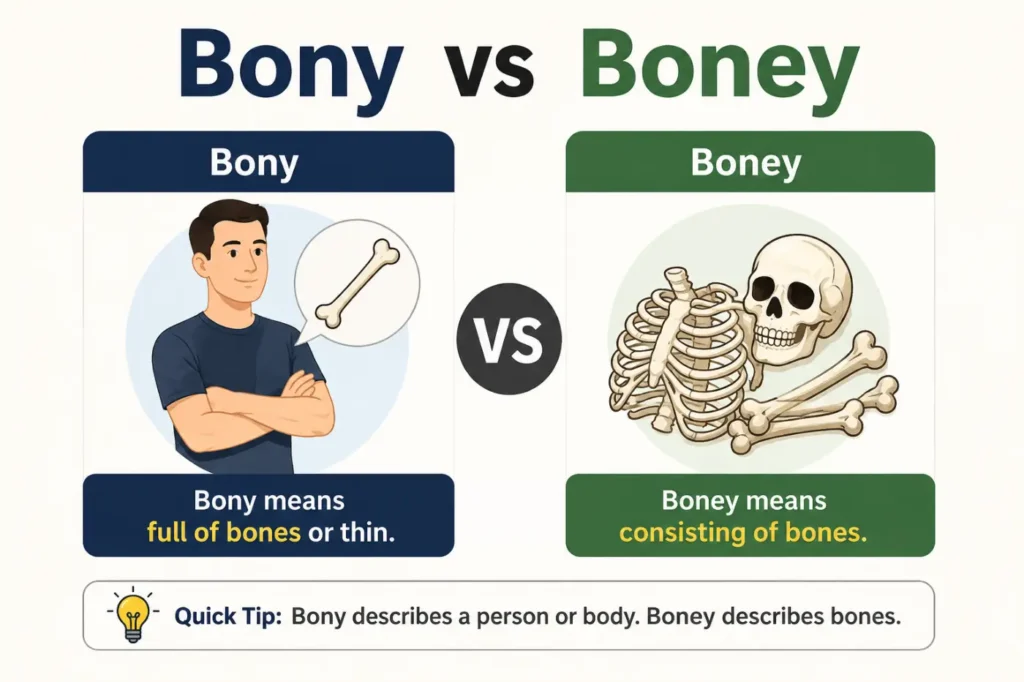
Both bony and boney describe something that has many bones or has bones that are easy to see. In modern English, bony is the standard and preferred spelling. Boney is a recognized variant, but it appears far less often and is usually limited to older writing, regional preferences, proper names, or intentional stylistic choices.
Quick Answer
If you only need the short answer, remember these points.
- Bony is the standard spelling in modern English.
- Boney is a less common variant that still appears in some contexts.
- Use bony in school assignments, professional writing, business communication, and everyday English.
- Keep boney only when it is part of an official name, quotation, or established expression.
Just as writers often confuse bony vs boney, many also struggle with the correct spelling of proving because the extra “o” seems logical but is actually incorrect.
Comparison Table
| Feature | Bony | Boney |
|---|---|---|
| Part of speech | Adjective | Adjective |
| Standard spelling | Yes | Variant spelling |
| Meaning | Having many bones or visible bones | Same meaning in most contexts |
| Origin | From bone plus the suffix y | Historical variant of bony |
| Formality | Standard and widely accepted | Less common and often informal or historical |
| Common contexts | Anatomy, medicine, everyday writing, biology | Older texts, surnames, place names, creative writing |
| Usage frequency | Very common | Rare |
| Dictionary status | Preferred by major dictionaries | Usually listed as a variant |
| Example | The dog looked bony after its illness. | The old novel described a boney hand. |
Meaning Of Both Words
Although these spellings share the same basic meaning, one has become the clear favorite in modern English.
What Does Bony Mean
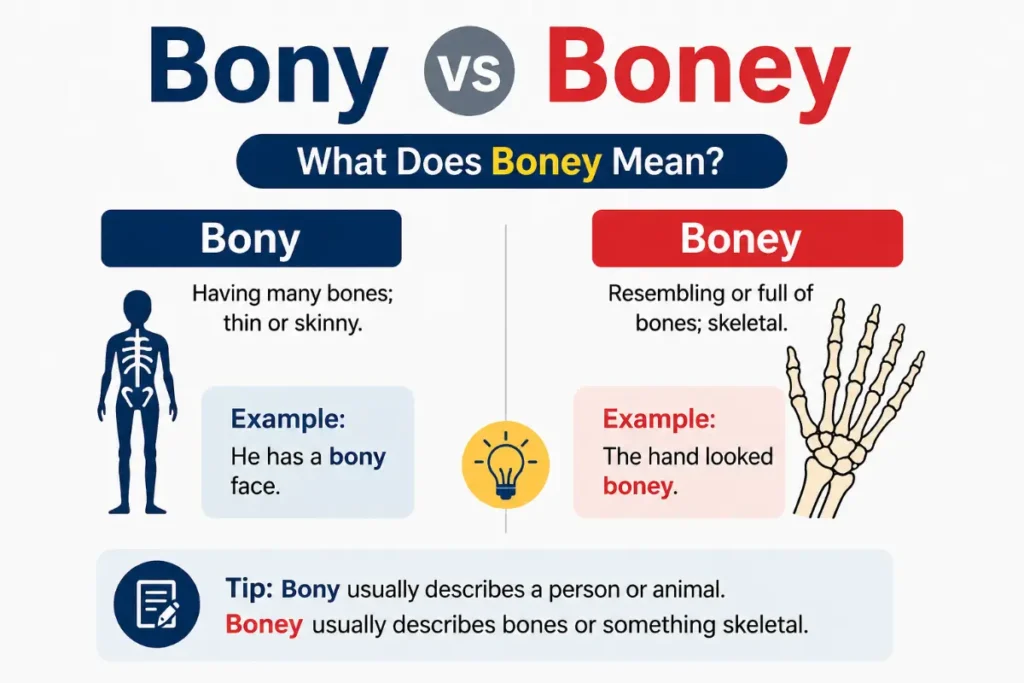
Bony is an adjective that describes a person, animal, or object with prominent bones or a structure made up of bones. It often refers to someone who is very thin, but it can also describe parts of the body where bones are easy to see or feel.
You will commonly find the word in these situations.
- Describing a thin person.
- Talking about animals with visible bones.
- Medical or anatomical discussions.
- Biology and zoology.
- Everyday conversation.
Examples include bony shoulders, bony hands, bony knees, and bony fish.
The word can also describe objects that feel hard or resemble bone in texture or appearance.
What Does Boney Mean
Boney has the same basic meaning as bony, but it is much less common. Most modern dictionaries identify it as a variant spelling rather than the preferred form.
You may still see it in:
- Older books.
- Historical documents.
- Family names.
- Place names.
- Creative or regional writing.
Outside these situations, most editors recommend using bony because it matches modern spelling conventions.
Key Differences
The biggest difference is not meaning but usage.
Both spellings describe something with noticeable bones, yet one has become the accepted standard while the other has gradually become uncommon.
Here are the main differences.
- Bony is the preferred spelling in modern English.
- Boney is a recognized variant but appears much less often.
- Both words have the same pronunciation.
- Professional writers and editors almost always choose bony.
- Boney is usually preserved only in names, quotations, or historical writing.
Another important point is reader expectation. Most English speakers expect to see bony in books, newspapers, websites, and academic writing. Using the standard spelling helps your writing appear more polished and consistent.
Which One Is Correct
If you are writing for a modern audience, bony is the correct choice.
Major dictionaries, educational institutions, publishers, and style guides all recognize it as the preferred spelling. It works in nearly every situation, including essays, reports, articles, emails, and professional documents.
That does not mean boney is always wrong. It still exists as a legitimate variant and may appear in historical literature, proper names, or creative works that intentionally preserve the older spelling.
A simple editing rule can help.
- Use bony for general writing.
- Keep boney only when you are reproducing an official name or an original source.
Following this approach keeps your writing accurate while respecting established names and historical texts.
Pronunciation Guide
The pronunciation is identical regardless of spelling, which explains why many people become unsure about the correct form.
IPA Pronunciation
Bony
/ˈboʊ.ni/
Boney
/ˈboʊ.ni/
Syllable Breakdown
Both spellings have two syllables.
Bone ee
The stress falls on the first syllable in both words.
Common Pronunciation Mistakes
Most native speakers pronounce the word correctly without thinking about it, but English learners sometimes make small mistakes.
The most common ones include:
- Adding an extra syllable.
- Stressing the second syllable instead of the first.
- Assuming the spelling changes the pronunciation.
Neither spelling changes the way the word is spoken. The only real difference is which form is considered standard in modern English.
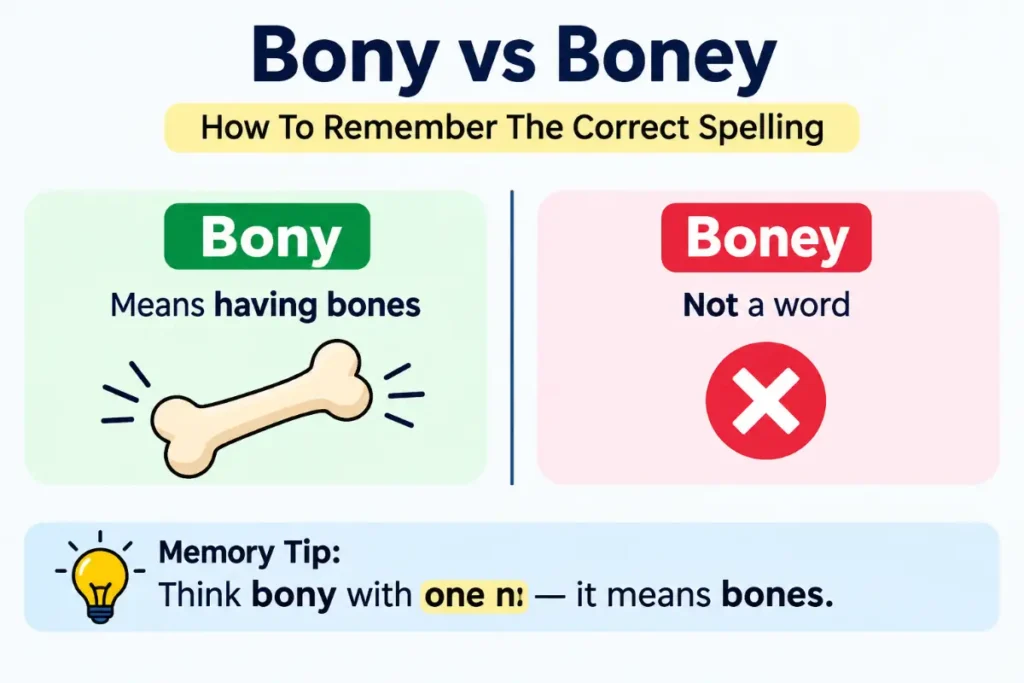
How To Remember The Correct Spelling
A simple memory trick makes this pair easy to remember. Think about the word bone. When you add the common adjective ending y, you get bony, just as cloud becomes cloudy and dust becomes dusty.
This pattern matches many familiar English adjectives, making bony feel natural to native speakers. You can also remember that dictionaries, textbooks, and newspapers almost always use bony. If you are ever uncertain, choosing the standard spelling is the safest option.
The only time you should keep boney is when you are writing an official name, quoting an original source, or preserving the spelling used in a historical document.
Examples In Sentences
Seeing both spellings in real sentences is one of the easiest ways to understand how they are used. As you read the examples below, notice that bony appears naturally in modern English, while boney is mostly limited to special situations such as historical writing or official names.
Examples Using Bony
These examples reflect standard English usage.
- The rescued dog looked bony after spending weeks without proper food.
- His bony shoulders showed through his thin shirt.
- The doctor examined the patient’s bony wrist after the fall.
- A bony ridge runs along the top of the shoulder blade.
- The bird has long, bony legs that help it move through shallow water.
- The museum displayed the bony skeleton of an ancient dinosaur.
- Her cat became bony because of an underlying medical condition.
- The child rested his head on his grandfather’s bony knee.
- Marine biologists study bony fish and cartilaginous fish to understand how they evolved.
- The old chair had a hard, bony frame that made it uncomfortable to sit on.
These examples show that bony is the natural choice in everyday conversation, biology, medicine, and descriptive writing.
Examples Using Boney
The following examples demonstrate situations where the variant spelling may appear.
- The old diary described a boney hand reaching through the doorway.
- We visited a restaurant called Boney Creek Grill during our trip.
- The novel preserved the original spelling boney because it reflected the language of its time.
- The local history book mentioned a family named Boney.
- An artist titled the sculpture Boney Shadows.
- The museum displayed a letter written in the nineteenth century that used the spelling boney.
- A game developer chose Boney as the name of a fictional character.
- The event poster featured the name Boney Trail Festival.
- Some older newspapers used boney more often than modern publications.
- The editor kept the original spelling because it was part of a historical quotation.
These examples highlight an important point. The variant spelling usually survives because it belongs to a proper name or preserves the wording of an earlier source.
Common Mistakes
The confusion surrounding these spellings is understandable because they sound exactly alike. Most errors happen when writers rely on pronunciation instead of checking the standard spelling. Here are the mistakes editors see most often.
Assuming Both Spellings Are Equally Common
Many people believe both versions are accepted in everyday writing. They are not. While both forms exist, bony is overwhelmingly preferred in modern English.
Using The Variant In Formal Writing
Some writers use boney in essays, reports, or business documents because they have seen it online. Professional editors normally replace it with bony unless the unusual spelling belongs to an official name or historical source.
Confusing Proper Names With Standard English
Family names, businesses, roads, and places sometimes include Boney. That does not change the standard spelling of the adjective. Always preserve the spelling of a proper name, but use bony when describing a person, animal, or object.
Thinking The Words Have Different Meanings
Another common misunderstanding is that the two spellings describe different things. In reality, they share the same basic meaning. The difference lies in spelling preference rather than definition.
Ignoring Context
Context always matters. Before choosing a spelling, ask yourself one question. Are you describing something with visible bones, or are you writing the official name of a person, place, business, or historical document? That simple check prevents most spelling mistakes.
If you’re interested in similar spelling patterns, our guide to spelling double-letter exceptions explains why words like transferred gain an extra “r” while others do not.
Etymology And Word Origin
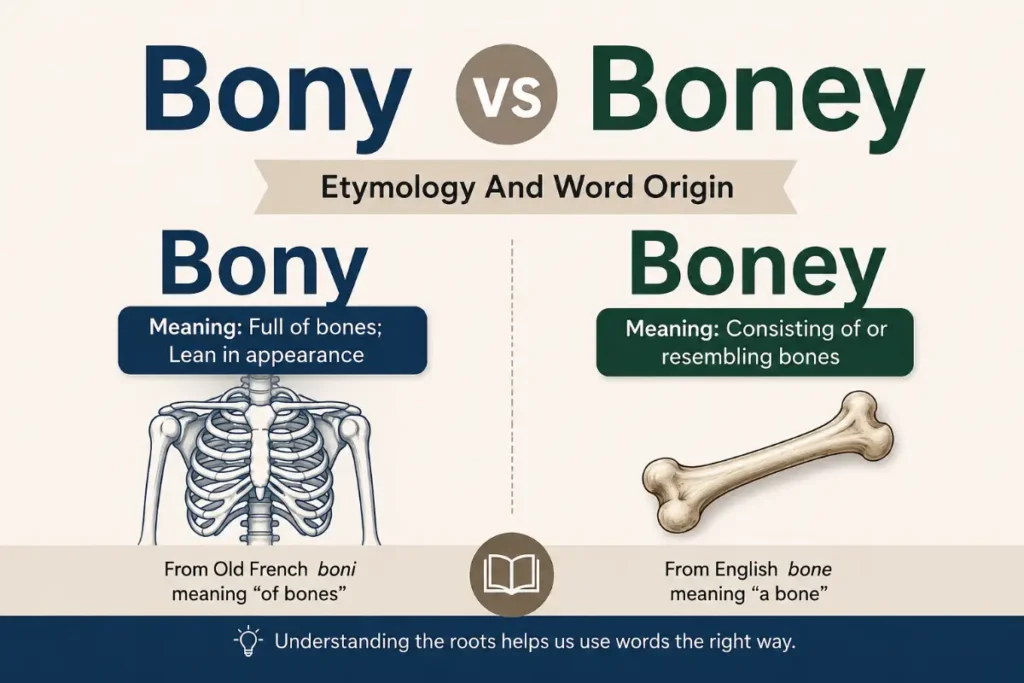
The adjective bony developed from the noun bone, which has been part of the English language since Old English. The familiar suffix y was added to create an adjective meaning full of, made of, or characterized by bones.
This pattern appears throughout English. Examples include:
- Cloud becomes cloudy.
- Dust becomes dusty.
- Ice becomes icy.
- Stone becomes stony.
The variant spelling boney appeared centuries ago as an alternative form. English spelling was much less standardized at that time, so writers often spelled words differently even within the same document.
As dictionaries and publishing standards became more consistent, bony gradually became the preferred spelling. Today, the older variant survives mainly in names, historical texts, and occasional stylistic choices.
Bony vs Boney Regional Usage
Unlike many spelling differences in English, this pair does not divide along American and British lines.
American English
American dictionaries and style guides strongly prefer bony.
The variant spelling appears mainly in proper names and historical references.
British English
British English follows the same convention.
Publishers, newspapers, and educational materials almost always use bony in modern writing.
Australian English
Australian English also treats bony as the standard form.
The alternative spelling is uncommon outside names or older publications.
Canadian English
Canadian English matches the same pattern.
Although Canadian spelling sometimes reflects both American and British influences, bony remains the accepted modern spelling.
Across the major English speaking countries, the preferred spelling is remarkably consistent.
Grammar Rules
Understanding how the word functions in sentences helps you use it naturally and confidently.
Part Of Speech
Bony is an adjective. It describes the appearance or physical characteristics of a person, animal, body part, or object.
Examples include:
- A bony hand.
- A bony shoulder.
- A bony tail.
- A bony structure.
Comparative And Superlative Forms
Like many short adjectives, bony forms its comparisons with more and most in many writing styles, although bonier and boniest are also accepted and commonly used.
Examples include:
- This puppy looks bonier than it did last month.
- That was the boniest horse on the farm.
- After recovering, he no longer looked as bony as before.
Common Word Combinations
Native speakers frequently use combinations such as:
- Bony fingers.
- Bony knees.
- Bony shoulders.
- Bony face.
- Bony frame.
- Bony fish.
- Bony skeleton.
- Bony structure.
These combinations appear naturally in medicine, biology, literature, journalism, and everyday conversation.
Real Life Usage Examples
The adjective appears in many different fields, each with its own context and meaning.
Daily Conversation
People commonly use the word to describe physical appearance.
Examples include:
- That stray cat looks bony.
- His elbows are surprisingly bony.
- The backpack felt uncomfortable against my bony shoulders.
The word simply describes visible or prominent bones. By itself, it does not necessarily suggest illness or poor health.
Academic Writing
Biologists, doctors, veterinarians, and anatomists frequently use bony in scientific writing. One common example is bony fish, a major group of fish with skeletons made primarily of bone rather than cartilage. This scientific meaning is completely separate from describing a thin person.
Professional Communication
Medical professionals may describe a bony prominence, bony anatomy, or bony injury in patient records and research papers. Veterinarians also use the adjective when examining animals or discussing skeletal development.
Literature And Media
Novelists often use the word to create vivid imagery. A phrase such as bony hands, bony face, or bony fingers quickly helps readers picture a character without requiring lengthy descriptions.
Bony Meaning In Business
The word has no specialized meaning in business English. When it appears in professional settings, it usually keeps its ordinary descriptive sense or forms part of a company name or product title.
For example, a business might include Boney in its brand identity, but that does not affect the standard spelling of the adjective.
Bony Fish
The term bony fish refers to fish whose skeletons are primarily made of bone. This group includes thousands of species and represents the vast majority of fish found around the world.
The phrase is widely used in biology, marine science, and educational materials, making it one of the most common technical uses of the adjective.
Related Words And Confused Terms
People comparing these spellings often search for similar words that describe physical appearance, anatomy, or body structure. Some are true synonyms, while others have different meanings and should not be used interchangeably.
The table below explains the most common related terms.
| Word | Meaning | Notes |
|---|---|---|
| Bony | Having visible or prominent bones | Standard spelling |
| Boney | Variant spelling of bony | Mostly found in names or older writing |
| Skinny | Very thin | Neutral or informal depending on context |
| Lean | Thin in a healthy or athletic way | Often positive |
| Slender | Gracefully thin | Usually complimentary |
| Thin | Not thick or overweight | General description |
| Gaunt | Extremely thin because of illness or hardship | Often negative |
| Skeletal | Resembling a skeleton | Strong descriptive word |
| Emaciated | Dangerously thin because of severe illness or starvation | Medical or formal context |
| Boneless | Without bones | Opposite meaning |
If you are looking for bony synonyms, choose the word that best matches your context. For example, lean can describe a healthy body, while gaunt and emaciated suggest poor health. Although skinny is common in conversation, it may sound judgmental in some situations.
For another commonly confused word pair, explore another commonly confused word pair involving courtesy and curtesy to avoid mistakes in both formal and everyday writing.
Expert Language Insight
From an editor’s perspective, this spelling choice is straightforward. Modern dictionaries, newspapers, publishers, and educational institutions consistently favor bony. That consistency is one reason readers rarely question the spelling when they see it in books, articles, or professional documents.
The variant spelling still has a place, but its role is limited. Editors preserve Boney when it appears in a surname, business name, place name, historical document, or direct quotation. Outside those situations, changing it to bony improves clarity and aligns with current English usage.
Another point worth remembering is context. Describing someone as bony focuses on visible bones or a thin build. It is a physical description, not a diagnosis or a judgment. In sensitive situations, writers often choose more neutral language if appearance is not relevant to the discussion.
When editing your own work, ask yourself two simple questions.
- Am I describing a person, animal, or object with visible bones?
- Am I referring to an official name that intentionally uses the variant spelling?
If the answer to the first question is yes, bony is almost always the right choice.
Frequently Asked Questions About Bony vs Boney
Is bony or boney the correct spelling?
Bony is the preferred spelling in modern English. It appears in major dictionaries, school textbooks, newspapers, and professional publications. Boney is a recognized variant, but it is much less common and is usually limited to names, historical writing, or stylistic choices.
Is boney a real word?
Yes. Boney is a real word, but it is not the standard spelling used in most modern writing. You may encounter it in older books, family names, business names, or historical documents, but bony is the form recommended for everyday use.
Do bony and boney have different meanings?
No. Both spellings generally describe something with noticeable bones or a body structure where bones are easy to see. The difference lies in spelling preference rather than meaning.
How do you spell boney correctly?
If you are describing a person, animal, or object, the correct modern spelling is bony. Keep Boney only when it is part of a proper name or when you are reproducing the original spelling from a historical source.
What does bony person mean?
A bony person has bones that are easy to see because there is very little fat or muscle covering them. The description refers to physical appearance and does not automatically mean someone is unhealthy.
What are bony fish?
Bony fish are fish whose skeletons are primarily made of bone rather than cartilage. They make up the largest group of fish species and include salmon, trout, tuna, cod, and thousands of others studied in biology and marine science.
Is bony used in business English?
There is no special business meaning for bony. In professional communication, the word keeps its ordinary descriptive meaning or appears as part of a company or product name.
Why do people confuse bony and boney?
The confusion happens because both spellings sound exactly the same. Many people also come across the variant in names, older books, or online content and assume it is equally common in modern English. In reality, professional writers overwhelmingly prefer bony.
Conclusion
The difference between bony vs boney is simpler than it first appears. Bony is the standard form used throughout modern English, making it the right choice for everyday writing, academic work, professional communication, and published content.
Although boney is a legitimate variant, it is far less common today. You will usually see it in historical texts, family names, place names, or creative works that intentionally preserve the older spelling. Outside those situations, using bony helps your writing match current language standards and reader expectations.
If you ever hesitate, remember one practical rule. Choose bony unless you are referring to an official name or quoting a source that uses the alternative spelling. That simple habit will keep your writing accurate, consistent, and easy to understand.