If you searched for seing vs seeing, you are probably trying to figure out which spelling is correct before sending an email, writing an assignment, or publishing content. It is an easy mistake to make because both words look similar, and the extra letter can seem unnecessary at first glance.
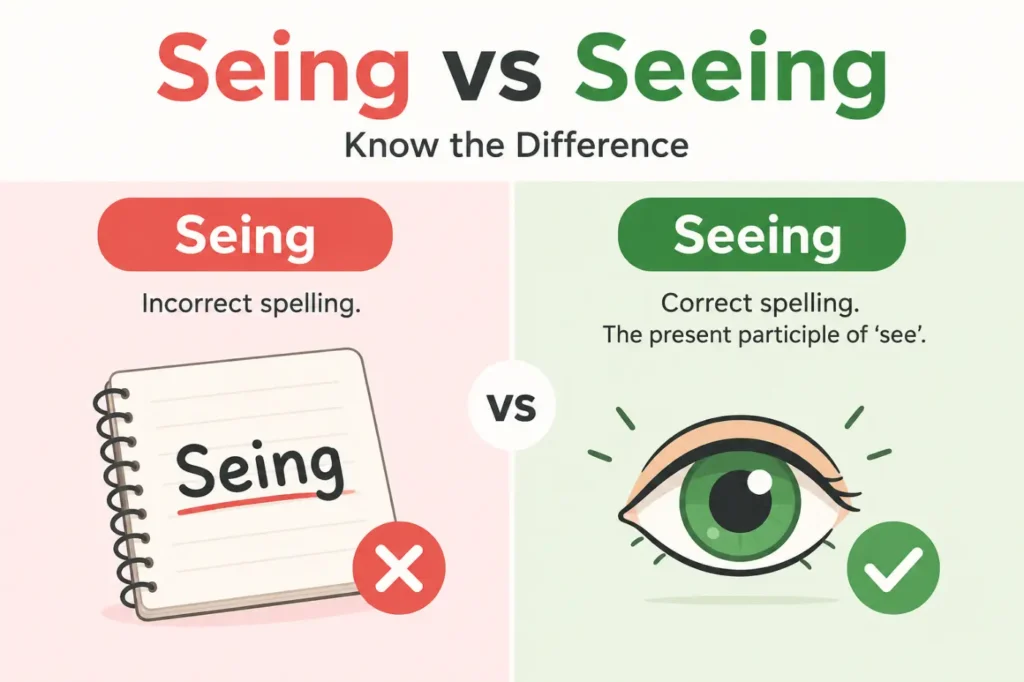
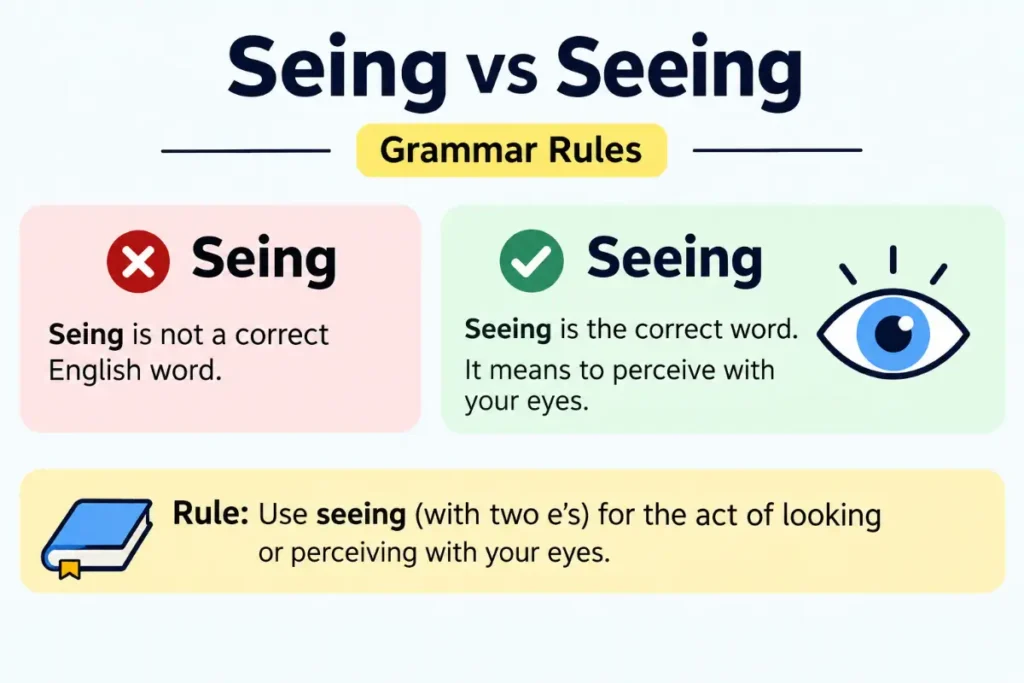
The correct spelling is seeing. It is the present participle and gerund form of the verb see. The spelling seing is a misspelling and is not recognized as a standard English word. If you use it in formal writing, grammar checkers and spell check tools will usually flag it as an error.
The confusion happens because English spelling rules are not always straightforward. When a verb ends with two vowels, people sometimes remove one by mistake. That is exactly what happens with seeing. Since the base word is see, both e letters remain before adding ing.
In this guide, you will learn the correct spelling, pronunciation, grammar rules, word origin, common mistakes, real world examples, and practical tips to remember the correct form. By the end, you will know exactly when to use seeing and why seing should be avoided.
Quick Definition
Seeing is the correct spelling of the present participle and gerund of the verb see. It means using your eyes to notice something or understanding a situation. Seing is simply a spelling mistake and has no accepted meaning in standard English.
Quick Answer
If you only need a fast answer, remember these key points.
- Seeing is the correct English spelling.
- Seing is a spelling error.
- Use seeing in academic, professional, and everyday writing.
- Grammar checkers and dictionaries recognize seeing but not seing.
Comparison Table
| Feature | Seeing | Seing |
|---|---|---|
| Part of speech | Present participle Gerund | Not a standard word |
| Correct spelling | Yes | No |
| Meaning | The act of using your eyes or understanding something | None |
| Origin | Derived from the verb see | Misspelling of seeing |
| Formality | Standard in all writing | Incorrect in all formal writing |
| Common contexts | Conversation education business literature | Typing errors informal messages |
| Usage frequency | Extremely common | Very rare |
| Dictionary status | Recognized by major dictionaries | Not recognized |
| Example | I am seeing my friends tomorrow. | I am seing my friends tomorrow. ✗ |
Meaning Of Both Terms
Although these spellings differ by only one letter, they are not equal in English. One is a proper word with several meanings, while the other is simply an error.
What Does Seeing Mean
Seeing comes from the verb see. It has several related meanings depending on the context.
It can describe:
- Using your eyes to notice something.
- Meeting or spending time with someone.
- Understanding or realizing an idea.
- Visiting a person or place.
- Experiencing an event firsthand.
For example:
- I am seeing beautiful mountains from my hotel room.
- She is seeing a doctor this afternoon.
- After reading the report, I am finally seeing the problem.
- We spent the weekend seeing famous landmarks.
Because the word has several meanings, context tells the reader exactly how it is being used.
What Does Seing Mean
Seing has no accepted definition in standard English. It appears because writers accidentally leave out one of the two e letters when typing seeing. Spell checkers usually identify this error immediately, and professional editors replace it with the correct spelling.
If you notice seing in an article, email, or report, treat it as a typo rather than a legitimate English word.
Key Differences
The difference between these spellings is simple but important.
Seeing is a correctly spelled English word with multiple grammatical uses. Seing is an incorrect spelling that should not appear in polished writing.
Here are the main differences.
- Seeing appears in dictionaries and grammar guides.
- Seing is considered a spelling mistake.
- Seeing functions as both a present participle and a gerund.
- Seing has no grammatical role in English.
- Professional writers, teachers, and editors always use seeing.
Although the words look similar, only one belongs in standard English. Using the correct spelling improves clarity and shows attention to detail.
Which Spelling Is Correct
The correct spelling is seeing. English spelling rules explain why the word keeps both e letters. The base verb is see. When ing is added, no letters are removed, so the correct form becomes seeing.
Many learners expect one e to disappear because other English verbs change spelling before adding ing. For example, make becomes making after dropping the silent e.
The verb see follows a different pattern because it already ends with a double vowel rather than a silent e. As a result, both letters remain. If you are writing essays, emails, blog posts, reports, or social media updates, always choose seeing.
If spelling mistakes like seing can slip into your writing, it’s also worth learning the correct spelling of transferred to avoid another commonly confused word.
Pronunciation Guide
The pronunciation stays the same regardless of spelling, although only one version is correct.
IPA Pronunciation
Seeing
/ˈsiː.ɪŋ/
Syllable Breakdown
The word has two syllables.
See ing
The first syllable receives the primary stress.
Common Pronunciation Mistakes
Most learners pronounce the word correctly, but these mistakes sometimes occur.
- Saying it as one syllable instead of two.
- Stressing the second syllable instead of the first.
- Pronouncing the ending too quickly so the second vowel sound disappears.
Listening to native speakers helps reinforce the natural rhythm and pronunciation.
How To Remember The Correct Spelling
One of the easiest ways to avoid this mistake is to think about the base word before adding ing.
The verb is see.
Notice that it already ends with two e letters. Since no letter is removed before adding ing, the correct spelling naturally becomes seeing.
You can also remember this simple rule.
- See has two e letters.
- Keep both letters.
- Add ing.
- The result is seeing.
Another helpful strategy is to use a grammar checker or spell checker while writing. These tools instantly highlight seing because it is not recognized as a standard English word.
With a little practice, the correct spelling becomes automatic, and the common typo quickly disappears from your writing.
Examples In Sentences
The easiest way to understand the correct spelling is to see it used in natural sentences. The first set shows proper usage, while the second highlights the common typo so you can recognize and avoid it.
Examples Using Seeing
These examples use the correct spelling in different contexts.
- I am seeing my grandparents this weekend.
- We enjoyed seeing the sunset over the ocean.
- She is seeing a specialist for her knee injury.
- Thank you for seeing me on such short notice.
- They were excited about seeing the new museum.
- I remember seeing that movie years ago.
- Seeing your hard work finally pay off is rewarding.
- He smiled after seeing the final results.
- We spent the afternoon seeing historic landmarks around the city.
- Seeing the problem from another perspective helped us find a better solution.
Notice that the word can describe physical sight, meeting someone, visiting places, or understanding an idea. The meaning changes with the context, but the spelling always stays the same.
Examples Using Seing
The spelling seing is incorrect. These examples show how the typo commonly appears and how it should be corrected.
- I am seing my friends tomorrow. ✗ → seeing ✓
- Thanks for seing me today. ✗ → seeing ✓
- We enjoyed seing the fireworks. ✗ → seeing ✓
- She is seing a dentist next week. ✗ → seeing ✓
- They were seing the sights downtown. ✗ → seeing ✓
- I remember seing that television show. ✗ → seeing ✓
- He kept seing the same mistake. ✗ → seeing ✓
- We are seing better results this year. ✗ → seeing ✓
- She looks forward to seing everyone again. ✗ → seeing ✓
- I appreciate seing your feedback. ✗ → seeing ✓
If you accidentally type seing, most grammar checkers and spell check tools will immediately suggest seeing.
Common Mistakes
Because the words differ by only one letter, the error appears frequently in emails, text messages, assignments, and online posts. Understanding the reason behind the mistake makes it much easier to avoid.
Leaving Out One Letter
The most common mistake is deleting one of the two e letters.
Incorrect:
Seing
Correct:
Seeing
This usually happens because people type quickly or assume one vowel should disappear before adding ing.
Applying The Wrong Spelling Rule
Many English verbs drop the final e before adding ing.
Examples include:
- Make → Making.
- Write → Writing.
- Drive → Driving.
Some learners assume see follows the same pattern. It does not. Since see ends with two vowels rather than a silent e, both letters remain.
Confusing Seen And Seeing
Another common mistake is mixing up seen and seeing. Although they come from the same verb, they have different grammatical roles.
Examples:
- I have seen that movie before.
- I am seeing that movie tonight.
The first sentence uses the past participle with the helping verb have. The second uses the present participle to describe an ongoing or planned action.
Trusting Fast Typing
Even experienced writers occasionally type seing without noticing. A quick proofread or grammar checker usually catches the mistake before the document is published.
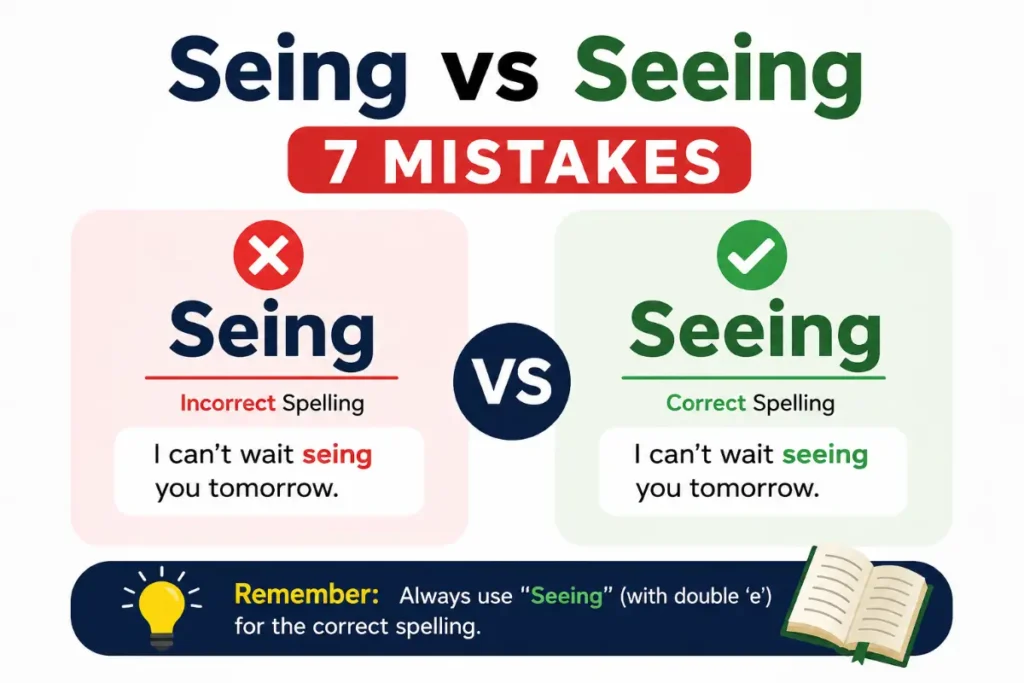
Seing vs Seeing 7 Mistakes
The spelling mistake is easy to make, but it is also easy to fix once you know what to watch for. Avoid these common errors to keep your writing clear and professional.
- Skipping a final proofread.
A quick review before you publish or send your writing can catch simple spelling mistakes that are easy to miss while typing. - Writing seing instead of seeing.
Seeing is the correct spelling. Seing is always a typo. - Dropping one e before adding ing.
The base verb is see, so keep both e letters when adding ing. - Confusing seeing with seen.
Use seeing for ongoing actions and seen with helping verbs like have, has, or had. - Ignoring spell check warnings.
Most grammar checkers flag seing as an error. Do not ignore those suggestions. - Assuming the typo is acceptable online.
You may spot seing on social media or forums, but it is still incorrect in standard English. - Using the wrong form in formal writing.
Emails, school assignments, reports, and articles should always use seeing.
Etymology And Word Origin
The word seeing comes from the Old English verb seon, which meant to perceive with the eyes or understand something through observation. Over many centuries, the spelling gradually developed into the modern verb see.
When English grammar forms the present participle, ing is added to the base verb. Because see already ends with two e letters, the spelling naturally becomes seeing.
The incorrect form seing has no historical basis. It developed simply as a typing error and has never been accepted as part of standard English.
The history of the word also explains its wide range of meanings. Originally linked to physical vision, it gradually expanded to include ideas such as understanding, meeting people, visiting places, and experiencing events.
Regional Usage
Unlike many English words that change spelling between countries, this one remains the same across the major varieties of English.
American English
American English always uses seeing. The incorrect spelling occasionally appears online, but it is treated as a typo rather than a regional variation.
British English
British English follows the same spelling. Schools, publishers, dictionaries, and newspapers all recognize seeing as the standard form.
Australian English
Australian English also uses seeing in formal and informal communication. There is no accepted regional spelling with one e.
Canadian English
Canadian English follows the same rule. Although Canadian spelling sometimes combines American and British conventions, seeing remains unchanged. No matter where English is spoken, seeing is the correct spelling.
Grammar Rules
Understanding how the word functions in grammar helps you use it with confidence.
Present Participle
The most common role is as the present participle of see.
Examples include:
- I am seeing improvements every day.
- They are seeing more customers this month.
In these sentences, the word forms part of the present continuous tense.
Gerund
The word can also function as a noun.
Examples:
- Seeing is believing.
- Seeing new places broadens your perspective.
Here, the action itself becomes the subject of the sentence.
After Prepositions
The word frequently follows prepositions.
Examples include:
- Thank you for seeing me.
- She left without seeing the manager.
- We talked about seeing the exhibition.
Common Expressions
Native speakers often use the word in familiar phrases.
Examples include:
- Nice seeing you.
- Seeing eye dog.
- Seeing double.
- Seeing things.
- Seeing clearly.
These expressions have become a natural part of everyday English and appear in both spoken and written communication.
Real Life Usage Examples
The word appears in many situations beyond simple descriptions of vision.
Daily Conversation
People commonly use it when talking about plans, relationships, or experiences.
Examples include:
- I am seeing my cousins this weekend.
- We are seeing better weather today.
- She is seeing a physical therapist.
Academic Writing
Teachers and researchers often use the word when discussing observation or evidence.
Examples include:
- Students are seeing consistent improvements in reading scores.
- Scientists are seeing encouraging results from the study.
Professional Communication
Businesses regularly use the word in emails and reports.
Examples include:
- We are seeing increased customer demand.
- Thank you for seeing our proposal.
- The team is seeing positive progress this quarter.
Literature And Media
Authors use the word both literally and figuratively.
Examples include:
- Seeing the world through another person’s eyes.
- Seeing beyond appearances.
- Seeing hope after difficult times.
Seeing Someone Meaning
In everyday English, seeing someone often means dating or having a romantic relationship.
Example:
- She has been seeing someone for several months.
The same phrase can also mean visiting a professional.
Examples include:
- I am seeing my lawyer tomorrow.
- He is seeing a doctor this afternoon.
The intended meaning depends entirely on the surrounding context.
Seeing You Meaning
The phrase seeing you usually refers to meeting or observing another person.
Examples include:
- It was great seeing you yesterday.
- I look forward to seeing you again soon.
Depending on the situation, it may express appreciation, anticipation, or simple observation.
Seeing Synonym
The best synonym depends on the context.
Common alternatives include:
- Watching.
- Observing.
- Noticing.
- Looking at.
- Viewing.
- Witnessing.
- Meeting.
- Visiting.
- Understanding.
- Recognizing.
Not every synonym fits every sentence, so choose the one that matches your intended meaning.
Improving your proofreading habits also means understanding the difference between courtesy and curtesy, since these similar-looking words have completely different meanings.
Related Words And Confused Terms
The verb see has several forms that learners often mix up. Understanding the differences helps you choose the right word in every sentence.
| Word | Part of Speech | Meaning | Example |
|---|---|---|---|
| See | Base verb | To use your eyes or understand | I see the mountains. |
| Seeing | Present participle Gerund | Looking observing meeting or understanding | We are seeing better results. |
| Seen | Past participle | Used with helping verbs such as have has and had | I have seen that movie. |
| Sight | Noun | The ability to see or something visible | The view was a beautiful sight. |
| Vision | Noun | The ability to see or a future plan | She has excellent vision. |
| Observe | Verb | To watch carefully | Scientists observed the changes. |
| Notice | Verb | To become aware of something | Did you notice the difference? |
| Watch | Verb | To look at something over time | We watched the game together. |
These words are closely related, but they are not interchangeable. The correct choice depends on grammar and context.
Another pair that often causes confusion is seen and seeing.
- Seen is the past participle and must be used with a helping verb.
- Seeing is the present participle or a gerund and can describe an ongoing action or act as a noun.
For example:
- I have seen that documentary.
- I am seeing that documentary tonight.
Although both forms come from the same verb, they serve different grammatical purposes.
Expert Language Insight
Professional editors rarely see seing in published writing because proofreading software catches it almost immediately. When it does appear, it is nearly always the result of fast typing rather than a misunderstanding of English grammar.
One habit separates confident writers from everyone else. They think about the base word before adding a suffix. In this case, the base verb is see. Since it already ends with two e letters, both remain when ing is added.
Native speakers do not consciously remember this spelling rule every time they write. Instead, they have seen the correct form thousands of times through reading books, articles, emails, and everyday messages. Frequent exposure gradually makes the spelling feel natural.
If you are learning English, reading regularly is one of the best ways to strengthen your spelling. The more often you encounter correctly written words in context, the easier it becomes to recognize mistakes without relying on a grammar checker.
Frequently Asked Questions
Is seeing or seing correct?
Seeing is the correct spelling. It is the present participle and gerund form of the verb see. Seing is a spelling mistake and should not be used in formal or informal writing.
Why is seeing spelled with two e letters?
The base verb is see, which already ends with two e letters. When ing is added, both letters remain. Unlike verbs such as make or write, no letter is removed before adding the suffix.
Is seing a real English word?
No. Seing is not recognized as a standard English word. Dictionaries and grammar references list seeing as the correct spelling, while spell check tools normally mark seing as an error.
What does seeing mean?
The word can describe using your eyes to observe something, meeting a person, visiting a place, or understanding an idea. The intended meaning depends on the sentence and surrounding context.
What is the difference between seen and seeing?
Seen is the past participle and requires a helping verb such as have, has, or had. Seeing is the present participle or a gerund and is used for ongoing actions or as a noun.
Does grammar checker detect seing?
Yes. Most grammar checkers and spell check programs recognize seing as a misspelling and recommend replacing it with seeing. Even so, proofreading your work is still a good habit because automated tools can occasionally miss other writing errors.
What does seeing someone mean?
The phrase can have two meanings. It often refers to dating someone in a romantic relationship. It can also mean visiting a professional, such as a doctor, lawyer, or therapist. The surrounding sentence makes the intended meaning clear.
What does seeing you mean?
The phrase usually means meeting or spending time with another person. It may also refer to physically noticing someone. Expressions such as It was great seeing you are common in everyday conversation and simply mean it was enjoyable to meet that person.
If you’re exploring tricky spelling variations, you may also find it helpful to learn when to use bony or boney, especially when describing someone’s appearance or anatomy.
Conclusion
The answer is simple. When comparing seing vs seeing, seeing is the correct spelling, while seing is a common misspelling that should be avoided in all types of writing.
The easiest way to remember the rule is to start with the base verb see. Since the word already ends with two e letters, you simply add ing without removing either one. This pattern stays the same in emails, essays, articles, business communication, and everyday conversations.
It also helps to understand how the word functions in grammar. Seeing can describe an ongoing action, act as a noun, or appear in common expressions that native speakers use every day. Once you recognize these patterns, choosing the correct spelling becomes much more natural.
Whenever you proofread your writing, take an extra second to look for this common typo. A small correction can make your work look more polished, professional, and trustworthy.