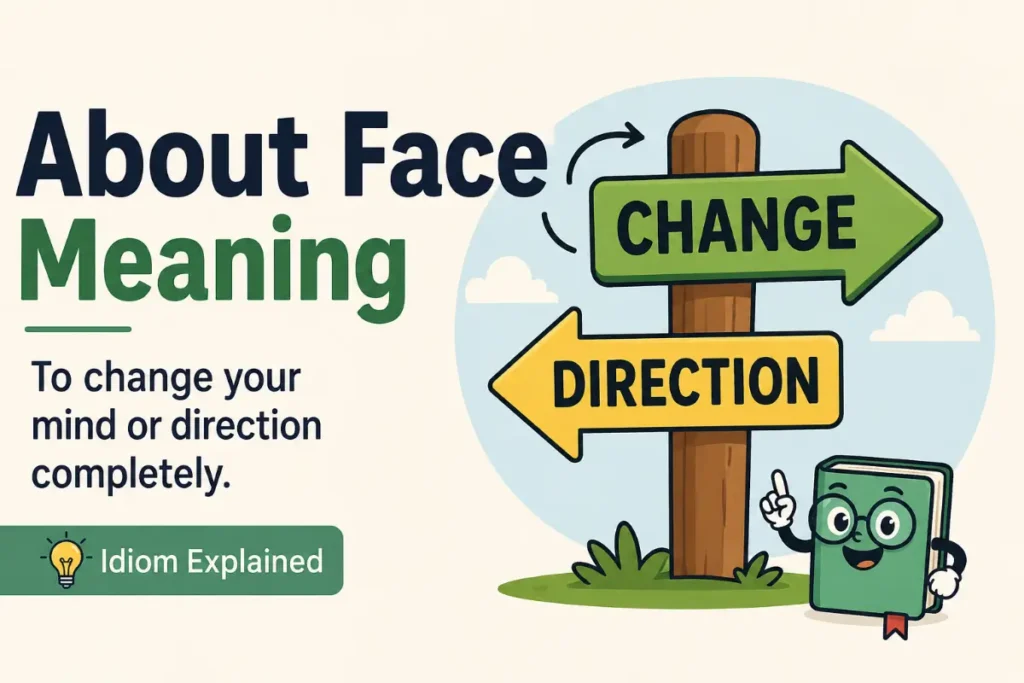
Sometimes a person changes direction so suddenly that the change feels like someone physically turning around and walking the other way. That is the basic idea behind about face meaning. The expression can describe a literal 180 degree turn, a military command, or a sudden reversal in an opinion, decision, policy, or behavior.
The phrase has a strong connection to military drill. A soldier who receives the command about face turns to face the opposite direction. Over time, that physical movement became a useful figurative image for situations where someone completely reverses course. Today, you might read that a company made an about face on a policy or hear that a politician did an about face after facing public pressure.
This guide explains the expression from its literal military use to its modern figurative meaning. You will also learn how it works in American English, how it differs from terms such as U turn and reversal, how to use it naturally in a sentence, and why the spelling sometimes appears with a hyphen.
Quick Answer
About face is a military command telling a person or group to turn around and face the opposite direction. As a noun, about face or about face with a hyphen can describe a complete reversal of direction, opinion, attitude, policy, or behavior. In everyday English, the figurative sense is often more common than the literal military sense.
For example:
The company made an about face and abandoned the plan.
Here, nobody physically turned around. The sentence means the company completely changed its position.
What Does About Face Mean
The expression has two closely connected meanings.
The first is literal. It describes turning around so that you face the opposite direction. In military drill, an about face is a 180 degree movement from the original position. Merriam Webster defines the noun as a 180 degree turn and also gives the broader meanings of reversal in direction, attitude, behavior, or point of view.
The second meaning is figurative. It describes a sudden and complete change from a previous position.
That position might be:
- An opinion.
- A political position.
- A business decision.
- A personal attitude.
- A strategy.
- A policy.
- A direction.
- A plan.
- A behavior.
- A public statement.
The figurative meaning works because the mental image is so clear. Imagine someone walking north, stopping without warning, turning 180 degrees, and walking south. That physical reversal becomes a powerful way to describe a change of mind or direction.
When someone says something was “much needed,” they mean it was greatly needed or especially welcome at that moment, so understanding a much-needed explanation can help clarify the phrase’s tone and usage.
About Face In Military Use
The military meaning is the original idea behind the modern expression.
When a soldier stands at attention and receives the command about face, the soldier turns to face the opposite direction. The command is associated with military drill and synchronized movement. Cambridge describes it as a phrase used in the military to tell soldiers to turn around and face the other way.
The command is short because military commands need to be direct. There is no need for a long explanation such as turn around and face the opposite direction. About face communicates the movement immediately.
You might encounter the expression in descriptions of:
- Military training.
- Marching drills.
- Ceremonial formations.
- Historical military writing.
- Fiction involving soldiers.
- Descriptions of military commands.
In modern everyday conversation, however, people are more likely to use the figurative sense.
About Face As A Change Of Direction
The literal movement gives the expression its figurative power.
Suppose a driver is heading toward a destination and suddenly realizes the road is closed. The driver turns around and heads in the opposite direction. That is a physical about face.
Now imagine a company that spends months saying it will launch a product and then suddenly cancels the launch. You could describe that decision as an about face.
The physical action and the figurative action follow the same pattern:
Original direction → complete reversal → opposite direction.
That pattern makes the expression easy to understand even when the subject is an abstract idea.
Cambridge gives examples involving changes in physical direction as well as changes in opinion and behavior.
About Face As A Change Of Opinion
One of the most common modern uses involves changing your mind.
For example:
The senator made an about face on the proposal.
This means the senator previously held one position but later adopted a significantly different or opposite position.
The expression often suggests that the change was noticeable. It is stronger than simply saying someone adjusted an opinion.
Compare these sentences:
The manager changed his mind.
The manager made an about face.
The first sentence is neutral. The second suggests a sharper reversal.
That difference matters in writing. If you want to emphasize how dramatic or unexpected a change was, this expression gives the sentence more force.
About Face As A Policy Reversal
The expression appears frequently in journalism and political writing because governments and organizations sometimes reverse decisions.
For example:
The government made an about face on the proposed regulation.
This tells the reader that the government had previously supported or pursued one position and then moved in another direction.
It can also describe a company:
The company made an about face and restored the original pricing model.
Or a school:
The district made an about face and decided to keep the program open.
The phrase is particularly useful when the reversal is significant enough to attract attention.
About Face In Business Writing
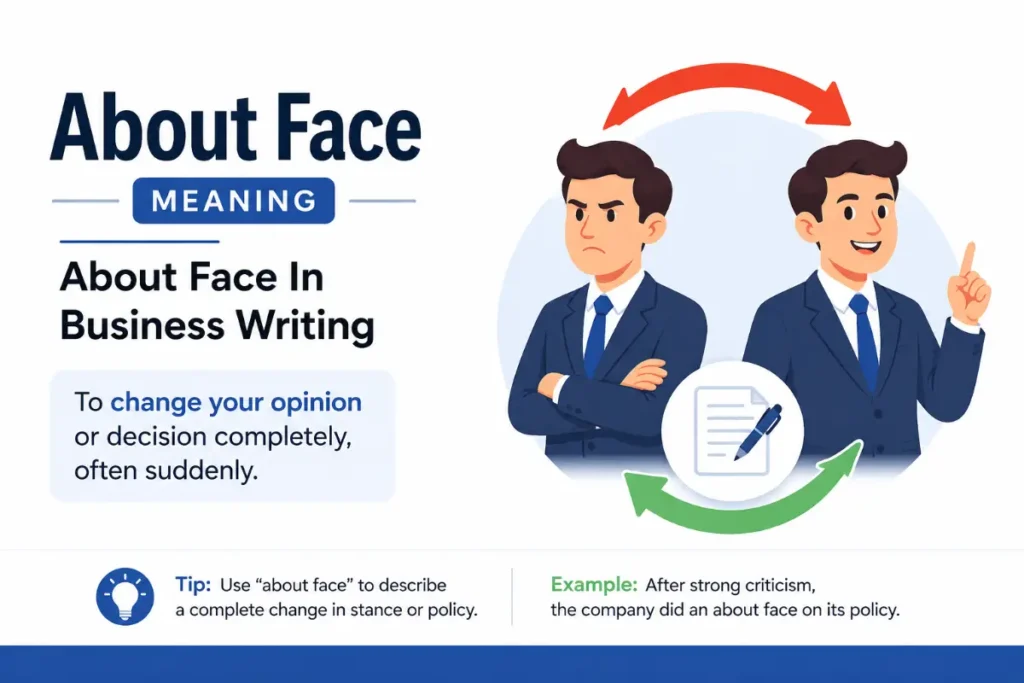
Business writers often use the expression to describe a major strategic reversal.
Consider a company that announces plans to close physical stores. A few months later, executives decide to expand the stores instead.
A writer might say:
The retailer made an about face and announced plans to open new locations.
The phrase immediately tells the reader that the second decision conflicts with the earlier direction.
It can describe changes involving:
- Pricing.
- Hiring.
- Product strategy.
- Marketing.
- Expansion.
- Investment.
- Customer policy.
- Technology.
- Company leadership.
- Corporate strategy.
There is one editorial point worth remembering. An about face usually suggests a meaningful reversal. Do not use it for every small adjustment.
If a company changes the color of a product package, calling that an about face would sound exaggerated. If the company completely abandons the product strategy it spent years promoting, the expression fits much better.
About Face In Everyday Conversation
The expression is not limited to politics or business.
People use it to describe personal decisions too.
For example:
I was going to sell the car, but I did an about face and decided to keep it.
She made an about face and accepted the invitation.
He did an about face after talking with his family.
These sentences all describe a noticeable reversal.
The phrase can add personality to ordinary conversation because it creates a visual image. Instead of simply saying someone changed their mind, you can make the change feel more dramatic.
About Face In Slang
People sometimes search for about face meaning slang because the expression appears in informal conversations and online discussions.
It is important to separate slang from an informal idiom.
About face is not really slang in the modern linguistic sense. It is an established English expression with a military origin and a widely recognized figurative meaning.
You can find it in newspapers, books, business writing, political commentary, and ordinary conversation. It can sound conversational, but that does not make it slang.
For example:
He did an about face after everyone criticized the idea.
That sentence is informal enough for conversation but does not rely on slang.
If you are writing an essay or professional article, the expression can still work when the context calls for a strong reversal.
About Face Meaning In Text
In text messages and online conversations, the expression usually carries its figurative meaning.
If someone writes:
She did an about face.
They probably mean that she suddenly changed her mind, position, or behavior.
The phrase can also appear in shorter casual exchanges.
For example:
He said he was leaving, then did an about face.
The reader understands that he reversed his decision.
You do not need special internet slang knowledge to understand the expression. Its meaning remains close to standard dictionary usage.
About Face Vs About Turn
The closest regional comparison is about turn.
Cambridge identifies about turn as the UK equivalent of the military command and also lists it as a related expression for changes in direction.
American English commonly uses about face.
British English can use about turn for the same general idea.
For example:
The soldier was ordered to do an about face.
In British usage you may encounter:
The soldier was ordered to do an about turn.
The figurative meanings also overlap.
The government made an about face.
The government made an about turn.
Both can describe a major reversal, although regional preference and context affect which expression sounds more natural.
About Face Vs U Turn
U turn is another close synonym, but it has a slightly different feel.
A U turn literally describes a vehicle turning around to travel in the opposite direction. Figuratively, it can describe a major change in policy, opinion, or strategy.
For example:
The company made a U turn on its pricing policy.
The company made an about face on its pricing policy.
Both sentences communicate a reversal.
The difference is mostly stylistic and contextual. U turn is especially common when the image of changing direction is important. About face has a stronger connection to military drill and can sound more formal or deliberate in some contexts.
Cambridge lists U turn as a synonym for the figurative sense and about turn as a regional alternative.
About Face Vs Reversal
Reversal is broader and more neutral.
If you write:
The company announced a reversal of its policy.
You simply state that the policy changed.
If you write:
The company made an about face on its policy.
You emphasize the sharpness of the change.
This makes reversal useful in formal analytical writing, while about face can give the sentence a stronger visual and rhetorical effect.
A good editor chooses between them based on tone.
Use reversal when you want a neutral description.
Use about face when you want to highlight the dramatic change.
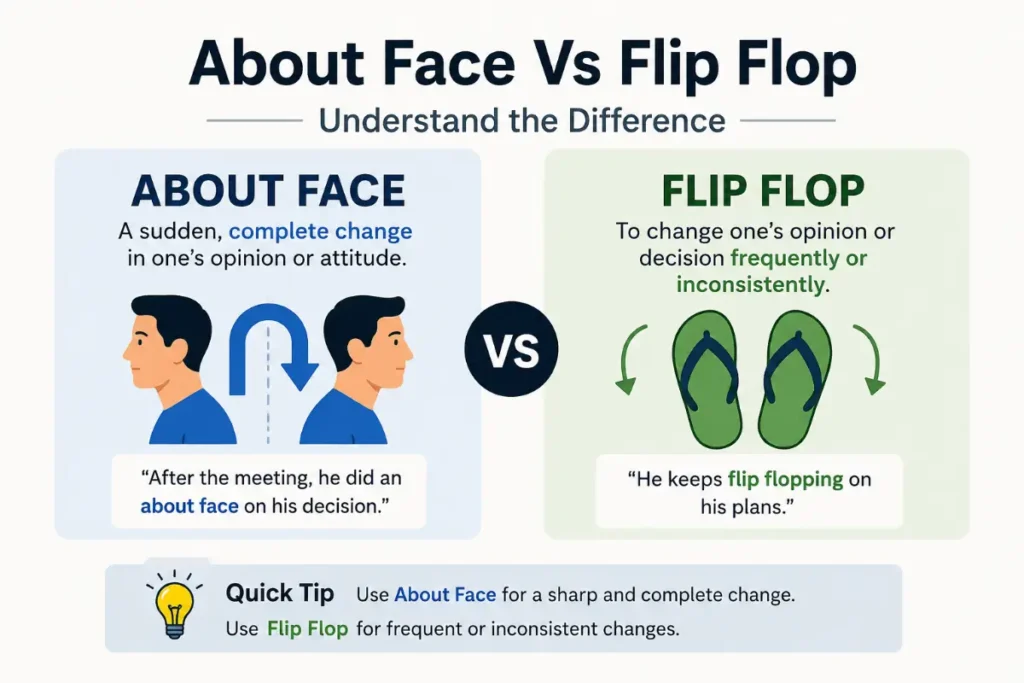
About Face Vs Flip Flop
Flip flop can also describe a change in opinion or position, but it often carries a more critical tone.
If a politician changes positions repeatedly, a critic might accuse the politician of flip flopping. An about face can describe one major reversal without necessarily accusing someone of being dishonest or inconsistent.
For example:
The company made an about face after testing the new product.
This sounds relatively neutral.
The company keeps flip flopping on its strategy.
This suggests criticism because the company appears indecisive. That distinction matters when writing about people or organizations.
About Face Synonyms
Several words and expressions can communicate a similar idea.
- Reversal means a change to an opposite position or direction.
- U turn describes a sharp change in direction or position.
- Turnaround can describe a major change in circumstances, direction, or performance.
- Change of mind is a simple and neutral expression.
- Change of heart often suggests a personal or emotional shift.
- Shift describes movement from one position to another but does not always imply a complete reversal.
- Flip flop often suggests repeated or inconsistent changes.
- About turn is a common British alternative.
- Volte face describes a sudden and complete change in position or attitude and has a more formal feel.
- Reversal of course emphasizes a change in direction or strategy.
The best synonym depends on the situation. Not every word suggests the same degree of suddenness or criticism.
Just as “about face” can describe a complete change in direction, knowing when someone says “well said” helps you understand how people express approval of a particularly clear or insightful remark.
About Face Origin
The expression comes from the language of military drill. Merriam Webster traces about face to the imperative phrase about face and gives a first known use of about face as a noun in 1835.
The underlying construction combines about with face.
In this context, about carries the sense of turning around or changing orientation, while face relates to the direction in which a person is facing.
The original command therefore describes a person changing orientation to face the opposite direction.
The figurative meaning developed naturally from that physical image. Once English speakers had a phrase for turning around completely, it was an easy step to apply the expression to changes in opinions, policies, strategies, and behavior.
Dictionary sources describe the expression as an American English development and date it to the nineteenth century.
The Military Roots Behind The Idiom
Military drill has contributed many expressions to everyday language because drill commands are short, memorable, and strongly visual.
An about face is especially effective as a metaphor because the movement is complete. A soldier does not make a small adjustment. The person turns around to face the opposite direction.
That physical precision gives the figurative expression its strength.
When a newspaper says that a company made an about face, readers immediately understand the implied movement. The company was heading in one direction and then suddenly went the other way.
This is one reason the expression has remained useful long after most people encounter it outside military training.
How To Write About Face Correctly
The expression appears in several grammatical forms.
As a noun, you can write:
The company made an about face.
Many dictionaries use the hyphenated spelling about face as about face when it functions as a noun. Merriam Webster and Cambridge both present about face as a noun while also recognizing the military command as about face.
As a verb, you can use:
The company about faced after the announcement.
The verb forms are about faced and about facing in dictionary descriptions.
The spelling can vary by grammatical function and style guide, so writers should check the conventions of the publication they are writing for.
About Face Or About Face
This is one of the most confusing parts of the expression because the same words can appear with different punctuation depending on their grammatical role.
As a military command, dictionaries commonly show:
About face.
As a noun, dictionaries commonly show:
about face.
As a verb, you may see:
about faced or about facing.
The important point is to avoid treating the phrase as one fixed spelling in every grammatical situation.
Merriam Webster lists the noun as about face and traces it to the imperative phrase about face.
For polished publishing, follow the dictionary or style guide used by your publication.
About Face Pronunciation
The expression is pronounced roughly like:
uh BOUT FACE
The commonly listed American pronunciation is approximately /əˌbaʊtˈfeɪs/. Cambridge gives the same basic pronunciation for the noun in both its US and UK entries.
There are two main parts:
about
face
The stress falls strongly on face, while about carries secondary stress in the noun pronunciation.
The phrase is usually easy for English speakers to pronounce because both words are familiar.
About Face In A Sentence
Here are natural examples showing the expression in different contexts.
Personal Decisions
- I was ready to quit, but I did an about face after talking to my manager.
- She made an about face and decided to stay for another year.
- He did an about face when he realized the plan could save money.
Business
- The company made an about face and returned to its original pricing strategy.
- The retailer did an about face after customers complained about the new policy.
- Management made an abrupt about face on remote work.
Politics
- The senator made an about face on the proposed bill.
- The administration announced an about face after months of defending the policy.
- Voters were surprised by the candidate’s sudden about face.
Direction
- The driver made an about face after reaching the closed road.
- The aircraft made an about face and returned to the airport.
- The hikers made an about face when the trail became unsafe.
Military Context
- The instructor gave the command to about face.
- The recruits performed an about face during the drill.
- The soldiers executed an about face and marched in the opposite direction.
These examples show why context matters. The same expression can describe a physical turn or an abstract reversal.
Common Mistakes With About Face
The most common problems involve meaning, punctuation, and overuse.
Treating It As Pure Slang
The expression is not limited to slang. It is an established idiom with a military origin and a long history in standard English.
Using It For A Tiny Change
An about face usually suggests a substantial reversal.
Changing a meeting from 2:00 PM to 2:30 PM is not normally an about face.
Abandoning an entire strategy can be.
Confusing It With Change Of Heart
A change of heart often emphasizes emotion or personal feeling.
An about face emphasizes reversal.
For example:
She had a change of heart and forgave him.
This sounds emotional.
She made an about face and rejected the proposal.
This focuses on a clear reversal.
Assuming It Always Means A Military Turn
The military sense is important because it explains the origin, but modern English frequently uses the expression figuratively.
A news article about business policy may use it without any military context.
When About Face Sounds Natural
The expression works best when the change is clear and significant.
It sounds natural with verbs such as:
- Make an about face.
- Do an about face.
- Take an about face.
- Make a sudden about face.
- Make an abrupt about face.
- Make a complete about face.
The most natural combinations often involve make or do.
For example:
The company made an about face on the issue.
He did an about face after hearing the news.
These patterns are common and easy for readers to understand.
When To Choose A Different Expression
Sometimes another word is cleaner.
If you simply mean someone changed their mind, use:
changed his mind
If you mean a policy changed, use:
reversed the policy
If you mean a vehicle turned around, use:
turned around
If you mean a politician repeatedly changes positions, use:
flip flopped
If you mean a formal change in direction, use:
reversal
Strong writing is not about using the most colorful expression available. It is about choosing the word that matches the exact meaning.
Regional Usage
American English strongly associates about face with the expression.
British English also recognizes it, but about turn is a common alternative, especially for the military command. Cambridge explicitly labels about turn as the UK equivalent of the military command.
This regional difference is useful for writers working with international audiences.
- If your audience is primarily American, about face will sound familiar.
- If your audience is primarily British, about turn may sound more natural in certain contexts.
The figurative sense of a complete reversal is understood broadly across English varieties.
If you are exploring the meanings behind expressions and symbols, learning what purple roses symbolize can also reveal how color and context influence the way we communicate ideas.
Expert Language Insight
The strength of this expression comes from its physical image.
Good idioms often survive because they make abstract ideas concrete. Changing an opinion is invisible. Turning your body around is visible. By connecting the two, English gives readers an immediate picture of a mental or strategic reversal.
That is why about face can feel stronger than simply saying change.
- A change can be gradual.
- An about face usually feels sudden.
- A change can be minor.
- An about face suggests something substantial.
- A change can move in any direction.
- An about face suggests a reversal from the previous course.
This difference is especially useful in editorial writing. If an article says a company changed its policy, the reader knows something happened. If it says the company made an about face, the reader expects a sharper reversal and may naturally wonder why.
The phrase therefore carries more than its dictionary definition. It also carries a sense of contrast between the old position and the new one.
About Face In Literature And Media
Writers have long used the expression because it creates an immediate visual moment.
Imagine a character walking away after an argument. Suddenly, the character stops, turns around, and returns. Describing that action as an about face can make the scene feel decisive.
The figurative version works in the same way. A character may defend one belief throughout a story and then make an about face after a major revelation. A political leader may promise one policy and later reverse course. A company may announce one strategy and then abandon it.
The phrase compresses that entire reversal into a compact image.
Eight Quick Answers About The Expression
What does about face mean
It means a complete turn toward the opposite direction or a sudden reversal in opinion, attitude, behavior, policy, or strategy. The literal expression comes from military drill, where a command tells a soldier to turn around and face the opposite direction. The figurative sense developed from that clear physical image.
Is about face a military term
Yes. The original literal use is a military command. It tells soldiers to turn around and face the opposite direction. Modern English also uses the expression outside military contexts to describe a major reversal in direction or position.
Is about face slang
No. Although it can sound informal in casual conversation, it is an established English expression rather than modern slang. It appears in dictionaries and is used in journalism, business writing, political commentary, literature, and everyday speech.
What is an about face in politics
In politics, it means a major reversal in a politician’s or government’s position. For example, if a leader strongly opposes a proposal and later supports it, a writer might describe that change as an about face.
What is the synonym for about face
Common alternatives include reversal, U turn, about turn, change of direction, change of mind, turnaround, and volte face. Flip flop can also work when the writer wants to suggest repeated or inconsistent changes.
Is about face hyphenated
As a noun, dictionaries commonly use the hyphenated form about face. The military command is commonly written as about face. Verb forms such as about faced and about facing are also used. Follow the dictionary and style guide appropriate for your publication.
What is the British version of about face
The British expression is often about turn, especially as a military command. The figurative meaning of a complete reversal can also be expressed with about turn.
Does about face mean change your mind
It can. In modern figurative English, it often means making a sudden and significant change in opinion, position, policy, or behavior. However, it can also describe a literal physical turn in the opposite direction.
Final Takeaway
The expression describes a complete reversal. In its original military sense, it tells someone to turn around and face the opposite direction. In modern English, it commonly describes a sudden change in opinion, policy, strategy, behavior, or direction.
The easiest way to remember the figurative meaning is to picture someone walking one way and then suddenly turning around. That image explains why the phrase works so well for changes of mind or changes of course.
Use it when the reversal is meaningful and noticeable. For a small adjustment, a simpler word such as change or shift will usually sound better.
If you are writing for an American audience, about face is a familiar expression. For British readers, about turn may be the more natural choice in some contexts. Either way, the core idea remains the same: one direction is abandoned and another takes its place.