Have you ever heard someone say they need a much needed break, a much needed vacation, or a much needed change? The phrase is common in everyday English, but it can be confusing because its meaning changes slightly depending on the sentence. It can describe something that is strongly required, greatly wanted, or especially helpful at a particular moment.
The expression is also sometimes mistaken for slang because people use it so often in casual messages and social media posts. It is not slang. It is a standard English expression that works in conversations, professional writing, articles, emails, and everyday speech. The main issue is usually punctuation and context rather than meaning.
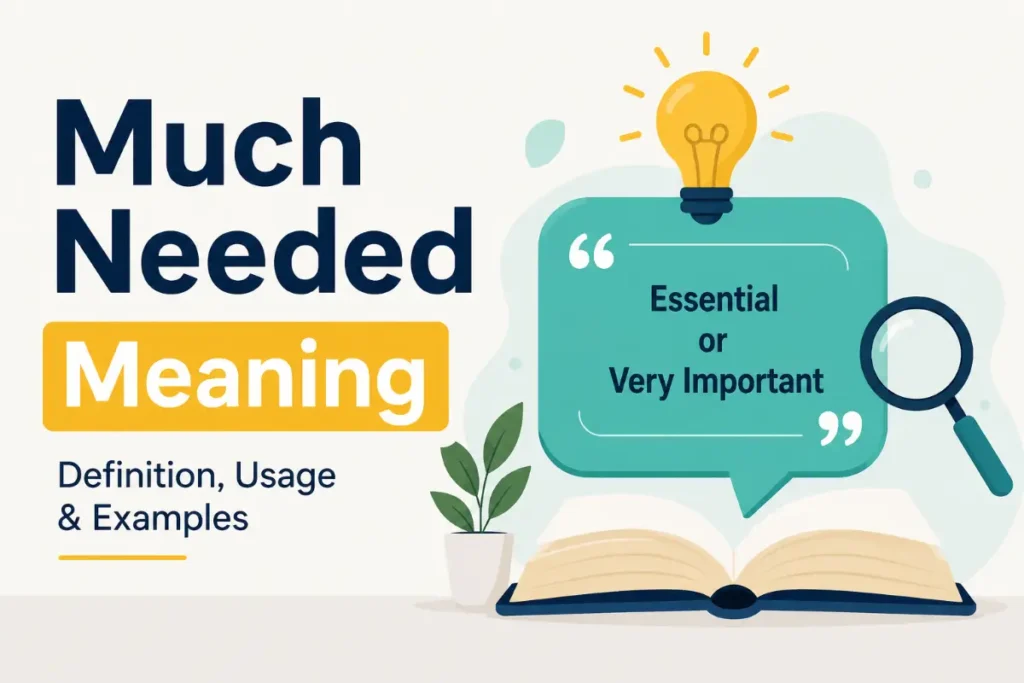
In simple terms, much needed means strongly needed or greatly necessary. A much needed break is a break that someone really needs. A much needed answer is an answer that has become important or urgent. A much needed rainstorm is rain that arrives after a dry period and provides relief.
This guide explains the phrase from several angles. You will learn its meaning, grammar, punctuation, common synonyms, sentence patterns, slang usage, examples, regional usage, and the difference between much needed and similar expressions such as badly needed, greatly needed, much appreciated, and much wanted.
Quick Answer
Much needed means greatly needed, strongly required, or very necessary. It describes something that is particularly useful or necessary at a certain time. For example, I finally took a much needed break means the person had been working or dealing with something difficult and really needed time to rest.
The expression is not slang. It is ordinary English and can be used in casual conversation as well as professional and formal contexts.
When it appears before a noun as a compound adjective, the standard written form is usually much needed with a hyphen between the two words: a much needed break. When it comes after a verb, the hyphen is generally unnecessary: The break was much needed.
What Does Much Needed Mean
The phrase describes something that is needed to a significant degree. The word much strengthens the adjective needed, making the idea stronger than simply saying something is needed.
Compare these sentences:
- I need a break.
- I need a much needed break.
The first sentence says that a break is necessary. The second emphasizes the strength of that need and suggests that the break is especially timely or valuable.
In natural English, the phrase often carries an emotional sense of relief. When someone says they had a much needed vacation, the speaker usually means the vacation came at the right time after stress, work, exhaustion, or a long period without rest.
The same idea works with many other nouns:
- A much needed rest.
- A much needed vacation.
- A much needed change.
- A much needed solution.
- A much needed break.
- A much needed opportunity.
- A much needed improvement.
- A much needed conversation.
- A much needed rain.
- A much needed update.
The phrase does not always mean that something is literally required for survival. In ordinary conversation, needed can mean strongly wanted because circumstances make it useful, timely, or beneficial.
For example, That coffee was much needed does not normally mean the person would have been unable to survive without coffee. It means the coffee was especially welcome or helpful at that moment.
If you’re unsure what a term says about someone’s work or identity, understanding what an employer name means can provide useful context.
Is Much Needed Slang
No. Much needed is not slang.
It is a standard English expression that appears across many kinds of communication. You can find it in casual conversation, workplace messages, news writing, personal writing, advertising, reviews, and formal contexts.
The phrase can sound casual when used in a short response such as:
Much needed.
Someone might post this after receiving a vacation, taking a nap, getting a meal, or enjoying a quiet weekend. The shortened expression feels conversational because the rest of the sentence is understood.
For example:
That weekend away was much needed.
can become:
Much needed.
The shorter version is common in texts, captions, comments, and social media. That informal use does not make the phrase slang. It simply shows how English speakers shorten familiar expressions when the context is obvious.
A useful distinction is this:
Slang usually involves words or expressions strongly associated with informal speech, social groups, trends, or particular communities.
Much needed does not belong to that category. It is ordinary vocabulary with a flexible level of formality.
What Does Much Needed Mean In A Sentence
The exact meaning depends on what is being described.
In I took a much needed break, the phrase means the break was strongly needed because the speaker had been working or dealing with pressure.
In The city received much needed rain, the phrase means the rain arrived after a period when rain was scarce and conditions made it important.
In She gave me a much needed answer, the phrase suggests that the answer was important because uncertainty or confusion had continued.
In We finally got the much needed funding, the expression emphasizes that the money was necessary for a project or organization to move forward.
The common thread is timing. Something is not merely needed in theory. It is needed at that particular point.
That sense of timing is one reason the expression sounds natural in everyday English. It often communicates relief.
Much Needed Break Meaning
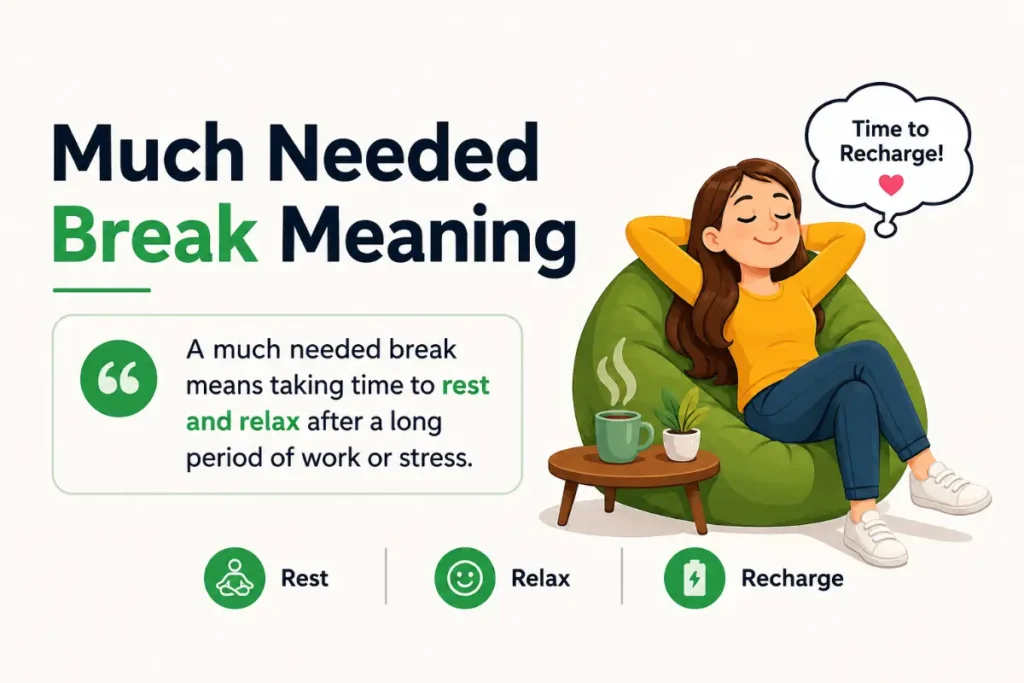
A much needed break is a period of rest that someone strongly needs. The phrase is especially common after work, travel, studying, stressful events, or long periods of responsibility.
For example:
After six straight days at work, I took a much needed break.
The sentence tells us more than I took a break. It suggests that the person was tired and that the timing of the rest mattered.
You can use the expression for short breaks or longer periods of rest:
- A much needed lunch break.
- A much needed afternoon off.
- A much needed weekend away.
- A much needed vacation.
- A much needed night of sleep.
The phrase often has a positive emotional tone because the speaker feels relief after finally getting something they needed.
Much Needed Rest Meaning
Much needed rest means rest that is strongly necessary because someone is tired, stressed, sick, busy, or mentally drained.
For example:
After the long trip, she finally got some much needed rest.
This sentence suggests that the person had not had enough time to recover.
You can also use it in a more figurative way:
The old building received some much needed attention.
Here, the phrase does not describe physical rest. It simply emphasizes that attention was overdue and important.
Much Needed Change Meaning
A much needed change is a change that people believe is necessary or beneficial.
For example:
The company introduced a much needed change to its scheduling system.
The expression suggests that the old system had a problem and that the new approach addresses it.
You can use it in personal situations too:
Moving to a quieter neighborhood was a much needed change for our family.
The phrase works well here because the change is not merely different. It solves a problem or improves a situation.
Much Needed Help Meaning
Much needed help refers to assistance that is strongly required.
For example:
The volunteers provided much needed help after the storm.
The phrase emphasizes the importance of the assistance.
It can also describe small acts of support:
Thanks for the much needed help with my presentation.
Here, the speaker is saying that the assistance made a meaningful difference.
Much Needed Rain Meaning
Much needed rain is a particularly common expression in weather and environmental writing.
It usually describes rain that arrives after dry conditions.
For example:
The farmers welcomed the much needed rain.
The rain is not simply rain. It has arrived when the land, crops, or people need it.
You may also hear:
The region finally received much needed rainfall.
This construction is common because it efficiently communicates both the event and its importance.
Much Needed Synonyms
Several expressions can communicate a similar idea, but each carries a slightly different tone.
Greatly Needed
Greatly needed emphasizes importance.
The community received greatly needed supplies.
This sounds slightly more formal than much needed.
Badly Needed
Badly needed emphasizes urgency or strong necessity.
The team badly needed a win.
This can sound more emotional and direct.
Strongly Needed
Strongly needed is understandable but less natural in many everyday contexts. Native speakers usually prefer greatly needed, badly needed, or much needed.
Urgently Needed
Urgently needed focuses on immediate necessity.
The hospital urgently needed additional supplies.
This is stronger and more serious than many everyday uses of much needed.
Greatly Appreciated
Do not confuse greatly appreciated with much needed.
Your help was much needed means the help was strongly necessary.
Your help was greatly appreciated means the speaker was very thankful for it.
Both expressions can appear together:
Your much needed help was greatly appreciated.
That sentence says the assistance was necessary and that the speaker was grateful.
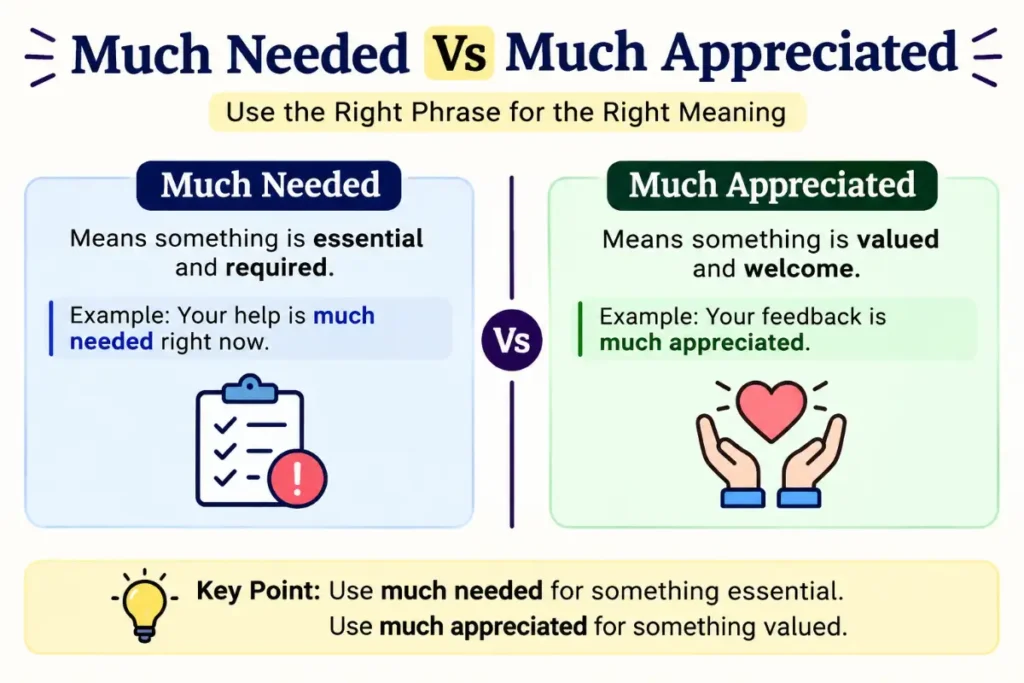
Much Needed Vs Much Appreciated
These phrases are sometimes confused because both appear in thank you messages.
The difference is simple.
Much needed describes necessity.
Much appreciated describes gratitude.
Compare:
Your advice was much needed.
The advice was necessary or especially useful.
Your advice was much appreciated.
The speaker is thankful for the advice.
You can use both:
Your advice was much needed and much appreciated.
This tells the reader that their advice solved a real need and that the speaker values their effort.
Much Needed Vs Badly Needed
These expressions are close, but they have different emotional tones.
Much needed often sounds warm, positive, or relieved.
Badly needed can sound more urgent or desperate.
Compare:
I took a much needed vacation.
This sounds relaxed and positive.
We badly needed a solution.
This sounds more urgent because the problem has become serious.
In many casual situations, much needed is the smoother choice.
Much Needed Vs Must Needed
Must needed is not standard English when you want to say that something is strongly necessary.
You should say:
Much needed.
Or:
Greatly needed.
Or:
Urgently needed.
The confusion probably comes from the word must, which expresses necessity in constructions such as:
We must act now.
You cannot simply place must before needed and produce the same meaning.
Correct:
The project needed more funding.
The project was much needed by the community.
The project urgently needed more funding.
Incorrect:
The project was must needed.
Much Needed In A Sentence
The expression can appear in several useful sentence patterns.
Before A Noun
When it modifies a noun directly, it functions as a compound adjective.
Examples include:
- We took a much needed vacation.
- She received a much needed promotion.
- The team got a much needed victory.
- The garden received much needed rain.
- He finally had a much needed rest.
This structure is common because it puts the importance of the noun right before the thing being described.
After A Linking Verb
You can also place the expression after a verb.
Examples:
- The vacation was much needed.
- The rest was much needed.
- The rain was much needed.
- Her support was much needed.
- The change was much needed.
In this structure, the phrase describes the subject after a linking verb such as was.
If you’ve come across the abbreviation PMG in a message or document, you may also want to see the PMg meaning explained in a clear, straightforward way.
Much Needed Or Much Needed
There is no difference in meaning between much needed and much needed as words. The important issue is punctuation and sentence position.
When the phrase appears before a noun as a compound modifier, a hyphen is normally used in standard edited writing:
a much needed vacation
When it appears after the noun or after a linking verb, the hyphen is usually removed:
The vacation was much needed.
This distinction follows a broader English writing pattern. Compound modifiers placed before nouns are often hyphenated to make the relationship between the words immediately clear.
Compare:
a well known writer
The writer is well known
The same principle applies here.
Is Much Needed Hyphenated
Yes, when it functions as a compound adjective before a noun, standard edited English commonly writes it with a hyphen.
Examples:
a much needed break
a much needed solution
a much needed vacation
a much needed update
However, after the noun or linking verb, the hyphen is generally unnecessary.
Examples:
The break was much needed.
The solution was much needed.
The vacation was much needed.
The hyphen helps readers understand that much and needed work together to modify the following noun.
Much Needed Or Much Needed Break
When writing much needed break, the standard edited form is:
much needed break
The compound adjective comes before the noun and shows that the break is strongly necessary.
In many style guides and publications, the hyphenated version is preferred:
much needed break
The same pattern applies to:
much needed rest
much needed help
much needed support
much needed change
The exact punctuation can vary slightly among style guides, but the underlying grammar remains the same.
20 Examples Of Much Needed
Here are natural examples from different situations.
- I finally took a much needed weekend off.
- The team earned a much needed win.
- We received some much needed help from our neighbors.
- The plants are getting some much needed rain.
- She took a much needed nap after lunch.
- The project received much needed funding.
- He enjoyed a much needed vacation with his family.
- The office needed a much needed update to its equipment.
- The discussion provided a much needed opportunity to clear the air.
- The patient was finally able to get some much needed rest.
- The community welcomed the much needed improvements.
- I had a much needed conversation with my friend.
- The new policy brought a much needed sense of clarity.
- The garden received much needed water during the dry spell.
- After the exam, I enjoyed a much needed evening at home.
- The company hired additional staff to provide much needed support.
- The team made a much needed adjustment before the final round.
- The quiet weekend gave me some much needed time to think.
- The repairs gave the old house a much needed fresh start.
- That cup of coffee was much needed after the long drive.
These examples show how flexible the expression is. It can describe physical rest, emotional relief, financial support, practical improvements, weather, opportunities, and even small everyday comforts.
Much Needed In Casual Conversation
The expression is especially natural in casual English.
A friend might say:
That nap was much needed.
Another person might reply:
Seriously. I was exhausted.
On social media, someone might post a picture from a vacation with the caption:
Much needed.
The full meaning is understood from the image or context. It might mean This vacation was much needed or This break was much needed.
That shortened style is common online. It is concise and expressive without being slang.
The phrase can also appear in texting:
Finally home. Much needed rest tonight.
Or:
That coffee was much needed.
The expression works because the emotional meaning is immediately recognizable.
Much Needed In Professional Writing
The phrase is perfectly acceptable in professional communication when the tone fits the situation.
For example:
The team received much needed additional support during the transition.
The department completed a much needed software update.
The new funding provided much needed resources for the project.
However, in very formal writing, you may sometimes prefer a more precise expression.
Instead of:
The project received much needed funding.
You could write:
The project received additional funding that was necessary to complete the next phase.
The second version provides more information. The first is shorter and more natural.
Good writing is not about avoiding ordinary phrases. It is about choosing the level of detail that the reader actually needs.
Much Needed In American English
The expression is common in American English and does not carry a strong regional identity.
You will hear it in everyday conversation, workplace communication, journalism, advertising, social media, and personal writing.
American speakers commonly use it with words such as:
- Break.
- Rest.
- Vacation.
- Help.
- Support.
- Change.
- Rain.
- Funding.
- Improvement.
- Update.
The phrase is also familiar to speakers of British English, Australian English, and Canadian English. The basic meaning remains the same.
Much Needed In British English
British English uses the phrase in much the same way as American English.
For example:
The team enjoyed a much needed break.
The region received some much needed rain.
She finally took some much needed time off.
The spelling and grammar surrounding the expression can vary according to regional style, but the phrase itself is not restricted to one variety of English.
Much Needed In Social Media
Social media has helped popularize the shortened use of the expression.
A person might post:
- Much needed coffee.
- Much needed vacation.
- Much needed family time.
- Much needed sleep.
These captions are easy to understand because the phrase communicates an emotional reaction as well as a literal need. It often suggests relief, satisfaction, or recovery.
A caption such as Much needed sleep tells the reader that the person was tired before sleeping. A caption such as Much needed vacation suggests that the person had been busy, stressed, or simply ready for time away.
Much Needed In Text Messages
Texting often removes words that would be necessary in formal prose.
Someone might write:
That was much needed.
The phrase can refer to almost anything discussed previously.
If a friend sends you a funny video after a stressful day, you might say:
Much needed.
The meaning could be That laugh was much needed.
The phrase is therefore highly dependent on context. It can stand alone when both speakers already know what is being discussed.
You Are Much Needed Meaning
When someone says you are much needed, the meaning is usually personal and positive.
It means that your presence, help, skills, support, or contribution is very important.
For example:
You are much needed on this project.
This means your skills or participation are important.
You are much needed here right now.
This means the speaker wants or requires your presence.
The phrase can also sound affectionate:
You are much needed in my life.
In that context, the speaker is expressing strong emotional value rather than simply describing practical usefulness.
The meaning depends heavily on context and relationship.
Is Much Needed A Compliment
It can be.
When someone tells you you are much needed, they are usually saying that your presence or contribution matters.
For example:
Your advice is much needed.
This is a compliment because it suggests that your knowledge is valuable.
Your help is much needed.
This may be both a compliment and a direct request for assistance.
You are much needed here.
This tells someone that their presence is important.
The phrase is not automatically a compliment, though. It can simply describe a practical requirement.
For example:
Additional funding is much needed.
There is no person being praised. The phrase simply says that more funding is necessary.
Common Mistakes
Several mistakes appear frequently when people use this expression.
Treating It As Slang
The phrase is not slang. It is standard English.
Its short use in social media captions can make it look informal, but the underlying expression is completely ordinary.
Using Must Needed
Avoid must needed when you mean something is strongly necessary.
Use much needed, badly needed, or urgently needed, depending on the intended meaning.
Forgetting The Hyphen Before A Noun
In polished writing, use a compound modifier when appropriate:
a much needed break
After a linking verb:
The break was much needed.
Confusing Need With Want
Something that is much needed is not simply something someone happens to want.
For example:
A much needed rest
suggests genuine necessity or strong benefit.
A much wanted vacation
emphasizes desire.
The two ideas can overlap, but they are not identical.
For words connected with praise, congratulations, or formal occasions, learning the meaning of felicitation can help you choose the right expression.
Much Needed Vs Much Wanted
Much needed emphasizes necessity.
Much wanted emphasizes strong desire.
Compare:
The doctor recommended a much needed rest.
The rest is important for recovery.
The children received the much wanted toys.
The toys were strongly desired.
A vacation can be both:
The much wanted vacation was also much needed.
This means the person had strongly desired the vacation and also genuinely needed the rest.
Much Needed Vs Long Overdue
These expressions are also related but not identical.
Much needed means strongly necessary.
Long overdue means something should have happened earlier.
For example:
The team received much needed funding.
The funding was necessary.
The team received a long overdue funding increase.
The second sentence emphasizes that the increase should have happened sooner.
You can combine the ideas:
The company finally made a much needed and long overdue change.
Now the sentence says the change was necessary and should have happened earlier.
How Native Speakers Use The Expression
Native speakers often use much needed when they want to communicate more than simple necessity. The phrase frequently carries a sense of timing and relief.
Consider:
I need a vacation.
This is straightforward.
I need a much needed vacation.
This sounds awkward because need and needed repeat the same idea.
A more natural sentence would be:
I finally took a much needed vacation.
Or:
I really needed that vacation.
This illustrates an important writing point. Even a grammatically possible phrase can sound clumsy when the surrounding sentence repeats the same concept.
Good usage depends on the whole sentence rather than one phrase in isolation.
A Simple Way To Use Much Needed Correctly
Before using the phrase, ask yourself three questions.
- Is the thing especially necessary or helpful right now?
If yes, much needed may fit naturally.
- Am I describing a noun directly?
If yes, consider the compound adjective form before the noun.
a much needed break
- Am I describing something after a linking verb?
If yes, the phrase normally appears without a hyphen.
The break was much needed.
This simple check handles most situations.
Final Takeaway
The expression much needed means greatly needed, strongly necessary, or especially helpful at a particular time. It is standard English rather than slang, although its shortened form Much needed is especially common in texts, captions, comments, and casual conversation.
Use it for things such as much needed breaks, much needed rest, much needed help, much needed rain, much needed changes, and much needed support. The phrase often suggests that something arrived at exactly the right moment.
Pay attention to punctuation too. Before a noun, the compound modifier is commonly written with a hyphen in polished English: a much needed break. After a linking verb, write The break was much needed without the hyphen.
The most important distinction is meaning. Much needed focuses on necessity. Much appreciated focuses on gratitude. Much wanted focuses on desire. Badly needed adds urgency, while long overdue emphasizes that something should have happened sooner.
Once you understand those differences, the phrase becomes easy to use. It is a simple expression, but it can add a strong sense of relief, importance, and timing to an otherwise ordinary sentence.