If you have come across the word felicitation in a speech invitation certificate ceremony or formal message you may have wondered what it actually means. The word is connected with praise congratulations and expressions of happiness for someone who has achieved something important. It often appears in formal English and is especially common in South Asian English.
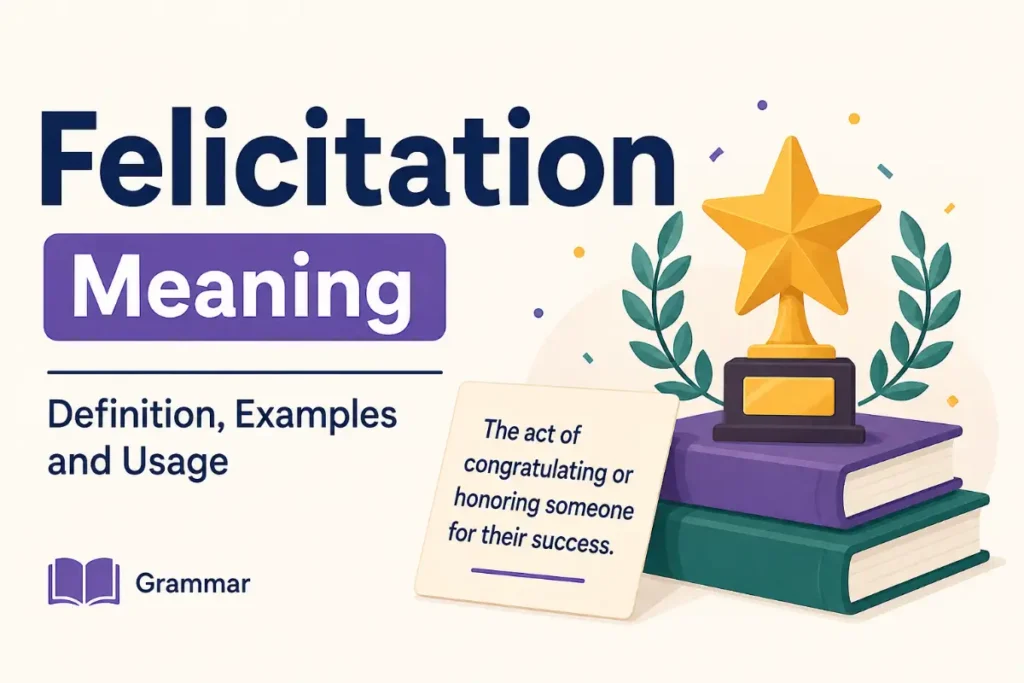
The felicitation meaning is an expression of congratulations or praise given to someone on a special achievement occasion or honor. In simple English it means publicly congratulating and honoring a person for something they have accomplished.
You may see the word in phrases such as felicitation ceremony, felicitation program, felicitation speech, and felicitation message. In everyday American English people are more likely to say congratulations celebration or honoring someone. Still the word has a clear meaning and an established place in formal English.
Quick Definition
Felicitation means an expression of congratulations praise or good wishes given to someone because of an achievement success honor or special occasion. It can describe the act of congratulating someone or a formal event held to honor that person. The word has a formal tone and is especially common in speeches ceremonies and official programs.
What Does Felicitation Mean
At its simplest felicitation means congratulating or honoring someone.
Imagine a student receives the highest score in a school. The principal invites the student onto the stage gives a short speech and presents an award. The event may be described as a felicitation ceremony because the student is being publicly honored and congratulated.
The same idea works in professional settings. A company may organize a formal event to recognize an employee who has completed many years of service. A university may hold a program to honor a professor for an academic achievement. A community organization may felicitate a person who has made an important contribution to society.
The word therefore carries more than the basic idea of saying congratulations. It often suggests a deliberate expression of respect appreciation and honor.
In ordinary conversation you might simply say Congratulations on your achievement. In a formal program the organizers might call the event a felicitation ceremony.
That difference in tone is important. The meaning remains positive but the setting changes how natural the word sounds.
If you’re unsure about an abbreviation used in a message or document, understanding what DSL stands for can make the context much clearer.
Simple Meaning Of Felicitation
A simple way to understand the word is this:
Felicitation means publicly or formally congratulating and honoring someone.
It can refer to a spoken message a written message an award presentation or an organized event.
For example:
- The school held a felicitation ceremony for the winning students.
- The mayor offered his felicitation to the award recipients.
- The organization arranged a felicitation program for its retiring director.
- She received felicitation from her colleagues after winning the competition.
In each example the central idea is recognition.
The person being felicitated has usually achieved something worthy of praise. The focus is not simply on happiness but on recognizing that person’s success or contribution.
Is Felicitation A Formal Word
Yes. Felicitation is generally a formal word.
It sounds more ceremonial than ordinary words such as congratulations praise or celebration. You are more likely to encounter it in an official speech school program university event government function award ceremony newspaper report or formal invitation.
For example:
We are pleased to invite you to the felicitation ceremony honoring our national award winners.
This sounds formal and appropriate for an organized event.
In casual American conversation the same idea would usually be expressed differently:
We are having a ceremony to honor the award winners.
Or:
We are getting together to celebrate their achievement.
Both sentences communicate the idea clearly without using a formal term.
Felicitation Meaning In Simple English
If you need to explain the word to a child English learner or someone unfamiliar with formal vocabulary you can simply say:
Felicitation means congratulating and honoring someone for an achievement.
For example if your friend wins a national competition and you publicly praise that person for the achievement you are offering congratulations. If the school organizes a special event to honor the winner that event can be called a felicitation ceremony.
This simple explanation captures the core meaning without unnecessary vocabulary.
Felicitation Ceremony Meaning
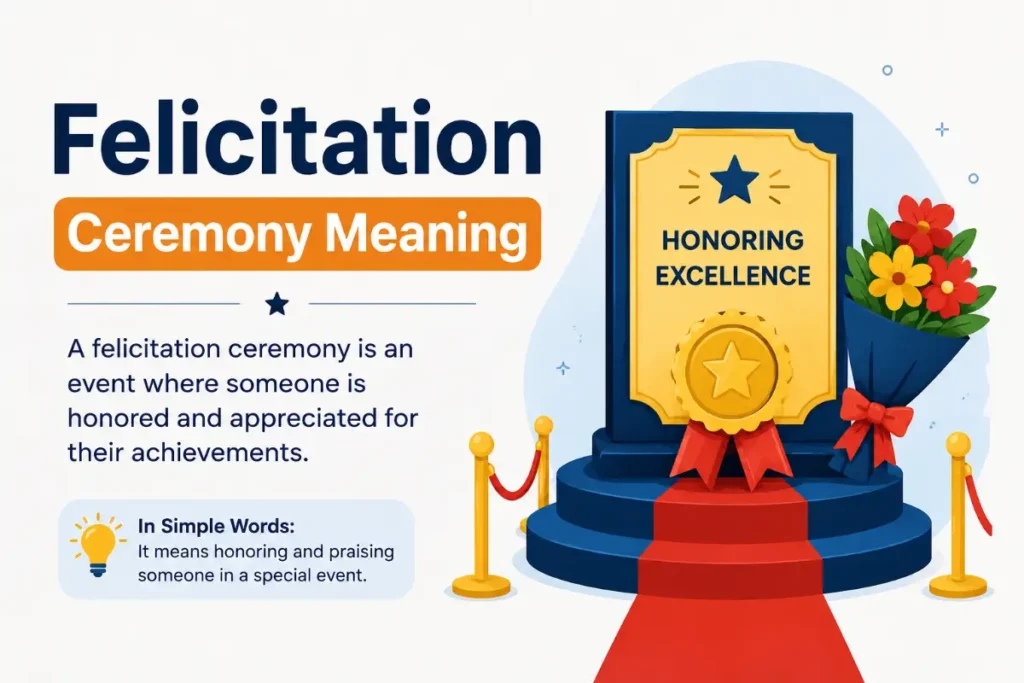
A felicitation ceremony is a formal event organized to honor and congratulate one or more people.
These ceremonies are common in schools colleges universities workplaces professional organizations community groups and public institutions.
A ceremony might recognize:
- Academic achievement.
- Sports success.
- Professional accomplishment.
- Retirement.
- Long service.
- Awards and honors.
- Community service.
- Artistic achievement.
- Public service.
- Outstanding performance.
A typical ceremony may include an introduction a speech presentation of an award flowers a certificate a commemorative gift and words of appreciation.
For example:
The university organized a felicitation ceremony to honor its top graduates.
The sentence does not simply say that the graduates were congratulated. It suggests an organized formal occasion created specifically to recognize them.
Felicitation Program Meaning
A felicitation program is another formal expression used for an organized event where people are honored or congratulated.
The phrase is particularly common in Indian Pakistani and other South Asian English contexts.
For example:
The school arranged a felicitation program for the students who won national science competitions.
The program may include speeches performances awards and personal messages from teachers or administrators.
In American English the phrase is understandable but less common. A native speaker in the United States might say award ceremony, recognition event, honoring ceremony, or celebration instead.
That does not make felicitation incorrect. It simply reflects differences in regional usage and preferred vocabulary.
Felicitation Speech Meaning
A felicitation speech is a formal speech that congratulates honors or praises someone.
The speaker may describe the person’s achievements explain why the recognition matters and offer good wishes for the future.
For example:
The principal delivered a felicitation speech for the students who achieved outstanding results.
A strong speech of this kind usually has three basic elements:
- Recognition of the achievement.
- Appreciation of the person’s effort or contribution.
- Good wishes for future success.
The tone is normally warm respectful and positive.
A felicitation speech does not need to sound complicated. In fact a short sincere speech can be more effective than one filled with overly formal language.
Felicitation Message Meaning
A felicitation message is a written or spoken message expressing congratulations and appreciation.
It can appear in:
- Event brochures.
- School publications.
- Company newsletters.
- Award ceremonies.
- Anniversary programs.
- Retirement events.
- Graduation programs.
- Official announcements.
For example:
Please accept my warm felicitation on your outstanding achievement.
This sounds formal.
A simpler version would be:
Congratulations on your outstanding achievement. I wish you continued success.
The second version is usually more natural in everyday American English.
Felicitation Synonyms
Several words can overlap with felicitation but they are not always perfect replacements.
Congratulations
This is the most common everyday alternative.
Congratulations on your promotion.
It directly expresses happiness about another person’s success.
Praise
Praise focuses on expressing approval or admiration.
The coach praised the team for its discipline.
Praise does not always involve a special achievement or celebration.
Commendation
Commendation is formal recognition of good work behavior or achievement.
The officer received a commendation for his service.
It is especially common in professional and official contexts.
Recognition
Recognition means acknowledging someone’s achievement contribution or importance.
The company gave her recognition for ten years of service.
This word is broader than felicitation.
Honor
Honor means showing respect or giving special recognition.
The university honored the professor for her research.
Celebration
Celebration focuses more on marking a happy event than specifically praising an individual.
The family held a celebration after his graduation.
These words overlap but each has its own emphasis. Felicitation sits closest to formal congratulations and public recognition.
Felicitation Vs Congratulations
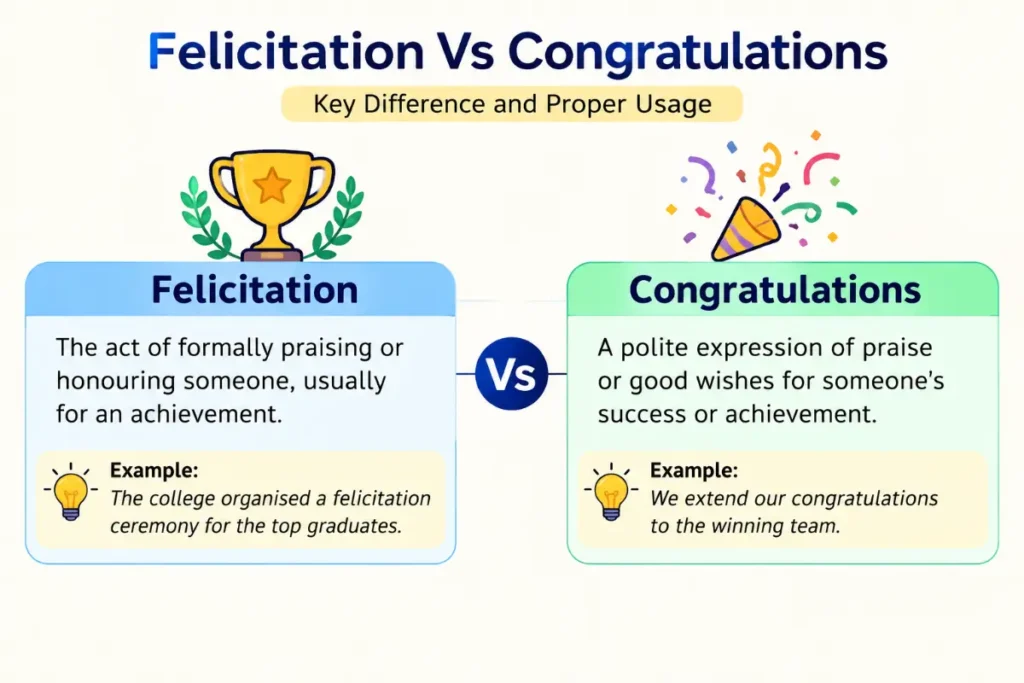
The difference is mostly one of tone and context.
Congratulations is common natural and flexible. You can use it with friends family members coworkers classmates and strangers.
Felicitation is more formal and ceremonial. It often appears when congratulations are being expressed publicly or as part of an organized event.
Compare these examples:
Congratulations on your promotion.
This sounds completely natural in everyday conversation.
The company organized a felicitation ceremony to honor her promotion and years of service.
This sounds formal and event focused.
A useful rule is simple. Use congratulations when speaking naturally to someone. Use felicitation when describing formal recognition or a ceremonial act of honoring someone.
Felicitation Vs Appreciation
These words are related but they do not mean exactly the same thing.
Appreciation means recognizing the value or effort of someone or something.
Felicitation focuses more specifically on congratulating or honoring someone for an achievement or occasion.
For example:
We appreciate your hard work.
This expresses gratitude and recognition.
We are holding a felicitation ceremony to honor your achievement.
This expresses formal recognition and congratulations.
A person can receive appreciation without achieving something extraordinary. Felicitation usually has a clearer connection with achievement recognition or celebration.
Felicitation Vs Celebration
A celebration marks a happy or important event.
A felicitation specifically recognizes a person or group through congratulations praise or honor.
For example a graduation party is a celebration. A formal event honoring the top graduate can be a felicitation ceremony.
The two can happen at the same time. A university might celebrate graduation while also felicitating students who achieved exceptional results.
10 Usage Tips
- Use it for formal congratulations. Felicitation works best when someone is being publicly recognized for an achievement honor or contribution.
- Choose congratulations for casual situations. When speaking with friends family or coworkers, congratulations usually sounds more natural.
- Use felicitation ceremony for formal events. This phrase fits school university professional and institutional programs where someone is officially honored.
- Use felicitation speech for public recognition. A felicitation speech usually praises someone’s achievement and offers good wishes for future success.
- Match the word to your audience. The term is especially common in South Asian English but may sound formal to American readers.
- Do not use it as a replacement for every form of praise. Appreciation recognition commendation and honor have related meanings but each carries a slightly different emphasis.
- Use felicitate as the verb. For example, you can write, The university felicitated the award winning students.
- Use it with achievements and milestones. Academic success professional awards retirement and long service are natural contexts.
- Keep formal messages simple. A sincere message is stronger than one filled with complicated vocabulary.
- Consider the tone before using it. If your goal is friendly everyday communication, congratulations is usually the better choice. If you are describing a formal recognition event, felicitation can be a precise choice.
Is Felicitation Correct English
Yes. Felicitation is a legitimate English word.
The important question is not simply if the word is correct. The better question is if it fits the context and audience.
In formal English the word can be appropriate and precise.
In everyday American English it can sound unusually formal. If you are writing a casual email to a friend you would almost certainly choose congratulations instead.
This distinction matters for good writing. A word can be grammatically correct and still sound unnatural in a particular situation.
Strong writers choose vocabulary based on audience purpose and tone.
Felicitation In American English
American English recognizes the word felicitation, but it is not a common everyday expression.
American speakers are more likely to use:
- Congratulations.
- Congratulations on your achievement.
- Recognition ceremony.
- Award ceremony.
- Honoring ceremony.
- Celebration.
- Commendation.
You may still encounter felicitation in formal writing or international contexts. It can also appear in academic and diplomatic language.
If your audience is primarily American and you want natural everyday language, congratulations will usually be the better choice.
Felicitation In British English
The word is also understood in British English, particularly in formal contexts.
However, it is not one of the most common words in ordinary British conversation. Speakers may choose congratulations, tribute, recognition, or honor depending on the situation.
British English also has a strong tradition of ceremonial and institutional language, so felicitation can fit naturally in certain official settings.
In professional forms or applications, knowing what an employer name means can help you provide the correct information without confusion.
Felicitation In South Asian English
The word is particularly visible in South Asian English.
You may encounter expressions such as:
- Felicitation ceremony.
- Felicitation program.
- Felicitation function.
- Felicitation speech.
- Felicitation message.
- Felicitation of guests.
- Felicitation of award winners.
These expressions are widely understandable in formal educational institutional and community settings.
This is an important example of how English develops across regions. A phrase may be less common in American conversation while being completely normal in another English speaking community.
Birthday Felicitation Meaning
A birthday felicitation refers to congratulating or honoring someone on their birthday.
The expression is more formal than simply saying Happy Birthday.
For example:
The organization held a birthday felicitation for its senior director.
This suggests that the birthday was marked through a formal event or public recognition.
In ordinary American English you would usually say:
We celebrated her birthday.
Or:
The team wished her a happy birthday.
The formal expression is still understandable but may sound ceremonial.
Felicitation For Achievement
Achievement is one of the most natural contexts for the word.
Someone may be felicitated after:
- Winning a competition.
- Receiving an award.
- Completing a major project.
- Earning an academic distinction.
- Reaching a professional milestone.
- Completing many years of service.
- Making an important contribution.
- Receiving public recognition.
For example:
The athlete was felicitated after winning the national championship.
This sentence means that the athlete was publicly honored and congratulated.
The verb felicitated is less common than felicitation, but it is grammatically valid.
Felicitate As A Verb
Felicitate is the verb connected to felicitation.
It means to congratulate or honor someone.
For example:
The principal felicitated the students for their outstanding performance.
The organization felicitated the retiring director during the annual ceremony.
The governor felicitated the award winners at the official event.
The noun is felicitation.
The verb is felicitate.
The person receiving the recognition can be described as being felicitated.
These forms are especially common in formal South Asian English.
How To Use Felicitation In A Sentence
The word usually appears in formal structures involving recognition honor or congratulations.
Natural examples include:
- The university organized a felicitation ceremony for its distinguished graduates.
- A felicitation program was held to honor the award winning students.
- The chairman delivered a felicitation speech at the annual event.
- The organization sent a felicitation message to the newly appointed director.
- The athlete received felicitation from local officials after the victory.
- The school hosted a ceremony to felicitate the students for their achievements.
- The event included the felicitation of teachers who completed twenty five years of service.
- The community organized a felicitation event to recognize her contribution.
- The guest of honor offered his felicitation to the successful candidates.
- The award ceremony ended with a formal felicitation of the winners.
These examples show the word in different grammatical structures rather than repeating the same sentence pattern.
Common Mistakes With Felicitation
People often use the word in ways that make it sound awkward rather than incorrect.
Using It In Very Casual Conversation
Saying I sent my felicitation to my friend sounds much more formal than necessary.
A natural alternative is:
I congratulated my friend.
Or:
I sent my friend a congratulations message.
Treating It As A Direct Replacement For Happy Birthday
You would not normally say Felicitation instead of Happy Birthday.
The word describes the act of congratulating or honoring someone. It is not the standard birthday greeting itself.
Overusing The Word
Formal words lose their effect when they appear in every sentence.
If an article or speech repeatedly uses felicitation felicitation ceremony and felicitation message the writing can become stiff.
Use the word when it adds precision. Otherwise choose a simpler expression.
Assuming It Means Only Congratulations
The word often includes congratulations but can also carry the idea of formal recognition or honor.
That broader meaning explains why it works naturally in ceremonies and official events.
Etymology Of Felicitation
The word comes from the Latin root felix, which means happy fortunate or successful.
The same root is connected with words associated with happiness and good fortune in several European languages.
The English word felicitation developed through French influence. It is related to the French word félicitation, which means congratulations.
French féliciter means to congratulate.
This connection explains why the English and French forms look and sound related.
The underlying idea is positive recognition of someone’s happiness success or good fortune.
Félicitations Meaning In French
In French félicitations means congratulations.
It is commonly used when someone has achieved something or experienced a happy event.
For example the French expression Félicitations is comparable to saying Congratulations in English.
The French connection is useful because it helps explain the origin of the English word. However, English felicitation has developed its own usage and is especially associated with formal recognition and ceremonies in certain varieties of English.
Do not assume that every use of the English word must match everyday French usage exactly. Related words can develop different patterns after entering another language.
Is Felicitation A Noun
Yes. Felicitation is a noun.
It refers to the act expression or occasion of congratulating or honoring someone.
For example:
The felicitation of the winners took place after the final ceremony.
The related verb is felicitate.
The committee felicitated the winners.
The related noun felicitation names the act or event.
Pronunciation Of Felicitation
A common English pronunciation is approximately:
fə LIS uh TAY shən
A dictionary style pronunciation may be represented as /fɪˌlɪsɪˈteɪʃən/ depending on the variety of English.
The strongest stress generally falls on the tay syllable.
The word can be divided into several spoken parts:
fe li ci ta tion
For English learners the most important point is to avoid treating every syllable as equally strong. The middle and final parts flow naturally in connected speech.
The French word félicitations has a different pronunciation and rhythm because it belongs to French rather than English.
Formality And Tone
Felicitation carries a respectful ceremonial tone.
It works particularly well when the writer wants to communicate dignity and public recognition.
For example:
The board extended its felicitation to the retiring chairman.
This sounds official.
Compare:
Congratulations to the retiring chairman.
This sounds warmer and more direct.
Neither is inherently better. The right choice depends on the setting.
If you are writing an official event program a formal term may fit. If you are texting a friend a simpler word will usually sound more natural.
Felicitation In Law
The phrase felicitation meaning in law can be confusing because felicitation is not primarily a technical legal term.
In legal or official documents the word may still appear in general English when someone is being congratulated or formally recognized. Its meaning does not suddenly become a special legal concept simply because it appears in a legal setting.
For example a formal record might mention the felicitation of an individual at an official event. In that case the word still refers to congratulations recognition or honor.
If a legal document uses the word in a specific clause it is important to read the surrounding language because context can determine the precise sense.
Felicitation And Honor
Felicitation and honor overlap strongly.
When someone is felicitated they are often being honored for an achievement.
However honor is broader.
You can honor someone for courage service sacrifice achievement or character. Felicitation is more closely tied to congratulation and positive recognition.
For example:
The city honored the firefighter for his bravery.
This does not necessarily imply a congratulatory celebration.
The city held a felicitation ceremony for the award winning firefighter.
This suggests a formal event recognizing the achievement.
How To Write A Felicitation Message
A good formal message does not need complicated vocabulary.
Start by identifying the achievement or occasion. Then express sincere congratulations and finish with a positive wish for the future.
A simple structure is:
- Mention the achievement.
- Offer congratulations.
- Recognize the person’s effort or contribution.
- Wish them continued success.
For example:
Warm congratulations on this outstanding achievement. Your dedication and hard work have brought great credit to the organization. We are pleased to recognize your success and wish you continued growth in the years ahead.
This sounds formal without becoming unnecessarily ornate.
How To Write A Felicitation Speech
A short speech can follow a similar structure.
Begin by welcoming the audience and identifying the person being honored. Explain the achievement briefly and mention why it matters. Then offer congratulations and close with good wishes.
Avoid turning the speech into a list of exaggerated compliments. Specific praise is more convincing.
Instead of saying:
She is an amazing wonderful outstanding and exceptional person.
Say:
Her years of patient work have helped the organization expand its training program and support hundreds of new members.
Specific details create credibility.
If PMG appears in a message, title, or workplace context, checking the meaning of PMG can help you understand exactly what the abbreviation refers to.
Why The Word Sounds More Formal
The word has several syllables and comes from a formal vocabulary tradition. It also appears frequently in organized events where people are introduced honored and publicly recognized.
That combination gives it a ceremonial feel.
English has many pairs like this.
- You can say help or assistance.
- You can say start or commence.
- You can say congratulations or felicitation.
The longer word is not automatically better. Good writing chooses the word that fits the audience.
When To Use Felicitation
Use the word when the setting is formal ceremonial or institutional.
Good contexts include:
- Award ceremonies.
- School functions.
- University events.
- Retirement programs.
- Official recognition.
- Professional honors.
- Public achievements.
- Formal speeches.
- Institutional announcements.
- Commemorative events.
For casual conversations choose simpler language.
Congratulations on your new job.
Congratulations on winning the award.
We are proud of you.
These usually sound more natural than using a formal noun.
Final Takeaway
Felicitation means congratulating praising or formally honoring someone for an achievement success or special occasion. The word is a noun and is strongly associated with formal ceremonies speeches messages and public recognition.
Its closest everyday synonym is congratulations, but the two words do not have exactly the same tone. Congratulations is natural in ordinary conversation while felicitation has a more formal ceremonial feel.
The word is correct English, but context matters. If you are talking to a friend use congratulations. If you are describing a formal event where someone is publicly recognized and honored, felicitation can be an accurate and polished choice.