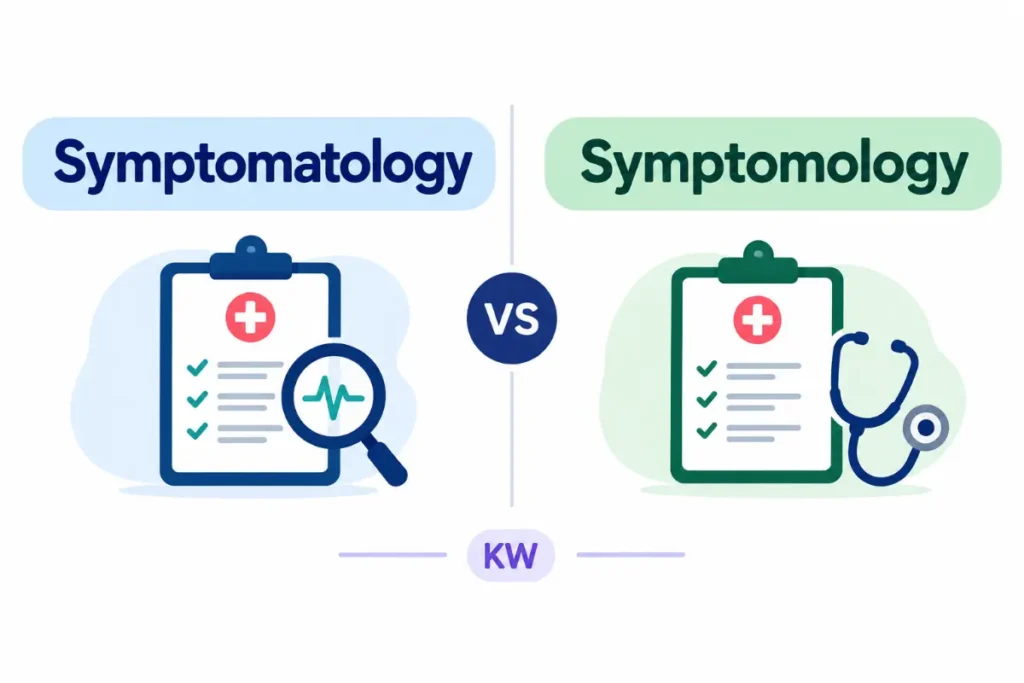
When you need to describe the pattern, range, or study of symptoms associated with a disease or condition, two similar terms can cause confusion: symptomatology vs symptomology. They look almost identical, sound similar, and both appear in medical and psychological writing. That makes it easy to wonder if they are interchangeable spellings or if one is actually incorrect.
The standard term in medical English is symptomatology. It refers to the study or description of symptoms, especially the collection and pattern of symptoms associated with a disease, disorder, or clinical condition. Symptomology also appears in English and is understandable, but it is less established and is often treated as a variant or less preferred form in formal medical writing.
The distinction becomes clearer when you look at the words’ origins, pronunciation, grammar, and actual use in healthcare and psychiatry. This guide explains the meaning of both forms, shows how they work in sentences, covers common mistakes, and explains which choice is safest for professional and academic writing.
Quick Answer
Symptomatology is the established and preferred term in medical and academic English. It describes the collection, pattern, or study of symptoms associated with a disease or condition. Symptomology is also found in English and can be understood, but it is less conventional. For formal healthcare, scientific, and academic writing, choose symptomatology.
Symptomatology And Symptomology Comparison
| Feature | Symptomatology | Symptomology |
|---|---|---|
| Correct form | Established standard term | Less common variant |
| Part of speech | Noun | Noun |
| Core meaning | Study or description of symptoms | Study or description of symptoms |
| Origin | Formed from symptom and atology | Formed from symptom and ology |
| Formality | Formal and medical | Less conventional |
| Common contexts | Medicine, psychiatry, research | Medicine, psychology, general discussion |
| US usage | Preferred | Used less often |
| UK usage | Established | Less common |
| Example | The patient’s symptomatology changed over time. | The paper discusses the disorder’s symptomology. |
The most important point is that these forms are not a simple case of one being a completely meaningless spelling mistake. Symptomology has genuine usage in English, but symptomatology has the stronger position in established medical terminology and is generally the safer choice when you want precise, conventional professional language.
If you are comparing technical terms or checking unusual word forms, understanding the correct spelling of pentoxide can help you avoid similar terminology and spelling mistakes.
What Does Symptomatology Mean
Symptomatology is a noun that refers to the symptoms associated with a disease, disorder, or medical condition and, depending on context, the study or systematic description of those symptoms.
In practical medical writing, the word can describe the overall pattern of symptoms rather than one isolated complaint. A clinician or researcher may discuss the symptomatology of depression, schizophrenia, influenza, a neurological disorder, or another condition.
For example:
The patient’s symptomatology included persistent fatigue, dizziness, and headaches.
Here, the word refers to the overall set or pattern of symptoms.
The term is particularly useful when discussing symptoms as a group. Instead of listing individual complaints repeatedly, a medical writer can refer to the condition’s overall symptom profile.
What Is Symptomology
Symptomology is a noun formed from symptom and the suffix ology. It is used to refer to the study or description of symptoms and can function in contexts similar to symptomatology.
The important distinction is conventional usage. Symptomology is understandable and can be found in medical, psychological, and general writing, but it does not have the same level of established terminology as symptomatology.
For a reader who simply wants to know which word to use, the practical recommendation is straightforward: use symptomatology in formal medical, academic, and scientific writing unless you have a specific reason to preserve the other form.
The Main Difference Between The Terms
The biggest difference is not their basic idea. Both forms relate to symptoms. The real distinction concerns conventionality, terminology, and context.
Meaning
Both words can refer to symptoms and their overall presentation. Symptomatology is more firmly established as a technical term.
Word Formation
Symptomatology contains the element atology, reflecting its development as a specialized term. Symptomology uses the more familiar ology ending directly after symptom.
Formality
Symptomatology generally sounds more technical and established. It is common in clinical research, medical literature, psychiatric discussions, and academic writing.
Symptomology may appear in similar contexts, but many editors would favor symptomatology when the goal is conventional medical terminology.
Professional Usage
A physician, researcher, psychologist, or medical writer may use symptomatology to describe the presentation of a condition.
For example:
The study examined the symptomatology of major depressive disorder.
The wording sounds natural in formal clinical research.
Reader Expectations
Readers familiar with medical terminology are more likely to recognize symptomatology as the conventional form. Symptomology may still be understood, but it can appear less familiar or less technically established.
Which Form Should You Use
For most writers, symptomatology is the best choice.
Choose it when you are writing:
- A medical article.
- A scientific paper.
- A psychiatric report.
- A psychology paper.
- A clinical discussion.
- A healthcare website.
- An academic assignment.
- A professional medical document.
Symptomology can be encountered in published writing, so it should not automatically be treated as a nonsensical word. However, if you are choosing the form yourself and want the most established terminology, symptomatology is the stronger option.
A useful rule is simple:
When in doubt, use symptomatology.
Examples In Sentences
The best way to understand the distinction is to see the term in realistic contexts.
Symptomatology Examples
- The patient’s symptomatology became more severe during the second week of illness.
- The researchers examined the symptomatology associated with the disorder.
- The clinical team documented the patient’s changing symptomatology.
- Early symptomatology can vary considerably from one patient to another.
- The physician considered the patient’s complete symptomatology before making a diagnosis.
- The study focused on the neurological symptomatology of the condition.
- Researchers compared the symptomatology of patients in two treatment groups.
- The patient’s symptomatology included insomnia, irritability, and difficulty concentrating.
- The article describes the psychiatric symptomatology associated with the disorder.
- Understanding the symptomatology can help clinicians recognize different clinical presentations.
These examples show that the word usually works best when referring to a collection, pattern, or presentation of symptoms rather than one isolated symptom.
Symptomology Examples
Because symptomology is less conventional, it is useful to understand how it may appear in real writing.
- The paper discusses the symptomology associated with the condition.
- The researchers described the disorder’s symptomology in detail.
- The clinician reviewed the patient’s symptomology during the evaluation.
- The study compared the symptomology of several patient groups.
- The article examines the symptomology commonly reported in the condition.
- The researcher analyzed changes in symptomology over time.
- The report provides an overview of the disorder’s symptomology.
- The book discusses psychological symptomology in clinical settings.
- The authors explored differences in symptomology between the groups.
- The chapter introduces the basic symptomology of the disorder.
These sentences are understandable, but in formal writing, many editors would replace symptomology with symptomatology when the intended meaning is the established medical concept.
Common Mistakes
The confusion usually involves more than simply choosing between two spellings. Several mistakes can arise because the terms look so similar.
Treating Them As Completely Different Concepts
The two forms generally refer to closely related concepts. It would be misleading to teach them as if they described two completely unrelated medical ideas.
The main issue is conventional terminology rather than a dramatic difference in meaning.
Assuming The Shorter Form Is Automatically Better
Writers sometimes prefer symptomology because it looks simpler. Shorter does not always mean more natural or more standard.
Medical vocabulary often preserves specialized formations that may look longer than their everyday alternatives.
Assuming Symptomology Is Always Wrong
Calling symptomology an impossible or meaningless word is too strong. It does occur in English and is understandable in context.
The better guidance is that symptomatology is the more established and safer choice for formal medical and academic writing.
Confusing Symptoms With Symptomatology
A symptom is an individual indication or complaint associated with a condition.
For example:
Fatigue is a common symptom.
Symptomatology refers to the broader collection or pattern of symptoms.
For example:
The patient’s symptomatology included fatigue, weakness, and difficulty sleeping.
The first sentence focuses on one symptom. The second describes a broader clinical picture.
Using The Word For A Diagnosis
Symptomatology does not mean the diagnosis itself. Symptoms can contribute to diagnosis, but the two concepts are different.
A patient may have a particular symptomatology that helps a clinician evaluate possible diagnoses. The word describes the symptom presentation, not the diagnostic conclusion.
Pronunciation Guide
The pronunciation of symptomatology vs symptomology can seem intimidating because both words are long and look remarkably similar.
The pronunciation of symptomatology can seem intimidating because the word is long.
In American English, a useful IPA representation is:
/ˌsɪmptəˌmætəˈlɑːdʒi/
A simple learner friendly breakdown is:
symp tuh mat uh LAH juh
The primary stress falls near the end of the word, on the la syllable.
The word can be divided approximately as:
symp to mat o lo gy
Do not try to pronounce every letter with equal force. Natural English pronunciation reduces several unstressed vowels, so the middle of the word can sound lighter than its spelling suggests.
Pronouncing Symptomology
Symptomology can be represented approximately as:
/ˌsɪmptəˈmɑːlədʒi/
A simple approximation is:
symp tuh MOL uh jee
Pronunciation can vary slightly among speakers and accents, but the central difference is the structure of the word itself.
Word Origin And Etymology
The history of these terms helps explain why the longer form became established.
The word symptom ultimately traces back through Latin and Greek. The Greek symptōma referred to something that happens or befalls someone and developed into the medical idea of a sign or manifestation of illness.
Symptomatology was built from symptom and a suffixal formation associated with the study or systematic description of symptoms. The ending connects the term with the broader vocabulary of medical and scientific classification.
The related word symptomology uses ology, a familiar English ending associated with fields of study. Its formation is therefore easy to understand from a modern English perspective.
That difference in formation helps explain why symptomology looks perfectly plausible. It follows a productive pattern that English speakers recognize from words such as biology, psychology, and terminology related to various academic fields. Still, the established medical term developed along its own historical path.
Just as medical terminology can vary in spelling and form, English also contains closely related word forms that look similar but may have different meanings or usage patterns.
Symptomatology In Medical Terms
In medical language, symptomatology generally refers to the overall presentation of symptoms connected with a particular illness or condition.
It can include information about:
- Which symptoms occur.
- How severe the symptoms are.
- How frequently they occur.
- How long they have been present.
- How symptoms appear together.
- How symptoms change over time.
- How the presentation differs among patients.
This broader meaning makes the word useful in clinical and research settings.
For example, saying the symptom was severe focuses on one complaint. Saying the patient’s symptomatology was severe can suggest a broader and more complex pattern of symptoms.
The exact interpretation still depends on context, so writers should avoid using the term simply to make a sentence sound more medical.
Symptomatology In Psychiatry
Psychiatry is one of the fields where the term appears frequently.
Mental health conditions can involve groups of symptoms that interact in complicated ways. Researchers and clinicians may therefore discuss the symptomatology of a disorder when describing its clinical presentation.
For example:
The researchers examined the symptomatology associated with anxiety disorders.
In this setting, the word can encompass patterns involving emotional, cognitive, behavioral, and physical symptoms.
Psychiatric writing also benefits from distinguishing symptoms from diagnoses. A symptom pattern may be clinically important without being identical to a diagnostic label.
Formal And Casual Usage
Symptomatology is strongly associated with formal language. It is not a word most people would normally use in casual conversation.
In everyday speech, a person is more likely to say:
She has several symptoms.
A healthcare professional writing a research report might say:
The patient presented with a complex symptomatology.
The second sentence is more technical and appropriate for certain professional contexts, but it may sound unnecessarily formal in ordinary conversation.
Good writing considers the audience. A patient education page may sometimes benefit from symptoms or symptom pattern instead of symptomatology because those expressions are easier for general readers to understand.
American English And Other Varieties
There is no major American versus British spelling distinction between these terms.
Symptomatology is established in American English and is also used in British English and other varieties of English used in medicine and academia.
Symptomology can also be encountered across English language sources, but it does not function as a clear American versus British spelling difference.
This means you should not choose between the forms based on nationality alone. The stronger consideration is conventional medical usage.
For US focused professional writing, symptomatology is the safest standard choice.
Grammar Rules
Symptomatology is a noun. It normally describes a set, pattern, or study of symptoms.
It can appear as a subject:
The symptomatology was unusual.
It can appear as an object:
The researchers analyzed the symptomatology of the condition.
It can also follow descriptive modifiers:
The patient showed complex neurological symptomatology.
The word is generally treated as an uncountable noun when it refers to symptom presentation as a whole. You would normally write:
The symptomatology was consistent with the condition.
rather than treating it like an ordinary count noun and adding a plural ending.
When referring to multiple groups or conditions, writers can restructure the sentence rather than forcing an awkward plural.
For example:
The researchers compared the symptom patterns of the two disorders.
This can be clearer than trying to pluralize a technical noun unnecessarily.
Choosing Simpler Language For Patients
A technically correct word is not always the clearest word.
This matters especially in healthcare communication. Medical professionals may understand symptomatology immediately, but patients may find symptoms or symptom pattern easier to understand.
Compare:
The treatment may affect your symptomatology.
with:
The treatment may change your symptoms.
The second sentence is simpler and more direct for a general audience.
For a research paper, clinical article, or specialist discussion, symptomatology may be entirely appropriate. For patient instructions, plain language often works better.
This is an important distinction between professional terminology and effective communication. The best word depends on the reader.
Related Words And Similar Terms
Several words occupy the same semantic area.
Symptom
A symptom is an individual indication or experience associated with an illness or condition.
Sign
A sign is an observable or measurable indication of a condition. In medical usage, signs and symptoms are related but not identical.
Syndrome
A syndrome is a recognizable group or pattern of signs and symptoms that occur together.
Clinical Presentation
Clinical presentation refers to how a condition appears in a patient, including relevant symptoms, signs, history, and other clinical information.
Symptom Profile
Symptom profile is a more accessible phrase for describing the particular collection and pattern of symptoms associated with a person or condition.
Symptomatic
Symptomatic is an adjective meaning showing or associated with symptoms.
For example:
The patient remained symptomatic after treatment.
These related terms can sometimes replace symptomatology when they communicate the idea more clearly.
These kinds of differences are worth paying attention to because English has many common spelling mix-ups that can change the meaning or correctness of a word.
Which Word Should You Use
If you are writing a formal medical or academic sentence and need a noun describing the overall pattern or study of symptoms, choose symptomatology.
Use symptomology only when the context specifically calls for that form, such as when discussing an existing source, preserving an original title, or explaining the terminology itself.
For most practical writing, this decision can be reduced to a few situations:
- Medical research: Use symptomatology.
- Psychiatric writing: Use symptomatology.
- Academic writing: Use symptomatology.
- Clinical documentation: Use symptomatology when the technical term is appropriate.
- Patient education: Consider symptoms or symptom pattern for clearer language.
- Casual conversation: Use symptoms rather than either technical noun in most cases.
- Discussing a source that uses symptomology: Preserve the original wording when necessary.
The strongest writing choice is not always the longest technical term. It is the term that gives the reader the right meaning at the right level of formality.
Expert Usage Tips
A careful editor would make three distinctions here.
First, symptomatology is the conventional technical choice. It is the form most appropriate when you want established medical terminology.
Second, symptomology should not automatically be treated as a catastrophic error. It has recognizable usage and transparent meaning. However, its lower conventional status makes it a weaker choice when you are producing polished medical or academic content from scratch.
Third, writers should ask if they need either word at all. A sentence such as The study examined the symptoms experienced by participants may be clearer than The study examined the symptomatology experienced by participants.
Technical vocabulary has a purpose. It can condense complex ideas and fit naturally into specialist communication. But unnecessary jargon can create distance between the writer and reader.
For US readers, the safest editorial rule is therefore simple: use symptomatology for established technical terminology, but use plain alternatives when they communicate the same idea more clearly to a general audience.
Frequently Asked Questions
Is Symptomatology The Correct Word
Yes. Symptomatology is the established medical and academic term used to describe the collection, pattern, or study of symptoms associated with a disease or condition. Symptomology also appears in English, but it is less conventional. For formal healthcare, scientific, and academic writing, symptomatology is generally the safer choice.
Is Symptomology A Real Word
Yes. Symptomology is found in English and its meaning is understandable from its formation. However, it is less established than symptomatology in formal medical terminology. If you are choosing a term for a research paper, clinical article, or professional document, symptomatology is usually the better option.
What Does Symptomatology Mean In Medical Terms
In medical language, symptomatology refers to the collection, pattern, or presentation of symptoms associated with a disease, disorder, or condition. It can describe which symptoms occur, how they appear together, and how the overall clinical presentation develops. The term is especially common in medical, psychiatric, psychological, and research contexts.
What Is A Simple Synonym For Symptomatology
Depending on the sentence, useful alternatives include symptoms, symptom pattern, symptom profile, and clinical presentation. These are not perfect synonyms in every context. Symptomatology can carry a more technical meaning, while simpler alternatives may be easier for patients and general readers to understand.
How Do You Pronounce Symptomatology
In American English, symptomatology is commonly pronounced approximately as symp tuh mat uh LAH juh. Its IPA representation is approximately /ˌsɪmptəˌmætəˈlɑːdʒi/. The word contains several unstressed syllables, so fluent speakers normally reduce some vowel sounds rather than giving every syllable equal emphasis.
Is Symptomatology Used In Psychiatry
Yes. Symptomatology is commonly useful in psychiatric and psychological contexts when discussing the overall pattern or presentation of symptoms associated with a mental health condition. It can describe groups of emotional, cognitive, behavioral, and physical symptoms. The term refers to symptom presentation rather than serving as another name for a diagnosis.
Should I Use Symptomatology In Patient Education
Not always. Symptomatology is technically appropriate, but many patients will understand simpler wording such as symptoms or symptom pattern more easily. Patient education generally benefits from plain language. Technical terminology is most useful when the audience already understands the field or when precision requires the specialized term.
Is There A British Spelling Difference
No major British and American spelling difference separates symptomatology and symptomology. Symptomatology is established in both varieties of English. Symptomology can also appear in both, but it is less conventional. The choice is therefore mainly about standard terminology and context rather than a US versus UK spelling rule.
Conclusion
Symptomatology is the established and preferred term for formal medical, psychiatric, scientific, and academic writing when you need to describe the collection, pattern, or study of symptoms. Symptomology is also encountered in English and can be understood, but it is less conventional.
The two forms can look interchangeable because they share the same basic meaning and differ by only a few letters. Still, writers who want the safest professional choice should use symptomatology.
For general readers, simpler expressions such as symptoms, symptom pattern, or symptom profile may communicate the idea more clearly. When choosing between symptomatology vs symptomology, the best option depends on the audience and purpose, but symptomatology vs symptomology is an important distinction to understand when using established medical terminology.