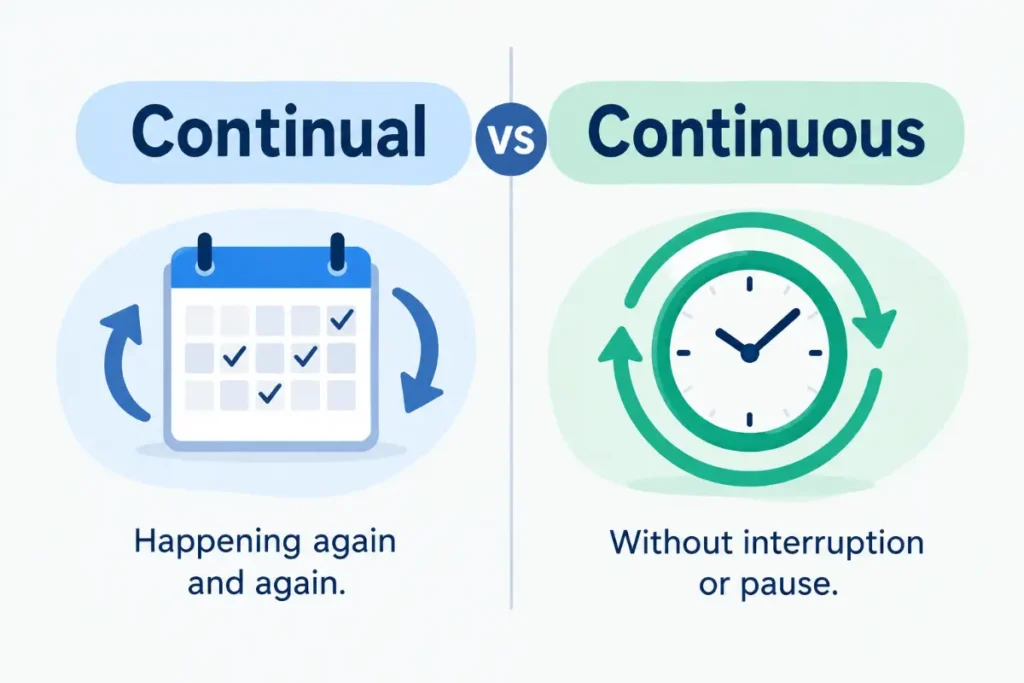
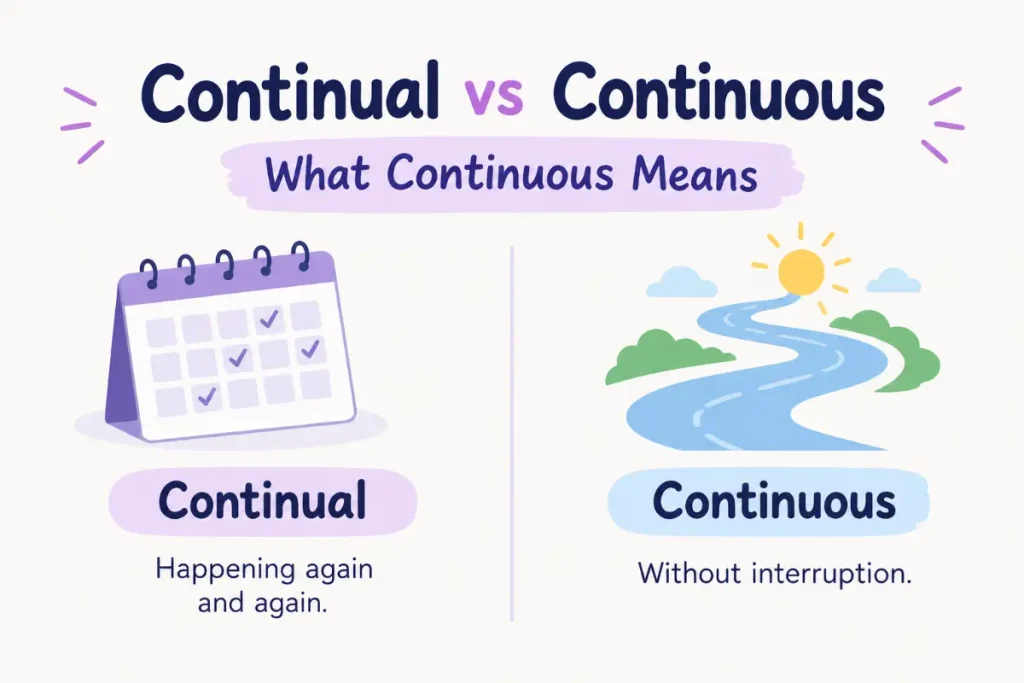
The difference between continual vs continuous comes down mainly to interruption. Continual usually describes something that happens again and again, often with pauses between events. Continuous describes something that continues without stopping or interruption. That distinction sounds simple, but real usage can be less tidy because the two words overlap in some contexts.
For example, continual interruptions happen repeatedly. A continuous noise keeps going without a break. Both words describe something that continues over time, but they focus on different patterns. Continual emphasizes recurrence, while continuous emphasizes an uninterrupted flow.
This distinction matters in everyday conversation, professional writing, school assignments, emails, and technical language. It also explains why phrases such as continuous improvement are so common, even though continual improvement is also grammatically valid. The sections below explain the meanings, grammar, pronunciation, examples, common mistakes, related words, and practical choices so you can use each word naturally.
Quick Answer
Continual usually means happening repeatedly, often with breaks between occurrences. Continuous means happening without stopping or interruption. Use continual for repeated events such as continual complaints or continual interruptions. Use continuous for an uninterrupted process such as continuous rain, continuous service, or a continuous sound. Both words are standard in American English.
Continual Vs Continuous At A Glance
| Feature | Continual | Continuous |
|---|---|---|
| Part of speech | Adjective | Adjective |
| Core meaning | Happening repeatedly | Happening without interruption |
| Main focus | Recurrence | Unbroken duration |
| Pauses possible | Yes | Usually no |
| Common tone | Can suggest annoyance or inconvenience | Usually neutral and descriptive |
| Common contexts | Complaints, interruptions, demands, changes, problems | Noise, rain, service, movement, pain, flow |
| US usage | Standard American English | Standard American English |
| UK usage | Standard British English | Standard British English |
| Related adverb | Continually | Continuously |
| Example | The continual interruptions made it hard to work. | The machine produced a continuous hum. |
The table gives you the practical distinction, but it should not be treated as an absolute rule for every sentence. Dictionaries recognize overlapping meanings, and actual usage can depend on context. The safest approach is to ask what you want the reader to notice: repeated events or an uninterrupted state.
What Continual Means
Continual is an adjective that describes something happening repeatedly or frequently over a period of time. The individual events do not have to happen without a break. In fact, the possibility of pauses is one of the most useful ways to distinguish continual from continuous.
Imagine a student who keeps interrupting a teacher. The interruptions happen many times, but the student is not interrupting every second. There are moments when the class continues normally. Those repeated interruptions can be described as continual interruptions.
The word can also carry a mild negative feeling. Cambridge defines continual in American English as happening often or repeating, while its broader English definition notes that the word is often associated with something annoying or inconvenient.
That connotation is not mandatory. Continual can describe neutral or even positive repetition. Still, native speakers often encounter it with problems, demands, interruptions, complaints, or other situations that happen so frequently that they become noticeable.
Consider these examples.
- The continual interruptions made it difficult to finish the meeting.
- We dealt with continual changes to the project schedule.
- Her continual questions showed that she wanted to understand the lesson.
- The team faced continual requests for updates.
- His continual complaints were beginning to frustrate his coworkers.
- The neighborhood experienced continual construction during the summer.
- The company made continual improvements to its customer service process.
- The continual arrival of new information changed our plans several times.
- The dog barked at the continual stream of delivery drivers.
- The patient needed continual monitoring throughout the afternoon.
Notice that these examples do not require one uninterrupted action. The interruptions happen, stop, and happen again. The requests arrive at different times. The construction may stop at the end of each work period. The changes occur one after another.
That repeated pattern is the heart of continual.
When discussing long-term relocation, it also helps to understand the difference between moving from one country to another, especially when choosing between words that describe an ongoing process and a completed action.
What Continuous Means
Continuous describes something that continues without a pause, break, or interruption. The focus is not on separate events happening repeatedly. Instead, the idea is that the activity or condition forms one uninterrupted stretch.
For example, continuous rain means the rain does not stop during the period being described. Continuous noise keeps going. A continuous line has no spaces in it. A continuous supply remains available without a break.
Cambridge defines continuous as occurring without a pause or interruption and also recognizes a separate grammatical meaning connected with verb forms that show an ongoing action.
The word is generally neutral. It does not normally suggest annoyance by itself. A continuous stream of water is simply a stream that keeps flowing. A continuous internet connection describes uninterrupted service. A continuous sound keeps going.
Here are some examples.
- The machine made a continuous buzzing sound.
- We had continuous rain for most of the afternoon.
- The hospital needs a continuous supply of electricity.
- The road has a continuous white line along the center.
- The video provides continuous coverage of the event.
- The sensor records continuous changes in temperature.
- She experienced continuous pain after the injury.
- The factory operates with a continuous flow of materials.
- The child talked continuously during the entire car ride.
- The system requires continuous monitoring during the test.
In each example, the emphasis is on an activity or condition that remains uninterrupted for the relevant period.
The Main Difference In Plain English
A simple mental picture can make the distinction easier.
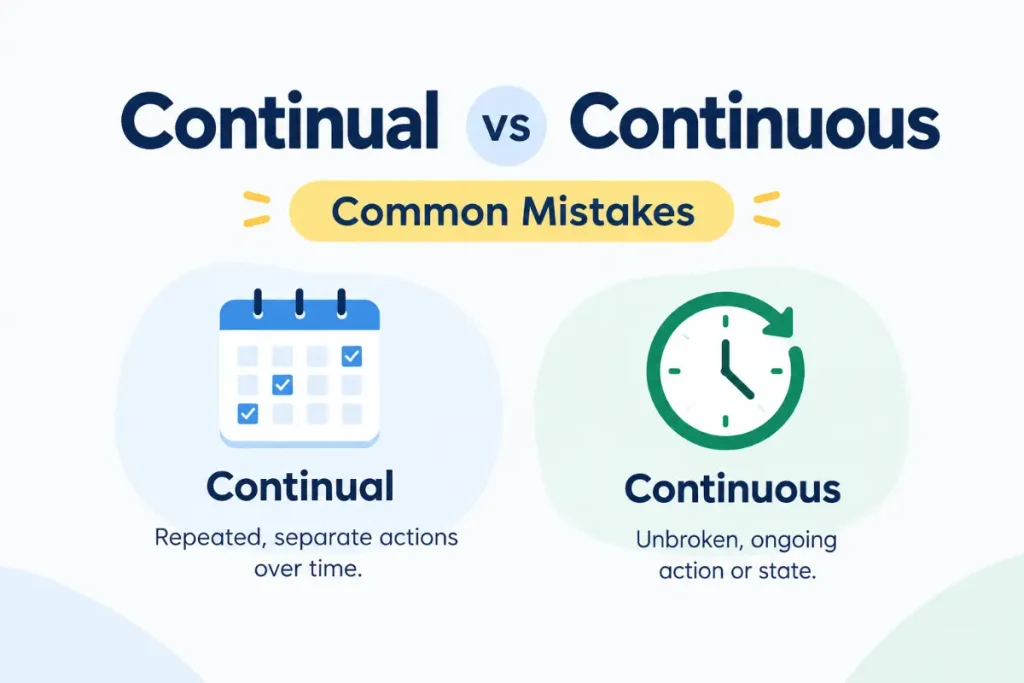
Think of continual as a series of dots.
Something happens. It stops. It happens again. It stops again. The pattern repeats.
Think of continuous as one unbroken line.
Something begins and keeps going without a meaningful interruption.
For example, a person may make continual complaints throughout a workday. They complain several times, but they are not speaking every second. By contrast, a person who speaks continuously talks without stopping for the period being discussed.
The same distinction works with physical events. Continual traffic problems might mean that problems keep occurring throughout the year. Continuous traffic might mean vehicles are moving along the road without a noticeable gap.
This is a useful rule, but it is not an ironclad law of English. Natural language contains overlap. Dictionaries and professional sources recognize that continual and continuous can sometimes be used in similar ways. The context determines which aspect of the situation matters most.
When you are editing your own sentence, ask one question: Am I describing repetition or an uninterrupted stretch?
If the answer is repetition, continual is often the clearer choice. If the answer is no interruption, continuous is usually the better choice.
Continual Vs Continuous Examples
Examples With Continual
The following sentences show situations where repeated events are more important than uninterrupted duration.
- The manager received continual requests for clarification from the new employees.
- Our flight was delayed by continual thunderstorms in the area.
- The teacher dealt with continual questions during the review session.
- The software company released continual updates throughout the year.
- Their continual disagreements slowed the decision making process.
- The child made continual attempts to open the locked cabinet.
- The restaurant received continual complaints about slow service.
- The neighborhood experienced continual power problems during the storm season.
- Her continual efforts eventually helped the team solve the problem.
- The continual revisions made the final report much clearer.
The tenth example is useful because continual does not have to be negative. Revisions can be beneficial. The word simply highlights that the revisions happened repeatedly.
Examples With Continuous
These sentences focus on an uninterrupted action, condition, flow, or state.
- The generator provided continuous power throughout the night.
- We heard a continuous alarm until the technician arrived.
- The river creates a continuous flow of water through the valley.
- The security camera provides continuous recording.
- The patient remained under continuous observation.
- The speaker talked continuously for nearly an hour.
- The factory requires continuous access to electricity.
- The software monitors the connection continuously.
- A continuous line marked the edge of the restricted area.
- The system maintained a continuous connection during the test.
The important point is not simply how long something lasts. Something can last a long time and still be continual if it consists of repeated events. Continuous specifically highlights the lack of interruption.
Continual Vs Continuous Improvement
The phrase continuous improvement deserves special attention because it is extremely established in workplace, quality, operations, and business language.
In quality management, continuous improvement refers to ongoing efforts to improve products, services, or processes. The American Society for Quality also notes that continuous improvement is sometimes called continual improvement. Its definition includes both incremental and breakthrough improvements.
That means continual improvement is not grammatically wrong. It can describe improvement that happens repeatedly over time. However, continuous improvement is a highly established expression in quality and process improvement terminology.
There is also an interesting technical distinction discussed within the quality field. Some practitioners use continual improvement as a broader idea that can include different kinds of improvements, while continuous improvement may emphasize an ongoing process. ASQ notes that these terms are frequently used interchangeably while also documenting this more specialized distinction.
For general business writing, you usually do not need to force that technical distinction. If you are talking about an established quality management concept, continuous improvement is the familiar phrase.
For example:
- The company has a continuous improvement program.
- Our team uses continuous improvement to reduce errors.
- The department reviews its processes as part of its continuous improvement efforts.
- Small changes can contribute to continuous improvement over time.
The phrase is common enough that replacing it with continual improvement can make the wording feel less conventional even though the alternative is grammatically valid.
Continually Vs Continuously
The adverbs follow the same basic distinction as their adjective forms.
Continually means repeatedly or frequently. Continuously means without stopping or interruption. Cambridge defines continually as happening repeatedly and continuously as happening without a pause or interruption.
Compare these sentences.
She continually checked her phone.
This means she checked it again and again. She put the phone down between checks.
She checked her phone continuously for ten minutes.
This suggests she kept checking or interacting with it throughout the stated period without a meaningful break.
Another example makes the difference clearer.
The customer continually called the office.
The customer made repeated calls.
The alarm sounded continuously.
The alarm kept sounding without stopping.
The adverbs can sometimes be used loosely in ordinary conversation. If the distinction matters, however, use continually for repeated actions and continuously for uninterrupted actions.
Continuous In Grammar
Continuous has another important meaning in English grammar.
The continuous form of a verb shows an action or situation as ongoing. It is formed with a form of be plus the present participle, usually the verb form ending in ing. Cambridge identifies continuous as a grammatical term and also uses progressive as a related term.
For example:
- I am studying.
- She is working.
- They were waiting.
- We are planning the event.
- He was driving home.
In I am studying, the continuous form presents studying as an ongoing activity.
This grammatical meaning is separate from the everyday adjective meaning of continuous. The connection is logical because both meanings involve an action or condition continuing over time.
Do not confuse the grammatical term with continual. You would not say the continual tense when referring to the present continuous or past continuous. In grammar, continuous is the standard technical term.
Just as bear and bare correctly depends on understanding their distinct meanings, choosing between continual and continuous requires paying attention to the context rather than relying on how similar the words sound.
Continual Continuous And Constant
Constant is another word that often enters this discussion. It can overlap with continuous and continual, but it has its own emphasis.
Constant can describe something that stays the same or something that happens very frequently. It can therefore overlap with both words depending on context.
Compare these examples.
The constant noise made it hard to concentrate.
This suggests the noise was persistent or frequent and may imply that it seemed to be there all the time.
The continuous noise made it hard to concentrate.
This more specifically emphasizes that the noise did not stop.
The continual noise from the construction site made it hard to concentrate.
This suggests repeated noise over time, potentially with pauses between episodes.
Other related words have different shades of meaning.
| Word | Main idea | Example |
|---|---|---|
| Continual | Repeated events | Continual interruptions |
| Continuous | No interruption | Continuous noise |
| Constant | Persistent or unchanging | Constant pressure |
| Repeated | Happening again | Repeated requests |
| Ongoing | Still developing or continuing | An ongoing project |
| Persistent | Continuing despite resistance or difficulty | Persistent problems |
| Incessant | Continuing with little or no pause and often irritating | Incessant chatter |
If your sentence feels ambiguous, repeated can sometimes be the clearest replacement for continual, while without interruption can clarify continuous.
Common Mistakes
The most common mistake is treating continual and continuous as perfect synonyms. They are closely related, but their usual emphasis differs.
- Incorrect for repeated events: The continuous interruptions made the meeting difficult.Better: The continual interruptions made the meeting difficult.The interruptions occurred repeatedly rather than as one uninterrupted event.
- Incorrect for an uninterrupted sound: The continual alarm sounded for twenty minutes without stopping.Better: The continuous alarm sounded for twenty minutes without stopping.The sentence specifically emphasizes the absence of a break.
- Potentially confusing: We experienced continual rain for six hours.Clearer when there was no break: We experienced continuous rain for six hours.Continuous makes the uninterrupted nature explicit.
- Potentially confusing: The company has a continual improvement program.Conventional business wording: The company has a continuous improvement program.Both forms can be understood, but continuous improvement is the established expression in quality and process improvement contexts.
- Incorrect grammar terminology: The teacher explained the continual tense.Correct: The teacher explained the continuous tense.Continuous is the standard grammatical term for this verb form.
- Unnecessarily vague: The system has continual monitoring.Clearer if monitoring never stops: The system has continuous monitoring.Continuous tells the reader that monitoring remains active without interruption.
The larger lesson is simple. Do not choose between these words only because they look similar. Choose based on the pattern you want the reader to understand.
Pronunciation
The two words look and sound similar, which contributes to the confusion.
In US English, Cambridge gives the following pronunciations.
| Word | US IPA | Simple guide |
|---|---|---|
| Continual | /kənˈtɪn.ju.əl/ | kun TIN yoo uhl |
| Continuous | /kənˈtɪn.ju.əs/ | kun TIN yoo us |
| Continually | /kənˈtɪn.ju.ə.li/ | kun TIN yoo uh lee |
| Continuously | /kənˈtɪn.ju.əs.li/ | kun TIN yoo us lee |
Both adjectives begin with a similar sound and share the stressed tin syllable. The endings are different. Continual ends with an uhl sound, while continuous ends with an us sound.
The pronunciation difference is useful when speaking, but context remains the main clue because the words sound similar enough that listeners may rely on the surrounding sentence.
Word Origin And Etymology
Continual and continuous are closely related historically. Both developed from the same Latin family associated with the idea of continuing or remaining connected.
That shared origin helps explain why the words have such similar forms and meanings. Over time, English developed different patterns of use around the two adjectives. Modern usage generally gives continual an emphasis on repetition and continuous an emphasis on uninterrupted duration.
The historical relationship is useful context, but you do not need to memorize the etymology to choose the right word. The practical distinction between repeated events and uninterrupted activity is much more useful for everyday writing.
American And British English
There is no major US versus UK spelling difference between continual and continuous. Both are standard English words in American and British English.
The basic distinction is also broadly recognized in both varieties. Continual commonly describes repeated events, while continuous commonly describes something that does not stop. Dictionary definitions in both forms of English reflect this general difference.
Usage can still overlap. Native speakers do not always draw a perfectly sharp line between the words, especially when the context makes the meaning obvious.
For American readers, the safest practical rule remains:
- Use continual when repeated events are the main idea.
- Use continuous when uninterrupted duration is the main idea.
- Use continuous improvement when referring to the established business and quality concept.
- Use continuous for grammatical terms such as present continuous and past continuous.
There is no reason to treat either word as a British spelling or an American spelling. Both belong to standard English on both sides of the Atlantic.
Formal Vs Casual Usage
Both continual and continuous are neutral words suitable for professional, academic, and everyday communication.
They do not belong to a special formal vocabulary. You can use them in a work email, school paper, report, conversation, or social media post.
The bigger issue is connotation.
Continual can sound mildly critical when used with problems, interruptions, complaints, or demands. For example, continual interruptions often suggests that the interruptions are unwanted.
Continuous tends to sound more descriptive. Continuous monitoring simply describes monitoring that does not stop. It does not inherently express approval or annoyance.
In professional writing, precision matters more than formality. If you mean repeated events, continual can be the more accurate word. If you mean an uninterrupted process, continuous gives the reader a clearer picture.
When neither distinction matters, a simpler word may work better. Repeated, ongoing, or constant can sometimes communicate the intended idea more directly.
Which Word Should You Use
When you need to make the choice quickly, use this practical test.
- Can there be breaks between events? Use continual if the events happen repeatedly.
- Does the activity continue without a break? Use continuous.
- Are you describing repeated complaints, interruptions, requests, or changes? Continual will often fit.
- Are you describing an uninterrupted sound, flow, supply, connection, or process? Continuous will often fit.
- Are you talking about a quality management concept? Continuous improvement is the established phrase.
- Are you naming a verb form such as present continuous? Use continuous.
- Is the sentence still unclear? Rewrite it with a more precise phrase such as repeated or without interruption.
The key is to focus on the meaning rather than the spelling. Both words are correct. The question is which one expresses the pattern you have in mind.
English has many confusing word pairs and groups, including similar-sounding words like cite, where meaning and context determine which word is appropriate.
Expert Usage Tips
A useful editing habit is to visualize the event on a timeline.
- If you can picture several separate points, continual is often a natural choice.
- If you can picture one uninterrupted line, continuous is usually clearer.
This technique works particularly well in professional writing. Consider the difference between continual system failures and continuous system failure. The first suggests that the system fails repeatedly. The second suggests one failure or state that continues without interruption.
You can also use a rewrite test. Replace continual with repeated. If the sentence keeps its intended meaning, continual is probably doing the right job. Replace continuous with without interruption. If that replacement works, continuous is probably the clearer choice.
Do not force the distinction when ordinary usage does not require it. English words often have overlapping meanings, and insisting on a rigid rule can make otherwise natural writing sound unnatural. The goal is clarity, not winning a vocabulary argument.
For editors, the best choice is the one that makes the intended time pattern obvious to the reader.
Frequently Asked Questions
What is the difference between continual and continuous?
Continual usually means happening repeatedly, while continuous means happening without interruption. Continual interruptions happen again and again with breaks between them. Continuous noise keeps going without a break. The distinction is useful rather than absolute because the words can overlap in some contexts.
Is continual improvement or continuous improvement correct?
Both phrases are grammatically possible, but continuous improvement is the established expression in quality management and business process improvement. The American Society for Quality describes continuous improvement as ongoing improvement of products, services, or processes and notes that continual improvement is also used as a name for the concept.
Is continual a synonym for continuous?
Continual can be a related synonym in some contexts, but the words are not always interchangeable. Continual usually emphasizes repeated occurrences, while continuous emphasizes an uninterrupted state or activity. If the distinction matters, using the more precise word prevents confusion.
Can continual and continuous be used interchangeably?
Sometimes, especially when the context makes the intended meaning obvious. However, they have different typical emphases. Continual points toward recurrence, while continuous points toward an unbroken duration. In careful writing, choose the word that best describes the actual pattern.
What does continual mean in a sentence?
Continual means happening repeatedly or frequently over time. In The continual interruptions made it difficult to work, the interruptions occur again and again rather than lasting without a break. The word can also be neutral or positive, although it often appears with situations that a speaker finds inconvenient or unwanted.
What does continuous mean in a sentence?
Continuous means continuing without a pause or interruption. In The machine produced a continuous sound, the sound keeps going rather than stopping and starting. Continuous can also describe uninterrupted flow, service, movement, monitoring, or other ongoing conditions.
Is continuous more formal than continual?
No. Both are standard and neutral English words. The difference is mainly semantic rather than formal. Continual often describes repeated events, while continuous describes uninterrupted activity or duration. Either word can appear naturally in everyday speech, professional emails, academic writing, and formal documents.
What is the difference between continual and constant?
Continual usually emphasizes repeated occurrences, while constant can emphasize something persistent, unchanging, or very frequent. Continual interruptions suggests repeated interruptions. Constant noise suggests noise that seems persistent or ever present. The best choice depends on the exact meaning you want to communicate.
Conclusion
The simplest way to remember the difference between continual vs continuous is to focus on interruption. Continual usually describes something that happens repeatedly, often with breaks between occurrences. Continuous describes something that keeps going without interruption.
Use continual for repeated complaints, interruptions, requests, changes, or problems. Use continuous for uninterrupted noise, rain, service, flow, monitoring, or activity. Remember that the distinction is a practical guideline rather than an absolute rule, because the two words can overlap in real English.
For business and quality writing, continuous improvement is the established expression. For grammar, continuous is also the standard term in forms such as present continuous. Once you focus on recurrence versus uninterrupted duration, the choice becomes much easier.