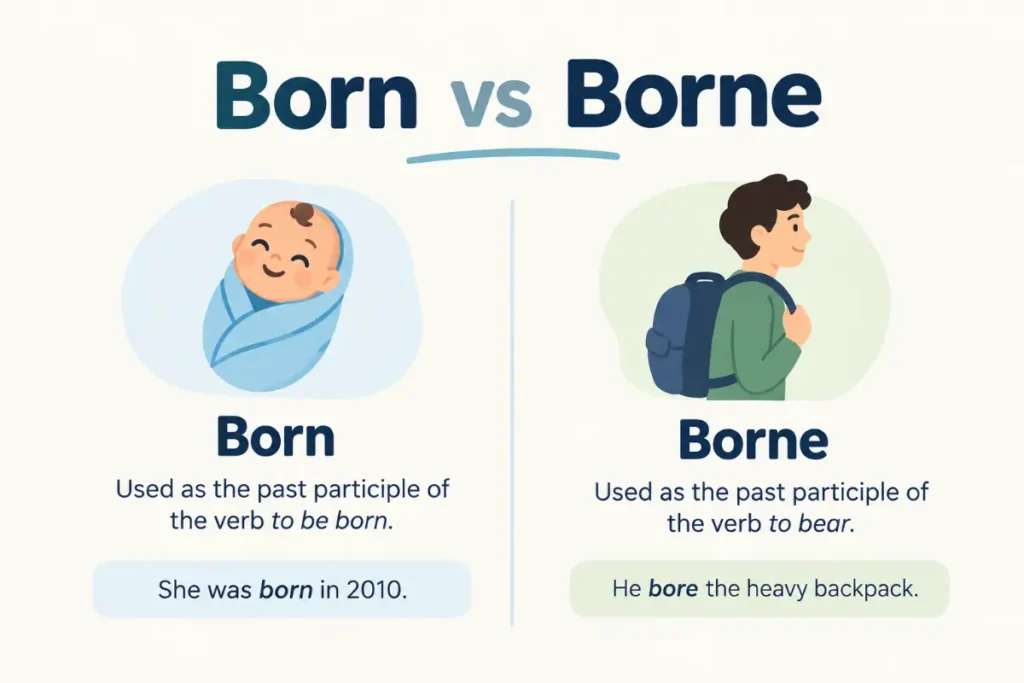
The difference between born vs borne can be confusing because both words come from the same verb, bear, and both relate to the past participle form of that verb. The key is context. Born is used almost exclusively when talking about birth, while borne is used for other meanings of bear, such as carrying, enduring, producing, or being caused by something.
For example, you would write, “She was born in Texas,” but “The cost was borne by the company.” You would also write, “The tree has borne fruit,” because the meaning there is producing rather than giving birth.
The distinction becomes easier once you understand how bear, bore, born, and borne fit together. This guide explains the difference in plain American English, shows how each form works in real sentences, covers expressions such as borne out of, and explains why born and borne are not interchangeable.
Quick Answer
Born is used for birth: “He was born in Chicago.” Borne is the past participle of bear when the meaning involves carrying, enduring, producing, or being caused by something: “She has borne the responsibility for years.” Use born for birth and borne for most other meanings of bear.
Born vs Borne At a Glance
The easiest way to understand the distinction is to connect each word with its main meaning.
| Feature | Born | Borne |
|---|---|---|
| Basic meaning | Related to birth | Carried, endured, produced, or caused |
| Word class | Past participle of bear in birth contexts | Past participle of bear in most other contexts |
| Main use | Giving birth or coming into existence | Carrying, supporting, enduring, producing, or being caused |
| Common pattern | Was born, were born, born in | Has borne, was borne, borne by |
| Example | She was born in Ohio. | The expense was borne by the employer. |
| Common phrase | Born in 1995 | Borne out of experience |
| Typical tone | Neutral | Neutral to formal |
| American English | Standard | Standard |
There is an important grammatical detail behind this table. Born is not simply an alternative spelling of borne. The two forms developed different functions, and modern English normally reserves born for the sense connected with birth.
If you’re unsure whether a phrase describes something ordinary or something that happens each day, everyday and every day explained can help clarify the difference.
What Does Born Mean?
Born refers to coming into life through birth. It is most commonly used with forms of be, especially in sentences such as “was born,” “were born,” and “is born.”
Examples include:
- Maria was born in California.
- My grandfather was born in 1942.
- Their daughter was born in May.
- The twins were born three minutes apart.
- He was born and raised in Boston.
- She was born into a large family.
- The baby was born healthy.
- I was born in a small town in Iowa.
- Their son was born during the winter.
- She was born to immigrant parents.
In these sentences, born tells us about the event or circumstances of birth. It can identify a person’s birthplace, birth date, family circumstances, or conditions surrounding birth.
The word can also be used figuratively to describe something that comes into existence. For example, you might say, “A new tradition was born.” The idea is that something new came into existence, using birth as a metaphor.
Born With and Born Into
Born with describes something a person has from birth.
- He was born with excellent hearing.
- She was born with a natural talent for music.
- The child was born with a rare condition.
Born into describes the circumstances or family a person enters at birth.
- She was born into a farming family.
- He was born into a wealthy household.
- They were born into difficult circumstances.
These expressions are common in both everyday and formal writing.
Born To
The expression born to can describe parentage or an apparent natural purpose or ability.
- She was born to hardworking parents.
- He was born to lead.
- She was born to be a teacher.
The first example concerns actual parentage. The second and third use born figuratively to suggest that someone seems naturally suited to a particular role.
What Does Borne Mean?
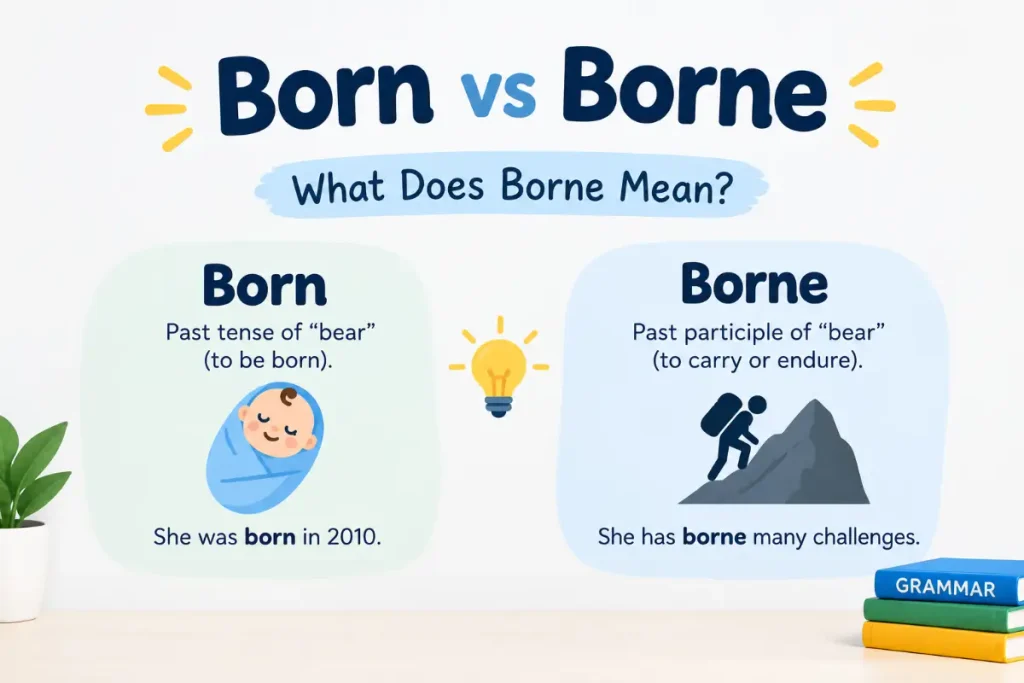
Borne is the past participle of bear when bear means something other than giving birth. Its meanings include carrying, supporting, enduring, producing, transmitting, or being caused by something.
For example:
- The cost was borne by the company.
- She has borne the responsibility for years.
- The tree has borne fruit.
- The disease is borne by mosquitoes.
- The decision was borne out of necessity.
In each sentence, borne has a meaning connected to the broader verb bear.
This is where many learners become confused. The words look almost identical and come from the same verb, but English separates their modern uses.
The Difference Comes From the Verb Bear
Understanding the forms of bear makes the distinction much easier.
The principal forms are:
bear → bore → borne
For example:
- I bear the responsibility.
- She bore the responsibility.
- She has borne the responsibility.
When the verb refers to giving birth, modern English uses born instead of borne in the passive construction.
- She bore a child.
- The child was born yesterday.
Notice the difference in structure. The mother bore the child. The child was born.
This distinction is especially useful because bear has several meanings. It can mean to carry something physically, tolerate something emotionally, produce something, or give birth.
The past tense is bore for all of these meanings.
- She bore the burden.
- The tree bore fruit.
- She bore a child.
The past participle depends on the context.
- She has borne the burden.
- The tree has borne fruit.
- The child was born yesterday.
That final distinction is the one you need to remember.
When Should You Use Born?
Use born when the sentence is about birth.
A simple test is to ask yourself: Is this sentence talking about someone or something coming into existence through birth?
If the answer is yes, born is normally the right choice.
Common patterns include:
Was born
- He was born in Denver.
- She was born in 1998.
- My mother was born in July.
Were born
- The twins were born in the same hospital.
- Three puppies were born overnight.
Is born
- A new star is born.
- Every generation is born into a different world.
Born and raised
- She was born and raised in Seattle.
- He was born and raised in rural Kentucky.
Born to
- She was born to two teachers.
- He was born to succeed.
Born with
- The child was born with a hearing impairment.
- She was born with an unusual talent for languages.
In ordinary American English, these constructions are natural and familiar.
When Should You Use Borne?
Use borne when bear means something other than giving birth.
There are several important patterns to recognize.
Borne by
This structure often means that someone or something carries, supports, pays, or transmits something.
- The costs were borne by the customer.
- The financial burden was borne by the company.
- The virus is borne by mosquitoes.
- The message was borne by a messenger.
The exact meaning depends on the noun that follows.
Borne out of
Borne out of means caused by, resulting from, or developing from something.
- The policy was borne out of necessity.
- Her interest in medicine was borne out of personal experience.
- The partnership was borne out of years of cooperation.
This expression is especially common in formal writing.
Borne by
In passive constructions, borne by can describe something that is carried or experienced.
- The responsibility was borne by the entire team.
- The consequences were borne by the local community.
- The burden was borne by a small group of employees.
Borne fruit
The expression borne fruit means produced a successful result.
- Years of research have finally borne fruit.
- Their efforts bore fruit after several months.
- The new strategy has borne excellent results.
Here, borne is connected to the idea of producing something, much like a tree bears fruit.
Similar confusion can occur with prepositions and adverbs, which is why understanding the difference between into and in to can make your writing more precise.
Examples of Born in Sentences
Here are varied examples showing how born works naturally.
- She was born in New York but grew up in Arizona.
The word identifies her place of birth. - My brother was born in 2001.
The word refers directly to the year of birth. - The baby was born just before midnight.
The sentence describes the time of birth. - They were born into a family of musicians.
Here, born into describes family circumstances. - He was born with a natural curiosity about science.
The quality existed from birth. - A new idea was born during the meeting.
This is a figurative use referring to the creation of an idea. - She was born and raised in Texas.
This familiar expression combines birthplace and upbringing. - The twins were born only five minutes apart.
The word describes their births. - He was born to parents who owned a small bookstore.
The sentence identifies his parentage. - The organization was born from a need for better community services.
This is a figurative use describing the creation of an organization.
Notice that the last example is not about physical birth. English still uses born because the sentence presents the organization as something that came into existence.
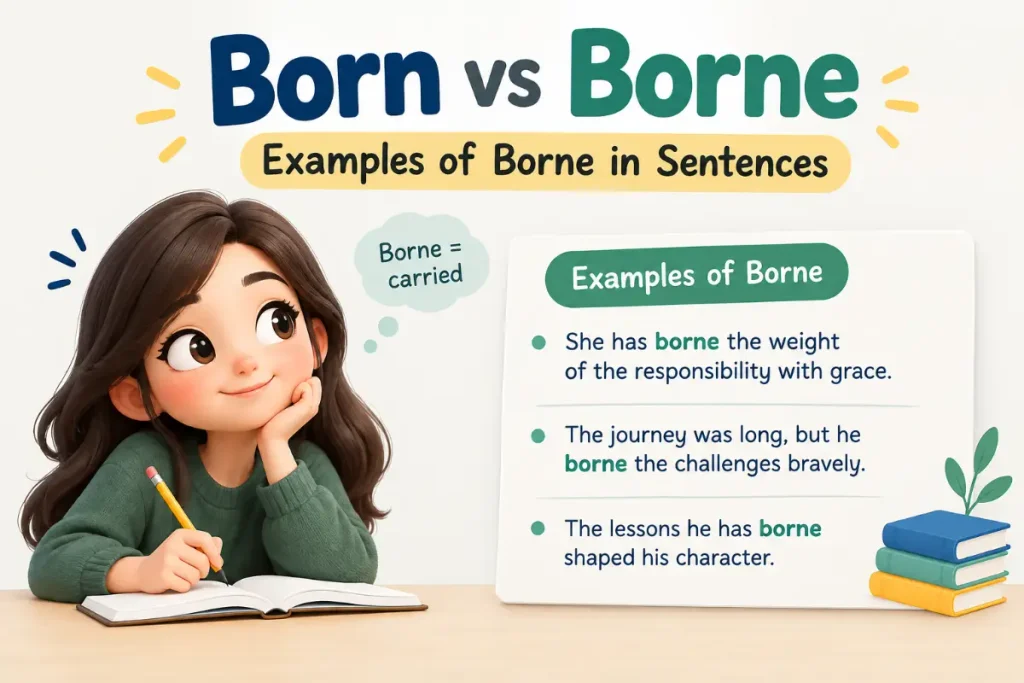
Examples of Borne in Sentences
Now compare those examples with sentences where borne is appropriate.
- The cost of the repairs was borne by the landlord.
Here, borne means paid or carried as a responsibility. - She has borne the responsibility for the project since January.
The meaning is carried or accepted as a responsibility. - The disease is borne by infected mosquitoes.
Here, borne means carried or transmitted. - The tree has borne fruit every summer.
The meaning is produced. - Their efforts have finally borne fruit.
The efforts produced a positive result. - The decision was borne out of financial necessity.
The decision resulted from a particular circumstance. - The burden was borne by several departments.
The departments carried the burden. - She has borne considerable criticism during her career.
Here, borne means endured or tolerated. - The expense must be borne by the purchaser.
The purchaser must accept responsibility for the expense. - The agreement was borne out of years of cooperation.
The agreement developed as a result of that cooperation.
These examples demonstrate why replacing borne with born can change the meaning or make a sentence grammatically inappropriate.
Born and Borne Are Not Interchangeable
A common mistake is treating these words as two spellings of the same form.
Consider these sentences:
Correct: She was born in Florida.
Incorrect: She was borne in Florida.
The second sentence does not use the normal modern English form for a person’s birth.
Now reverse the situation:
Correct: The costs were borne by the company.
Incorrect: The costs were born by the company.
The second sentence can look plausible because born is familiar, but it is not the standard form when bear means carrying or accepting a cost.
A useful mental shortcut is:
Birth means born.
Carrying, enduring, producing, or transmitting means borne.
This shortcut will not explain every historical or highly specialized use of bear, but it works extremely well for ordinary modern English.
Bear Bore Born or Borne
The sequence bear, bore, born, and borne can seem complicated because bear has several meanings.
Here is the practical pattern.
| Form | Main function | Example |
|---|---|---|
| Bear | Present tense | I cannot bear the noise. |
| Bore | Past tense | She bore the burden alone. |
| Born | Birth related past participle | He was born in 1990. |
| Borne | Other past participle uses | She has borne the burden for years. |
The important point is that bore is the past tense, while born and borne are specialized past participle forms.
You might see:
- She bore a child.
- The child was born in June.
- She has borne the responsibility.
- The responsibility was borne by her.
This makes the grammar much more logical.
The mother bore the child. The child was born. The mother has borne the responsibility.
Common Mistakes With These Words
Mistake 1: Using Born for Every Meaning of Bear
Incorrect: The company has born the cost.
Correct: The company has borne the cost.
The sentence means the company has carried or accepted the cost, so borne is required.
Mistake 2: Using Borne for Birth
Incorrect: She was borne in California.
Correct: She was born in California.
The sentence refers to the person’s birth, so born is the standard modern form.
Mistake 3: Confusing Bore With Born
Incorrect: He was bore in 1995.
Correct: He was born in 1995.
Bore is a past tense form of bear. It does not work in the passive birth construction.
Mistake 4: Forgetting the Phrase Borne Out Of
Incorrect: The plan was born out of necessity.
Correct: The plan was borne out of necessity.
In careful formal writing, borne out of is used when something develops from or results from a particular condition.
Mistake 5: Writing Born Fruit
Incorrect: The project has born fruit.
Correct: The project has borne fruit.
The expression means that the project produced results.
Borne Out Of Meaning
Borne out of is one of the most useful expressions to learn because it appears frequently in formal and professional writing.
It means that something was caused by, developed from, or resulted from something else.
For example:
- The program was borne out of a community need.
- Her decision was borne out of years of experience.
- The agreement was borne out of extensive negotiations.
- The idea was borne out of a simple observation.
The expression often describes an origin or cause. It does not refer to physical transportation or birth.
There is another expression that looks similar: borne out.
Borne Out
Borne out means confirmed or supported by evidence.
- The results bore out his prediction.
- Later evidence borne out by testing supported the theory.
In modern usage, the related verb phrase bear out means to confirm or support.
For example:
- The evidence bears out her claim.
- The results bear out the original assumption.
The grammar differs depending on the sentence, so it is useful to distinguish borne out of from bear out.
Is Born Ever Used Figuratively?
Yes. Born can describe something that comes into existence figuratively.
Examples include:
- A new tradition was born.
- The idea was born during a conversation.
- A new movement was born from the protests.
- Their friendship was born in college.
This does not mean born suddenly replaces borne in every figurative expression.
The choice depends on the underlying sense. If the writer presents something as coming into existence, born can work. If the meaning is carrying, enduring, producing, or being caused by something, borne is generally appropriate.
Compare:
- The idea was born during a conversation.
- The idea was borne out of years of research.
The first emphasizes creation. The second emphasizes the circumstances that produced the idea.
Pronunciation of Born and Borne
In most American English speech, born and borne are pronounced the same way.
Both are commonly pronounced /bɔrn/.
A simple pronunciation guide is:
born: born
borne: born
The spelling difference does not normally create a pronunciation difference.
This is one reason the words can be confusing in speech. You can hear the word correctly and still need to determine the spelling from context.
For example:
- “She was born in Ohio.”
- “The cost was borne by the company.”
The listener relies on the surrounding meaning to understand which form is intended.
Born vs Borne in American English
Both born and borne are standard in American English. The distinction is based mainly on meaning and grammar, not on American versus British spelling.
American writers should therefore not treat borne as a British alternative to born. It is a legitimate English word with its own functions.
The same basic distinction appears in other major varieties of English as well.
There are some differences in style and frequency across regions, especially in formal expressions, but the central rule remains stable:
- Use born for birth.
- Use borne for other relevant meanings of bear.
Formal and Casual Usage
Both forms are neutral English words, but borne appears more often in formal, professional, academic, legal, and technical writing because its meanings often involve responsibility, costs, causes, or transmission.
For example, a business document might say:
- The additional expenses will be borne by the supplier.
A less formal conversation might use a simpler construction:
- The supplier will pay the extra costs.
Both communicate essentially the same idea, but the second is more direct and conversational.
Similarly:
- Formal: The financial burden was borne by the organization.
- Conversational: The organization had to cover the cost.
Knowing this distinction can help you edit for clarity. Borne is perfectly correct, but sometimes a simpler verb communicates the same idea more naturally.
Born vs Borne vs Bourne
The word Bourne is different from both born and borne.
Bourne is generally a proper name or a literary word with historical meanings related to a boundary or destination. It also appears in names of people and places.
For example:
- Jason Bourne is a fictional character.
- The word bourne can appear in literary expressions such as “the bourne of life.”
Do not treat Bourne as another spelling of born or borne.
The pronunciation can also vary depending on the specific name or word, so context matters.
For ordinary grammar questions about birth or the verb bear, the relevant choices are born and borne, not Bourne.
Paying attention to context is equally important when choosing the right everyday expression, particularly when two forms look almost identical but function differently.
A Simple Way to Remember the Difference
If you regularly mix up these words, remember the meaning rather than the spelling.
Think Born When You See Birth
Ask:
Is someone coming into life or existence?
If yes, born is usually the right choice.
- born in Texas
- born in 2005
- born into a family
- born with a talent
- born and raised in Chicago
- a new idea was born
Think Borne When You See Bearing
Ask:
Is something being carried, endured, produced, transmitted, or caused?
If yes, borne is usually the right choice.
- borne by the company
- borne by mosquitoes
- borne out of necessity
- borne fruit
- borne the burden
- borne the cost
This distinction is far more reliable than trying to remember the words as separate spellings.
Frequently Asked Questions
Which is correct, born or borne?
Both are correct, but they have different uses. Born is used primarily for birth, as in “She was born in Florida.” Borne is used for other meanings of bear, including carrying, enduring, producing, and being caused by something, as in “The cost was borne by the company.”
Is born the past tense of bear?
No. Bore is the simple past tense of bear. Born and borne are past participle forms used in different contexts. For example, “She bore a child” uses bore as the past tense, while “The child was born yesterday” uses born in a passive construction.
Is borne grammatically correct?
Yes. Borne is a standard English word and is the past participle of bear in many contexts. It appears in expressions such as “borne by the company,” “borne out of necessity,” and “has borne fruit.” It is not an alternative spelling of born.
Why do born and borne have the same pronunciation?
Both words are commonly pronounced /bɔrn/ in American English. Their different spellings reflect different grammatical and semantic functions rather than different sounds. Context therefore tells readers and listeners which meaning is intended.
What does borne out of mean?
Borne out of means caused by, developed from, or resulting from something. For example, “The decision was borne out of necessity” means that necessity was the reason the decision developed. The expression is especially common in formal and professional writing.
Is born out of correct?
Born out of is also used in modern English, especially when describing the creation of an idea, organization, movement, or other thing. For example, “The project was born out of frustration.” Borne out of emphasizes being caused or resulting from something and is also well established. Context determines which expression fits the intended meaning.
What is the difference between bore and borne?
Bore is the simple past tense of bear, while borne is a past participle. For example, “She bore the responsibility alone” uses the past tense. “She has borne the responsibility for years” uses the past participle. Born is the specialized form used for birth.
How can I remember when to use borne?
Connect borne with the broader meanings of bear: carrying, enduring, producing, transmitting, or resulting from something. Connect born with birth. If you can replace the idea with “came into life,” use born. If the meaning is closer to “carried” or “endured,” borne is usually the right choice.
Conclusion
The distinction between born vs borne becomes much easier once you connect each word with its meaning. Use born when you are talking about birth or something figuratively coming into existence. Use borne when bear means carrying, enduring, producing, transmitting, or resulting from something.
Remember the most useful shortcut: born relates to birth, while borne relates to bearing. You can then apply the rule to common expressions such as “was born in Texas,” “borne by the company,” “borne out of necessity,” and “has borne fruit.”
If you are unsure, look at the role of bear in the sentence. That meaning usually tells you which form belongs there.