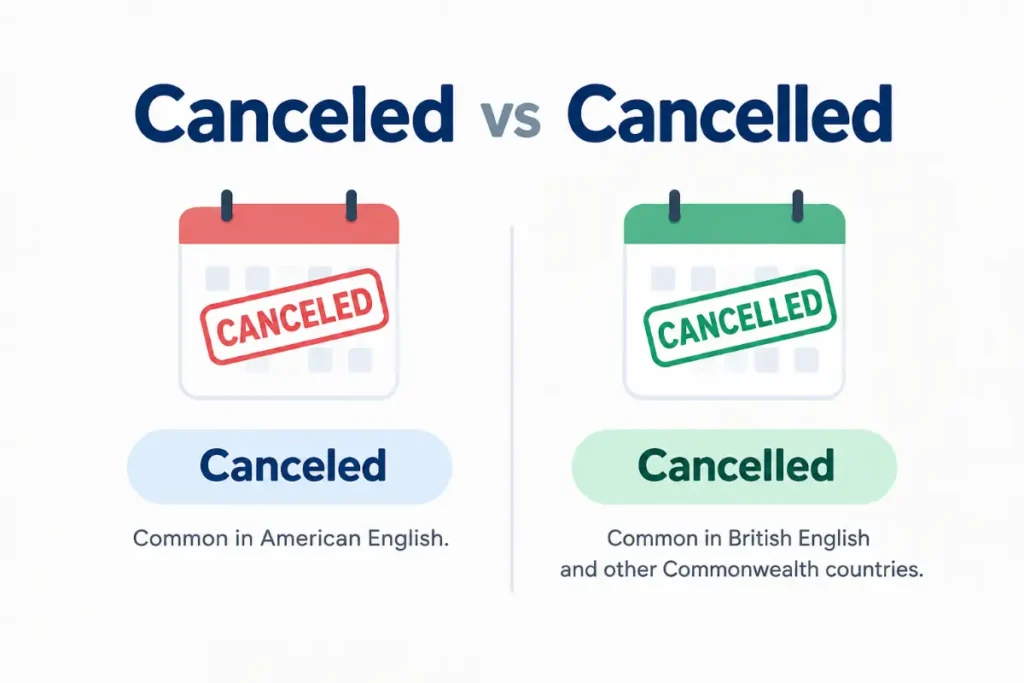
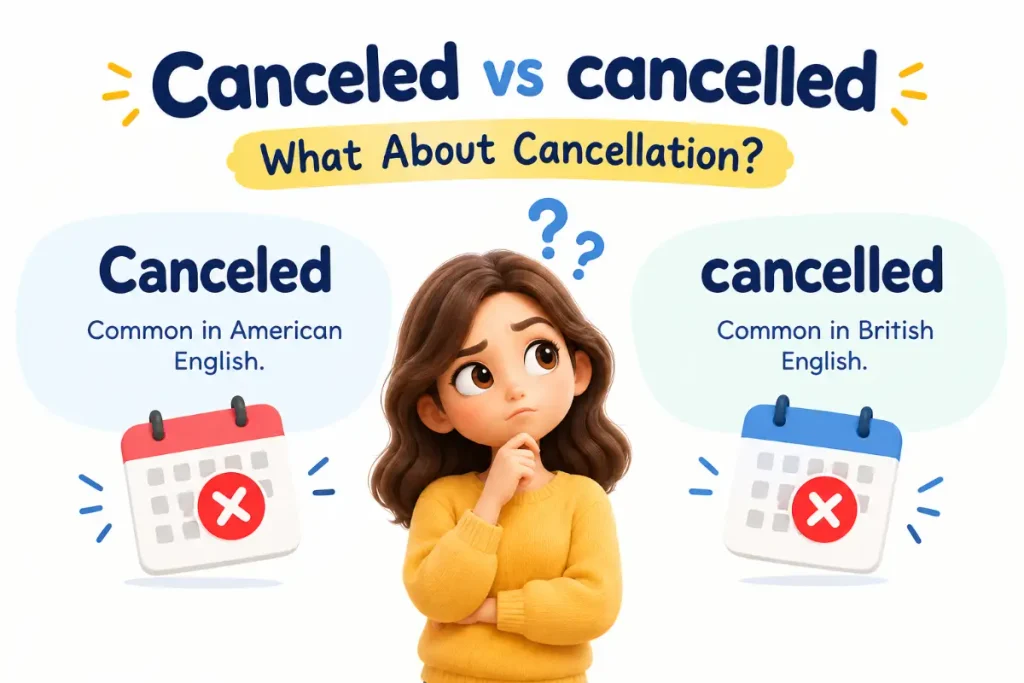
If you are unsure about canceled vs cancelled, the answer depends mainly on the variety of English you are writing. Canceled is the standard spelling in American English, while cancelled is the standard spelling in British English and is also common in other varieties such as Canadian and Australian English. Both forms come from the same verb, cancel, and they have exactly the same meaning.
The difference is simply a spelling convention. American English usually uses one l before the ending, giving us canceled and canceling. British English normally doubles the l, producing cancelled and cancelling. Cambridge specifically lists the US forms as canceled and canceling and the UK forms as cancelled and cancelling.
That distinction becomes useful when you are writing emails, school assignments, business documents, news copy, website content, or anything else for a particular audience. This guide explains the spelling difference, the grammar behind it, the related noun cancellation, examples in real sentences, common mistakes, and which form to choose in American English.
Quick Answer
Canceled is the standard spelling in American English. Cancelled is the standard British spelling and is also used in several other English varieties. The two forms have the same meaning and pronunciation. Choose canceled for standard US writing and cancelled when following British or another regional spelling system.
Canceled and Cancelled Have the Same Meaning
The two spellings do not represent different meanings. Both are the past tense and past participle of the verb cancel.
To cancel something means to decide that an event, appointment, reservation, order, service, or other planned activity will not happen or should no longer continue. Cambridge gives examples involving canceled or cancelled flights, appointments, television shows, and other arrangements.
Consider these sentences:
- The airline canceled the flight because of severe weather.
- The airline cancelled the flight because of severe weather.
The meaning is identical. The spelling changes because the writer is following a different English spelling convention.
The same distinction applies to many contexts:
- A meeting can be canceled or cancelled.
- A reservation can be canceled or cancelled.
- A subscription can be canceled or cancelled.
- A concert can be canceled or cancelled.
- An order can be canceled or cancelled.
- A television series can be canceled or cancelled.
The important point is that neither spelling describes a different kind of cancellation. The extra l is a regional spelling difference.
If you enjoy sorting out other easily confused word pairs, understanding when to use “into” and “in to” can make your writing more precise.
Canceled vs Cancelled at a Glance
| Feature | Canceled | Cancelled |
|---|---|---|
| Standard US spelling | Yes | No |
| Standard UK spelling | No | Yes |
| Meaning | To stop or call off something | To stop or call off something |
| Part of speech | Verb form | Verb form |
| Base verb | Cancel | Cancel |
| Past tense | Canceled | Cancelled |
| Past participle | Canceled | Cancelled |
| Present participle | Canceling | Cancelling |
| Pronunciation | The same | The same |
| Main difference | American spelling convention | British spelling convention |
| Common US contexts | Emails, business, school, news, everyday writing | Usually seen when following UK or another regional style |
The table shows why treating one spelling as a misspelling in every situation can be misleading. The correct choice depends on the English variety and style you are using.
Why Does Cancelled Have Two Ls?
The difference comes from how American and British English handle certain words ending in a stressed or unstressed vowel sound followed by l when adding suffixes.
British English commonly doubles the final l in forms such as:
- cancel → cancelled
- cancel → cancelling
- travel → travelled
- travel → travelling
American English generally keeps one l in these forms:
- cancel → canceled
- cancel → canceling
- travel → traveled
- travel → traveling
This is part of a broader difference between American and British spelling. It is not a grammatical difference, and it does not change the underlying word.
There is one detail worth remembering. The noun cancellation normally has two ls in both American and British English, although cancelation also exists as a US variant. Cambridge’s American dictionary lists cancellation as the standard noun while noting cancelation as an alternative US spelling.
That can seem inconsistent at first:
- US: canceled
- US: canceling
- US: cancellation
- UK: cancelled
- UK: cancelling
- UK: cancellation
The spelling pattern depends on the form of the word, so you should not automatically remove or add a letter simply because you see another form.
Which Spelling Should You Use in American English?
For a US audience, use canceled.
That is the spelling readers will normally expect in American English. It is appropriate for ordinary writing, professional communication, educational material, websites, business documents, and most other US contexts.
For example:
- The school canceled classes because of the snowstorm.
- I canceled my dentist appointment this morning.
- The customer canceled the order before it shipped.
- The company canceled the meeting at the last minute.
- The airline canceled our flight.
- She canceled her subscription after three months.
- The event was canceled because the venue lost power.
- The restaurant canceled our reservation after closing early.
If your entire document follows American spelling, using canceled keeps the spelling consistent.
Consistency matters more than trying to make one spelling look more formal. Cancelled is not a more sophisticated version of canceled, and canceled is not an informal version of cancelled. They are regional spellings of the same word.
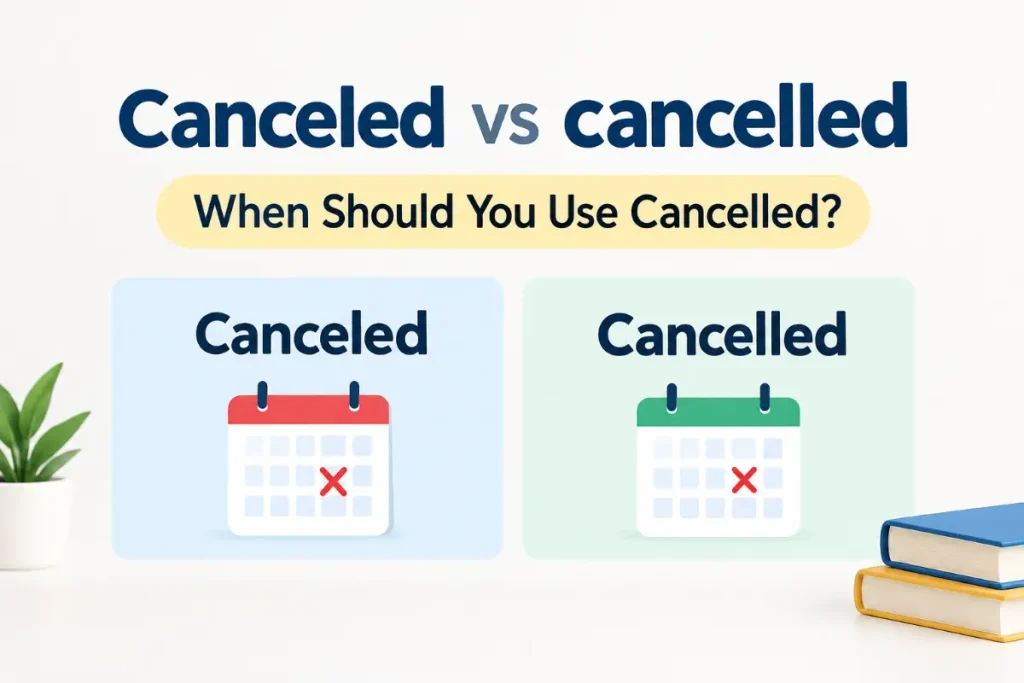
When Should You Use Cancelled?
Use cancelled when you are following British English spelling or the spelling conventions of a regional variety that uses the doubled l.
For example:
- The match was cancelled because of heavy rain.
- The train was cancelled without warning.
- She cancelled her appointment yesterday.
- The company cancelled the event.
- His flight was cancelled in the afternoon.
- The show was cancelled after two seasons.
- They cancelled their reservation before traveling.
- The meeting was cancelled due to a scheduling problem.
A US reader will generally understand cancelled without difficulty. It is not a different word. It simply signals a spelling convention associated most strongly with British English and other varieties that follow similar patterns.
The reverse is also true. A British reader will understand canceled, even though it may look distinctly American.
Examples of Canceled in American English
The best way to understand the US spelling is to see it in different settings.
Everyday Conversation
I canceled my plans because I wasn’t feeling well.
Here, canceled describes an action that happened in the past.
We canceled dinner and ordered takeout instead.
The word works naturally in casual conversation because the spelling difference has nothing to do with formality.
Text Messages
The game got canceled, so we’re heading home.
Texting does not require a different spelling. Standard American English still uses canceled.
Sorry, I canceled the reservation by mistake.
The sentence is casual, but the spelling remains standard US usage.
Workplace Email
The client canceled today’s meeting and asked to reschedule for Friday.
This form is suitable for professional correspondence.
The training session has been canceled due to a scheduling conflict.
The passive construction is especially common in workplace announcements.
School Writing
The school canceled the field trip because of severe weather.
For a US school assignment, canceled follows American spelling conventions.
The lecture was canceled, so the professor posted the material online.
The word works naturally in academic contexts as well.
Business Communication
The customer canceled the order before it entered production.
This wording is clear and neutral.
The company canceled the contract after reviewing the revised terms.
The verb can also appear in legal and commercial contexts.
News and Public Notices
The city canceled the outdoor event because of dangerous weather conditions.
Several flights were canceled after the airport temporarily closed.
These examples demonstrate that the US spelling works across formal and public communication, not just casual writing.
Examples of Cancelled in British English
The doubled spelling follows the same grammatical patterns.
Everyday Use
I cancelled my plans for Saturday.
Travel
Our train was cancelled because of a technical problem.
Appointments
She cancelled her appointment earlier today.
Workplace Communication
The meeting has been cancelled until further notice.
Events
The concert was cancelled because the venue was unavailable.
Television
The series was cancelled after its second season.
Orders
The customer cancelled the order before it was shipped.
Reservations
We cancelled the hotel reservation after changing our travel plans.
None of these sentences has a different meaning from its American counterpart. Only the spelling changes.
The Grammar Behind the Word
Cancel is a verb. It can be used transitively, meaning it takes a direct object, or in some contexts without an object when the intended meaning is clear.
For example:
The airline canceled the flight.
Here, the airline is the subject, canceled is the verb, and the flight is the object.
You can also say:
I had to cancel.
The object is understood from the context.
The verb has several common forms:
| Verb form | American English | British English |
|---|---|---|
| Base form | cancel | cancel |
| Third person singular | cancels | cancels |
| Past tense | canceled | cancelled |
| Past participle | canceled | cancelled |
| Present participle | canceling | cancelling |
Notice that the base form cancel is spelled the same in both varieties.
The difference appears when suffixes are added to the word.
Canceled or Cancelled in the Past Tense
If you are writing American English, the past tense is canceled.
She canceled the appointment yesterday.
If you are writing British English, the past tense is cancelled.
She cancelled the appointment yesterday.
Both are grammatically correct within their respective spelling systems.
The same rule applies when the form is used as a past participle.
- The flight was canceled.
- The flight was cancelled.
The first follows American spelling. The second follows British spelling.
English has plenty of another common spelling distinction where a small difference in spacing or form can change how a phrase functions.
Canceled or Cancelled in the Present Participle
The same regional distinction appears in the ing form.
American English:
canceling
British English:
cancelling
For example:
I am canceling my subscription.
British spelling:
I am cancelling my subscription.
This is useful to remember because writers sometimes use canceled correctly but then accidentally write cancelling in the same US document.
For consistent American English, use:
- canceled
- canceling
For consistent British English, use:
- cancelled
- cancelling
What About Cancellation?
Cancellation is the noun that refers to the act or result of canceling something.
For example:
- The cancellation of the flight caused major delays.
- We received a cancellation notice this morning.
- There is a cancellation fee for appointments missed without notice.
The standard spelling cancellation uses two ls. Cambridge identifies cancellation as the American noun and notes cancelation as an alternative US spelling.
This creates a spelling pattern that surprises some writers:
cancel → canceled → canceling → cancellation
The noun should not be changed to cancelation simply because American English drops an l in canceled. The noun has its own established spelling pattern.
For most US writing, cancellation is the safest and most familiar choice.
Canceled vs Cancelled in Professional Writing
In professional writing, the best choice is usually the one that matches the style of the audience, organization, or publication.
For an American company, use canceled:
The meeting was canceled due to a scheduling conflict.
For a British company, use cancelled:
The meeting was cancelled due to a scheduling conflict.
If you are writing for an international organization, check its internal style guide. Some organizations follow a specific regional variety consistently, while others may have their own editorial preferences.
The key is consistency. Avoid switching between the two forms without a reason.
For example, this looks inconsistent in American English:
The meeting was canceled, but the afternoon session was cancelled.
There is no meaning based reason for switching spellings. If the document uses American English, write:
The meeting was canceled, but the afternoon session was canceled.
Is Cancelled Wrong in American English?
No. Cancelled is not an inherently incorrect spelling.
It is the standard spelling in British English and is used in other English varieties as well. American readers may recognize it as a British or international spelling, but that does not make the word meaningless or grammatically wrong.
The same principle works in reverse. Canceled is not an error simply because a British writer normally uses cancelled.
Regional spelling differences are common in English. Similar examples include:
- color and colour
- center and centre
- traveled and travelled
- labeled and labelled
- organize and organise
The important question is not which spelling is universally correct. The useful question is which spelling fits the English variety you are using.
Common Mistakes With These Spellings
Mixing Regional Forms
A common mistake is switching between American and British forms in the same piece of writing.
Inconsistent: The event was canceled, but the meeting was cancelled.
Consistent US English: The event was canceled, but the meeting was canceled.
Consistent UK English: The event was cancelled, but the meeting was cancelled.
Using Cancelled Because It Looks More Formal
The extra l does not make the word more formal.
Canceled is perfectly appropriate for formal American writing.
The hearing was canceled.
There is no need to use cancelled to make the sentence sound more professional.
Forgetting the Present Participle
Some writers remember canceled but use cancelling in the same US document.
For American English:
I am canceling the appointment.
For British English:
I am cancelling the appointment.
Changing Cancellation to Cancelation Automatically
American English allows cancelation as a variant, but cancellation remains a standard and widely used spelling. Cambridge specifically lists cancellation and notes the US variant cancelation.
For general American writing, cancellation is a straightforward choice.
Pronunciation of Cancel
The pronunciation does not change because of the spelling.
In American English, cancel is pronounced approximately like KAN suh l, with the first syllable receiving the main stress. Cambridge gives the US pronunciation as /ˈkæn.səl/.
The past forms are pronounced essentially the same:
canceled: KAN suhld
cancelled: KAN suhld
The extra l in the British spelling does not create an extra spoken syllable.
This is one reason the difference can be confusing for learners. You can hear the same word but encounter two spellings in written English.
Where the Spelling Difference Comes From
The spelling difference is part of the larger historical development of American and British English.
American spelling was influenced by efforts to establish distinctive and more streamlined spelling conventions. British English retained or developed spelling patterns that differ from common American forms.
The distinction involving cancel is not an arbitrary mistake made by modern writers. Both patterns are established conventions.
For learners, the practical lesson is more important than memorizing the history:
- American English: canceled and canceling.
- British English: cancelled and cancelling.
Once you recognize that pattern, the spelling becomes much easier to remember.
How to Remember the US Spelling
If you primarily write for an American audience, remember this simple pair:
cancel → canceled → canceling
Think of American English as keeping one l when forming these two verb forms.
You do not need to apply that idea blindly to every related word. For example, cancellation is normally written with two ls in American English.
A useful memory sentence is:
The US canceled the event and is canceling the next meeting.
That gives you both important American forms in one sentence.
For another useful usage comparison, consider “born” and “borne,” two forms that look similar but are used in different contexts.
Which Form Should You Use?
The right choice depends on your audience.
Use canceled when:
- You are writing standard American English.
- Your audience is primarily in the United States.
- You are writing a US business email.
- You are preparing American educational content.
- You are following an American editorial style.
- You are writing US focused website content.
Use cancelled when:
- You are writing standard British English.
- Your publication follows British spelling.
- Your organization uses British spelling conventions.
- You are writing specifically for an audience that expects that regional form.
If you are writing for Americans and have no special style guide telling you otherwise, canceled is the natural choice.
Frequently Asked Questions
Which is correct, canceled or cancelled?
Both are correct spellings, but they belong to different regional spelling systems. Canceled is standard American English, while cancelled is standard British English and is also used in several other varieties. The words have the same meaning, pronunciation, and grammatical function.
Is canceled the American spelling?
Yes. Canceled is the standard American spelling of the past tense and past participle of cancel. American English also normally uses canceling rather than cancelling. Cambridge explicitly identifies the US forms as canceled and canceling.
Is cancelled the British spelling?
Yes. Cancelled is the standard British spelling. British English also normally uses cancelling with two ls. The base verb remains cancel in both varieties.
Why does American English use canceled?
American English generally uses one l in this form, while British English commonly doubles the l. This is a spelling convention rather than a difference in grammar or meaning. Similar differences occur with words such as traveled and travelled.
Is cancelation correct?
Cancelation is a recognized US variant, but cancellation is the more familiar standard noun form for general writing. Cambridge lists cancellation and notes cancelation as a US alternative. For most American readers, cancellation is a clear choice.
Is canceled or cancelled more formal?
Neither spelling is inherently more formal. The difference is regional, not stylistic. Canceled is appropriate in formal American English, while cancelled is appropriate in formal British English. Choose the spelling that matches the English variety used by your audience or publication.
How do you spell the past tense of cancel in American English?
The American spelling is canceled. For example: The company canceled the meeting. The corresponding British spelling is cancelled. The pronunciation and meaning remain the same.
Should I use canceled or cancelled in US content?
Use canceled for standard US content unless a specific style guide or quoted material requires another form. This applies to websites, emails, business documents, school assignments, customer messages, and most other writing intended for American readers.
Final Takeaway
The difference between canceled vs cancelled is a matter of regional spelling, not meaning. Canceled is the standard form in American English, while cancelled is the standard British form. Both are the past tense and past participle of cancel, and both describe something that was stopped, called off, or ended.
For US writing, the easiest rule is simple: use canceled and canceling. If you are following British English, use cancelled and cancelling. Keep cancellation in mind as well, since the noun normally retains two ls even in American English.
Once you know which English variety you are using, the choice becomes straightforward. The spelling should match your audience, and consistency throughout the same piece of writing matters most.