Choosing between into vs in to can feel surprisingly difficult because the two forms usually sound almost identical when spoken. The difference becomes clearer once you look at the job each form performs in a sentence. Into is usually a single preposition that expresses movement toward the inside of something, a change from one state to another, contact, involvement, or strong interest. In to, on the other hand, contains two separate words that happen to appear next to each other.
The easiest way to decide is to look at the words around the expression. If into means something like inside, toward the inside, or becoming something else, write it as one word. If in belongs to a verb or phrasal verb and to introduces an infinitive or another phrase, keep them separate.
This distinction matters in everyday writing, workplace emails, school assignments, technical instructions, and professional communication. The examples below show how the two forms work, where writers commonly get confused, and how to make the correct choice quickly.
Quick Answer
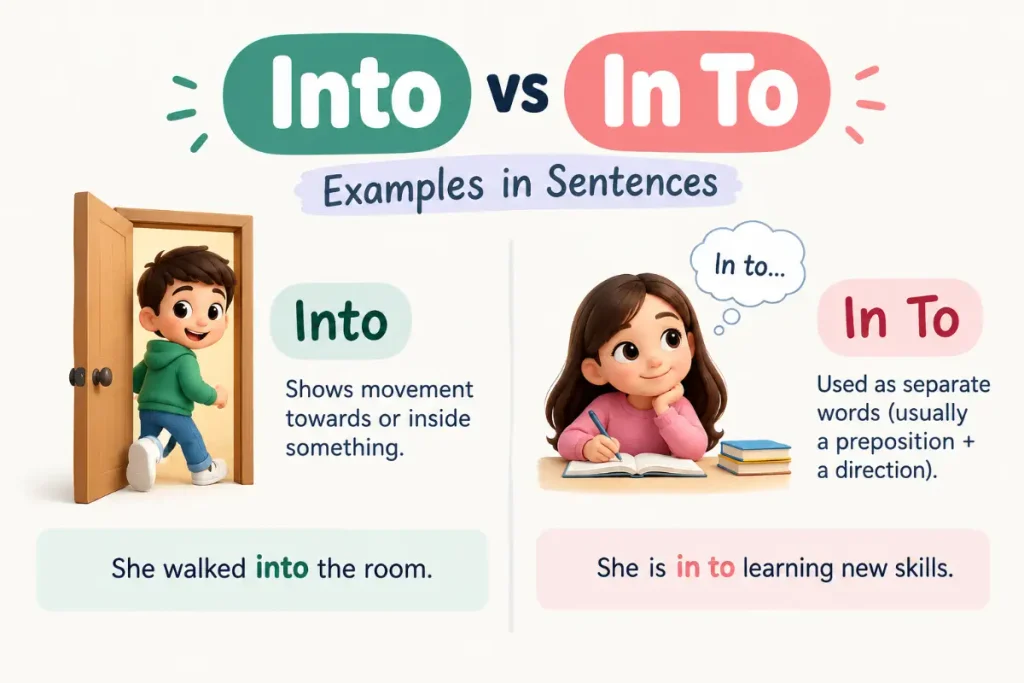
Into is one word when it functions as a preposition showing movement inside something, transformation, contact, involvement, or interest. In to is two words when in belongs to the preceding verb or phrase and to has its own grammatical role. Compare She walked into the room with She came in to talk.
Into vs In To: The Main Difference
The most important distinction is grammatical, not simply visual.
Into functions as a single word. It commonly connects an action or condition with a destination, container, new form, subject, or activity. It can describe physical movement, transformation, collision, involvement, or interest.
In to consists of the preposition or adverb in followed by to, which may introduce an infinitive verb or serve another grammatical purpose. The two words are independent even though they appear beside each other.
| Feature | Into | In to |
|---|---|---|
| Form | One word | Two words |
| Main function | Preposition | Two separate grammatical words |
| Common meaning | Inside, toward, change, contact, involvement | In plus another use of to |
| Physical movement | She walked into the store. | Usually not used for this meaning |
| Transformation | The caterpillar turned into a butterfly. | Not normally used |
| Phrasal verbs | Can be part of a larger phrase | Often occurs after phrasal verbs |
| Before an infinitive | No | Common, such as came in to help |
| Pronunciation | Usually pronounced as one unit | Often sounds nearly identical |
| Common confusion | Mistakenly separated | Mistakenly combined |
Cambridge identifies into as a preposition with several uses, including movement toward the inside, transformation, forceful contact, direction, involvement, interest, and division. It also explains that in can function as part of phrasal verbs, which helps explain why in to sometimes appears naturally as two words.
The key is to avoid deciding based only on sound. Instead, identify the grammatical relationship.
If you’re dealing with words that sound alike but have different meanings, exploring common homophone mix-ups can help you avoid similar mistakes in everyday writing.
When to Use Into
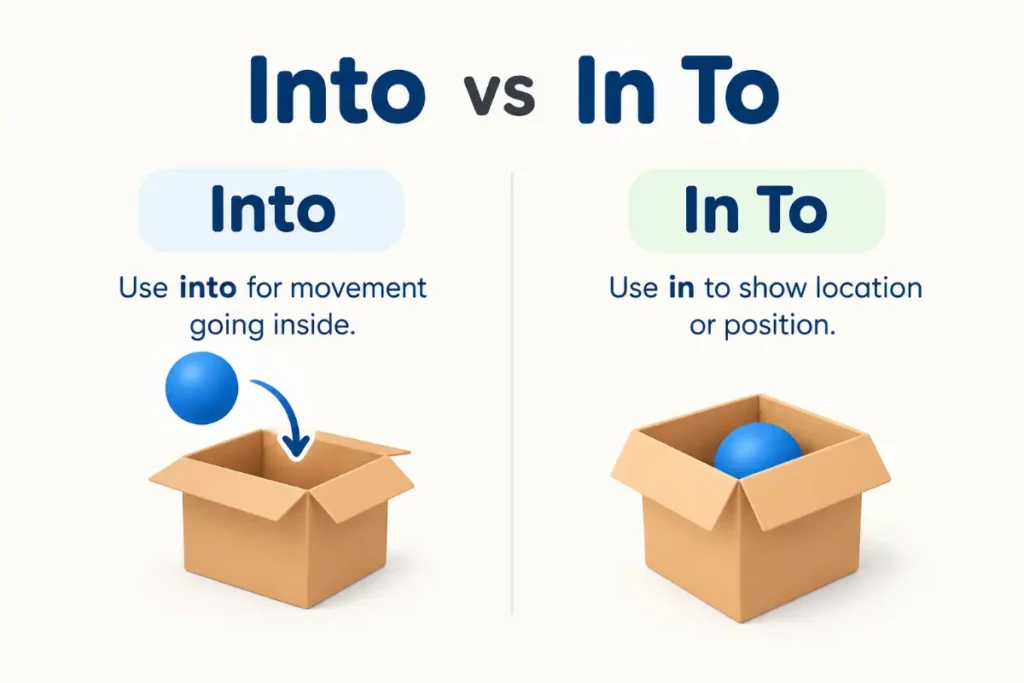
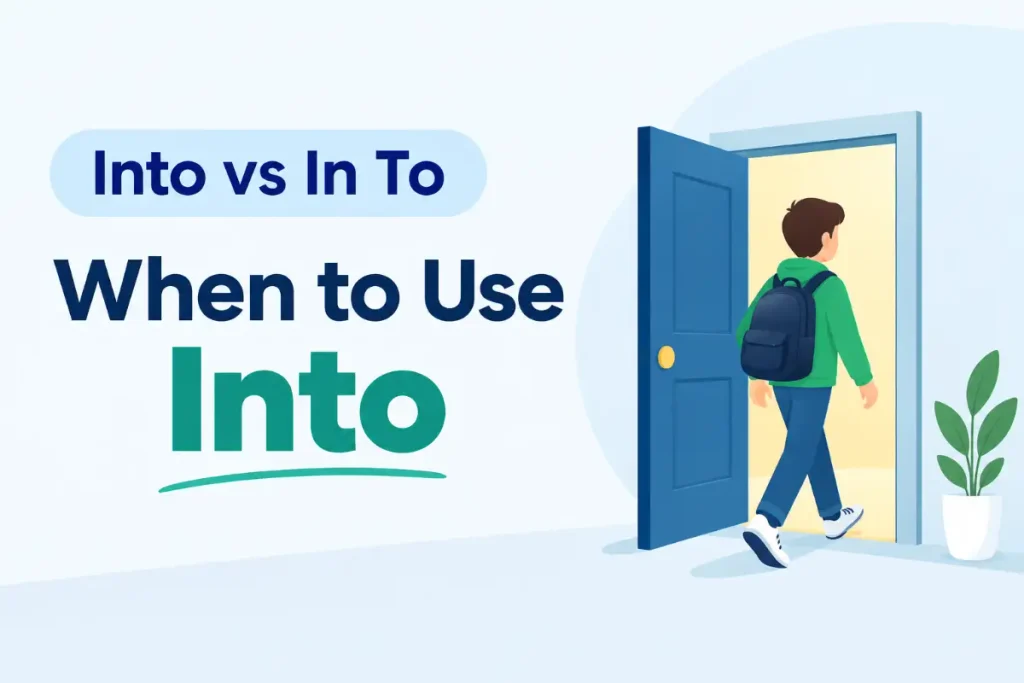
Use into when the word expresses movement toward the inside of a place, container, area, or object.
Consider these examples:
- The kids ran into the house.
- She poured the coffee into the mug.
- He put the documents into the folder.
- The dog jumped into the car.
- We walked into the restaurant.
- She dropped her keys into her purse.
- The ball rolled into the garage.
- He stepped into the elevator.
In each sentence, something moves toward or enters a destination. The destination does not have to be a literal container. A room, building, vehicle, area, or other bounded space can all work.
Cambridge describes this core use as movement toward the inside or middle of something.
There are also several important uses that do not involve literal physical entry.
Into Can Show Transformation
Use into when something changes from one form, state, or condition to another.
Examples include:
- The company turned the warehouse into an office.
- The ice melted into water.
- The artist transformed the sketch into a finished painting.
- The caterpillar changed into a butterfly.
- They divided the cake into eight pieces.
- The small business grew into a national brand.
- The conversation developed into an argument.
- The old garage was converted into a studio.
Here, into connects the original state with the resulting state. Cambridge specifically lists change and transformation as major uses of the preposition.
Into Can Show Contact or Collision
Into can also describe movement that ends with contact, particularly when one thing strikes another.
Examples:
- The car crashed into a fence.
- I walked into the door.
- She bumped into an old friend at the mall.
- The cyclist ran into a parked vehicle.
- The ball flew into the wall.
- He backed the truck into the garage door.
The object does not have to contain the thing that moves. In The car crashed into the fence, the car does not enter the fence. The word describes the direction and resulting contact.
This is one reason the simple rule of replacing into with inside does not work for every sentence. A better rule is to ask what relationship the word expresses.
Into Can Show Involvement or Interest
The word also appears in less physical expressions.
Examples include:
- The investigation into the accident continues.
- She is really into photography.
- He got into trouble at school.
- They looked into the complaint.
- I do not want to get into an argument.
- The committee launched an inquiry into the issue.
In She is really into photography, the meaning is interested in or enthusiastic about. In an investigation into the accident, the word connects the investigation with its subject.
When to Use In To
Use in to when in and to perform separate grammatical jobs.
One common pattern occurs when in is part of a phrasal verb and to introduces an infinitive.
For example:
I came in to talk to you.
Here, came in means entered or arrived inside, while to talk expresses the purpose of coming in. Combining the words into came into talk would change the grammatical structure and produce an incorrect sentence.
More examples:
- She came in to ask a question.
- He stopped in to pick up his mail.
- We went in to discuss the proposal.
- The manager called in to check on the team.
- I dropped in to say hello.
- She stepped in to help her coworker.
- He stayed in to finish the report.
- They came in to meet the new director.
Grammarly highlights this exact problem with expressions such as drop in to say hello, where in belongs to the phrasal verb drop in and to introduces say.
This is probably the most useful pattern to recognize when choosing between the two forms.
A Simple Test That Usually Works
When you are unsure, try separating the sentence into its grammatical parts.
Ask yourself:
Does into describe movement, transformation, contact, involvement, or interest?
If yes, into is probably the correct form.
For example:
She walked into the office.
The word describes movement toward the inside of the office.
Now consider:
She came in to speak with the manager.
Here, came in is complete by itself. The phrase to speak explains why she came in. Because the two words have separate functions, keep them apart.
Another useful test is to remove to and see what remains.
He came in to help.
Remove to help, and you get:
He came in.
That is a complete expression. This strongly suggests that in belongs to the verb phrase and to help is a separate infinitive.
Compare:
He walked into the room.
Removing to the room leaves He walked, but into is still functioning as the preposition connecting the movement with its destination.
This test is not a universal grammar formula, but it is highly useful for everyday editing.
When choosing between words that look or sound similar, checking similar-looking word pairs can make it easier to spot the correct spelling and meaning.
Into Examples in Sentences
The following examples show the most common uses in natural American English.
- The teacher walked into the classroom.
The teacher moved inside the classroom. - Please put the leftovers into the refrigerator.
The leftovers move inside a container or appliance. - The discussion turned into a heated debate.
One type of situation changed into another. - She poured the juice into a glass.
The juice moved inside the glass. - The truck crashed into the barrier.
The truck collided with the barrier. - He is really into jazz.
He is strongly interested in jazz. - The committee launched an investigation into the complaint.
The investigation concerns the complaint. - They divided the class into four groups.
One group was separated into multiple groups. - The empty room was converted into a home office.
The room changed into a different use or function. - She ran into her former teacher downtown.
She encountered her former teacher unexpectedly.
Notice how varied these examples are. The word does not always mean literally going inside something. Its broader meaning depends on the verb and context.
In To Examples in Sentences
Here are examples where the two words need to remain separate.
- I came in to check on you.
Came in describes entering, while to check expresses purpose. - She dropped in to say hello.
Dropped in is the phrasal verb, and to say begins an infinitive. - He stayed in to finish his homework.
Stayed in means remained inside, and to finish explains the purpose. - The manager stepped in to help.
Stepped in is the action, and to help gives the reason. - They went in to talk with the doctor.
Went in describes entering, while to talk explains what they intended to do. - I called in to ask about my application.
Called in is the main verb phrase, followed by an infinitive. - She came in to pick up her package.
The purpose of coming in is picking up the package. - He stopped in to see his parents.
Stopped in describes a brief visit, and to see gives the purpose.
The important point is that in to is not a special compound expression with one fixed meaning. It is simply two words that happen to occur next to each other.
Common Mistakes
The most frequent mistake is combining in and to simply because they sound like one unit.
Mistake 1: Combining a Phrasal Verb With To
Incorrect: I came into ask a question.
Correct: I came in to ask a question.
The problem is that came in and to ask have different grammatical functions.
Mistake 2: Separating Into When It Shows Movement
Incorrect: She walked in to the kitchen.
Correct: She walked into the kitchen.
Here, into connects the movement with the destination. The intended meaning is that she entered the kitchen.
Mistake 3: Confusing Log Into With Log In To
This is especially common in technology writing.
Log in to your account.
Here, log in is the verb phrase and to your account identifies the destination or account.
You will also see log into your account in common usage. Major dictionaries and style resources recognize that usage, particularly in informal and technical contexts. Still, log in to makes the grammatical structure especially clear because log in functions as the verb and to introduces the account.
For careful professional writing, log in to your account is a clear choice.
Mistake 4: Confusing Turn Into With Turn In To
These forms can have completely different meanings.
The caterpillar turned into a butterfly.
This describes transformation.
Please turn in to the office before noon.
This sentence is unusual without additional context, but it could contain turn in as a phrasal verb followed by to. The meaning depends entirely on the grammatical structure.
Mistake 5: Treating Sound as the Rule
Pronunciation cannot always tell you which spelling to use. In normal speech, into and in to can sound extremely similar.
The written form depends on grammar and meaning, not simply pronunciation.
Log Into or Log In To
Technology creates a particularly common point of confusion.
Both log into and log in to appear in modern English. The distinction often depends on how the verb is analyzed.
In log in to your account, log in functions as the phrasal verb and to your account identifies the account being accessed.
Examples:
- Please log in to your account.
- I logged in to the employee portal.
- She could not log in to the website.
- You need to log in to view your messages.
The single word form also appears:
- Please log into your account.
- I logged into the employee portal.
- She logged into the website.
The combined form has become widespread because English often develops new verb patterns from phrasal verbs and prepositions. Grammarly specifically discusses log into alongside log in to, noting the grammatical distinction behind the separate form.
For an editor trying to make the structure unmistakable, log in to is often the clearest choice.
Turn Into or Turn In To
The difference becomes much easier once you identify the verb.
Turn into means change into something.
Examples:
- The seedling will turn into a large plant.
- The discussion turned into an argument.
- They turned the spare room into a nursery.
- The water eventually turned into ice.
In each case, something changes form, condition, identity, or function.
Turn in to, by contrast, contains turn in, which can function as a phrasal verb, followed by to.
For example:
She turned in to get some sleep.
Here, turned in can mean went to bed, while to get expresses purpose.
The sentence structure determines the spelling.
In To or Into With Other Phrasal Verbs
Phrasal verbs create many of the hardest examples because in may belong to the verb itself.
Common expressions include:
- come in
- go in
- drop in
- call in
- step in
- check in
- turn in
- hand in
- give in
- stay in
When one of these is followed by to plus a verb, the words usually remain separate.
Examples:
- She came in to help.
- He stopped in to talk.
- They called in to confirm the appointment.
- I stayed in to finish the project.
But when into itself connects an action to a destination or object, use the single word.
- She walked into the office.
- He drove into the parking garage.
The difference comes from sentence structure rather than from a special spelling rule.
Into and In Are Not Always Interchangeable
Another useful distinction involves in and into when describing location and movement.
In usually describes a position.
The keys are in the drawer.
The keys are already inside the drawer.
Into commonly describes movement toward that position.
She put the keys into the drawer.
The keys move from outside the drawer to a position inside it.
This distinction is especially useful with verbs such as go, walk, run, put, jump, fall, and move. Cambridge notes that in describes position, while into commonly describes movement toward an interior space. It also notes that certain verbs, including put, fall, and jump, can sometimes take either form without a meaningful difference in context.
For example:
- Put the milk in the refrigerator.
- Put the milk into the refrigerator.
Both are standard.
The first sounds especially natural in everyday American conversation. The second places more emphasis on the movement into the refrigerator.
Understanding context is especially important when choosing the right preposition, since small differences can change how clearly a sentence communicates its meaning.
Formal and Casual Usage
The distinction between the two forms is grammatical in both casual and formal writing. It does not disappear in conversation.
In a casual text, you might write:
I came in to grab my jacket.
In a professional email, you could write:
I stopped in to review the updated document.
In academic writing:
The study examines the factors that contribute to the transition into adulthood.
In technical instructions:
Log in to your account before changing your password.
The main issue is not formality. It is identifying the grammatical role of each word.
Professional writing benefits from particular care because small errors involving into and in to can make a sentence look careless even when the meaning is understandable.
Pronunciation of Into
In American English, into is commonly pronounced /ˈɪn.tuː/, although the final vowel can become weaker in natural speech. Cambridge gives the US pronunciation as /ˈɪn.tuː/.
The two word sequence in to can sound nearly identical in connected speech. That is why proofreading by sound alone is unreliable.
Say these aloud:
- She walked into the room.
- She came in to talk.
The difference is much easier to see in writing than to hear in ordinary conversation.
Related Expressions That Cause Confusion
Several common phrases deserve special attention because their meanings change when the word division changes.
Break Into
Break into means enter by force or suddenly begin something.
- Someone broke into the house.
- The audience broke into applause.
Break In To
Break in to can occur when break in is a complete phrasal verb and to begins another phrase.
- She broke in to explain what had happened.
Here, broke in means interrupted, and to explain gives the purpose of the interruption.
Get Into
Get into commonly means enter, become involved in, develop an interest in, or reach a particular state.
- He got into the car.
- She got into photography.
- They got into trouble.
Get In To
Get in to can occur when get in and to are separate.
I need to get in to see the doctor.
Here, get in is separate from to see.
Look Into
Look into means investigate or examine something.
The company will look into the complaint.
This is not the same structure as:
I looked in to see if she needed help.
In the second sentence, looked in means briefly visited or checked, while to see expresses purpose.
These examples show why context matters more than memorizing a single substitution rule.
A Practical Editing Strategy
If you regularly confuse these forms, use this three step method.
- Identify the verb.
Look at the main verb and ask if in belongs to it. Expressions such as come in, drop in, step in, and stay in can be complete phrasal verbs. - Check the word after to.
If to is followed by a base verb such as ask, help, see, finish, or talk, it is often introducing an infinitive. That makes in to a strong possibility when in belongs to the preceding verb. - Check the meaning of the whole phrase.
If the sentence describes movement inside something, transformation, collision, direction, involvement, or interest, into is usually the right choice.
For example:
She stepped into the office.
The destination is the office, so into works.
She stepped in to help.
The verb phrase is stepped in, and to help explains the purpose.
Once you start looking at sentence structure this way, the distinction becomes much more predictable.
Frequently Asked Questions
Which is correct, into or in to?
Both are correct, but they have different grammatical functions. Use into as one word when it acts as a preposition showing movement, transformation, contact, direction, involvement, or interest. Use in to when in belongs to the preceding phrase and to has a separate function, often before an infinitive such as to help or to ask.
Is into always one word?
When into has its standard prepositional meaning, it is written as one word. Examples include walk into the room, turn into water, and run into a friend. It should not be separated simply because the sentence contains both the ideas of being in something and moving toward it.
When should I use in to?
Use in to when in and to belong to different parts of the sentence. A common pattern is a phrasal verb followed by an infinitive: She came in to help. Here, came in is the verb phrase and to help expresses the purpose.
Is log into grammatically correct?
Log into is widely used, particularly in technology and everyday digital communication. Log in to also occurs and makes the underlying structure more explicit because log in functions as the verb and to connects it with the account or system. For careful editing, log in to your account is a clear option.
What is the difference between turn into and turn in to?
Turn into describes transformation, as in The caterpillar turned into a butterfly. Turn in to has separate grammatical parts, as in She turned in to get some sleep, where turned in can mean went to bed and to get introduces the purpose. The sentence structure determines the correct form.
Is into a preposition?
Yes. Into is a preposition. It can express movement toward the inside of something, transformation, contact, direction, involvement, interest, and other relationships. For example, She walked into the store uses into to connect the movement with its destination.
Can in and into mean the same thing?
Sometimes in and into can both work, especially with verbs such as put, fall, or jump. For example, Put the book in the drawer and Put the book into the drawer can communicate the same basic idea. In other contexts, the distinction between position and movement is more important.
Conclusion
The choice between into vs in to becomes much easier once you stop treating it as a spelling problem and start treating it as a grammar problem. Into is one word when it functions as a preposition, commonly showing movement inside something, transformation, contact, direction, involvement, or interest. In to uses two separate words, often because in belongs to a phrasal verb and to introduces an infinitive.
A quick check of the sentence structure will usually settle the question. If you mean inside, toward, changed into, or a related prepositional meaning, choose into. If you have a phrase such as came in to help, keep the words separate. Once you recognize the role each word plays, the correct form becomes much more natural.