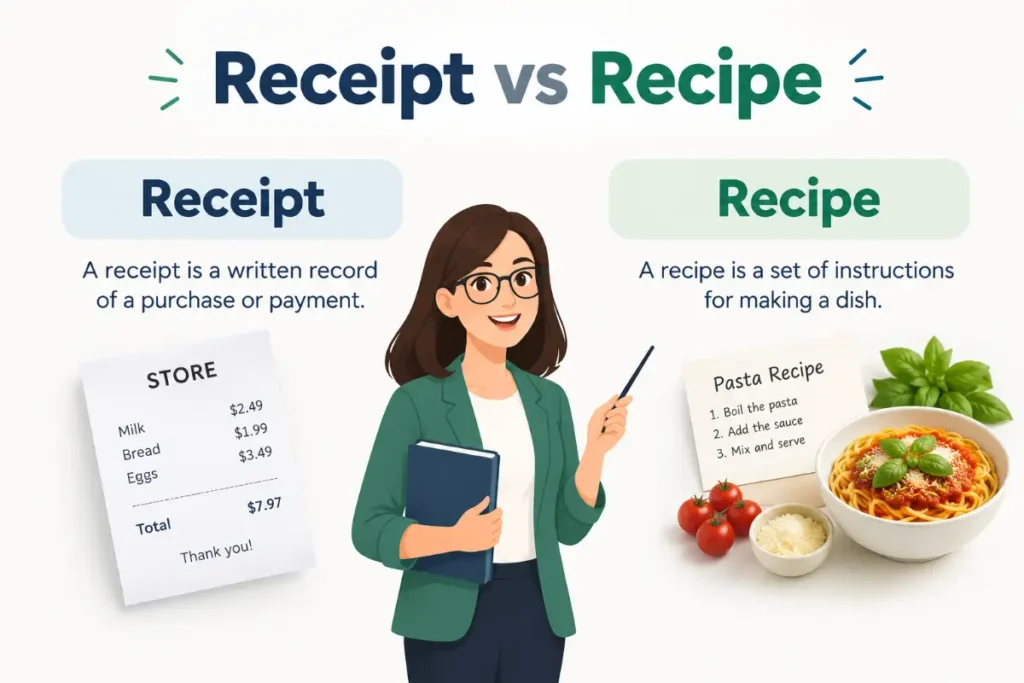
The difference between receipt vs recipe comes down to what you are talking about. A receipt is a document or record that confirms a payment or transaction. A recipe is a set of instructions for preparing food. You get a receipt after buying groceries, but you follow a recipe to turn those groceries into dinner.
These words look similar, share several letters, and differ by only one vowel near the beginning. That small spelling difference can cause confusion in writing, text messages, school assignments, and online searches. The confusion becomes even more understandable when you discover that older English used the word receipt to mean a recipe or a set of instructions for preparing something.
Today, American English generally keeps the two words separate in everyday use. A store gives you a receipt, while a cookbook provides recipes. However, the historical connection between them explains why you might encounter old cookbooks that use receipt in a way that seems incorrect by modern standards.
Understanding their meanings, pronunciation, origins, and sentence patterns will help you choose the right word. You will also learn how to use both terms naturally in everyday conversation, professional writing, and food related contexts.
When deciding between receipt and recipe, choosing the simpler word for your intended meaning is important because each term serves a different purpose in everyday English.
Quick Answer
A receipt is proof of payment or a record of a transaction. A recipe is a list of ingredients and instructions for preparing food. For example, you keep a receipt after buying flour and sugar, then use a recipe to bake a cake. Both spellings are correct, but they serve different purposes in modern English.
What Does Receipt Mean
A receipt is a noun that usually refers to written or digital confirmation that someone has received money, goods, or something else of value. In everyday American English, it most often means the paper or electronic record you receive after making a purchase.
For example, when you buy a pair of shoes at a store, the cashier may print a receipt showing the items you purchased, their prices, the sales tax, the total amount paid, and the payment method. You might keep that document in case you need to return the shoes or prove that you bought them. An emailed order confirmation or digital payment record can serve a similar purpose, depending on the transaction and the business’s policies.
The word also appears in accounting, business, and legal contexts. A company may record its cash receipts, meaning money received during a particular period. An accountant might ask for a receipt to verify a business expense, while a nonprofit organization might issue a receipt to acknowledge a donation.
Receipt in Simple Terms
Think of a receipt as a record that something has been received. Most commonly, it confirms that a payment has taken place, although the word can describe acknowledgment of other items or documents.
Consider these examples.
1. Please keep your receipt in case you need to return the jacket.
2. The cashier handed me a receipt after I paid for lunch.
3. I received an email receipt for my online order.
4. The accountant asked me to submit the receipt for my business expenses.
5. The store could not process my return without proof of purchase.
The last example uses a related expression rather than the word itself. Proof of purchase can include a receipt, but it may also include other records accepted by the seller.
Receipt as a Verb
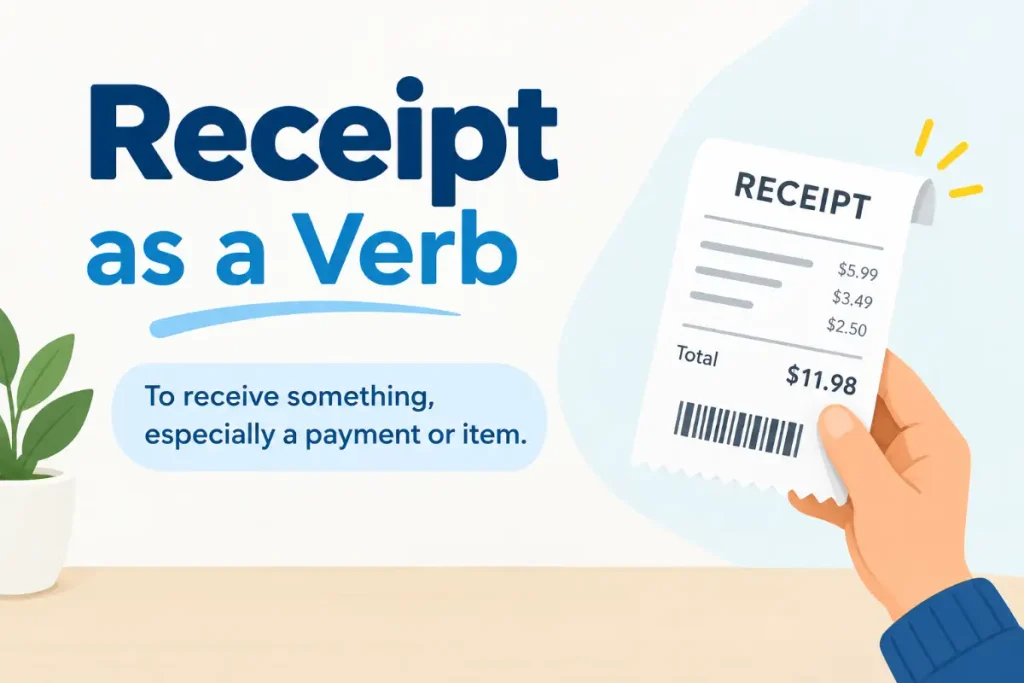
Although receipt is primarily a noun in everyday American English, it can also appear as a verb in specialized business or administrative language. To receipt something can mean to acknowledge or record its receipt. However, this usage is less common in ordinary conversation than phrases such as confirm receipt or acknowledge receipt.
For example, a business might instruct an employee to confirm receipt of a shipment. In everyday writing, this phrasing is usually clearer than using receipt as a verb.
What Does Recipe Mean
A recipe is a noun that provides the ingredients and instructions needed to prepare a particular food or drink. It usually explains what ingredients to use, how much of each ingredient is needed, and what steps to follow.
For example, a chocolate chip cookie recipe might list flour, butter, sugar, eggs, and chocolate chips. It would then explain how to combine the ingredients, shape the dough, and bake the cookies. The recipe gives you a practical method for producing a particular result.
Recipes can range from simple instructions for scrambled eggs to detailed guides for elaborate meals. They may also include preparation times, cooking temperatures, serving sizes, substitutions, and storage advice.
Recipe in Simple Terms
Think of a recipe as a plan for making food. The ingredients tell you what you need, while the directions tell you what to do with those ingredients.
Here are some examples.
1. I found a recipe for homemade pizza.
2. My grandmother shared her favorite soup recipe with me.
3. This recipe calls for two cups of flour.
4. The recipe recommends baking the bread at 375 degrees Fahrenheit.
5. I changed the recipe by adding extra garlic.
In each sentence, recipe refers to instructions for preparing something to eat or drink.
Can Recipe Mean a Method for Success
Yes. In informal and figurative English, recipe can describe a combination of factors likely to produce a particular result. The result does not have to involve cooking.
For example, “Poor planning and rushed decisions are a recipe for disaster.” The sentence uses recipe figuratively to mean a combination of circumstances likely to lead to an undesirable outcome. Similarly, “Consistent practice and patience are a recipe for success” compares a successful approach to a set of ingredients.
This figurative meaning is common in American English. It extends the original cooking idea into other areas of life, work, and communication.
Receipt vs Recipe Meaning and Key Differences
The central difference is straightforward. A receipt records or confirms something received, while a recipe tells you how to prepare something. The words have different meanings, even though their spellings are similar.
| Feature | Receipt | Recipe |
|---|---|---|
| Part of speech | Primarily a noun | Noun |
| Main meaning | A record or acknowledgment of something received | Instructions for preparing food |
| Common context | Shopping, payments, accounting, business | Cooking, baking, food preparation |
| Typical contents | Items, prices, date, total, payment details | Ingredients, quantities, steps, cooking times |
| Common verb | Receive | Prepare, cook, bake |
| Related word | Receipt holder or receipt record | Recipe book or recipe collection |
| Example | I saved the receipt from the store. | I followed a recipe for banana bread. |
| Figurative use | Acknowledgment or record of receipt | A combination of factors likely to produce a result |
The quickest way to choose correctly is to look at the action involved. If someone pays for a product and needs proof of the transaction, the word is receipt. If someone combines ingredients and follows cooking instructions, the word is recipe.
Receipt vs Recipe Pronunciation
Receipt and recipe have different pronunciations, although some of their sounds overlap.
Receipt is pronounced rih-SEET. Its International Phonetic Alphabet pronunciation is /rɪˈsiːt/. It has two syllables, and the stress falls on the second syllable. The letter p is silent, so you do not pronounce it as rih-SEEPT.
Recipe is commonly pronounced RES-uh-pee in American English. Its IPA pronunciation is /ˈrɛsəpi/. It has three syllables, with the stress on the first syllable.
The main differences are the number of syllables, the stressed syllable, and the vowel sounds. Receipt ends with a sound like seat, while recipe ends with a sound like see.
A helpful practice is to say the words aloud in short sentences. Try saying, “I saved the receipt” and “I followed the recipe.” Hearing the difference in rhythm and ending sounds can help you remember both spellings.
Like receipt and recipe, commonly confused English words can have similar spellings but completely different meanings, making it essential to understand their correct usage.
Why Is the P Silent in Receipt
The silent p in receipt reflects the word’s history. Receipt entered English through French from Latin recepta, associated with the idea of receiving. The spelling developed under the influence of its Latin origin, including the letter p, even though English pronunciation does not sound that letter.
This spelling pattern can surprise learners because English often retains letters that are not pronounced. Receipt is a familiar example of a word whose spelling reflects its historical development rather than its modern sound.
The word recipe has a related historical background. It also developed from Latin language associated with receiving or taking, but its spelling and pronunciation evolved along a different path.
The important point is that the silent p belongs in the spelling of receipt. Writing reciept or receit is incorrect in standard modern English.
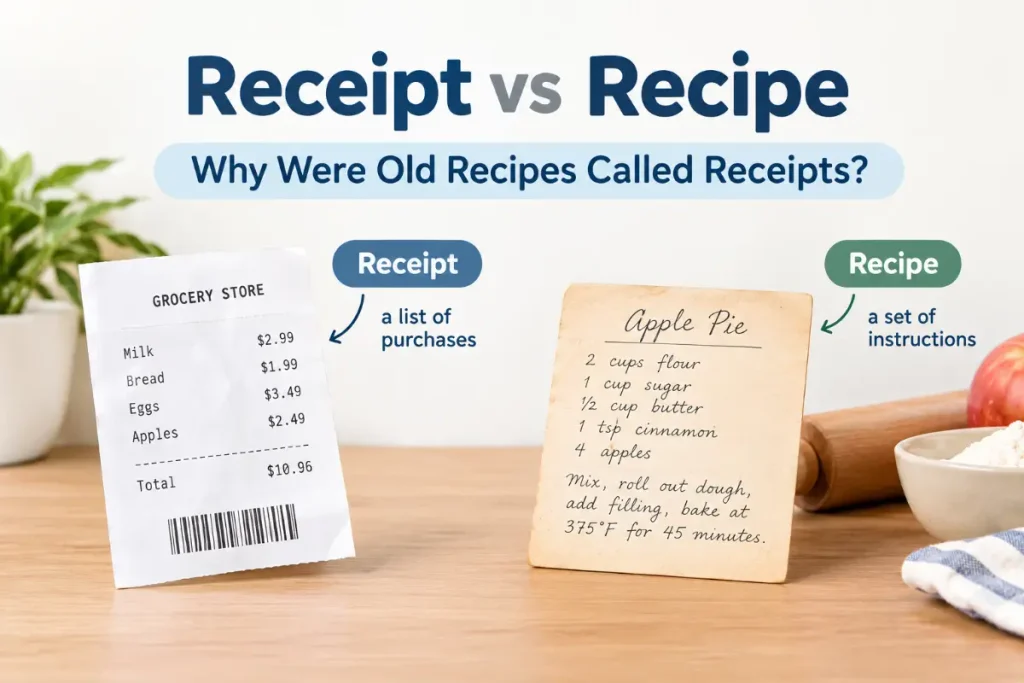
Why Were Old Recipes Called Receipts
Older English used receipt in a broader way than modern American English does. Historically, the word could refer to a formula, prescription, or set of instructions for preparing something. That meaning included instructions for cooking, making household products, and preparing remedies.
As a result, old cookbooks sometimes used receipt where modern readers would expect recipe. A historical cookbook might include a heading such as “A Receipt for Gingerbread” or “A Receipt for Preserving Fruit.” In that context, receipt was not necessarily a spelling mistake. It reflected an established historical use of the word.
Over time, recipe became the standard everyday term for cooking instructions, while receipt became closely associated with acknowledgment and proof of receiving something. Modern American English generally maintains that distinction.
Are Old Receipts the Same as Modern Recipes
In many historical cookbooks, yes. An old receipt for cake, bread, preserves, or another dish often serves the same purpose as a modern recipe. It gives instructions for preparing the food, although the directions may use unfamiliar measurements, older ingredient names, or less precise cooking methods.
For example, an old receipt might tell the cook to add a certain quantity of flour and sugar and bake the mixture in a moderately heated oven. A modern recipe would likely specify exact measurements, a temperature in degrees, and a suggested cooking time.
The wording may also reflect the era’s writing conventions. Older instructions sometimes assume that the reader already understands basic cooking techniques. Therefore, a historical receipt can require more interpretation than a recipe written for today’s home cooks.
What Is a Food Receipt
The expression food receipt can have different meanings depending on the context. In modern shopping or accounting, it usually refers to a receipt for food purchases, such as a grocery store receipt or a restaurant payment record. In historical cooking material, however, a food receipt may refer to what modern readers call a recipe.
Context tells you which meaning applies. If someone is discussing grocery expenses, a food receipt is likely proof of purchase. If someone is examining an old cookbook, the phrase may refer to cooking instructions.
This distinction is especially useful when reading historical documents, family recipe collections, or old household manuals.
Receipt vs Recipe Examples in Sentences
The easiest way to understand the difference is to see how each word works in everyday situations. The following examples cover shopping, cooking, workplace communication, school, and informal conversation.
Examples Using Receipt
1. I forgot to ask for a receipt after buying my coffee.
2. The store emailed me a receipt for my online purchase.
3. Keep the receipt if you might need to exchange the shoes.
4. My manager asked me to attach the hotel receipt to my expense report.
5. The cashier printed a receipt showing the total and sales tax.
6. I checked the receipt because the grocery bill seemed unusually high.
7. The customer requested a receipt for the returned merchandise.
8. The charity provided a receipt acknowledging the donation.
9. Please confirm receipt of the documents by Friday.
10. I found last month’s receipt in the bottom of my backpack.
These sentences show how receipt relates to payment, documentation, acknowledgment, or records. Notice that the word does not describe the instructions for preparing the food that someone purchased.
Examples Using Recipe
1. I found a recipe for homemade chicken soup.
2. This recipe uses fresh tomatoes instead of canned tomatoes.
3. My sister sent me her favorite brownie recipe.
4. The recipe says to preheat the oven before mixing the ingredients.
5. I saved the recipe because the pasta sauce turned out delicious.
6. The teacher asked students to write a recipe using imperative verbs.
7. I changed the recipe to make it less spicy.
8. The cookbook contains a recipe for traditional apple pie.
9. Too much sugar can change the texture of a recipe.
10. Clear instructions are an important part of a useful recipe.
These examples show that recipe refers to a method or set of instructions, usually for making food. It can also appear in educational contexts, where students study instructions, sequencing, and action verbs.
Common Mistakes With Receipt and Recipe
Because the words look similar, writers sometimes use the wrong spelling without noticing. The best correction depends on the meaning of the sentence.
Mistake one: Using recipe when you mean proof of purchase.
Incorrect: Please keep your recipe in case you need to return the shoes.
Correct: Please keep your receipt in case you need to return the shoes.
The sentence concerns a purchase, so receipt is the appropriate word.
Mistake two: Using receipt when you mean cooking instructions.
Incorrect: I followed a receipt to make the chocolate cake.
Correct: I followed a recipe to make the chocolate cake.
The sentence describes preparing food, so recipe is correct in modern English.
Mistake three: Misspelling receipt.
Incorrect: The cashier gave me a reciept.
Correct: The cashier gave me a receipt.
The correct spelling places the letters ei after the c and retains the silent p at the end.
Mistake four: Assuming historical usage is always wrong.
Incorrect assumption: Every old cookbook that says receipt contains a spelling error.
Correct understanding: Historical English sometimes used receipt to mean a recipe or formula.
This last distinction matters because modern word choice rules do not always reflect older usage. A historical text should be interpreted according to the language conventions of its period.
Receipt vs Recipe Synonyms
Receipt and recipe have different synonyms because their meanings are different. Choosing a synonym can also make your writing clearer when the original word does not fit the context.
Synonyms for Receipt
Depending on the situation, useful alternatives include:
1. Proof of purchase.
2. Payment record.
3. Transaction record.
4. Invoice, in contexts where a request for payment or billing document is intended.
5. Acknowledgment, when referring to confirmation that something has been received.
These terms are related but not interchangeable in every situation. An invoice usually requests or documents payment rather than proving that payment has already occurred. A transaction record may include more information than a standard receipt.
For everyday American readers, proof of purchase is often a useful alternative when discussing returns or exchanges. In accounting, payment record or transaction record may be more appropriate.
Synonyms for Recipe
Useful alternatives include formula, cooking instructions, preparation method, and set of directions. The best choice depends on the context.
A formula may refer to a specific combination of ingredients or a method for producing a result. Cooking instructions emphasize the steps involved, while preparation method describes the general approach.
The figurative use of recipe has additional alternatives. In “a recipe for disaster,” for example, you might use a combination of factors likely to cause trouble. However, that substitution changes the sentence’s style and may not preserve the same familiar expression.
Understanding spelling variations in English, such as breakroom versus break room, can help you recognize accepted forms and avoid common writing mistakes when distinguishing between receipt and recipe.
Receipt and Recipe in Formal and Casual Writing
Both words are common in American English, but their contexts differ. Receipt appears frequently in shopping, financial records, reimbursement requests, business communication, and administrative documents. Recipe appears in cookbooks, food blogs, cooking classes, school assignments, and everyday conversations about preparing meals.
In a professional email, you might write, “I have attached the receipt for my business travel expenses.” The word identifies the supporting financial document. In a message to a friend, you might write, “Can you send me the recipe for those cookies?” The word identifies the instructions needed to make the food.
Both words work in formal and casual writing when used correctly. Neither is slang, and neither is limited to a particular region of the United States.
The clearest writing choice is the one that accurately identifies the thing you mean. If your reader needs proof of payment, use receipt. If your reader needs instructions for making a dish, use recipe.
Frequently Asked Questions
What is the difference between receipt and recipe
A receipt is a document or record that confirms payment or acknowledges that something has been received. A recipe is a set of instructions for preparing food. You receive a receipt after buying ingredients at a grocery store, then follow a recipe to turn those ingredients into a meal.
What does receipt mean
Receipt usually means written or digital proof that a payment or transaction has taken place. It can also refer to the act of receiving something or acknowledgment that something has arrived. In historical cooking texts, receipt could mean a recipe or formula, but that is not its usual meaning in modern American English.
What does recipe mean
A recipe is a set of ingredients and instructions used to prepare food or a drink. It commonly includes measurements, preparation steps, cooking temperatures, and timing. Recipe also has a figurative meaning, as in “a recipe for success,” where it describes a combination of factors likely to produce a particular outcome.
Why were old recipes called receipts
Older English used receipt to describe formulas and instructions, including directions for preparing food. The word’s historical meaning was broader than its common modern meaning. Over time, recipe became the standard term for cooking instructions, while receipt became associated mainly with records and acknowledgment of receiving something.
What is a food receipt
In modern shopping and accounting, a food receipt is usually proof of payment for groceries, restaurant meals, or other food purchases. In historical cooking contexts, receipt may refer to a formula or set of instructions for preparing a dish. The surrounding text helps determine which meaning is intended.
What are the two types of receipts
There is no single universal classification that limits receipts to exactly two types. In everyday business use, people commonly distinguish between paper receipts and electronic receipts. Other classifications depend on the purpose, such as sales receipts, payment receipts, donation receipts, and expense receipts.
How do you pronounce receipt and recipe
Receipt is pronounced rih-SEET, with two syllables and a silent p. Recipe is pronounced RES-uh-pee, with three syllables and stress on the first syllable. Listening to the ending sounds can help you distinguish them because receipt ends like seat, while recipe ends like see.
Is receipt ever correct when talking about food
Yes, but the intended meaning matters. A grocery receipt records a food purchase, and a historical cooking receipt may provide instructions for preparing a dish. In modern American English, use recipe for ordinary cooking instructions and receipt for proof of payment or acknowledgment of receiving something.
Conclusion
The difference between receipt and recipe is easy to remember once you connect each word with its purpose. A receipt records a transaction or confirms that something has been received, while a recipe tells you how to prepare food. You keep a receipt for your groceries and use a recipe to turn those groceries into dinner.
The historical connection explains why older cookbooks sometimes use receipt to mean cooking instructions. That usage was legitimate in its time, but recipe is the standard word for cooking instructions in modern American English. When you are unsure, ask yourself if you need a record of a purchase or a set of directions for making something. That simple distinction will help you choose the right word in conversation, schoolwork, professional writing, and everyday life.